World

Webb telescope captures 'breathtaking' images of Orion Nebula

The wall of dense gas and dust resembles a massive winged creature, its glowing maw lit by a bright star as it soars through cosmic filaments.

An international research team on Monday revealed the first images of the Orion Nebula captured with the James Webb Space Telescope, leaving astronomers “blown away.”

The stellar nursery is situated in the constellation Orion, 1,350 light-years away from Earth, in a similar setting in which our own solar system was birthed more than 4.5 billion years ago.

Astronomers are interested in the region to better understand what happened during the first million years of our planetary evolution.

The images were obtained as part of the Early Release Science program and involved more than 100 scientists in 18 countries, with institutions including the French National Centre for Scientific Research (CNRS), Western University in Canada, and the University of Michigan.

“We are blown away by the breathtaking images of the Orion Nebula,” Western University astrophysicist Els Peeters said in a statement.

“These new observations allow us to better understand how massive stars transform the gas and dust cloud in which they are born,” she added.

Nebulas are obscured by large amounts of dust that made it impossible to observe with visible light telescopes, such as the Hubble Space Telescope, Webb’s predecessor. 

Webb however operates primarily in the infrared spectrum, penetrating the dust.

This revealed numerous spectacular structures, down to the scale of 40 astronomical units, or the size of our solar system.

These include dense filaments of matter, which could birth new generations of stars, as well as forming stellar systems that consist of a central proto-star surrounded by a disc of dust and gas, in which planets form.

“We hope to gain understanding about the entire cycle of star birth,” said Edwin Bergin, University of Michigan chair of astronomy and a member of the international research team. 

“In this image we are looking at this cycle where the first generation of stars is essentially irradiating the material for the next generation. The incredible structures we observe will detail how the feedback cycle of stellar birth occurs in our galaxy and beyond.”

Webb is the most powerful space telescope ever built, boasting a primary mirror measuring 6.5 meters (more than 21 feet) that is made up of 18 hexagonal, gold-coated segments, as well as a five-layer sunshield the size of a tennis court.
Top US diplomat in Mexico for economic talks

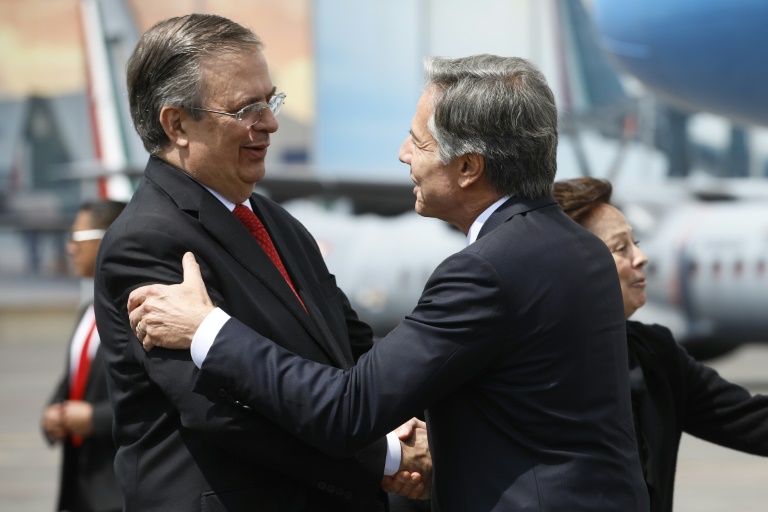
Secretary of State Antony Blinken and other top US officials visited Mexico on Monday for high-level economic talks, with President Andres Manuel Lopez Obrador striking a conciliatory tone despite trade tensions.

Washington in July filed a formal complaint against Mexico under a North American free trade agreement, saying its energy policies discriminated against US firms.

Lopez Obrador says the complaint is unjustified, but his government has pledged to work toward a solution.

Asked if he would discuss the energy dispute with Blinken, Lopez Obrador told reporters that there was no fixed agenda for their meeting, but that if the issue was raised, it would “be dealt with.”

He welcomed the tone of a recent letter from US President Joe Biden, saying Mexico appreciated its “respectful attitude” compared to the trade complaint, which he described as “not the most diplomatic.”

Lopez Obrador’s push to roll back the effects of liberalization that he says benefited private companies has alarmed foreign investors and environmentalists, who see the moves as favoring fossil fuels over renewable energy.

Washington has requested dispute settlement consultations under the US-Mexico-Canada Agreement, the first step in a process that could lead to retaliation over actions it says harms US firms and impedes development of clean energy.

Lopez Obrador visited Washington in July for talks with Biden, who said that the two sides needed to rebuild relations.

A month earlier, the Mexican leader snubbed Biden by refusing to participate in the Summit of the Americas in Los Angeles on the grounds that Cuba, Venezuela and Nicaragua had not been invited.

As well as economic issues, Blinken plans to discuss cooperation to deal with irregular migration and the synthetic opioid fentanyl with Lopez Obrador and Foreign Minister Marcelo Ebrard, the State Department said.

The top US diplomat will later co-chair the US-Mexico High-Level Economic Dialogue.

Before the Covid-19 pandemic, Mexico was the second-largest trading partner of the United States, behind China, with more than $675 billion in annual trade, according to US figures.

'Tears in our eyes': Ukrainians rejoice in liberated Izyum

In the Ukrainian city of Izyum, the country’s blue and yellow flag has just been raised again over the charred city hall, months after Russian tanks barrelled in.

Gleeful residents rush to a hill near a cell phone tower, the only place in town with a signal, to call relatives to share their good news: the Russians are out.

Ukrainian soldiers liberated the eastern city at the weekend as the army reclaimed swathes of territory, part of its lighting counter-offensive to beat back Russian soldiers who invaded February 24.

For some Izyum residents, the sight of Ukrainian soldiers sparked waves of emotion. 

“We welcomed them with tears in our eyes. We had been waiting for them for months… we are very happy,” 61-year-old Nadiya Nesolena tells AFP. 

Izyum, in the Kharkiv region with a pre-war population of 50,000, had been fully occupied by Russian troops since April and had become a key logistics base for Moscow.

Life in the city was “very difficult” under the Russians, Nadiya says, recalling constant shelling, cold and hunger. 

But she says she was one of the fortunate few, “lucky enough to have a house with a basement and some food”. 

– ‘Please never leave’ – 

Signs of Russia’s occupation abound in Izyum. 

Plumes of white smoke rose over the roofs of the city, from ongoing fire at the ammunition depot that exploded Saturday as Russian troops fled.  

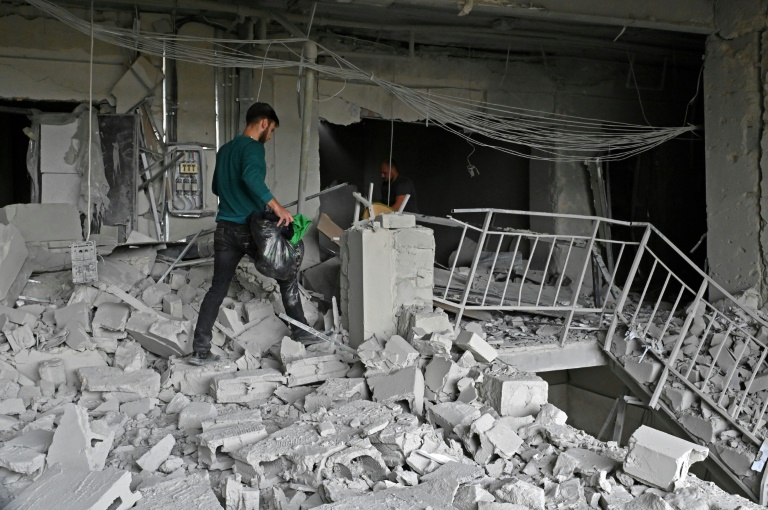
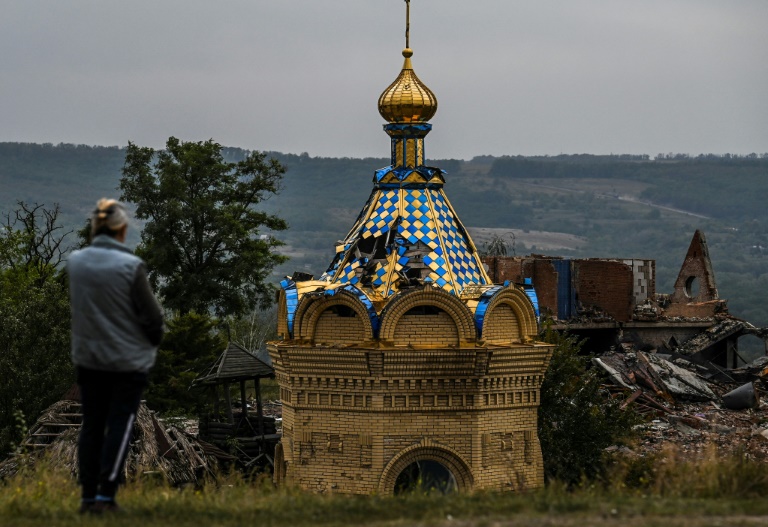
Izyum’s city hall, now adorned triumphantly with the Ukrainian flag, is battle scarred like so many buildings in the city: houses, apartment blocks, shops, two bridges, and a school and a religious building, all destroyed.

Still dotting the city are huge signboards with Russian flags saying “We are Russia, one united nation”.

The Ukrainian soldiers, busy securing the area, still haven’t had time to take them down. 

Back on the hill near the cell tower, 64-year-old Yuriy Kurotshka is stunned with joy that his city is back in Ukrainian hands. 

“All bad things eventually come to an end,” he says. 

He was trying to reach his family who left for Kyiv in March, when Russian troops first entered the city.

Yuriy has a message for the Ukrainian army: “Please never leave, don’t hand us over to those Russians!” 

Grygoriy Pyvovar, 61, who wanders through the quasi-empty city with his 16-year-old son Kyrylo, recounts how he met soldiers arriving in Izyum on Sunday. 

“We had tears in our eyes. We were so happy to see that our guys had come here!” Grygoriy tells AFP. 

“We didn’t expect it would happen so quickly.” 

– Signs of retreat – 

But the Ukrainian troops were not welcome back by all. 

Many residents say that their pro-Russian neighbours took the road towards the Moscow-controlled east even before Russian troops evacuated.

Moscow says several thousand people have crossed over to Russia from the Kharkiv region. 

Around Izyum, abandoned Russian armoured vehicles were being towed by Ukrainian military trucks on Monday.

Ukrainian army convoys roamed the area, as footsoldiers march by or set up camp in the city’s periphery. 

Several dozen broken-down Russian vehicles — branded ‘Z’, the symbol of the invasion — were lying on the side of the road.

Alongside them, burnt trees, craters, shrapnel and unexploded munitions completed the picture.

In a small newly-liberated town near Izyum, soldiers have piled up ammunition left behind by the Russians. 

“We’re certainly planning on ‘sending’ all this ammunition back to them as a gift by air,” laughs a soldier nicknamed “Tank” who is busy securing bombs left behind.

There is also Russian food, but Tank jokes that his group “won’t eat that, it’s not good.”  

Tank and his colleagues arrived early on Sunday to carry out demining operations and to disarm the traps they say Russian soldiers left behind. 

Another group of soldiers passes by, saying they’ll have to come back later: they found a T72 Russian tank near the exit of the village, but it’s out of battery.

'We are erased': Afghan women demand action at UN

Afghan women made an impassioned plea at the UN Monday for solid international action to address the “gender apartheid” in their country since the Taliban swept to power last year.

“Today, human rights in Afghanistan do not exist,” Afghan Mahbouba Seraj told the United Nations Human Rights Council in Geneva.

The outspoken journalist and rights activist said she was “sick and tired” of sounding the alarm over the decimation of the rights of women and girls, especially in Afghanistan, and seeing no action.

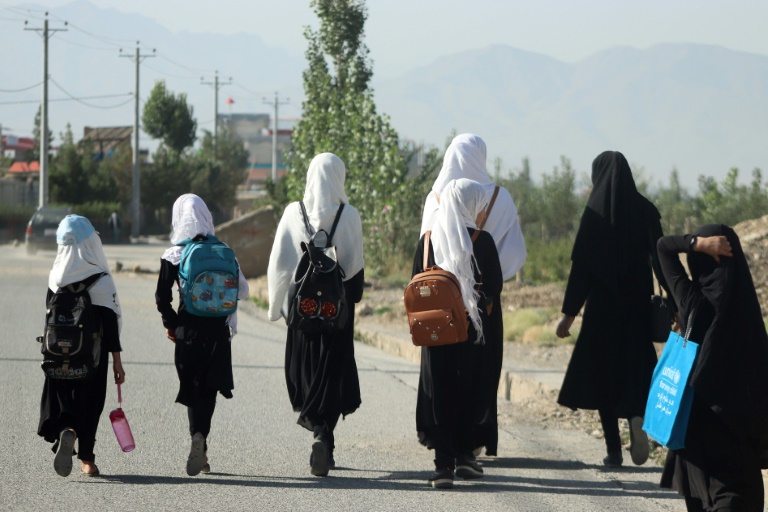
The Taliban have imposed harsh restrictions on girls and women to comply with their austere vision of Islam since returning to power in August last year — effectively squeezing them out of public life.

The hardline Islamists have shut girls’ secondary schools in most provinces and barred women from many government jobs.

They have also ordered women to fully cover up in public, ideally with an all-encompassing burqa.

“The women of Afghanistan are now left to the mercy of a group that is inherently anti-women and does not recognise women as human beings,” Razia Sayad, an Afghan lawyer and former commissioner at the Afghanistan Independent Human Rights Commission, told the council.

– ‘Staggering regression’ –

Saraj agreed. 

“Women of that country, we don’t exist… We are erased,” she told the council during a debate focused specifically on the rights of women and girls in Afghanistan.

She appealed to the top UN rights body to take any action possible to improve the situation.

“I’m begging all of you: Please if this council has something to do, do it!” she said, adding that “otherwise, please don’t talk about it. Because talking has been … cheap” when it comes to Afghanistan.

“You’ve got to do something.”

She and others suggested the council could create an independent group of experts to monitor all abuses, with an eye to eventually hold perpetrators to account.

“God only knows what kind of atrocities are not being reported,” she warned.

Richard Bennett, the special rapporteur on the rights situation in Afghanistan, also stressed the urgent need to strengthen accountability, suggesting the situation could be described as “gender apartheid.”

Earlier Monday, Bennett had presented his first report on the overall rights situation, warning the council that “Afghans are trapped in a human rights crisis that the world has seemed powerless to address.”

In addition to the “staggering regression” in the rights of women and girls, he listed a slew of other violations, including the persecution of Hazara and other Shiite minorities.

Afghanistan’s Shiite Hazaras have faced persecution for decades, with the Taliban accused of abuses against the group when they first ruled from 1996 to 2001 and picking up again after they swept to power last year.

Bennet said Hazara and other groups have been “arbitrary arrested, tortured, summarily executed, displaced from traditional lands, subjected to discriminatory taxation and otherwise marginalised.” 

They are also the frequent target of attacks, including by the Taliban’s enemy the Islamic State-Khorasan group, which considers them heretics.

“These attacks appear to be systematic in nature and reflect elements of an organisational policy,” Bennett told the council, warning that the attacks bear the “hallmarks of international crimes and need to be fully investigated.”

International crimes cover the most serious crimes of concern to the global community: war crimes, crimes against humanity and genocide.

The United Nations mission in Afghanistan has accused the Taliban authorities of intimidating and harassing its female staff, including detaining three women for questioning on Monday.

Booming gun ownership triggers fears for Brazil vote

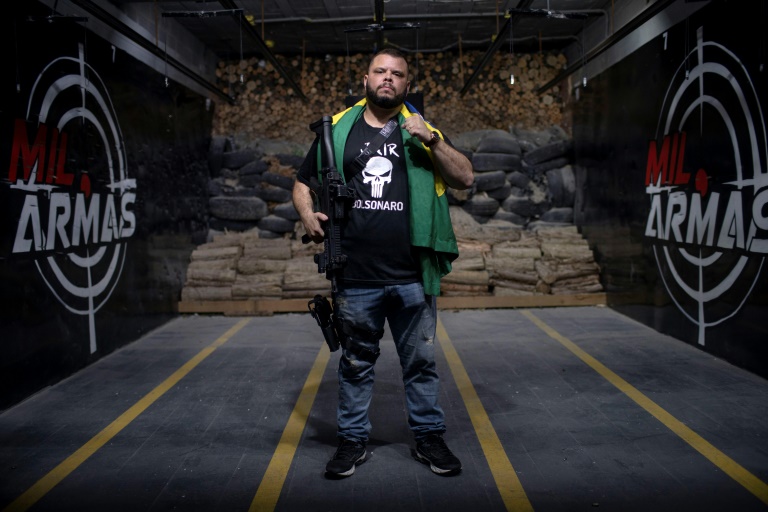
Wearing a black T-shirt stamped with the word “Bolsonaro” and a skull, Brazilian ex-cop Elitusalem Gomes Freitas takes aim with his .40-caliber rifle and fires, savoring the smell of gunpowder as he nails his target.

Clutching his bulky black rifle at a firing range in the Rio de Janeiro suburbs, a handgun strapped to his thigh, Freitas proudly repeats one of far-right President Jair Bolsonaro’s maxims: “An armed populace will never be enslaved.”

Freitas is part of a demographic that has boomed in Bolsonaro’s Brazil: since the former army captain became president in 2019, the number of registered gun owners has more than quintupled, from 117,000 to 673,000, as the administration has loosened gun-control laws.

There are now more civilian gun owners in Brazil than police — 406,384.

That is making some Brazilians nervous as the country heads for a divisive presidential election on October 2 pitting Bolsonaro against his leftist nemesis, ex-president Luiz Inacio Lula da Silva (2003-2010), who leads in the polls.

Citing fears of election violence, the Supreme Court temporarily suspended several of Bolsonaro’s gun-control rollbacks last week. The week before, the Superior Electoral Tribunal (TSE) banned voters from bringing guns to polling stations.

Like Bolsonaro, Freitas is no fan of the electoral authority, which the president accuses of allowing what he insists — without evidence — is rampant fraud in Brazil’s electronic voting system.

After inspecting the white silhouette target he has just filled with holes, Freitas, 42, explains he is ready to take up arms if necessary to defend Brazil’s “freedom.”

“I can’t allow half a dozen people (the TSE’s judges) to decide our nation’s destiny against the people’s will. The right to bear arms is how we guarantee our freedom and defend our sovereignty against the internal enemy,” he says.

But he adds there is nothing to fear from Brazil’s burgeoning class of firearm owners.

“It’s not about arming everyone. It’s about giving good citizens the right to access a firearm and learn to use it.”

– ‘Cursed inheritance’ –

Security expert Bruno Langeani says hardliners ready to take up arms in the name of politics are a minority in Brazil.

But he emphasizes that “even a minority can cause huge damage if it’s radicalized,” pointing to the rioters who stormed the US Capitol last year after the election loss of ex-president Donald Trump — Bolsonaro’s political role model.

Langeani says the massive expansion of gun ownership in Brazil will be a “cursed inheritance” that could fuel violence for years to come.

“A civilian can now buy more powerful guns than the police,” he says.

“Licensed hunters, sport shooters and collectors can in some cases own up to 60 firearms per person, including 30 assault rifles.”

There are 4.4 million firearms in civilian hands in Brazil, a country of 212 million people, according to the Brazilian Public Security Forum.

One-third of them have expired permits.

Bolsonaro points to a fall in murders as evidence his gun policies are a success: last year, the number of homicides fell by 13 percent.

However, the number of murders with firearms increased by 24 percent, according to health ministry figures.

– ‘Like a shopping mall’ –

Around 1,000 shooting clubs — members-only firing ranges — have opened in Brazil since Bolsonaro took office, according to army figures cited by online news site UOL.

“When the government made it easier to purchase firearms, I said, ‘We have to jump on this,'” says former policeman Marcelo Costa, president of the club where Freitas practices, Mil Armas (One Thousand Firearms), which opened four years ago.

Costa operates the club with his two sons, both in their twenties and both fellow gun enthusiasts. His wife, a psychologist, is licensed by the authorities to perform the mandatory psychological evaluations of all new members.

The club, which has strict security protocols, offers lessons for members, and legal advice for those who want to obtain a gun license.

Members can borrow or purchase weapons from the club’s vast arsenal, with prices ranging from 5,000 to 20,000 reais ($950-$3,800).

“It’s like a shopping mall. We have everything,” says Costa, who offers the option to buy guns in up to 12 installments with no interest.

Germany 'regrets' Iran failure to agree to nuclear deal

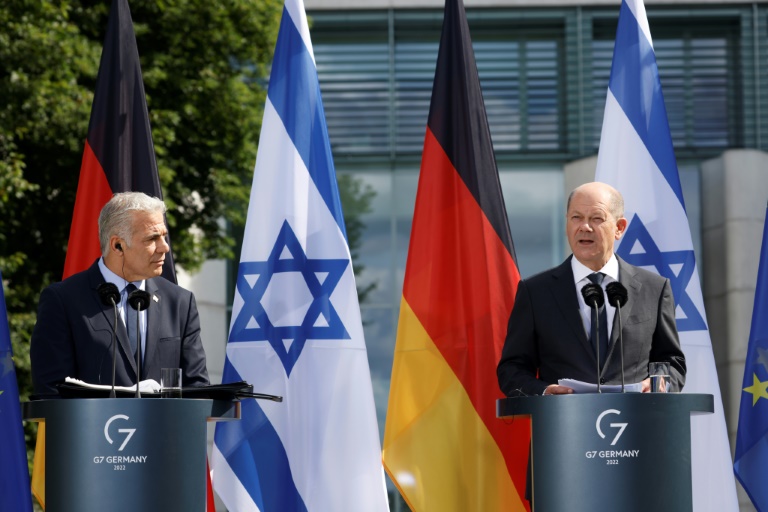
German Chancellor Olaf Scholz Monday ruled out the revival of a nuclear deal with Iran “in the near future”, as Israel pushed for a “credible military threat” to pressure Tehran.

Scholz’s sombre assessment came during Israeli Prime Minister Yair Lapid’s visit — his latest diplomatic effort to persuade Western powers to ditch the agreement with the Jewish state’s arch nemesis.

Israel has long opposed a revival of the 2015 accord that seeks to tame Tehran’s nuclear ambitions. 

The agreement has been moribund since then US president Donald Trump unilaterally withdrew in 2018 and reimposed biting sanctions on Tehran.

Momentum that built towards a restored agreement last month has stumbled, with the three European nations party to the agreement — Germany, France and Britain — expressing doubts about Iran’s sincerity over the weekend.

Speaking alongside the Israeli leader in Berlin, Scholz said he regretted that Iran “has not yet given a positive response to proposals” from the Europeans.

“There is now actually no reason for Iran not to agree to these proposals. But we have to note that this is not the case, and will not happen certainly in the near future.”

Lapid said it was “time to move past the failed negotiations with Iran. 

“They cannot and will not achieve the goal we all share to stop Iran from getting a nuclear weapon.”

A senior Israeli official said that everyone was asking them what comes next in terms of the nuclear deal.

“It is time to have a dialogue with the Americans and the Europeans… to put on the table a credible military threat to pressure Iran into a better deal”, than just returning to the JCPOA, said the official.

The 2015 agreement, known formally as the Joint Comprehensive Plan of Action (JCPOA), gave Iran sanctions relief in return for restricting its nuclear programme.

Negotiations underway in Vienna since April 2021 have sought to restore the agreement, by lifting the sanctions on Tehran and pushing Iran to fully honour its prior nuclear commitments.

– ‘Critical diplomatic opportunity’ –

In a joint statement at the weekend, Germany, France and Britain charged that Tehran “has chosen not to seize this critical diplomatic opportunity”. 

“Instead, Iran continues to escalate its nuclear programme way beyond any plausible civilian justification”, it added. 

Iran’s foreign ministry criticised those comments as “unconstructive.”

Further complicating efforts to revive the deal, the UN nuclear watchdog said in a report last week that it “cannot assure” the peaceful nature of Tehran’s nuclear programme. 

Iran on Monday reaffirmed its “readiness” to cooperate with the International Atomic Energy Agency.

Before flying to Berlin, Lapid told his cabinet that “Israel is conducting a successful diplomatic campaign to stop the nuclear agreement and prevent the lifting of sanctions on Iran. 

“It is not over yet,” he added. “There is still a long way to go, but there are encouraging signs.” 

As well as Scholz, Lapid met Foreign Minister Annalena Baerbock and President Frank-Walter Steinmeier in Berlin. 

Israel insists Iran would use revenue from sanctions relief to bolster allied groups capable of attacking Israelis.

These groups notably include Lebanese Shiite group Hezbollah as well as Hamas and Islamic Jihad, two key Palestinian militant organisations. 

At a conference in the United States Monday, Israeli Defence Minister Benny Gantz presented a map showing 10 sites in Syria, including in Masyaf, that he said were used by Iran to produce weapons for Hezbollah. 

Last month, the European Union, which acts as the mediator of the nuclear talks, put forward a “final” draft of the agreement.

Iran and the US then took turns to respond to the text, with Washington saying on Friday that Tehran’s reply was a step “backwards”.

Lapid, whose late father survived the Holocaust, is also travelling with a delegation of survivors who joined him and Scholz on a visit to Wannsee, site of a 1942 conference where top Nazi officials finalised plans to send Jews to death camps.

EU watchdog approves vaccine targeting Omicron sub-variants

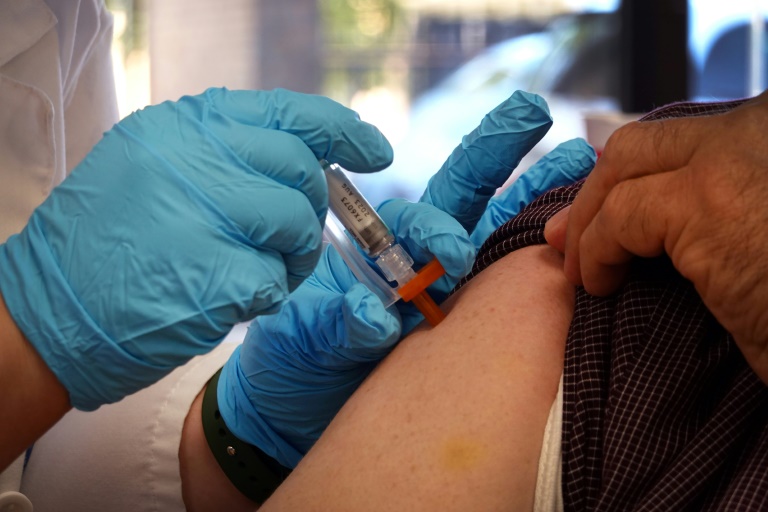
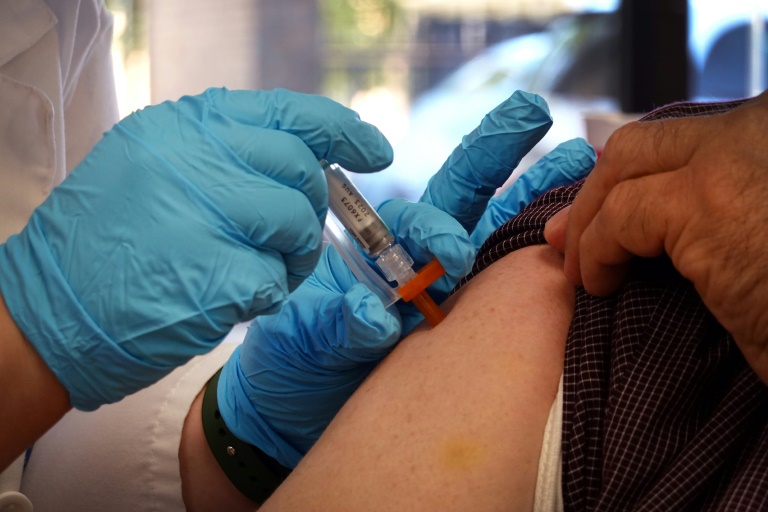
The EU’s medicines watchdog on Monday approved a vaccine specifically targeting the new and contagious types of the Omicron variant amid fears of a new wave of Covid-19 winter infections.

The so-called “bivalent” jab, made by Pfizer/BioNTech, is directed at the highly infectious BA.4 and BA.5 types of the variant and is the first of its kind to be approved within the 27-nation bloc.

“This recommendation will further extend the arsenal of available vaccines to protect people against Covid-19 as the pandemic continues and new waves of infections are anticipated in the cold season,” the European Medicines Agency (EMA) said.

The vaccine also targets “the original strain of SARS-CoV-2” and comes 11 days after the Amsterdam-based drug watchdog approved vaccines by Pfizer and Moderna against the Omicron BA.1 variant.

The latest shot is aimed at people over 12 and who have already received at least one primary vaccination against the coronavirus, and it is an adaptive version of Pfizer’s original Comirnaty vaccine.

European nations have been keen to rush through the new generation of jabs so they can start booster campaigns ahead of a feared Covid surge in the latter part of this year.

The latest vaccines “better match the circulating variants of SARS-CoV-2 and are expected to provide broader protection against different variants,” the EMA said.

“Prompt assessment of the available data on these adapted vaccines will enable their timely deployment in the autumn vaccination campaigns,” it added.

The EMA’s recommendation — which will now be sent to the European Commission for a final decision — was specifically based on clinical data from Pfizer’s vaccines aimed at the original virus and the Omicron BA.1 variant.

– New wave feared –

“Apart from containing mRNA matching different, but closely related, Omicron sub-variants, Comirnaty Original/Omicron BA.4-5 and Comirnaty Original/Omicron BA.1 have the same composition,” the EMA said.

Pfizer’s vaccine works on the principle of tiny molecules carrying instructions for the human body to temporarily produce spike proteins similar to those found on the coronavirus — and which it uses to enter the body’s cells.

The body’s immune system recognises the spike protein as foreign and activates natural defences against them.

When a person then comes in contact with the real virus, the body’s immune system will also recognise and attack it. 

The United States authorised its first anti-Omicron vaccines late last month, approving Pfizer and Moderna jabs for the BA.4 and BA.5 strains. 

Britain authorised the Moderna vaccine for the BA.1 type in mid-August.

While the original vaccines, approved nearly two years ago provided some protection against newer coronavirus variants, the race had been on to come out with a newer group of vaccines that also target the milder but more infectious Omicron strains.

While previous “variants of concern” like Alpha and Delta eventually petered out, Omicron and its sub-lineages have dominated throughout 2022.

The BA.4 and BA.5 types have in particular helped to drive a wave of new cases of the disease in Europe and the United States in recent months.

All Omicron variants tend to have a milder disease course as they settle less in the lungs and more in the upper nasal passages, causing symptoms like fever, tiredness and loss of smell.

jhe/rox

EU watchdog approves vaccine targeting Omicron sub-variants

The EU’s medicines watchdog on Monday approved a vaccine specifically targeting the new and contagious types of the Omicron variant amid fears of a new wave of Covid-19 winter infections.

The so-called “bivalent” jab, made by Pfizer/BioNTech, is directed at the highly infectious BA.4 and BA.5 types of the variant and is the first of its kind to be approved within the 27-nation bloc.

“This recommendation will further extend the arsenal of available vaccines to protect people against Covid-19 as the pandemic continues and new waves of infections are anticipated in the cold season,” the European Medicines Agency (EMA) said.

The vaccine also targets “the original strain of SARS-CoV-2” and comes 11 days after the Amsterdam-based drug watchdog approved vaccines by Pfizer and Moderna against the Omicron BA.1 variant.

The latest shot is aimed at people over 12 and who have already received at least one primary vaccination against the coronavirus, and it is an adaptive version of Pfizer’s original Comirnaty vaccine.

European nations have been keen to rush through the new generation of jabs so they can start booster campaigns ahead of a feared Covid surge in the latter part of this year.

The latest vaccines “better match the circulating variants of SARS-CoV-2 and are expected to provide broader protection against different variants,” the EMA said.

“Prompt assessment of the available data on these adapted vaccines will enable their timely deployment in the autumn vaccination campaigns,” it added.

The EMA’s recommendation — which will now be sent to the European Commission for a final decision — was specifically based on clinical data from Pfizer’s vaccines aimed at the original virus and the Omicron BA.1 variant.

– New wave feared –

“Apart from containing mRNA matching different, but closely related, Omicron sub-variants, Comirnaty Original/Omicron BA.4-5 and Comirnaty Original/Omicron BA.1 have the same composition,” the EMA said.

Pfizer’s vaccine works on the principle of tiny molecules carrying instructions for the human body to temporarily produce spike proteins similar to those found on the coronavirus — and which it uses to enter the body’s cells.

The body’s immune system recognises the spike protein as foreign and activates natural defences against them.

When a person then comes in contact with the real virus, the body’s immune system will also recognise and attack it. 

The United States authorised its first anti-Omicron vaccines late last month, approving Pfizer and Moderna jabs for the BA.4 and BA.5 strains. 

Britain authorised the Moderna vaccine for the BA.1 type in mid-August.

While the original vaccines, approved nearly two years ago provided some protection against newer coronavirus variants, the race had been on to come out with a newer group of vaccines that also target the milder but more infectious Omicron strains.

While previous “variants of concern” like Alpha and Delta eventually petered out, Omicron and its sub-lineages have dominated throughout 2022.

The BA.4 and BA.5 types have in particular helped to drive a wave of new cases of the disease in Europe and the United States in recent months.

All Omicron variants tend to have a milder disease course as they settle less in the lungs and more in the upper nasal passages, causing symptoms like fever, tiredness and loss of smell.

jhe/rox

Stock markets rally, as euro briefly surges

Stock markets rallied Monday, building on pre-weekend momentum as investors priced in the expectation of further interest rate hikes aimed at taming decades-high inflation.

The euro surged against main rivals, a day after German central bank chief Joachim Nagel signalled that the European Central Bank (ECB) would probably continue raising its key rate.

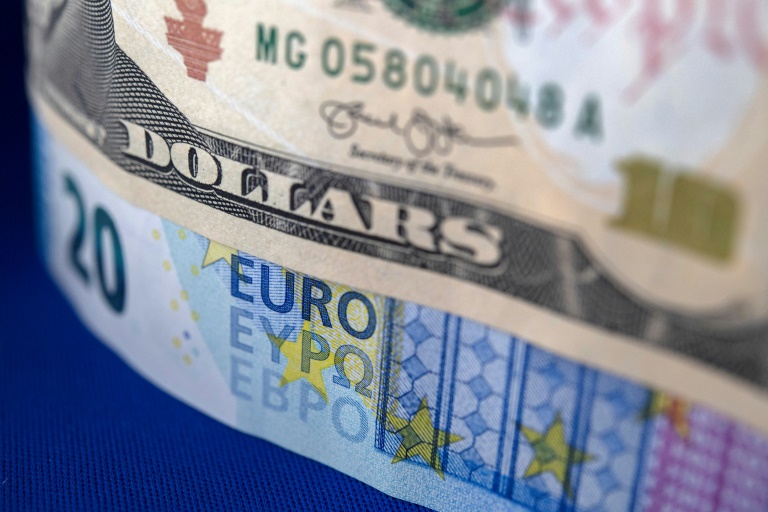
The European single currency rocketed more than 1.4 percent against the dollar and 1.6 percent versus the yen before trimming gains around midday.

The ECB raised the key rate by a historic 75 basis points last week, and markets expect a similar-sized hike at an October meeting.

Frankfurt led the way, closing more than two percent higher, followed by Paris and London not far behind after data showed the British economy rebounded slightly in July.

On Wall Street, stocks also advanced extending last week’s rally.

Tokyo closed with a gain of more than one percent thanks to a weaker yen. Markets in Hong Kong, mainland China and South Korea were closed for a public holiday.

Investors worldwide are awaiting key US inflation data for August, due Tuesday, with the consumer price index (CPI) expected to ease slightly to eight percent — still well above the Fed’s two-percent target.

Traders expect the Fed to impose another large rate hike next week, after two 75-basis-point increases already.

Clifford Bennett, chief economist at ACY Securities, said he expected stocks to “continue to drift higher” ahead of Tuesday’s CPI data.

The inflation print “may well see further improvement as petrol prices have continued to pull back”, he said. 

Oil prices gained Monday but remain pressured by the possibility of global demand weakening as growth slows and China’s harsh zero-Covid policy continues to sap economic activity.

– ‘Soft landing’ hopes –

US Treasury Secretary Janet Yellen on Sunday said she was hopeful the US economy could avoid a recession, but that the Fed would need to skilfully manage interest rates and also rely on “some good luck to achieve what we sometimes call a soft landing.

“My hope is we will achieve a soft landing, but Americans know it’s essential to bring inflation down and, over the longer run, we can’t have a strong labour market without inflation under control,” she told CNN.

Yellen said that while the US economy’s growth rate was slowing, the labour market remained “exceptionally strong”, with almost two openings for every jobseeker.

The release on Tuesday of the consumer price index will “provide some telling inflation data that will influence the market’s perspective on the Fed’s monetary policy approach”, analyst Patrick O’Hare of Briefing.com said.

– Key figures at around 1545 GMT –

London – FTSE 100: UP 1.7 percent at 7,473.03 points (close)

Frankfurt – DAX: UP 2.4 percent at 13,402.27 points (close)  

Paris – CAC 40: UP 1.95 percent at 6,333.59 points (close)  

EURO STOXX 50: UP 2.1 percent at 3,646.51 points

New York – Dow: UP 0.8 percent at 32,395.08 points  

Tokyo – Nikkei 225: UP 1.2 percent at 28,542.11 (close) 

Hong Kong – Hang Seng Index: closed for public holiday

Shanghai – Composite: closed for public holiday

Euro/dollar: UP at $1.0129 from $1.0046 

Pound/dollar: UP at $1.1699 from $1.1587 

Euro/pound: DOWN at 86.56 pence from 86.84 pence

Dollar/yen: DOWN at 142.45 yen from 142.56 yen 

Brent North Sea crude: UP 2.0 percent at $94.73 per barrel

West Texas Intermediate: UP 1.95 percent at $88.48 per barrel

Ukraine recaptures more ground as Russia strikes back

Ukrainian forces said Monday their lightning counter-offensive took back yet more ground in the past 24 hours, as Russia responded with strikes on some of the recaptured areas.

The territorial shifts marked one of Russia’s biggest reversals since its troops were turned back from Kyiv in the earliest days of the nearly seven months of fighting, yet Moscow signalled it was no closer to agreeing a negotiated peace.

The retreat of Russian troops in recent days has drawn weeping and relieved locals into bomb-cratered streets, including on Sunday in the strategic but heavily damaged town of Izyum.

“It’s not enough to say I’m happy. I just don’t have enough words to express myself,” said Yuriy Kurochka, 64. 

Yet by Monday Moscow had announced air, rocket and artillery attacks on reclaimed areas in the Kharkiv region, a day after Kyiv said Russian strikes on electricity infrastructure caused power failures.

The retaliatory fire came as Ukraine said forces had retaken more than 20 additional settlements, claiming “Russian troops are hastily abandoning their positions and fleeing”.

Kyiv had already announced the recapture of Izyum in the country’s east, while Ukraine said 3,000 square kilometers of its territory (1,158 square miles) had been prised from Russian control since September’s start.

“Ukraine has turned the tide in its favour, but the current counter-offensive will not end the war,” US think tank Institute for the Study of War tweeted.

Ukraine also said on Monday its forces recaptured 500 square kilometres (193 square miles) in the southern Kherson region which were in addition to the huge gains in the east at the weekend.

Defence Minister Oleksii Reznikov told French daily Le Monde, in an interview published Monday, the war has entered a new phase with the help of Western weapons.

“We started by using the HIMARS mobile artillery systems [from the US] to cut off enemy supply lines and destroy fuel and weapon depots,” he reportedly said.

Moscow conceded having lost territory, which experts saw as a serious blow to its war ambitions, but Kremlin spokesman Dmitry Peskov saw no prospects for negotiations.

“The special military operation continues and will continue until the objectives that were originally set are achieved,” he added, using Russia’s terminology for the internationally condemned war.

Eastern parts of Ukraine were hit with widespread electricity blackouts on Sunday evening, which President Volodymyr Zelensky said deliberately hit civilian infrastructure. He blamed “Russian terrorists”.

The blackouts hit regions with an estimated combined population of nine million people — including territory controlled by Russia.

– ‘Weapons, weapons, weapons’ –

The Russian strikes hit 15 locations on Sunday, from Kramatorsk in the east to Mykolaiv in the south and Dnipro in between, Ukraine’s military said.

Ukraine had already lost all power from the Russian-controlled Zaporizhzhia nuclear plant, threatened by shelling since February’s invasion.

The country’s nuclear energy agency said the final reactor at the plant, Europe’s largest nuclear power station, had been shut off as a safety measure.

Kyiv and Moscow have shown “signs that they are interested” in creating a security zone around the Zaporizhzhia plant, the UN atomic watchdog said Monday.

“What we need here really is Ukraine and Russia to agree on a very simple principle of not attacking or not shelling the plant,” IAEA director general Rafael Grossi told reporters.

The speed of Ukraine’s fightback has apparently caught Russia’s military off-guard, bringing swathes of territory Moscow had controlled for months back into Kyiv’s fold.

Images posted by the Ukrainian military showed crates of munitions and military hardware scattered across territory abandoned by Russian forces.

In his evening address Sunday, Zelensky praised the soldiers who had “liberated hundreds of our cities and villages… and most recently Balakliya, Izyum and Kupiansk”.

Around Balakliya, one of the first towns to be retaken by Ukrainian troops, AFP journalists saw evidence of fierce battles, with buildings destroyed or damaged and streets mostly deserted.

The country’s foreign minister used the momentum to appeal to Western allies for more stockpiles of sophisticated weapons.

“Weapons, weapons, weapons have been on our agenda since spring. I am grateful to partners who have answered our call: Ukraine’s battlefield successes are our shared ones,” Dmytro Kuleba said.

Close Bitnami banner
Bitnami