World

Blackout 'compromises safe operation' of Ukraine nuclear plant: IAEA

A blackout caused by fresh shelling near Ukraine’s Zaporizhzhia nuclear power plant has compromised the site’s safety, the UN atomic watchdog warned Friday, adding the plant’s operator is considering shutting down the sole remaining reactor.

“Shelling has caused a complete blackout in Energodar (town) and compromised the safe operation of the nearby Zaporizhzhia (plant),” International Atomic Energy Agency (IAEA) chief Rafael Grossi tweeted, calling it a “dramatic development”.

“This is completely unacceptable. It cannot stand,” he said, calling for “the immediate cessation of all shelling in the entire area”.

“Only this will ensure the security of operating staff and allow the durable restoration of power to Energodar and to the power plant,” he added.

The Zaporizhzhia plant is Europe’s largest nuclear power facility. 

It was occupied by Russian troops in March and has been shelled in recent weeks, with Ukraine and Russia blaming each other for the attacks, raising fears of a nuclear disaster.

Grossi said he learned of the shelling on Friday from IAEA staff on the site.

The shelling of the switchyard at Energodar’s thermal power plant has led to a “complete power black-out” in the city, where the Zaporizhzhia nuclear power plant is located, he said.

“No running water, no power, no sewage,” he said.

– ‘Significant risk’ –

Plant operators and others living in Energodar faced “increasingly dire circumstances”, with a “significant risk” there would no longer be enough essential staff at the plant.

And there was “little likelihood of re-establishing reliable offsite power” given the increased and continued shelling, he added.

“As a result, the IAEA understands that the operator, having no longer confidence in the restoration of offsite power, is considering shutting down the only remaining operating reactor,” he said.

The plant in recent days has relied on this reactor for the power it needs for cooling and other safety functions.

“The entire power plant would then be fully reliant on emergency diesel generators for ensuring vital nuclear safety and security functions,” Grossi warned.

The IAEA called Tuesday for a security zone to be set up around the Zaporizhzhia nuclear power plant, saying the current situation was “untenable”.

The IAEA sent a 14-person team to the site last week. Two members are remaining there on a permanent basis to ensure the facility’s safety.

Kyiv on Wednesday called for an international mission to be set up at the plant and for the population to evacuate the area amid fears of a nuclear disaster.

North Korea law makes nuclear programme 'irreversible'

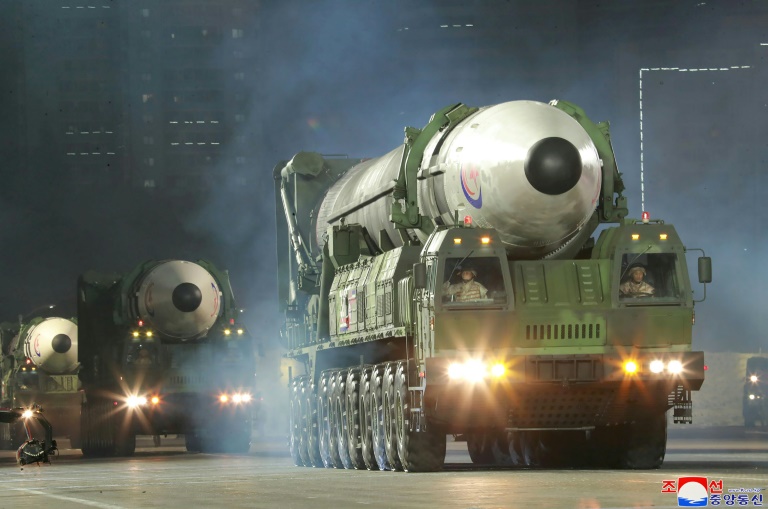
North Korea has passed a law declaring its readiness to launch preventive nuclear strikes, including in the face of conventional attacks, state media said Friday.

The move effectively eliminates the possibility of denuclearisation talks, with leader Kim Jong Un saying the country’s status as a nuclear state was now “irreversible”.

The announcement comes at a time of heightened tension between North and South, with Pyongyang blaming Seoul for the outbreak of Covid-19 in its territory and conducting a record number of weapons tests this year. 

The newly enacted law says North Korea can carry out a preventive nuclear strike “automatically” and “immediately to destroy the hostile forces” when a foreign country poses an imminent threat, the official Korean Central News Agency (KCNA) said. 

The law specifically states the North can use nuclear weapons “in case of a nuclear or non-nuclear attack by hostile forces on the state leadership and the command organization of the state’s nuclear forces”, among other situations, according to state media. 

“The status of our country as a nuclear weapons state has become irreversible”, Kim said, KCNA reported. 

The law “publicly justifies Pyongyang’s use of its nuclear power” in the event of any military clash, Cheong Seong-chang of the Center for North Korea Studies at the Sejong Institute told AFP. 

As the North’s dictator, “Kim Jong Un does not need laws to launch a nuclear strike”, but the new law serves as a way to “vindicate Kim’s use of nuclear weapons in case of emergency by disclosing the principles of nuclear use at home and abroad in advance,” he added. 

Kim in July said his country was “ready to mobilise” its nuclear capability in any war with the United States and the South.

He reiterated that Pyongyang would never give up the nuclear weapons it needed to counter hostilities from Washington, claiming the United States was seeking the “collapse” of his regime.

Nuclear talks and diplomacy between Washington and Pyongyang have been derailed since 2019 over sanctions relief and what the North would be willing to give up in return.

“There is absolutely no such thing as giving up nuclear weapons first, and there is no denuclearisation and no negotiation for it,” Kim said during a speech at North Korea’s rubber-stamp parliament on Thursday, KCNA reported.

– ‘Height of absurdity’ –

A blitz of North Korean weapons tests since January included the firing of an intercontinental ballistic missile at full range for the first time since 2017.

Washington and South Korean officials have repeatedly warned that the North is preparing to carry out what would be its seventh nuclear test.

Yang Moo-jin, a professor at the University of North Korean Studies, said the North’s latest announcement clearly reaffirmed Pyongyang’s stance — that nuclear negotiations are no longer on the table.

“Pyongyang is likely to form closer ties with China and Russia against Washington, and … launch its seventh nuclear test in the near future,” he told AFP.

In Washington, the State Department said it remains focused on the objective of “the complete denuclearisation of the Korean peninsula”.

“We have made clear we have no hostile intent” toward North Korea, a spokesperson said, but added that Pyongyang continues to ignore overtures for talks.

“The United States remains fully committed to the defence of the Republic of Korea (South Korea) using the full range of US defence capabilities,” the spokesperson said.

Seoul, Washington’s key security ally, last month offered Pyongyang an “audacious” aid plan that would include food, energy and infrastructure help in return for the North abandoning its nuclear weapons programme. 

But Pyongyang ridiculed the offer, calling it the “height of absurdity” and a deal the North would never accept.

South Korea’s hawkish President Yoon Suk-yeol said last month that his administration had no plans to pursue its own nuclear deterrent.

UK business mourns queen as souvenir sales boom

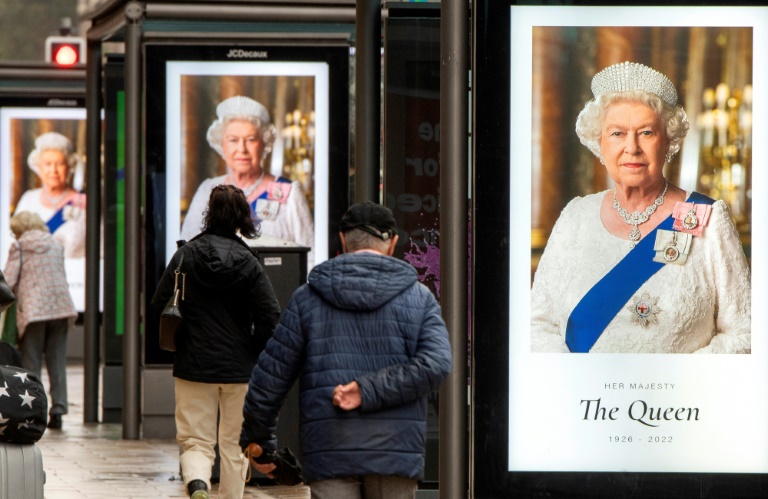
British business paid tribute Friday to Queen Elizabeth II, with department stores shut, flags lowered, clocks stopped and meetings postponed, but souvenir sales boomed near Buckingham Palace as well-wishers thronged.

London’s iconic Selfridges, on the capital’s Oxford Street shopping thoroughfare, and nearby Liberty on Regent Street closed out of respect for the nation’s longest serving monarch who died Thursday.

Many company headquarters lowered flags, while the Bank of England has delayed an interest rate meeting until after the funeral.

Fortnum and Mason, the Royal Family’s tea supplier, was shuttered and even stopped the clock on the front of its luxury department store in London’s Piccadilly quarter.

“We are proud to have held a warrant from Her Majesty since 1954, and to have served her and the royal household throughout her life,” F&M said on their website.

“As a sign of our deep respect, we have lowered our flag to half-mast and stopped the Piccadilly facade clock.”

Elsewhere, the remembrance business was in full swing nearer the palace, as well-wishers gathered to pay respects to the Royal Family — and hoped to catch a glimpse of King Charles III and Queen Consort Camilla.

– ‘Everyone wants a souvenir’ –

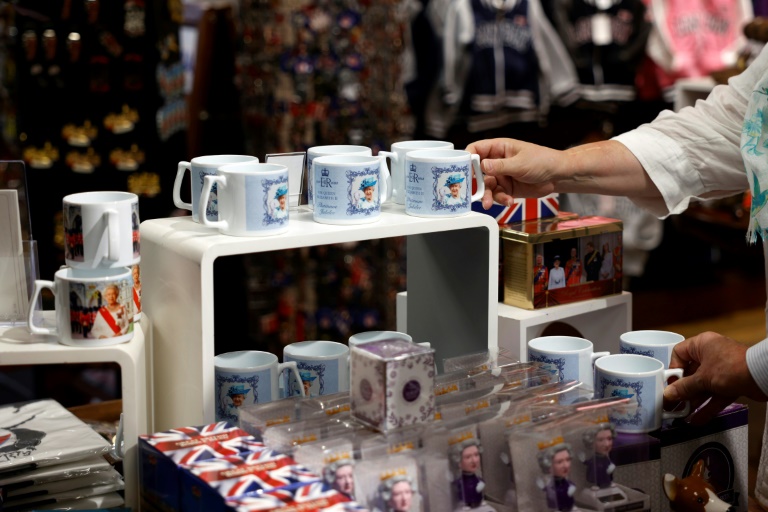
“Everyone wants a queen souvenir,” shop manager Nassir Abdel told AFP at Buckingham Gate, a stone’s throw from the main royal residence.

Abdel, who kept his shop open overnight owing to keen demand, said he had placed an order for souvenirs featuring King Charles III — but they will take a couple of weeks to arrive.

Customer Janet Saxton, a 73-year-old pensioner from Yorkshire in northern England, browsed the shop’s key rings, mugs and other trinkets bearing the likeness of the late monarch before heading to the palace gates.

On Oxford Street, souvenir salesman Nazz said business was brisk.

“In the coming days we’re going to sell” even more objects featuring the queen while awaiting Charles merchandise, he told AFP.

– ‘Object of fascination’ –

Worldwide coverage of the queen’s passing is expected to boost Britain’s economy to some extent as it looks to stave off recession caused by decades-high inflation.

Her funeral due September 19 “should have an impact on the tourism sector and the souvenir industry”, according to Mirabaud analyst John Plassard.

“The royal family, which regularly features on the front pages of newspapers, is an object of constant fascination, including well beyond the kingdom’s borders.

“Souvenir sales are expected to rise by £60 million ($69 million) as a result of the funeral,” he added.

Most shops remained open on Oxford Street, including department store John Lewis, where accountant Jo-Anne Allen was seeking out a coat.

Britain’s economy “needs to be kept going, it is no time to shut the country”, she said.

“I do not think she would have wanted more disruption to the country after her death, after Covid and the cost-of-living crisis.”

Tony Danker, head of UK business lobby group CBI, echoed the sentiment. 

“Times are hard right now — made more so by the loss of our much-loved queen — and our tribute should be to work tirelessly to build a better future for the people of this country in memory of Her Majesty.”

Kisses for King Charles III as he greets crowd at palace

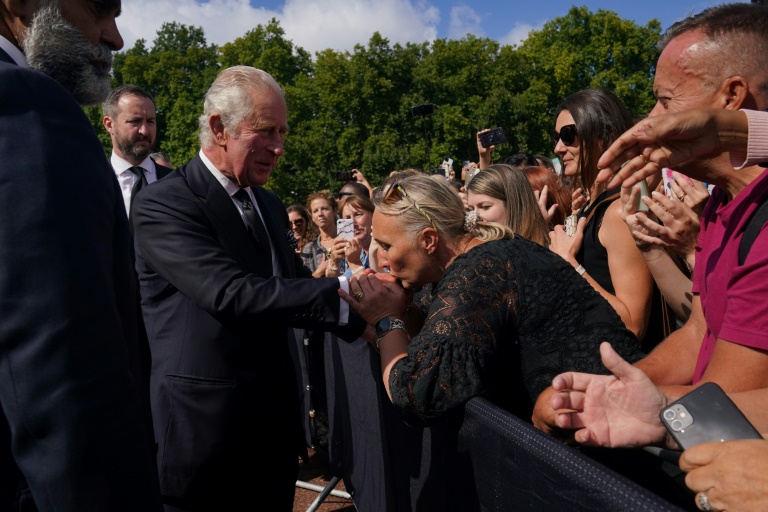
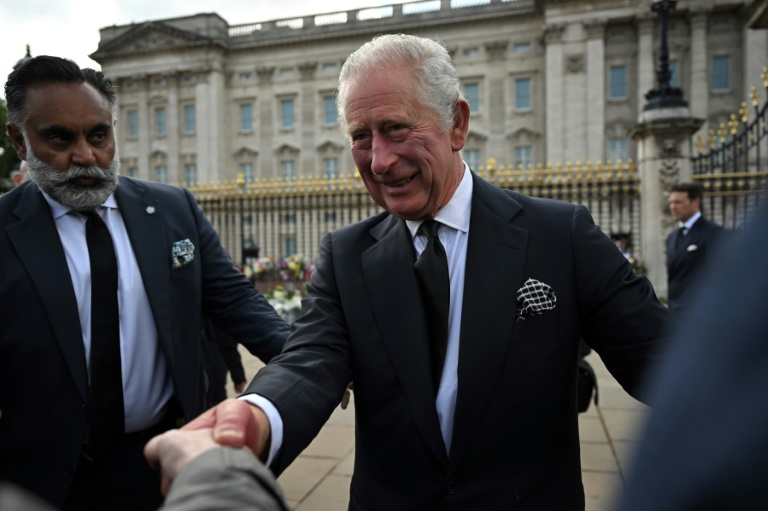
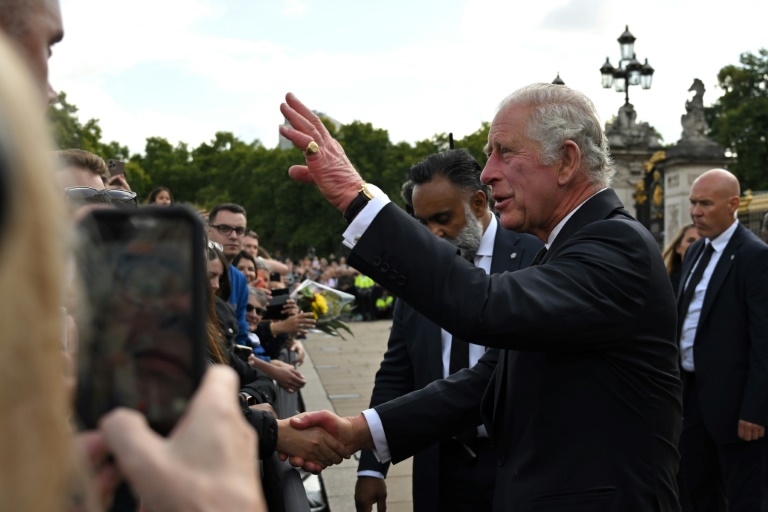
A smiling King Charles III received a kiss from one well-wisher as he was greeted by cheers of “God Save the King” at Buckingham Palace Friday. 

Returning to London for the first time since the death on Thursday of his mother, Queen Elizabeth II, he got out of his car to meet some of the thousands of people gathered to mourn and greet the new monarch.

He shook hands, accepted flowers and waved as people held up their phones to take selfies, while others offered some words of condolence, and calls of “We love you King Charles” were heard.

“I saw the top of his head, I wasn’t expecting to, I was only coming to bring my flowers,” said Apophia Othieno, a lecturer, adding: “It was lovely.”

There were impromptu renditions of the national anthem, with the word “queen” switched to “king”, and cries of “hip, hip hooray”.

Charles, 73, wearing a black suit and tie and white shirt, afterwards walked to see some of the bouquets and tributes left at the gates of the palace for his late mother.

“It was impressive, touching, a good move to come out to the crowds,” said Ammar Al-Baldawi, a 64-year-old retiree from north of London.

“These are true loyalists here and it’s nice to see him back in post, taking charge of the family and the Crown, which is reassuring.”

Charles was joined by his wife Camilla, the Queen Consort, before they went inside, where the new king was due to record his inaugural television address to the UK and the Commonwealth.

They had flown down from Scotland where they had been with the queen at her Balmoral estate, where she died on Thursday aged 96 after a record-breaking 70 years on the throne.

“He’s got a hard act to follow,” said Stephen Johnson, a 56-year-old Londoner.

He said he was feeling “very emotional”, similar to when Charles’ ex-wife Diana died in a car crash in Paris in 1997.

“I’m still getting my head round King Charles III,” he told AFP.

“He’s our king now, we’ve got to love him but memories of Diana are fresh, only last month we marked the 25th anniversary of her passing.”

Stocks and oil rally as dollar drops

Stock markets and oil prices rallied Friday, with investors largely pricing in more interest rate hikes aimed at taming runaway inflation.

The dollar slid as much as one percent versus the pound and euro after recent hefty gains.

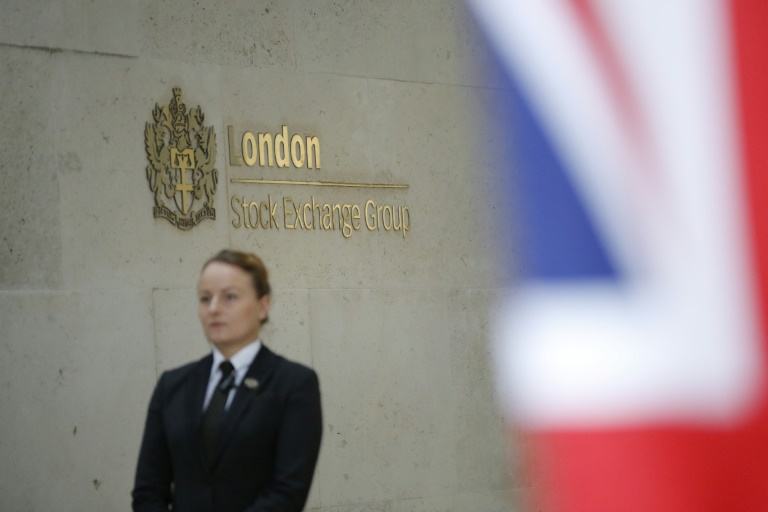
London’s stock market jumped 1.2 percent, mirroring advances in Paris and Frankfurt, while the British capital’s exchange mourned the death of Queen Elizabeth II.

“We are deeply saddened at the passing of Her Majesty Queen Elizabeth II,” the London Stock Exchange said in a message posted on its website.

The LSE is expected to shut on the day of the queen’s funeral following her death on Thursday.

“Markets are being very British about the whole thing, carrying on in a fashion that I suspect she would have approved of,” said IG analyst Chris Beauchamp.

– Dollar off highs –

The more confident mood across equity and oil markets was reflected in a cooler dollar, which had surged to multi-decade highs against major peers in recent weeks owing to the US Federal Reserve’s hawkish tilt to tighter monetary policy.

“There are hopes that the sharp rate increases from the Fed may already have dampened demand, causing US inflation to weaken,” said City Index and FOREX.com analyst Fawad Razaqzada. 

The greenback’s softness came even after Fed chief Jerome Powell reasserted the US central bank’s determination to keep hiking interest rates to fight prices, even at the cost of economic growth.

His warning that “we need to act now forthrightly, strongly” followed comments from his deputy Lael Brainard, who said policymakers would lift borrowing costs for as long as it takes to bring inflation down from 40-year highs.

Nevertheless, Wall Street has pushed higher on Thursday and Friday, putting markets on course for a weekly gain and easing some pressure after hefty losses in August caused by worries that rising rates would spark a recession.

In Asia, Hong Kong rose close to three percent heading into a long weekend.

Edward Moya, analyst at trading platform OANDA, said traders cheered as “Powell stuck to his hawkish script and affirmed the commitment to tighten policy until inflation is back towards their target.”

There was also some cheer from news that inflation in China had eased slightly in August, giving the government more room to introduce more economy-supporting measures, though the recovery remains hostage to leaders’ strict zero-Covid strategy of growth-sapping lockdowns.

A Thursday pledge by Britain’s new Prime Minister Liz Truss to freeze domestic energy bills for two years also helped temper inflation concerns and boosted sentiment about the economy.

The euro was holding well above parity with the dollar, one day after the European Central Bank announced its own 75 basis-point rise as it warned inflation was “far too high” and likely to stay above target for “an extended period”.

ECB chief Christine Lagarde suggested policy would continue to be tightened for some time.

The yen strengthened as officials began speaking up after the unit approached a 32-year low versus the greenback.

The pick-up came after Bank of Japan chief Haruhiko Kuroda met Prime Minister Fumio Kishida on Friday before saying “the rapid weakening of the yen is undesirable”. 

The talks were seen as a sign of intent to act in support of the currency if it continued to weaken. 

– Key figures at around 1530 GMT –

New York – Dow: UP 1.0 percent at 32,086.36 points

EURO STOXX 50: UP 1.2 percent at 3,570.04

London – FTSE 100: UP 1.2 percent at 7,351.07 (close)

Frankfurt – DAX: UP 1.4 percent at 13,088.21 (close)

Paris – CAC 40: UP 1.4 percent at 6,212.33 (close)

Tokyo – Nikkei 225: UP 0.5 percent at 28,214.75 (close)

Hong Kong – Hang Seng Index: UP 2.7 percent at 19,362.25 (close)

Shanghai – Composite: UP 0.8 percent at 3,262.05 (close)

Euro/dollar: UP at $1.0037 from $1.0001 on Thursday

Pound/dollar: UP at $1.1580 from $1.1500

Euro/pound: DOWN at 86.66 pence from 86.93 pence

Dollar/yen: DOWN at 142.52 yen from 144.07 yen 

Brent North Sea crude: UP 3.0 percent at $91.82 per barrel

West Texas Intermediate: UP 3.1 percent at $86.15 per barrel

burs-rl/lth

EU ministers fast-track 'unprecedented' energy plan

The EU executive pledged Friday to come up with unprecedented measures in the coming days to solve an energy price shock triggered by Russia’s war on Ukraine, including a controversial gas price cap that could further anger the Kremlin.

Moscow’s invasion has seen the price of natural gas hit record levels, throwing the EU economy into deep uncertainty, with all eyes on whether Russian President Vladimir Putin will cut off the flow entirely.

European energy ministers tasked the European Commission in Brussels to work through the weekend to draw up legal texts that will include emergency funding for consumers sinking under the weight of soaring bills.

The EU will table “unprecedented measures next week for an unprecedented situation”, energy commissioner Kadri Simson said, after meeting the ministers.

Simson said compensation for struggling households and businesses would be covered by a levy on non-gas electricity companies, such as nuclear, solar or renewable firms, that are seeing a revenue bonanza on the back of high prices for electric power.

The market price of electricity in Europe is closely linked to the gas price, meaning non-gas utilities are enjoying huge revenues despite far lower costs.

Simson said fossil fuel companies would also be levied on their mega profits from the inflated energy prices.

– Gas price cap –

Despite heated debate among European countries, the EU will also attempt to lower the price on natural gas, possibly through a price cap on Russian imports or through negotiations with other suppliers.

Czech Industry and Trade Minister Jozef Sikela, whose country holds the EU presidency, said there was a “prevailing view” among EU countries that some form of price ceiling was necessary.

But he called for patience “to fine tune where properly … the cap should be implemented”, adding that nothing was decided at this stage.

Fears are rife that targeting Russia alone would only further rile Moscow, which has threatened to cut off the supply to Europe entirely if a cap is imposed.

Last week Russia caused a major scare when it halted gas deliveries to Germany via a key pipeline for an indefinite period, a move the Kremlin blamed on Western sanctions.

One leading approach would be for EU countries to jointly negotiate with major suppliers such as Norway, Algeria or the United States in order to squeeze out better terms.

“Countries are calling for new thinking about capping the gas price … and the question arises in different technical terms,” said French energy transition minister Agnes Pannier-Runacher. 

Despite the differences, she added, “what is interesting is that there is a common desire to move forward on this subject.”

– Binding measures? –

One proposal that has broad backing is an idea to rescue electricity companies that are struggling to hedge their spending on energy markets that have been extremely volatile.

This would be done by relaxing EU rules on state rescues of companies that are suddenly facing more onerous terms for cash as fears of a crisis spread.

The commission will also design a mechanism to cut back on energy demand, with mandatory cuts imposed if voluntary limits at peak hours fail.

“Member states are us usually very reluctant to support binding measures, but this is exactly what Commission is considering,” Simson said.

The commission, which draws up laws that are then ratified by member states and the European Parliament, will likely make its proposals as early as Tuesday.

“We will have a busy weekend and first days of next week before the final product…will be really ready,” Simson said.

Sombre Edinburgh readies to receive the queen

Sadness, drizzle and a strange frisson filled the Edinburgh air as the Scottish capital prepared to receive the coffin of Queen Elizabeth II this weekend.

The monarch died at her Scottish Balmoral estate on Thursday and the coffin’s arrival in Edinburgh will be the first stage on its journey to a state funeral in London.

Against a damp wall at Holyroodhouse, the royal palace in Edinburgh, the mass of flowers continued to grow.

Gary Millar, a 45-year-old technician, added a bouquet to the pile that started to build when news broke of the queen’s death.

He stepped back and paused in a silent moment of contemplation. 

Millar had arrived early in the morning to show his “respects” and “to honour the lady”. 

“She honoured us her whole reign by doing her duty and I think it’s time that the public gave that back a little,” he said, his voice tight with emotion. 

In Scotland, led by a government that wants independence from the United Kingdom, the queen is much more popular than the monarchy itself. 

For Millar, the late sovereign “held the country together”.

“She was the figurehead of our union of Great Britain. She’s been around all my life,” he continued, praising her “hard work” and “dedication”. 

– ‘Right monarch for the times’ –

Holyroodhouse is expected to receive Queen Elizabeth’s coffin over the weekend. 

Her body will then be carried in a procession along the Royal Mile, the main artery of the Scottish capital, to St Giles Cathedral for a religious service. 

The queen’s children are expected to hold a “Vigil of the Princes” while the coffin lies in the cathedral. Members of the public are due to be allowed in later to pay their respects. 

The coffin will then be transported by plane to London. 

At the foot of the wall, gardeners were preparing the lawn for the occasion. The palace grounds rang to the sound of mowers and a damp smell of motor fuel and cut grass hung in the air. 

Moved to tears, Rebecca Evans, 44, said simply that she was “sad”. 

“She just welcomed the new prime minister on Tuesday and to go from Tuesday to be well, and then to Thursday to leave us, it’s just very, very sad,” she sobbed. 

“There’s so much going on in the UK right now,” said Evans, listing Brexit, the energy crisis and the predicted recession. 

“I think we’re notoriously grumpy people in Scotland,” she added. “But… we do love the queen. We do love the royal family.”

Evans, who works for a think tank on global warming, predicted King Charles III would be “the right monarch for these times”.

“He was ridiculed for his views but this is a time for action, for people to stand up and say we need to do things about climate change,” she said.

– ‘Never on strike’ –

The fact the queen’s coffin will rest in Edinburgh is a source of great local pride, Evans said, “because so many things in the UK are focused on London”.

“Especially when you’ve seen the mountain behind in the mist. It’s so beautiful and I can’t think of a nicer way to go than to just pass away peacefully in the mountains,” she added, visibly moved. 

Out of respect for the queen, postal workers and railway workers have called off planned strikes. 

“That’s maybe the most British response you can find… that rail workers and postal workers don’t strike because she never went on strike, did she?,” added Evans. 

Orla Bell, a 48-year-old Irishwoman living in Edinburgh, came to lay flowers because her mother is a “big fan of the royal family”. 

Twenty five years ago she and her mother left a bouquet when Princess Diana died. 

“The queen was like a mum to everybody in the country,” she said.

“Even if you’re not a fan of the royal family or you’re not British, I think it’s important to everybody.”

Crowds hail King Charles III as mourning begins for late queen

King Charles III greeted crowds singing “God Save the King” outside Buckingham Palace on Friday before making his inaugural address to Britain and the Commonwealth after the death of his mother, Queen Elizabeth II. 

The smiling 73-year-old — the oldest monarch to ascend to the throne — shook hands and accepted flowers from well-wishers after returning to London from Scotland at the start of his reign. 

One kissed his hand, another kissed his cheek, and some sang the national anthem, adapted to a new monarch following the passing of the 96-year-old Elizabeth after seven decades on the throne. 

Church bells and ceremonial gun salutes rang out across the UK and Britain’s overseas territories in honour of the late queen, who died “peacefully” at her beloved Balmoral retreat in Scotland after a year of ill-health. 

Charles will make his first televised address as king at 6:00 pm (1700 GMT) before being formally proclaimed king to the public at 11:00 am Saturday morning.

Elizabeth II had reigned for a record-breaking 70 years, a source of stability in a period of extraordinary change whose death sparked heartfelt tributes from across the world.

“During this period of mourning and change, my family and I will be comforted and sustained by our knowledge of the respect and deep affection in which the queen was so widely held,” Charles said in a statement on Thursday.

Buckingham Palace said the king and other members of the royal family would observe an extended mourning period from now until seven days after her funeral.

The date of the funeral, which will be attended by heads of state and government, has yet to be officially announced but is expected to be on Monday, September 19.

– World leader –

While Britons adjusted to the shock of the departure of their only head of state since the aftermath of World War II, tributes poured in for one of the planet’s most recognisable people.

News of her death dominated global headlines, while the popular UK tabloid the Daily Mail declared: “Our hearts are broken.”

Flowers were also left at British embassies around the world, including in Moscow — currently at odds with London over the war in Ukraine.

Buckingham Palace in London became the epicentre for thousands of mourners, with flowers piling up in a sign of the reverence felt for the queen.

Joan Russell, a 55-year-old project manager from northeast London, had tears running down her cheeks as she looked at the tributes lining the gates. 

“I think I came to say a prayer. She has been our monarch all my life and she has led by example, she has learnt, she has listened, wherever you go, she is our stamp,” she told AFP.

“Charles has had such a great example to follow.”

The new king was due to hold his first audience Friday with Prime Minister Liz Truss, who was only appointed on Tuesday in one of the queen’s last official acts before her death.

Truss offered the nation’s support to Charles as she said he now bore an “awesome responsibility” at the start of two days of special tributes to his mother in parliament.

“Even as he mourns, his sense of duty and service is clear,” she said.

Truss lavished praise on the queen as “one of the greatest leaders the world has ever known”.

“Her legacy will endure through the countless people she met, the global history she witnessed and the lives that she touched,” the premier said.

Charles was also due to meet officials in charge of the arrangements for his mother’s elaborate state funeral, which will take place before she is laid to rest in the King George VI memorial chapel at Windsor Castle.

Church bells tolled at Westminster Abbey, St Paul’s Cathedral and at Windsor, among other places, and Union flags flew at half-mast across the UK.

Gun salutes — one round for every year of the queen’s life — were fired Friday across Hyde Park in central London and from the Tower of London on the River Thames.

While the government has said there is no obligation on organisations to suspend business during the period of national mourning, many are doing so as a mark of respect.

The Premier League postponed all matches this weekend, the TUC umbrella body of trade unions postponed its congress due to begin on Sunday, while railway and postal workers halted upcoming strikes over pay, as Britain is gripped by soaring inflation and spiralling energy prices.

The queen’s death and its ceremonial aftermath comes as the government strives to rush through emergency legislation to tackle the kind of war-fuelled economic privation that marked the start of Elizabeth’s reign in 1952.

– Tearful tributes –

Elizabeth’s public appearances had become rarer in the months since she spent an unscheduled night in hospital in October 2021 for undisclosed health tests.

She was seen smiling in her last official photographs from Tuesday when she appointed Truss as the 15th prime minister of her reign, which started with Winston Churchill in Downing Street.

But the queen, visibly thinner and stooped, leant on a walking stick. Her hand was also bruised dark blue-purple, sparking concern. 

Jane Barlow, the photographer who took the last public pictures of the queen on Tuesday, said she was “frail” but in “good spirits”.

The queen’s closest family members had rushed to be at her bedside at Balmoral, a private residence set among thousands of acres (hectares) of rolling grouse moors and forests in the Scottish Highlands.

Her body is expected to remain there initially before being taken Sunday to the Palace of Holyroodhouse in Edinburgh. 

From the Scottish capital, her coffin is due to be flown to London on Tuesday for a lying in state accessible to the public. 

Officials expect more than one million people to file past the catafalque in Westminster Hall, the oldest part of the parliamentary complex, before the televised funeral service at Westminster Abbey opposite.

– Consistently popular –

Queen Elizabeth II came to the throne aged just 25 in the exhausted aftermath of World War II, joining a world stage dominated by political figures from Churchill to Mao Zedong and Joseph Stalin.

In the ensuing decades, the last vestiges of Britain’s vast empire crumbled. 

At home, Brexit shook the foundations of her kingdom, and her family endured a series of scandals.

But throughout, she remained consistently popular and was head of state not just of the United Kingdom but 14 former British colonies, including Australia and Canada. 

New Zealand proclaimed Charles its new king. But Australia’s new government looks set to revive a push to ditch the monarchy, casting doubt on his inheritance even as it mourns the queen.

The final public farewell at Westminster Abbey in London will be a public holiday in the form of a Day of National Mourning.

Charles’s coronation, an elaborate ritual steeped in tradition and history, will take place in the same historic surroundings, as it has for centuries, on a date to be fixed.

burs-del/ar/jv

Tesla looking at building lithium refinery in Texas

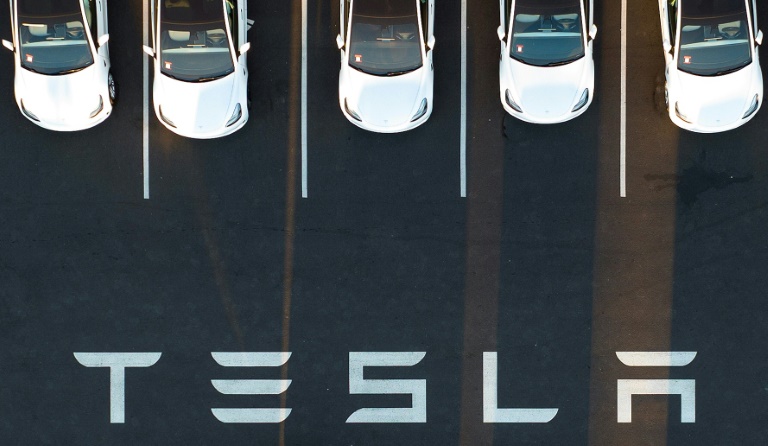
US electric car maker Tesla is studying the possibility of building a lithium refinery in Texas and is seeking tax breaks from the state to complete the project, according to documents made public Friday. 

While the project is only in the feasibility stage, Tesla said the factory on the Gulf coast would be the first of its kind in North America, producing an element critical to the batteries used in the growing EV market. 

In an application sent to the Texas Comptroller at the end of August and made public on Friday, Tesla said the plant “will process raw ore material into a usable state for battery production.”

The finished product, battery-grade lithium hydroxide, would be shipped by road and rail to various Tesla battery plants throughout the country. 

Construction could begin by the end of the year with production staring by the end of 2024. 

The company led by billionaire Elon Musk stressed that “Tesla is still evaluating the feasibility of this project” which is in a “very preliminary” phase, so no contracts have been signed and no permits have been issued for construction.

The decision to go ahead “will be based on a number of commercial and financial considerations, including the ability to obtain relief regarding local property taxes,” the document said.

The cost of the project has not been quantified.

Tesla also is studying the possibility of building a similar site in the state of Louisiana as an alternative. 

Tesla’s proposed project comes amid soaring lithium prices due to strong demand for the component, essential for making electric batteries. 

Musk complained about the rising costs in a tweet in April, and hinted at the possibility of moving into production. 

“Price of lithium has gone to insane levels! Tesla might actually have to get into the mining & refining directly at scale, unless costs improve,” he said on Twitter. 

China, Australia, Chile and Argentina, where the world’s largest lithium resources are located, dominate the market for the production and exploitation of this highly coveted mineral.

King Charles III faces 'testing times'

Trained from childhood to be king, Charles III has endured the longest wait for the throne in British history — and has the toughest of acts to follow.

His mother, Queen Elizabeth II, was crowned in 1953 with huge fanfare and national excitement aged just 25, and in the ensuing years earned the love and respect of millions worldwide.

But after 73 years as her understudy, Charles’s reign risks paling in comparison.

“It will be very difficult for him in terms of following the queen,” said Robert Hazell, founder of the Constitution Unit at University College London.

“The monarchy is likely to go through, I think, some testing times,” he told AFP.

For decades, Charles was defined by his marriage in 1981 to Diana, the mother of their two sons William and Harry. The union began as a fairy tale before collapsing very publicly, with both sides admitting infidelity.

After her death in a car crash in Paris in 1997, there was an outpouring of public grief and anger — much of it directed at Charles.

But there has been a gradual acceptance of his relationship with his long-term lover Camilla Parker Bowles, whom he married in 2005.

Charles has also been known for his outspoken comments on topics from farming to modernist architecture, and often faced mockery and accusations of meddling, even if his environmental concerns have now become mainstream.

Huge crowds turned up at Buckingham Palace Friday to see Charles arrive, although military veteran Michael Hull, 82, complained: “I don’t like a ruler that talks to trees.”

– Scrupulously neutral –

As king, Charles will have to change to be “scrupulously neutral”, said Hazell.

The new king has made clear he will have to stop his public campaigning, telling the BBC in 2018: “I’m not that stupid.”

But neutrality could prove difficult in Scotland, where nationalists are pushing for another referendum on independence to break up the United Kingdom, while saying they would keep the monarchy. 

However, Hazell also praised Charles’s “very strong sense of public service and public duty”. 

“I think that will carry him in very good stead when he becomes king.”

Opinion polling by YouGov shows the prospect of Charles as monarch divides British public opinion almost equally.

In 2022, just under a third of respondents said he would not make a good king, while almost exactly the same proportion said he would.

By contrast, over 80 percent say the queen has done a fairly good or very good job.

Support for a republic has stood at a meagre 15 percent in the past two years.

But the pressure group Republic began a billboard campaign in mid-2021 calling for the abolition of the monarchy.

Chief executive Graham Smith predicted Charles’s accession would be “a major turning point”, with Barbados already ditching the UK monarchy in November 2021 and Australia now under a pro-republic government.

“He’s not protected by the almost impenetrable shield of deference that surrounds the queen,” Smith said.

One recurrent call heard from some of the public is for Charles to abdicate in favour of his 40-year-old son William. 

Hazell said while Elizabeth II would never have abandoned her pledge of lifetime service, Charles could “conceivably” do so.

There is precedent in Europe: Belgium’s king Albert stood down in 2013, at 79, in favour of his son, as did Juan Carlos I of Spain, the following year.

– Slimming down –

With public scrutiny of royal finances increasing, Charles reportedly wants to reduce the number of royals on official duties — now around a dozen. 

Limiting royal roles is not primarily about saving money, but reducing the risk that “one of them will go off the rails”, Hazell said.

Prince Harry has already moved to California with his American wife Meghan. Charles’s brother Prince Andrew stepped down because of a furore over his friendship with the convicted sex offender Jeffrey Epstein.

The mixed-race Meghan complained in a sensational Oprah Winfrey interview that the couple’s son Archie had not received the title “prince”.

She linked this to the slimming down, but also said that one royal had made a racist remark before Archie’s birth.

– ‘No discrimination’ –

“There’s been no change that I know of to the rules, there’s been no discrimination against Harry,” Hazell said. 

Charles does now have the monarch’s ability to confer titles, including whether to make William the prince of Wales — the title he held since 1958.

The Sun tabloid reported that Charles does not plan to make his youngest brother Edward the duke of Edinburgh, even though it was his late father’s wish.

But in one of her last decisive acts over the succession, the queen settled the issue about what Charles’s wife Camilla would be called, giving her blessing for “queen consort”.

Close Bitnami banner
Bitnami