World

European stocks, euro tumble as Russia fuels energy crisis

European stocks tumbled Monday and the euro hit a new 20-year dollar low on energy crisis fears, after Russia said it would not restart gas flows to Germany and effectively most of the continent.

Natural gas prices spiked almost a third, while oil rallied on expectations OPEC and its Russia-led allies could decide at a meeting Monday to lower crude output in a bid to lift prices.

Europe’s fast-moving gas crisis sent Frankfurt equities slumping more than three percent before trimming losses, while Paris shed two percent at one stage.

London stocks also lost ground before the much-anticipated announcement of Britain’s next prime minister at around 1130 GMT.

– ‘Weaponization of energy’ –

“Russia’s ongoing weaponization of energy supplies continues to increase downside risks for European economies and the euro,” said Lee Hardman, currency analyst at financial services group MUFG. 

The euro sank Monday to $0.9878, its lowest since December 2002, despite expectations the European Central Bank will hike interest rates again Thursday to combat soaring inflation.

The shared eurozone unit has collapsed by about 13 percent against the dollar since the start of the year, hit also by the US Federal Reserve’s more aggressive monetary tightening.

State gas giant Gazprom announced late Friday the key Nord Stream pipeline would remain shut indefinitely, blaming leaks.

Gazprom’s announcement came the same day as the G7 nations said they would work to quickly implement a price cap on Russian oil exports, a move that would starve the Kremlin of critical revenue for its war on Ukraine.

Resumption of deliveries via the pipeline, which runs from near Saint Petersburg to Germany under the Baltic Sea, had been due to resume on Saturday after what Gazprom had described as three days of maintenance work.

– ‘Grim shadow before winter’ –

The news intensified an energy crisis caused by Europe’s sanctions on Moscow for its invasion of Ukraine in February.

Investors are fearful of an energy supply crunch during the peak-demand northern hemisphere winter.

That could potentially lead to a painful recession.

“Russia’s decision to turn off Europe’s gas hangs over the continent like a grim shadow ahead of winter,” said AJ Bell investment director Russ Mould.

At the same time, governments worldwide are grappling with the impact of rocketing domestic energy costs.

Germany on Sunday unveiled a new 65-billion-euro ($65-billion) package to help households cope with soaring prices, and eyed windfall profits from energy companies to help fund the move.

That took Berlin’s total relief to almost 100 billion euros since the start of the Ukraine war.

Elsewhere on Monday, Asian bourses experienced mixed trade as last week’s upbeat US jobs report partly offset fears over Europe’s outlook — and China’s new Covid lockdowns.

– Key figures at around 1000 GMT –

London – FTSE 100: DOWN 0.6 percent at 7,234.88 points

Frankfurt – DAX: DOWN 2.3 percent at 12,747.73

Paris – CAC 40: DOWN 1.6 percent at 6,071.27

EURO STOXX 50: DOWN 1.9 percent at 3,478.13

Tokyo – Nikkei 225: DOWN 0.1 percent at 27,619.61 (close)

Hong Kong – Hang Seng Index: DOWN 1.2 percent at 19,225.70 (close)

Shanghai – Composite: UP 0.4 percent at 3,199.91 (close)

New York – Dow: DOWN 1.1 percent at 31,318.44 (close)

Euro/dollar: DOWN at $0.9927 from $0.9954 on Friday

Dollar/yen: UP at 140.43 yen from 140.20 yen

Pound/dollar: UP at $1.1515 from $1.1509

Euro/pound: DOWN at 86.20 pence from 86.48 pence

West Texas Intermediate: UP 2.7 percent at $89.17 per barrel

Brent North Sea crude: UP 2.7 percent at $95.52 per barrel

burs-rfj/bcp/cdw
UN warns famine 'at the door' in Somalia

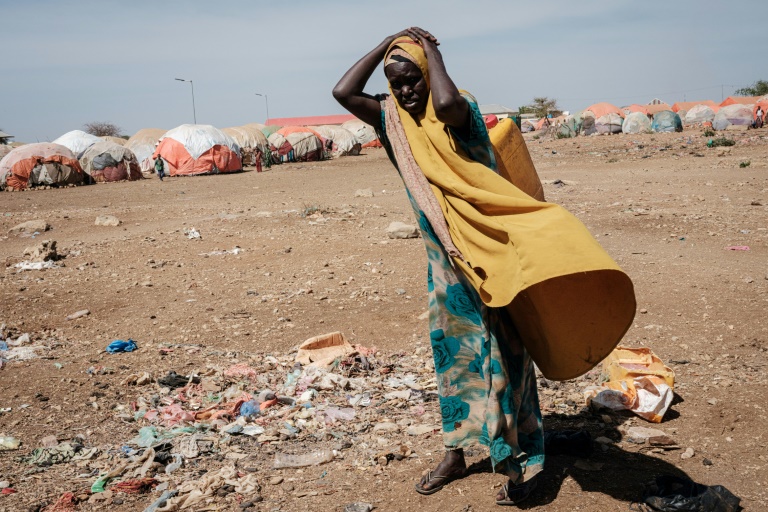
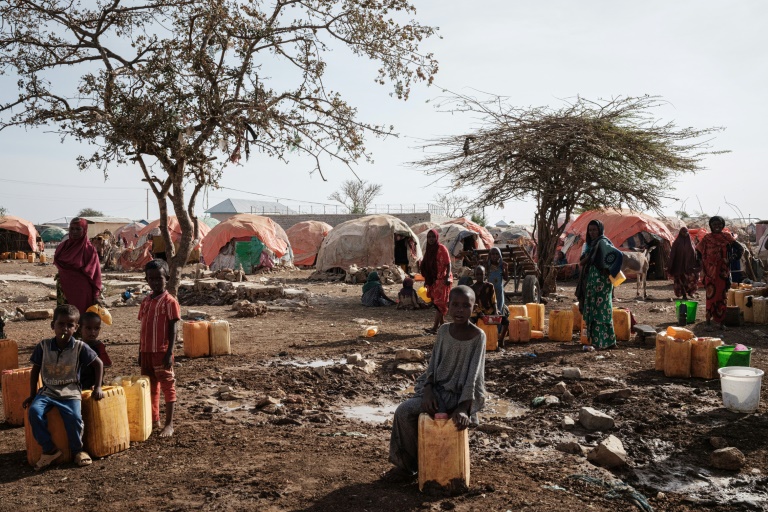
The UN’s humanitarian chief warned Monday that drought-ravaged Somalia was on the brink of famine for the second time in just over a decade, and time was running out to save lives.

“Famine is at the door and we are receiving a final warning,” Martin Griffiths told a press conference in the Somali capital Mogadishu. 

A food and nutrition report due for release on Monday has “concrete indications” that famine will strike the regions of Baidoa and Burhakaba in south-central Somalia between October and December, Griffiths said. 

“I’ve been shocked to my core these past few days by the level of pain and suffering we see so many Somalis enduring,” said the head of the UN Office for the Coordination of Humanitarian Affairs (OCHA), who began a visit to the country on Thursday.

“The unprecedented failure of four consecutive rainy seasons, decades of conflict, mass displacement, severe economic issues are pushing many people to… the  brink of famine,” he said.   

“We are in the last moment of the 11th hour to save lives.”

Somalia and its neighbours in the Horn of Africa including Ethiopia and Kenya are in the grip of the worst drought in more than 40 years after four failed rainy seasons wiped out livestock and crops.

Humanitarian agencies have been ringing alarm bells for months and say the situtuation is likely to deteriorate with a likely fifth failed rainy season in the offing.

Griffiths said the situation was worse in Somalia than during the last famine in 2011 when 260,000 people, more than half of them children under the age of six. 

The UN’s World Food Programme (WFP) last month said the number of people at risk of starvation across the Horn had increased to 22 million.

In Somalia alone, the number of people facing crisis hunger levels is 7.8 million, or about half the population, while around a million have fled their homes on a desperate quest for food and water, UN agencies say. 

Griffiths described scenes of heart-rending suffering during a visit to Baidoa, describing it as the epicentre of the crisis where he saw “children so malnourished they could barely speak” or cry.

– ‘Beyond breaking point’ –

Conflict-wracked Somalia is considered one of the most vulnerable to climate change but is particularly ill-equipped to cope with the crisis.

A deadly insurgency by the radical Islamist Al-Shabaab group for more than a decade and a half against the fragile federal government is limiting humanitarian access to many areas.

A long-running political crisis also diverted attention away from the drought, but new President Hassan Sheikh Mohamud used his inauguration speech in June to appeal for international help to stave off disaster.

In recent years, increasingly extreme droughts and floods have added to the devastation caused by a locust invasion and the Covid-19 pandemic.

“Somalia is facing unprecedented levels of drought which have particularly hit rural communities, alongside other impacts like conflict, Covid-19, macroeconomic challenges, and a recent desert locust upsurge,” the UN’s Food and Agriculture Organization (FAO) said in a statement on Friday. 

It said people’s means to produce food and earn income were “stretched beyond breaking point”.

The UN’s World Meteorological Organization (WMO) has said the Horn was likely facing a fifth straight failed rainy season over the months of October to December.

– ‘Sleepwalking’ to catastrophe – 


At the start of this year, the WFP had put the number of people facing hunger across the Horn at 13 million, and appealed for donors to open their wallets.

Funds were initially slow in coming, with Russia’s invasion of Ukraine among other crises drawing attention from the disaster in the Horn, humanitarian workers said.

The war in Ukraine has also sent global food and fuel prices soaring, making aid delivery more expensive.

In June, British charity Save the Children had issued an alert that the international community was “sleepwalking towards another catastrophic famine” in Somalia.

OCHA has said the March-May 2022 rainy season was the driest on record in the last 70 years, and 2020-2022 had surpassed “the horrific droughts in both 2010-2011 and 2016-2017 in duration and severity”.

“An estimated 2.3 million girls and boys are at imminent risk of violence, exploitation, abuse, neglect, and death from severe acute malnutrition as result of food and nutrition crisis across Somalia,” it said in August.

In 2017, more than six million people in Somalia, more than half of them children, needed aid because of a prolonged drought across East Africa.

But early humanitarian action averted famine that year.

ECB poised for big rate hike in face of record inflation

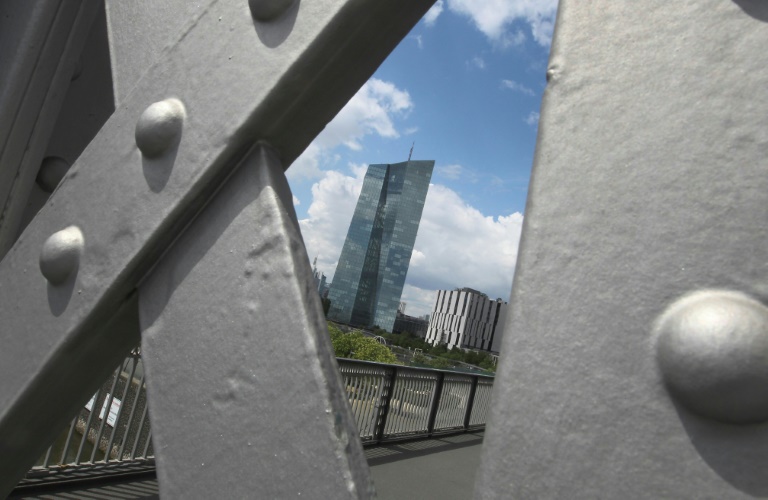
After raising interest rates for the first time in over a decade at their last meeting, European Central Bank policymakers are poised to deliver another bumper hike on Thursday in a show of determination to tame soaring inflation.

Steep increases in the price of energy in the wake of the Russian invasion of Ukraine have heaped pressure on households and sent the pace of consumer price rises to new highs. 

Eurozone inflation hit 9.1 percent in August, a record in the history of the single currency and well above the two-percent rate targeted by the ECB.

Meanwhile on Monday, the euro fell to a 20-year low against the dollar Monday, dropping below $0.99 as fears of a eurozone recession grew.

The ECB was unlikely to raise its rates “with the explicit goal of strengthening the currency”, said Frederik Ducrozet, head of macroeconomic research at Pictet, but the euro’s struggles against the greenback could “have some bearing on its decision-making”.

The Frankfurt-based institution is playing catch-up with other central banks in the United States and Britain that started raising rates harder and faster in response to inflation.

The “only question” for the ECB’s meeting this week was “whether it will be a 50 or 75 basis point hike,” said Carsten Brzeski, head of macro at the ING bank.

– ‘Determination’ –

Speaking at the annual Jackson Hole central banking symposium at the end of August, ECB board member Isabel Schnabel said the central bank needed to show “determination” to tame price rises.

Under this approach, the central bank would respond “more forcefully to the current bout of inflation, even at the risk of lower growth and higher unemployment”, she said.

In her speech in the US, Schnabel stressed the need for the people to “trust” that the ECB will restore their purchasing power.

The ECB’s 25-member governing council surprised with a 50-basis-point hike at its last meeting in July, bringing an end to eight years of negative interest rates in one fell swoop.

So-called forward guidance issued by the ECB, which limited its scope for action, has been ditched. Policymakers would now take their decisions “meeting-by-meeting”, the ECB President Christine Lagarde announced in July.

With that, the door has been opened for the ECB to follow in the footsteps of the US Federal Reserve and raise rates by a 75 basis points.

Following August’s red-hot inflation numbers, the influential head of the German central bank, Joachim Nagel, said the ECB needed a “strong rise in interest rates in September”.

– ‘Steady pace’ –

“Further interest rate steps are to be expected in the following months,” the Bundesbank president predicted.

But the ECB’s chief economist, Philip Lane, has counselled colleagues to follow a “steady pace” of interest rate rises.

Hiking at a rate that was “neither too slow nor too fast” was important due to the “high uncertainty” around the economy and the future path of inflation.

Alongside its policy decisions, the ECB will also share an updated set of economic forecasts for the eurozone.

In its last estimates, published in June, the ECB said it expected inflation to sit at 6.8 percent in 2022 before falling to 3.5 percent next year, while growth would slow from 2.8 percent this year to 2.1 in 2023.

But a more severe energy shock as Russia reduces gas deliveries to Europe could push the eurozone into a “deeper winter recession” and hold growth to zero percent in 2023, said Ducrozet.

At the same time, the soaring cost of energy would drive inflation close to double digits by the end of the year, he predicted.

The ECB had “no choice but to commit to faster monetary tightening as long as inflation keeps rising” even as a recession loomed, said Ducrozet. 

Police in Argentina arrest companion of Kirchner attacker: media

Argentine police arrested on Sunday a companion of the man who attempted to shoot Vice President Cristina Kirchner after the politician’s lawyers said the assailant “didn’t act alone,” local media reported.

Scandal-tainted Kirchner, 69, survived the assassination attempt as she mingled with supporters outside her home on Thursday night, when a gun brandished by Fernando Andre Sabag Montiel failed to fire.

Video footage showed Brenda Uliarte, 23, in the company of attacker Sabag Montiel on the day of the attack, local media said, citing sources close to the investigation. 

Kirchner enjoys a loyal support base among followers of the center-left Peronism movement inherited from former president Juan Peron, but is disliked in equal measure by the political opposition.

Tens of thousands of Argentines took to the streets to denounce political violence after the shooting attempt. 

Uliarte was arrested under a warrant issued by the magistrate in charge of the investigation, according to judicial sources cited by local media, including the official Telam news agency.

She had said in an interview with local television channel Telefe that she had been living with Sabag Montiel for more than a month but had not seen him in the 48 hours before the incident. 

She also expressed shock that her friend had attempted to kill the vice president. 

“To tell the truth, I don’t remember any mention of the vice president. He was complaining about the dollar and the economy, like everyone else,” she told Telefe.

Sabag Montiel, 35, a Brazilian national who has been living in Argentina since his youth, has not told investigators what his motivations were.

“He didn’t act alone because there were preparatory actions to the assassination attempt,” Kirchner’s lawyer Gregorio Dalbon told C5N television station, without offering further details.

“There were, without a doubt, other people who were aware of this situation.”

– Intended to kill –

Kirchner, who is currently on trial for corruption and accused of accepting bribes in her Patagonian stronghold, was greeting supporters outside her Buenos Aires home when Sabag Montiel pointed a gun at her head from within the crowd.

For reasons as yet unknown, the weapon did not go off despite being fired, President Alberto Fernandez said shortly after the incident, which led to messages of support from the Pope, the UN, United States and Latin American leaders.

The attacker was arrested on the spot and the entire incident caught on camera. 

Kirchner’s lawyer has said he would also like investigators to interview a man named “Mario”, who has identified himself as the attacker’s friend.

Shortly after the attack, Mario had told a television channel that he had been friends with Sabag Montiel since they were teenagers and that he was “sure that his intention was to kill” Kirchner.

He also said he had not seen Sabag Montiel in 10 months, the period in which the would-be killer had sought to acquire a gun.

Sabag Montiel had previously been arrested on March 17, 2021, for carrying a knife, but the case was later closed. 

In photos on his Instagram account, he appears to bear numerous tattoos. Some — like one of a black sun and another resembling the Iron Cross — are associated with Nazi symbolism.

“I can say upfront that there are more people involved,” the lawyer Dalbon said, adding that “they are not public personalities, they are like this boy.” 

Australia, New Zealand exempt from Solomons naval ban

Australia and New Zealand are exempt from a ban on foreign naval visits to Solomon Islands, the country’s prime minister said Monday as he flagged an end to the moratorium.

Prime Minister Manasseh Sogavare said a review of the makeshift ban was “progressing very well. We do not expect the temporary moratorium to last for a long time”.

Solomon Islands suspended visits from all foreign navies last week, citing a need to review approval processes, after a US coast guard was unable to refuel at its port. 

But when questioned in parliament on Monday, Sogavare said that the pause did not apply to military ships involved in the Solomons International Assistance Force — which includes Australia, New Zealand, Fiji and Papua New Guinea.

Vessels deployed as part of this mission — established after deadly riots in Honiara late last year — will be granted exemptions, he said. 

He also said vessels taking part in planned illegal fishing patrols, or responding to direct requests for assistance from the Solomons, could be allowed to dock during the moratorium.

Two weeks ago, US Coast Guard ship Oliver Henry opted to turn away from Honiara, capital of the Solomons, after a lengthy delay in reply to their request to dock.

The HMS Spey, a British naval patrol vessel, also left Solomons waters before getting a late answer to their docking request.

When asked about the Oliver Henry incident, Sogavare said it had not been refused permission but instead opted to leave “prior to being informed of approval” to dock.

He said the “temporary” ban was because the Pacific nation had seen “a sudden increase” in requests for visits by military vessels.

“In many cases, service requests are made at short notice and there is expectation that all requests will always be approved,” Sogavare said.

“Each request needs proper assessment, including of the benefits and risks to Solomon Islands.”

He told parliament the review was nearly complete.

Sogavare has deepened his South Pacific nation’s ties with China, and faced street protests against his decision to switch diplomatic recognition from Taipei to Beijing.

After widespread rioting in Honiara and demands for his ouster last year, his government signed a secretive defence pact with Beijing that — according to a leaked draft — allows him to call in Chinese security forces to quell unrest.

Last month, Sogavare’s office accused Western media organisations in the Solomons of “spreading anti-China sentiment”.

A statement issued by the office threatened to ban or deport reporters for “disrespectful and demeaning” coverage and said some foreign media were trying to “engineer regime change”.

Germany, Israel mark 50 years since Munich Olympics massacre

Germany and Israel’s presidents will on Monday lead commemorations marking 50 years since the Munich Olympics attack, with hopes that a long-awaited compensation deal for bereaved families will finally help them begin healing from the painful episode.

A row over the financial offer previously made by Berlin to victims’ relatives had threatened to sour the ceremony, with family members planning a boycott. 

But a deal was finally agreed last Wednesday for Berlin to provide 28 million euros ($28 million) in compensation. It also — for the first time — saw the German state acknowledge its “responsibility” in failings that led to the deaths of 11 Israelis.

Germany’s President Frank-Walter Steinmeier admitted Sunday it was “shameful” that it had taken such a long time for Berlin to reach the agreement with victims’ families.

“For far too long, we have refused to acknowledge the pain of the bereaved,” said Steinmeier at a state banquet for his Israeli counterpart Isaac Herzog.

“And for far too long, we have not wanted to acknowledge that we also bear our share of responsibility. It was up to us to ensure the safety of the Israeli athletes,” he said, on the eve of the commemorations at Fuerstenfeldbruck airbase where the hostage-taking reached its tragic climax.

At a separate ceremony on Monday morning at the Olympic village where the Israeli team was staying, Munich mayor Dieter Reiter apologised for the “momentous mistakes” made by those responsible for the Games.

“I am sorry for that and I apologise for the fact that after the attack, what would have been demanded by humanity was simply not done — admitting the mistakes and taking responsibility for them.” 

– ‘No minimal effort’ –

On September 5, 1972, eight gunmen of the Palestinian militant group Black September stormed into the Israeli team’s flat at the Olympic village, shooting dead two and taking nine Israelis hostage.

West German police responded with a bungled rescue operation in which all nine hostages were killed, along with five of the eight hostage-takers and a police officer.

The Games were meant to showcase a new Germany 27 years after the Holocaust but instead opened a deep rift with Israel. 

In 2012, Israel released 45 official documents on the killings, including specially declassified material, which lambasted the performance of the German security services.

Included in the reports is an official account from the former Israeli intelligence head Zvi Zamir who said the German police “didn’t make even a minimal effort to save human lives”.

– ‘Inhuman and incomprehensible’ –

Bereaved relatives have over the years battled to obtain an official apology from Germany, access to official documents and appropriate compensation beyond an initial 4.5 million euros.

As recently as just two weeks ago, relatives of the victims said they were offered 10 million euros — including the sum that had already been given.

Ankie Spitzer, whose husband Andre Spitzer was killed in the hostage-taking, had called the previous offer “insulting”.

“I came home with the coffins after the massacre,” she told AFP. “You don’t know what we’ve gone through for the past 50 years.”

Herzog underlined the pain faced by the grieving relatives, saying they simply “hit a wall” whenever they tried to raise the issue with Germany or even with the International Olympic Committee. 

“I think there was tragic suppression here,” he said, noting the litany of failings that were “inhuman and incomprehensible” such as “the fact that the hostages were being led to slaughter and the Games went on”.

After an initial suspension, then-IOC president Avery Brundage had declared that “the Games must go on”.

Herzog voiced hope that the agreement would bring “this painful episode to a place of healing”. 

“I hope that from now on, we shall continue to remember, invoke, and most importantly reaffirm the lessons of this tragedy, including the importance of fighting terror, for future generations,” said the Israeli president.

Dying of hunger: What is a famine?

On Monday, the UN’s humanitarian chief Martin Griffiths warned that Somalia was on the brink of famine for the second time in just over a decade.

Here is an exploration of a term that evokes the very worst of human suffering.

– What is a famine? –

“Famine” is a word freighted with dread of hunger and privation, dating back to the dawn of humanity.

More recently, though, it has been codified scientifically to help policymakers and focus humanitarian aid.

Since 2004, global agencies are supposed to only use the term according to the Integrated Food Security Phase Classification (IPC) scale.

Famine is the fifth and highest phase of the scale, with the IPC defining it as “an extreme deprivation of food”.

“Starvation, death, destitution and extremely critical levels of acute malnutrition are or will likely be evident.”   

According to the IPC scale, famine exists when at least 20 percent of households in a specific area have extremely limited access to basic food; at least 30 percent of children suffer from acute malnutrition; and two people out of every 10,000 die each day “due to outright starvation or to the interaction of malnutrition and disease”.

– Where have famines occurred? –

Over the last century, famines hit China, the Soviet Union, Iran and Cambodia, often the result of human actions.

Europe suffered several famines in the Middle Ages, but its most recent were during World War I and II, where parts of Germany, Poland and the Netherlands were left starving under military blockades.

In Africa there have been several famines in recent decades, from Biafra in Nigeria in the late 1960s to the 1983-1985 Ethiopian famine, which ushered in a new form of celebrity fundraising and unprecedented media attention on the suffering.

The last time famine was declared was in South Sudan in 2017 in Leer and Mayendit counties, areas that have often been a flashpoint for violence.

In Somalia, famine in 2011 in southcentral areas of the country killed an estimated 260,000 people, half of them children under the age of six. 

Griffiths, the head of the UN Office for the Coordination of Humanitarian Affairs (OCHA), said Monday that famine was likely in two areas of south-central Somalia, Baidoa and Burhakaba, between October and December.

– What are the causes? –

Throughout history, famines have generally been caused by human action, usually wars which ravage crops and livestock, ruin trade, displace people and complicate the distribution of aid. 

Famine “represents a failure on the part of many parties,” said Daniel Maxwell, professor of food security at Tufts University in the United States, told AFP.

“Currently in famine-risk areas (Somalia, Ethiopia, South Sudan, Yemen, northeastern Nigeria), violent conflict is the common denominator, but climate factors are playing an increasing role,” Maxwell said. 

“Even in the context of violent conflict, drought has been a factor in all recent famines in Somalia.”

An arid country whose impoverished population depends on livestock and agriculture, Somalia is considered one of the regions most vulnerable to climate change. 

In recent years, increasingly extreme droughts and floods have added to devastation caused by a locust invasion and the Covid-19 pandemic, as well as instability fuelled by a jihadist insurgency.

– How does famine kill? –

When lack of food has led to an 18 percent loss of weight, the body starts undergoing physiological disturbances, according to a 1997 study of hunger strikes published in the British Medical Journal (BMJ).

When people have insufficient food over several weeks, it leads to organ failure and eventually death.

“In most contemporary famines, most people don’t literally starve to death,” said Maxwell.

“In crowded conditions, killer diseases like cholera or measles are more frequently the actual cause of death, especially of young children. Unfortunately, we have already seen outbreaks of both cholera and measles in Somalia this year.”

Lack of food weakens the immune system, making the body more vulnerable to disease, while those displaced by drought often live in makeshift camps, with poor hygiene and limited access to drinking water.

“Between starvation and death, there is nearly always disease,” the World Health Organization (WHO) has said.

Hunger leads to stunted growth and impacts cognitive development, and can lead to poor health throughout a person’s life.

Even without reaching famine, parts of Africa go through regular cycles of hunger that have long-term social consequences.

Turkey's inflation stays at 80% in boost to Erdogan

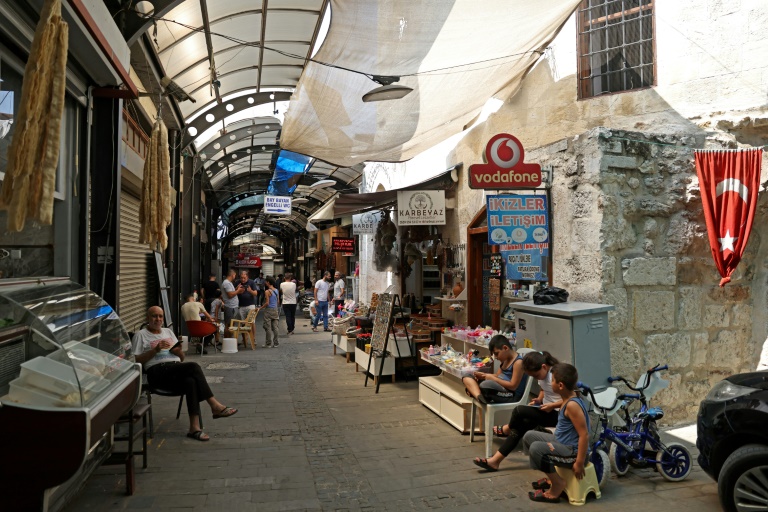
Turkey’s official inflation rate barely changed on Monday in a sign that a year-long crisis that has seen prices soar by 80 percent may finally be starting to ease.

The TUIK state statistics agency said that consumer prices rose by 80.2 percent in August from a year earlier.

The figure was fractionally higher than the 79.6 percent reported in July and only a small bump up from the 78.6 percent reading in June.

Turkey’s prices have been steadily rising since a low of 16.6 percent in May 2021.

The strategically important developing nation lurched into its latest economic crisis when President Recep Tayyip Erdogan launched an unorthodox experiment that attempted to fight inflation by lowering the main interest rate.

Conventional economic theory embraced by almost every other big nation pursues the exact opposite approach.

But Erdogan argues that higher interest rates contribute to price increases by making borrowing more expensive for businesses.

The president also says that charging interest violates Islamic rules against usury.

The central bank said over the weekend it expects the inflation rate to fall to 65 percent by the end of the year.

Erdogan himself says prices will only start falling in January.

The crisis has seen the ruling party’s approval ratings drop to historic lows heading into the next general election due by June 2023.

– ‘Wishful thinking’ –

The increases were led by a 117-percent jump in the cost of transportation and a rise of more than 90 percent in the price of food and household goods.

Erdogan’s government attributes inflation to outside factors such as the global spike in food and energy prices caused by Russia’s invasion of Ukraine.

But analysts blame Erdogan’s own government for pushing ahead with policies that have devalued the lira by more than 50 percent in 12 months.

That has made energy imports even more expensive and forced Turkey to strike deals with former regional rivals in a bid to prop up its depleting hard currency reserves.

It has also prompted Turks to buy even more dollars in a bid to preserve their eroding saving — a vicious circle that analysts warn can only be broken with sharp interest rate hikes.

None appears to be in the offing.

The central bank stunned the markets by actually lowering its main interest rate to 13 percent from 14 percent last month.

Erdogan has redoubled down on his economic rhetoric heading into election season and analysts fear that the policy rate is more likely to go down than up in the coming months.

“It seems that further interest rate cuts are more likely than not later this year,” Capital Economic said in a research note issued after the inflation report.

Some analysts and opposition leaders also question the accuracy of Turkey’s official economic readings.

Istanbul last week reported a 100-percent annual jump in prices.

Economists say the difference in inflation reported by Turkey’s largest city and the national figure — now at 20 percentage points — has never been higher.

They also point out that Erdogan has stacked most state institutions with allies while Istanbul is led by an opposition party mayor.

“I no longer believe the official (inflation) series,” said emerging market economic Timothy Ash of BlueBay Asset Management in London. 

“It looks like fantasy, wishful thinking.”

Famine 'at the door' in Somalia: UN humanitarian chief

The UN’s humanitarian chief warned on Monday that drought-ravaged Somalia was on the brink of famine and time was running out to save lives.

“Famine is at the door and we are receiving a final warning,” Martin Griffiths, head of the UN’s Office for the Coordination of Humanitarian Affairs (OCHA), told a press conference in Mogadishu.

“We are in the last moment of the 11th hour to save lives,” he declared.

An upcoming food and nutrition report on Somalia has concrete evidence that famine will strike two regions between October and December, Griffiths said. 

“I’ve been shocked to my core these past few days at the level of pain and suffering we see so many Somalis enduring,” said Griffiths, who began a visit to the country on Thursday.

Somalia and its neighbours in the Horn of Africa including Ethiopia and Kenya are in the grip of the worst drought in more than 40 years following four failed rainy seasons that have wiped out livestock and crops.

Humanitarian agencies have been ringing alarm bells for months.

The UN’s World Food Programme (WFP) last month said the number of people at risk of starvation across the region had increased to 22 million.

In Somalia alone, the number of people facing crisis hunger levels is 7.8 million, or about half the population, while around a million have fled their homes on a desperate quest for food and water, UN agencies say. 

In 2011, famine in parts of Somalia, one of the poorest countries on the planet, cost the lives of 260,000 people, more than half of them children under the age of six. 

Griffiths described scenes of heart-rending suffering during his visit to Baidoa, one of the two areas at risk of famine, saying he saw “children so malnourished they could barely speak” or cry.

– ‘Unprecedented drought’ –

The conflict-wracked country is considered one of the most vulnerable to climate change but is particularly ill-equipped to cope with the crisis.

A deadly insurgency by the radical Islamist Al-Shabaab group against the fragile federal government is limiting humanitarian access to many areas.

A long-running political crisis also diverted attention away from the drought, but new President Hassan Sheikh Mohamud used his inauguration speech in June to appeal for international help to stave off looming disaster.

In recent years, increasingly extreme droughts and floods have added to the devastation caused by a locust invasion and the Covid-19 pandemic.

“Somalia is facing unprecedented levels of drought which have particularly hit rural communities, alongside other impacts like conflict, Covid-19, macroeconomic challenges, and a recent desert locust upsurge,” the UN’s Food and Agriculture Organization (FAO) said in a statement on Friday. 

It said people’s means to produce food and earn income were “stretched beyond breaking point”.

The UN’s World Meteorological Organization (WMO) has said the Horn was likely facing a fifth straight failed rainy season over the months of October to December.

– ‘Sleepwalking’ to catastrophe – 


At the start of this year, the WFP had put the number at 13 million, and appealed for donors to open their wallets at a time of great need.

Funds were initially slow in coming, with Russia’s invasion of Ukraine among other crises drawing attention from the disaster in the Horn, humanitarian workers said.

The war in Ukraine has also sent global food and fuel prices soaring, making aid delivery more expensive.

In June, British charity Save the Children had issued an alert that the international community was “sleepwalking towards another catastrophic famine” in Somalia.

OCHA has said the March-May 2022 rainy season was the driest on record in the last 70 years “making the 2020-2022 surpass the horrific droughts in both 2010-2011 and 2016-2017 in duration and severity”.

“An estimated 2.3 million girls and boys are at imminent risk of violence, exploitation, abuse, neglect, and death from severe acute malnutrition as result of food and nutrition crisis across Somalia,” it said in August.

In 2017, more than six million people in Somalia, more than half of them children, needed aid because of a prolonged drought across East Africa.

But early humanitarian action averted famine that year.

The Inter-Agency Standing Committee chaired by Griffiths brings together the heads of 18 organisations inside and outside the UN.

China accuses US of 'tens of thousands' of cyberattacks

Beijing on Monday accused the United States of launching “tens of thousands” of cyberattacks on China and pilfering troves of sensitive data, including from a public research university.

Washington has accused Beijing of cyberattacks against US businesses and government agencies, one of the issues over which ties between the two powers have nosedived in recent years.

China has consistently denied the claims and in turn lashed out against alleged US cyber espionage, but has rarely made public disclosures of specific attacks.

But a report released Monday by its National Computer Virus Emergency Response Center (CVERC) accused the US National Security Agency (NSA) of carrying out “tens of thousands of malicious attacks on network targets in China in recent years”.

It specifically accused the NSA’s Office of Tailored Access Operations (TAO) of infiltrating the Northwestern Polytechnical University in the city of Xi’an.

The university is funded by China’s Ministry of Industry and Information Technology, and specialises in aeronautical and space research.

CVERC alleged that TAO infiltrated the university’s networks and took “control of tens of thousands of network devices” including servers, routers and network switches.

Using dozens of cyber weapons and exploiting previously unknown flaws in the SunOS operating system, the unit gained access to “core technical data” including passwords and the operations of key network devices, the report said.

TAO has “stolen over 140 gigabytes of high-value data” in recent years and received assistance from groups in Europe and South Asia, CVERC said in the report, which was co-authored by the private Chinese cybersecurity firm Qihoo 360.

The foreign ministry in Beijing on Monday condemned the alleged hack, saying it “seriously endangers China’s national security and users’ personal data security”.

“We ask the US to provide an explanation and urge them to stop immediately this illegal move,” Mao Ning, a spokeswoman for the foreign ministry, said at a regular press conference.

The NSA did not immediately respond to an AFP request for comment.

In June, Xi’an authorities said they had launched an investigation into a reported cyberattack at Northwestern Polytechnical University that carried the hallmarks of “overseas hacking groups and unlawful elements”.

The attacks “caused significant risks and hidden dangers for normal work and life at our school”, a university cybersecurity official told state broadcaster CCTV in comments published on Monday.

Last year, Washington accused Beijing of carrying out a massive attack on Microsoft’s email software that affected at least 30,000 US organisations — including local governments — as well as customers in other countries.

China denied the allegations and countered that Washington was the “world champion” of cyber espionage.

Close Bitnami banner
Bitnami