AFP

Stocks and oil sink on recession fears

World stock markets mostly sank Thursday on intensifying recession fears, while oil prices receded after an OPEC decision to proceed with a limited boost to output.

London ended the day down two percent, with both Frankfurt and Paris close behind.

That followed a largely downbeat performance in Asia, although Shanghai rose after data showed a forecast-beating improvement in China’s services sector on easing Covid restrictions.

Wall Street’s main indices also fell, with the Dow down 0.9 percent in late morning trading.

Crude futures slumped as major oil producers led by Saudi Arabia and Russia kept to a decision on a limited boost to output despite the risk that high oil prices may help push the global economy into recession.

– ‘Terrible mood’ –

“Stock markets have fallen heavily in June so it seems only fitting that they’re ending the month with big losses as reality continues to bite,” said Craig Erlam, senior market analyst at trading platform OANDA.

Stock markets are “in a terrible mood across Europe”, said AJ Bell investment director Russ Mould.

“There really is a lack of good news for investors to cling onto, and the near-term outlook looks bleak.”

The threat of an extended period of elevated inflation and painful interest rate hikes has left traders fretting over the threat of a prolonged economic downturn, while the Ukraine war continues to sow uncertainty.

“Recession continues to be the primary concern at the moment… as countries continue to grapple with spiralling inflation and cost-of-living crises,” said Mihir Kapadia, head of Sun Global Investments.

The surge in inflation to multi-decade highs has forced central banks to swiftly raise interest rates, dealing a hefty blow to equities as companies faces higher borrowing costs.

The Federal Reserve is next month expected to announce a successive 75-basis-point hike in US interest rates.

Sweden’s central bank on Thursday announced its biggest hike in 22 years, raising its main rate by 50 basis points to 0.75 percent.

There had been hope that policymakers would ease off their hikes as economies show signs of slowing, but analysts say some officials are less concerned about a recession than letting prices run out of control.

– Risk of ‘going too far’ –

Fed boss Jerome Powell, speaking at a European Central Bank conference Wednesday, hinted again that such hikes could lead to economic contraction.

“Is there a risk that we would go too far? Certainly there’s a risk,” Powell said.

“The bigger mistake to make… would be to fail to restore price stability,” he insisted.

ECB President Christine Lagarde stated this week that the guardian of the euro would go “as far as necessary” to fight inflation that was set to remain “undesirably high” for “some time to come”.

US data released Thursday showed that a key annual inflation measure held steady at 6.3 percent in May, but real spending by consumers declined by 0.4 percent month-over-month.

Briefing.com analyst Patrick O’Hare said the decline “will fuel concerns about the Fed continuing to tighten into a slowing economic environment.”

– Key figures at around 1530 GMT –

New York – Dow: DOWN 0.9 percent at 30,754.90 points

EURO STOXX 50: DOWN 1.6 percent at 3,449.46

London – FTSE 100: DOWN 2.0 percent at 7,169.28 (close) 

Frankfurt – DAX: DOWN 1.7 percent at 12,783.77 (close)

Paris – CAC 40: DOWN 1.8 percent at 5,922.86 (close)

Tokyo – Nikkei 225: DOWN 1.5 percent at 26,393.04 (close)

Hong Kong – Hang Seng Index: DOWN 0.6 percent at 21,859.79 (close)

Shanghai – Composite: UP 1.1 percent at 3,398.62 (close)

Brent North Sea crude: DOWN 1.2 percent at $114.87 per barrel

West Texas Intermediate: DOWN 2.7 percent at $106.85 per barrel

Euro/dollar: DOWN at $1.0457 from $1.0442 Wednesday

Pound/dollar: UP at $1.2152 from $1.2124

Euro/pound: DOWN at 86.06 pence from 86.12 pence

Dollar/yen: DOWN at 135.89 yen from 136.59 yen

burs/rl/lth
Smugglers and shelters — San Antonio, hub city for US immigration

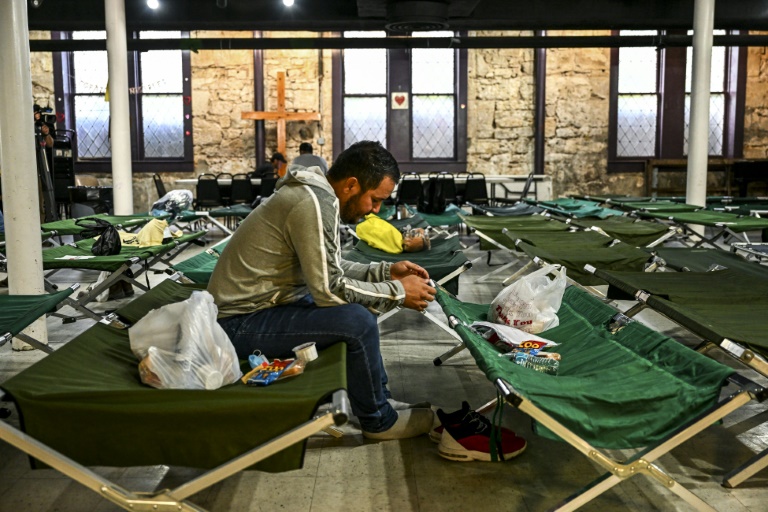
Dozens of migrants wait in line outside a shelter in San Antonio, most of them young men but also women and children, hoping for a hot meal and a roof over their head.

Every year thousands like them pass through this Texas city on the frontline of America’s struggle to cope with waves of migrants seeking to escape poverty and violence and find a better life in the United States.

The city is 240 kilometers (150 miles) from the border with Mexico and is often the first stop on an odyssey across the country as migrants fight to remain in America and settle down to a new life.

This week it was also the scene of a horrific discovery that laid bare the price that some pay — 53 people died after being left inside a big-rig truck abandoned next to train tracks and junk yards in San Antonio.

One of those waiting outside the shelter after putting up with hours in the rain is Edwin Sanchez, 42, a Venezuelan who left home on May 12 and has been in San Antonio for five days.

He hopes to make it soon to New York, where he says an acquaintance has promised him a job.

“We are hoping to get a little help,” Sanchez said.

He got through a border crossing despite Title 42, a Covid-era rule still in place under which people arriving at the border can be turned back without being able to apply for asylum.

The policy is applied unevenly: it is rarely used against people from Venezuela or Cuba, which have leftist governments seen by US officials as authoritarian, but it is often applied against Mexicans and Central Americans.

No matter how people get in, if they traveled through northeast Mexico there is a good chance they stop off in San Antonio.

– ‘At the crossroads’-  

The city has an airport, a bus station and is well connected to the rest of the country, said Roger Enriquez, a professor of criminology at the University of Texas, San Antonio.

“It is at the crossroads of two major highways: the I-10, which links California to Florida, and the I-35, which runs from the southern border in Laredo all the way to Minnesota in the north. It is the perfect place to stop over,” said Enriquez.

But the location also suits people-smugglers who take advantage of the fact that most of the population of San Antonio is Latino, so migrants being brought in illegally can blend in, said Enriquez.

As many arrive with little but the clothes on their back, charities try to help them.

One of them is Corazon (Heart) Ministries, which runs the night shelter that Edwin Sanchez was waiting to enter.

It opens every evening at 7:00 pm and closes the next day at 8:00 am, offering people dinner and a place to sleep, said director Monica Sosa.

As she speaks, shortly before opening time, volunteers set up cots with the red logo of the American Red Cross.

The shelter supposedly has room for 150 people but there are always more to take care of, some times as many as 400. Many migrants end up sleeping on the floor or in a nearby park.

“Our resources are very limited. We need more support,” said Sosa.

– A city of smugglers – 

Austin Hernandez, a 20 year old Honduran, has been in San Antonio for four days and has not yet managed to land a bed in the shelter.

He says he wished he could get more help but does not lose hope of making it to the state capital Austin, which is only 130 kilometers away.

“The trip was very hard. I was robbed, I begged for food in the streets. I have endured cold, rain and slept in the rough,” Hernandez said of his trek.

He said he made the trip without the help of smugglers known as coyotes. But often, facing tight security at the border, migrants do put their lives in the hands of traffickers.

The discovery Monday of the abandoned tractor trailer in San Antonio highlighted that clandestine trips are highly lucrative for smugglers.

“It is estimated that the coyotes can charge from $8,000 to $10,000 per person, and they can put as many as 100 people in a truck. That’s a million dollars,” said Enriquez.

“I am surprised there are not more tragedies due the danger and the risks these people are taking.”

Bullish Biden vows to stay course in Ukraine against Russia

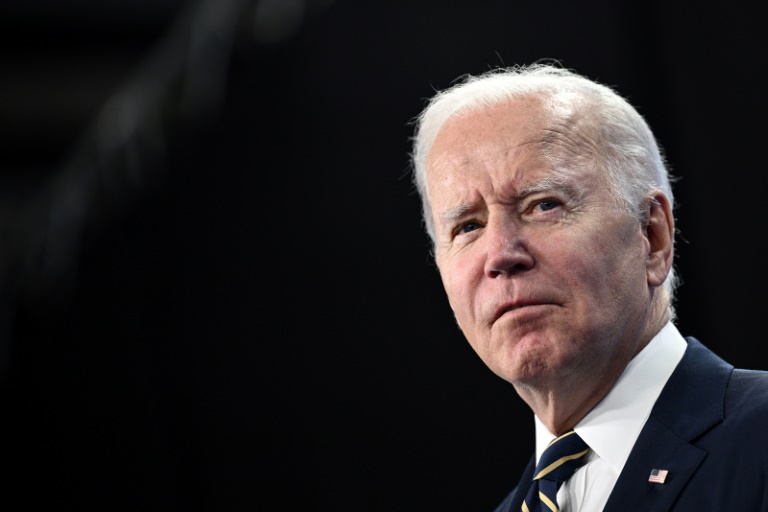
A bullish President Joe Biden on Thursday announced $800 million in new weapons for Ukraine and said the United States will support Kyiv “as long as it takes” in its war against Russia.

As Western-armed Ukrainian forces notched up a victory by recapturing strategic Snake Island in the Black Sea, and NATO leaders expressed strong unity during their Madrid summit, Biden made clear he intends to keep the pressure on President Vladimir Putin.

“Before the war started, I told Putin that if he invaded Ukraine, NATO would not only get stronger but would get more united,” an energised looking Biden told a press conference.

He spoke before returning to Washington after the NATO summit and a meeting of G7 leaders earlier in Germany, where he did not hold a press conference and kept a relatively low profile.

The Democrat announced yet another $800 million disbursement of US funding for Ukraine’s military in “the next few days”.

This will include “advanced Western air defence systems for Ukraine, more artillery and ammunition, counter-battery radar, additional ammunition for the HIMARS multiple launch rocket systems that we’ve already given Ukraine and more HIMARS coming from other countries as well.”

The latest arms, which notably focus on the deadly and highly accurate HIMARS systems, come on top of a staggering list of weaponry that has already transformed Ukraine’s forces, allowing them to fight head-to-head with the Russian invaders.

Biden said international contributions now amounted to “nearly 140,000 anti-tank systems, more than 600 tanks, nearly 500 artillery systems, more than 600,000 rounds of artillery ammunition, as well as advanced multiple launch rocket systems, anti-ship systems and air defence systems”.

– ‘Stick with Ukraine’ –

With nearly $7 billion in donated arms, the US is “leading the way”, Biden declared.

The US president has encountered sporadic pressure in Western capitals and in the Washington foreign policy establishment to steer Ukraine to a compromise, given ever growing economic fallout for ordinary Americans and Europeans. 

The war is also causing dangerous disruptions to global food supplies with the Russian attack against Ukraine’s agricultural industry.

But Biden spurned any suggestion of easing off in his press conference, saying that Russia was already badly damaged and would never be allowed to win.

“We are going to stick with Ukraine, and all of the alliance are going to stick with Ukraine, as long as it takes to make sure they are not defeated by Russia,” he said.

“Ukraine has already dealt a severe blow to Russia,” Biden said.

He mentioned the recapture of Snake Island by Ukraine and said Russia is “paying a very, very heavy price” on the battlefield.

“I don’t know how it’s going to end, but it will not end with a Russian defeat of Ukraine in Ukraine,” he said.

Declaring that Moscow “has already lost its international standing,” Biden also painted a dire picture of Russian economic prospects under the weight of Western sanctions, saying Moscow had defaulted on its debt and “they’ve lost 15 years of gains”.

US tells pharmas to make Covid boosters targeting BA.4 and BA.5

The US Food and Drug Administration on Thursday told vaccine makers that Covid boosters for this fall and winter should include components targeting the BA.4 and BA.5 sublineages of Omicron.

Earlier this week, a panel of medical experts convened by the agency voted in favor of updating Covid vaccines against Omicron, with most indicating they would favor shots that target the latest iterations rather than its original form, BA.1, fearing the latter would be too out-of-date.

BA.4 and BA.5, which are more transmissible and immune evasive, now comprise more than 52 percent of US Covid cases, according to an official tracker.

“We have advised manufacturers seeking to update their Covid-19 vaccines that they should develop modified vaccines that add an omicron BA.4/5 spike protein component to the current vaccine composition to create a two component (bivalent) booster vaccine,” the FDA said in a statement.

These vaccines would also need to target the original Wuhan strain, in order to increase the breadth of immune response.

Pfizer and Moderna, which produce messenger RNA Covid vaccines, have developed and tested vaccines against BA.1, and representatives of both companies indicated during the experts’ meeting they would need around three months to produce BA.4 and BA.5 vaccines at scale. 

Pfizer shared early results showing its BA.4/5 vaccine produced a strong antibody response in mice, but it hasn’t yet been trialed in humans.

Novavax, which makes a protein subunit vaccine, said it could offer BA.4/5 vaccines by the end of the year.

The FDA said in its new statement that the companies would need to submit human data prior to authorization.

The “primary series” or first shots a person receives would remain against the original strain, the FDA added.

While previous “variants of concern” like Alpha and Delta eventually petered out, Omicron and its sublineages have dominated throughout 2022, to the point it comprises the vast majority of all Covid in the world, FDA official Jerry Weir told the expert meeting this week.

This makes it more likely that the virus’s future evolution will also occur along the Omicron branch of the Covid family tree, he added.

Earlier this month, the World Health Organization also recommended the use of Omicron boosters after a primary series against the original strain.

Malta to review application of abortion ban after US tourist case

Malta’s health minister said Thursday he had ordered a review of how the country’s abortion ban was applied, after the treatment of a pregnant American tourist sparked headlines worldwide.

“I have asked our staff to see whether we have parts of our law which preclude our doctors from giving treatment where it is needed in any instance,” Chris Fearne told reporters.

It was the first public comment by a Maltese government minister since the case of US tourist Andrea Prudente last week shone a spotlight on Malta’s total ban on terminations.

She suffered a partial miscarriage while on holiday and the foetus was given no chance of survival. But because it still had a heartbeat, she was denied an abortion despite fears she could contract a life-threatening infection.

In the end, she and her partner flew to Spain where Prudente was given an abortion, but not before the case sparked headlines around the world and protests in Malta, the only EU nation with a total prohibition.

Her partner Jay Weeldreyer told AFP that doctors were “playing chicken” with her life.

“Certainly there shouldn’t be any part of Maltese law which precludes or interferes with our doctors and professionals from saving lives,” Fearne, who was formerly a surgeon, said when asked about the case.  

“That is clear, and I have asked our technical and legal staff to see whether this is the case with Maltese law in its entirety.”

Currently doctors who administer abortions can be jailed for up to four years and banned from practising medicine for life.

“I have assurances from the State Advocate (Malta’s highest legal officer) that, in cases like this, they do not take any action against medical professionals giving treatment and doing their utmost to save lives,” Fearne said.

He added: “This is not an isolated case… it has happened before and it will happen again.”

However, there was no suggestion from his comments that the review would lead to changes in the law.

Abortion is a thorny issue in Catholic-majority Malta, and is rarely discussed among politicians.

Only one of Malta’s 79 MPs — Rosianne Cutajar, a backbench lawmaker with the governing Labour party — has spoken out about the case, telling parliament this week that no woman should risk losing her life in Malta because of the abortion law.

More than 130 doctors in Malta filed a legal protest Monday against the abortion ban, warning it represented an obstacle to proper medical care.

Kazakhstan mulls endangered antelope cull after population boom

Kazakhstan is considering culls of its endangered saiga antelope, the ecology ministry told AFP Thursday, after citing scientific advice about the threat posed to agriculture since the population rebounded. 

Conservation efforts that included a crackdown on poaching have seen the saiga’s numbers in Kazakhstan soar from under 200,000 following a die-off in 2015 to 1.3 million ahead of this year’s spring calving season, officials said. 

“We have a scientific recommendation to regulate the population of saigas,” a spokeswoman said. 

“We are studying it, but no final decision has been taken,” she added, without offering any deadline for the decision, set to affect some 80,000 animals.  

The former Soviet country’s vast steppe is home to a majority of the world’s Saiga, known for its distinctive bulbous nose and the horns whose status in Chinese medicine fuelled the poaching.

Russia’s Kalmykia region and Mongolia host smaller numbers of the animal.

A ban on hunting introduced in the late 1990s is set to run out in 2023 and Kazakhstan’s ecology minister Serikkali Brekeshev suggested Wednesday that the ministry had “made a decision” about regularly culling up to 10 percent of the Ural saiga population in western Kazakhstan — the largest of three saiga population groups in the Central Asian nation. 

“Today…saigas cross over not only into pasture land, but also farm land. It’s a definite problem,” Brekeshev was quoted as saying by local media.

But the ministry spokeswoman told AFP that any decision would need to be approved by President Kassym-Jomart Tokayev, and that the “position of society” would be taken into account.

Kazakhstan’s leaders intensified their crackdown on illegal hunting in 2019, after two state rangers were killed by poachers, causing popular anger.  

Kazakhstan’s 2015 saiga antelope die-off saw more than half the global population at the time wiped out by what scientists later determined was a nasal bacterium that spread in unusually warm and humid conditions.

Hells Angels founder Sonny Barger dead at 83

Sonny Barger, a founding member of the Hells Angels Motorcycle Club who spent decades as the public face of the notorious biker gang, has died at the age of 83, according to his Facebook page.

With their leather vests and the roar of their engines as they cruised in packs on the open road, for many years the Hells Angels were a symbol — a frightening one for some Americans — of counterculture living.

Barger founded the now-international motorcycle club’s original group, based out of Oakland, California in 1957.

As sanctioned offshoots of the club were established around the United States, and controversies around the group’s activities compounded, Barger acted as a de-facto spokesperson, defending their outlaw lifestyle.

Barger was present at a notorious 1969 Rolling Stones concert in California, for which the Hells Angels had been hired as security, using their bikes as a makeshift barrier in front of the stage.

The unruly gathering at the Altamont Speedway is remembered for the death of Meredith Hunter, who was beaten and stabbed to death by members of the Hells Angels, after he brandished a handgun near the stage.

By that point, the biker gang had already entered popular culture as a rough-and-tumble fraternity, through films, such as the 1967 “Hells Angels on Wheels” starring Jack Nicholson, and an in-depth 1966 profile written by journalist Hunter S. Thompson, who spent a year living with the group.

In 2019, the Netherlands became the first country to ban the Hells Angels nationwide, saying the group had a “culture of lawlessness,” and was “a danger to the public order.” 

– ‘Ride free with the angels’ –

For various gun and weapons charges, as well as a 1988 conviction for conspiring to kill rival gang members, Barger spent over a decade of his life in prison, according to The Washington Post.

In addition to several on-screen performances, including in the 1967 “Hells Angels” film, Barger worked as a consultant on multiple other biker-related projects.

More recently, he played a character named Lenny “The Pimp” Janowitz in the hit TV series “Sons of Anarchy” about a fictional biker gang.

Barger also wrote multiple novels and memoirs about the biker gang lifestyle, including a bestselling autobiography.

“He’s smart and he’s crafty, and he has a kind of wild animal cunning,” Thompson told The Washington Post in 2000.

Due to a bout with throat cancer, Barger had his vocal cords removed later in life and used an electronic device to speak.

“If you are reading this message, you’ll know that I’m gone,” his Facebook account said Thursday morning, adding he died after a battle with cancer.

The post had garnered more than 20,000 comments by noon Thursday.

“You will forever now have the sun in your face, the wind at your back. Ride free with the angels,” wrote one poster, named Dia Edinger Nickelsen.

Leaders must deliver 'strong' ocean treaties: Greenpeace

Governments must adopt strong, enforceable treaties to protect oceans affected by global warming, overfishing and rampant pollution, Greenpeace activists said while staging a protest Thursday at the UN Ocean Conference in Lisbon.

“Our leaders are failing to deliver on their promise to protect the oceans,” said Laura Meller, lead for the environmental group’s protect the oceans campaign. 

“We need a strong global ocean treaty that really changes how we look at the ocean and puts protection over profit,” she said on the margins of the five-day meeting, which ends Friday.

Draft treaties slated for completion this year must “create a network of ocean sanctuaries that allows marine life to heal”.

The Lisbon conference — attended by government officials, experts and advocates from 140 countries — is not a negotiating forum. 

But it will help set the oceans agenda at two critical summits later this year — the COP27 UN climate talks in November, hosted by Egypt, followed by the long-delayed COP15 UN biodiversity negotiations, recently moved from China to Canada.

At the heart of the COP15 draft treaty is a provision to designate 30 percent of Earth’s land area and oceans as protected zones by 2030.

Currently, under eight percent of oceans have protected status.

The United States, European Union nations, Mexico, Canada, Japan and India are among 100 nations to have endorsed the so-called 30-by-30 target. China, Russia, Indonesia and Brazil have yet to do so.

In August, nations will also try to finalise a separate treaty — decades in the making — governing the exploitation of marine life in the high seas beyond areas of national jurisdiction known as “exclusive economic zones”.  

Greenpeace activists sought to mount a banner showing a dead shark with the inscription “Killed by Political Action” at the conference site, but were stopped and escorted off the premises. 

Climate change cases surge as courts become environment battleground

A quarter of all climate change-related legal cases since the 1980s were filed in the last two years, according to new research Thursday showing surging litigation targeting governments, fossil fuel firms and a growing array of other companies.  

The report, which underscores the rising importance of the courts in climate action, comes on the same day that the United States Supreme Court ruled that the government’s key environmental agency cannot issue broad limits on greenhouse gases in a blow to climate policy and environment protections.    

From legal efforts to steer governments to do more to curb emissions, to court action over companies’ misleading green claims, the number, scope and ambitions of climate litigation is expanding, say experts from the Grantham Research Institute at the London School of Economics. 

Their report found that of the 2,000 or so legal cases filed since 1986, 475 were started since the beginning of 2020. 

“We’re likely to see more and more growth,” said report co-author Catherine Higham, a Policy Analyst at the Grantham Research Institute. 

She added that there is an increasing number of cases where the claimants aim to bring about broad shifts in policies or behaviour.

Most cases are brought against governments, with perhaps the most successful being the landmark 2019 ruling that saw a Dutch Supreme Court ruled that the Netherlands should make more ambitious cuts to its emissions. 

Higham said the overwhelming consensus in climate science and broad international agreement on the severe challenges posed by global warming have shifted the legal battleground to focus less on whether governments should act and more on how.  

“It’s actually very rare at the moment for a government to challenge the underlying climate science,” she told AFP.  

The report found a growing number of cases targeting the production and consumptions of oil, coal and gas, adding that legal action has played an “important role” in the move toward phasing out fossil fuels. 

More and more cases are being filed in the Global South, the report said, with claimants often challenging the development of fossil fuel projects that would “lock in” dependence on carbon pollution. 

Legal action against other types of businesses is also on the rise, with more than half of cases involving corporate defendants in 2021 filed against firms in other sectors, like food and agriculture, transport, plastics and finance.

– Chilling effect –

But resorting to the courts can go the other way too, with litigants challenging the introduction of regulations or policies that would lead to greenhouse gas emissions reductions.

There is rising concern that governments could be sued for trillions of dollars by fossil fuel companies seeking compensation for lost revenue and stranded assets. 

“There is a potential for these cases to have a significant chilling impact on regulation,” said Higham. 

Governments could argue that firms have been aware for decades of the need to transition from fossil fuels, she said

It is too soon to say how this would play out before boards of arbitration, she added.   

“But it is certainly true that whether it’s the Supreme Court of the US, or it’s these arbitral tribunals, courts do have huge potential influence over the direction of climate policy, and that that can go either way,” she said.

OPEC+ stays the course on oil output boost

Major oil producers led by Saudi Arabia and Russia stuck to a previously decided output boost on Thursday, despite calls for bigger increases to tame crude prices.

Russia’s invasion of Ukraine has exacerbated concerns about oil supplies, sending prices to record highs this year.

Oil prices fell following the announcement by the 13-nation Organization of the Petroleum Exporting Countries led by Saudia Arabia and its 10 partners headed by Russia.

In their monthly video conference, which lasted about an hour, the 23 members of OPEC+ agreed to add another 648,000 barrels per day in August, the same as for July.

“As expected, OPEC+ stuck to its planned 648,000 barrel increase in August and refrained from any decision beyond then,” said Craig Erlam, a senior market analyst at OANDA trading platform.

This “could add an element of uncertainty to future targets, particularly given recent reports that even Saudi Arabia and UAE are running near capacity,” Erlam added.

– ‘Symbolic’ –

Tamas Varga, an analyst with PVM Energy, said the decision seemed “symbolic” as most OPEC+ members have been failing to meet their output quotas.

“Now all eyes will be on Saudi Arabia and the United Arab Emirates,” Varga said. “Any hint that they also struggle to increase output will probably be met with a fresh wave of buying.”

The 13 members of OPEC, chaired by Saudi Arabia, and their 10 partners, led by Russia, drastically slashed output in 2020 as the coronavirus pandemic and the resulting lockdowns sent demand plummeting.

Since last year, they have been gradually increasing output again. In recent months, the United States and other top oil consumers urged OPEC+ to open the tabs more widely.

The group finally decided at its last meeting in early June to add 648,000 barrels per day to the market in July, up from 432,000 in previous months. 

But the larger-than-expected boost failed to cool prices.

Since Russia invaded Ukraine on February 24, the international benchmark, Brent North Sea Crude, has added around 17 percent, while the US benchmark WTI has jumped more than 18 percent.

Analysts have warned that only a recession may be able to bring down prices.

“The prices will likely push higher unless the recession fears take the upper hand,” said Ipek Ozkardeskaya, an analyst at Swissquote Bank.

“All the talk of a summer of discontent is likely to spill over into the autumn and winter as high oil and gas prices remain a feature of markets,” said Jamie Maddock, an equity research analyst at Quilter Cheviot.

“Attention will now inevitably turn to what OPEC+ does from September,” Maddock added.

– Biden heading to Saudi Arabia –

Production will be back to pre-pandemic levels after August, at least on paper.

Several OPEC+ members have been failing to meet the output quotas, while Iran and Venezuela — and now also Russia — are blocked by sanctions. 

The United Arab Emirates said this week it was close to its oil output ceiling, ahead of a regional visit by US President Joe Biden, who is expected to lobby for increased production.

Biden will visit neighbouring Saudi Arabia, the world’s biggest oil exporter, as part of his tour next month, but analysts doubt it will convince OPEC+ to boost output.

On Monday, at the meeting of the G7 club of industrialised nations in Germany, French President Emmanuel Macron was caught on camera telling Biden details of a conversation with UAE leader Sheikh Mohamed bin Zayed Al-Nahyan.

According to Macron, Sheikh Mohamed said the UAE was at its “maximum” capacity and Saudi Arabia also faced a limit for raising production.

Close Bitnami banner
Bitnami