AFP

Rival camps dig in for fight after US abortion ruling

Elected leaders across the US political divide rallied Sunday for a long fight ahead on abortion — state by state and in Congress — with total bans in force or expected soon in half of the country.

Two days after the US Supreme Court scrapped half-century constitutional protections for the procedure, abortion rights defenders kept up their mobilization, with several hundred gathered outside the high court during a candlelight vigil in Washington Sunday.

Dozens of arrests and some instances of vandalism were reported during a weekend of mostly peaceful protests that turned disorderly in places — as the country grapples with a new level of division: between states where abortion is or will soon be illegal, and those that still allow it.

Conservative-led US state legislatures have moved swiftly, with at least eight imposing immediate bans on abortion — many with exceptions only if a woman’s life is in danger — and a similar number to follow suit within weeks.

In a first glimpse of the legal battles ahead, the nation’s largest abortion provider Planned Parenthood filed suit in Utah seeking to block the state’s ban.

And Democratic governors in Michigan and Wisconsin have stepped in to try to keep abortion legal in their Midwestern states.

Defending the ban now in effect in South Dakota, which makes no exception for victims of rape or incest, Republican Governor Kristi Noem called the Supreme Court’s ruling “wonderful news in the defense of life.”

Speaking on ABC’s “This Week,” Noem also voiced support for legislation banning “telemedicine abortions” in which a doctor prescribes pills to end a pregnancy — set to become a key resource in many places where abortion is illegal.

Governor Asa Hutchinson of Arkansas likewise argued that “forcing someone to carry a child to term” in order to save an unborn baby was an “appropriate” use of government power.

States should now focus on helping mothers and newborns by expanding services including adoption, he said on NBC’s “Meet the Press.”

But the Republican also opposed calls to go further with a federal abortion ban — an ultimate goal of many on the religious right — or restrictions on contraception, which he said is “not going to be touched” in Arkansas.

Fears that the Supreme Court’s strong conservative majority — made possible by Donald Trump — will now seek to target other rights like same-sex marriage and contraception have fueled the nationwide mobilization since Friday.

– ‘Appalling’ –

President Joe Biden has condemned the Supreme Court’s ruling as a “tragic error” — but with power now resting with often anti-abortion state legislatures, he has also acknowledged his hands are largely tied.

The president’s main hope is for voters to turn out in defense of abortion rights in November’s midterm elections — and in the meantime, Biden’s Democrats have vowed to defend women’s reproductive rights every way they can.

In Wisconsin, where an 1849 law banning abortion except to save the life of the mother may go into effect, Governor Tony Evers vowed to offer clemency to any doctors who face prosecution, according to local media.

And Michigan’s Governor Gretchen Whitmer promised to “fight like hell,” saying a temporary injunction has been filed to keep abortion legal in her state.

Congresswoman Alexandria Ocasio-Cortez warned nightmare scenarios may soon come true — as women are forced to continue with unwanted pregnancies, travel long distances to states where abortion remains legal, or undergo clandestine abortions.

“Forcing women to carry pregnancies against their will will kill them. It will kill them,” the progressive lawmaker told NBC, urging Biden to explore opening health care clinics on federal lands in conservative states in order to help people access abortion services.

A CBS poll released Sunday showed that a solid majority — 59 percent — of Americans and 67 percent of women disapproved of the court’s ruling.

While thousands of people rallied peacefully through the weekend — most of them in protest, but many others celebrating — there were isolated incidents of violence. Police fired tear gas on protesters in Arizona and a pickup truck drove through a group of protesters in Iowa.

In the Virginia city of Lynchburg, police were investigating a case of vandalism Saturday at an anti-abortion pregnancy center — which was spray-painted with graffiti and had its windows smashed.

And in Colorado, police were probing a suspected arson attack Saturday at a similar anti-abortion center in the town of Longmont, which was painted with graffiti reading: “If abortions aren’t safe, neither are you.”
Ecuador to cut fuel prices that sparked protests

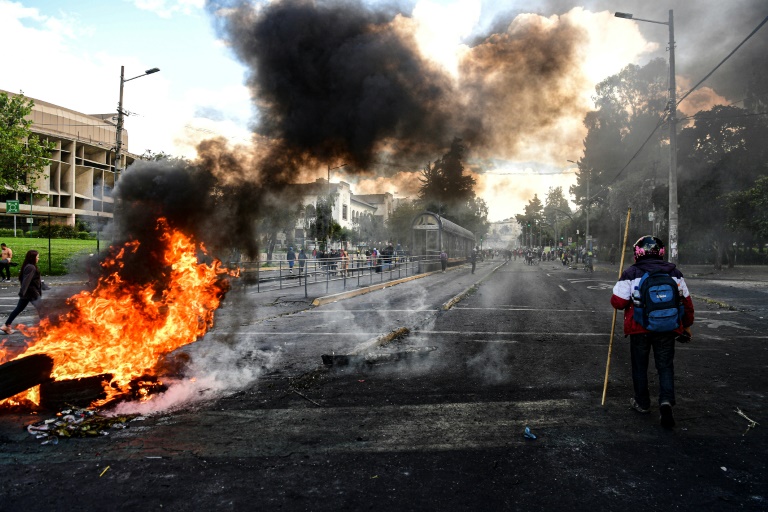
President Guillermo Lasso announced Sunday that Ecuador will cut fuel prices, which had sparked weeks of demonstrations, though not by as much as protesters have demanded.

“I have decided to reduce the price of gasoline by 10 cents per gallon and diesel also by 10 cents per gallon,” he said in a television and radio address.

The powerful Confederation of Indigenous Nationalities of Ecuador (Conaie), which since June 13 has been blocking roads and occupying oil wells in different parts of the country, had demanded a reduction in prices by an additional 30 cents and 35 cents, respectively.

Earlier on Sunday, the country’s energy ministry warned that oil production had reached a “critical” level and could be halted entirely within 48 hours if the protests and roadblocks continued.

The protests, which are also against rising living costs, have crippled transportation in Ecuador, with roadblocks set up in 19 of the oil-rich country’s 24 provinces.

“Oil production is at a critical level,” the ministry said in a statement.

“If this situation continues, the country’s oil production will be suspended in less than 48 hours as vandalism, the seizure of oil wells and road closures have prevented the transport of equipment and diesel needed to keep operations going.”

“Today, the figures show a decrease of more than 50 percent” in production, which was at roughly 520,000 barrels per day before the protests, it said.

Ecuador’s economy is highly dependent on oil revenues, with 65 percent of output exported in the first four months of 2022.

– Impeachment debate –

Late on Sunday, the country’s parliament suspended seven hours of debate over whether to impeach Lasso, with proceedings set to resume on Tuesday. At least 20 members of parliament are still due to speak.

The president’s impeachment would require 92 of the 137 possible votes in the National Assembly, where the opposition holds a fragmented majority. MPs will have a maximum of 72 hours to vote following the end of the debate. 

An estimated 14,000 protesters have taken part in the nationwide demonstrations, most of them in Quito.

Shortages are already being reported in the capital, where prices have soared.

Violence between police and demonstrators has reportedly left five dead, while about 500 people have been injured.

Earlier in the day, Production Minister Julio Jose Prado said that public-private economic losses from the protests totaled $500 million.

“Each additional day of downtime represents $40 to $50 million lost,” he said on Sunday.

Overall losses since the protests began include 8.5 million liters of milk worth $13 million as well as $90 million in agricultural goods and livestock.

The tourism industry has seen cancellations rise to 80 percent, with losses amounting to at least $50 million.

Additionally, “in the flower farm sector, 12 days of shutdown resulted in $30 million in losses and damage to trucks and farms,” Prado said.

Stampede at New York Pride parade after fireworks mistaken for gunfire

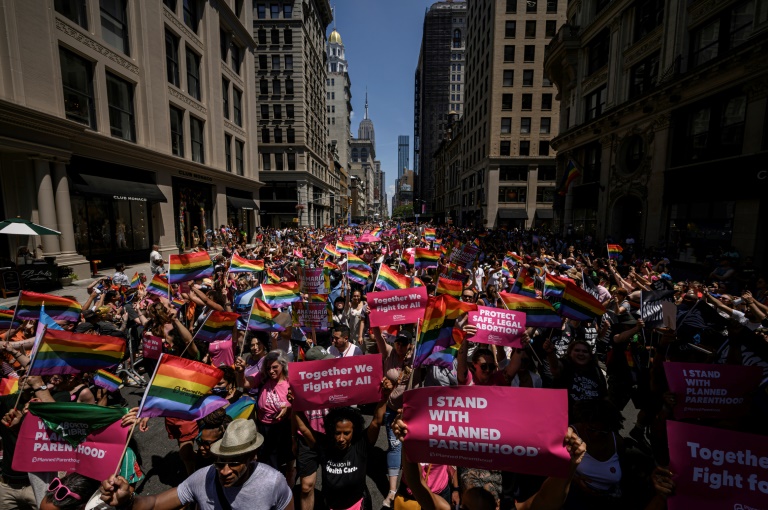
A stampede occurred at a Pride parade in the US city of New York on Sunday, with hundreds of people attempting to flee after mistaking the sound of fireworks for gunfire, police said.

“There were NO shots fired in Washington Square Park. After an investigation, it was determined that the sound was fireworks set off at the location,” the NYPD said in a tweet shortly after the incident. 

Police told AFP “there were no serious injuries” from the stampede.

Terrified people ran or walked briskly along a street adjacent to the square after the scare, videos on social media showed.

Tens of thousands of people attended Sunday’s LGBTQIA+ Pride parade, which wound its way through the streets of lower Manhattan under the blazing sun.

The atmosphere was largely festive, although the shadow of Friday’s US Supreme Court decision to abolish a constitutional right to abortion — leaving states to legislate on the matter themselves — loomed over proceedings.

New York’s Pride parade is the second-largest in the United States, after San Francisco, and Sunday’s gathering was the first time it had taken place since the Covid-19 pandemic began.

Organizers said the US Supreme Court decision on abortion was “devastating.”

“This dangerous decision puts millions in harm’s way, gives government control over our individual freedom to choose, and sets a disturbing precedent that puts many other constitutional rights and freedoms in jeopardy,” organizers said. 

Many rights groups fear that the verdict on abortion could be the beginning of a broader push by the Supreme Court, currently dominated by a conservative majority, to curtail other freedoms won in recent decades, such as rights to contraception or same-sex marriage. 

Japan swelters as heatwave prompts power crunch warning

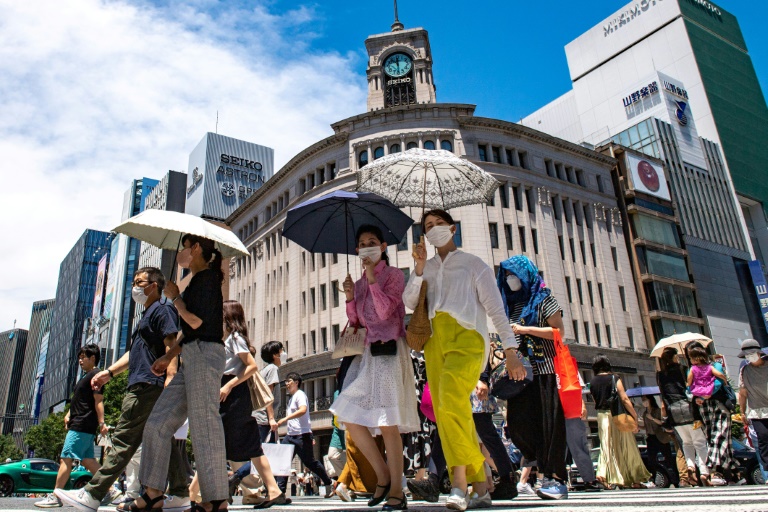
Japan’s government warned Monday of a power crunch as extreme heat hits the country, with temperature records toppling and Tokyo’s rainy season declared over at the earliest date on record.

Residents in and around the capital have been asked to conserve energy, particularly in the early evening.

Temperatures of 35 degrees Celsius (95 degrees Fahrenheit) are forecast in Tokyo throughout Monday, and the mercury is not expected to drop below 34 until Sunday, according to the Japan Meteorological Agency (JMA).

“We ask the public to reduce energy consumption during the early evening hours when the reserve ratio falls,” Yoshihiko Isozaki, deputy chief cabinet secretary, told a regular press briefing.

But he warned that residents should do what was needed to stay cool and avoid heatstroke.

Much of Japan would normally be experiencing rainy season at this time of year, but the JMA on Monday declared the season over in the Kanto region, home to Tokyo, and neighbouring Koshin area.

It was the earliest end to the season since records began in 1951 and a full 22 days earlier than usual.

The agency also declared an end to rainy season in central Japan’s Tokai and part of southern Kyushu, saying this year’s rainy season in these areas and Kanto-Koshin was the shortest on record.

On Sunday, Isesaki city in Gunma prefecture north of Tokyo logged the hottest temperature ever seen in Japan in June, at 40.2C.

“Immediately after the rainy season ends, many people are yet to be fully acclimated to heat and face a greater risk of heat stroke,” the weather agency warned in a statement.

Asako Naruse, 58, was out sightseeing in Ginza alongside pedestrians carrying parasols for shade.

“Every year, July and August are this hot, but it’s the first time I’ve felt such heat in June,” she told AFP.

“I’m from northern Japan, so these temperatures seem really extreme.”

Rival camps dig in for fight after US abortion ruling

Elected leaders across the US political divide rallied Sunday for a long fight ahead on abortion — state by state and in Congress — with total bans in force or expected soon in half of the country.

Two days after the US Supreme Court scrapped half-century constitutional protections for the procedure, abortion rights defenders kept up their mobilization, with several hundred gathered outside the high court during a candlelight vigil in Washington Sunday.

Dozens of arrests and some instances of vandalism were reported during a weekend of mostly peaceful protests that turned disorderly in places — as the country grapples with a new level of division: between states where abortion is or will soon be illegal, and those that still allow it.

Conservative-led US state legislatures have moved swiftly, with at least eight imposing immediate bans on abortion — many with exceptions only if a woman’s life is in danger — and a similar number to follow suit within weeks.

In a first glimpse of the legal battles ahead, the nation’s largest abortion provider Planned Parenthood filed suit in Utah seeking to block the state’s ban.

And Democratic governors in Michigan and Wisconsin have stepped in to try to keep abortion legal in their Midwestern states.

Defending the ban now in effect in South Dakota, which makes no exception for victims of rape or incest, Republican Governor Kristi Noem called the Supreme Court’s ruling “wonderful news in the defense of life.”

Speaking on ABC’s “This Week,” Noem also voiced support for legislation banning “telemedicine abortions” in which a doctor prescribes pills to end a pregnancy — set to become a key resource in many places where abortion is illegal.

Governor Asa Hutchinson of Arkansas likewise argued that “forcing someone to carry a child to term” in order to save an unborn baby was an “appropriate” use of government power.

States should now focus on helping mothers and newborns by expanding services including adoption, he said on NBC’s “Meet the Press.”

But the Republican also opposed calls to go further with a federal abortion ban — an ultimate goal of many on the religious right — or restrictions on contraception, which he said is “not going to be touched” in Arkansas.

Fears that the Supreme Court’s strong conservative majority — made possible by Donald Trump — will now seek to target other rights like same-sex marriage and contraception have fueled the nationwide mobilization since Friday.

– ‘Appalling’ –

President Joe Biden has condemned the Supreme Court’s ruling as a “tragic error” — but with power now resting with often anti-abortion state legislatures, he has also acknowledged his hands are largely tied.

The president’s main hope is for voters to turn out in defense of abortion rights in November’s midterm elections — and in the meantime, Biden’s Democrats have vowed to defend women’s reproductive rights every way they can.

In Wisconsin, where an 1849 law banning abortion except to save the life of the mother may go into effect, Governor Tony Evers vowed to offer clemency to any doctors who face prosecution, according to local media.

And Michigan’s Governor Gretchen Whitmer promised to “fight like hell,” saying a temporary injunction has been filed to keep abortion legal in her state.

Congresswoman Alexandria Ocasio-Cortez warned nightmare scenarios may soon come true — as women are forced to continue with unwanted pregnancies, travel long distances to states where abortion remains legal, or undergo clandestine abortions.

“Forcing women to carry pregnancies against their will will kill them. It will kill them,” the progressive lawmaker told NBC, urging Biden to explore opening health care clinics on federal lands in conservative states in order to help people access abortion services.

A CBS poll released Sunday showed that a solid majority — 59 percent — of Americans and 67 percent of women disapproved of the court’s ruling.

While thousands of people rallied peacefully through the weekend — most of them in protest, but many others celebrating — there were isolated incidents of violence. Police fired tear gas on protesters in Arizona and a pickup truck drove through a group of protesters in Iowa.

In the Virginia city of Lynchburg, police were investigating a case of vandalism Saturday at an anti-abortion pregnancy center — which was spray-painted with graffiti and had its windows smashed.

And in Colorado, police were probing a suspected arson attack Saturday at a similar anti-abortion center in the town of Longmont, which was painted with graffiti reading: “If abortions aren’t safe, neither are you.”
Asian markets extend rally as rate hike fears subside

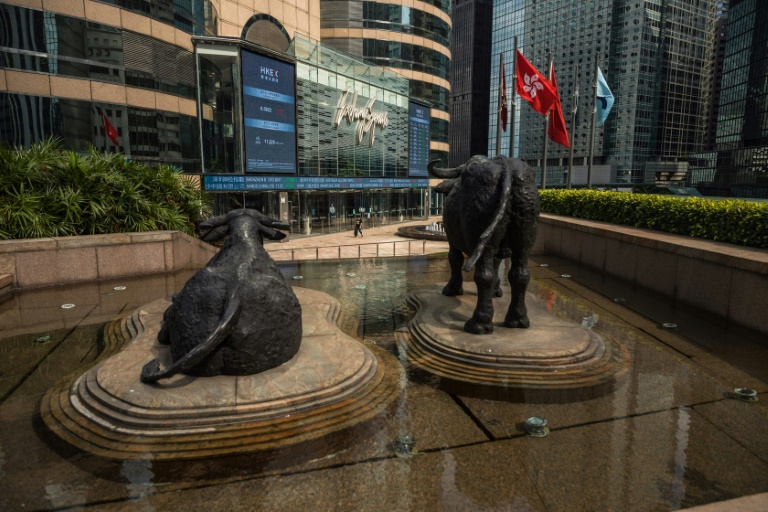
Asian markets rallied again Monday, building on last week’s advances and following a strong performance on Wall Street as speculation that inflation may have peaked tempered expectations about central bank interest rate hikes.

With prices surging at a pace not seen in a generation, finance chiefs have been forced to lift borrowing costs and wind back their ultra-loose monetary policies in recent months, sending a chill across trading floors.

But a string of weak data has led many investors to believe that inflation may have plateaued or is about to, giving room for banks to be less hawkish.

The prospect that rates will not go as high as initially expected helped send Wall Street stocks higher Friday, with the S&P 500 and Nasdaq ending up more than three percent.

And Asia continued last week’s rally.

Hong Kong led gainers, climbing more than two percent thanks to a strong performance in Chinese tech firms. Indications that China’s crackdown on the sector could be coming to an end added to the upbeat mood in the city.

Tokyo, Shanghai, Seoul, Singapore, Sydney, Manila and Wellington were also well up.

“Market conviction that perhaps the Fed won’t now hike rates as aggressively as previously feared and/or that rate cuts before the end of 2023 are now an even more realistic prospect if recession-like conditions lay ahead, have had a big hand in last week’s improvement in risk sentiment,” said National Australia Bank’s Ray Attrill.

He added that the rally had helped pare about two-thirds of the losses suffered in a painful sell-off from June 9-16.

While Fed chiefs continue to flag further big interest rate hikes in the pipeline, expectations for a prolonged period of increases have waned, which has in turn taken some heat out of the dollar.

Bitcoin has also won some support, after falling to as low as $17,600 last week for the first time since December 2020.

“There’s a feeling that things aren’t as bad as we thought they were going to be,” Carol Pepper, of Pepper International, told Bloomberg Radio.

“There’s a hope that perhaps we’ve oversold, perhaps there’s not going to be a recession,” she said.

– Key figures at around 0230 GMT –

Tokyo – Nikkei 225: UP 1.0 percent at 26,768.77 (break)

Hong Kong – Hang Seng Index: UP 2.7 percent at 22,297.74

Shanghai – Composite: UP 0.8 percent at 3,377.22

Dollar/yen: DOWN at 134.63 yen from 135.17 yen late Friday

Pound/dollar: UP at $1.2282 from $1.2280

Euro/dollar: UP at $1.0563 from $1.0559

Euro/pound: UP at 86.01 pence from 85.95 pence

West Texas Intermediate: DOWN 0.2 percent at $107.41 per barrel

Brent North Sea crude: FLAT at $113.10 per barrel

New York – Dow: UP 2.7 percent at 31,500.68 (close)

London – FTSE 100: UP 2.7 percent at 7,208.81 (close)

Asian markets extend rally as rate hike fears subside

Asian markets rallied again Monday, building on last week’s advances and following a strong performance on Wall Street as speculation that inflation may have peaked tempered expectations about central bank interest rate hikes.

With prices surging at a pace not seen in a generation, finance chiefs have been forced to lift borrowing costs and wind back their ultra-loose monetary policies in recent months, sending a chill across trading floors.

But a string of weak data has led many investors to believe that inflation may have plateaued or is about to, giving room for banks to be less hawkish.

The prospect that rates will not go as high as initially expected helped send Wall Street stocks higher Friday, with the S&P 500 and Nasdaq ending up more than three percent.

And Asia continued last week’s rally.

Hong Kong led gainers, climbing more than two percent thanks to a strong performance in Chinese tech firms. Indications that China’s crackdown on the sector could be coming to an end added to the upbeat mood in the city.

Tokyo, Shanghai, Seoul, Singapore, Sydney, Manila and Wellington were also well up.

“Market conviction that perhaps the Fed won’t now hike rates as aggressively as previously feared and/or that rate cuts before the end of 2023 are now an even more realistic prospect if recession-like conditions lay ahead, have had a big hand in last week’s improvement in risk sentiment,” said National Australia Bank’s Ray Attrill.

He added that the rally had helped pare about two-thirds of the losses suffered in a painful sell-off from June 9-16.

While Fed chiefs continue to flag further big interest rate hikes in the pipeline, expectations for a prolonged period of increases have waned, which has in turn taken some heat out of the dollar.

Bitcoin has also won some support, after falling to as low as $17,600 last week for the first time since December 2020.

“There’s a feeling that things aren’t as bad as we thought they were going to be,” Carol Pepper, of Pepper International, told Bloomberg Radio.

“There’s a hope that perhaps we’ve oversold, perhaps there’s not going to be a recession,” she said.

– Key figures at around 0230 GMT –

Tokyo – Nikkei 225: UP 1.0 percent at 26,768.77 (break)

Hong Kong – Hang Seng Index: UP 2.7 percent at 22,297.74

Shanghai – Composite: UP 0.8 percent at 3,377.22

Dollar/yen: DOWN at 134.63 yen from 135.17 yen late Friday

Pound/dollar: UP at $1.2282 from $1.2280

Euro/dollar: UP at $1.0563 from $1.0559

Euro/pound: UP at 86.01 pence from 85.95 pence

West Texas Intermediate: DOWN 0.2 percent at $107.41 per barrel

Brent North Sea crude: FLAT at $113.10 per barrel

New York – Dow: UP 2.7 percent at 31,500.68 (close)

London – FTSE 100: UP 2.7 percent at 7,208.81 (close)

Ecuador warns protests could force halt to oil production

Ecuador’s energy ministry warned Sunday that oil production had reached a “critical” level and could be halted entirely within 48 hours if protests and roadblocks continue in the crisis-wracked South American country.

Nearly two weeks of Indigenous-led protests against rising fuel prices and living costs have crippled transportation in Ecuador, with roadblocks set up in 19 of the oil-rich country’s 24 provinces.

“Oil production is at a critical level,” the ministry said in a statement.

“If this situation continues, the country’s oil production will be suspended in less than 48 hours as vandalism, the seizure of oil wells and road closures have prevented the transport of equipment and diesel needed to keep operations going.”

“Today, the figures show a decrease of more than 50 percent” in production, which was at roughly 520,000 barrels per day before the protests, it said.

Ecuador’s economy is highly dependent on oil revenues, with 65 percent of output exported in the first four months of 2022.

An estimated 14,000 protesters are taking part in the nationwide demonstrations, most of them in Quito.

Shortages are already being reported in the capital, where prices have soared.

Violence between police and demonstrators has reportedly left five dead, while about 500 people have been injured, according to various sources.

The National Assembly will eventually vote on whether to oust President Guillermo Lasso over what opposition lawmakers say is his role in the protests, with a no-confidence hearing resuming for a second day late Sunday.

Earlier in the day, Production Minister Julio Jose Prado said that public-private economic losses from the protests totaled $500 million.

“Each additional day of downtime represents $40 to $50 million lost,” he said on Sunday.

Overall losses since the protests began include 8.5 million liters of milk worth $13 million as well as $90 million in agricultural goods and livestock.

The tourism industry has seen cancellations rise to 80 percent, with losses amounting to at least $50 million.

Additionally, “in the flower farm sector, 12 days of shutdown resulted in $30 million in losses and damage to trucks and farms,” Prado said.

Ailing oceans in the spotlight at major UN meet

A long-delayed UN conference on how to restore the faltering health of global oceans kicks off in Lisbon Monday, with thousands of policymakers, experts and advocates on the case.

Humanity needs healthy oceans. They generate 50 percent of the oxygen we breathe and provide essential protein and nutrients to billions of people every day.

Covering more than two-thirds of Earth’s surface, the seven seas have also softened the impact of climate change for life on land. 

But at a terrible cost.

Absorbing around a quarter of CO2 pollution — even as emissions increased by half over the last 60 years — has turned sea water acidic, threatening aquatic food chains and the ocean’s capacity to pull down carbon. 

And soaking up more than 90 percent of the excess heat from global warming has spawned massive marine heatwaves that are killing off precious coral reefs and expanding dead zones bereft of oxygen.

“We have only begun to understand the extent to which climate change is going to wreak havoc on ocean health,” said Charlotte de Fontaubert, the World Bank’s global lead for the blue economy.

Making things worse is an unending torrent of pollution, including a garbage truck’s worth of plastic every minute, according the UN Environment Programme (UNEP). 

On current trends, yearly plastic waste will nearly triple to one billion tonnes by 2060, according to a recent OECD report.

– Wild fish stocks –

Microplastics — found inside Arctic ice and fish in the ocean’s deepest trenches — are estimated to kill more than a million seabirds and over 100,000 marine mammals each year.

Solutions on the table range from recycling to global caps on plastic production. 

Global fisheries will also be under the spotlight during the five-day UN Ocean Conference, originally slated for April 2020 and jointly hosted by Portugal and Kenya. 

“At least one-third of wild fish stocks are overfished and less than 10 percent of the ocean is protected,” Kathryn Matthews, chief scientist for US-based NGO Oceana, told AFP.

“Destructive and illegal fishing vessels operate with impunity in many coastal waters and on the high seas.”

One culprit is nearly $35 billion in subsidies. Baby steps taken last week by the World Trade Organization (WTO) to reduce handouts to industry will hardly make a dent, experts said.

The conference will also see a push for a moratorium on deep-sea mining of rare metals needed for a boom electric vehicle battery construction.

Scientists say poorly understood seabed ecosystems are fragile and could take decades or longer to heal once disrupted.

Another major focus will be “blue food”, the new watchword for ensuring that marine harvests from all sources are sustainable and socially responsible.

– Protected areas –

Rising aquaculture yields — from salmon and tuna to shellfish and algae — are on track to overtake wild marine harvests in decline since the 1990s, with each producing roughly 100 million tonnes per year.

If properly managed, “wild ocean fish can provide a climate-friendly, micro-nutrient protein source that can feed one billion people a healthy seafood meal every day — forever,” said Matthews.

The Lisbon meet will see ministers and even a few heads of state, including French President Emmanuel Macron, but is not a formal negotiating session.

But participants will push for a strong oceans agenda at two critical summits later this year: the COP27 UN climate talks in November, hosted by Egypt, followed by the long-delayed COP15 biodiversity negotiations, recently moved from China to Montreal.

Oceans are already at the heart of a draft biodiversity treaty tasked with halting what many scientists fear is the first “mass extinction” event in 65 million years.

Nearly 100 nations support a cornerstone provision that would designate 30 percent of the planet’s land and ocean as protected areas.

For climate change, the focus will be on carbon sequestration: boosting the ocean’s capacity to soak up CO2, whether by enhancing natural sinks such as mangroves or through geoengineering schemes.

At the same time, scientists warn, a drastic reduction of greenhouse gases is needed to restore ocean health.

Ailing oceans in the spotlight at major UN meet

A long-delayed UN conference on how to restore the faltering health of global oceans kicks off in Lisbon Monday, with thousands of policymakers, experts and advocates on the case.

Humanity needs healthy oceans. They generate 50 percent of the oxygen we breathe and provide essential protein and nutrients to billions of people every day.

Covering more than two-thirds of Earth’s surface, the seven seas have also softened the impact of climate change for life on land. 

But at a terrible cost.

Absorbing around a quarter of CO2 pollution — even as emissions increased by half over the last 60 years — has turned sea water acidic, threatening aquatic food chains and the ocean’s capacity to pull down carbon. 

And soaking up more than 90 percent of the excess heat from global warming has spawned massive marine heatwaves that are killing off precious coral reefs and expanding dead zones bereft of oxygen.

“We have only begun to understand the extent to which climate change is going to wreak havoc on ocean health,” said Charlotte de Fontaubert, the World Bank’s global lead for the blue economy.

Making things worse is an unending torrent of pollution, including a garbage truck’s worth of plastic every minute, according the UN Environment Programme (UNEP). 

On current trends, yearly plastic waste will nearly triple to one billion tonnes by 2060, according to a recent OECD report.

– Wild fish stocks –

Microplastics — found inside Arctic ice and fish in the ocean’s deepest trenches — are estimated to kill more than a million seabirds and over 100,000 marine mammals each year.

Solutions on the table range from recycling to global caps on plastic production. 

Global fisheries will also be under the spotlight during the five-day UN Ocean Conference, originally slated for April 2020 and jointly hosted by Portugal and Kenya. 

“At least one-third of wild fish stocks are overfished and less than 10 percent of the ocean is protected,” Kathryn Matthews, chief scientist for US-based NGO Oceana, told AFP.

“Destructive and illegal fishing vessels operate with impunity in many coastal waters and on the high seas.”

One culprit is nearly $35 billion in subsidies. Baby steps taken last week by the World Trade Organization (WTO) to reduce handouts to industry will hardly make a dent, experts said.

The conference will also see a push for a moratorium on deep-sea mining of rare metals needed for a boom electric vehicle battery construction.

Scientists say poorly understood seabed ecosystems are fragile and could take decades or longer to heal once disrupted.

Another major focus will be “blue food”, the new watchword for ensuring that marine harvests from all sources are sustainable and socially responsible.

– Protected areas –

Rising aquaculture yields — from salmon and tuna to shellfish and algae — are on track to overtake wild marine harvests in decline since the 1990s, with each producing roughly 100 million tonnes per year.

If properly managed, “wild ocean fish can provide a climate-friendly, micro-nutrient protein source that can feed one billion people a healthy seafood meal every day — forever,” said Matthews.

The Lisbon meet will see ministers and even a few heads of state, including French President Emmanuel Macron, but is not a formal negotiating session.

But participants will push for a strong oceans agenda at two critical summits later this year: the COP27 UN climate talks in November, hosted by Egypt, followed by the long-delayed COP15 biodiversity negotiations, recently moved from China to Montreal.

Oceans are already at the heart of a draft biodiversity treaty tasked with halting what many scientists fear is the first “mass extinction” event in 65 million years.

Nearly 100 nations support a cornerstone provision that would designate 30 percent of the planet’s land and ocean as protected areas.

For climate change, the focus will be on carbon sequestration: boosting the ocean’s capacity to soak up CO2, whether by enhancing natural sinks such as mangroves or through geoengineering schemes.

At the same time, scientists warn, a drastic reduction of greenhouse gases is needed to restore ocean health.

Close Bitnami banner
Bitnami