AFP

US panel recommends Covid vaccines for youngest children

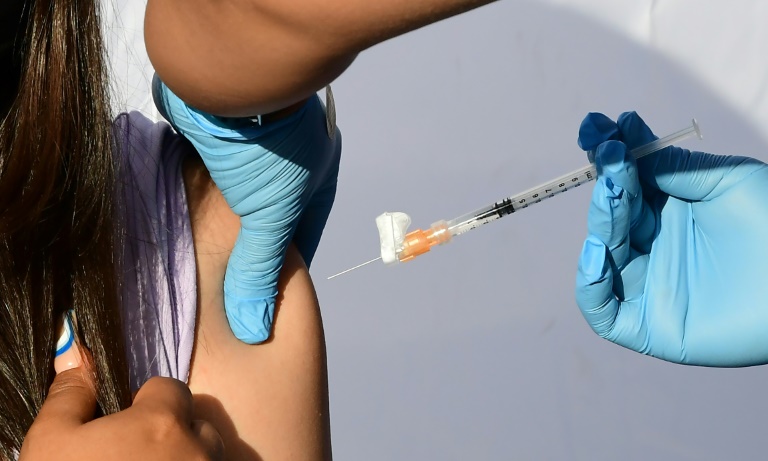
A panel of experts convened by the US Food and Drug Administration unanimously recommended Covid-19 vaccines Wednesday for children under five, the final age group awaiting immunization in most countries.

Formal authorizations for Moderna and Pfizer should follow soon, with the first shots in arms expected early next week, just over a year-and-a-half after the first Covid vaccines were greenlighted for the elderly in December 2020.

“This recommendation does fill a significant unmet need for a really ignored younger population,” said Michael Nelson, a professor of medicine at the University of Virginia, one of the 21 experts asked to vote for the milestone meeting.

Unlike regulators in other countries, FDA offers livestreams of its internal deliberations and its stamp of approval is considered the global gold standard.

Opening the discussion, senior FDA scientist Peter Marks said that despite studies showing the majority of children have now been infected with the coronavirus, the high rate of hospitalizations among infants, toddlers and young children during last winter’s Omicron wave underscored an urgent need for vaccination.

“We are dealing with an issue where we have to be careful we don’t become numb to the pediatric deaths because of the overwhelming number of older deaths,” he said.

“Every life is important and vaccine-preventable deaths are something we would like to try to do something about.”

The United States has recorded 480 Covid deaths in the 0-4 age group in the pandemic — far higher than even a bad flu season, Marks said.

As of May 2022, there have been 45,000 hospitalizations in that group, nearly a quarter of which required intensive care.

Ahead of the meeting, the FDA posted its independent analyses of the pharmaceutical companies’ vaccines, deeming both safe and effective.

Both vaccines are based on messenger RNA, which delivers genetic code for the coronavirus spike protein to human cells that then grow it on their surface, training the immune system to be ready. The technology is now considered the leading Covid vaccination platform.

Pfizer sought authorization for three doses at three micrograms given to children aged six months through four years, while Moderna asked for the FDA to authorize its vaccine as two doses of a higher 25 micrograms for ages six months through five years.

Both vaccines were tested in trials of thousands of children. They were found to cause similar levels of mild side effects as in older age groups and triggered similar levels of antibodies.

– Two doses, or three? –

Efficacy against infection was higher for Pfizer, with the company placing it at 80 percent, compared to Moderna’s estimates of 51 percent for children aged six-months to two years old and 37 percent for those aged two to five years.

But the Pfizer figure is based on very few cases and is thus considered preliminary. It also takes three doses to achieve its protection, with the third shot given eight weeks after the second, which is given three weeks after the first.

Moderna’s vaccine should provide strong protection against severe disease after two doses, given four weeks apart, and the company is studying adding a booster that would raise efficacy levels against mild disease.

However, Moderna’s decision to go with a higher dose is associated with higher levels of fevers in reaction to the vaccine compared to Pfizer.

There are some 20 million US children aged four years and under. 

Although obesity, neurological disorders and asthma are associated with increased risk of severe disease among young children, it’s not easy to predict severe outcomes.

In fact, 64 percent of hospitalizations in those under five occurred in patients without comorbidities.

Children can also go on to contract multisystem inflammatory syndrome in children (MIS-C), a rare but serious post-viral condition. Some three to six percent can experience long Covid symptoms for more than 12 weeks.

The FDA is expected to soon act on the panel’s recommendation, and the matter will go to the Centers for Disease Control and Prevention for a final say.

White House officials last week said the rollout of 10 million shots at pharmacies and doctors’ offices could begin as soon as June 21.
Parts of storm-wrecked Yellowstone to remain shut all year

Parts of Yellowstone will remain closed for the rest of the year because of extensive flood damage, managers say, with the oldest national park in the United States completely shuttered Wednesday.

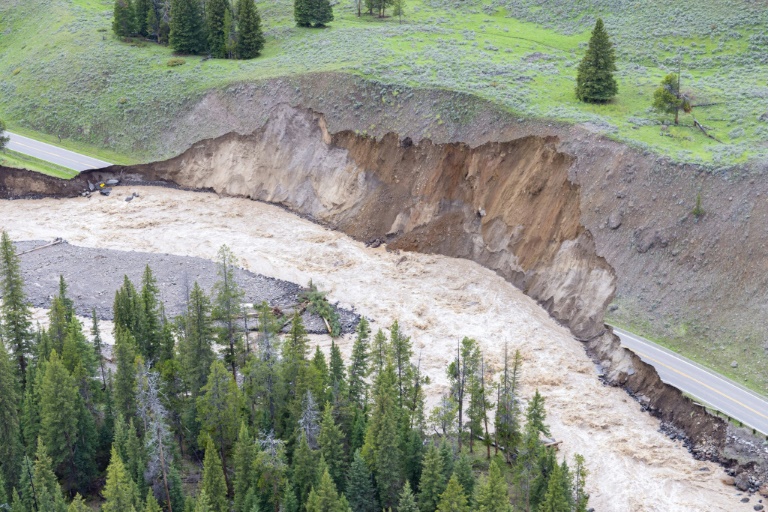
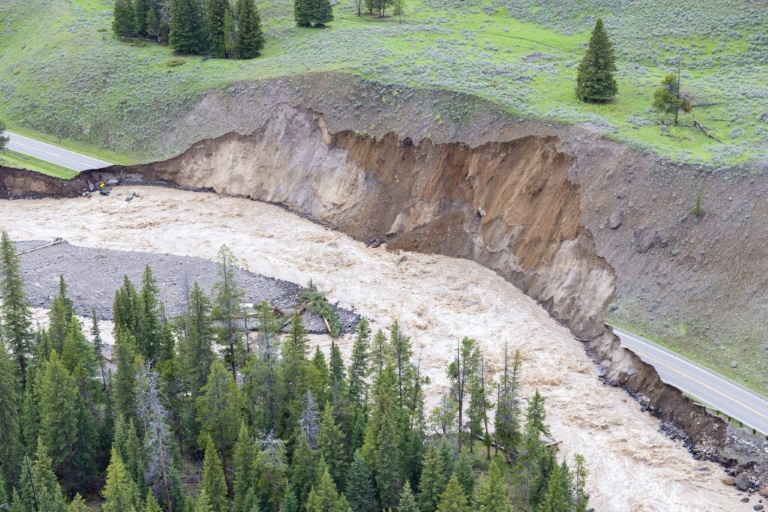
Roads have been washed out in the northern portion of the 9,000 square kilometer (3,400 square mile) park after torrential rainfall and snowmelt sent months’ worth of run-off into rivers in just a couple of days.

All the entrances to the park, which sits chiefly in Wyoming and is home to the Old Faithful geyser, remained closed Wednesday for a third consecutive day.

Images released by the National Park Service showed large sections of paved road had been swept away by raging rivers.

Aerial reconnaissance revealed “major damage to multiple sections of road” in the northern part of the park, the agency said in its latests assessment.

“Many sections of road in these areas are completely gone and will require substantial time and effort to reconstruct.

“The National Park Service will make every effort to repair these roads as soon as possible; however, it is probable that road sections in northern Yellowstone will not reopen this season.”

Several communities on the north side of the park in Montana also experienced significant flooding, with bridges and roads washed out in Park County. 

Montana Governor Greg Gianforte declared a statewide disaster on Tuesday “to help impacted communities get back on their feet as soon as possible,” he said on Twitter.

A huge dome of high pressure is sitting over the United States, sending temperatures soaring for 120 million people.

Meteorologists say the edge of that dome, where colder air meets warm air, is experiencing wild weather, including heavy rainfall.

Higher-than-usual temperatures have also caused snowpack on the high mountains to melt, adding to the influx of water into rivers.

Forecasters at CNN calculated that several months’ of run-off in Yellowstone has cascaded into rivers in just two days, resulting in their overflow.

Park service officials said they will look at conditions in the southern section of Yellowstone, to see when visitors can be allowed back in, but will likely limit admissions to avoid placing too much strain on the area.

Yellowstone Park, which welcomed more than 4.8 million visitors last year, is America’s oldest national park.

The park was the inspiration for Jellystone Park in the 1960s cartoon “Yogi Bear.”

Parts of storm-wrecked Yellowstone to remain shut all year

Parts of Yellowstone will remain closed for the rest of the year because of extensive flood damage, managers say, with the oldest national park in the United States completely shuttered Wednesday.

Roads have been washed out in the northern portion of the 9,000 square kilometer (3,400 square mile) park after torrential rainfall and snowmelt sent months’ worth of run-off into rivers in just a couple of days.

All the entrances to the park, which sits chiefly in Wyoming and is home to the Old Faithful geyser, remained closed Wednesday for a third consecutive day.

Images released by the National Park Service showed large sections of paved road had been swept away by raging rivers.

Aerial reconnaissance revealed “major damage to multiple sections of road” in the northern part of the park, the agency said in its latests assessment.

“Many sections of road in these areas are completely gone and will require substantial time and effort to reconstruct.

“The National Park Service will make every effort to repair these roads as soon as possible; however, it is probable that road sections in northern Yellowstone will not reopen this season.”

Several communities on the north side of the park in Montana also experienced significant flooding, with bridges and roads washed out in Park County. 

Montana Governor Greg Gianforte declared a statewide disaster on Tuesday “to help impacted communities get back on their feet as soon as possible,” he said on Twitter.

A huge dome of high pressure is sitting over the United States, sending temperatures soaring for 120 million people.

Meteorologists say the edge of that dome, where colder air meets warm air, is experiencing wild weather, including heavy rainfall.

Higher-than-usual temperatures have also caused snowpack on the high mountains to melt, adding to the influx of water into rivers.

Forecasters at CNN calculated that several months’ of run-off in Yellowstone has cascaded into rivers in just two days, resulting in their overflow.

Park service officials said they will look at conditions in the southern section of Yellowstone, to see when visitors can be allowed back in, but will likely limit admissions to avoid placing too much strain on the area.

Yellowstone Park, which welcomed more than 4.8 million visitors last year, is America’s oldest national park.

The park was the inspiration for Jellystone Park in the 1960s cartoon “Yogi Bear.”

Countries haggle through the night to salvage WTO deals

Ministers were frantically haggling through the night into Thursday at the World Trade Organization in a bid to salvage deals on food security, fishing and combating Covid-19.

The global trade body’s 164 members added on an extra fifth day of talks to try to break the deadlock gripping the WTO headquarters in Geneva.

But despite relaxing their original Wednesday deadline, countries were trading concessions through the early morning hours to cobble together a wide-ranging set of results.

Countries have hit a brick wall trying to secure each separate deal on its own merits, so are now making tit-for-tat offers in an attempt to keep them all afloat.

“They’re looking at a broad package: what can be achieved, trade-offs in different areas,” a Geneva trade official told reporters.

“It’s basically, ‘what can I get here, (in exchange) for this’,” the official said.

“We’re into the real bargaining part of the meeting. This is where all the action is happening and hopefully where some deals are going to be struck.”

– Juice and sandwiches –

US Trade Representative Katherine Tai was seen heading in and out of the late-night talks, while a giant tray of sandwiches was brought in to keep the deal-makers going.

“It’s going to go all night. Everything. People look tired,” the Geneva-based trade official told AFP, adding: “They’re negotiating, which is good news.”

He said the talks had run out of juice — but only fruit juice, rather than energy.

The WTO is hoping to prove it still has a role to play in tackling big global challenges.

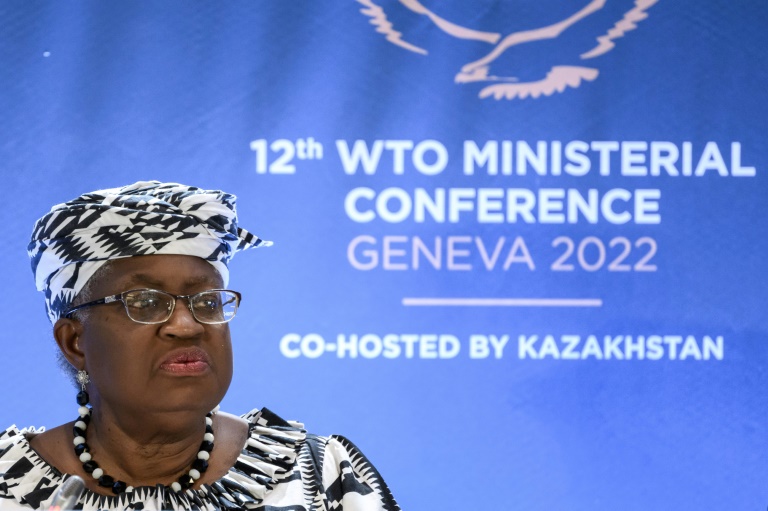
WTO chief Ngozi Okonjo-Iweala, who took over in March 2021, has hinged her leadership on breathing new life into the sclerotic organisation.

“Progress is being made but it needs a little more work and more time,” the director-general said.

“It requires that we work and work nights; whatever it takes.”

The last WTO ministerial conference, in December 2017 in Buenos Aires, was widely considered a flop, closing without a major agreement and Okonjo-Iweala wants no repeat.

The global trade body only takes decisions by consensus among all 164 members, making deals all the harder to conclude.

Okonjo-Iweala was hoping to pull off a coup by securing a long-sought deal on curbing harmful fishing subsidies.

– India in the firing line –

Negotiations towards banning subsidies that encourage overfishing and threaten the sustainability of the planet’s fish stocks have been going on at the WTO for more than two decades.

Diplomats say a deal is closer now than ever before.

But India threw a spanner in the works late Tuesday, insisting it would not sign up without a 25-year exemption — far longer than many are comfortable with.

Some emerging from the negotiating rooms are blaming Indian intransigence on not just fisheries but across the board.

Citing their “destructive tactics”, one diplomatic source close to the negotiations said: “The question is are they really going to pull the whole edifice down, or whether they’re willing to go along with the views of the vast majority of members.”

On fishing, the source added: “Now is the time… civil society wants this, fishing communities want it, and our fish need it.”

WTO reform, agriculture and e-commerce deals are also on the table.

– ‘Saving WTO, not lives’ –

“There are things that are going in the right direction and others that unfortunately are not progressing very much,” France’s foreign trade minister Franck Riester told reporters before the all-night talks, with health issues looking among the most promising.

One pandemic-related text seeks to tackle supply constraints faced by certain countries in getting hold of Covid-fighting tools.

Ministers are also discussing the possibility of imposing a temporary waiver on Covid-19 vaccine patents.

But some countries that host major pharmaceutical companies, like Britain and Switzerland, are finding some of the draft wording problematic.

NGOs believe the text does not go nearly far enough.

Civil society activists staged a “die-in” protest in the WTO’s atrium, accusing the EU, Britain, Switzerland and the United States of scuppering a meaningful Covid intellectual property waiver.

“The proposal on the table is intended to save the reputation of the WTO but it will not save a human life from the pandemic,” demonstration organiser Deborah James told AFP.

Swiss economy minister Guy Parmelin insisted he remained against a wide-ranging waiver, adding: “Patents have not slowed access to vaccines — quite the opposite”.

Kim Kardashian accused of damaging Marilyn Monroe dress at Met gala

The private museum that owns an iconic dress worn by Marilyn Monroe allowed it to be “permanently damaged” when it lent it to reality star Kim Kardashian for her appearance at the Met Gala extravaganza last month, a Monroe memorabilia collector alleged Wednesday.

A platinum blonde Kardashian shined but also stirred controversy when she donned the stunning skintight gown Monroe wore in 1962 to sing “Happy Birthday, Mr President” to John F Kennedy.

Scott Fortner, a collector who runs a website dedicated entirely to Monroe, released before and after photos this week of the crystal-studded cream gown.

The after shots were taken by a friend of Fortner, who saw the dress on display Sunday at curiosity museum Ripley’s Believe It or Not! in Los Angeles, which owns the dress and had allowed Kardashian to wear it.

The comparison shots seem to show small tears in the fabric near hooks that fastened the dress together as well as missing crystals and others hanging by a thread.

The alleged damage to the gown, which Ripley’s bought at auction for a record $4.8 million, has drawn widespread criticism on social media in recent days.

In an update published to his Instagram account on Wednesday, Fortner specified that “I blame Ripley’s, as they allowed the dress to be worn.”

“I feel that any and every celebrity offered a chance to wear this garment very likely would jump at the opportunity,” he said. “There’s a reason someone would want to wear it. Kim K. just happened to be the one who got to do it.”

“It’s now permanently damaged, and likely would have been damaged regardless of who wore it,” Fortner said.

Asked by AFP about the accusations, Ripley’s did not respond Wednesday afternoon.

In early May, Ripley’s trumpeted the opportunity for Kardashian to wear the dress. 

“Great care was taken to preserve this piece of history. With input from garment conservationists, appraisers, archivists, and insurance, the garment’s condition was top priority,” the company said.

Kardashian, who reportedly went on a major diet to be able to squeeze into the legendary garment, did not respond to the allegations on her social networks.

Two US volunteers in Ukraine feared captured by Russia

Two Americans who volunteered to support Ukraine have gone missing and are feared to have been taken prisoner by Russia, officials and family members said Wednesday.

Captive Americans would add another layer of complexity to efforts by the United States, which is pumping billions of dollars into Ukraine but trying to steer clear of direct confrontation with Russia.

Alexander Drueke and Andy Huynh, both US military veterans who had been living in Alabama, lost contact with their families after combat in Ukraine.

Drueke’s mother reached out earlier this week, said her local congresswoman, Terri Sewell.

“According to his family, they have not heard from Drueke in several days,” Sewell said in a statement.

“We will continue to do everything in our power to assist in locating him and finding answers for his family.”

White House spokesman John Kirby said he could not confirm the disappearance of the two Americans but said, “If it’s true, we’ll do everything we can to get them safely back home.”

He said that the United States discouraged Americans from traveling to Ukraine, which has endured a nearly four-month war against invading Russian forces.

“It is a war zone. It is combat. And if you feel passionate about supporting Ukraine, there’s any number of other ways to do that that are safer and just as effective,” Kirby told reporters.

The Telegraph, which first reported their disappearances, quoted an unnamed fellow fighter who said the two men were captured after running into a larger Russian force during a June 9 battle northeast of Kharkiv.

Drueke’s mother, Lois Drueke, said that her son told his family that he was teaching Ukrainian troops how to use US-made weapons.

“Alex felt very strongly that he had been trained in ways that he could help the Ukrainians be strong and push Putin back,” she told The Washington Post, referring to Russian President Vladimir Putin.

The two are the first Americans believed to have been captured or harmed in Ukraine, which Putin invaded in February.

Two British nationals have been reported killed in the fighting and another two Britons are facing the death penalty after being captured and convicted as mercenaries by a pro-Russian court.

President Joe Biden earlier Wednesday announced another $1 billion in military aid to Ukraine but has said that US forces will not directly engage Russia, a fellow nuclear power.

It's a small world: Disney to fly guests round all 12 parks for $110,000

Not sure which Disney resort to visit next summer? 

Disney chiefs have a solution for its most obsessive — and deep-pocketed — fans, offering a round-the-world package trip to all 12 parks, starting at a hefty $110,000 per person.

“Disney Parks Around The World — A Private Jet Adventure” will fly 75 mega-fans around the world in July 2023, with VIP visits to Disney resorts in California, Tokyo, Shanghai, Hong Kong, Paris and Florida.

Across 24 days, there will also be stops at countries which do not have Disney parks, including tours of the Taj Mahal in Agra, India and Egypt’s Pyramids of Giza.

According to its brochure, the “bucket list adventure” also includes a “rare opportunity to be a guest at Summit Skywalker Ranch,” founded by “Star Wars” creator George Lucas outside San Francisco.

“You’ll travel in luxury via a VIP-configured Boeing 757, operated by Icelandair, with long-range capabilities that allows for direct flights to maximize your time in each destination,” it says.

Guests will be joined on board by “experts and staff, who use an audiovisual system for informative briefings and lectures,” while Disney “leaders” and “Imagineers” will be on hand at various points.

As well as the movies, TV shows and theme parks it is best known for, the Walt Disney Company has long offered travel packages, including cruises.

With theme park attendances and tourism more generally recovering from the pandemic, Disney’s latest offering is its most luxurious yet.

The $109,995 per person price tag is based on two people sharing, with those who travel solo facing an additional surcharge of at least $10,995.

No discount is offered for children, who must be at least 12, and airfare to Los Angeles and from Orlando for the first and last legs is excluded.

US Fed announces biggest interest rate hike since 1994

The US Federal Reserve announced the most aggressive interest rate increase in nearly 30 years on Wednesday, and said it is prepared to do so again next month in an all-out battle to drive down surging inflation.

The super-sized 0.75-percentage-point hike came with the Fed under intense pressure to curb soaring gas and food prices that have left millions of Americans struggling to make ends meet and sent President Joe Biden’s approval ratings plunging.

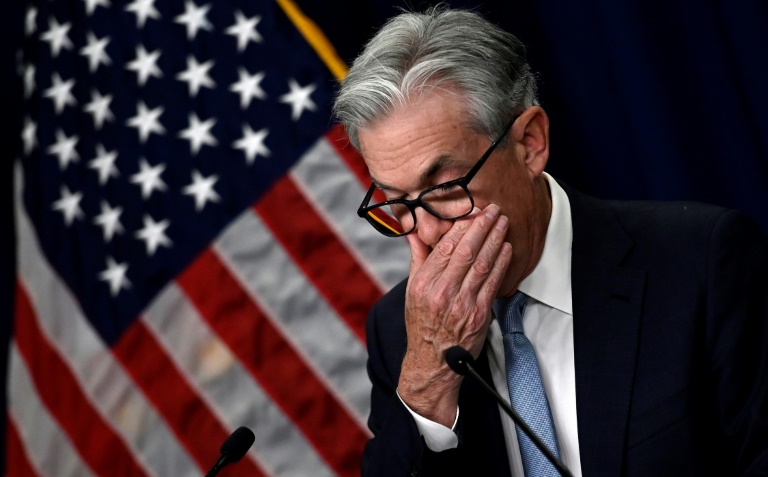
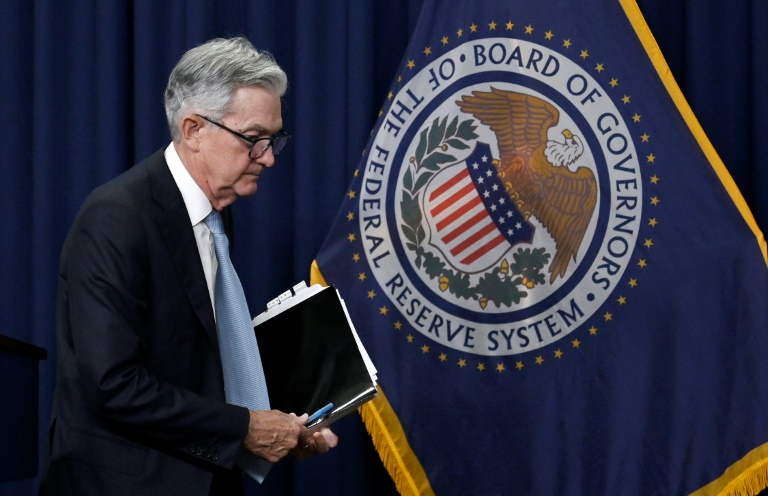
Fed Chair Jerome Powell said it was “essential” to lower inflation, and policymakers “have both the tools we need and the resolve it will take to restore price stability on behalf of American families.”

He stressed that the goal is to achieve that without derailing the US economy, but acknowledged there is always a risk of going too far.

The Fed’s policy-setting Federal Open Market Committee raised the benchmark borrowing rate to a range of 1.5-1.75 percent, up from zero at the start of the year.

It was the first 75-basis-point increase since November 1994.

Powell told reporters the move was “an unusually large one,” but he does not expect “moves of this size to be common.”

However, “from the perspective of today, either a 50-basis-point or a 75-basis-point increase seems most likely at our next meeting,” he said.

“It is essential that we bring inflation down if we are to have a sustained period of strong labor market conditions that benefit all.”

Biden has endorsed the Fed’s effort and is hoping for success as his Democrats face the possibility of losing control of Congress in key midterm elections in November.

He has blamed opposition Republicans for blocking bills meant to help lower costs and ease supply constraints.

White House economic adviser Brian Deese told Fox News “the most constructive steps that Congress and the executive branch can take to help support what the Fed is trying to do are to lower the cost that families face directly and to lower the federal deficit.”

– ‘Brace yourself’ –

Wall Street loved the aggressive posture, closing sharply higher following Powell’s comments.

But Kansas City Federal Reserve Bank President Esther George, a noted inflation hawk, dissented from the committee vote, preferring a smaller, half-point increase.

Until recently, the central bank seemed set to approve a 0.5-percentage-point increase, but economists say the rapid surge in inflation put the Fed behind the curve, meaning it needed to react strongly to prove its resolve to combat scorching price increases.

Committee members now see the federal funds rate ending the year at 3.4 percent, up from the 1.9 percent projection in March, according to the median quarterly forecast.

They also expect growth slowing to 1.7 percent in 2022 from the previous 2.8 percent forecast.

However, Powell stressed that “we are not trying to induce a recession now.”

But Diane Swonk of Grant Thornton, a long-time Fed watcher, said, “It is not clear the economy will be as resilient as the Fed expects.”

She called the central bank’s outlook “fanciful” and compared the current situation to the early 1980s when then-Fed chief Paul Volcker drove interest rates up to 20 percent to choke off inflation, tumbling the economy into recession.

“Brace yourself for what comes next. This is a Volcker-Esque Fed. That means the Fed is willing to take a rise in unemployment and a recession to avert a repeat of mistakes of the 1970s,” she said on Twitter. “Growing up in Detroit, I remember that period well. It was ugly with deep scars.”

– Caught off guard –

US central bankers began raising interest rates off zero in March as buoyant demand from American consumers for homes, cars and other goods clashed with transportation and supply chain snarls in parts of the world where Covid-19 remained — and remains — a challenge.

That fueled inflation, which got dramatically worse after Russia invaded Ukraine in late February and Western nations imposed steep sanctions on Moscow, sending food and fuel prices up at a blistering rate.

US gasoline prices have topped $5.00 a gallon for the first time ever and are setting new records daily.

Economists thought March was the peak for consumer price hikes, but the rate spiked again in May, jumping 8.6 percent in the latest 12 months.

The Fed was caught off guard with the speed of the price increases, and while policymakers usually prefer to clearly telegraph any policy shift to financial markets, the latest data changed the calculus.

Wall Street stocks greet aggressive Fed rate hike

Wall Street stocks welcomed Wednesday’s aggressive moves by the Federal Reserve to counter inflation, while European equities also gained following an emergency central bank meeting to address fallout from monetary tightening.

The US central bank raised the benchmark borrowing rate by 0.75 percentage points, bigger than the telegraphed 0.5-percentage-point increase after economic data in recent days showed inflation strengthening and consumer confidence weakening.

Fed Chair Jerome Powell said the Fed has the “tools” and “resolve” to do what it takes to lower inflation from the highest level in more than 40 years, noting that the central bank could hike the benchmark interest rate by another 0.75 percentage points in July.

Powell emphasized that the Fed was not trying to induce a recession, but that aggressive measures were needed to counter inflation.

Stocks climbed after the Fed decision, strengthening somewhat during the news conference. The S&P 500, which tumbled into a “bear market” earlier this week, finished up 1.5 percent.

However, stocks also rallied after the Fed raised interest rates in May, only to weaken substantially in subsequent sessions.

“The market is getting comfortable with the idea that the Fed is now starting to take the inflation situation very seriously,” said Tom Cahill of Ventura Wealth Management, who nonetheless expressed skepticism that the Fed could achieve a “soft landing.” 

Data released Wednesday showed US retail sales declined by 0.3 percent in May, confounding analysts who had expected a modest rise.

“These numbers were worse than expected and point to a US economy that appears to be weaker than thought,” said CMC Markets analyst Michael Hewson. 

Wells Fargo economist Jay Bryson shifted his outlook from an economic soft landing to a “mild recession starting in mid-2023,” noting signs that inflation is becoming “increasingly entrenched in the economy” and cautioning that higher interest rates will curtail some spending.

– Emergency meeting –

Earlier, Frankfurt, London and Paris all rallied as investors were reassured by news of an emergency European Central Bank meeting.

The ECB said after its surprise meeting that it would use “flexibility” to ease stress on sovereign debt markets and design a new instrument to ward off a fresh crisis in the eurozone.

The borrowing costs of some eurozone countries have risen faster than those of others as the ECB tightens its monetary policy. The bank has vowed to prevent such “fragmentation,” which occurred during the eurozone debt crisis a decade ago.

Markets.com analyst Neil Wilson called the announcement “somewhat underwhelming” and did not merit a special meeting.

Earlier, Wilson had said the emergency meeting “smacks of panic and a lack of control — but the market is happy to see it happen.”

The ECB is due to raise eurozone interest rates and end its massive bond-buying stimulus program in July.

Asian stock markets closed mixed Wednesday with investors on edge over the looming Fed decision that has taken on greater significance since forecast-busting US inflation recently sent shockwaves through world markets.

– Key figures at around 2030 GMT –

New York – Dow: UP 1.0 percent at 30,668.53 (close)

New York – S&P 500: UP 1.5 percent at 3,789.99 (close)

New York – Nasdaq: UP 2.5 percent at 11,099.15 (close)

London – FTSE 100: UP 1.2 percent at 7,273.41 (close)

Frankfurt – DAX: UP 1.4 percent at 13,485.29 (close)

Paris – CAC 40: UP 1.4 percent at 6,030.13 (close)

EURO STOXX 50: UP 1.6 percent at 3,532.32 (close)

Tokyo – Nikkei 225: DOWN 1.1 percent at 26,326.16 (close)

Hong Kong – Hang Seng Index: UP 1.1 percent at 21,308.21 (close)

Shanghai – Composite: UP 0.5 percent at 3,305.41 (close)

Euro/dollar: DOWN at $1.0457 from $1.0416 late Tuesday

Pound/dollar: UP at $1.2181 from $1.1997

Euro/pound: DOWN at 85.80 pence from 86.83 pence

Dollar/yen: DOWN at 133.69 yen from 135.47 yen

Brent North Sea crude: DOWN 2.2 percent at $118.51 per barrel

West Texas Intermediate: DOWN 3.0 percent at $115.31 per barrel

Biden chastises oil industry over fuel costs

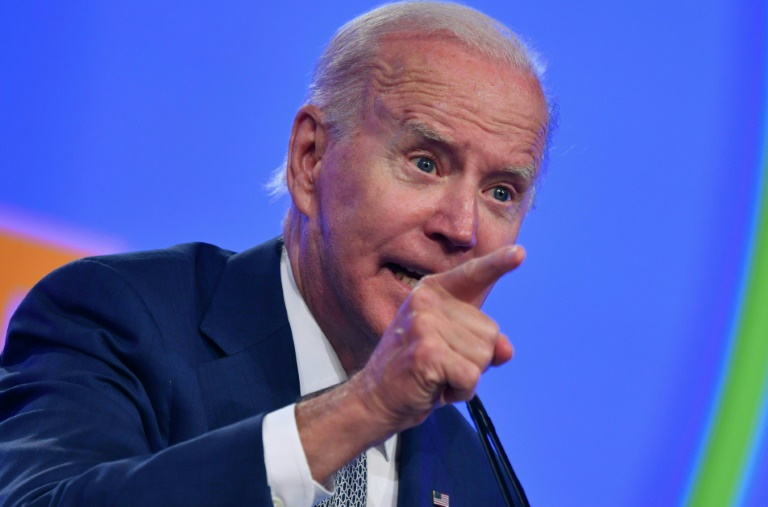
US President Joe Biden on Wednesday chastised the oil industry over soaring fuel prices at the heart of 40-year-high inflation, warning of unspecified emergency measures.

In a letter to seven major oil corporations, Biden delivered his most direct salvo yet in a campaign to blame the industry for stoking price increases. 

Average fuel prices are now $5 a gallon for drivers in the United States, up from $3 a year ago, and the spike is reverberating through the entire economy, helping to sink Biden’s approval ratings to below 40 percent.

“Refinery profit margins well above normal being passed directly onto American families are not acceptable,” Biden wrote in the letter to executives from Shell, Marathon Petroleum Corp, Valero Energy Corp, ExxonMobil, Phillips 66, Chevron and BP.

Biden said the economy is in “a time of war,” referring to the global fallout from President Vladimir Putin’s invasion of Ukraine and subsequent sanctions against energy exporter Russia.

“My administration is prepared to use all reasonable and appropriate federal government tools and emergency authorities to increase refinery capacity and output in the near term, and to ensure that every region of this country is appropriately supplied,” Biden said, without detailing what kind of actions he could take.

White House Press Secretary Karine Jean-Pierre told reporters that Biden sees it as US oil companies’ “patriotic duty” to increase capacity.

The president has regularly lambasted the oil industry for what he says is a failure to tap into already approved wells and increase output. 

But the letter, accompanied by a graph depicting rising producer profits, marked an escalation in the war of words.

In the letter Biden asked for “explanation of any reduction in your refining capacity since 2020 and any concrete ideas that would address the immediate inventory, price, and refining capacity issues in the coming months — including transportation measures to get refined product to market.”

“The crunch that families are facing deserves immediate action. Your companies need to work with my Administration to bring forward concrete, near-term solutions that address the crisis,” he wrote.

Biden’s Democratic Party risks a heavy defeat, losing control of Congress, in November elections and polls show that fears over the economy dominate.

In a fiery speech Tuesday, Biden blamed Republican obstruction in Congress and Russia’s war in Ukraine for price increases that he said are “sapping the strength of a lot of families.”

The US Federal Reserve announced the most aggressive interest rate increase in nearly 30 years Wednesday, raising the benchmark borrowing rate by 0.75 percentage points.

The goal is to tamp down inflation, but Federal Reserve Chair Jerome Powell said the central bank was “not trying to induce a recession.”

Close Bitnami banner
Bitnami