AFP

UK fines US AI firm £7.5m over mass image collection

Britain announced Monday it had fined US facial recognition company Clearview AI Inc more than £7.5 million ($9.4 million, 8.8 million euros) for amassing online images of people without their knowledge.

The UK’s data watchdog also ordered the company to stop obtaining personal data of UK residents available on the internet and to delete the data of UK residents from its systems.

The action by the Information Commissioner’s Office (ICO) follows a joint investigation with the Office of the Australian Information Commissioner.

Clearview AI Inc has a database of more than 20 billion images of people’s faces culled from the internet and social media platforms without telling people how their information was being collected.

The company’s customers — including the police — can then upload an image of a person to an app, which checks its database for a match.

“Clearview AI Inc has collected multiple images of people all over the world, including in the UK, from a variety of websites and social media platforms, creating a database with more than 20 billion images,” said UK Information Commissioner John Edwards.

“The company not only enables identification of those people, but effectively monitors their behaviour and offers it as a commercial service. That is unacceptable.”

The ICO found that Clearview AI Inc breached UK data protection laws by failing to use the information of people in Britain in a “fair and transparent” way and for failing to prevent the data being retained indefinitely.

Earlier this month Clearview AI agreed to limit access to its controversial facial recognition database in the United States, settling a lawsuit filed by privacy advocates, according to a court filing.

UK fines US AI firm £7.5m over mass image collection

Britain announced Monday it had fined US facial recognition company Clearview AI Inc more than £7.5 million ($9.4 million, 8.8 million euros) for amassing online images of people without their knowledge.

The UK’s data watchdog also ordered the company to stop obtaining personal data of UK residents available on the internet and to delete the data of UK residents from its systems.

The action by the Information Commissioner’s Office (ICO) follows a joint investigation with the Office of the Australian Information Commissioner.

Clearview AI Inc has a database of more than 20 billion images of people’s faces culled from the internet and social media platforms without telling people how their information was being collected.

The company’s customers — including the police — can then upload an image of a person to an app, which checks its database for a match.

“Clearview AI Inc has collected multiple images of people all over the world, including in the UK, from a variety of websites and social media platforms, creating a database with more than 20 billion images,” said UK Information Commissioner John Edwards.

“The company not only enables identification of those people, but effectively monitors their behaviour and offers it as a commercial service. That is unacceptable.”

The ICO found that Clearview AI Inc breached UK data protection laws by failing to use the information of people in Britain in a “fair and transparent” way and for failing to prevent the data being retained indefinitely.

Earlier this month Clearview AI agreed to limit access to its controversial facial recognition database in the United States, settling a lawsuit filed by privacy advocates, according to a court filing.

Biden says 'extra efforts' not needed against monkeypox

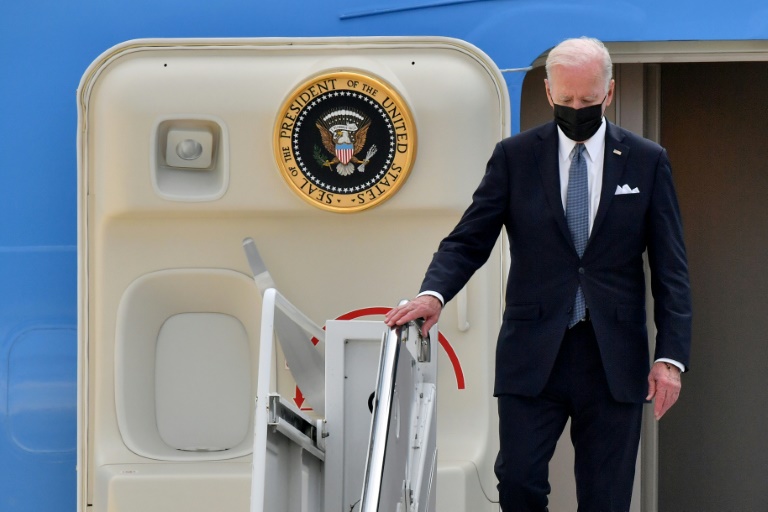
The United States has enough vaccines to deal with a potential outbreak of monkeypox and “extra efforts” are not needed to prevent its spread, President Joe Biden said on Monday.

Biden was asked if Americans could expect to see weeks-long quarantines for people infected with monkeypox after several cases were detected this month in North America and Europe.

“No, I don’t think so. Look, we’ve had this monkeypox in larger numbers in the past,” he said at a press conference in Tokyo after talks with Japanese Prime Minister Fumio Kishida.

“Number two, we have vaccines to take care of it. Number three, thus far, there doesn’t seem to be the need for any kind of extra efforts beyond what’s going on.”

Monkeypox, which is not usually fatal, can cause a fever, muscle aches, swollen lymph nodes, chills, exhaustion and a chickenpox-like rash on the hands and face. 

The virus, which is endemic in parts of Africa, can be transmitted through contact with skin lesions or droplets of bodily fluid from an infected person.

Biden, who is on his maiden trip to Asia as president, said Sunday in South Korea that people should be on guard against the disease, warning it has the potential for a “consequential” impact if it were to spread further.

On Monday, he reiterated his call for people to be careful, but said the situation did not warrant the same emergency response seen worldwide during the coronavirus pandemic.

“I just don’t think it rises to the level of the kind of concern that existed with Covid-19,” he said, adding that he believes the United States has enough smallpox vaccine stockpiled.

Fly me to the Moon: US, Japan aim for lunar landing

Japan and the United States said Monday they want to put the first Japanese astronaut on the Moon as the allies deepen cooperation on space projects.

No non-American has ever touched down on the lunar surface, and Japan has previously said it hopes to achieve a Moon landing by the end of this decade.

President Joe Biden, after his first face-to-face meeting with Japan’s Prime Minister Fumio Kishida in Tokyo, said the nations will work together in the US-led Artemis programme to send humans to the Moon, and later to Mars.

Biden said he was “excited” about the collaboration, including on the Gateway facility, which will orbit the Moon and provide support for future missions.

“I’m excited (about) the work we’ll do together on the Gateway Station around the Moon, and look forward to the first Japanese astronaut joining us on the mission to the lunar surface under the Artemis programme,” he said at a joint press conference.

Japan’s domestic space programme focuses on satellites and probes, so Japanese astronauts have turned to the US and Russia to travel to the International Space Station.

But space agency JAXA is looking to revitalise its ranks, last year launching its first recruitment of new astronauts in 13 years.

It lifted the requirement that applicants have a science degree and urged women to apply, because all seven of the nation’s current astronauts are men.

US unveils Asia-Pacific trade framework, but questions remain

US President Joe Biden launched a new Asia-Pacific trade initiative Monday in Tokyo, with 13 countries including India and Japan signed up, although questions about the pact’s effectiveness remain.

Biden formally unveiled the Indo-Pacific Economic Framework for Prosperity, or IPEF, on his second day in Japan, where he held talks with Prime Minister Fumio Kishida ahead of a regional Quad summit on Tuesday.

“I believe we’ll win the competition of the 21st century together,” he said at the launch, attended in person by Kishida and Indian Prime Minister Narendra Modi, and virtually by representatives from the other countries.

Unlike traditional trade blocs, there is no plan for IPEF members to negotiate tariffs and ease market access — a tool that has become increasingly unpalatable to US voters fearful of seeing homegrown manufacturing undermined.

Instead, the programme foresees integrating partners through agreed standards in four main areas: the digital economy, supply chains, clean energy infrastructure and anti-corruption measures.

The starting list of members in addition to the United States is Australia, Brunei, India, Indonesia, Japan, Malaysia, New Zealand, the Philippines, Singapore, South Korea, Thailand and Vietnam.

The countries touted IPEF as a framework for what will ultimately become a tight-knit group of trading nations.

“We share a commitment to a free, open, fair, inclusive, interconnected, resilient, secure, and prosperous Indo-Pacific region,” they said in a joint statement.

“Deepening economic engagement among partners is crucial for continued growth, peace, and prosperity.”

– Rebuilding alliances –

Together, the participants account for about 40 percent of global GDP and “there are other countries that could conceivably join us,” Biden’s national security adviser, Jake Sullivan, told reporters.

Biden has pushed to rapidly rebuild strategic military and trade alliances weakened under his predecessor Donald Trump since taking office in 2021.

IPEF is intended to offer US allies an alternative to China’s growing commercial presence across the Asia-Pacific.

However, there is no political will in Washington for returning to a tariffs-based Asia trade deal following Trump’s 2017 withdrawal from the Trans-Pacific Partnership — a huge trading bloc that was revived under a new name in 2018, without US membership.

While the TPP reduces trade barriers for members, US Secretary of Commerce Gina Raimondo emphasised to reporters that IPEF was not designed to go down the same route.

The “framework is intentionally designed not to be a same old, same old traditional trade agreement,” she said.

Even so, Japan’s Kishida said there is a desire for US involvement in the larger pact abandoned by Trump.

The country welcomes the new framework and will “participate and cooperate”, he said, but “from a strategic standpoint, Japan hopes that the United States will return to the TPP”.

– No Taiwan –

China has criticised IPEF as an attempt to create a closed club. Sullivan rejected this, saying “it is by design and definition an open platform.”

Taiwan, the self-governing democracy that China claims sovereignty over, has pointedly not been brought into the initial line-up — despite being an important link in supply chains for microchips.

Sullivan said nevertheless that the United States is “looking to deepen our economic partnership with Taiwan, including on high-technology issues, including on semiconductors and supply chains”.

This will happen, however, only “on a bilateral basis”.

From the start, the US initiative faced scepticism.

Without offering increased access to the huge US market, it is unclear what enforcement mechanisms could be applied to promote the proposed integration.

But Raimondo said IPEF would be a powerful force, suggesting that if it had been in place before the Covid-19 pandemic the United States would have “experienced much less disruption” in the subsequent supply chain crisis.

And more broadly, the US trade-boosting initiative is welcomed by businesses that “increasingly look for alternatives to China”, she said.

Asian markets rise as Biden 'considers' lifting China tariffs

Asian stocks rose Monday after US President Joe Biden said he was considering lifting some Trump-era trade tariffs imposed on China, although concerns over inflation and growth weighed on sentiment.

Tariffs on hundreds of billions of dollars of Chinese imports are due to expire in July, and Biden has faced growing calls to get rid of the punitive duties to help combat the highest US inflation in more than four decades.

Biden’s comments Monday during a visit to Tokyo come after Treasury Secretary Janet Yellen last week said some of the duties imposed by former president Donald Trump “seem to impose more harm on consumers and businesses” and do little to address real issues posed by the Asian giant.

The president also said a recession in the United States was not inevitable but acknowledged the economic pain felt by American consumers, saying “this is going to take some time”.

Ending the tariffs could help cut roaring US inflation by making imports cheaper.

Biden also announced that 13 countries had joined a new, US-led Asia-Pacific trade initiative, although there are questions about the pact’s effectiveness.

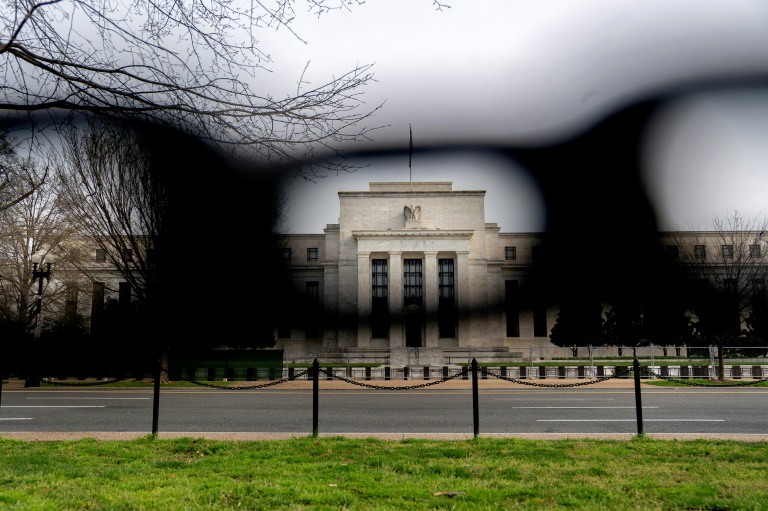
Investors will be looking to the release on Wednesday of notes from the latest Federal Reserve committee meeting for clues on further rate hikes by the US central bank.

Trade was cautious in Asia after Wall Street briefly dipped into a bear market Friday, with the S&P 500 index down about 19 percent from its January high. 

Tokyo closed 1.0 percent higher, while Shanghai ended flat. Hong Kong fell 1.2 and Singapore was down 0.6 percent but most other Asian markets saw gains, with Seoul, Bangkok, Taipei and Mumbai in the green.

Sydney ended marginally higher following a weekend election that saw the centre-left Labor party end a decade of conservative rule.

The new government of Prime Minister Anthony Albanese is expected to undertake some policy shifts, particularly on climate change, but economists said they were unlikely to upset growth forecasts.

An interest rate cut by Beijing did little to cheer Chinese markets, with investors concerned about continuing Covid restrictions that are hurting the world’s second-largest economy and snarling international supply chains.

European markets opened higher despite lingering concerns over inflation, with London up 0.8 percent, Frankfurt 1.4 percent higher and Paris adding 0.7 percent.

Downcast earning reports from retailers have also heightened market uncertainty at a time of rising interest rates, surging energy prices and Russia’s ongoing war in Ukraine, which is driving commodity prices higher.

“As macro-economic concerns stemming from aggressive monetary tightening, the Russia-Ukraine conflict and China’s stringent Covid lockdowns persist, we anticipate great volatility in the market,” Louise Dudley, portfolio manager global equities at Federated Hermes, said in a note, Bloomberg News reported.

Oil was higher, with US crude benchmark WTI up 0.9 percent and Brent gaining 1.0 percent.

The invasion of Ukraine has shaken up the global market and the outlook for key producer Russia, which has been largely shunned by Western countries.

“Concerns over demand destruction appear to be limiting the upside, while threats of oil embargoes are keeping a floor under the downside,” said Michael Hewson, chief market analyst at CMC Markets.

– Key figures at around 0730 GMT –

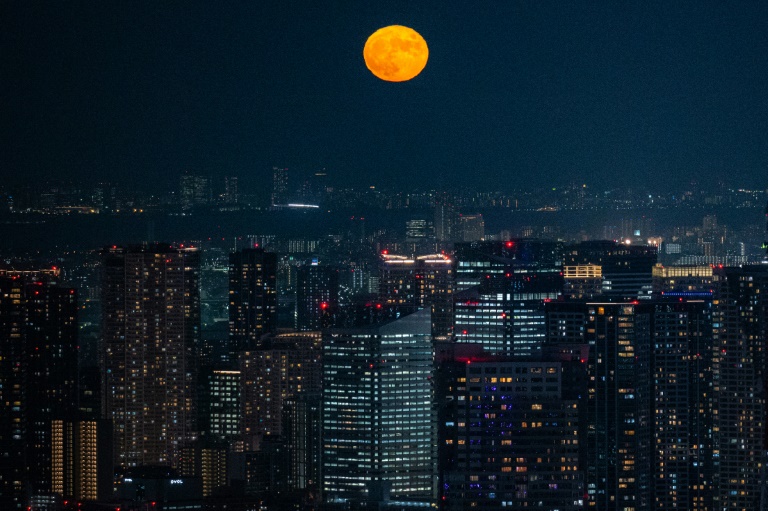
Tokyo – Nikkei 225: UP 1.0 percent at 27,001.52 (close)

Hong Kong – Hang Seng Index: DOWN 1.2 percent at 20,470.06 (close)

Shanghai – Composite: FLAT at 3,146.86 (close)

Dollar/yen: DOWN at 127.67 yen from 127.86 yen on Friday

Euro/dollar: UP at $1.0605 from $1.0564

Pound/dollar: UP at $1.2572 from $1.2497

Euro/pound: DOWN at 84.36 pence from 84.50 pence

West Texas Intermediate: UP 0.9 percent at $111.27 per barrel

Brent North Sea crude: UP 1.0 percent at $113.70 per barrel

New York – Dow: FLAT at 31,261.90 (close)

London – FTSE 100: UP 0.8 percent at 7,447.31

More than 100 million people forcibly displaced: UN

Russia’s war in Ukraine has pushed the number of forcibly displaced people around the world above 100 million for the first time ever, the United Nations said on Monday.

“The number of people forced to flee conflict, violence, human rights violations and persecution has now crossed the staggering milestone of 100 million for the first time on record, propelled by the war in Ukraine and other deadly conflicts,” said UNHCR, the UN Refugee Agency.

The “alarming” figure must shake the world into ending the conflicts forcing record numbers to flee their own homes, the UNHCR said in a statement.

UNHCR said the numbers of forcibly displaced people rose towards 90 million by the end of 2021, spurred by violence in Afghanistan, Burkina Faso, the Democratic Republic of Congo, Ethiopia, Myanmar and Nigeria.

Russia invaded Ukraine on February 24 and since then more than eight million people have been displaced within the country, while more than six million refugees have fled across the borders.

– ‘Wake-up call’ –

“One hundred million is a stark figure — sobering and alarming in equal measure. It’s a record that should never have been set,” said UN High Commissioner for Refugees Filippo Grandi.

“This must serve as a wake-up call to resolve and prevent destructive conflicts, end persecution and address the underlying causes that force innocent people to flee their homes.”

The 100 million figure amounts to more than one percent of the global population. Only 13 countries have a bigger population than the number of forcibly displaced people in the world.

The figures combine refugees, asylum-seekers and more than 50 million people displaced inside their own countries.

“The international response to people fleeing war in Ukraine has been overwhelmingly positive,” said Grandi.

“Compassion is alive and we need a similar mobilisation for all crises around the world. But ultimately, humanitarian aid is a palliative, not a cure.

“To reverse this trend, the only answer is peace and stability so that innocent people are not forced to gamble between acute danger at home or precarious flight and exile.”

UNHCR will provide the full data on forced displacement in 2021 in its annual Global Trends Report, due for release on June 16.

– ‘Plague of human suffering’ –

More than two years on since the start of the Covid-19 pandemic, at least 20 countries still deny access to asylum for people fleeing conflict, violence, and persecution based on measures to clamp down on the virus.

Grandi called on May 20 for those countries to lift any remaining pandemic-related asylum restrictions, saying they contravene a fundamental human right.

“I am worried that measures enacted on the pretext of responding to Covid-19 are being used as cover to exclude and deny asylum to people fleeing violence and persecution,” he said.

A joint report last week by the Internal Displacement Monitoring Centre (IDMC) and the Norwegian Refugee Council (NRC) said around 38 million new internal displacements were reported in 2021. Some of those were by people forced to flee multiple times during the year.

The figure marks the second-highest annual number of new internal displacements in a decade after 2020, which saw record-breaking movement due to a string of natural disasters.

Last year, new internal displacements specifically from conflict surged to 14.4 million — marking a 50-percent jump from 2020, the report showed.

“Today’s sobering 100 million displacement figure is indisputable proof that global leaders are failing the world’s most vulnerable people on a scale never before seen,” NRC secretary-general Jan Egeland said in a statement.

“We are witnessing an unprecedented plague of human suffering.”

He said the aid system would not be able to support 100 million people in need without more resources.

“It is twice the number of people compared to a decade ago, without a doubling of funding to match it,” Egeland said.

Natural disasters continued to account for most new internal displacement, spurring 23.7 million such movements in 2021.

US unveils Asia-Pacific trade framework, but questions remain

President Joe Biden launched a new Asia-Pacific trade initiative Monday in Tokyo, with 13 countries including India and Japan signing up, although questions about the pact’s effectiveness remain.

Biden formally unveiled the Indo-Pacific Economic Framework for Prosperity, or IPEF, on his second day in Japan, where he is also holding talks with Prime Minister Fumio Kishida before joining a regional Quad summit on Tuesday.

“This framework is a commitment to working with our close friends and partners in the region on challenges that matter most to ensuring economic competitiveness in the 21st century,” he said.

Unlike traditional trade blocs, there is no plan for IPEF members to negotiate tariffs and ease market access — a tool that has become increasingly unpalatable to US voters fearful of seeing homegrown manufacturing undermined.

Instead, the programme foresees integrating partners through agreed standards in four main areas: the digital economy, supply chains, clean energy infrastructure and anti-corruption measures.

The starting list of members in addition to the United States is Australia, Brunei, India, Indonesia, Japan, Malaysia, New Zealand, the Philippines, Singapore, South Korea, Thailand and Vietnam.

The countries touted IPEF as a framework for what will ultimately become a tight-knit group of trading nations.

“We share a commitment to a free, open, fair, inclusive, interconnected, resilient, secure, and prosperous Indo-Pacific region,” they said in a joint statement.

“Deepening economic engagement among partners is crucial for continued growth, peace, and prosperity.”

– Rebuilding alliances –

Together, the participants account for about 40 percent of global GDP and “there are other countries that could conceivably join us,” Biden’s national security adviser, Jake Sullivan, told reporters.

Biden has pushed to rapidly rebuild strategic military and trade alliances weakened under his predecessor Donald Trump since taking office in 2021.

IPEF is intended to offer US allies an alternative to China’s growing commercial presence across the Asia-Pacific.

However, there is no political will in Washington for returning to a tariffs-based Asia trade deal following Trump’s 2017 withdrawal from the Trans-Pacific Partnership — a huge trading bloc that was revived under a new name in 2018, without US membership.

While the TPP reduces trade barriers for members, US Secretary of Commerce Gina Raimondo emphasised to reporters that IPEF was not designed to go down the same route.

The “framework is intentionally designed not to be a same old, same old traditional trade agreement,” she said.

Even so, Japan’s Kishida said there is still an appetite for US involvement in the larger pact abandoned by Trump.

The country welcomes the new framework and will “participate and cooperate”, he said, but “from a strategic standpoint, Japan hopes that the United States will return to the TPP”.

– No Taiwan –

China has criticised IPEF as an attempt to create a closed club. Sullivan rejected this, saying “it is by design and definition an open platform.”

Taiwan, the self-governing democracy that China claims sovereignty over, has pointedly not been brought into the initial line-up — despite being an important link in supply chains for microchips.

Sullivan said nevertheless that the United States is “looking to deepen our economic partnership with Taiwan, including on high-technology issues, including on semiconductors and supply chains”.

This will happen, however, only “on a bilateral basis”.

The United States faces skepticism, given the lack of incentives to go along with IPEF’s plan for smoother integration.

Without offering increased access to the huge US market, it is unclear what enforcement mechanisms could be applied.

But Raimondo said that if IPEF had been in place before the Covid-19 pandemic triggered mass economic shutdowns, the United States would have “experienced much less disruption”.

And more broadly, the US trade-boosting initiative is welcomed by businesses that “increasingly look for alternatives to China”, she said.

Turkey dreams of far-fetched gas pipeline with Israel

Turkey is ready for energy cooperation with Israel after years of enmity, reviving a project to pipe Israeli gas to Europe as Ankara seeks to reduce its dependence on Russia.

But the plan faces Israeli scepticism over past diplomatic tensions and seems a pipe dream in the eyes of experts due to its logistical complexity and cost.

President Recep Tayyip Erdogan has voiced readiness to “cooperate (with Israel) in energy and energy security projects” with the prospect of shipping Israeli gas to Europe through Turkey as the conflict in Ukraine triggers supply fears.

“Turkey has the experience and capacity to implement such projects. The recent developments in our region has shown once again the importance of energy security,” he said in March.

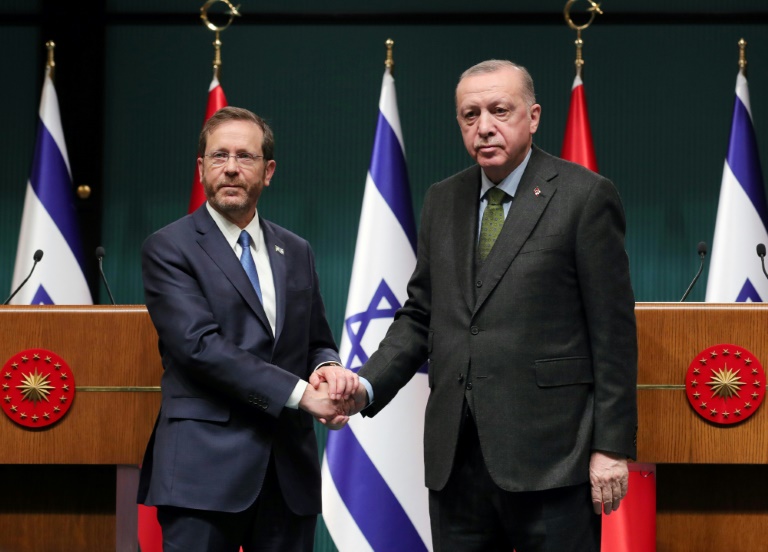
Israeli President Isaac Herzog made a landmark visit to Ankara in March to build relations with his Turkish counterpart when both leaders proclaimed a new era following more than a decade of diplomatic rupture.

Turkish Foreign Minister Mevlut Cavusoglu will visit Israel on Wednesday. Energy Minister Fatih Donmez is also expected to travel but it was not immediately clear if he will accompany Cavusoglu. 

But according to some experts, there is little Israeli interest in energy cooperation with Turkey.

– ‘Erdogan an untrustworthy party’ –

“Energy relations are forged by cooperative, trusting states — certainly not how one would describe the current dynamics between the two countries,” Gabi Mitchell, policy fellow at the Mitvim Institute in Israel, told AFP.

“There are those in Israel who argue that Erdogan is an untrustworthy party,” he said.

The Turkish leader is known for his angry outbursts at the Jewish state, especially over its policy towards the Palestinians.

In 2009, he stormed out of a Davos panel after a heated exchange with the then Israeli president, Shimon Peres. 

NATO member Turkey had been Israel’s key ally in the Muslim world until a 2010 crisis where 10 civilians died in an Israeli raid on a ship seeking to breach a blockade on the Gaza Strip.

In 2016, the two countries agreed to start examining the feasibility of an undersea pipeline to pump Israeli gas to Turkish consumers and on to Europe.

But no progress has been made amid the tension between the two sides, with Erdogan seeing himself as a champion of the Palestinian cause and a strong backer of Hamas.

Yet Erdogan has been muted in his criticism in recent months and only voiced sadness over the Israeli-Palestinian violence at the flashpoint Al-Aqsa mosque compound, in a phone call with Herzog in April.

The pipeline project runs through controversial waters in the eastern Mediterranean, where Turkey and EU members Cyprus and Greece are often at odds.

Mitchell said: “This isn’t something Israel is interested in pursuing as it would damage relations” with Cyprus, Greece and the European Union.

“I’ve never thought the project feasible,” the Foreign Policy Research Institute’s Middle East Program director Aaron Stein told AFP. 

“The idea of the project comes back every time there is a thaw but the logistics needed to take it from a dream to reality is complicated and expensive,” he said. 

The pipeline from Israeli fields to Turkey could cost $1.5 billion, according to some media reports.  

– ‘Difficult but reasonable’ –

Ankara is hugely dependent on Russia for its energy imports, with 45 percent of its gas demand last year met by Russian sources, and is keen to diversify supplies, with a close eye on Israel’s developing resources.

Turkey imports natural gas through pipelines from Russia, Azerbaijan and Iran. It also buys liquefied natural gas (LNG) from suppliers including Qatar, Nigeria, Algeria and the United States.

“A gas pipeline crossing the south of Turkey in theory makes sense,” said energy expert Necdet Pamir of Cyprus International University. 

Turkey consumed 48 billion cubic metres of gas in 2020. This reached 60 billion in 2021 and is estimated to be 62-63 billion this year, he said.

“We need alternative gas supplies and new agreements are in Turkey’s interests as long as the circumstances including the financing are ripe,” Pamir added.

The Turkish option has reappeared on the agenda especially after the United States snubbed an eastern Mediterranean pipeline aimed at transferring natural gas from Israeli waters to Europe via Cyprus and Greece. That project excluded Turkey.

Turkey sees the gas project with Israel as more feasible than the EastMed pipeline despite the challenges. 

“It is not a project that begins today and ends tomorrow,” a Turkish official told AFP. 

“It’s difficult but it’s reasonable and feasible, especially compared to the Greece-led EastMed,” the official, who wished to remain anonymous, said.

With the basic economics of the Turkey-Israel pipeline still being questioned, some experts indicate LNG is a desirable, cheaper option.

“Beyond the politics, and the issue of Cyprus, land-based LNG terminals make more sense,” Stein said. “Financially, and it’s easier politically.”


Asian markets mixed as inflation fears weigh

Asian stocks were mixed Monday as inflation fears and concerns about low economic growth weighed on markets.

Investors will be looking to the release on Wednesday of notes from the latest Federal Reserve committee meeting for clues on further rate hikes by the US central bank.

Wall Street ended the week essentially flat after the S&P 500 had briefly dipped into a bear market, with the index down about 19 percent from its January high.

A Chinese interest rate cut did little to cheer Asian markets, with investors concerned about continuing Covid restrictions that are hurting the world’s second-largest economy and snarling international supply chains.

Downcast earning reports from retailers have also heightened market uncertainty at a time of rising interest rates, surging energy prices and Russia’s ongoing war on Ukraine, which is driving commodity prices higher.

“As macro-economic concerns stemming from aggressive monetary tightening, the Russia-Ukraine conflict and China’s stringent Covid lockdowns persist, we anticipate great volatility in the market,” Louise Dudley, portfolio manager global equities at Federated Hermes, said in a note, Bloomberg News reported.

In Asian trade Monday, Tokyo climbed 1.3 percent while Hong Kong slipped 1.5 percent and Shanghai was down 0.5 percent.

Seoul, Kuala Lumpur and Bangkok were higher while Singapore and Manila were down and Sydney was flat following a weekend election that saw the centre-left Labor party end a decade of conservative rule.

The new government of Prime Minister Anthony Albanese is expected to undertake some policy shifts, particularly on climate change, but economists said they were unlikely to upset growth forecasts.

“In our view there was little proposed by the incoming government during the election campaign that at this stage requires us to revisit our economic forecasts,” Commonwealth Bank of Australia economists said in a note.

“Put another way, our economic forecasts and call on the (Australian central bank) are unchanged despite the change of national leadership.”

Oil was higher, with US crude benchmark WTI up 0.5 percent and Brent gaining 0.7 percent.

The invasion of Ukraine has shaken up the global market and the outlook for key producer Russia, which has been largely shunned by Western countries.

– Key figures at around 0300 GMT –

Tokyo – Nikkei 225: UP 1.3 percent at 26,872.01 (break)

Hong Kong – Hang Seng Index: DOWN 1.5 percent at 20,416.04

Shanghai – Composite: DOWN 0.5 percent at 3,131.23

Dollar/yen: DOWN at 127.30 from 127.86 yen on Friday

Euro/dollar: UP at $1.0592 from $1.0564

Pound/dollar: UP at $1.2543 from $1.2497

Euro/pound: DOWN at 84.45 from 84.50 pence

West Texas Intermediate: UP 0.5 percent at $110.81 per barrel

Brent North Sea crude: UP 0.7 percent at $113.29 per barrel

New York – Dow: FLAT at 31,261.90 (close)

London – FTSE 100: UP 1.2 percent at 7,389.98 (close)

Close Bitnami banner
Bitnami