AFP

New PM Sharif orders 'Pakistan speed' to fix stagnant economy

Pakistan’s new Prime Minister Shehbaz Sharif said Thursday the country’s economy had stagnated under his predecessor Imran Khan, setting the tone for possibly months of bitterness before an election that must be held by October next year.

Sharif, sworn in Monday after Khan was ousted by a no-confidence vote in parliament, is still finalising his cabinet but has called for “Pakistan speed” to hurry along development projects and fix the economy.

On Thursday the 70-year-old notorious workaholic visited a metro bus project in Rawalpindi and complained about the pace of infrastructure development.

“Almost all sectors of economy remained stagnant under IK,” he later tweeted, referring to his predecessor by his initials.

His early-morning visit came after Khan on Wednesday night held a huge rally in Peshawar.

Khan — along with most of his Pakistan Tehreek-e-Insaf (PTI) lawmakers — quit the national assembly after losing Sunday’s no-confidence vote, saying he would take his fight to the people to press for an early election.

On Wednesday, Khan said he would stage twice-weekly rallies across the country until a new poll date was set.

“Young people, get ready, I will take to the streets with you. I will go out in every city, and I will continue to go out until they are forced to hold election.”

Sharif, younger brother of three-time prime minister Nawaz Sharif, set out his stall on Tuesday by ordering the government to adopt a six-day work-week, instead of the previous five, and bringing forward office opening hours to 8 am from 10 am.

His “Pakistan speed” policy is an extension of a similar programme he introduced as chief minister of Punjab, the country’s most populous province, where he was credited with launching a series of high-profile — and vote-catching — projects.

– Broken economy –

The government would take unspecified “emergency measures” to stabilise the economy, Sharif’s office said later, focusing on steps to improve the condition of ordinary people.

Sharif inherits crippling national debt, galloping inflation and a feeble rupee — although analysts say Khan also took over a broken economy in 2018 that was further battered by the Covid-19 pandemic.

Khan’s ouster heralds the return of two dynastic parties that have dominated Pakistan politics for decades.

Sharif’s centrist Pakistan Muslim League-N (PML-N) joined forces with the centre-left Pakistan Peoples Party (PPP) — fiefdom of the Bhutto family — to press the no-confidence vote.

Khan tried everything to stay in power after losing his majority in parliament through defections by his own lawmakers and a coalition partner — including dissolving the assembly and calling a fresh election.

But the Supreme Court deemed all his actions illegal and ordered them to reconvene and vote.

On Thursday Pakistan’s military insisted it played no role in the PM’s ousting, although the head of its public relations wing said Khan had consulted them on his options.

There have been four coups since Pakistan attained independence in 1947 and the country has spent more than three decades under army rule.

“All what happened in recent days was part of a political process,” Major-General Babar Iftikhar told a press conference, urging parties “not to drag the army into politics”.

Khan insists he has been the victim of a “regime change” conspiracy involving Washington and his opponents, and vowed to take his fight to the streets in the hope of forcing an early election.

On Wednesday night Khan told thousands of supporters that the new government was “imported”, saying Pakistan needed to forge an independent global path.

He has said Washington wanted him removed because he refused to take sides in the Russia-Ukraine conflict, and because of his close links to China.

Washington, Moscow and Beijing have all congratulated Sharif since he took over.

Sri Lankans abandon holiday celebrations for protests

Life usually stops in Sri Lanka’s capital during April’s holiday period, but with an economic crisis derailing traditional home celebrations, Colombo’s city centre is instead teeming with frustrated crowds.

Sri Lankans ritually boil milk on the first day of the island nation’s New Year, but the commodity is one of many in short supply — along with the liquid gas and kerosene used to heat stoves in many Colombo households, and rice to serve family members.

Demonstrators this year brought the custom out of their homes and heated clay pots over makeshift bonfires outside the capital’s Presidential Secretariat, highlighting the plight of households now forced to cook with firewood.

The seafront park by the neoclassical office has since the weekend hosted a running protest vigil, demanding the government’s resignation over Sri Lanka’s worst financial crisis in memory. 

“The economic situation is unbearable for many people,” Hemakumara Perera, who joined the protest from a small town south of the capital, told AFP. 

Perera, his wife and two children camped at the site overnight to “show solidarity” with fellow Sri Lankans suffering through what is usually a joyous family celebration. 

“We support their call for the president and the prime minister to step down,” he said. 

Other New Year customs have been abandoned, such as the buying of new garments to symbolise fresh beginnings.

“We are not in a mood to wear new clothes and celebrate when we know how people are suffering,” said Lakshika Gunawardena, who joined the protest carrying her five-month-old baby. 

– ‘We can’t go’ –

Sri Lanka’s New Year is usually a private affair, with families sharing meals at home and giving sweets to neighbours as commercial activity comes to a standstill.

The crowds now thronging public spaces are an unusual sight for this time of year — as is the silence from the country’s besieged leaders. 

The government skipped its usual handout photographs of top politicians celebrating the occasion with their families. 

And there was no sign of a text message holiday greeting from Prime Minister Mahinda Rajapaksa, sent to every mobile phone in the country in previous years.

Both he and younger brother Gotabaya Rajapaksa — Sri Lanka’s president — have been accused of mismanaging the economy and blindly leading the country into its present predicament. 

The country is now in default of its $51 billion foreign debt ahead of negotiations for an International Monetary Fund bailout, and authorities have begged Sri Lankans abroad to send money home to help alleviate the crisis.

The president has not returned to his office since the protest began on the weekend, and a bolstered security presence is keeping watch over the encampment. 

But interactions between police and the crowd were jovial and even festive, with demonstrators chatting to officers and sharing traditional New Year food and sweets.

“The demonstrators won’t go until the government goes,” said a traffic constable standing watch outside the building while sheltering from the scorching morning sun. 

“And we can’t go until both leave,” he added.

Death toll from Philippines landslides, floods hits 133

The death toll from landslides and flooding in the Philippines triggered by tropical storm Megi rose to 133 on Thursday, official figures showed, as more bodies were found in mud-caked villages.

Scores of people are still missing and feared dead after the strongest storm to strike the archipelago nation this year dumped heavy rain over several days, forcing tens of thousands into evacuation centres.

In the central province of Leyte — the worst affected by Megi — devastating landslides smashed farming and fishing communities, wiping out houses and transforming the landscape.

The disaster-prone region is regularly ravaged by storms — including a direct hit from Super Typhoon Haiyan in 2013 — with scientists warning they are becoming more powerful as the world gets warmer because of climate change.

Emergency personnel in Abuyog municipality have retrieved dozens of bodies from the coastal village of Pilar, which was destroyed by a landslide on Tuesday.

At least 42 people died in landslides that hit three villages in the municipality, police said. Another person drowned.  

Most of those deaths were in Pilar, with at least 28 bodies brought by boat to a sandy lot near the municipal government building after roads leading to the settlement were cut off by landslides.

More than 100 remained missing, and Abuyog Mayor Lemuel Traya told AFP there was little hope of finding anyone else alive.

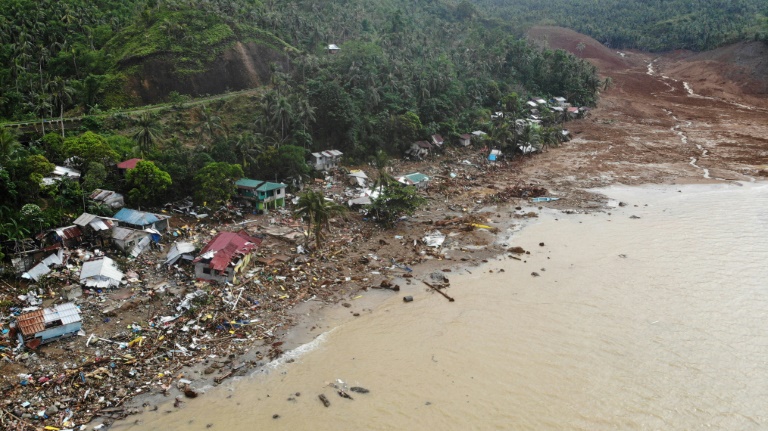
An aerial photo showed a wide stretch of mud and earth that had swept down a mountain to the sea, crushing everything in its path.

The wreckage of houses and debris were scattered along the shore.

Bad weather and thick mud had complicated retrieval efforts in Pilar, where the ground was unstable. Searchers were also combing the coastline after some bodies were swept kilometres away by ocean currents.

“This will not end soon, it could go on for days,” Traya warned. 

Many of those who died had hiked to higher ground to avoid flash floods, villagers told AFP. 

“It sounded like a helicopter,” said Pilar councillor Anacleta Canuto, 44, describing the noise made by the landslide.

Canuto, her husband and their two children survived, but they lost at least nine relatives.

Pilar fisherman Santiago Dahonog, 38, said he rushed into the sea with two siblings and a nephew as the landslide hurtled towards them.

“We got out of the house, ran to the water and started swimming,” he told AFP. “I was the only survivor.” 

– Scores missing in Baybay –

Another 86 people were killed and dozens injured in vegetable, rice and coconut-growing villages around Baybay City at the weekend, local authorities said. At least 117 are still missing.

The hardest hit was Kantagnos, where 32 people died and 103 have not been found. 

In the nearby village of Bunga, 17 people perished when sodden soil shot down a hill and slammed into the riverside community. Only a few rooftops are visible in the mud, which has started to smell of rotting flesh. 

Three people also drowned on the main southern island of Mindanao, and one person died in the central province of Iloilo, the national disaster agency said in its latest update.

Another three deaths previously reported in the central province of Negros Oriental were dropped from the tally after they were found to be unrelated to the storm. 

Megi struck at the beginning of Holy Week, one of the most important holidays in the mainly Catholic nation, when thousands travel to visit relatives.

It came four months after a super typhoon devastated swathes of the country, killing more than 400 and leaving hundreds of thousands homeless.

The Philippines — ranked among the most vulnerable nations to the impacts of climate change — is hit by an average of 20 storms every year.

New PM Sharif orders 'Pakistan speed' to fix stagnant economy

Pakistan’s new Prime Minister Shehbaz Sharif said Thursday the country’s economy had stagnated under his predecessor Imran Khan, setting the tone for possibly months of bitterness before an election that must be held by October next year.

Sharif, sworn in Monday after Khan was ousted by a no-confidence vote in parliament, is still finalising his cabinet but has called for “Pakistan speed” to hurry along development projects and fix the economy.

On Thursday the 70-year-old notorious workaholic visited a metro bus project in Rawalpindi and complained about the pace of infrastructure development.

“Almost all sectors of economy remained stagnant under IK,” he later tweeted, referring to his predecessor by his initials.

His early-morning visit came after Khan on Wednesday night held a huge rally in Peshawar.

Khan — along with most of his Pakistan Tehreek-e-Insaf (PTI) lawmakers — quit the national assembly after losing Sunday’s no-confidence vote, saying he would take his fight to the people to press for an early election.

On Wednesday, Khan said he would stage twice-weekly rallies across the country until a new poll date was set.

“Young people, get ready, I will take to the streets with you. I will go out in every city, and I will continue to go out until they are forced to hold election.”

– ‘Pakistan speed’ –

Sharif, younger brother of three-time prime minister Nawaz Sharif, set out his stall on Tuesday by ordering the government to adopt a six-day work-week, instead of the previous five, and bringing forward office opening hours to 8 am from 10 am.

His “Pakistan speed” policy is an extension of a similar programme he introduced as chief minister of Punjab, the country’s most populous province, where he was credited with launching a series of high-profile — and vote-catching — projects.

The government would take unspecified “emergency measures” to stabilise the economy, Sharif’s office said later, focusing on steps to improve the condition of ordinary people.

Sharif inherits crippling national debt, galloping inflation and a feeble rupee — although analysts say Khan also took over a broken economy in 2018 that was further battered by the Covid-19 pandemic.

Khan’s ouster heralds the return of two dynastic parties that have dominated Pakistan politics for decades.

Sharif’s centrist Pakistan Muslim League-N (PML-N) joined forces with the centre-left Pakistan Peoples Party (PPP) — fiefdom of the Bhutto family — to press the no-confidence vote.

Khan tried everything to stay in power after losing his majority in parliament through defections by his own lawmakers and a coalition partner — including dissolving the assembly and calling a fresh election.

But the Supreme Court deemed all his actions illegal and ordered them to reconvene and vote.

The cricketer-turned-politician insists he has been the victim of a “regime change” conspiracy involving Washington and his opponents, and vowed to take his fight to the streets in the hope of forcing an early election.

On Wednesday night Khan told thousands of supporters that the new government was “imported”, saying Pakistan needed to forge an independent global path.

He has said Washington wanted him removed because he refused to take sides in the Russia-Ukraine conflict, and also because of his close links to China.

Washington, Moscow and Beijing have all congratulated Sharif since he took over.

Taiwan's TSMC reports record first-quarter revenue

Taiwanese tech giant TSMC posted record revenue for the first three months of the year Thursday as demand soared for chips used in everything from smartphones and cars to missiles.

Taiwan Semiconductor Manufacturing Company (TSMC) operates the world’s largest silicon wafer factories and produces some of the most advanced microchips.

Its first-quarter revenue rose 36 percent on-year and 12 percent on-quarter, respectively, to a record Tw$491.1 billion (US$17.6 billion), according to a company statement.

It also posted a 45 percent year-on-year profit of Tw$202.7 billion in the January-March period. 

That was up 22 percent from the 2021 fourth quarter.

CEO C.C. Wei said first-quarter revenue was “above the high-end of our guidance mainly due to better demand from smartphone and automotive-related applications than our forecast three months ago”. 

TSMC had forecast Q1 sales of between Tw$458.16 billion and Tw$474.72 billion at an investor conference in January.

Smartphone and high-performance computing (HPC) accounted for 40 percent and 41 percent of net revenue respectively, while automotive represented five percent in the first three months, company figures showed. 

Revenue from HPC and automotive both rose 26 percent in this period from the fourth quarter in 2021. 

A global chip shortage fulled by the coronavirus pandemic has not eased and wait time for semiconductor delivery reportedly grew again in March partly due to China’s strict Covid lockdowns.

“Moving into second quarter 2022, we expect our business to be supported by HPC and automotive-related demand, partially offset by smartphone seasonality,” Wei said. 

TSMC forecast its revenue in the April-June period to be between US$17.6 billion and US$18.2 billion, said chief financial officer Wendell Huang. 

“Despite the manufacturing cost challenges… we continue to believe a long-term growth margin of 53 percent and higher is achievable,” he added.

Uniqlo operator lifts profit outlook despite China lockdowns

Fast Retailing, the operator of Japanese casualwear giant Uniqlo, revised its annual net profit forecast upwards on Thursday even as business in China is hit by fresh lockdowns.

China is a key market for Uniqlo, but consumer spending has been hampered by tough lockdowns imposed on cities like Shanghai under the country’s zero-Covid policy.

Uniqlo operations in mainland China saw “a decrease in revenue and a large decline in profit” for the six months to February, Fast Retailing said, attributing the falls to curbs on movement.

In a news conference, Fast Retailing president Tadashi Yanai described the effect of China’s zero-Covid policy on profits as “very troubling”.

But elsewhere in Asia, business was brisk — buoyed by a strong performance in countries including Malaysia, where virus restrictions were eased.

In North America, strengthened branding efforts helped boost sales, the company said, unveiling plans to increase its stores in the traditionally money-losing region from 57 to 200 within five years.

Overall, the group reported that net profit for the first half jumped 38.7 percent on-year to 146.8 billion yen ($1.2 billion).

Operating profit was up 12.7 percent on-year “even after stripping out the impact of yen depreciation”, the company said.

The cheap-chic Japanese clothing group — which rivals Zara, Gap and H&M — revised its full-year net profit forecast from the previous 175 billion yen to 190 billion yen.

Despite pandemic restrictions, Fast Retailing has aggressively expanded in China, where it aims to open 100 new stores each year.

But it has suspended sales in Russia and now expects a loss for the second half of the fiscal year, after a U-turn on an initial decision to stay open despite Moscow’s invasion of Ukraine.

Yanai came under fire for his original plan to keep Uniqlo stores open, and he touched only broadly on the conflict on Thursday, saying he remains “strongly opposed to all kinds of war”.

“The ongoing war must be stopped immediately, and we must think in earnest how we can solve serious conflicts between nations, create a peaceful world and ensure people around the world will live happy lives,” he added.

Asian, eurozone markets rise but inflation haunts outlook

Asian and eurozone stocks rose Thursday after a recovery on Wall Street, but investors remained cautious about the ongoing impact of skyrocketing inflation and the war in Ukraine.

Prices were already soaring in major economies when Russia’s invasion of Ukraine sent shockwaves through the global energy, food and commodity markets.

Despite lingering concerns about the US Federal Reserve’s next moves to contain prices, Wall Street enjoyed a buoyant session — especially the tech-rich Nasdaq, which surged 2.0 percent.

Asia was in a similar mood Thursday as Tokyo closed 1.2 percent higher, while Hong Kong and Shanghai also ended in positive territory.

Sydney rose 0.6 percent as Australia posted its lowest unemployment rate — a smidge under four percent — in 48 years.

Seoul was flat, meanwhile, as South Korea’s central bank raised its key interest rate to the highest level since August 2019 to tame rising inflation.

Analysts had warned overnight that the uncertainty was far from over.

“With a thicker fog of war starting to roll in and engulf the global markets again, it is another worrying setup amid the widespread bearish sentiment out there,” Stephen Innes of SPI Asset Management said in a note.

Frankfurt and Paris opened higher as eyes turned to the European Central Bank policymakers meeting on Thursday, with the outlook for the eurozone economy still murky.

Elsewhere, London’s FTSE 100 index dropped at the open.

– ‘Countervailing forces’ –

Data this week from the United States — the world’s biggest economy — and Britain showed inflation at levels not seen in decades.

The grim outlook was reflected in the latest earnings report from JP Morgan Chase, the largest American bank by assets.

“There’s this very strong underlying economy,” its chief executive Jamie Dimon said.

But he pointed to “countervailing forces”, including rising interest rates, inflation and the war in Ukraine.

“And those things are going to collide at one point, probably sometime next year,” he said in a conference call with reporters.

“I’m not predicting a recession… But is it possible? Absolutely.”

Analysts said, however, that markets had welcomed an indication that US inflation may be approaching its peak.

Both main oil contracts stayed above the $100 per barrel mark, with fears swirling about global supply constraints over the invasion of Ukraine by Russia — a major producer of oil and gas.

“The oil complex is heavily fixated on the short-term,” Vandana Hari of Singapore-based Vanda Insights told Bloomberg News.

“The prospect of an EU ban on Russian oil will keep the market on edge as long as Ukraine festers.”

– Key figures around 0810 GMT –

Tokyo – Nikkei 225: UP 1.2 percent at 27,172.00 (close)

Hong Kong – Hang Seng: UP 0.7 percent at 21,518.08 (close)

Shanghai – Composite: UP 1.2 percent at 3,225.64 (close)

London – FTSE 100: DOWN 0.3 percent at 7,561.35

Euro/dollar: UP at 1.0911 from $1.0894 at 2100 GMT

Pound/dollar: UP at $1.3136 from $1.3109

Euro/pound: UP at 83.07 pence from 83.03 pence

Dollar/yen: DOWN at 125.35 from 125.59

Oil – Brent: DOWN 1.1 percent at 107.63 per barrel

Oil – WTI: DOWN 1.2 percent at 102.98 per barrel

New York – Dow: UP 1.0 percent at 34,564.59 (close)

— Bloomberg News contributed to this story —

New hope to help advanced Parkinson's patients walk, sleep again

People with advanced Parkinson’s disease often struggle to walk more than a few steps or sleep through the night, but new research offers hope of relief from these two debilitating symptoms.

Suffered by millions worldwide, the degenerative disease erodes motor functions and in its later stages often confines patients to a bed or wheelchair.

This is due to a condition called orthostatic hypotension, which occurs when a person stands up and their blood pressure drops, causing dizziness and even fainting after a couple of steps. 

For Parkinson’s sufferers, it happens because a regulator in the brain — which normally ensures sufficient blood flows to the brain when we stand up — has been disrupted.

But new French research published in the New England Journal of Medicine last week found that a spinal cord implant could help advanced Parkinson’s patients get back on their feet.

– Quality of life improved –  

Earlier this year, neurosurgeon Jocelyne Bloch and Gregoire Courtine revealed that such an implant had enabled three paralysed people to walk again.

Both were also involved in the latest research, which tested a similar implant on a 48-year-old woman.

While the woman did not have Parkinson’s, she had such similar symptoms — including orthostatic hypotension — that she was initially diagnosed with the disease.

For paralysed people, the spinal cord implant mimics how the brain sends electrical pulses to muscles, reconnecting a severed link.

But for orthostatic hypotension, it stimulates the regulator in the brain that senses the need to send more blood when people stand upright.

Before receiving the implant, the woman would faint after a taking a few of steps.

Three months after the surgery, she was able to walk more than 250 metres (820 feet) with the help of a walking frame, the study said.

“She is not cured, she would not run a marathon, but this surgery has clearly improved her quality of life,” Bloch told AFP.

However it is a single case and further research is needed, particularly involving Parkinson’s patients.

It is not yet certain that the form of orthostatic hypotension seen in Parkinson’s patients can be fixed solely by stimulating the regulator the implant targets.

– Anti-insomnia pump –

Insomnia is another common scourge of the 10 million Parkinson’s sufferers globally, more than three quarters of whom have sleep-related symptoms, according to the Parkinson’s Foundation.

Sleep can be affected by uncontrolled shaking which wakes patients up, while another factor is a lack of a dopamine, common in people with Parkinson’s.

The medication apomorphine is normally used to replace dopamine, lessening symptoms such as shaking and stiffness.

But when taken orally, the drug can cause dopamine to spike and then drop, leading to muscle spasms.

A device similar to an insulin pump that delivers continuous apomorphine throughout the night could solve the problem, according to a study published in the journal Lancet Neurology on Thursday.

Co-author Emmanuel Flamand-Roze led previous research indicating that such a pump would help with Parkinson’s, but the new study looked at how it helped with sleep.

The randomised study found that those using the pump had “significantly improved” sleep compared to those who received a placebo.

Flamand-Roze told AFP that “the constraints linked to wearing a small pump” are much lower during the night, compared to carrying such a device around all day.

However because the study had a small sample size — fewer than 50 people — and focused on people at an already advanced stage of Parkinson’s, further research is needed.

Uniqlo operator lifts profit outlook despite China lockdowns

Fast Retailing, the operator of Japanese casualwear giant Uniqlo, revised its annual net profit forecast upwards on Thursday even as business in China is hit by fresh lockdowns.

China is a key market for Uniqlo, but consumer spending has been hampered as coronavirus cases surge in cities such as Shanghai, prompting authorities to impose tough lockdowns under the country’s zero-Covid policy.

Uniqlo operations in mainland China saw “a decrease in revenue and a large decline in profit” for the six months to February, Fast Retailing said, attributing the falls to curbs on movement.

But elsewhere in Asia, business was brisk, buoyed by strong performance in countries such as Malaysia where virus restrictions were eased.

In North America, too, strengthened branding efforts helped boost sales, the company said.

These factors, coupled with what the group described as a “greater diversification” of its revenue streams, led to net profit for the first half jumping 38.7 percent on-year to 146.8 billion yen ($1.2 billion).

“Operating profit reached a record high, even after stripping out the impact of yen depreciation,” the company said as it logged 189.2 billion yen in operating profit in the first half, up 12.7 percent on-year.

The cheap-chic Japanese clothing group, which rivals Zara, Gap and H&M, revised its full-year net profit forecast from the previous 175 billion yen to 190 billion yen.

Pandemic restrictions have not stopped Fast Retailing from aggressively expanding in Greater China, where it aims to open 100 new stores each year.

The war in Ukraine has also forced the company to strike a delicate balance between politics and profitability.

Moscow’s invasion has prompted the temporary closure of Uniqlo operations in Russia, where Fast Retailing now expects to “report a loss in the second half of fiscal 2022”.

This suspension was announced in March, in a U-turn from the Japanese firm’s earlier decision to stay open in Russia.

“Clothing is a necessity of life. The people of Russia have the same right to live as we do,” Fast Retailing president Tadashi Yanai initially said in comments that prompted calls for a boycott.

Death toll from Philippines landslides, floods hits 117

The death toll from landslides and flooding in the Philippines triggered by tropical storm Megi rose to 117 on Thursday, official figures showed, as more bodies were found in mud-caked villages.

Scores of people are still missing and feared dead after the strongest storm to strike the archipelago nation this year dumped heavy rain over several days, forcing tens of thousands into evacuation centres.

In the central province of Leyte — the worst affected by Megi — devastating landslides smashed farming and fishing communities, wiping out houses and transforming the landscape.

The disaster-prone region is regularly ravaged by storms — including a direct hit from Super Typhoon Haiyan in 2013 — with scientists warning they are becoming more powerful as the world gets warmer because of climate change.

Emergency personnel in Abuyog municipality have retrieved dozens of bodies from the coastal village of Pilar that was destroyed by a landslide on Tuesday.

At least 28 people were killed and around 150 are missing, Abuyog Mayor Lemuel Traya told AFP, adding there was little hope of finding anyone else alive.

Bad weather and thick mud had complicated retrieval efforts in Pilar where the ground was unstable. Searchers were also combing the coastline after some bodies were swept kilometres away by ocean currents.

“This will not end soon, it could go on for days,” Traya warned. 

Many of those who died had hiked up a mountain to avoid flash floods, villagers told AFP. 

“It sounded like a helicopter,” said Pilar councillor Anacleta Canuto, 44, describing the noise made by the landslide.

Canuto, her husband and their two children survived, but they lost at least nine relatives.

Pilar fisherman Santiago Dahonog, 38, said he rushed into the sea with two siblings and a nephew as the landslide hurtled towards them.

“We got out of the house, ran to the water and started swimming,” he told AFP. “I was the only survivor.” 

– Scores missing in Baybay –

Another 86 people were killed and dozens injured in vegetable, rice and coconut-growing villages around Baybay City at the weekend, local authorities said. At least 117 are still missing.

The hardest hit was Kantagnos where 32 people died and 103 have not been found. 

In the nearby village of Bunga, 17 people perished when a wave of sodden soil swept down a hill and slammed into the riverside community. Only a few rooftops are visible in the mud which has started to smell of rotting flesh. 

Three people also drowned on the main southern island of Mindanao, the national disaster agency said in its latest update.

Another three deaths previously reported in the central province of Negros Oriental were dropped from the tally after they were found to be unrelated to the storm. 

Megi struck at the beginning of Holy Week, one of the most important holidays in the mainly Catholic country when thousands travel to visit relatives.

It came four months after a super typhoon devastated swathes of the country, killing more than 400 and leaving hundreds of thousands homeless.

The Philippines — ranked among the most vulnerable nations to the impacts of climate change — is hit by an average of 20 storms every year.

Close Bitnami banner
Bitnami