AFP

Young Sami return to reindeer herding despite climate fears

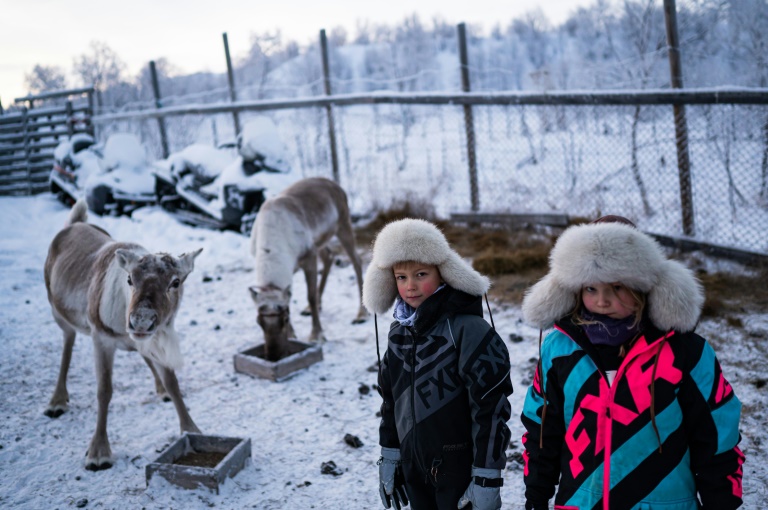
In the snowy Arctic darkness Suvi Kustula throws bundles of lichen to her excitable herd of reindeer, their antlers lit up by her van’s headlights.

“I was just a few months old when I fed my first reindeer,” the 24-year-old laughed, saying she “pretty much always knew” she would follow her father and grandfather into herding.

“I managed one and a half weeks living in a city before I switched to reindeer herding college,” Kustula told AFP. 

“It’s a way of life. Reindeer before everything.”

Twenty years ago the ancient tradition of herding reindeer for meat and fur appeared to be in decline in Lapland, the vast area of forest and tundra which spans northern Finland, Sweden, Norway and Russia’s Kola Peninsula.

Young people felt they had to move south “to make a good life”, said Anne Ollila, head of Finland’s Reindeer Herders’ Association. 

But nowadays nearly a quarter of Finland’s 4,000 herders are under 25, as more young people choose to stay or return home to Lapland. 

The number of women entering the traditionally male-dominated profession is also at its highest ever.

“People have learned to better appreciate freedom and nature and tradition,” Ollila said. “Even if you can’t make big money.”

Instead herders get to live an outdoor life, dictated by the seasons and the weather in the often stunningly beautiful Arctic wilderness. 

But the new generation faces an array of emerging challenges, including a warming climate and pressure from industries keen to exploit Lapland’s resource-rich landscape.

– Indigenous culture revival –

A herder needs intimate knowledge of the landscape and how their animals behave to keep tabs on their reindeer, which roam freely across the plains and forests.

And asking how many animals a herder has is a big no-no.

“It’s a bit like if I asked you how much you have in your bank account,” Kustula laughed.

Most young herders are either born in or have married into a reindeer herding family, Ollila said.

Many belong to the indigenous Sami community, who have herded reindeer across northern Lapland for centuries. 

Oppressed for years by Nordic governments, many Sami have in recent decades begun reclaiming their traditional culture and language.

“Some earlier generations were ashamed of being Sami,” Ollila says. “But I think the young people choosing reindeer herding are very proud of it.”

– Long periods away –

Herding has been passed down through generations of the Lansman family, who live on Finland’s northern border with Norway.

In late November, with the sun setting at 1 pm — not to rise again for seven weeks — Anna Nakkalajarvi-Lansman and her two children climbed onto their snowmobile and drove to the enclosure where their children’s two reindeer live.

“The lighter one’s mine, called Golden Horn,” said six-year-old Antti Iisko, as he and his sister scatter lichen for the animals to eat.

He wants to be a herder when he grows up, while Anni-Sivia, eight, would like to be a vet.

“I’ll be able to give the reindeer their vaccinations,” Anni-Sivia told AFP.

“Our daily routine depends on the season and whether we’re helping out with the herding,” explained their mother Anna Nakkalajarvi-Lansman, a Sami musician.

pad

Two hours’ drive away, father Asko Lansman had just spent a fortnight at a meat-packaging plant. 

Demand is soaring, Lansman told AFP, standing in front of piles of boxes of vacuum-packed reindeer meat ready to be delivered across Finland.

“It’s my greatest hope that the kids continue the work, just like it was my father’s hope when I was young,” he said.

– New challenges –

The job has changed a lot, Lansman said, with quad bikes, helicopters and now drones making gathering the reindeer much easier.

But with temperatures in the Arctic warming three times faster than the rest of the planet, climate change is bringing new challenges.

The shorter winters can turn snow into ice “and cause the reindeers’ drinking holes to freeze over”, Lansman said, as well as making their food inaccessible.

Numerous proposed mining and energy projects across Lapland also threaten the animals’ pasture lands, herders warn.

“The more the land use changes, the less space we’ll have for reindeer,” Kustula said.

“I am hopeful about the future, she insisted, “but the government should listen to us more.”
Kenya jail goes green to fix sewage woes and protect sea

Heading north from Mombasa, the unmistakable whiff of a foul stench in the air was as reliable as any mile marker for motorists taking the highway along the Kenyan coast.

“You would always know you were near Shimo la Tewa Prison,” said Stephen Mwangi, a government scientist who has lived for decades in the coastal region where thousands of inmates are incarcerated in a maximum security jail.  

The smell wasn’t coming from the prison itself but its septic system, which had collapsed from overuse.

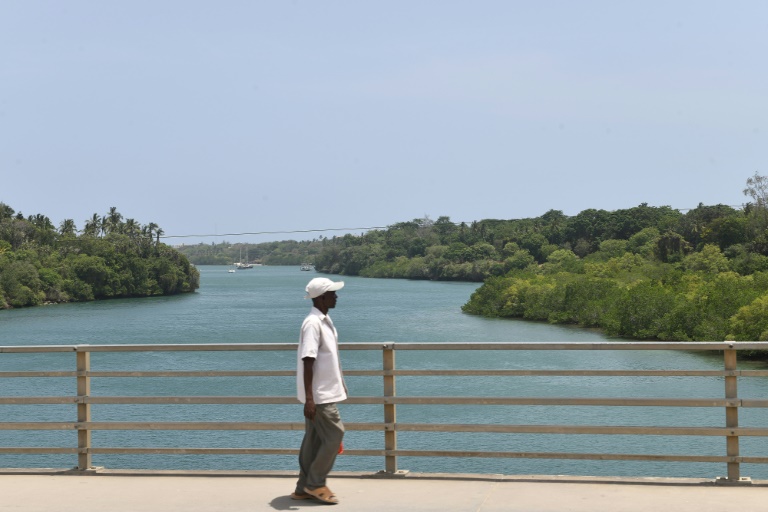
Every day, a small river of sewage flowed downhill into Mtwapa Creek, which empties into the Indian Ocean.

The contamination threatened fishing grounds, waterside hotels and restaurants, and the tropical reefs of Mombasa’s protected marine park, a jewel of the tourism industry just offshore.

Motorists pinched their noses as they passed over the creek but on the prison grounds, the stench was inescapable.

Government lodgings used by prison wardens and hospital staff were deemed uninhabitable, and abandoned over public health concerns.

“Those who were living in the quarters were really affected by the smell,” said Erick Ochieng, deputy officer in charge of Shimo la Tewa Prison.

“It was not good.”

– Harnessing nature – 

In an effort to solve the perennial menace, a low-cost “green tech” approach is being adopted to treat the wastewater.

An artificial wetland is being constructed on the prison grounds — a simple yet efficient system that mimics the way nature cleans pollutants from water using vegetation, soil and microbes.

Once fully operational — expected by end-April — sewage will first pass through an improved septic tank where solids are separated.

From there, the semi-treated water percolates through underground beds of sand and gravel, filtering out pathogens and other impurities.

The end result should be safe not only for the creek, but irrigating farms or fish ponds around the prison, said Mwangi, a scientist with the Kenya Marine and Fisheries Research Institute, which is involved in the project.

Reeds planted on the surface of the wetland help with filtration and absorb nutrients from below, attracting birds and other wildlife, and beautifying a space few dared linger in the past.

“There will be no smell. We will actually have a very good environment,” said Mwangi.

– Climate friendly – 

The UN Environment Programme (UNEP), which sponsors the project, said artificial wetlands offered an affordable and versatile solution for sanitation, while storing carbon and helping cool the planet.

Champions of the technology say big cost savings are possible thanks to relatively inexpensive materials that filter the waste through simple gravity.

Traditional sewage systems require huge volumes of concrete to create retention ponds for the waste, and pumps and other electricity-gobbling machinery to treat it. 

GreenWater, the Kenya-based company building the Shimo la Tewa system, has constructed sustainable wetland systems for schools, homes, businesses and farms.

The prison complex houses as many as 6,000 people — convicts but also jail wardens, hospital staff and courthouse officials — and the project serves as a model for other built-up areas on waterways and beaches.

Home to 40 percent of the world’s population, coastal areas are among the most densely populated parts of the planet, UNEP says.

Creeks and inlets along the Kenyan coast self-clean by flushing out water with the ebbing and flowing of tides, said ecologist David Obura.

“The problem is now with just so many people, and so much pressure… that cleaning function has been overwhelmed,” said Obura, director of CORDIO East Africa, a Kenya-based oceans research institute.

“It’s not working anymore. And you can see it on the Kenyan coast.”

Sewage dumped into creeks around Mombasa — Kenya’s oldest and second-largest city — drifts north on the winds and currents, turning beaches brown and harming coral reefs, seagrass and fisheries.

Obura said it was too late for a major overhaul of sewage systems in crowded cities like Mombasa, but artificial wetlands were a “key tool” for policymakers trying to address the pollution crisis.

“We need to have locally-driven treatment using natural systems, and then I think we can really start to resolve some of these challenges.”

Disaster tourism: blackouts, shortages hit Sri Lanka recovery hopes

In a Sri Lankan beach guesthouse blacked out by a power cut, the owner’s son illuminates a printed Wifi password with his phone for two European backpackers. A moment later the trio grasp the gesture’s futility.

Electricity stoppages, petrol queues and escalating protests are threatening hopes that a tourism revival could help arrest the island nation’s intensifying financial crisis.

After being ravaged by civil war for decades the country’s coconut palm-lined beaches and exotic wildlife more recently made it a popular stomping ground for both high-end globetrotters and budget travellers.

Tourism became crucial to the economy — its pandemic-enforced closure underlies the foreign exchange shortage that is the root cause of the current situation.

But now the effects of the crisis are putting in jeopardy the industry that is a key element of any possible solution, with many smaller operators expecting to hit the wall soon.

“Because of the power cuts, we can’t serve our customers,” the darkened hostel’s owner Dilip Sandaruwan told AFP. “They’re not satisfied and they’re asking for lower prices.”

His guesthouse a short walk from the beach in the languid coastal town of Mirissa has few reservations, and his family are struggling to pay the interest on borrowings taken to weather the Covid years — let alone the principal.

“We are always tense,” Sandaruwan said. “We don’t know how to pay back our loans, but the banks are putting a lot of pressure on us.” 

Similar tales of woe echo among business owners up and down Mirissa’s back lanes. 

Guests gripe about sweating through tropical nights without air conditioning, hoteliers cannot access online booking platforms, and restaurants fret over how to cater to western tastes when they struggle to source imported coffee.

Worsening fuel shortages are making it harder to move around the country, with long lines of motorbike taxis snarled outside service stations waiting for scarce petrol. 

“I never let the foreigners know that there is a problem with the fuel,” said motorboat tour company owner Pradeep Chandana De Silva. 

He sends staff out before dawn each day to hunt for diesel to ferry tourists across the mangrove lagoons of Balapitiya, pointing out cormorants and baby crocodiles along the way. 

“At the moment the situation is okay, but if there’s longer queues and less fuel, it will be terrible for the entire industry,” he said.

– ‘Pretty crazy’ –

Shortages are making daily life miserable for many in Sri Lanka and resentment is flaring, with security forces deployed around Colombo Friday after protesters attempted to storm the president’s home overnight.

But bewildered foreign adventurers often arrive without knowledge of the crisis, or a grasp of its scale.

“Everyone here is telling you, ‘Hey, we have a lot of problems with gas, fuel, electricity and stuff like that’,” said Nick Reiter, a German tourist waiting to fill up his rented scooter at a petrol station.

“But right now, this is pretty crazy.”

Indian tourist Ayesha Khan said she was unaware of the situation until after booking her flights, and considered cancelling.

“We didn’t know a lot until we actually came here,” she said, breaking off a romantic sunset walk along Mirissa beach with her husband. 

Both knew their driver had waited for hours in petrol lines and said the electricity in their accommodation had regularly cut out without warning, but neither regretted their trip.

“It’s been nothing but a good experience for us,” said Afnan Syed, Khan’s partner. 

“I wouldn’t mind coming here again.”

– ‘Not sufficient at all’ –

Sri Lankan tourism has been plagued by setbacks before, even after the civil war. Islamist attacks on Easter Sunday three years ago targeted hotels and churches, killing 279 people and leading to a wave of cancellations.

A post-pandemic recovery began late last year, with nearly 100,000 coming in February, around 40 percent of previous peaks.

But late that month Russia invaded Ukraine, halting nearly all visits from the number one and three sources of foreign arrivals.

And now even a fully thriving tourism industry would not be enough on its own for Sri Lanka to claw itself out from under its escalating loan repayments, experts say.

“While tourism has picked up since Covid… it’s not sufficient at all,” said Suramya Ameresekera, an economist at the JB Securities advisory firm in Colombo.

“The amount that comes due every month is not covered by the size of the tourism receipts,” she added. “Even in Sri Lanka’s history when tourism was at its peak… we were still running a current account deficit.”

The government is scrambling to insulate holidaymakers from the hardships facing much of the nation’s 22 million people. Accredited tour guides are allowed to skip petrol queues — to the occasional chagrin of other drivers waiting in line.

“We found some problems because they are out of petrol,” said Spanish tourist Nazareth Marina in Galle’s centuries-old Dutch Fort.

But the Sri Lankan people, she added, “treat us really well, so it was really nice to come here now”.

Amazon locked in tight unionization votes in two US states

Amazon narrowly led in an effort to prevent unionization in Alabama, according to preliminary results Thursday, but the e-commerce behemoth trailed in a partial tally in a parallel election in New York. 

The results were not final in either case. At stake is Amazon’s ability to remain union-free in its home market, a status it has guarded fiercely since the company was founded in the 1990s.

“We already made history. We defeated a lot of odds to get here,” said Christian Smalls, a leader of the New York campaign who said he was not surprised by the union’s early lead of more than 360 votes.

In the Alabama election, a re-vote after federal officials threw out results of a 2021 referendum, 993 workers voted against the labor group, compared with 875 employees in favor.

But there were 416 “challenged” ballots, a “determinative” amount, according to the National Labor Relations Board, meaning the number of ballots still to be settled is big enough to potentially decide the final result.

The fate of the challenged ballots will be settled following an NLRB hearing that is not expected for at least a couple of weeks.

Stuart Appelbaum, president of the Retail, Wholesale and Department Store Union (RWDSU), said workers “will have to wait just a little bit longer,” on Twitter.

“Every vote must be counted, and every objection heard,” he said.

– ‘Ignited a movement’ –

In New York, union backers had reason for hope as ballots were counted from the Staten Island JFK8 warehouse, where more of the facility’s 5,000 workers turned out compared with Bessemer, which has 6,000 employees.

When the New York count wrapped up for the day early Thursday evening, there were 1,518 workers voting in favor of the union, compared with 1,154 employees voting no.

“It’s very clear that we’ll finish tomorrow,” an NLRB official said shortly before the counting stopped for the day.

At a news conference Thursday, Applebaum noted that their initial campaign last year — which received lots of media coverage and even an official endorsement by President Joe Biden — helped spur similar moves around the country.

“We ignited a movement with this campaign,” said the RWDSU president.

He added that he was “honored” the Alabama campaign was cited by leaders of a successful Starbucks union drive last December in New York — the first for the large coffee chain.

Since then, employees in over 150 Starbucks have requested union votes.

While the outcome of the latest votes remain uncertain, labor advocates hope they represent an inflection point as the overall rate of US private-sector unionization edges lower and unions remain on the outs in several states, especially in the South and West.

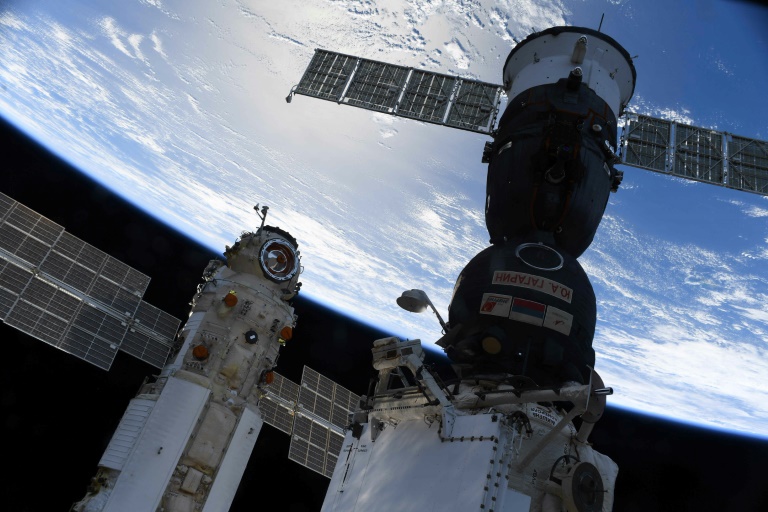
Failure to launch: War scuppers Russia-West space collaboration

Russia’s invasion of Ukraine has had repercussions not just around the world but beyond it, bringing to a grinding halt joint space projects between Moscow and the West that began in the aftermath of the Cold War.

When the head of Russian space agency Roscosmos Dmitry Rogozin announced on Thursday that Russia would stop supplying the United States with rocket engines, his message was blunt: “Let them fly to space on their broomsticks.”

He also said Roscosmos would dramatically “adjust” its programme to prioritise making military satellites, adding that all future spacecraft will be “dual purpose” — with one of those purposes in the Russian defence ministry’s interest.

In response to the sweeping sanctions imposed on Russia by most of the Western world, Roscosmos also told the German Aerospace Center that it will no longer take part in “joint space experiments” on the International Space Station. 

Roscosmos had earlier suspended launches from Europe’s spaceport in French Guiana’s Kourou, which use Russian Soyuz rockets, withdrawing around a hundred of its workers.

Another victim is the Rosalind Franklin rover, whose launch under the joint Russian-European ExoMars mission had already been postponed from 2020 due to the pandemic. 

The rover, which is designed to drill into Mars to search for signs of life, is now “very unlikely” to launch this year, the European Space Agency said.

The ESA’s rover was to be launched from the Baikonur Cosmodrome in Kazakhstan by a Russian rocket, then taken down to the Martian soil by Russia’s Kazachok lander.

– ‘Heartbreaking for science’ –

Getting the Rosalind Franklin, named after an English chemist and DNA pioneer, into space without Russian help would require huge revisions — and the window to launch only comes around every two years.

“It is heartbreaking for science and scientists who have built up links over the years and invested years of work,” said Isabelle Sourbes-Verger, a specialist in space policy at the French National Centre for Scientific Research.

ExoMars had symbolised the culmination of a partnership between Europe and Russia that began in 1996, she told AFP.

“After the collapse of the Eastern Bloc and the break-up of the USSR, Europe and the US naturally sought to make room for the Russians” in their space plans, an analyst in the European space sector said on condition of anonymity.

No side wanted the knowledge and expertise of such a great space power to go to waste.

Its experience with the Mir space station significantly contributed to the development of the ISS, the greatest space collaboration between the West and Russia, where astronauts and cosmonauts have long lived and worked side-by-side.

The idea was that civilian space cooperation would be a “way of bringing nations together”, the analyst said.

On a commercial level, Russia has “done everything to facilitate access to space”, including offering its Soyuz rockets to the international market, the analyst added.

Europe was “particularly proud” to have reached a deal that has seen its Arianespace work with Roscosmos since 2011 to launch Soyuz rockets from Kourou and Baikonur, the analyst said.

However, relations became strained over the years, particularly since Russia’s annexation of Crimea from Ukraine in 2014.

Then came the war.

– ISS still afloat –

Just how much the war and sanctions will affect space cooperation between Russia and the West remains to be seen.

The ESA’s director general tweeted last week that “notwithstanding the current conflict, civil space cooperation remains a bridge”.

Russia’s declaration that it has ended joint space experiments with Germany on the ISS has put German astronaut Matthias Maurer — who is currently onboard the station — in a tight spot.

NASA said this week it is exploring ways to keep the ISS in orbit with Russian help, after Roscosmos chief Rogozin raised the prospect of pulling out in response to US sanctions.

But Kathy Lueders, who heads NASA’s human spaceflight programme, said Monday that operations on the ISS were proceeding “nominally” and “we’re not getting any indications at a working level that our counterparts are not committed”.

She said it would be “very difficult for us to be operating on our own”, adding that “it would be a sad day for international operations if we can’t continue to peacefully operate in space.”

Scientific discovery about space is also expected to be a victim of the war.

As of Friday, more than 7,400 Russian scientists and academics had signed an open letter lambasting the invasion, saying that “many years spent strengthening Russia’s reputation as a leading centre” of science in the world “have been completely scuppered”.

Ukraine: a nuclear-powered nation under fire

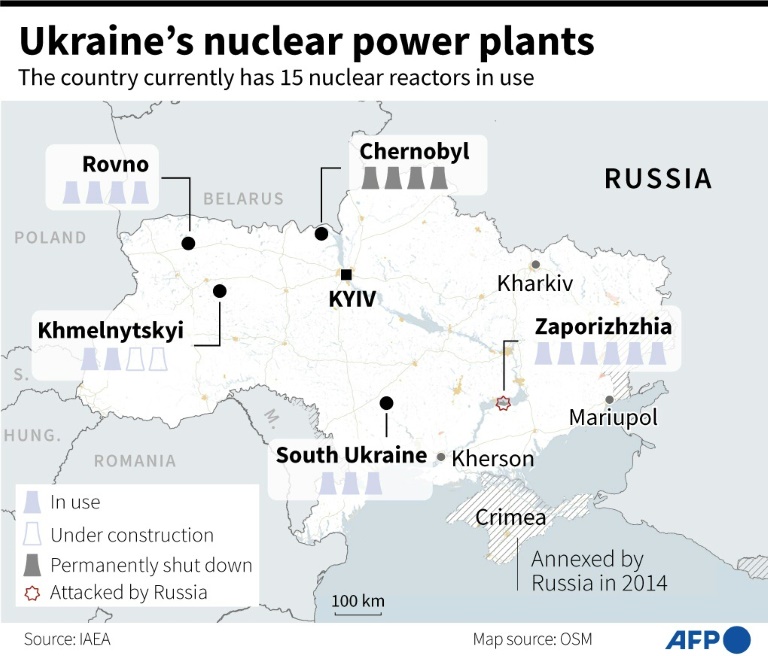
The Russian shelling of Zaporizhzhia nuclear power plant in Ukraine — the largest in Europe — has sparked international outrage and fears over the country’s 15 operational reactors.

The Zaporizhzhia reactors, apparently undamaged by the attack, were taken over by invading Russian forces that have also stationed themselves at Chernobyl, the site of the worst civilian nuclear disaster in history.

Experts have condemned the attack, while stressing that Ukraine’s modern reactors are built to withstand most human-caused and natural impacts.  

Here’s what we know about nuclear power in Ukraine:

– Nuclear-powered nation – 

Ukraine is the seventh-largest producer of nuclear electricity in the world, according to International Atomic Energy Agency (IAEA) figures for 2020. 

The country, which relies on nuclear energy for more than half of its power supply, has made significant improvements in nuclear safety over the years, experts say. 

Zaporizhzhia has six of the country’s 15 reactors and can create enough energy for four million homes.

The plant is “relatively modern”, said Mark Wenman of Imperial College London, noting its reactor components are housed inside a heavily reinforced containment building that can “withstand extreme external events, both natural and man-made, such as an aircraft crash or explosions”.  

“The design is a lot different to the Chernobyl reactor, which did not have a containment building, and hence there is no real risk, in my opinion, at the plant now [that] the reactors have been safely shut down,” he told the Science Media Centre. 

The battle at the site caused a fire at an adjacent training facility, IAEA chief Rafael Grossi said early Friday. 

He said only one of the six reactors was operating at about 60 percent, another had been undergoing maintenance, two were in “safety-controlled shutdown” and the last two “were already being held in reserve and are operating in low-power mode”.

Ukrainian monitors say there has been no spike in radiation.

– Conflict fears –

Earlier this week Greenpeace warned that the Russian invasion risks a “nightmare scenario” at one of the country’s nuclear sites, potentially involving an explosion that caused cooling systems to fail and large amounts of radioactivity to be spread on the wind. 

This, the charity said in an analysis focusing on Zaporizhzhia, could render large parts of Europe and Russia “uninhabitable for at least many decades”.    

The main risk now is a loss of the power supply as the plant needs water and electricity to operate the safety systems and cool the reactor core, according to Karine Herviou, Deputy Director General of the French Institute for Radiation Protection and Nuclear Safety. 

But the site has emergency generators, which normally have fuel to operate for seven to 10 days, as well as water reserves. 

The other risk is direct aggression.

Herviou said the containment buildings offer protection to a point “but it all depends on what we are talking about”. 

An attack that hit another part of the plant could affect safety systems, she added.

– Chernobyl –

Ukraine, which has significant uranium reserves, began developing nuclear power in the 1970s — when it was still a part of the USSR — with the construction of Chernobyl. 

The 1986 Chernobyl disaster left hundreds dead and spread radioactive contamination west across Europe.

Damaged Reactor No. 4 was initially covered by a temporary sarcophagus, then by a containment arch completed in 2017. 

Russia seized the site on February 24.

The Ukrainian authorities have recently noted an increase in radiation at Chernobyl, but the IAEA has said the levels measured pose no danger to the public. 

Experts have speculated that military activity around the site may have kicked up contaminated dust.  

Ukraine’s current stock of reactors are Soviet or Russian-designed VVERs, which are pressurised water reactors. 

“Ukraine receives most of its nuclear services and nuclear fuel from Russia,” says the World Nuclear Association, although it has noted that the country had already begun “reducing this dependence”.

The nuclear operator Energoatom has recently turned to the US firm Westinghouse to build new reactors. 

Sony and Honda plan joint electric vehicle firm

Sony is teaming up with automaker Honda to start a new company that will develop and sell electric vehicles, as the Japanese tech and electronics giant leaps into the rapidly growing sector.

Major global carmakers are increasingly prioritising electric and hybrid vehicles as concern about climate change grows.

Sony Group said Friday the two Japanese names hope to establish their firm by the end of this year with sales of their first electric model expected to begin in 2025.

The announcement comes on the heels of Sony’s January unveiling of a new prototype, its Vision-S electric vehicle, and the announcement of a new subsidiary Sony Mobility to explore entering the EV market.

“Although Sony and Honda are companies that share many historical and cultural similarities, our areas of technological expertise are very different,” Sony Group president Kenichiro Yoshida said in a statement.

“I believe this alliance which brings together the strengths of our two companies offers great possibilities for the future of mobility.”

At a joint press conference, Honda CEO Toshihiro Mibe said discussions on the collaboration had picked up speed when Honda and Sony staff “felt big possibilities, like a chemical reaction” at a joint mobility workshop held last year.

Honda will be responsible for manufacturing the pair’s first vehicle, but both companies will work together on design, tech and sales.

Mio Kato, an analyst at Lightstream Research who publishes on Smartkarma, said Sony would be able to make use of its technology from image sensors to next-gen display as well as AI in the new vehicles.

“(The alliance) helps Sony maintain its asset-light model and is also positive for Honda, but we do feel that it makes Honda look a little lost in the changing world,” he said in a note.

At present, around 10 percent of European car sales are EVs, and the US figure is just two percent.

But demand is growing, and other major automakers including Honda’s Japanese rivals are investing money and resources into electric vehicles.

Earlier this year, the Nissan auto alliance promised to offer 35 new electric models by 2030 as it announced a total investment of $25 billion in the sector.

Toyota, the world’s top-selling carmaker, has also recently hiked its 2030 electric vehicle sales goal by 75 percent in a more ambitious plan for the sector.

And last week, German auto giant Volkswagen said it was drawing up plans to list its luxury brand Porsche as it looks to raise the funds for its move to electric vehicles.

Yoshida emphasised on Friday that the new partnership was “not exclusive”.

“We want to expand it, because we want to contribute to and lead the evolution of mobility,” he said.

Sony and Honda plan electric vehicle joint firm

Sony is teaming up with automaker Honda to start a new company that will develop and sell electric vehicles, the electronics giant said Friday, its latest step into the rapidly growing sector.

Major global carmakers are increasingly prioritising electric and hybrid vehicles as concern about climate change grows. 

Sony’s news comes on the heels of a January unveiling of a new prototype, its Vision-S electric vehicle, and the announcement that its new subsidiary Sony Mobility will explore jumping into the sector.

Sony Group said in a statement Friday that the two Japanese names hope to establish their firm by the end of this year, calling it “a strategic alliance”.

“This alliance aims… to realize a new generation of mobility and services that are closely aligned with users and the environment,” Sony said in a statement.

Sales of their first electric model are expected to begin in 2025, with Honda responsible for its manufacturing but both companies working on design, tech and sales.

“Although Sony and Honda are companies that share many historical and cultural similarities, our areas of technological expertise are very different,” Sony Group president Kenichiro Yoshida said.

“I believe this alliance which brings together the strengths of our two companies offers great possibilities for the future of mobility.”

At present, around 10 percent of European car sales are EVs, and the US figure is just two percent.

But demand is growing, and other major automakers including Honda’s Japanese rivals are investing money and resources into electric vehicles.

Earlier this year, the Nissan auto alliance promised to offer 35 new electric models by 2030 as it announced a total investment of $25 billion in the sector.

Toyota, the world’s top-selling carmaker, has also recently hiked its 2030 electric vehicle sales goal by 75 percent in a more ambitious plan for the sector.

Lions, tigers evacuated from Ukraine to Poland

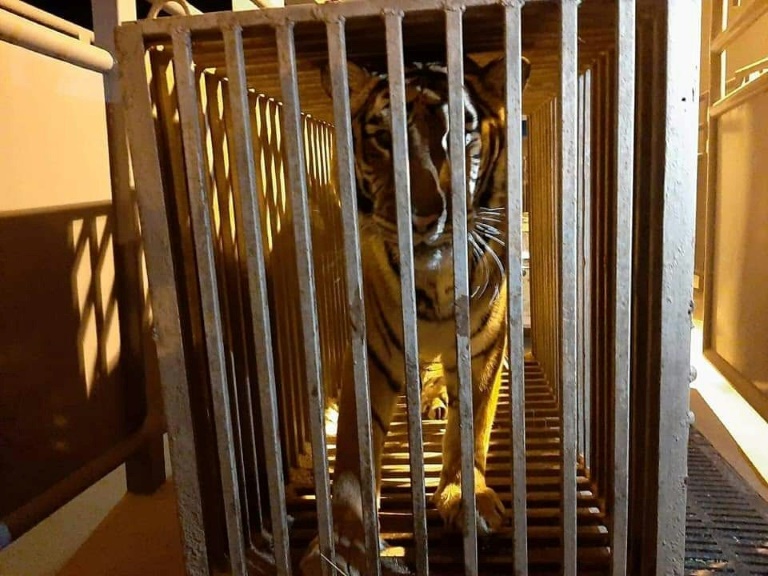
Six lions and six tigers evacuated from near Kyiv arrived at a zoo in Poland on Thursday following a two-day odyssey skirting battle frontlines and coming face to face with Russian tanks, a zoo spokesman said.

A Ukrainian truck drove the animals, along with two wild cats and a wild dog, nearly 1,000 kilometres (600 miles) to the Polish border while avoiding the Zhytomyr region, which the invading Russian forces have bombarded, spokeswoman Malgorzata Chodyla told AFP.

At one point, the truck had to stop overnight opposite Russian tanks. 

The driver rested under his vehicle while the owner of the Ukrainian shelter fed the animals because the transport crew did not know how to, the spokeswoman said.

At the border, the animals were transferred to a Polish truck while the Ukrainian driver returned home to his children.

For now, the animals will be cared for at the Poznan zoo.

Zoo director Ewa Zgrabczynska, who helped arrange the evacuation, said she is already in contact with several western organisations that want to take in the animals.

She also launched a fundraising drive as the city of Poznan, which runs the zoo, lacks a budget for the evacuated animals. 

Long road ahead for Iraq pledge to phase out gas flares

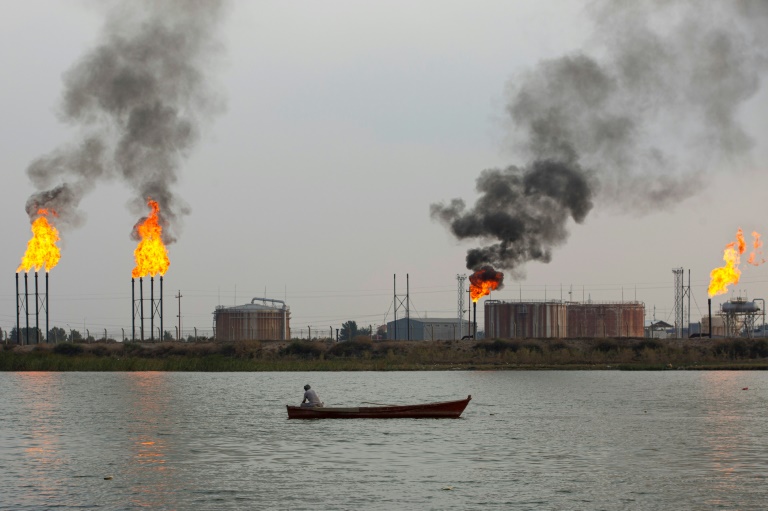
In the oilfields of southern Iraq, billions of cubic feet of gas literally go up in smoke, burnt off on flare stacks for want of the infrastructure to capture and process it.

The flares produce vast amounts of carbon dioxide and other greenhouse gases, contributing to global warming without any economic or social benefit.

Analysts say the waste is particularly egregious, as Iraq is a significant importer of natural gas, meeting a third of its needs through expensive and not always reliable supplies from neighbouring Iran.

The government has pledged to phase out the practice by 2030 but the road to a greener, less wasteful energy sector is proving a long one.

For the oil companies exploiting the mega fields around Basra, it is actually cheaper to flare off the associated gas than to capture, process and market it, despite the obvious environmental costs.

Currently, only half of the three million cubic feet of gas that comes out of Iraqi oil wells each day is captured and processed.

The rest is burnt off in flares creating the plumes of acrid black smoke that blight the skies.

“Flared gas, if captured and processed, could provide electricity to three million homes,” said Yesar al-Maleki, Gulf analyst at Middle East Economic Survey.

“This could definitely help the country end its acute power shortages that go up all the way to a supply and demand gap of nine gigawatts in summer.”

– ‘Up in smoke’ –

In December, Iraq’s oil minister Ihsan Ismail pledged to cut flare gas by 90 percent by 2024.

But despite contracts with foreign oil majors, including France’s TotalEnergies, the target is likely to face bureaucratic obstacles in a sector which provides 90 percent of government revenues.

Over the past two years, the government has cut flare gas by just five percent.

The captured gas is fuel that Iraq desperately needs for its power stations.

Under an exemption from US sanctions on Iran, Iraq imports 750 million cubic feet per day from its eastern neighbour.

Any disruption to that supply can lead to widespread power cuts, particularly in summer when the demand for air conditioning and refrigeration peaks.

Maleki said the failure to address the issue bore multiple costs for Iraq.

“It loses financially by burning money in the air; it loses more money by importing gas from neighbouring countries at a premium; it loses more money resolving resultant issues in its power sector when it switches its gas turbines to costly and pollutive liquid fuels; and it definitely loses environmentally.”

Basra province is home to Iraq’s five largest oilfields and accounts for 65 percent of its flared gas, according to World Bank figures.

The Basrah Gas Company, a consortium of Iraq’s state-owned South Gas Company, Shell and Mitsubishi, captures one billion cubic feet of gas from the three fields in which it operates.

It plans to raise that figure to 1.4 billion cubic feet by the end of 2023 but doing so requires heavy investment, in processing as well as capture.

Managing director Malcolm Mayes said the consortium was investing around $1.5 billion in a giant new processing facility in Artawi, outside Basra.

“In Artawi, we are building two processing trains,” Mayes said. 

“The first will be on stream in May 2023 and the second will come on stream in November 2023, and at that point we will have the capacity to process 1.4 billion cubic feet — approaching 90 percent from our lease area.”

– ‘Cleaner electricity’ –

Iraq has also signed a mega-contract with TotalEnergies that includes building a processing facility for the associated gas from three southern oilfeilds.

“The plant’s launch is scheduled for 2026,” the French firm said.

Iraq says the plant will process 300 million cubic feet a day of gas that is currently flared off, rising to 600 million in a second phase.

Teams from TotalEnergies are already on the ground carrying out preliminary studies, but the process is dragging on.

Last month, Baghdad said some clauses of the contract “require time and cannot be implemented or solved in a short period”.

A similar project awarded to Chinese firms in neighbouring Maysan province is only half finished.

In the meantime, Basra’s residents continue to live with the environmental consequences.

“Everything is polluted by these flares — the water, the animals, they’re all dead,” said Salem, an 18-year-old shepherd in the village of Nahr Bin Omar, site of a major oilfield just north of Basra.

Close Bitnami banner
Bitnami