AFP

Hawaii volcano sprays fountains of lava in spectacular eruption

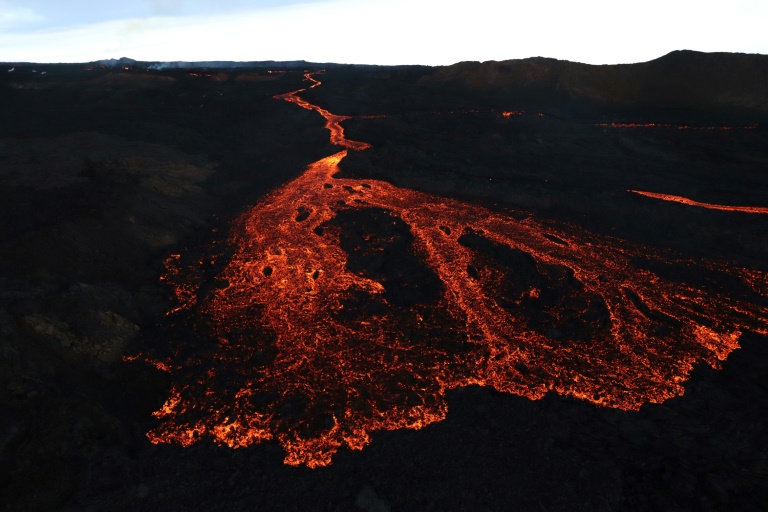
Fountains of lava and rivers of molten rock were spewing from the world’s biggest volcano Friday, as the first eruption there in almost four decades showed no signs of abating.

Two fissures on Mauna Loa were venting huge volumes of viscous rock and gases from deep within the Earth, in a thunderous display of the power of nature.

Vulcanologists said they were watching lava flows heading towards a highway on Hawaii’s largest island, though they still believe the eruption, which began Sunday, posed no immediate threat to humans.

“The Northeast Rift Zone eruption of Mauna Loa continues, with two active fissures feeding lava flows downslope,” the United States Geological Survey (USGS) said on Thursday.

“Fissure 3 remains the dominant source of the largest lava flow. The fissure 3 lava flows are traveling to the north toward the Daniel K. Inouye Highway (Saddle Road) but have reached relatively flatter ground and have slowed down significantly as expected.”

The molten rock was travelling at around 130 feet (40 meters) per hour and was still a few miles (kilometers) from the road.

“Advance rates may be highly variable over the coming days and weeks due to the way lava is emplaced on flat ground,” the USGS said.

“At the rate observed over the past 24 hours, the earliest the lava flow might be expected to reach the Daniel K. Inouye Highway (Saddle Road) is one week.”

But, the agency warned, volcanoes can be unpredictable and these calculations could change.

The other fissure still producing lava is sending it northeast, while plumes of volcanic gas were lofting high into the air and Pele’s Hair was falling to earth.

Pele’s Hair is fine strands of volcanic glass formed when lava skeins cool quickly in the air.

Named after Pele, the Hawaiian goddess of volcanoes, the strands can be very sharp and pose potential danger to skin and eyes.

Scientists say their seismic monitoring equipment was detecting a large number of earthquakes around the two active fissures.

“This indicates that magma is still being supplied, and activity is likely to continue as long as we see this signal,” the USGS said.

Pressure has been building at Mauna Loa for years, but it has not erupted since 1984.

Fountains of lava as high as 200 feet have been observed this week, lighting up the night sky in a spectacle that could be seen from Kona, a town 45 miles away.

– ‘Long Mountain’ –

The largest volcano on Earth by volume, Mauna Loa, whose name means “Long Mountain,” is larger than the rest of the Hawaiian islands combined.

The volcano’s submarine flanks stretch for miles to an ocean floor that is in turn depressed by Mauna Loa’s great mass — making its summit some 11 miles above its base, according to the USGS. 

One of six active volcanoes on the Hawaiian islands, Mauna Loa has erupted 33 times since 1843.

Its most recent eruption, in 1984, lasted 22 days.

Kilauea, a volcano on the southeastern flank of Mauna Loa, erupted almost continuously between 1983 and 2019, and a minor eruption there has been ongoing for months.

Eleven sentenced to death in Tanzania over conservationist's murder

A court in Tanzania sentenced 11 people to death on Friday over the 2017 murder of renowned conservationist Wayne Lotter.

Lotter, a 51-year-old South African based in Tanzania, was a founder of the PAMS Foundation which worked to stop the poaching of elephants and trafficking of ivory in the east African country.

He was shot dead in Dar es Salaam while in a taxi on his way back from the airport.

The exact motive for his killing is still unknown but colleagues of Lotter believe he was targeted for his work on protecting elephants.

“Some of the suspects, in their statements recorded by police officers, confessed to have taken part in the conspiracy meetings and in killing,” the judge, Laila Mgonya, told the court.

“The evidence provided was strong enough to convict them.”

The handing down of death sentences is not uncommon in Tanzania but they are generally commuted to life in prison. 

The last execution carried out in the country was in 1994.

Tanzania has been one of the African countries worst hit by elephant poaching, losing more than 66,000 elephants in a decade, but interdiction efforts mean poaching has declined in recent years.

US green plan should be 'wake-up call' for EU industry: French minister

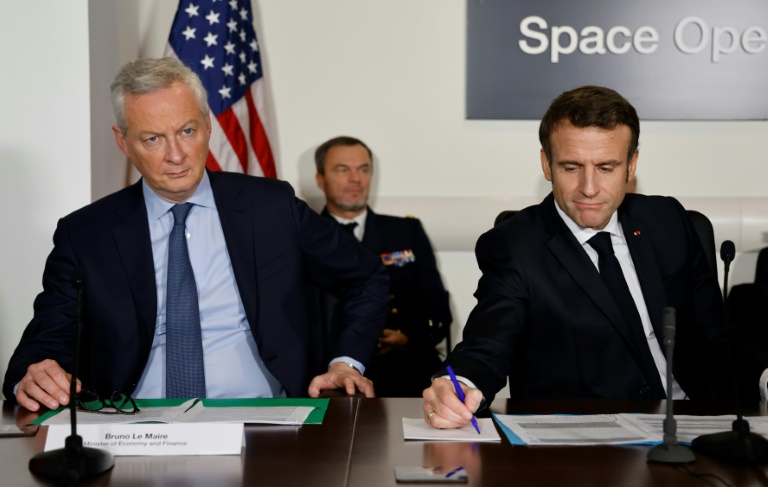
French Finance Minister Bruno Le Maire on Friday said Washington’s $430 billion plan to spur climate-friendly technologies in the United States must be seen as a wake-up call for Europe.

The EU “must be able to sweep in front of our own door” before worrying about the effects of the US climate plan on European industry, Le Maire told AFP in Washington, where he was part of French President Emmanuel Macron’s US state visit.

Even though the EU has already “changed its approach” on promoting green industry, the US climate plan must be seen as a “wake-up call” in the European Union, he added.

Le Maire’s comments came as EU countries have poured criticism on Washington’s landmark Inflation Reduction Act (IRA), seeing it as anti-competitive and a threat to European jobs, especially in the energy and auto sectors.

The act, designed to accelerate the US transition to a low-carbon economy, contains around $370 billion in subsidies for green energy as well as tax cuts for US-made electric cars and batteries. 

Macron on Wednesday slammed the plan’s “Made in USA” provisions as “super aggressive” for European businesses.

But at a joint press conference with Macron, Biden said that he and the French leader had agreed to “discuss practical steps to coordinate and align our approaches”, though he said he would not apologize for the US plan.

Biden added the IRA was never intended to disadvantage any US allies.

Last month, EU Internal Market Commissioner Thierry Breton threatened to appeal to the World Trade Organization and consider “retaliatory measures” if the United States did not reverse its subsidies.

Le Maire also criticized the EU’s own climate spending plans, arguing that they were too cumbersome and loaded with red tape.

“If the ambition is the same” as the Europeans, the United States relies on methods that “are simpler and faster”, he said.

“They put immediate and massive tax credits where we provide state aid (to specific projects) which sometimes take two years to be adopted and are too complex to implement,” said Le Maire.

EU strikes deal on oil price cap to starve Russia's war machine

The EU on Friday joined the G7 in agreeing a cap on the price of Russian oil to starve the Kremlin of resources for its Ukraine war, as Vladimir Putin said strikes on Ukraine’s infrastructure were “inevitable”.

The price cap of $60 per barrel, previously agreed on a political level with the United States and the G7 group of wealthy democracies, will come into effect with an EU embargo on Russian crude oil from Monday.

The embargo will prevent shipments of Russian crude by tanker vessel to the EU, which account for two thirds of imports, potentially depriving Russia’s war chest of billions of euros.

Poland had refused to back the price cap plan over concerns the ceiling was too high, before its ambassador to the bloc confirmed Warsaw’s agreement on Friday evening, allowing the measure to be made official this weekend.

The Czech presidency of the EU and diplomats from other member states said the deal had been confirmed and that the bureaucratic procedure to bring it into effect was underway.

The price cap is designed to make it harder to bypass the sanctions by selling beyond the EU.

Poland’s ambassador to the bloc, Andrzej Sados, also said Brussels would take into account Polish and Baltic state suggestions for a “painful and expensive” ninth round of sanctions against Moscow.

– Infrastructure strikes ‘inevitable’ –

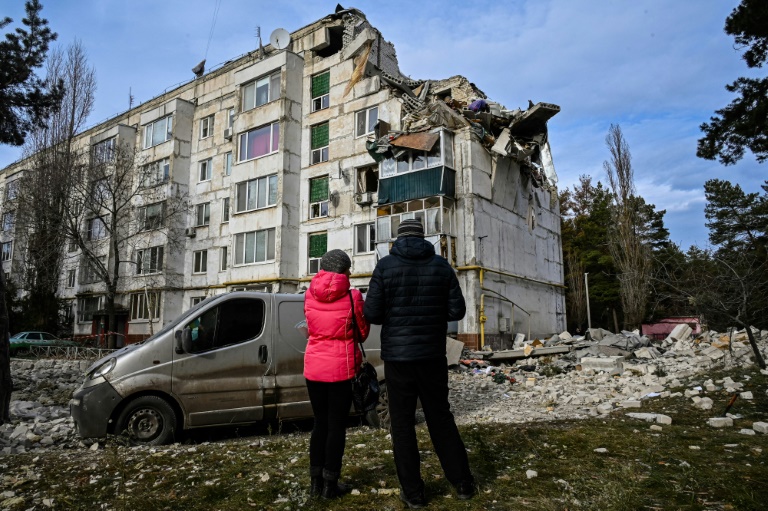
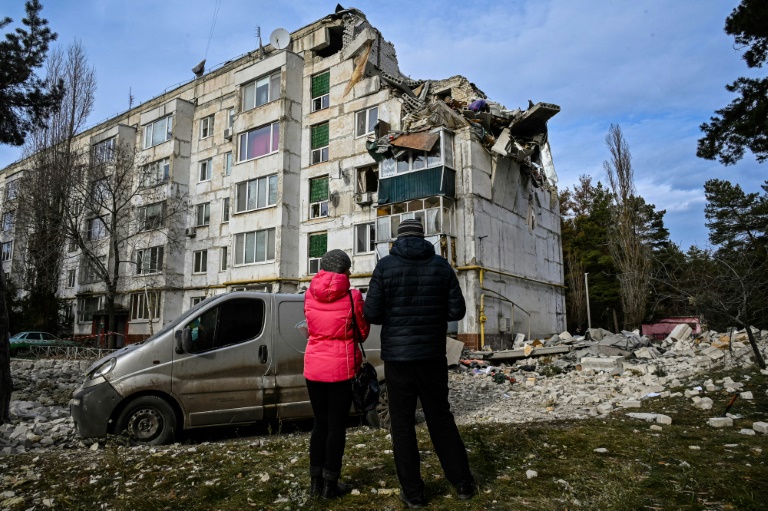
After suffering humiliating defeats during what has become the largest armed conflict in Europe since World War II, Russia began targeting Ukrainian energy infrastructure in October, causing sweeping blackouts.

President Vladimir Putin said Russian strikes on Ukrainian infrastructure were “inevitable”, in his first conversation with German Chancellor Olaf Scholz since mid-September.

“Such measures have become a forced and inevitable response to Kyiv’s provocative attacks on Russia’s civilian infrastructure,” Putin told Scholz, according to a Kremlin readout of the telephone talks.

The Kremlin leader referred in particular to the October attack on a bridge linking Moscow-annexed Crimea to the Russian mainland.

During the hour-long call, Scholz “urged the Russian president to come as quickly as possible to a diplomatic solution including the withdrawal of Russian troops”, according to the German leader’s spokesman Steffen Hebestreit.

Putin urged Berlin to “reconsider its approaches” and accused the West of carrying out “destructive” policies in Ukraine, the Kremlin said, stressing that its political and financial aid meant Kyiv “completely rejects the idea of any negotiations”.

Ukrainian President Volodymyr Zelensky had ruled out any talks with Russia while Putin is in power shortly after the Kremlin claimed to have annexed several Ukrainian regions.

– Talks off the table – 

The Kremlin also indicated Moscow was in no mood for talks over Ukraine, after US President Joe Biden said he would be willing to sit down with Putin if the Russian leader truly wanted to end the fighting.

“What did President Biden say in fact? He said that negotiations are possible only after Putin leaves Ukraine,” Putin’s spokesman Dmitry Peskov told reporters, adding Moscow was “certainly” not ready to accept those conditions. 

Russia’s strikes have destroyed close to half of the Ukrainian energy system and left millions in the cold and dark at the onset of winter.

In the latest estimates from Kyiv, Mykhaylo Podolyak, an adviser to Zelensky, said as many as 13,000 Ukrainian troops have died in the fighting.

Both Moscow and Kyiv are suspected of minimising their losses to avoid damaging morale.

Top US general Mark Milley last month said more than 100,000 Russian military personnel have been killed or wounded in Ukraine, with Kyiv’s forces likely suffering similar casualties. 

– ‘We are not defeated’ –

The fighting in Ukraine has also claimed the lives of thousands of Ukrainian civilians and forced millions to flee their homes.

Those who remain in the country have had to cope with emergency blackouts as authorities sought to relieve the pressure on the energy infrastructure.

In an attempt to boost the mood in the capital Kyiv, musicians played a classical music concert on Thursday with hundreds of LED candles lighting up the stage.

“We thought it was a good idea to save energy,” Irina Mikolaenko, one of the concert’s organisers, told AFP. 

She said they wanted to spread “inspiration, light and love” and “tell people that we are not defeated”. 

Ukrainian officials have said they are expecting a new wave of Russian attacks shortly.

EU strikes deal on oil price cap to starve Russia's war machine

The EU on Friday joined the G7 in agreeing a cap on the price of Russian oil to starve the Kremlin of resources for its Ukraine war, as Vladimir Putin said strikes on Ukraine’s infrastructure were “inevitable”.

The price cap of $60 per barrel, previously agreed on a political level with the United States and the G7 group of wealthy democracies, will come into effect with an EU embargo on Russian crude oil from Monday.

The embargo will prevent shipments of Russian crude by tanker vessel to the EU, which account for two thirds of imports, potentially depriving Russia’s war chest of billions of euros.

Poland had refused to back the price cap plan over concerns the ceiling was too high, before its ambassador to the bloc confirmed Warsaw’s agreement on Friday evening, allowing the measure to be made official this weekend.

The Czech presidency of the EU and diplomats from other member states said the deal had been confirmed and that the bureaucratic procedure to bring it into effect was underway.

The price cap is designed to make it harder to bypass the sanctions by selling beyond the EU.

Poland’s ambassador to the bloc, Andrzej Sados, also said Brussels would take into account Polish and Baltic state suggestions for a “painful and expensive” ninth round of sanctions against Moscow.

– Infrastructure strikes ‘inevitable’ –

After suffering humiliating defeats during what has become the largest armed conflict in Europe since World War II, Russia began targeting Ukrainian energy infrastructure in October, causing sweeping blackouts.

President Vladimir Putin said Russian strikes on Ukrainian infrastructure were “inevitable”, in his first conversation with German Chancellor Olaf Scholz since mid-September.

“Such measures have become a forced and inevitable response to Kyiv’s provocative attacks on Russia’s civilian infrastructure,” Putin told Scholz, according to a Kremlin readout of the telephone talks.

The Kremlin leader referred in particular to the October attack on a bridge linking Moscow-annexed Crimea to the Russian mainland.

During the hour-long call, Scholz “urged the Russian president to come as quickly as possible to a diplomatic solution including the withdrawal of Russian troops”, according to the German leader’s spokesman Steffen Hebestreit.

Putin urged Berlin to “reconsider its approaches” and accused the West of carrying out “destructive” policies in Ukraine, the Kremlin said, stressing that its political and financial aid meant Kyiv “completely rejects the idea of any negotiations”.

Ukrainian President Volodymyr Zelensky had ruled out any talks with Russia while Putin is in power shortly after the Kremlin claimed to have annexed several Ukrainian regions.

– Talks off the table – 

The Kremlin also indicated Moscow was in no mood for talks over Ukraine, after US President Joe Biden said he would be willing to sit down with Putin if the Russian leader truly wanted to end the fighting.

“What did President Biden say in fact? He said that negotiations are possible only after Putin leaves Ukraine,” Putin’s spokesman Dmitry Peskov told reporters, adding Moscow was “certainly” not ready to accept those conditions. 

Russia’s strikes have destroyed close to half of the Ukrainian energy system and left millions in the cold and dark at the onset of winter.

In the latest estimates from Kyiv, Mykhaylo Podolyak, an adviser to Zelensky, said as many as 13,000 Ukrainian troops have died in the fighting.

Both Moscow and Kyiv are suspected of minimising their losses to avoid damaging morale.

Top US general Mark Milley last month said more than 100,000 Russian military personnel have been killed or wounded in Ukraine, with Kyiv’s forces likely suffering similar casualties. 

– ‘We are not defeated’ –

The fighting in Ukraine has also claimed the lives of thousands of Ukrainian civilians and forced millions to flee their homes.

Those who remain in the country have had to cope with emergency blackouts as authorities sought to relieve the pressure on the energy infrastructure.

In an attempt to boost the mood in the capital Kyiv, musicians played a classical music concert on Thursday with hundreds of LED candles lighting up the stage.

“We thought it was a good idea to save energy,” Irina Mikolaenko, one of the concert’s organisers, told AFP. 

She said they wanted to spread “inspiration, light and love” and “tell people that we are not defeated”. 

Ukrainian officials have said they are expecting a new wave of Russian attacks shortly.

EU agrees to impose price cap on Russian crude

The European Union will join the G7 powers in imposing a $60-per-barrel price cap on Russian oil, the Polish ambassador to the bloc said Friday, three days ahead of an EU embargo on imports by sea.

Poland had delayed approving the adoption of the plan while it pushed for a lower price ceiling and tough new sanctions to punish Russia for its war against Ukraine and starve its military of funds.

“We can formally agree to the decision,” Poland’s EU ambassador Andrzej Sados said, explaining that Poland’s fellow EU members had agreed to push forward with a new ninth round of sanctions against Russia. 

“We’re working on the next package of sanctions, which will be painful and expensive for Russia,” Sados told reporters.   

The European Union presidency, currently held by the Czech Republic, confirmed that member state ambassadors had reached agreement on the price cap and that the decision would enter into force when published in the EU official journal this weekend.

– Painful and expensive –

The oil price cap will run alongside the EU’s ban on imports of Russian oil, which comes into effect on Monday, and member states hope it will be the most damaging hit yet against the industry fuelling President Vladimir Putin’s Russian war machine.   

The Polish envoy told reporters that Warsaw was reassured that the European Union had taken on board suggestions from Poland and the Baltic States for a tough new ninth round of sanctions.  

He did not say which of the ideas might feature in the package that the European Commission is drawing up, but a discussion paper circulated last month called for Gazprombank, which facilitates payments for Russian energy exports, to be kicked off the SWIFT international payments system.

It also proposed bans on the export of a wide-range of consumer technology that could be pressed into use by the Russians and a ban on the importation of Russian diamonds. 

Monday’s oil embargo will prevent shipments of Russian crude by tanker vessel to the EU, which accounts for two thirds of imports, the rest arriving by pipeline. 

Energy experts like Phuc-Vinh Nguyen of the Delors Institute think tank estimate that Russia has earned 67 billion euros ($71 billion) selling oil to EU clients since its February invasion of Ukraine.

This alone is greater than Russia’s 60-billion-euro defence budget before the war and dwarfs the financial and military aid spent by EU states to support Kyiv’s pro-Western government.

From Monday, tankers will no longer be permitted to bring Russian crude to Europe — and the price cap is designed to make it harder to bypass the sanctions by selling beyond the EU.

China and India, for example, will still be able to import Russian oil, but under the proposed plan European insurers would be banned from covering tankers that carry oil trading at prices above the $60 ceiling. 

Under the European plan, which will be coordinated with the United States, the G7 and other western allies, if the market price of Russian oil falls below $60 then the cap will be cut until it is five percent lower than the market.

– Level of the cap –

The price of Urals Crude, the main variety sold by Russia, is volatile but it was trading at around $65 per barrel as EU ambassadors met to discuss the level of the cap.

But Poland, a strong supporter of its neighbour Ukraine in the battle against the Kremlin’s forces, had earlier been holding out for a lower sum, reportedly closer to just $30 a barrel, but Sados said that the market price was expected to rise and that $60 was now a reasonable starting point.   

Moscow has previously warned that it will not export oil to countries respecting a price cap.

Last week, Putin had warned that any attempt by the West to cap the price of Russian oil would have “grave consequences” for world markets.

“We will not comment until this news… is made official,” said Russian presidential spokesman Dmitry Peskov. “We are awaiting an official announcement.”

With Germany and Poland having decided to stop deliveries via a pipeline by the end of the year, Russian exports to the union will be cut by more than 90 percent, the Europeans say. 

For Phuc-Vinh Nguyen, the proposed instrument raises many questions. 

“An oil price ceiling has never been seen. We are in the unknown,” he said, stressing that the reaction of OPEC producing countries, or big buyers like India or China will be crucial. 

According to the analyst, a cap — even at a high tariff — would send “a strong political signal” to Putin, because, once in place, this mechanism could be tightened.

Oil ministers from the OPEC+ oil producers’ group will meet in Vienna on Sunday.

EU agrees to impose price cap on Russian crude

The European Union will join the G7 powers in imposing a $60-per-barrel price cap on Russian oil, the Polish ambassador to the bloc said Friday, three days ahead of an EU embargo on imports by sea.

Poland had delayed approving the adoption of the plan while it pushed for a lower price ceiling and tough new sanctions to punish Russia for its war against Ukraine and starve its military of funds.

“We can formally agree to the decision,” Poland’s EU ambassador Andrzej Sados said, explaining that Poland’s fellow EU members had agreed to push forward with a new ninth round of sanctions against Russia. 

“We’re working on the next package of sanctions, which will be painful and expensive for Russia,” Sados told reporters.   

The European Union presidency, currently held by the Czech Republic, confirmed that member state ambassadors had reached agreement on the price cap and that the decision would enter into force when published in the EU official journal this weekend.

– Painful and expensive –

The oil price cap will run alongside the EU’s ban on imports of Russian oil, which comes into effect on Monday, and member states hope it will be the most damaging hit yet against the industry fuelling President Vladimir Putin’s Russian war machine.   

The Polish envoy told reporters that Warsaw was reassured that the European Union had taken on board suggestions from Poland and the Baltic States for a tough new ninth round of sanctions.  

He did not say which of the ideas might feature in the package that the European Commission is drawing up, but a discussion paper circulated last month called for Gazprombank, which facilitates payments for Russian energy exports, to be kicked off the SWIFT international payments system.

It also proposed bans on the export of a wide-range of consumer technology that could be pressed into use by the Russians and a ban on the importation of Russian diamonds. 

Monday’s oil embargo will prevent shipments of Russian crude by tanker vessel to the EU, which accounts for two thirds of imports, the rest arriving by pipeline. 

Energy experts like Phuc-Vinh Nguyen of the Delors Institute think tank estimate that Russia has earned 67 billion euros ($71 billion) selling oil to EU clients since its February invasion of Ukraine.

This alone is greater than Russia’s 60-billion-euro defence budget before the war and dwarfs the financial and military aid spent by EU states to support Kyiv’s pro-Western government.

From Monday, tankers will no longer be permitted to bring Russian crude to Europe — and the price cap is designed to make it harder to bypass the sanctions by selling beyond the EU.

China and India, for example, will still be able to import Russian oil, but under the proposed plan European insurers would be banned from covering tankers that carry oil trading at prices above the $60 ceiling. 

Under the European plan, which will be coordinated with the United States, the G7 and other western allies, if the market price of Russian oil falls below $60 then the cap will be cut until it is five percent lower than the market.

– Level of the cap –

The price of Urals Crude, the main variety sold by Russia, is volatile but it was trading at around $65 per barrel as EU ambassadors met to discuss the level of the cap.

But Poland, a strong supporter of its neighbour Ukraine in the battle against the Kremlin’s forces, had earlier been holding out for a lower sum, reportedly closer to just $30 a barrel, but Sados said that the market price was expected to rise and that $60 was now a reasonable starting point.   

Moscow has previously warned that it will not export oil to countries respecting a price cap.

Last week, Putin had warned that any attempt by the West to cap the price of Russian oil would have “grave consequences” for world markets.

“We will not comment until this news… is made official,” said Russian presidential spokesman Dmitry Peskov. “We are awaiting an official announcement.”

With Germany and Poland having decided to stop deliveries via a pipeline by the end of the year, Russian exports to the union will be cut by more than 90 percent, the Europeans say. 

For Phuc-Vinh Nguyen, the proposed instrument raises many questions. 

“An oil price ceiling has never been seen. We are in the unknown,” he said, stressing that the reaction of OPEC producing countries, or big buyers like India or China will be crucial. 

According to the analyst, a cap — even at a high tariff — would send “a strong political signal” to Putin, because, once in place, this mechanism could be tightened.

Oil ministers from the OPEC+ oil producers’ group will meet in Vienna on Sunday.

US to unveil high-tech B-21 stealth bomber

The United States will on Friday unveil the B-21 Raider, a high-tech stealth bomber that can carry nuclear and conventional weapons and is designed to be able to fly without a crew on board.

The B-21 — which is on track to cost nearly $700 million per plane and is the first new US bomber in decades — will gradually replace the B-1 and B-2 aircraft, which first flew during the Cold War.

“The B-21 will be the backbone of our future bomber force. It will possess the range, access and payload to penetrate the most highly-contested threat environments and hold any target around the globe at risk,” US Air Force spokesperson Ann Stefanek told AFP.

The first B-21 flight is expected to take place next year, and the Air Force plans to buy at least 100 of the aircraft, Stefanek said.

Manufacturer Northrop Grumman said six of the planes are currently in different stages of assembly and testing at its facility in Palmdale, California, where the unveiling will take place.

The bomber will be a key part of the US “nuclear triad,” which consists of weapons that can be launched from the land, air and sea.

“For nuclear deterrence, the bomber fleet provide flexibility to US nuclear posture, and redundance should any of the other legs fail,” said Amy Nelson, a fellow at the Brookings Institution think tank.

Many specifics of the aircraft are being kept under wraps, but the plane should offer significant advances over existing bombers in the US fleet.

– ‘Designed to evolve’ –

Among the new capabilities offered by the B-21 is the potential for uncrewed flight. Stefanek said the aircraft is “provisioned for the possibility, but there has been no decision to fly without a crew.”

The plane also features an “open architecture,” which is meant to allow easier and quicker upgrades.

Nelson said the B-21 is “designed to evolve.”

“The ‘open architecture’ allows for the future integration of improved software (including for autonomy) so the aircraft doesn’t become obsolete as quickly,” she said.

“The B-21 is much fancier than its predecessors — truly modern. Not only is it dual-capable (unlike the B-2), which means it can launch nuclear or conventionally armed missiles, it can launch long- and short-range missiles,” Nelson added.

Like the F-22 and F-35 warplanes, the B-21 will feature stealth technology, which minimizes an aircraft’s signature through both its shape and the materials it is constructed from, making it harder for adversaries to detect.

The technology has been around for decades, but Northrop said the plane will feature the “next generation of stealth” and that it is employing unspecified “new manufacturing techniques and materials” on the B-21.

The “Raider” portion of the aircraft’s name honors the 1942 US bomber raid on Tokyo led by lieutenant colonel James Doolittle — the first American strike on Japan’s homeland following the surprise attack on Pearl Harbor the previous year.

Stocks fall after strong US jobs data

Stock markets stumbled on Friday after strong US jobs data raised concerns that the US Federal Reserve may continue to aggressively hike interest rates to tame inflation.

Oil prices, meanwhile, were stable as investors awaited an output decision by OPEC and its Russia-led allies and tracked Western plans to cap Russian crude prices.

Stock markets are focused on the next moves of the US central bank.

While Fed chief Jerome Powell signalled on Wednesday that the central bank could start “moderating” the pace of rate hikes as soon as December, investors were unnerved by Friday’s jobs figures.

US government data showed that the world’s biggest economy added 263,000 jobs in November, with the unemployment rate remaining at 3.7 percent.

Strong job gains raise concerns among investors, as a healthy economy could convince the Fed it still has room to deliver more sharp rate increases to fight inflation.

“The report itself is good news from an economic standpoint, yet the market sees it as bad news, thinking it will push out any eventual pivot by the Fed with its monetary policy,” said Briefing.com analyst Patrick O’Hare.

Wall Street’s main indices were down in late morning trades while Paris finished lower and London closed flat. Frankfurt bucked the trend as it ended in the green.

– OPEC+ –

The focus was also on OPEC+, which may decide Sunday to slash oil production further to boost prices for its members, which include Saudi Arabia and Russia.

“There remains considerable uncertainty around the action OPEC+ will take when it meets…, although there’s every chance that the meeting will be delayed or that discussions take longer than normal, as a result of the price cap being finalised by the EU,” noted OANDA trading platform analyst Craig Erlam.

Beyond the economic gloom, the big unknown in the oil equation currently is Russian oil, as Western nations seek to decouple themselves from Moscow’s energy supplies as fast as possible.

The EU has decided to ban member states from buying Russian oil exported by sea from Monday, “putting at risk over two million barrels per day,” according to estimates by ANZ analysts.

Investors are also scrutinising EU plans to join G7 powers in imposing a $60-per-barrel price cap on Russian oil after Poland, which had pushed for a lower ceiling, dropped its objection.

Oil prices did not budge much after Poland’s announcement.

Prices have fallen heavily in recent weeks on expectations of weaker Chinese demand.

There are signs, however, that China is edging towards a pivot from its draconian Covid-zero strategy, which has seen the lockdown of tens of millions and strangled the giant economy this year.

The move came after widespread protests across the country earlier in the week against almost three years of heavy-handed containment measures and calls for more political freedoms.

Observers say they expect officials to signal a shift in priorities at a key meeting later this month, with a focus turning to kickstarting the economy, though with vaccination rates low the move will likely be gradual.

Asian stock markets closed in the red.

– Key figures around 1645 GMT –

New York – Dow: DOWN 0.1 percent at 34,365.14 points

London – FTSE 100: FLAT at 7,556.23 (close)

Frankfurt – DAX: UP 0.3 percent at 14,529.39 (close)

Paris – CAC 40: DOWN 0.2 percent at 6,742.25 (close)

EURO STOXX 50: DOWN 0.2 percent at 3,977.90

Tokyo – Nikkei 225: DOWN 1.6 percent at 27,777.90 (close)

Hong Kong – Hang Seng Index: DOWN 0.3 percent at 18,675.35 (close)

Shanghai – Composite: DOWN 0.3 percent at 3,156.14 (close)

Euro/dollar: DOWN at $1.0518 from $1.0529 on Thursday

Dollar/yen: DOWN at 134.93 yen from 135.34 yen

Pound/dollar: UP at $1.2280 from $1.2251

Euro/pound: DOWN at 85.63 pence from 85.91 pence

Brent North Sea crude: DOWN 0.2 percent at $86.69 per barrel

West Texas Intermediate: UP 0.1 percent at $81.30 per barrel

burs-lth/jj

Stocks fall after strong US jobs data

Stock markets stumbled on Friday after strong US jobs data raised concerns that the US Federal Reserve may continue to aggressively hike interest rates to tame inflation.

Oil prices, meanwhile, were stable as investors awaited an output decision by OPEC and its Russia-led allies and tracked Western plans to cap Russian crude prices.

Stock markets are focused on the next moves of the US central bank.

While Fed chief Jerome Powell signalled on Wednesday that the central bank could start “moderating” the pace of rate hikes as soon as December, investors were unnerved by Friday’s jobs figures.

US government data showed that the world’s biggest economy added 263,000 jobs in November, with the unemployment rate remaining at 3.7 percent.

Strong job gains raise concerns among investors, as a healthy economy could convince the Fed it still has room to deliver more sharp rate increases to fight inflation.

“The report itself is good news from an economic standpoint, yet the market sees it as bad news, thinking it will push out any eventual pivot by the Fed with its monetary policy,” said Briefing.com analyst Patrick O’Hare.

Wall Street’s main indices were down in late morning trades while Paris finished lower and London closed flat. Frankfurt bucked the trend as it ended in the green.

– OPEC+ –

The focus was also on OPEC+, which may decide Sunday to slash oil production further to boost prices for its members, which include Saudi Arabia and Russia.

“There remains considerable uncertainty around the action OPEC+ will take when it meets…, although there’s every chance that the meeting will be delayed or that discussions take longer than normal, as a result of the price cap being finalised by the EU,” noted OANDA trading platform analyst Craig Erlam.

Beyond the economic gloom, the big unknown in the oil equation currently is Russian oil, as Western nations seek to decouple themselves from Moscow’s energy supplies as fast as possible.

The EU has decided to ban member states from buying Russian oil exported by sea from Monday, “putting at risk over two million barrels per day,” according to estimates by ANZ analysts.

Investors are also scrutinising EU plans to join G7 powers in imposing a $60-per-barrel price cap on Russian oil after Poland, which had pushed for a lower ceiling, dropped its objection.

Oil prices did not budge much after Poland’s announcement.

Prices have fallen heavily in recent weeks on expectations of weaker Chinese demand.

There are signs, however, that China is edging towards a pivot from its draconian Covid-zero strategy, which has seen the lockdown of tens of millions and strangled the giant economy this year.

The move came after widespread protests across the country earlier in the week against almost three years of heavy-handed containment measures and calls for more political freedoms.

Observers say they expect officials to signal a shift in priorities at a key meeting later this month, with a focus turning to kickstarting the economy, though with vaccination rates low the move will likely be gradual.

Asian stock markets closed in the red.

– Key figures around 1645 GMT –

New York – Dow: DOWN 0.1 percent at 34,365.14 points

London – FTSE 100: FLAT at 7,556.23 (close)

Frankfurt – DAX: UP 0.3 percent at 14,529.39 (close)

Paris – CAC 40: DOWN 0.2 percent at 6,742.25 (close)

EURO STOXX 50: DOWN 0.2 percent at 3,977.90

Tokyo – Nikkei 225: DOWN 1.6 percent at 27,777.90 (close)

Hong Kong – Hang Seng Index: DOWN 0.3 percent at 18,675.35 (close)

Shanghai – Composite: DOWN 0.3 percent at 3,156.14 (close)

Euro/dollar: DOWN at $1.0518 from $1.0529 on Thursday

Dollar/yen: DOWN at 134.93 yen from 135.34 yen

Pound/dollar: UP at $1.2280 from $1.2251

Euro/pound: DOWN at 85.63 pence from 85.91 pence

Brent North Sea crude: DOWN 0.2 percent at $86.69 per barrel

West Texas Intermediate: UP 0.1 percent at $81.30 per barrel

burs-lth/jj

Close Bitnami banner
Bitnami