AFP

Half of Kyiv residents still without electricity after strikes

Nearly half of Kyiv residents were still without electricity on Friday as engineers battled to restore services two days after Russian strikes hammered the country’s energy grid.

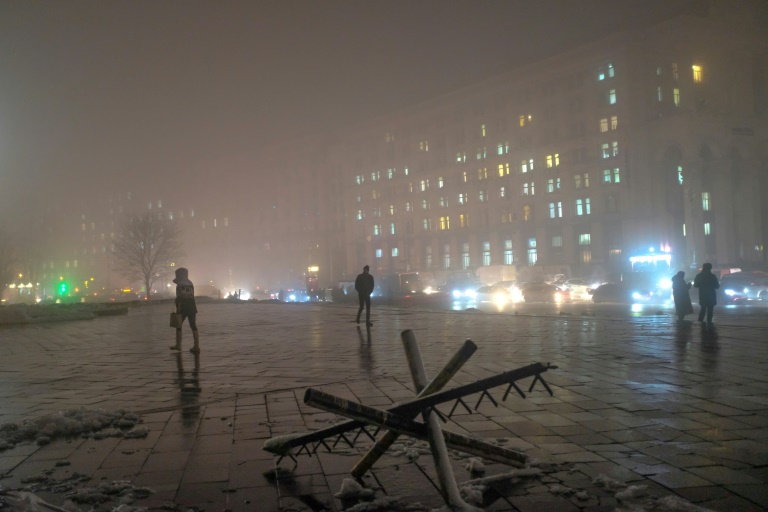
Systematic and targeted Russian attacks for weeks have brought Ukraine’s energy infrastructure to its knees as the country careens towards a freezing winter, spurring fears of a health crisis and a further exodus, nine months into war.

Municipal workers struggled Friday to reconnect essential services such as heat and water as temperatures in Kyiv approached freezing and UK Foreign Secretary James Cleverly visited to announce a new aid package.

“Half of consumers are still without electricity,” Mayor Vitali Klitschko said. “A third of houses in Kyiv already have heating and specialists continue to restore it.”

“During the day, energy companies plan to reconnect electricity for all consumers on an alternating basis,” he wrote on Telegram.

Lines of cars queued outside petrol stations in Kyiv on Friday to stock up, AFP journalists said. Mobile networks in some areas were still experiencing disruptions.

Nationwide, repair work was ongoing, said Volodymyr Kudrytskyi, head of national electricity operator Ukrenergo, but insisted that “the most difficult stage” had passed.

Ukrenergo said that producers were providing more than 70 percent of the need across the country.

– ‘We live like this now’ –

Millions of Ukrainians have endured the cold without power since Russia fired dozens of missiles and launched drone attacks at water and electricity facilities on Wednesday.

“Yes, this is a difficult situation and yes, it can happen again. But Ukraine can cope,” presidential advisor Mykhailo Podolyak said on television.

With gas for cooking and heating disconnected in her Kyiv apartment, Albina Bilogub told AFP that she and her children all sleep in the same room to stay warm.

“In our building, very few people have gas, so we go to the woman that I work for — I change her clothes because she is disabled — and we cook there,” she said.

“This is our life. One sweater, a second, a third. We live like this now.”

In northern Kyiv, a vet in blue scrubs and a face mask shone a light over an operating table in a darkened clinic as colleagues operated on an ailing dog late Thursday.

“We were in the middle of an operation and our lights turned off because a rocket fell not far away, so there was a power cut,” said Oleksiy Yankovenko.

“I had to finish the operation under the flashlights,” he added.

– ‘Brutal attacks’ –

Ukraine’s Western allies have denounced the Russian attacks on energy as a “war crime”, coming in the wake of a string of military setbacks for Russia on the frontlines.

Moscow insists it targets only military linked infrastructure and blamed Kyiv for the blackouts, saying Ukraine can end the suffering by agreeing to Russian demands.

Britain’s foreign minister announced new aid for Ukraine during his visit to Kyiv, including ambulances and support for victims of sexual violence by Russian soldiers.

“As winter sets in, Russia is continuing to try and break Ukrainian resolve through its brutal attacks on civilians, hospitals and energy infrastructure,” Cleverly said.

“Russia will fail,” he said, vowing UK support “will continue for as long as it takes”.

The attacks on Ukraine’s grid are Russia’s latest strategy designed to force Ukrainian capitulation after Moscow’s forces failed to topple the government and capture Kyiv nine months after launching their invasion.

Although they have captured swathes of territory in the south and east and the Kremlin claimed to annex four regions, Ukrainian troops are clawing back territory.

Russian forces have shelled the southern city of Kherson, from which they retreated earlier this month in their latest setback. The Ukrainian presidency said 11 people were killed and nearly 50 injured in the Kherson region on Thursday.
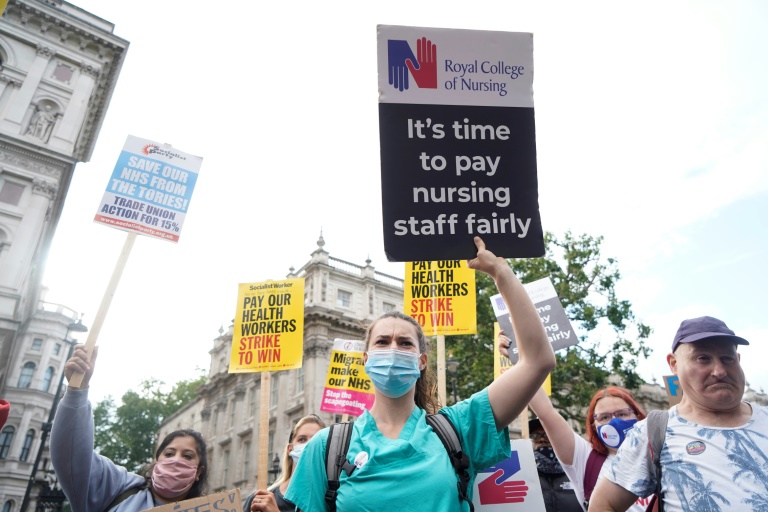
Nurses join other striking UK staff in two December walkouts

Nurses across most of Britain will hold the first strikes in their union’s 106-year history next month, joining a host of other workers taking industrial action over pay.

Staff in England, Wales and Northern Ireland — but not Scotland — will walk out on December 15 and 20, after the Royal College of Nursing (RCN) union said the government had turned down an offer of negotiations.

It will be the latest industrial action in Britain, where decades-high inflation and a cost-of-living crisis have prompted staff in various sectors to demand pay rises to keep up with spiralling prices.

RCN England director Patricia Marquis on Friday apologised to patients who would have operations or treatments cancelled.

But she said the strikes were about “nurses standing up for themselves but also critically for patients”.

The nurses’ strike will be sandwiched between the first of a series of two-day walkouts by national railway workers, while postal service employees will stage fresh stoppages in the run-up to Christmas.

Numerous other public and private sector staff, from lawyers to airport ground personnel, have also held strikes this year.

The Office for National Statistics said “well over half a million working days” were lost to strikes in August and September — the highest two-month total for more than a decade.

With more strikes expected, there are predictions that days lost to stoppages could reach levels not seen since the 1970s and 1980s.

Ambulance staff in Scotland are due to walk out on Monday.

Other health unions representing midwives, physiotherapists and junior doctors have or are planning to ballot their members.

“Nursing staff have had enough of being taken for granted, enough of low pay and unsafe staffing levels, enough of not being able to give our patients the care they deserve,” said RCN head Pat Cullen.

The union, which wants a pay rise significantly above inflation, announced earlier this month that a ballot of its more than 300,000 members had found a majority in favour of strikes.

Cullen said the union would set out details of which services would be exempt from strike action soon.

“What we will continue to provide is life-preserving services,” she told BBC radio adding that some cancer services would be exempt.

– ‘Challenging times ‘ –

UK inflation has surged to reach a 41-year high of 11.1 percent in October on soaring energy and food bills.

NHS bosses said in September that nurses were skipping meals to feed and clothe their children and were struggling to afford rising transport costs.

One in four hospitals had set up foodbanks to support staff, according to NHS Providers, which represents hospital groups in England.

The government says it has accepted independent pay recommendations, and given over one million NHS workers a pay rise of at least £1,400 ($1,590) this year. 

That follows on from a three percent increase last year when public sector pay was frozen.

But the RCN says this leaves experienced nurses worse off by 20 percent in real terms due to successive below-inflation awards since 2010.

In Scotland, the union paused announcing strike action after the devolved government in Edinburgh reopened pay talks.

The Scottish government said late Thursday it had made a “best and final offer” to unions of an average 7.5-percent increase, backdated to April if accepted.

UK health minister Steve Barclay said he was “hugely grateful for the hard work and dedication” of nurses and regretted the strikes.

The NHS had “tried and tested plans” to minimise disruption and ensure emergency services continue, he added.

“These are challenging times for everyone and the economic circumstances mean the RCN’s demands, which on current figures are a 19.2 percent pay rise, costing £10 billion a year, are not affordable,” he said.

Barclay said he was prepared to discuss better working conditions for nurses with the RCN — but not pay.

The union has questioned the UK government’s economic rationale, noting it spends billions of pounds on agency staff to plug workforce gaps.

It points to independent research it commissioned indicating that the finance ministry would recoup 81 percent of the initial outlay of a significant pay rise through higher tax receipts and savings on future recruitment and retention costs.

In the last year, 25,000 nursing staff left the Nursing and Midwifery Council register, it said. 

China's 'iPhone city' under Covid lockdown after violent clashes

Six million people were on Friday under Covid lockdown in a Chinese city home to the world’s largest iPhone factory, after clashes between police and workers furious over pay.

Authorities have ordered residents of eight districts in Zhengzhou, in the central province of Henan, not to leave the area for the next five days, setting up barriers around “high-risk” apartment buildings and checkpoints to restrict travel.

There have been only a handful of coronavirus cases in the city but under China’s zero-Covid policy even tiny outbreaks can spark gruelling lockdowns, travel restrictions and mass testing.

The lockdown in Zhengzhou follows protests by hundreds of employees over conditions and pay at Foxconn’s vast iPhone factory on the outskirts of the city, with images of fresh rallies emerging Friday.

Footage published on social media and geolocated by AFP showed a large group of people walking down a street in the east of the city, some holding signs.

“So many people,” a man can be heard saying. AFP was unable to verify precisely when the protests took place.

Workers previously told AFP the demonstrations had begun over a dispute over promised bonuses at the factory.

Scores of workers left the plant Thursday with payouts of 10,000 yuan ($1,400) from Foxconn.

On Friday posts on Chinese short-video apps said the Taiwanese tech giant was turning away many of thousands of people who had answered hiring ads from the firm after a raft of departures last month.

Some who arrived to take up newly vacant posts had been sent to quarantine hotels outside the plant despite in the end being refused a job, multiple workers told AFP.

“We are in a quarantine hotel, and have no way of going to the Foxconn campus,” one worker who asked to remain anonymous said.

Another employee said those turned away had been promised 10,000 yuan in compensation for being forced to quarantine, but had received only a fraction of that amount.

“They are not letting us start the job and we cannot return home,” one worker isolated in nearby Ruzhou city told AFP.

He added that there had been multiple small protests in other Henan cities by Foxconn workers made to quarantine and unable to start work.

– ‘Please share this’ –

Other videos posted online on Friday and geolocated by AFP showed angry workers knocking down furniture and swearing at police in the lobby of a hotel in Nanyang city, about 280 kilometres (174 miles) from Zhengzhou.

The workers appeared to have been quarantined in the hotel, with a man heard saying in one clip: “Everyone who’s online, please share this.”

The unrest in Zhengzhou comes against the backdrop of mounting public frustration over the government’s zero-tolerance approach to Covid.

China’s daily caseload stood at 33,000 on Friday — a record for the country of 1.4 billion although small by global standards.

The unrelenting zero-Covid push has sparked sporadic protests and hit productivity in the world’s second-largest economy.

In the southeastern manufacturing hub of Guangzhou, millions of people have been ordered not to leave their homes without a negative virus test.

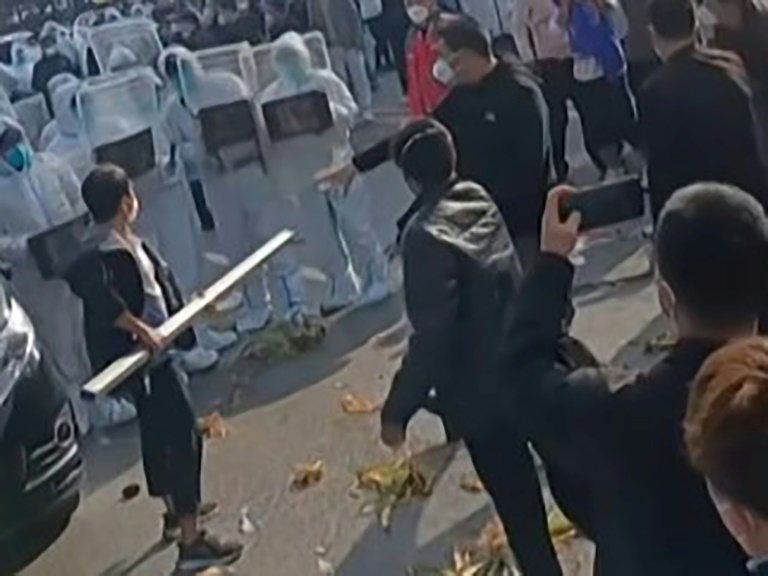
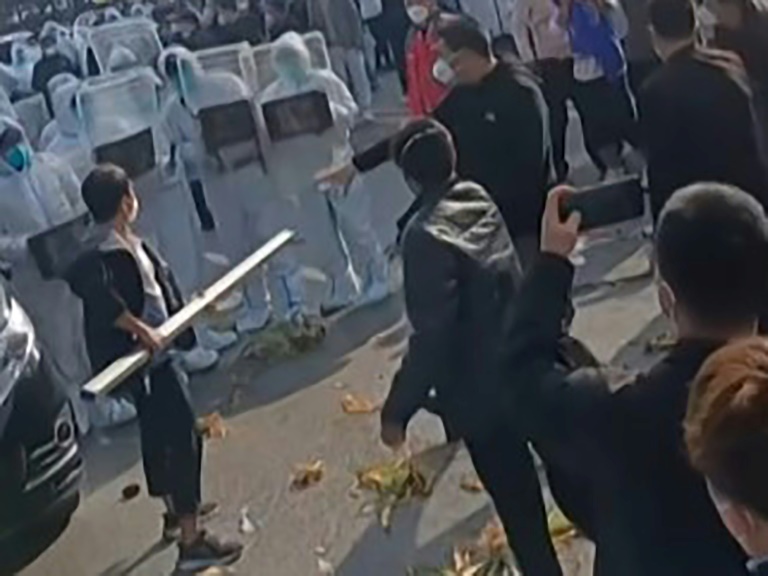
Social media footage published on Friday and geolocated by AFP showed residents of the city’s Haizhu district dismantling barricades and throwing objects at police in hazmat suits.

“What are you doing? What are you doing?” one police officer holding a shield can be heard asking as he and his colleagues back away from the projectiles.

China's 'iPhone city' under Covid lockdown after violent clashes

Six million people were on Friday under Covid lockdown in a Chinese city home to the world’s largest iPhone factory, after clashes between police and workers furious over pay.

Authorities have ordered residents of eight districts in Zhengzhou, in the central province of Henan, not to leave the area for the next five days, setting up barriers around “high-risk” apartment buildings and checkpoints to restrict travel.

There have been only a handful of coronavirus cases in the city but under China’s zero-Covid policy even tiny outbreaks can spark gruelling lockdowns, travel restrictions and mass testing.

The lockdown in Zhengzhou follows protests by hundreds of employees over conditions and pay at Foxconn’s vast iPhone factory on the outskirts of the city, with images of fresh rallies emerging Friday.

Footage published on social media and geolocated by AFP showed a large group of people walking down a street in the east of the city, some holding signs.

“So many people,” a man can be heard saying. AFP was unable to verify precisely when the protests took place.

Workers previously told AFP the demonstrations had begun over a dispute over promised bonuses at the factory.

Scores of workers left the plant Thursday with payouts of 10,000 yuan ($1,400) from Foxconn.

On Friday posts on Chinese short-video apps said the Taiwanese tech giant was turning away many of thousands of people who had answered hiring ads from the firm after a raft of departures last month.

Some who arrived to take up newly vacant posts had been sent to quarantine hotels outside the plant despite in the end being refused a job, multiple workers told AFP.

“We are in a quarantine hotel, and have no way of going to the Foxconn campus,” one worker who asked to remain anonymous said.

Another employee said those turned away had been promised 10,000 yuan in compensation for being forced to quarantine, but had received only a fraction of that amount.

“They are not letting us start the job and we cannot return home,” one worker isolated in nearby Ruzhou city told AFP.

He added that there had been multiple small protests in other Henan cities by Foxconn workers made to quarantine and unable to start work.

– ‘Please share this’ –

Other videos posted online on Friday and geolocated by AFP showed angry workers knocking down furniture and swearing at police in the lobby of a hotel in Nanyang city, about 280 kilometres (174 miles) from Zhengzhou.

The workers appeared to have been quarantined in the hotel, with a man heard saying in one clip: “Everyone who’s online, please share this.”

The unrest in Zhengzhou comes against the backdrop of mounting public frustration over the government’s zero-tolerance approach to Covid.

China’s daily caseload stood at 33,000 on Friday — a record for the country of 1.4 billion although small by global standards.

The unrelenting zero-Covid push has sparked sporadic protests and hit productivity in the world’s second-largest economy.

In the southeastern manufacturing hub of Guangzhou, millions of people have been ordered not to leave their homes without a negative virus test.

Social media footage published on Friday and geolocated by AFP showed residents of the city’s Haizhu district dismantling barricades and throwing objects at police in hazmat suits.

“What are you doing? What are you doing?” one police officer holding a shield can be heard asking as he and his colleagues back away from the projectiles.

Half of Kyiv residents still without electricity after strikes

Nearly half of Kyiv residents were still without electricity Friday, the Ukrainian capital’s mayor said, two days after Russian strikes battered the country’s already struggling energy grid.

“A third of houses in Kyiv already have heating and specialists continue to restore it. Half of consumers are still without electricity,” Mayor Vitali Klitschko said.

“During the day, energy companies plan to reconnect electricity for all consumers on an alternating basis,” he wrote on Telegram, as temperatures approached freezing.

The head of national electricity operator Ukrenergo, Volodymyr Kudrytskyi, said repair work was ongoing across the country and that the grid had already “passed the most difficult stage” after the most recent attacks.

Millions of Ukrainians spent Thursday without power, after Russia earlier fired around 70 missiles and launched attack drones at water and electricity facilities across the country.

The systematic Russian attacks have been denounced by Ukraine’s allies as a “war crime” and come in the wake of a string of military setbacks for Russia on the frontlines.

Moscow has said it is only targeting military-linked infrastructure and blamed Kyiv for the impact the blackouts have had on civilians, saying Ukraine can end that suffering by agreeing to Russian demands.

South Korean capital launches self-driving bus experiment

South Korea’s capital launched its first self-driving bus route on Friday, part of an experiment which engineers said aims to make people feel more comfortable with driverless vehicles on the roads.

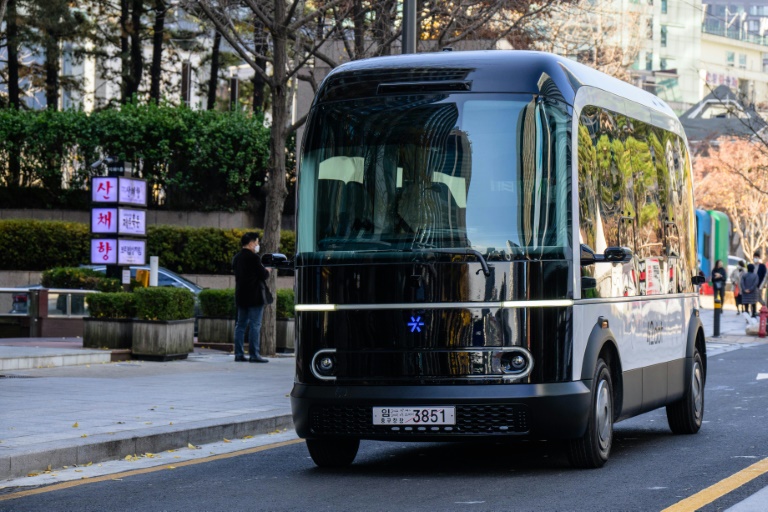
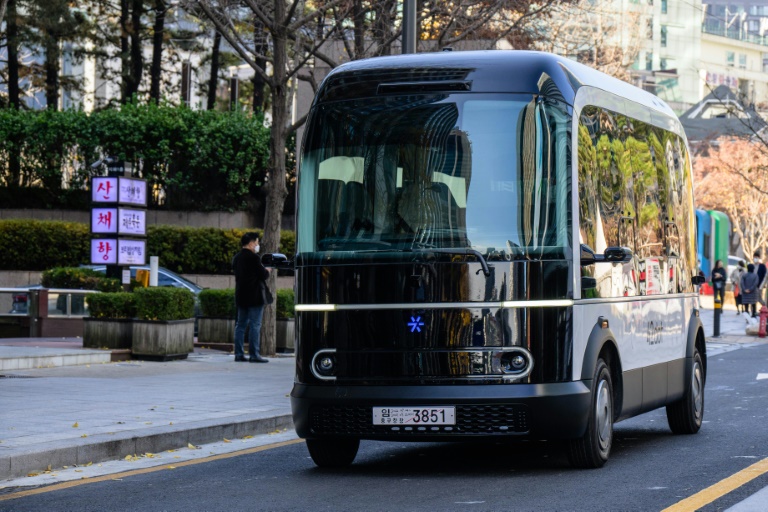
The new vehicle does not look like a regular bus and has rounded edges along with large windows that make it appear more like a toy than a technological breakthrough.

This design is intentional, said Jeong Seong-gyun, head of autonomous driving at 42dot, the start-up responsible for the self-driving technology that is now owned by auto giant Hyundai.

“This is the future,” he told AFP, adding that the bus required “a considerable new type of design”.

The bus looks a bit “like Lego” and is made of composite parts to help keep costs down and make it easy to replicate, he said.

It uses cameras and lasers to navigate the way instead of expensive sensors, Seong-gyun added.

The company’s goal was to make the technology low-cost, safe and easily transferable to many types of vehicle in the future, for example delivery trucks.

For now — with a safety driver monitoring closely — the bus will drive itself around a small 3.4-kilometre (2.1-mile) circuit in downtown Seoul that takes around 20 minutes.

The public can board at two designated stops after booking a free seat through an app.

“I feel like I’ve just hopped into a time machine to visit the future,” said Kim Yi hae-ran, 68, after her 20-minute ride during the launch of the bus Friday.

“I thought it might make me dizzy from a sudden acceleration but I didn’t feel any of it.”

The ride felt “very smooth and safe”, which she said made her feel proud of the technological progress the South Korean company has made.

South Korean capital launches self-driving bus experiment

South Korea’s capital launched its first self-driving bus route on Friday, part of an experiment which engineers said aims to make people feel more comfortable with driverless vehicles on the roads.

The new vehicle does not look like a regular bus and has rounded edges along with large windows that make it appear more like a toy than a technological breakthrough.

This design is intentional, said Jeong Seong-gyun, head of autonomous driving at 42dot, the start-up responsible for the self-driving technology that is now owned by auto giant Hyundai.

“This is the future,” he told AFP, adding that the bus required “a considerable new type of design”.

The bus looks a bit “like Lego” and is made of composite parts to help keep costs down and make it easy to replicate, he said.

It uses cameras and lasers to navigate the way instead of expensive sensors, Seong-gyun added.

The company’s goal was to make the technology low-cost, safe and easily transferable to many types of vehicle in the future, for example delivery trucks.

For now — with a safety driver monitoring closely — the bus will drive itself around a small 3.4-kilometre (2.1-mile) circuit in downtown Seoul that takes around 20 minutes.

The public can board at two designated stops after booking a free seat through an app.

“I feel like I’ve just hopped into a time machine to visit the future,” said Kim Yi hae-ran, 68, after her 20-minute ride during the launch of the bus Friday.

“I thought it might make me dizzy from a sudden acceleration but I didn’t feel any of it.”

The ride felt “very smooth and safe”, which she said made her feel proud of the technological progress the South Korean company has made.

Nurses join other striking UK staff in two December walkouts

Nurses across most of Britain will next month hold the first strikes in their union’s 106-year history, joining a host of other UK workers taking industrial action over pay.

Staff in England, Wales and Northern Ireland — but not Scotland — will walk out on December 15 and 20, after the Royal College of Nursing (RCN) union said the government had turned down an offer of negotiations.

It will be the latest industrial action in Britain, where decades-high inflation and a cost-of-living crisis have prompted staff in various sectors to demand pay rises to keep up with spiralling prices.

RCN England director Patricia Marquis on Friday apologised to patients who would have operations or treatments cancelled, and said it was about “nurses standing up for themselves but also critically for patients”.

“We are sorry for any disruption that’s caused but actually, unless we do this, we don’t see any prospects of things changing any time soon,” she told Sky News. 

The nurses’ strike will be sandwiched between the first of a series of two-day walkouts by national railway workers, while postal service employees will stage fresh stoppages in the run-up to Christmas.

Numerous other public and private sector staff, from lawyers to airport ground personnel, have also held strikes this year.

“Nursing staff have had enough of being taken for granted, enough of low pay and unsafe staffing levels, enough of not being able to give our patients the care they deserve,” said RCN head Pat Cullen.

The union, which wants a pay rise significantly above inflation, announced earlier this month that a ballot of its more than 300,000 members had found a majority in favour of strikes.

“Ministers have had more than two weeks since we confirmed that our members felt such injustice that they would strike for the first time,” Cullen said, adding that an offer of formal negotiations was declined.

“They have the power and the means to stop this by opening serious talks that address our dispute.”

– ‘Challenging times ‘ –

Amid the waves of industrial action, British inflation has continued its recent surge, reaching a 41-year high of 11.1 percent in October on soaring energy and food bills.

Bosses in the NHS said in September that nurses were skipping meals to feed and clothe their children and struggling to afford rising transport costs.

One in four hospitals had set up foodbanks to support staff, according to NHS Providers, which represents hospital groups in England.

The government says it has accepted independent pay recommendations, and given over one million NHS workers a pay rise of at least £1,400 ($1,590) this year. 

That follows on from a three percent increase last year when public sector pay was frozen.

But the RCN says this leaves experienced nurses worse off by 20 percent in real terms due to successive below-inflation awards since 2010.

In Scotland, the union has paused announcing strike action after the devolved government in Edinburgh, which has responsibility for health policy, reopened pay talks.

UK health minister Steve Barclay said he was “hugely grateful for the hard work and dedication” of nurses and regretted the strikes.

The NHS has “tried and tested plans” to minimise disruption and ensure emergency services continue, he added.

“These are challenging times for everyone and the economic circumstances mean the RCN’s demands, which on current figures are a 19.2 percent pay rise, costing £10 billion a year, are not affordable,” he said.

His door remained open to the RCN to discuss “way we can improve nurses’ working lives”, he added in a tweet.

The RCN has questioned the UK government’s economic rationale, noting it spends billions of pounds on agency staff to plug workforce gaps.

It points to independent research it commissioned indicating that the finance ministry would recoup 81 percent of the initial outlay of a significant pay rise through higher tax receipts and savings on future recruitment and retention costs.

In the last year, 25,000 nursing staff left the Nursing and Midwifery Council (NMC) register, it said. 

Other UK health unions are also balloting workers for industrial action, while ambulance staff in Scotland are due to walk out on Monday.

Meanwhile, across the wider economy, numerous sectors look set to continue their strikes into the new year.

Markets mixed as easing Fed fears tempered by China Covid spike

Asian markets were mixed on Friday at the end of a week in which hopes that the Fed will tone down its monetary tightening campaign were offset by fresh Covid lockdown fears in China.

With Wall Street closed for the Thanksgiving break, trading was light with few catalysts to drive action on trading floors and investors looking ahead to the release of US jobs data next week.

The mood across markets picked up this month as a series of indicators suggested the US economy, the world’s largest, was showing signs of weakness after the Federal Reserve ramped up interest rates.

The standout reports were consumer and wholesale inflation, which came in much lower than forecast and provided the central bank with room to row back on its hawkishness.

And while a selection of Fed officials lined up to warn there was more tightening to come, there is an expectation that the days of bumper 75 basis-point increases are gone.

That has slightly eased worries that the sharp rise in borrowing costs could tip the US economy into recession, though many observers still see a contraction coming.

SPI Asset Management’s Stephen Innes said there was a “market consensus bias to believe that US headline inflation will continue to ease substantially over the next month or two and that the tail risks around (more than five percent interest rates) have dropped sharply”.

“After all, a step down to 50 basis points in December would be an unambiguous signal that peak hawkishness has passed.”

Asian equities struggled at end of the week, however, with Tokyo, Hong Kong, Singapore, Seoul, Taipei, Mumbai, Bangkok and Jakarta all down.

There were gains in Shanghai, Sydney, Wellington and Manila.

London rose at the open while Paris and Frankfurt were flat.

Regional sentiment was sapped by ongoing fears about the spike in Covid cases in China, which authorities are trying to contain with a series of targeted measures in big cities including Beijing and Shanghai, though they are short of full-on lockdowns.

Still, Innes said there appeared to be less concern about the government’s reaction as it looks to ease parts of its strict Covid-zero strategy.

“Stock and currency market investors are tentatively looking through the current lockdown regime while betting on the more optimistic interpretation that China is hitting the limits of ‘Covid-zero’ and the authorities’ efforts to loosen restrictions will continue,” he added.

Meanwhile, Jun Bei Liu, at Tribeca Investment Partners, was upbeat about the outlook for Chinese markets.

“In the next 12 months things will get better,” she told Bloomberg TV.

“We have seen this playbook before across other economies. We’ll begin to see outperformance very soon in the next few quarters.”

– Key figures around 0820 GMT –

Tokyo – Nikkei 225: DOWN 0.4 percent at 28,283.03 (close)

Hong Kong – Hang Seng Index: DOWN 0.5 percent at 17,573.58 (close)

Shanghai – Composite: UP 0.4 percent at 3,101.69 (close)

London – FTSE 100: UP 0.1 percent at 7,470.36

Euro/dollar: UP at $1.0420 from $1.0411 on Thursday

Dollar/yen: UP at 138.65 yen from 138.39 yen

Pound/dollar: DOWN at $1.2110 from $1.2131

Euro/pound: UP at 86.05 pence from 85.82 pence

West Texas Intermediate: UP 1.0 percent at $78.68 per barrel

Brent North Sea crude: UP 0.7 percent at $85.97 per barrel

New York – Dow: Closed for a holiday

Markets mixed as easing Fed fears tempered by China Covid spike

Asian markets were mixed on Friday at the end of a week in which hopes that the Fed will tone down its monetary tightening campaign were offset by fresh Covid lockdown fears in China.

With Wall Street closed for the Thanksgiving break, trading was light with few catalysts to drive action on trading floors and investors looking ahead to the release of US jobs data next week.

The mood across markets picked up this month as a series of indicators suggested the US economy, the world’s largest, was showing signs of weakness after the Federal Reserve ramped up interest rates.

The standout reports were consumer and wholesale inflation, which came in much lower than forecast and provided the central bank with room to row back on its hawkishness.

And while a selection of Fed officials lined up to warn there was more tightening to come, there is an expectation that the days of bumper 75 basis-point increases are gone.

That has slightly eased worries that the sharp rise in borrowing costs could tip the US economy into recession, though many observers still see a contraction coming.

SPI Asset Management’s Stephen Innes said there was a “market consensus bias to believe that US headline inflation will continue to ease substantially over the next month or two and that the tail risks around (more than five percent interest rates) have dropped sharply”.

“After all, a step down to 50 basis points in December would be an unambiguous signal that peak hawkishness has passed.”

Asian equities struggled at end of the week, however, with Tokyo, Hong Kong, Singapore, Seoul, Taipei, Mumbai, Bangkok and Jakarta all down.

There were gains in Shanghai, Sydney, Wellington and Manila.

London rose at the open while Paris and Frankfurt were flat.

Regional sentiment was sapped by ongoing fears about the spike in Covid cases in China, which authorities are trying to contain with a series of targeted measures in big cities including Beijing and Shanghai, though they are short of full-on lockdowns.

Still, Innes said there appeared to be less concern about the government’s reaction as it looks to ease parts of its strict Covid-zero strategy.

“Stock and currency market investors are tentatively looking through the current lockdown regime while betting on the more optimistic interpretation that China is hitting the limits of ‘Covid-zero’ and the authorities’ efforts to loosen restrictions will continue,” he added.

Meanwhile, Jun Bei Liu, at Tribeca Investment Partners, was upbeat about the outlook for Chinese markets.

“In the next 12 months things will get better,” she told Bloomberg TV.

“We have seen this playbook before across other economies. We’ll begin to see outperformance very soon in the next few quarters.”

– Key figures around 0820 GMT –

Tokyo – Nikkei 225: DOWN 0.4 percent at 28,283.03 (close)

Hong Kong – Hang Seng Index: DOWN 0.5 percent at 17,573.58 (close)

Shanghai – Composite: UP 0.4 percent at 3,101.69 (close)

London – FTSE 100: UP 0.1 percent at 7,470.36

Euro/dollar: UP at $1.0420 from $1.0411 on Thursday

Dollar/yen: UP at 138.65 yen from 138.39 yen

Pound/dollar: DOWN at $1.2110 from $1.2131

Euro/pound: UP at 86.05 pence from 85.82 pence

West Texas Intermediate: UP 1.0 percent at $78.68 per barrel

Brent North Sea crude: UP 0.7 percent at $85.97 per barrel

New York – Dow: Closed for a holiday

Close Bitnami banner
Bitnami