AFP

N. Korea ICBM launch appears to have failed, Seoul says

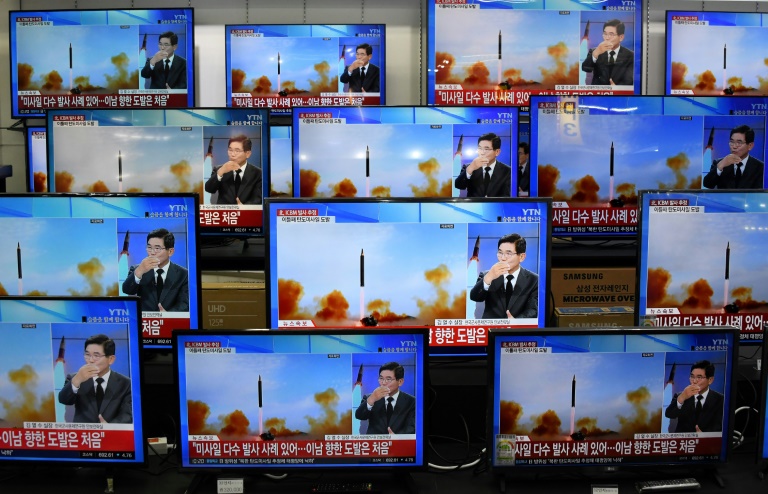
North Korea unsuccessfully fired an intercontinental ballistic missile during a new salvo of launches Thursday, the South Korean military said, with Washington urging all nations to enforce sanctions on Pyongyang.

The launches prompted South Korea and the United States to extend their ongoing joint air drills, the largest-ever such exercises, citing North Korea’s “provocations”.

People in parts of northern Japan were ordered to seek shelter during the North’s latest launches, which included two short-range missiles and followed a blitz of projectiles fired Wednesday.

The largest of Thursday’s launches, however, “is presumed to have ended in failure”, the South Korean military said.

The United States condemned the ICBM launch despite its apparent failure.

“This action underscores the need for all countries to fully implement DPRK-related UN Security Council resolutions,” US State Department spokesman Ned Price said, using the North’s official name of the Democratic People’s Republic of Korea.

Washington also confirmed information provided by the South Korean military, which said earlier it had detected the launch of the long-range ballistic missile at around 7:40 am (2240 GMT Wednesday) in the Sunan area of Pyongyang.

Seoul’s Joint Chiefs of Staff said the ICBM appeared to have failed during “second-stage separation”.

“The range of the long-range ballistic missile is around 760 kilometres, altitude of 1,920 kilometres at speed of Mach 15,” the military said.

It also detected what were “believed to be two short-range ballistic missiles fired at around 08:39 am from Kaechon, South Pyongan province.”

South Korea’s military “is maintaining a full readiness posture while closely cooperating with the US and strengthening surveillance and vigilance,” it said.

– ‘The most horrible price’ –

Pyongyang fired more than 20 missiles on Wednesday, including one that landed near South Korea’s territorial waters.

One short-range ballistic missile crossed the Northern Limit Line, the de facto maritime border, on Wednesday, prompting President Yoon Suk-yeol to call it “effectively a territorial invasion”.

The launches come as Seoul and Washington stage their largest-ever joint air drills, involving hundreds of warplanes from both sides.

Pyongyang has called the exercise, dubbed Vigilant Storm, “an aggressive and provocative military drill targeting the DPRK”, and warned that, if it continues, Seoul and Washington will “pay the most horrible price in history.”

The exercise had been due to end Friday, but South Korea’s air force said Thursday that it would extend its air drills with the United States in response to the latest launches.

“The joint air forces have agreed to extend the Vigilant Storm drill that kicked off on October 31 with respect to the North’s recent provocations,” the air force said in a statement.

Tokyo confirmed Thursday’s launches, with the Japanese government issuing a special warning to residents of northern regions to stay indoors or seek shelter.

Tokyo initially said the missile had flown over Japan, prompting a “J-Alert” to be issued, but defence minister Yasukazu Hamada later said that “the missile did not cross the Japanese archipelago, but disappeared over the Sea of Japan.”

– ‘Tactical nuclear drills’ –

Washington and Seoul have repeatedly warned that Kim Jong Un’s recent missile launches could culminate in another nuclear test — which would be Pyongyang’s seventh.

“Quite possible tactical nuclear weapons test(s) will be next. Possibly very soon,” Chad O’Carroll of Seoul-based specialist site NK News said on Twitter.

Ahn Chan-il, a North Korean studies scholar, agreed. 

“These are North Korea’s pre-celebration events ahead of their upcoming nuclear test,” he told AFP.

“They also seem like a series of practical tests for their tactical nuclear deployment.”

North Korea revised its laws in September to allow for pre-emptive nuclear strikes, with leader Kim declaring the country to be an “irreversible” nuclear power — effectively ending negotiations over its banned arms programs.

On October 4, North Korea fired a missile over Japan that also prompted evacuation warnings. Pyongyang later claimed it was a new type of “ground-to-ground intermediate-range ballistic missile”.

It was the first time North Korea had fired a missile over Japan since 2017.

Pyongyang later claimed that the launch and a blizzard of other tests around the same time were “tactical nuclear drills” that simulated showering South Korea with nuclear-tipped missiles.

Psychedelics show promise in treating depression: study

For years, scientists have been looking ever more seriously at the therapeutic effect of psychedelics, which are not legal under US federal law. However, despite this renewed interest, large-scale studies are still lacking.

On Wednesday, researchers took an important step to fill this gap.

Their work, published in the New England Journal of Medicine, is the largest clinical trial ever conducted to evaluate the effect of psilocybin, a psychoactive substance found naturally in  “magic” mushrooms.

A single dose of 25 milligrams reduced symptoms of depression in people for whom several conventional treatments had failed, they showed.

An estimated 100 million people worldwide suffer from treatment-resistant depression. Some experts view psychedelics as a possible way to help them.

The researchers tested a synthetic version of psilocybin developed by the start-up Compass Pathway, which also funded the trials.

A total of 233 people in 10 countries took part in the study, during which they halted ongoing treatment but received psychological support.

They were divided into three groups, randomly receiving 1 milligram, 10 milligrams or 25 milligrams of the treatment.

The sessions, in a dedicated room, lasted between six and eight hours during which the participants were never left alone. Some described being immersed in “a dream-like state” that could be remembered, study co-author James Rucker told a news conference.

One participant required a sedative during the session because of anxiety. But the side effects observed — headaches, nausea, anxiety — were generally moderate and disappeared quickly.

– Larger trials needed –

Three weeks later, patients who received 25 mg showed significant improvement compared to lower doses on a baseline measure for depression. Just under 30 percent were in remission.

“It is the strongest evidence so far to suggest that further, larger and longer randomized trials of psychedelics are justified, and that psilocybin may (one day) provide a potential alternative to antidepressants that have been prescribed for decades,” said Andrew McIntosh, professor of psychiatry at the University of Edinburgh.

McIntosh was not involved in the study.

The phase 2 trials were designed to determine the dosage and confirm the existence of an appropriate effect.

Phase 3 trials, involving more participants, are scheduled to begin this year and run until 2025. The startup is already in touch with the US Food and Drug Administration and regulators in Europe.

Another expert offered caution.

“We don’t yet know enough about the potential side effects, particularly whether some people may experience a worsening of some symptoms,” said Anthony Cleare, a professor of psychopharmacology in London, who was not involved in the study.

In the trials, three participants showed suicidal behavior among those who received 25 mg, compared with none in the other groups.

These events, however, occurred more than 28 days after treatment, noted Guy Goodwin, professor of psychiatry at Oxford and chief medical officer of Compass Pathways.

“Our hypothesis is that the differences are by chance… but we can only settle this by doing further experiments,” he said.

The matter of long-term impact also remains open, as it faded when the participants were followed up three months later. Repeated doses may be necessary. Two doses will be tested in future trials, Goodwin said.

– ‘More flexible state’ –

Taking psilocybin leads to an increase in dopamine (known to regulate mood) and another neurotransmitter that may promote brain plasticity, Rucker said.

“When the brain is in a more flexible state, it opens what we consider to be a therapeutic window of opportunity, in which –in the context… of psychotherapy — you may be able to elicit positive changes in the minds of people,” Rucker said.

Psilocybin promotes “more communication between brain regions,” added Nadav Liam Modlin, also a co-author of the study.

Psilocybin, which is not addictive, is also studied for other pathologies including post-traumatic stress, anorexia, anxiety and addictions.

In 2020, the state of Oregon voted in favor of the therapeutic use of psilocybin. Exemptions have also been granted in Canada. 

But at the US federal level, psilocybin is treated as a dangerous drug in the same category as heroin. 

Asia, Europe join Wall St plunge as Powell wrecks Fed pivot hopes

Asian and European markets sank Thursday after the Federal Reserve hiked interest rates and boss Jerome Powell suggested they would go higher than expected, blowing a hole in hopes for a more dovish pivot in its fight against inflation.

Equities have rallied for more than a week on speculation the US central bank would join others in tamping down its monetary-tightening campaign as the economy showed signs of slowing.

On Wednesday, the bank unveiled a fourth straight 75 basis-point increase — the sixth hike this year — and opened the door to a smaller increase at future meetings, giving a boost to Wall Street.

But Powell soon after sent traders scattering when he told a news conference that while it would be appropriate to lessen the size of the hikes, “incoming data since our last meeting suggests that ultimate level of interest rates will be higher than previously expected”.

He added that “we still have some ways” until borrowing costs were at the necessary level and that it “is very premature to be thinking about pausing”.

And while there is a building fear that the increasingly tight monetary conditions will send the world’s top economy into a recession, the Fed boss said it would take time for the effects of the measures to kick in.

“The historical record cautions strongly against prematurely loosening policy,” he warned. “We will stay the course, until the job is done.”

Investors now expect rates to top out at more than five percent, compared with four percent currently.

The comments hammered the narrative that had supported stocks, sending Wall Street’s three main indexes tanking — led by rate-sensitive tech giants — and pushing the dollar up against its peers.

“Every time the market gets a little bit of dovish hope, it gets smacked on the nose with a rolled-up newspaper,” Scott Rundell of Mutual Ltd said. “There’s a lot of volatility still ahead.”

Hong Kong led the losses as the city’s central bank hiked rates in line with the Fed, owing to their policy link via the dollar peg.

Traders gave back a chunk of the previous two days’ gains, which came on the back of speculation China was planning to roll back some of its painful zero-Covid policies. Adding to the selling was confirmation from Beijing’s health authority that it intended to stick to the strategy.

Shanghai, Sydney, Seoul, Wellington, Mumbai, Bangkok, Taipei and Manila were also well in the red. Tokyo was closed for a holiday.

London, Paris and Frankfurt extended the losses.

“While the market got what it wanted in the context of expectations of smaller rate rises, they probably weren’t expecting that rates might need to go quite a lot higher, thus removing any prospect of an imminent pause, or even a rate cut much before the end of 2024,” said Michael Hewson at CMC Markets.

The release Friday of US jobs figures will give another insight into the state of the economy and particularly the labour market, which has remained resilient in the face of decades-high inflation and rising rates.

As the Fed is basing its moves on data, a strong reading could give officials room to continue lifting. 

Before that, the Bank of England is tipped to lift its key rate by 0.75 percentage points to three percent — the most in 33 years and putting them at the highest since 2008 — though some analysts are even predicting a full percentage point hike.

The pound sank against the dollar ahead of the announcement.

– Key figures around 0815 GMT –

Hong Kong – Hang Seng Index: DOWN 3.1 percent at 15,339.49 (close)

Shanghai – Composite: DOWN 0.2 percent at 2,997.81 (close)

Tokyo – Nikkei 225: Closed for a holiday

London – FTSE 100: DOWN 0.8 percent at 7,087.64

Euro/dollar: DOWN at $0.9776 from $0.9816 on Wednesday

Pound/dollar: DOWN at $1.1325 from $1.1390

Dollar/yen: UP at 148.00 yen from 147.90 yen

Euro/pound: UP at 86.33 pence from 86.17 pence

West Texas Intermediate: DOWN 1.0 percent at $89.13 per barrel

Brent North Sea crude: DOWN 0.7 percent at $95.45 per barrel

New York – Dow: DOWN 1.6 percent at 32,147.76 (close)

Asia, Europe join Wall St plunge as Powell wrecks Fed pivot hopes

Asian and European markets sank Thursday after the Federal Reserve hiked interest rates and boss Jerome Powell suggested they would go higher than expected, blowing a hole in hopes for a more dovish pivot in its fight against inflation.

Equities have rallied for more than a week on speculation the US central bank would join others in tamping down its monetary-tightening campaign as the economy showed signs of slowing.

On Wednesday, the bank unveiled a fourth straight 75 basis-point increase — the sixth hike this year — and opened the door to a smaller increase at future meetings, giving a boost to Wall Street.

But Powell soon after sent traders scattering when he told a news conference that while it would be appropriate to lessen the size of the hikes, “incoming data since our last meeting suggests that ultimate level of interest rates will be higher than previously expected”.

He added that “we still have some ways” until borrowing costs were at the necessary level and that it “is very premature to be thinking about pausing”.

And while there is a building fear that the increasingly tight monetary conditions will send the world’s top economy into a recession, the Fed boss said it would take time for the effects of the measures to kick in.

“The historical record cautions strongly against prematurely loosening policy,” he warned. “We will stay the course, until the job is done.”

Investors now expect rates to top out at more than five percent, compared with four percent currently.

The comments hammered the narrative that had supported stocks, sending Wall Street’s three main indexes tanking — led by rate-sensitive tech giants — and pushing the dollar up against its peers.

“Every time the market gets a little bit of dovish hope, it gets smacked on the nose with a rolled-up newspaper,” Scott Rundell of Mutual Ltd said. “There’s a lot of volatility still ahead.”

Hong Kong led the losses as the city’s central bank hiked rates in line with the Fed, owing to their policy link via the dollar peg.

Traders gave back a chunk of the previous two days’ gains, which came on the back of speculation China was planning to roll back some of its painful zero-Covid policies. Adding to the selling was confirmation from Beijing’s health authority that it intended to stick to the strategy.

Shanghai, Sydney, Seoul, Wellington, Mumbai, Bangkok, Taipei and Manila were also well in the red. Tokyo was closed for a holiday.

London, Paris and Frankfurt extended the losses.

“While the market got what it wanted in the context of expectations of smaller rate rises, they probably weren’t expecting that rates might need to go quite a lot higher, thus removing any prospect of an imminent pause, or even a rate cut much before the end of 2024,” said Michael Hewson at CMC Markets.

The release Friday of US jobs figures will give another insight into the state of the economy and particularly the labour market, which has remained resilient in the face of decades-high inflation and rising rates.

As the Fed is basing its moves on data, a strong reading could give officials room to continue lifting. 

Before that, the Bank of England is tipped to lift its key rate by 0.75 percentage points to three percent — the most in 33 years and putting them at the highest since 2008 — though some analysts are even predicting a full percentage point hike.

The pound sank against the dollar ahead of the announcement.

– Key figures around 0815 GMT –

Hong Kong – Hang Seng Index: DOWN 3.1 percent at 15,339.49 (close)

Shanghai – Composite: DOWN 0.2 percent at 2,997.81 (close)

Tokyo – Nikkei 225: Closed for a holiday

London – FTSE 100: DOWN 0.8 percent at 7,087.64

Euro/dollar: DOWN at $0.9776 from $0.9816 on Wednesday

Pound/dollar: DOWN at $1.1325 from $1.1390

Dollar/yen: UP at 148.00 yen from 147.90 yen

Euro/pound: UP at 86.33 pence from 86.17 pence

West Texas Intermediate: DOWN 1.0 percent at $89.13 per barrel

Brent North Sea crude: DOWN 0.7 percent at $95.45 per barrel

New York – Dow: DOWN 1.6 percent at 32,147.76 (close)

Republican denial of election results a 'path to chaos': Biden

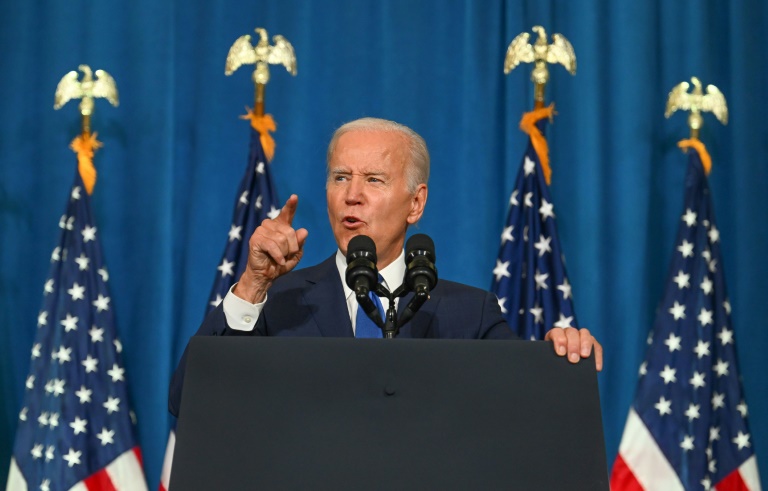
President Joe Biden warned US voters Wednesday that the future of democracy was at stake in next week’s midterms, with the steadfast refusal of some Republican candidates to accept election results opening a “path to chaos in America.”

With conservatives hammering his administration over the state of the economy, the 79-year-old Democrat aimed squarely at Republicans who have cast their lot with former president Donald Trump in denying Biden’s 2020 election victory.

“There are candidates running for every level of office in America… who won’t commit to accepting the results of the elections they’re in,” Biden said in a televised address to the nation.

Their goal, he said, was to follow Trump’s lead and try to “subvert the electoral system itself” — noting there are more than 300 Republican election deniers on the ballot in races across the country this year.

“They’ve emboldened violence and intimidation of voters and election officials,” he charged — less than two years after a mob of Trump supporters ransacked the US Capitol to try to overturn the 2020 result.

“That is the path to chaos in America,” he said. “It’s unprecedented. It’s unlawful. And, it is un-American.”

Biden’s dire warning of threats to democracy comes six days ahead of Tuesday’s vote, in which Republicans are heavily favored to capture the House of Representatives and possibly the Senate.

In the wake of a violent attack on the husband of the Democratic House speaker, Nancy Pelosi, which dramatically heightened concerns about heated political rhetoric, Biden urged Americans to unite in defense of democracy. 

“We must with an overwhelming voice stand against political violence and voter intimidation, period,” he said.

“We have to face this problem,” he said. “We can’t pretend it’s just going to solve itself.”

But nearly 22 months after the Capitol insurrection, polling shows that American voters are more concerned with the economy. 

More than half say the price of gas and consumer goods is the economic issue that worries them the most in a new Quinnipiac University national poll.

In response to Biden’s speech, House Republican Leader Kevin McCarthy accused the president of refusing “to address Americans top concerns.”

“In six days, Republicans will win convincingly and help put America back on track,” McCarthy, who stands to become House speaker if the Republicans win next week’s election, tweeted.

Democrats are being attacked on inflation and fears of a looming recession, with the Federal Reserve repeatedly hiking interest rates — and Biden acknowledged Wednesday that “inflation is still hurting” at a White House event with union workers and employers.

His admission came as the US central bank delivered another steep rate hike, raising the benchmark borrowing rate by 0.75 percentage points — the fourth straight increase of that size and the sixth hike this year.

– Balancing act –

Biden, whose approval rating has been underwater for more than a year, has been relatively inconspicuous on the campaign trail.

But he entered the fray in the home stretch with Wednesday’s address, ahead of stump speeches in Pennsylvania, New Mexico, California and Maryland.

Democrats have some major legislative victories to tout since Biden’s election win, but they have been hamstrung by internecine fights between progressives and moderates.

A huge row sparked by the party’s leftist flank calling on Biden to negotiate with President Vladimir Putin over Russia’s invasion of Ukraine was the most recent example of Democratic dysfunction.

Before settling on a “kitchen sink” strategy of talking about the cash in voters’ pockets, Democrats spent much of the campaign pulling in different directions on the importance of abortion rights, climate change, reproductive freedoms and the war in Ukraine.

But polling consistently shows voters more focused on their pocketbooks, and internal divisions left Democrats without a cohesive response to Republican attacks that they have mishandled the economy.

The nonpartisan Cook Political Report moved 10 House races toward the Republicans on Tuesday in the solidly Democratic states of New York, New Jersey, Oregon, California and Illinois.

If all of the races in Cook’s Republican column go as predicted, the party would need to win just six of the 35 “toss up” races to take the majority. Democrats would need 29. 

N. Korea ICBM launch appears to have failed, Seoul says

North Korea unsuccessfully fired an intercontinental ballistic missile during a new salvo of launches Thursday, the South Korean military said, with Washington urging all nations to enforce sanctions on Pyongyang.

The launches prompted South Korea and the United States to extend their ongoing joint air drills, the largest-ever such exercises, citing North Korea’s “provocations”.

People in parts of northern Japan were ordered to seek shelter during the North’s latest launches, which included two short-range missiles and followed a blitz of projectiles fired Wednesday.

The largest of Thursday’s launches, however, “is presumed to have ended in failure”, the South Korean military said.

The United States condemned the ICBM launch despite its apparent failure.

“This action underscores the need for all countries to fully implement DPRK-related UN Security Council resolutions,” US State Department spokesman Ned Price said, using the North’s official name of the Democratic People’s Republic of Korea.

Washington also confirmed information provided by the South Korean military, which said earlier it had detected the launch of the long-range ballistic missile at around 7:40 am (2240 GMT Wednesday) in the Sunan area of Pyongyang.

Seoul’s Joint Chiefs of Staff said the ICBM appeared to have failed during “second-stage separation”.

“The range of the long-range ballistic missile is around 760 kilometres, altitude of 1,920 kilometres at speed of Mach 15,” the military said.

It also detected what were “believed to be two short-range ballistic missiles fired at around 08:39 am from Kaechon, South Pyongan province.”

South Korea’s military “is maintaining a full readiness posture while closely cooperating with the US and strengthening surveillance and vigilance,” it said.

– ‘The most horrible price’ –

Pyongyang fired more than 20 missiles on Wednesday, including one that landed near South Korea’s territorial waters.

One short-range ballistic missile crossed the Northern Limit Line, the de facto maritime border, on Wednesday, prompting President Yoon Suk-yeol to call it “effectively a territorial invasion”.

The launches come as Seoul and Washington stage their largest-ever joint air drills, involving hundreds of warplanes from both sides.

Pyongyang has called the exercise, dubbed Vigilant Storm, “an aggressive and provocative military drill targeting the DPRK”, and warned that, if it continues, Seoul and Washington will “pay the most horrible price in history.”

The exercise had been due to end Friday, but South Korea’s air force said Thursday that it would extend its air drills with the United States in response to the latest launches.

“The joint air forces have agreed to extend the Vigilant Storm drill that kicked off on October 31 with respect to the North’s recent provocations,” the air force said in a statement.

Tokyo confirmed Thursday’s launches, with the Japanese government issuing a special warning to residents of northern regions to stay indoors or seek shelter.

Tokyo initially said the missile had flown over Japan, prompting a “J-Alert” to be issued, but defence minister Yasukazu Hamada later said that “the missile did not cross the Japanese archipelago, but disappeared over the Sea of Japan.”

– ‘Tactical nuclear drills’ –

Washington and Seoul have repeatedly warned that Kim Jong Un’s recent missile launches could culminate in another nuclear test — which would be Pyongyang’s seventh.

“Quite possible tactical nuclear weapons test(s) will be next. Possibly very soon,” Chad O’Carroll of Seoul-based specialist site NK News said on Twitter.

Ahn Chan-il, a North Korean studies scholar, agreed. 

“These are North Korea’s pre-celebration events ahead of their upcoming nuclear test,” he told AFP.

“They also seem like a series of practical tests for their tactical nuclear deployment.”

North Korea revised its laws in September to allow for pre-emptive nuclear strikes, with leader Kim declaring the country to be an “irreversible” nuclear power — effectively ending negotiations over its banned arms programs.

On October 4, North Korea fired a missile over Japan that also prompted evacuation warnings. Pyongyang later claimed it was a new type of “ground-to-ground intermediate-range ballistic missile”.

It was the first time North Korea had fired a missile over Japan since 2017.

Pyongyang later claimed that the launch and a blizzard of other tests around the same time were “tactical nuclear drills” that simulated showering South Korea with nuclear-tipped missiles.
Make glasses cool with new emojis, urges UK schoolgirl

British schoolgirl Lowri Moore is just 13 but has achieved a lot in her short life, championing children who like her wear glasses.

Aged nine, she persuaded Disney to create a bespectacled heroine for the first time, in the hit film “Encanto”.

Her #GlassesOn campaign has meanwhile struck a chord with thousands of young people and their parents around the world.

Now she has another US giant in her sights.

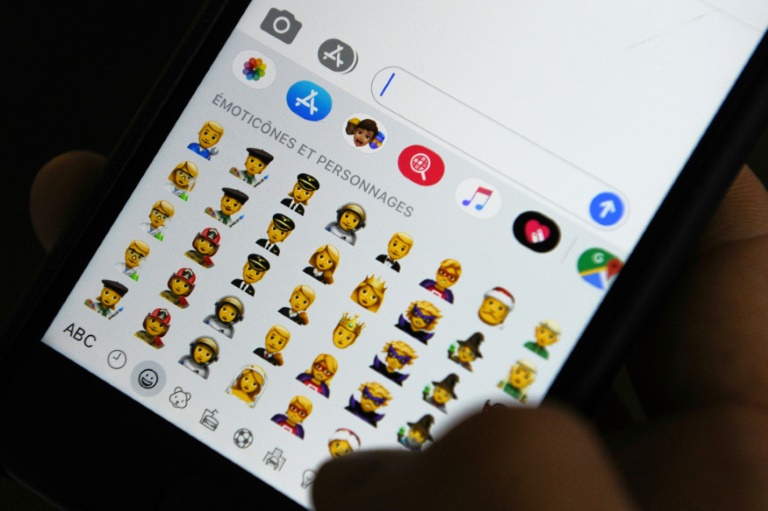
The teenager from Nottinghamshire, central England, is urging the body responsible for all new emojis to give people the option to put glasses on them.

She says many people believe that children being stigmatised for wearing glasses is a thing of the past.

But she argues many children still resist wearing their glasses for fear of appearing “different or uncool”.

Research shows children with spectacles are over 35 percent more likely to be bullied at school, and not wearing them can have far-reaching consequences.

“We are in touch with a professor who works in Botswana to give children glasses and he said that most of the children that get glasses don’t want to wear them for fear of being different and not cool,” Lowri told AFP.

– ‘Biggest fan’ –

She said that without glasses you need, “you won’t be able to learn and that will limit your job options and you will probably really struggle in life all because you didn’t wear your glasses. That’s not fair.”

Lowri’s latest campaign was sparked when her mother Cyrilyn tried to find an emoji relevant to her daughter.

“She was looking for an emoji that would represent me but all she found was a nerd.

“She kept on looking and there was a granny and a teacher but obviously that doesn’t represent me,” she said.

Lowri said it was great there were some bespectacled emojis, but three was not enough.

“It’s not really positive so we’re just asking for the option of putting glasses onto already existing emojis,” she said after handing in copies of her letter at the London offices of tech giants Google and Meta on Wednesday.

Lowri’s campaigning began in 2019 when she wrote to Disney calling for more characters with glasses in their films.

Two years later, the “Encanto” character Mirabel Madrigal hit the big screen.

Director Jared Bush revealed he had been inspired by the schoolgirl’s letter, telling her: “I am your biggest fan, I’m so impressed by you.”

The director also said he had wanted to let her know much earlier, but had to keep it secret until the movie was in the bag.

– ‘Negative stereotypes’ –

In her latest letter, Lowri praised the Unicode Consortium, the non-profit organisation based in California that oversees new emojis, for offering users more choice.

But she urged them to go further.

“I’d love to see the option to add glasses to face emojis, similar to changing skin colour or hair colour as you have already made available,” she wrote.

Having the current “nerd” emoji as the only one available for young people could be “damaging as it helps to confirm the negative stereotype and stigma that we are trying hard to destroy”, she added.

Lowri’s campaigning success was recognised earlier this year when she was named “Campaigner of the Year” by the International Agency for the Prevention of Blindness (IAPB).

Failing to wear glasses can prevent children’s eyes from developing normally and lead to avoidable eye conditions.

Jessica Thompson of the IAPB, which works in over 100 countries worldwide, said Lowri’s advocacy was helping to highlight the damage to children’s futures of not wearing glasses.

“If you struggle to see, you struggle to learn,” she told AFP.

Wearing glasses was the single “most effective” health intervention for schoolchildren, “reducing the odds of failing a class by 44 percent”, she added.

Parkland shooter jailed for life, confronted by victims' relatives

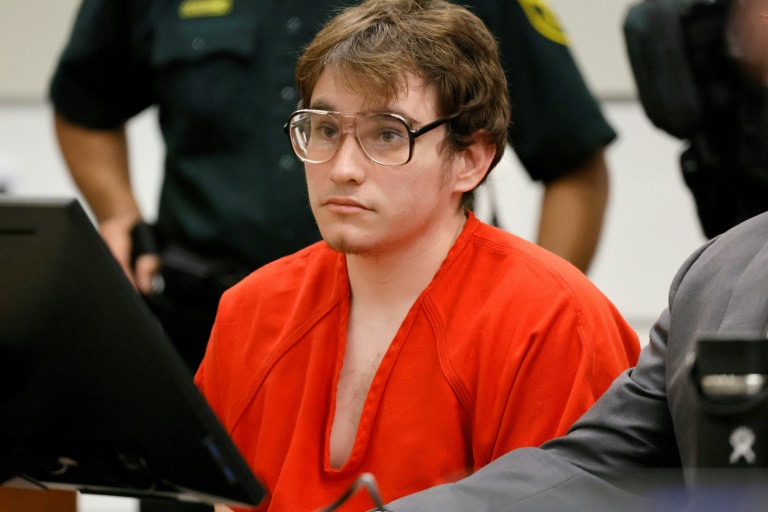
The gunman who murdered 17 people in a 2018 high school rampage was formally sentenced to life in prison Wednesday in a Florida court, where he was verbally confronted by furious parents.

Nikolas Cruz, now 24, avoided the death penalty last month when a jury could not unanimously agree that he deserved capital punishment for his shooting spree at Marjory Stoneman Douglas High School in Parkland.

Family members wept and held hands as Broward Circuit Judge Elizabeth Scherer read out the 17 sentences of first-degree murder, saying after each victim’s name that “the court imposes a mandatory life sentence without the possibility of parole.”

Cruz also received life sentences for each of the 17 people he wounded in the shooting.

The failure to mete out the death penalty shocked and angered several of the victims’ relatives last month. 

But over a two-day hearing that ended with Wednesday’s sentencing, multiple parents and other relatives of those killed were allowed to express their grief and anger by addressing Cruz directly.

“My hope for you is that the pain of what you did to my family burns and traumatizes you every day,” said Lori Alhadeff, whose 14-year-old daughter Alyssa was killed, in comments reported by National Public Radio.

Cruz pleaded guilty in October 2021. In the subsequent three-month penalty phase of the trial earlier this year, the jury saw graphic footage of the attack in which Cruz used an AR-15-style semiautomatic rifle, and they listened to harrowing testimony from survivors.

During the trial, relatives and survivors were not allowed to speak directly to Cruz. On Tuesday and Wednesday, they called him a monster and a “murdering bastard” who deserved to “burn in hell,” according to NPR.

In unadorned rage, some of them also excoriated the criminal justice system for sparing Cruz’s life, speaking to him from a lectern about 20 feet (six meters) away from the convict.

“The idea that you, a coldblooded killer, can actually live each day, eat your meals and put your head down at night seems completely unjust,” said teacher Stacey Lippel, who was wounded in the shooting, according to CBS News.

“The only comfort I have is that your life in prison will be filled with horror and fear.”

On February 14, 2018, then-19-year-old Cruz walked into the school carrying a semiautomatic rifle. He had been expelled a year earlier for disciplinary reasons.

In nine minutes, he killed 17 people and wounded another 17.

Cruz fled by mixing in with people frantically escaping the gory scene but was arrested by police shortly after as he walked along the street.

The Parkland shooting stunned the nation and reignited the debate on gun control since Cruz had legally purchased the weapon he used despite his mental health issues.

Asia joins Wall St plunge as Powell wrecks Fed pivot hopes

Asian markets sank Thursday after the Federal Reserve hiked interest rates and boss Jerome Powell suggested they would go higher than expected, blowing a hole in hopes for a more dovish pivot in its fight against inflation.

Equities have rallied for more than a week on speculation the US central bank would join others in tamping down its monetary-tightening campaign as the economy showed signs of slowing.

On Wednesday, the bank unveiled a fourth straight 75 basis-point increase — the sixth hike this year — and opened the door to a smaller increase at future meetings, giving a boost to Wall Street.

However, Powell soon after sent traders scattering when he told a news conference that while it would be appropriate to lessen the size of the hikes, “incoming data since our last meeting suggests that ultimate level of interest rates will be higher than previously expected”.

He added that “we still have some ways” until borrowing costs were at the necessary level and that it “is very premature to be thinking about pausing”.

And while there is a building fear that the increasingly tight monetary conditions will send the world’s top economy into a recession, the Fed boss said it would take time for the effects of the measures to kick in.

“The historical record cautions strongly against prematurely loosening policy,” he warned. “We will stay the course, until the job is done.”

Investors now expect rates to top out at more than five percent, compared with four percent currently.

The comments hammered the narrative that had supported stocks, sending Wall Street’s three main indexes tanking — led by rate-sensitive tech giants — and pushing the dollar up against its peers.

“Every time the market gets a little bit of dovish hope, it gets smacked on the nose with a rolled-up newspaper,” Scott Rundell, Mutual Ltd, said. “There’s a lot of volatility still ahead.”

Hong Kong led the losses as traders gave back a chunk of the previous two days’ gains that came on the back of speculation China was planning to roll back some of its painful zero-Covid policies. Adding to the selling was confirmation from Beijing’s health authority that it intended to stick to the strategy.

Shanghai, Sydney, Seoul, Wellington, Taipei, Manila and Jakarta were also well in the red. Tokyo was closed for a holiday.

The release Friday of US jobs figures will give another insight into the state of the economy and particularly the labour market, which has remained resilient in the face of decades-high inflation and rising rates.

As the Fed is basing its moves on data, a strong reading could give officials room to continue lifting. 

Before that, the Bank of England is tipped to lift its key rate 0.75 percentage points, though some analysts are predicting a full percentage point hike.

– Key figures around 0230 GMT –

Hong Kong – Hang Seng Index: DOWN 2.5 percent at 15,443.42

Shanghai – Composite: DOWN 0.3 percent at 2,993.76

Tokyo – Nikkei 225: Closed for a holiday

Euro/dollar: UP at $0.9836 from $0.9816 on Wednesday

Pound/dollar: UP at $1.1414 from $1.1390

Dollar/yen: DOWN at 147.27 yen from 147.90 yen

Euro/pound: UP at 86.18 pence from 86.17 pence

West Texas Intermediate: DOWN 0.8 percent at $89.32 per barrel

Brent North Sea crude: DOWN 0.5 percent at $95.64 per barrel

New York – Dow: DOWN 1.6 percent at 32,147.76 (close)

London – FTSE 100: DOWN 0.6 percent at 7,144.14 (close)

Asia joins Wall St plunge as Powell wrecks Fed pivot hopes

Asian markets sank Thursday after the Federal Reserve hiked interest rates and boss Jerome Powell suggested they would go higher than expected, blowing a hole in hopes for a more dovish pivot in its fight against inflation.

Equities have rallied for more than a week on speculation the US central bank would join others in tamping down its monetary-tightening campaign as the economy showed signs of slowing.

On Wednesday, the bank unveiled a fourth straight 75 basis-point increase — the sixth hike this year — and opened the door to a smaller increase at future meetings, giving a boost to Wall Street.

However, Powell soon after sent traders scattering when he told a news conference that while it would be appropriate to lessen the size of the hikes, “incoming data since our last meeting suggests that ultimate level of interest rates will be higher than previously expected”.

He added that “we still have some ways” until borrowing costs were at the necessary level and that it “is very premature to be thinking about pausing”.

And while there is a building fear that the increasingly tight monetary conditions will send the world’s top economy into a recession, the Fed boss said it would take time for the effects of the measures to kick in.

“The historical record cautions strongly against prematurely loosening policy,” he warned. “We will stay the course, until the job is done.”

Investors now expect rates to top out at more than five percent, compared with four percent currently.

The comments hammered the narrative that had supported stocks, sending Wall Street’s three main indexes tanking — led by rate-sensitive tech giants — and pushing the dollar up against its peers.

“Every time the market gets a little bit of dovish hope, it gets smacked on the nose with a rolled-up newspaper,” Scott Rundell, Mutual Ltd, said. “There’s a lot of volatility still ahead.”

Hong Kong led the losses as traders gave back a chunk of the previous two days’ gains that came on the back of speculation China was planning to roll back some of its painful zero-Covid policies. Adding to the selling was confirmation from Beijing’s health authority that it intended to stick to the strategy.

Shanghai, Sydney, Seoul, Wellington, Taipei, Manila and Jakarta were also well in the red. Tokyo was closed for a holiday.

The release Friday of US jobs figures will give another insight into the state of the economy and particularly the labour market, which has remained resilient in the face of decades-high inflation and rising rates.

As the Fed is basing its moves on data, a strong reading could give officials room to continue lifting. 

Before that, the Bank of England is tipped to lift its key rate 0.75 percentage points, though some analysts are predicting a full percentage point hike.

– Key figures around 0230 GMT –

Hong Kong – Hang Seng Index: DOWN 2.5 percent at 15,443.42

Shanghai – Composite: DOWN 0.3 percent at 2,993.76

Tokyo – Nikkei 225: Closed for a holiday

Euro/dollar: UP at $0.9836 from $0.9816 on Wednesday

Pound/dollar: UP at $1.1414 from $1.1390

Dollar/yen: DOWN at 147.27 yen from 147.90 yen

Euro/pound: UP at 86.18 pence from 86.17 pence

West Texas Intermediate: DOWN 0.8 percent at $89.32 per barrel

Brent North Sea crude: DOWN 0.5 percent at $95.64 per barrel

New York – Dow: DOWN 1.6 percent at 32,147.76 (close)

London – FTSE 100: DOWN 0.6 percent at 7,144.14 (close)

Close Bitnami banner
Bitnami