AFP

UK PM Truss 'sorry' for economic 'mistakes' but vows to stay on

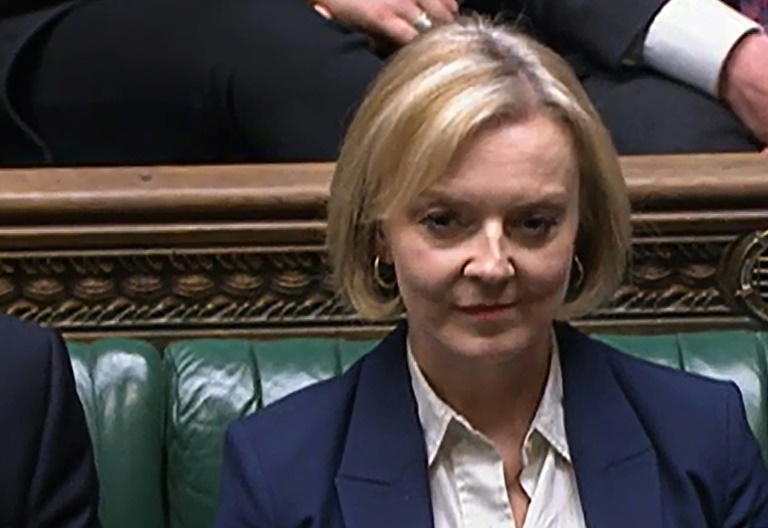
Embattled UK Prime Minister Liz Truss on Monday apologised for going “too far too fast” with reforms that triggered economic turmoil, but vowed to remain leader despite a series of humiliating climbdowns.

“I do want to accept responsibility and say sorry for the mistakes that have been made… we went too far and too fast,” she told the BBC. 

However, she said that she was “completely committed to delivering for this country” despite questions over who was now in control of government policy.

Her government on Monday axed almost all of its debt-fuelled tax cuts unveiled last month to avert fresh market chaos.

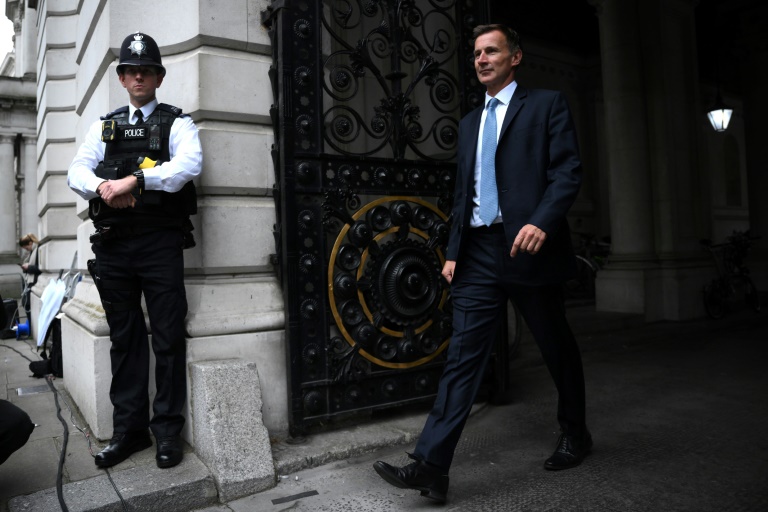
The shock move by new finance chief Jeremy Hunt — parachuted into the job on Friday to replace sacked Kwasi Kwarteng — leaves Truss’s position in a precarious state, with Conservative MP Roger Gale saying that Hunt was “de facto prime minister”.

Hunt estimated the tax changes would raise about £32 billion ($36 billion) per year, after economists estimated the government faced a £60-billion black hole. He also warned of tough spending cuts.

The chancellor of the exchequer said no government could control markets — but stressed his action would give certainty over public finances and help secure growth.

“The prime minister and I agreed yesterday to reverse almost all the tax measures announced in the growth plan three weeks ago,” Hunt told parliament, flanked by a grim-faced Truss.

The chancellor also announced the formation of an economic advisory council, featuring four experts outside of government. 

Hours earlier, he had used a brief televised statement to announce the dramatic reversals to nervous markets, conceding last month’s budget from his predecessor had harmed the public purse.

Truss told the BBC that she still believed in a “high-growth, low-tax economy”, but that economic stability was “my priority as prime minister”. 

– U-turns –

Hunt scrapped plans to axe the lowest rate of income tax, and curbed the government’s flagship energy price freeze — pulling the plug in April instead of late 2024.

After April, his department will “review” its energy support package, he said.

A proposed reduction in shareholder dividend tax was also binned, along with planned tax-free shopping for tourists and a freeze on alcohol duty.

The announcement comes as Truss’s governing Conservative party tanks in the opinion polls amid the reversals and Britain’s worsening cost-of-living crisis.

Truss fired her close friend Kwarteng on Friday after their recent tax-slashing budget sent bond yields spiking and the pound collapsing to a record dollar-low on fears of rocketing UK debt — fuelling intense speculation over her political future one month after taking office.

Hunt’s action on Monday sent the British pound soaring against the dollar and euro, while bond yields dipped.

– ‘Difficult decisions’ –

Tax reductions financed via borrowing were the centrepiece of last month’s ill-fated budget.

Truss had already staged two embarrassing budget U-turns, scrapping tax cuts for the richest earners and on company profits, and is now facing calls to resign even from her own MPs.

“There will be more difficult decisions I am afraid, on both tax and spending, as we deliver our commitment to get debt falling as a share of the economy over the medium term,” Hunt cautioned.

“All departments will need to redouble their efforts to find savings, and some areas of spending will need to be cut.”

Hunt already stated that he was not taking anything off the table amid speculation of cutbacks on areas like defence, hospitals and schools.

He met over the weekend with the governor of the Bank of England, Andrew Bailey, and the head of the Debt Management Office for talks.

In the wake of the earlier turmoil, the BoE launched emergency buying of UK government bonds — a policy that ended Friday.

The budget furore has reportedly sparked a plot to oust the prime minister.

UK media reported that senior Conservative MPs were plotting to unseat Truss.

– ‘Death knell’ –

Monday’s latest massive U-turn comes after Truss was elected Tory leader on a tax-slashing platform that analysts dubbed “Trussonomics”.

“That sound you can hear is the death knell for Trussonomics, with the vast majority of her tax cutting plans now consigned to the bin,” said Laura Suter, head of personal finance at stockbroker AJ Bell.

In two weeks’ time, Hunt will unveil his medium-term fiscal plan alongside independent economic forecasts from the Office for Budget Responsibility.

But the main opposition Labour party, riding high in the polls, said the ruling Tories were responsible for “chaos and fiasco”.

“This is a Tory crisis, made in Downing Street, but ordinary working people are paying the price,” its finance spokeswoman Rachel Reeves told parliament.
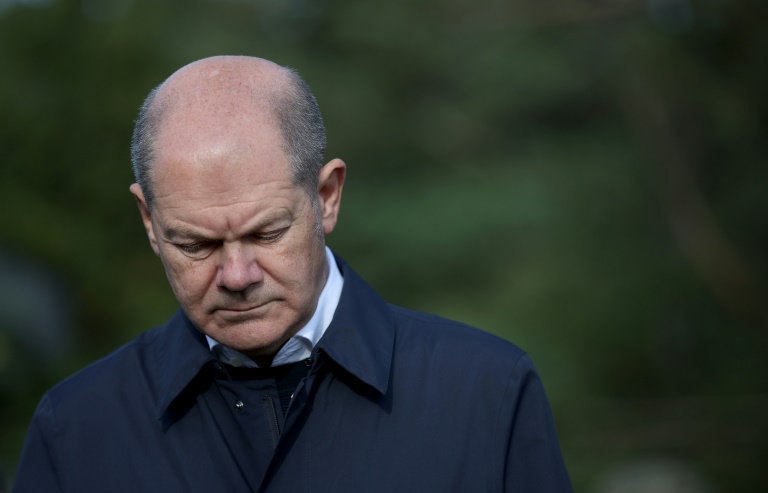
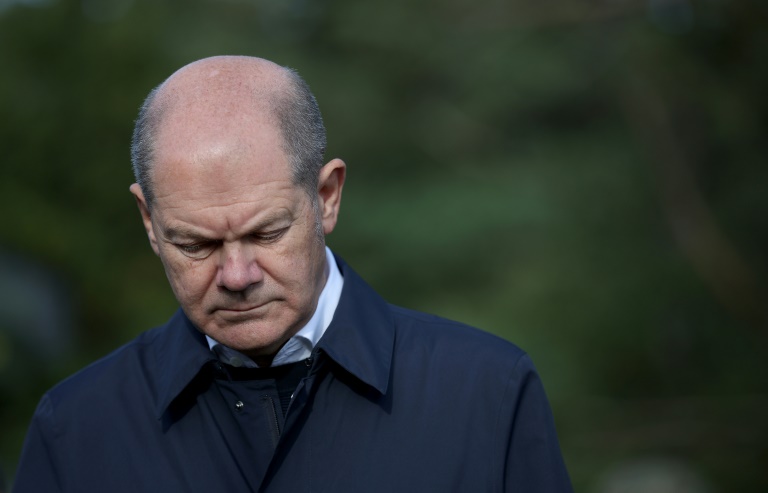
Scholz extends life of Germany's remaining nuclear plants

Chancellor Olaf Scholz on Monday ordered all three of Germany’s remaining nuclear power plants to stay operational until mid-April, breaking an impasse that had caused a rift among his coalition partners as an energy crisis looms.

Germany had initially planned to exit nuclear power by the end of the year, but Russia’s war in Ukraine and skyrocketing power prices since then have forced a rethink.

“The legal basis will be created to allow the operation of the nuclear power plants Isar 2, Neckarwestheim 2 and Emsland beyond December 31, 2022 until April 15, 2023,” Scholz said in a letter to cabinet ministers seen by AFP. 

Economy Minister Robert Habeck from the traditionally anti-nuclear Greens had recently said two of the three plants would be kept “on standby” until next spring, to help secure energy supplies if needed, in a major U-turn for the Greens.

But that did not go far enough for fellow coalition partner, the liberal FDP, who insisted the third plant, in Emsland in northern Germany, should also stay online. 

Repeated rounds of talks in recent days failed to resolve the row, and Scholz’s statement on Monday evening indicates he pulled rank.

– ‘Clarity’ –

In the letter, Scholz, from the centre-left Social Democrats, said he was invoking his authority as chancellor to issue a directive.

The order “is a smack in the face for Habeck”, wrote the topselling Bild daily.

Even more embarrassing, it comes after the Greens at a congress this weekend backed Habeck’s position on decommissioning the Emsland plant.

The FDP meanwhile celebrated Scholz’s decision to keep all three atomic plants online, although it fell short of their demand to extend their lifetimes until 2024.

Finance Minister Christian Lindner from the FDP, who has argued that Germany needs to use every energy source it has to help bring down prices and keep the lights on in Europe’s top economy, said Scholz had “provided clarity”.

“It is in the vital interest of our country and its economy that we maintain all power generation capacity this winter,” Lindner tweeted.

“We can create the legal basis together immediately. We will also work out viable solutions together for the winter of 2023/2024. People can count on that,” he wrote.

– Thunberg weighs in –

Green party co-leader Ricarda Lang criticised Scholz’s decision, saying “the Emsland nuclear power plant is not needed for grid stability”. 

The final word on the matter had yet to be spoken, Lang said. “We will have conversations about this,” she wrote on Twitter.

Lang did however welcome that Scholz had made clear that Germany would “definitively” quit atomic power by mid-April and that “no new fuel rods will be procured”.

Environmental group Greenpeace meanwhile slammed Scholz’s move as “irresponsible”.

“Extending the operating lives of nuclear power plants exposes us all to an unjustifiable risk,” said Greenpeace Germany’s executive director Martin Kaiser.

Former chancellor Angela Merkel had pushed through Germany’s nuclear exit in the wake of Japan’s Fukushima disaster in 2011.

But Germany, which was heavily reliant on Russian gas and oil before Russia’s invasion of Ukraine, has been hit hard by the fallout from the war and the nation is now bracing for a painful recession.

The conflict has sent energy prices soaring and Russia in late August halted the flow of gas through the crucial Nord Stream 1 pipeline, leaving Germany racing to diversify energy supplies and build up reserves ahead of the colder winter months.

The country has even restarted mothballed coal-fired power plants.

Climate activist Greta Thunberg last week said it was “a mistake” for Germany to press ahead with its nuclear exit while ramping up its coal usage.

Scholz extends life of Germany's remaining nuclear plants

Chancellor Olaf Scholz on Monday ordered all three of Germany’s remaining nuclear power plants to stay operational until mid-April, breaking an impasse that had caused a rift among his coalition partners as an energy crisis looms.

Germany had initially planned to exit nuclear power by the end of the year, but Russia’s war in Ukraine and skyrocketing power prices since then have forced a rethink.

“The legal basis will be created to allow the operation of the nuclear power plants Isar 2, Neckarwestheim 2 and Emsland beyond December 31, 2022 until April 15, 2023,” Scholz said in a letter to cabinet ministers seen by AFP. 

Economy Minister Robert Habeck from the traditionally anti-nuclear Greens had recently said two of the three plants would be kept “on standby” until next spring, to help secure energy supplies if needed, in a major U-turn for the Greens.

But that did not go far enough for fellow coalition partner, the liberal FDP, who insisted the third plant, in Emsland in northern Germany, should also stay online. 

Repeated rounds of talks in recent days failed to resolve the row, and Scholz’s statement on Monday evening indicates he pulled rank.

– ‘Clarity’ –

In the letter, Scholz, from the centre-left Social Democrats, said he was invoking his authority as chancellor to issue a directive.

The order “is a smack in the face for Habeck”, wrote the topselling Bild daily.

Even more embarrassing, it comes after the Greens at a congress this weekend backed Habeck’s position on decommissioning the Emsland plant.

The FDP meanwhile celebrated Scholz’s decision to keep all three atomic plants online, although it fell short of their demand to extend their lifetimes until 2024.

Finance Minister Christian Lindner from the FDP, who has argued that Germany needs to use every energy source it has to help bring down prices and keep the lights on in Europe’s top economy, said Scholz had “provided clarity”.

“It is in the vital interest of our country and its economy that we maintain all power generation capacity this winter,” Lindner tweeted.

“We can create the legal basis together immediately. We will also work out viable solutions together for the winter of 2023/2024. People can count on that,” he wrote.

– Thunberg weighs in –

Green party co-leader Ricarda Lang criticised Scholz’s decision, saying “the Emsland nuclear power plant is not needed for grid stability”. 

The final word on the matter had yet to be spoken, Lang said. “We will have conversations about this,” she wrote on Twitter.

Lang did however welcome that Scholz had made clear that Germany would “definitively” quit atomic power by mid-April and that “no new fuel rods will be procured”.

Environmental group Greenpeace meanwhile slammed Scholz’s move as “irresponsible”.

“Extending the operating lives of nuclear power plants exposes us all to an unjustifiable risk,” said Greenpeace Germany’s executive director Martin Kaiser.

Former chancellor Angela Merkel had pushed through Germany’s nuclear exit in the wake of Japan’s Fukushima disaster in 2011.

But Germany, which was heavily reliant on Russian gas and oil before Russia’s invasion of Ukraine, has been hit hard by the fallout from the war and the nation is now bracing for a painful recession.

The conflict has sent energy prices soaring and Russia in late August halted the flow of gas through the crucial Nord Stream 1 pipeline, leaving Germany racing to diversify energy supplies and build up reserves ahead of the colder winter months.

The country has even restarted mothballed coal-fired power plants.

Climate activist Greta Thunberg last week said it was “a mistake” for Germany to press ahead with its nuclear exit while ramping up its coal usage.

Parler seen as home for far-right — and now Kanye West

Seen as an online home for extremist rhetoric unwelcome at established social networks, Parler won fans in the ultra-far right and an aspiring buyer in celebrity Kanye West.

The 45-year-old rapper, who now goes by the name Ye, said in a release that he wants to buy Parler to make sure that those with conservative political viewpoints “have the right to freely express ourselves.”

Parler was temporarily removed from Apple and Google app stores last year for failing to moderate calls for violence after the attack on the US Capitol by supporters of former US president Donald Trump.

– ‘Status symbol?’ –

Parler was launched in the summer of 2018 by software engineer John Matze and Rebekah Mercer, a major Republican Party donor.

Little known until 2021, the platform caught the spotlight after Trump was ousted from Twitter due to concerns his posts would ignite more violence in his effort to overturn his election loss.

Ye’s proposed takeover of Parler comes as the rapper faces accusations of racism and anti-Semitism that have resulted in restrictions placed on his Twitter and Instagram accounts.

“By owning Parler, Kanye can make sure he can say what he wants on the platform,” Megan Brown and Joshua Tucker of New York University’s center for social media and politics said in a note.

“Of course, it may also be that owning a social media platform is now becoming a status symbol for the outspoken ultra-rich, especially those who have run into trouble with existing platforms.”

Trump launched his own social media network earlier this year, while Tesla chief Elon Musk’s $44 billion deal to buy Twitter appears to be back on after his effort to back out.

– Far from Facebook –

Parler has been downloaded 8.5 million times since its launch, including 6.2 million times in the United States, according to figures from data.ai.

Only 58,000 downloads of Parler were logged in September at major app shops run by Apple and Google, compared with some 72 million downloads of Facebook during the same period.

Parler did not respond to a request for information about the platform’s finances and user numbers.

Trump does not have an official account on Parler.

Ye, who opened his Parler account last week, is followed by 1,800 subscribers there while he has more than 31 million followers on Twitter and 18.2 million followers on Instagram.

– Banned for a bit –

Concerns over misinformation and rhetoric with the potential to cause real-world harm saw Apple and Google remove Parler from their rival app shops after the January 6 attack on the Capitol.

Amazon Web Services cloud computing platform gave similar reasoning for a decision to stop hosting Parler on its servers, effectively disabling the social media website.

Parler has since been allowed back in the App Store and Google Play shop, ostensibly after bringing its content moderation systems in line with policies at the rival tech companies.

“Google and Apple both require content moderation policies that remove illegal content including incitement to violence, which is why they were banned in the first place,” Brown and Tucker said.

– Limited audience –

Parler is one of many social networks wooing ultraconservatives opposed to the notion of platforms filtering dangerously inflammatory or deceptive posts.

Parler rivals include Gettr, Gab, Rumble, and Trump’s own Truth Social, which had some technical troubles after it launched in February.

Trump’s social network also found itself unwelcome at Google’s shop for content tailored for Android-powered mobile devices until it improved its content moderation systems.

According to a recent study by the Pew Research Center, only six percent of Americans regularly get information from one of these so-called “alternative” social media applications.

Scholz extends life of Germany's remaining nuclear plants

Chancellor Olaf Scholz on Monday ordered all three of Germany’s remaining nuclear power plants to stay operational until mid-April, breaking an impasse that had caused a rift among his coalition partners as an energy crisis looms.

Germany had initially planned to exit nuclear power by the end of the year, but Russia’s war in Ukraine and skyrocketing power prices since then have forced a rethink.

“The legal basis will be created to allow the operation of the nuclear power plants Isar 2, Neckarwestheim 2 and Emsland beyond December 31, 2022 until April 15, 2023,” Scholz said in a letter to cabinet ministers seen by AFP. 

Economy Minister Robert Habeck from the traditionally anti-nuclear Greens had recently said two of the three plants would be kept “on standby” until next spring, to help secure energy supplies if needed, in a major U-turn for the Greens.

But that did not go far enough for fellow coalition partner, the liberal FDP, who insisted the third plant, in Emsland in northern Germany, should also stay online. 

Repeated rounds of talks in recent days failed to resolve the row, and Scholz’s statement on Monday evening indicates he pulled rank.

– ‘Clarity’ –

In the letter, Scholz, from the centre-left Social Democrats, said he was invoking his authority as chancellor to issue a directive.

The order “is a smack in the face for Habeck”, wrote the topselling Bild daily.

Even more embarrassing, the order comes after the Greens at a congress this weekend backed Habeck’s position on decommissioning the Emsland plant.

The FDP meanwhile celebrated Scholz’s decision to keep all three atomic plants online, although it fell short of their demand to extend their lifetimes until 2024.

Finance Minister Christian Lindner from the FDP, who has argued that Germany needs to use every energy source it has to help bring down prices and keep the lights on in Europe’s top economy, said Scholz had “provided clarity”.

“It is in the vital interest of our country and its economy that we maintain all power generation capacity this winter,” Lindner tweeted.

“We can create the legal basis together immediately. We will also work out viable solutions together for the winter of 2023/2024. People can count on that,” he wrote.

– Thunberg weighs in –

Environment Minister Steffi Lemke, from the Greens, likewise said Scholz had brought “clarity”, and highlighted that his decision confirmed Germany remained committed to quitting atomic power.

“Germany will finally phase out nuclear energy on April 15, 2023. There will be no lifetime extension and no new fuel rods,” Lemke wrote on Twitter.

But Environmental group Greenpeace slammed Scholz’s move as “irresponsible”.

“Extending the operating lives of nuclear power plants exposes us all to an unjustifiable risk,” said Greenpeace Germany’s executive director Martin Kaiser.

Former chancellor Angela Merkel had pushed through Germany’s nuclear exit in the wake of Japan’s Fukushima disaster in 2011.

But Germany, which was heavily reliant on Russian gas and oil before Russia’s invasion of Ukraine, has been hit hard by the fallout from the war and the nation is now bracing for a painful recession.

The conflict has sent energy prices soaring and Russia in late August halted the flow of gas through the crucial Nord Stream 1 pipeline, leaving Germany racing to diversify its energy supplies and build up reserves.

The country has even restarted mothballed coal-fired power plants.

Climate activist Greta Thunberg last week said it was “a mistake” for Germany to press ahead with its nuclear exit while ramping up its coal usage.

Scholz extends life of Germany's remaining nuclear plants

Chancellor Olaf Scholz on Monday ordered all three of Germany’s remaining nuclear power plants to stay operational until mid-April, breaking an impasse that had caused a rift among his coalition partners as an energy crisis looms.

Germany had initially planned to exit nuclear power by the end of the year, but Russia’s war in Ukraine and skyrocketing power prices since then have forced a rethink.

“The legal basis will be created to allow the operation of the nuclear power plants Isar 2, Neckarwestheim 2 and Emsland beyond December 31, 2022 until April 15, 2023,” Scholz said in a letter to cabinet ministers seen by AFP. 

Economy Minister Robert Habeck from the traditionally anti-nuclear Greens had recently said two of the three plants would be kept “on standby” until next spring, to help secure energy supplies if needed, in a major U-turn for the Greens.

But that did not go far enough for fellow coalition partner, the liberal FDP, who insisted the third plant, in Emsland in northern Germany, should also stay online. 

Repeated rounds of talks in recent days failed to resolve the row, and Scholz’s statement on Monday evening indicates he pulled rank.

– ‘Clarity’ –

In the letter, Scholz, from the centre-left Social Democrats, said he was invoking his authority as chancellor to issue a directive.

The order “is a smack in the face for Habeck”, wrote the topselling Bild daily.

Even more embarrassing, the order comes after the Greens at a congress this weekend backed Habeck’s position on decommissioning the Emsland plant.

The FDP meanwhile celebrated Scholz’s decision to keep all three atomic plants online, although it fell short of their demand to extend their lifetimes until 2024.

Finance Minister Christian Lindner from the FDP, who has argued that Germany needs to use every energy source it has to help bring down prices and keep the lights on in Europe’s top economy, said Scholz had “provided clarity”.

“It is in the vital interest of our country and its economy that we maintain all power generation capacity this winter,” Lindner tweeted.

“We can create the legal basis together immediately. We will also work out viable solutions together for the winter of 2023/2024. People can count on that,” he wrote.

– Thunberg weighs in –

Environment Minister Steffi Lemke, from the Greens, likewise said Scholz had brought “clarity”, and highlighted that his decision confirmed Germany remained committed to quitting atomic power.

“Germany will finally phase out nuclear energy on April 15, 2023. There will be no lifetime extension and no new fuel rods,” Lemke wrote on Twitter.

But Environmental group Greenpeace slammed Scholz’s move as “irresponsible”.

“Extending the operating lives of nuclear power plants exposes us all to an unjustifiable risk,” said Greenpeace Germany’s executive director Martin Kaiser.

Former chancellor Angela Merkel had pushed through Germany’s nuclear exit in the wake of Japan’s Fukushima disaster in 2011.

But Germany, which was heavily reliant on Russian gas and oil before Russia’s invasion of Ukraine, has been hit hard by the fallout from the war and the nation is now bracing for a painful recession.

The conflict has sent energy prices soaring and Russia in late August halted the flow of gas through the crucial Nord Stream 1 pipeline, leaving Germany racing to diversify its energy supplies and build up reserves.

The country has even restarted mothballed coal-fired power plants.

Climate activist Greta Thunberg last week said it was “a mistake” for Germany to press ahead with its nuclear exit while ramping up its coal usage.

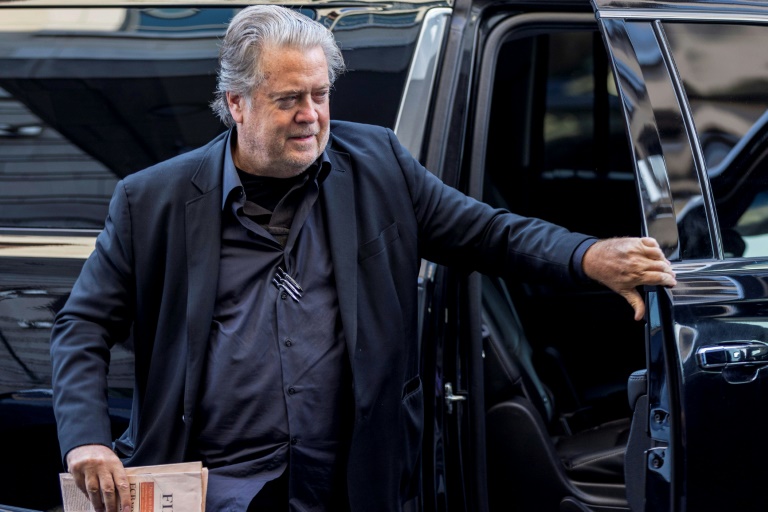
US seeks six months in jail for ex-Trump aide Bannon

The US Justice Department asked a judge Monday to sentence Donald Trump’s former aide Steve Bannon to six months in prison for refusing to testify in Congress’s probe of the January 6, 2021 attack on the Capitol.

Bannon, a longtime political strategist and vocal advocate for the Republican former president, was found guilty in July on two counts of  contempt of Congress for defying a subpoena to testify.

The Justice Department said in a sentencing recommendation that the 68-year-old Bannon should receive the six-month sentence and pay a fine of $200,000 because he repeatedly sought to delay the proceedings by hinting he might cooperate.

Bannon “has pursued a bad-faith strategy of defiance and contempt,” the department said.

The investigation by a special House committee depicted Bannon last week as knowing in advance of the plan by hardline Trump supporters to attack the Capitol to prevent Democrat Joe Biden from being confirmed as the next president.

It also showed him advocating for Congress to block Biden — who defeated Trump in the November 2020 election — from becoming president.

“The rioters who overran the Capitol on January 6 did not just attack a building — they assaulted the rule of law upon which this country was built and through which it endures,” the department said.

“By flouting the Select Committee’s subpoena and its authority, the defendant exacerbated that assault.”

The maximum sentence for contempt of Congress is 12 months, and a $100,000 fine. 

The department’s recommendation of six months in prison is at the top end of the standard sentencing guidelines, a calculation based on the context of the crime and the defendant’s own justice record.

Sentencing is set for October 21.

In a separate court submission Bannon, who currently runs a streaming political commentary website, asked the court to sentence him to probation, saying he had rejected the Congressional subpoena on the advice of his lawyers.

He also asked that the court place a stay on implementation of any sentence while his appeal of the original verdict goes ahead.

“Mr. Bannon respectfully asserts that a sentence of incarceration would violate his constitutional rights,” the submission said.

The UK: Is there a prime minister in the house?

Asked by the opposition to explain her latest humiliating climbdown, UK Prime Minister Liz Truss on Monday refused to answer the call, raising further speculation about her future. 

Truss last week sacked finance minister Kwasi Kwarteng after only 38 days in the role, as the markets were roiled following the announcement of the pair’s tax-cutting agenda.

His replacement, Jeremy Hunt, on Monday morning took an axe to the plans, leaving the country unsure about who was actually in charge.

Truss has been silent for three days as crisis consumes her leadership, and declined to answer requests from the Labour Party to tell parliament about her decision to sack Kwarteng, instead sending out minister Penny Mordaunt.  

“We have this utter vacuum,” in leadership, said Labour leader Keir Starmer. 

“Where is the Prime Minister? Hiding away, dodging questions, scared of her shadow,” he added. 

Scottish National Party deputy Westminster leader Kirsten Oswald weighed in, saying “if she doesn’t even have the backbone to show up here today, is there really any point in her showing up here again? 

“Surely time’s up, she needs to go and let the people decide,” she added.

Mordaunt told the Commons she was sorry that the government’s plans “added to the concerns” about “major volatility” in the economy, but said there was a “serious reason” for Truss’s absence, without specifying. 

The prime minister was “not under a desk”, she assured, to much hilarity. 

Truss then arrived in parliament, sitting silent as Hunt explained how he was gutting her showpiece budget, before swiftly departing. 

– Party plots –

In particular, Hunt announced that the freeze on household energy bills, planned to last for two years, was to be scrapped. 

Instead, the freeze will be reviewed in April. 

Markets were spooked by the plans to cut taxes despite huge unfunded Covid and energy subsidy bills.

A cut to income tax cut has also been postponed “indefinitely”.

Downing Street insisted that Truss was still running the country, and had been “working closely with her Chancellor over the weekend to agree this approach”.

Truss’s only public comments since Friday have been a handful of tweets, one of which on Monday stated that the “British people rightly want stability.”

She was holed up in the prime ministers’ country residence this weekend after a disastrous press conference on Friday in which she turned tail after eight minutes.

With few defenders in her party and rumours rife about plots to unseat her, Truss already appears to have lost all authority, despite only becoming leader last month.

The Conservative press is gunning for the woman whose agenda has been shredded, and four Tory MPs have already publicly called for her departure.

Dozens of others are said to be ready for a vote of no confidence, with the party facing almost total wipeout if an election were to take place, given its current polling numbers, although a national vote is not due for another two years.

It is unclear whether her decision to hire Hunt, twice an unsuccessful leadership candidate but a calm and experienced politician, was forced upon her.  

“I think Jeremy Hunt is de facto prime minister at the moment,” Tory MP Roger Gale MP told Sky News.

“I just don’t think that it’s tenable that she can stay in her position any longer. And I’m very sad to have to say that,” said MP Angela Richardson on Times radio.

UK axes 'almost all' budget tax cuts in humiliation for Truss

The British government on Monday axed almost all of its debt-fuelled tax cuts unveiled last month to avert fresh markets chaos, in a humiliating climbdown for embattled Prime Minister Liz Truss.

The shock move by new finance chief Jeremy Hunt, parachuted into the job on Friday to replace sacked Kwasi Kwarteng, leaves Truss’ position in a precarious state after a series of embarrassing U-turns.

Hunt estimated the tax changes would raise about £32 billion ($36 billion) per year, after economists estimated the government faced a £60-billion black hole. He also warned of tough spending cuts.

The chancellor of the exchequer said no government could control markets — but stressed his action would give certainty over public finances and help secure growth.

“The prime minister and I agreed yesterday to reverse almost all the tax measures announced in the growth plan three weeks ago,” Hunt told parliament, flanked by a grim-faced Truss.

“I want to be completely frank about the scale of the economic challenge we face,” he added, detailing the domestic and international headwinds confronting Britain.

The chancellor also announced the formation of an economic advisory council, featuring four experts outside of government. 

Hours earlier, he had used a brief televised statement to announce the dramatic reversals to nervous markets, conceding last month’s budget from his predecessor had harmed the public purse.

“The most important objective for our country right now is stability,” Hunt had noted.

– U-turns –

Hunt scrapped plans to axe the lowest rate of income tax, and curbed the government’s flagship energy price freeze — pulling the plug in April instead of late 2024.

After April, his department will “review” its energy support package, he said.

A proposed reduction in shareholder dividend tax was also binned, along with planned tax-free shopping for tourists and a freeze on alcohol duty.

The announcement comes as Truss’ governing Conservative party tanks in the opinion polls amid the reversals and Britain’s worsening cost-of-living crisis.

Truss fired her close friend Kwarteng on Friday after their recent tax-slashing budget sparked markets chaos — fuelling intense speculation over her political future one month after taking office.

“No government can control the markets but every government can give certainty about the sustainability of public finances,” Hunt added Monday.

His action sent the British pound soaring against the dollar and euro, while bond yields dipped.

Last month’s notorious budget had sent bond yields spiking and the pound collapsing to a record dollar-low on fears of rocketing UK debt.

– ‘Difficult decisions’ –

Tax reductions financed via huge borrowing were the centrepiece of last month’s ill-fated budget.

Truss had already staged two embarrassing budget U-turns, scrapping tax cuts for the richest earners and on company profits, and is now facing calls to resign even from her own MPs.

“There will be more difficult decisions I am afraid, on both tax and spending, as we deliver our commitment to get debt falling as a share of the economy over the medium term,” Hunt cautioned.

“All departments will need to redouble their efforts to find savings, and some areas of spending will need to be cut.”

Hunt already stated that he was not taking anything off the table” amid speculation of cutbacks on areas like defence, hospitals and schools.

He met over the weekend with the governor of the Bank of England, Andrew Bailey, and the head of the Debt Management Office for talks.

In the wake of the earlier turmoil, the BoE launched emergency buying of UK government bonds — a policy that ended Friday.

The budget furore has reportedly sparked a plot to oust the prime minister.

UK media reported senior Conservative MPs were plotting to unseat Truss, aghast at her short tenure.

– ‘Death knell’ –

Monday’s latest massive U-turn comes after Truss was elected Tory leader on a tax-slashing platform that analysts dubbed “Trussonomics”.

“That sound you can hear is the death knell for Trussonomics, with the vast majority of her tax cutting plans now consigned to the bin,” said Laura Suter, head of personal finance at stockbroker AJ Bell.

“People have had yogurt in their fridge that’s lasted longer than some of the government’s planned tax cuts,” she added.

In two weeks’ time, Hunt will unveil his medium-term fiscal plan alongside independent economic forecasts from the Office for Budget Responsibility.

But the main opposition Labour party, riding high in the polls, said the ruling Tories were responsible for “chaos and fiasco”.

“This is a Tory crisis, made in Downing Street, but ordinary working people are paying the price,” its finance spokeswoman Rachel Reeves told parliament.

Saudi defends oil policy in face of US charges

Saudi Arabia has rejected US accusations of aligning itself with Russia amid the Ukraine war by making oil production cuts to drive up crude prices, insisting it was purely a business decision.

“We are astonished by the accusations that the kingdom is standing with Russia in its war with Ukraine,” the Saudi defence minister, Prince Khaled bin Salman, tweeted late Sunday.

The Saudi-led OPEC+ cartel — which includes Russia — has angered Washington by deciding to cut production by two million barrels per day from November, adding further pressure on soaring crude prices.

“It is telling that these false accusations did not come from the Ukrainian government,” Prince Khaled wrote. 

“Although the OPEC+ decision, which was taken unanimously, was due to purely economic reasons, some accused the kingdom of standing with Russia.

“Iran is also a member of OPEC, does this mean that the kingdom is standing with Iran as well?” he asked, referring to Saudi Arabia’s regional rival.

In a speech broadcast on Sunday night, Saudi King Salman bin Abdulaziz Al Saud insisted his country was “working hard, within its energy strategy, to support the stability and balance of global oil markets”.

– Re-evaluation –

Appearing on CNN on Monday, Fahad Nazer, spokesman for the Saudi embassy in Washington, similarly stressed that the OPEC+ move was “determined strictly by market fundamentals”. 

He also emphasised the importance of US-Saudi ties, noting that the two countries cooperated in repelling Iraqi dictator Saddam Hussein’s 1990 invasion of Kuwait, and more recently in fighting against the jihadist Islamic State group.

“If that’s not the definition of an alliance, I don’t know what is. We certainly consider the United States to be our strongest partner. It has been for the past 80 years,” Nazer said.

“And it is by far our most important strategic partnership. And we certainly look forward to continue well into the future.”

The United Arab Emirates and Bahrain, which like Saudi Arabia are US partners as well as OPEC members, also defended the cartel’s decision Sunday as a “technical” move.

White House spokesman John Kirby said last week that Riyadh knew the cut “would increase Russian revenues and blunt the effectiveness of sanctions” on Moscow.

The United States has vowed to re-evaluate ties with the oil-rich kingdom since the cut, which was seen as a diplomatic slap in the face for President Joe Biden by hiking prices on US consumers weeks before congressional elections.

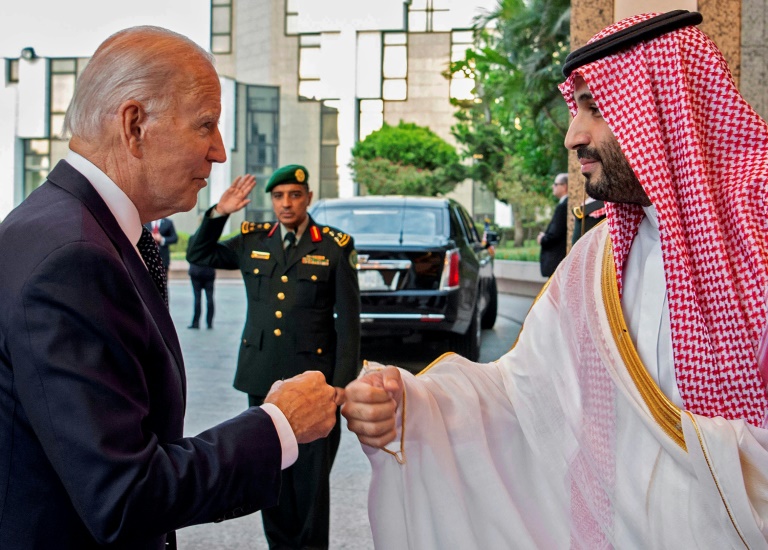
Despite vowing to make the kingdom an international “pariah” following the October 2018 murder of journalist Jamal Khashoggi, Biden travelled to Saudi Arabia in July and met with Crown Prince Mohammed bin Salman — with the two greeting each other with a high-profile fist bump.

But with relations now strained, US National Security Advisor Jake Sullivan said Sunday that Biden has “no plans” to meet with Prince Mohammed at an upcoming G20 summit in Indonesia.

Close Bitnami banner
Bitnami