
AFP

UK's embattled Truss told: 'The game is up'

Britain’s Prime Minister Liz Truss on Sunday vied to reboot her economic programme, but Conservative critics warned the party faces electoral oblivion under her crippled leadership.

With even US President Joe Biden joining in attacks on her libertarian platform, Truss admitted it had been a “wrench” to fire her friend Kwasi Kwarteng as chancellor of the exchequer on Friday.

But writing in the Sun on Sunday newspaper, she said: “We cannot pave the way to a low-tax, high-growth economy without maintaining the confidence of the markets in our commitment to sound money.” 

That confidence was jeopardised on September 23 when Kwarteng and Truss unveiled a right-wing programme, inspired by 1980s US president Ronald Reagan, of £45 billion ($50 billion) in tax cuts financed exclusively by higher debt.

Markets tanked in response, driving up borrowing costs for millions of Britons, and the Conservatives’ poll ratings have similarly slumped, leading to open warfare in the governing party mere weeks after Truss succeeded Boris Johnson.

“I think the game is up, and it’s now a question as to how the succession is managed,” senior Tory MP Crispin Blunt said on Channel 4.

Truss has been forced into a screeching policy U-turn which cost Kwarteng his job. But she depressed the bond markets even more with a painful press conference on Friday, and the government was nervously awaiting the resumption of trading on Monday.

Bidding to placate investors, Kwarteng’s replacement Jeremy Hunt is now warning that taxes may in fact have to rise, and is pressing for spending restraint by his cabinet colleagues even as Britons endure a cost-of-living crisis.

Hunt met the prime minister at her country retreat on Sunday to thrash out a new budget plan which he is due to deliver on October 31, effectively demolishing the “Trussonomics” programme that brought her to power.

– Who’s in charge? –

“It’s going to be very, very difficult, and I think we have to be honest with people about that,” Hunt told the BBC — prompting a warning from trade unions of concerted strike action if he enforces painful cuts.

Hunt said he was “not taking anything off the table”, but also defended Truss.

“She’s been willing to do that most difficult of things in politics, and that is to change tack,” he said, adding: “The prime minister’s in charge.” 

But many questioned that verdict. “Truss has become a pointless prime minister — an empty vessel with no policies or power,” the Sunday Times editorialised.

The Treasury declined to confirm reports that Hunt plans to delay a planned cut to the basic rate of income tax, removing yet another headline measure announced by the new government last month.

Up to 100 letters expressing no confidence in Truss have been submitted by Tory MPs, the Sunday Times and Sunday Express said.

Opponents were said to be coalescing around Truss’s defeated leadership rival Rishi Sunak and another one-time foe, Penny Mordaunt, for a possible “unity ticket” to rebuild the stricken Tories.

Defence Secretary Ben Wallace could be another compromise candidate for leader, the Sunday Mirror reported.

– ‘Libertarian jihadists’ –

Tory MP Robert Halfon, who supported Sunak, likened Truss and Kwarteng to “libertarian jihadists” who had indulged in “ultra free-market experiments”.

“Of course, colleagues are unhappy with what is going on, with haemorrhaging in the opinion polls,” he told Sky News. “It’s inevitable that colleagues are… talking to see what can be done about it.”

Fellow Tory Alicia Kearns, newly elected as chair of the powerful foreign affairs committee in the House of Commons, also questioned Truss’s prospects for survival.

“We’ve had questions around our moral competency (under Johnson),” she told Times Radio. “We’ve now got questions around our fiscal competency.”

But Johnson loyalists — still seething at Sunak’s perceived disloyalty towards the scandal-tainted former leader — warned against a coronation that cuts out Tory grassroots members.

Any new leader would face strong pressure to call an early general election, and the opposition Labour party has streaked far ahead in the polls.

Justin Welby, the Archbishop of Canterbury, echoed Biden’s critique of Truss’s “trickle-down” economics.

In an interview with the Guardian newspaper, the spiritual head of the Anglican Church said he was “deeply sceptical” that tax cuts for the rich would benefit anyone else.


French PM threatens to force workers back as energy strikes continue

France’s prime minister warned striking oil industry workers Sunday that the government might once again use its requisition powers to force workers back to their posts to ease fuel shortages.

Left-wing leader Jean-Luc Melenchon meanwhile backed calls by some trade unions for a general strike on Tuesday.

Elisabeth Borne told TF1 television that if the situation remained tense Monday, then the authorities would proceed with more requisitions like the ones enforced last week.

About 30 percent of service stations were experiencing supply problems for one type of fuel or another, she said. “That’s too many.”

She appealed to those TotalEnergeies workers still on strike not to “block the country with all the difficulties that that creates”.

After three weeks of industrial action, three out of seven of the country’s oil refineries and five major fuel depots (of around 200) are affected, the government said.

Geoffroy Roux de Bezieux, president of the Medef business lobby group, told Radio J that another week of fuel shortages might have a real impact on the economy.

“This isn’t a normal strike,” he added. “The right to strike has limits.”

Farmers are struggling to find the fuel they need to plant their winter crops on time, particularly in the north of the country.

– ‘General strike’ –

Borne’s warning came after tens of thousands marched through Paris Sunday to protest the rising cost of living, and government inaction over climate change.

The demonstration was called by the left-wing political opposition and led by Melenchon, head of the France Unbowed (LFI) party.

While most of the march passed peacefully, security forces did fire teargas and launched baton charges on several occasions after being pelted with objects. On the fringes of the march, masked men dressed in black ransacked a bank.

Some protesters wore yellow florescent vests, the symbol of the often violent anti-government protests in 2018 that shook the pro-business government of President Emmanuel Macron.

“The people at the top are out of touch,” said Christopher Savidan, an LFI activist out of work for five years.

“We pay taxes — we don’t know why. Everything is going down the drain.”

Opponents of Macron are hoping to build on the momentum created by the refineries dispute, which began at the end of September.

“We’re going to have a week the likes of which we don’t see very often,” Melenchon told the crowd.

“Everything is coming together. We are starting it with this march, which is an immense success.”

Melenchon also called for a “general strike” Tuesday. Some but not all unions have already declared the date a national day of strikes targetting road transport, trains and the public sector.  

– Huge profits –

The huge profits made by energy groups due to record fuel prices have led to some sympathy for employees pushing for higher wages. 

But some drivers struggling to find fuel for their vehicles are losing patience. Many companies have cut back on travel and deliveries, and even emergency service vehicles face shortages.

A poll by the BVA polling group released Friday suggested that only 37 percent of people supported the stoppages.

The strikes and protests are being closely watched by the government, which is aiming to pass a highly controversial change to the pensions system in the next few months. 

Macron, who won re-election in April, has pledged to push back the retirement age from 62, with the reform scheduled before the end of the winter.

“I’m really worried,” one ruling party MP told AFP last week on condition of anonymity. “We need to find a route between the need for reforms and the fact that people are riled up and tired.” 

TotalEnergies announced on Friday that it had reached a pay deal with the two largest unions representing staff at its refineries, raising hopes of an end to the standoff. 

But the hardline CGT union has refused to accept it, with its members continuing to maintain picket lines.

'Halloween Ends' starts strong, topping N.America box office

Universal scarefest “Halloween Ends” scored a strong start this weekend, topping the North American box office with an estimated take of $41.3 million, industry watcher Exhibitor Relations reported Sunday.

The movie, ostensibly the last in a long string of profitable “Halloween” films, again stars Jamie Lee Curtis in a tale replete with throat-slashing, choking, fatal falls and a mysterious masked sewer-dweller. 

Analysts had predicted a somewhat higher number: $50 million or so. But given the film’s simultaneous release on the Peacock streaming service and its production cost of just $30 million, its take was “excellent,” said David A. Gross of Franchise Entertainment Research.

The weeks before Halloween always smile on horror films — and this weekend another gruesome film, Paramount’s “Smile,” placed second at $12.4 million. Sosie Bacon stars as a therapist whose grasp on reality is shaken by a horrifying event.

In third place for the Friday-through-Sunday period, down one spot from its release last weekend, was Sony’s live action/computer-animated musical comedy “Lyle, Lyle Crocodile,” at $7.4 million. Javier Bardem, Shawn Mendes and Constance Wu star.

Another Sony film, history-inspired “The Woman King,” held tight at fourth place, with $3.7 million in ticket sales. Viola Davis stars as the leader of an all-female army of African warriors.

And in fifth, dropping two spots, was 20th Century’s comedy thriller “Amsterdam,” at $2.9 million. It stars Christian Bale, Margot Robbie and John David Washington.

Rounding out the top 10 were:

“Don’t Worry Darling” ($2.2 million)

“Barbarian” ($1.4 million)

“Bros” ($920,000)

“Terrifier 2” ($850,000)

“Top Gun: Maverick” ($685,000)

UK's embattled Truss told: 'The game is up'

Britain’s Prime Minister Liz Truss on Sunday vied to reboot her economic programme, but Conservative critics warned the party faces electoral oblivion under her crippled leadership.

With even US President Joe Biden joining in attacks on her libertarian platform, Truss admitted it had been a “wrench” to fire her friend Kwasi Kwarteng as chancellor of the exchequer on Friday.

But writing in the Sun on Sunday newspaper, she said: “We cannot pave the way to a low-tax, high-growth economy without maintaining the confidence of the markets in our commitment to sound money.” 

That confidence was jeopardised on September 23 when Kwarteng and Truss unveiled a right-wing programme, inspired by 1980s US president Ronald Reagan, of £45 billion ($50 billion) in tax cuts financed exclusively by higher debt.

Markets tanked in response, driving up borrowing costs for millions of Britons, and the Conservatives’ poll ratings have similarly slumped, leading to open warfare in the governing party mere weeks after Truss succeeded Boris Johnson.

“I think the game is up, and it’s now a question as to how the succession is managed,” senior Tory MP Crispin Blunt said on Channel 4.

Truss has been forced into a screeching policy U-turn which cost Kwarteng his job. But she depressed the bond markets even more with a painful press conference on Friday, and the government was nervously awaiting the resumption of trading on Monday.

Bidding to placate investors, Kwarteng’s replacement Jeremy Hunt is now warning that taxes may in fact have to rise, and is pressing for spending restraint by his cabinet colleagues even as Britons endure a cost-of-living crisis.

Hunt met the prime minister at her country retreat on Sunday to thrash out a new budget plan which he is due to deliver on October 31, effectively demolishing the “Trussonomics” programme that brought her to power.

– Who’s in charge? –

“It’s going to be very, very difficult, and I think we have to be honest with people about that,” Hunt told the BBC — prompting a warning from trade unions of concerted strike action if he enforces painful cuts.

Hunt said he was “not taking anything off the table”, but also defended Truss.

“She’s been willing to do that most difficult of things in politics, and that is to change tack,” he said, adding: “The prime minister’s in charge.” 

But many questioned that verdict. “Truss has become a pointless prime minister — an empty vessel with no policies or power,” the Sunday Times editorialised.

The Treasury declined to confirm reports that Hunt plans to delay a planned cut to the basic rate of income tax, removing yet another headline measure announced by the new government last month.

Up to 100 letters expressing no confidence in Truss have been submitted by Tory MPs, the Sunday Times and Sunday Express said.

Opponents were said to be coalescing around Truss’s defeated leadership rival Rishi Sunak and another one-time foe, Penny Mordaunt, for a possible “unity ticket” to rebuild the stricken Tories.

Defence Secretary Ben Wallace could be another compromise candidate for leader, the Sunday Mirror reported.

– ‘Libertarian jihadists’ –

Tory MP Robert Halfon, who supported Sunak, likened Truss and Kwarteng to “libertarian jihadists” who had indulged in “ultra free-market experiments”.

“Of course, colleagues are unhappy with what is going on, with haemorrhaging in the opinion polls,” he told Sky News. “It’s inevitable that colleagues are… talking to see what can be done about it.”

Fellow Tory Alicia Kearns, newly elected as chair of the powerful foreign affairs committee in the House of Commons, also questioned Truss’s prospects for survival.

“We’ve had questions around our moral competency (under Johnson),” she told Times Radio. “We’ve now got questions around our fiscal competency.”

But Johnson loyalists — still seething at Sunak’s perceived disloyalty towards the scandal-tainted former leader — warned against a coronation that cuts out Tory grassroots members.

Any new leader would face strong pressure to call an early general election, and the opposition Labour party has streaked far ahead in the polls.

Justin Welby, the Archbishop of Canterbury, echoed Biden’s critique of Truss’s “trickle-down” economics.

In an interview with the Guardian newspaper, the spiritual head of the Anglican Church said he was “deeply sceptical” that tax cuts for the rich would benefit anyone else.
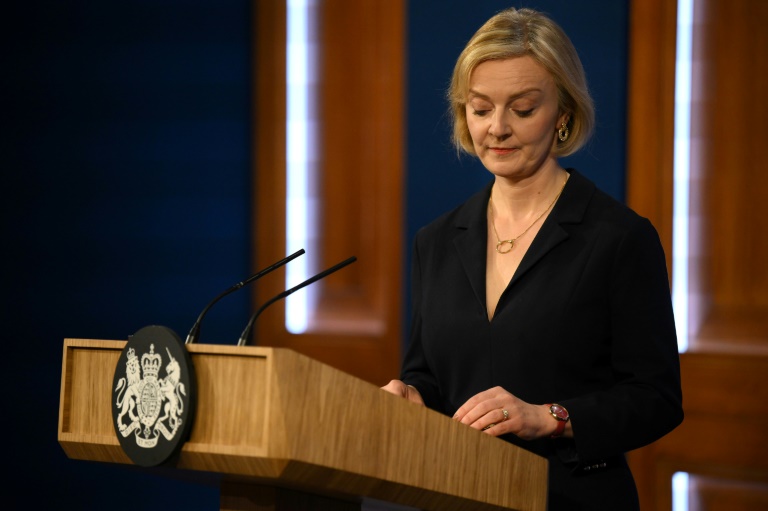
UK's Truss struggles to salvage premiership

Britain’s Prime Minister Liz Truss insisted on her commitment to economic discipline but Conservative critics stepped up warnings Sunday that the party faces electoral oblivion under her crippled leadership.

With even US President Joe Biden joining in attacks on her libertarian platform, Truss admitted it had been a “wrench” to fire her friend Kwasi Kwarteng as chancellor of the exchequer on Friday.

But writing in the Sun on Sunday newspaper, she said: “We cannot pave the way to a low-tax, high-growth economy without maintaining the confidence of the markets in our commitment to sound money.” 

That confidence was jeopardised on September 23 when Kwarteng and Truss unveiled a right-wing programme, inspired by 1980s US president Ronald Reagan, of £45 billion ($50 billion) in tax cuts financed exclusively by higher debt.

Markets tanked in response, driving up borrowing costs for millions of Britons, and the Conservatives’ poll ratings have similarly slumped, leading to open warfare in the governing party mere weeks after Truss succeeded Boris Johnson.

She has been forced into a screeching policy U-turn, but depressed the markets even more with a painful press conference on Friday.

Kwarteng’s replacement Jeremy Hunt is now warning that taxes may in fact have to rise, while pressing for spending restraint by his cabinet colleagues even as Britons endure a cost-of-living crisis.

The new chancellor met Truss at the prime minister’s country retreat on Sunday to thrash out a new budget plan which he is due to deliver on October 31, effectively demolishing the programme that brought her to power.

“It’s going to be very, very difficult, and I think we have to be honest with people about that,” Hunt said in a BBC television interview — prompting a warning from trade unions of concerted strike action if he enforces painful cuts.

– Who’s in charge? –

Hunt defended Truss. “She’s been willing to do that most difficult of things in politics, and that is to change tack,” he said, adding: “The prime minister’s in charge.” 

But many questioned that verdict. “Truss has become a pointless prime minister — an empty vessel with no policies or power,” the Sunday Times editorialised.

The Treasury declined to confirm reports that Hunt plans to delay a planned cut to the basic rate of income tax, removing yet another headline measure announced by the new government last month.

Up to 100 letters expressing no confidence in Truss have been submitted by Tory MPs, the Sunday Times and Sunday Express said.

Opponents were said to be coalescing around Truss’s defeated leadership rival Rishi Sunak and another one-time foe, Penny Mordaunt, for a possible “unity ticket” to rebuild the stricken Tories.

Defence Secretary Ben Wallace could be another compromise candidate for leader, the Sunday Mirror reported.

– ‘Libertarian jihadists’ –

“I worry that over the past few weeks, the government has looked like libertarian jihadists and treated the whole country as kind of laboratory mice in which to carry out ultra, ultra free-market experiments,” Tory MP Robert Halfon, who supported Sunak, told Sky News.

“Of course, colleagues are unhappy with what is going on, with haemorrhaging in the opinion polls,” he said. “It’s inevitable that colleagues are… talking to see what can be done about it.”

Fellow Tory Alicia Kearns, newly elected as chair of the powerful foreign affairs committee in the House of Commons, also questioned Truss’s prospects for survival.

“It’s a very difficult one,” she told Times Radio. “We’ve had questions around our moral competency (under Johnson). We’ve now got questions around our fiscal competency.”

But Johnson loyalists — still seething at Sunak’s perceived disloyalty towards the scandal-tainted former leader — warned against a coronation that cuts out Tory grassroots members.

Any new leader would face strong pressure to call an early general election, and the opposition Labour party has streaked far ahead in the polls.

The coming week could be key for Truss, starting with the first reactions on bond and currency markets when trading resumes Monday, and as her restive members of parliament reconvene in Westminster.

Hunt at least has won important endorsement for his fiscal approach from Bank of England governor Andrew Bailey, who had to stage costly interventions to calm the bond markets leading up to Friday.

Major flooding in Crete kills two

Two people were killed after torrential rain brought major flooding to the Greek island of Crete, firefighters said on Sunday.

Rain started to fall on Saturday morning in the southern Greek island, a popular holiday destination, hitting the Heraklion region particularly hard.

Greek firefighters said the body of a 49-year-old woman was found in the sea on Sunday, raising the death toll to two from the floods.

On Saturday, a man in his 50s was found dead after he was trapped in his car as torrential rains began.

The two individuals were going to Heraklion for work, Greek public television ERT reported.

A second missing individual was found alive on Saturday evening.

The rains forced the evacuation of several homes and unleashed extensive damage in seaside villages, where streets became rivers carrying away everything in their path, local media reported.

The flash floods pushed several cars into the sea along the beach of the seaside resort of Agia Pelagia, with some almost completely submerged in the water surrounded by debris. 

The beach was covered in scrap including plastic bottles and toys, next to straw umbrellas.

The flooding also damaged more than 15 shops, mainly fine restaurants, in Agia Pelagia, popular with wealthy diners.

The Civil Defence department said it was mobilised and asked all citizens to be vigilant on Sunday in Crete and the surrounding islands of Rhodes, Karpathos, Kastellorizo and Kasos. 

Padres, Phillies and Astros advance in MLB playoffs

San Diego eliminated a 111-win Los Angeles Dodgers squad while Philadelphia ousted defending champion Atlanta and Houston swept Seattle on Saturday in the Major League Baseball playoffs.

Jake Cronenworth’s two-run single capped a five-run seventh inning for San Diego as the Padres rallied to beat the Dodgers 5-3 and win their best-of-five National League division series 3-1.

“Since I was a little kid we’ve been getting beat up by the Dodgers but when it comes down to it and the games matter, this team stepped up top to bottom,” hometown Padres star Joe Musgrove said.

“The guys we’ve got in there, the dogs we’ve got, when the moment is big these guys turn it on.”

The Dodgers went 14-5 during the season against San Diego.

“Disappointment very high. It’s crushing,” Dodgers manager Dave Roberts said. “We didn’t expect to be in this position.”

The Dodgers led the MLB in wins this season and won the NL West division by 22 games over the Padres, making it the second-biggest upset in MLB playoff history, eclipsed only when the 1906 Chicago White Sox trailed the Chicago Cubs by 23 games but beat them in the World Series.

“These guys dominated us all year but we got hot at the right time,” Musgrove said. “We wanted it for these fans. We wanted it for ourselves. It’s a great feeling.”

For the first time since 1998, the Padres advanced to the best-of-seven NL Championship Series, where they will face the Philadelphia Phillies, who ripped Atlanta 8-3 to dispatch the Braves in four games.

J.T. Realmuto hit an inside-the-park home run while Brandon Marsh smacked a three-run homer and Bryce Harper added a solo homer for the Phillies, who hadn’t reached the playoffs since 2011 or the NLCS since 2010.

“What an opportunity,” Harper said.  “You’ve got to beat the champs to be the champs. I get chills, man. We’ve got two more. We’ve got (to win) eight more games.”

The Braves failed in their bid to become the first MLB repeat champion since the New York Yankees from 1998-2000.

In the American League, the Houston Astros won a marathon contest 1-0 at Seattle on Jeremy Pena’s solo home run in the 18th inning to eliminate the Mariners in three games.

Pena’s blast after the most scoreless innings in MLB playoff history sent the Astros into their sixth consecutive AL Championship Series.

“I’m tired. That was a long game,” Pena said. “But you still got to lock in, try to put together good at-bats. I was just trying to stay inside the baseball. Thought I drove it in the gap, but it just happened to leave the ball field.”

The Astros will face either the Yankees or the Cleveland Guardians, who rallied for a dramatic 6-5 victory over New York to grab a 2-1 series lead. Cleveland can advance with a home victory on Sunday.

Cleveland rookie Oscar Gonzalez hit a two-out, two-strike single with the bases loaded in the ninth inning to drive in the two deciding runs.

“I just wanted to put the ball in play. Thank God I got the results,” the Dominican said through a translator. “Then I was just waiting for the guys to score and celebrate.”

Cleveland trailed 5-3 in the ninth but consecutive singles by Myles Straw, Steven Kwan, Amed Rosario and Jose Ramirez pulled the hosts within 5-4 and loaded the bases, setting the stage for Gonzalez’s decider.

– Record-setting efforts –

At Philadelphia, Realmuto became the first catcher to hit an MLB playoff inside-the-park homer and only the 18th player in all to manage the feat. It was the first such homer in the playoffs since 2017.

At Seattle, relief pitchers were masterful for hours in the first MLB playoff game to go scoreless into the 16th inning. The total of 42 strikeouts in the contest also was an MLB playoff record.

Changing climate claims railways, houses and beaches in California

Steve Lang can see catastrophic erosion worsened by climate change happening in real time along one of the world’s most scenic railroad lines, where the sea is swallowing homes, tracks and California’s beautiful beaches.

“Every day I come here and watch this, and it makes me want to cry,” the 68-year-old tells AFP on rail tracks he crosses to go surfing.

Powerful waves wash in from the Pacific over the rails where the “Pacific Surfliner” runs, ferrying sightseers through the stunning coastal landscapes of southern California.

Not long ago, the railway was cushioned by hundreds of feet (tens of meters) of golden sand. But violent southern swells have washed that sand away.

With the beach gone, there was nothing to protect the rails from the fury of Tropical Storm Kay as it lashed the coast in September, eating away at the land on which they stood.

The track, which carries 8.3 million passengers annually between San Diego and San Luis Obispo, is now closed for emergency work. 

– Climate change – 

In the luxury Cyprus Shore settlement, an enclave of about a hundred plush villas that was once home to former president Richard Nixon, residents look on uneasily.

Without the beach to protect it, the hillside on which it is built is being eaten away and multi-million dollar homes are sliding towards the sea.

The cliffside parking lot is collapsing and two villas with cracked walls are now officially uninhabitable.

“These homes were valued at minimum $10 million each,” says Lang.

“We’ve been trying to raise the alert for years, but we don’t get much traction.”

The tragedy of the encroaching waters is not limited to San Clemente, says acting mayor Chris Duncan, but a problem for the whole state.

“This area here in Cyprus Shore… is a microcosm,” he says.

“The entire California coast is threatened by climate change and threatened by coastal erosion.”

Erosion is a natural phenomenon that has helped shape our continents over millennia.

But scientists say it is being speeded up by the warming of the planet; exacerbated by rising sea levels brought about by melting ice caps and glaciers, and by the more powerful waves that warmer oceans hold.

Humanity’s unchecked burning of fossil fuels since the industrial revolution has pushed average global temperatures up by 1.2 degrees celsius. They are expected to continue rising.

– ‘Lost battle’ – 

By 2050, between $8 billion and $10 billion of infrastructure could be underwater in California, and other construction valued at $6 billion to $10 billion will be in a high-tide hazard zone, according to a 2019 study released by California’s state legislature.

In San Clemente, local transport authorities are trying to stabilize the shifting tracks.

Every day, tons of rocks are dumped to reinforce the seawall and protect them, in a $12 million project expected to last more than six weeks.

But “it’s a losing battle,” Duncan sighs. 

The line was closed in September 2021 to add 18,000 tons of rock, and that didn’t solve the problem.

“While the rock might temporarily stabilize the slope, it causes exponential sand loss,” he says.

“Because now when the waves hit, it doesn’t hit a soft beach. It hits a hard rock, bounces off, takes all other sand with it.”

Duncan wants federal money to build back the beaches.

“I’m talking about breakwaters, about living shorelines, about possibly groins where it might be appropriate.”

Some advocate a more radical solution to save the railway line.

“The best would be to move (the track) back away from the coast,” says Joseph Street, a geologist at the California Coastal Commission.

“But of course that’s obviously a big, big effort to do that, very expensive.”

And, he points out, it does nothing to protect the homes that are at risk behind the track.

– Retreat –

“A lot of our urban planners and decision makers have really dragged their feet on responding to this problem,” says Stefanie Sekich-Quinn, of Surfrider Foundation. 

The environmental NGO advocates moving the line away from the coast, an option put forth in a 2009 federal report.

California has a handful of such initiatives. On the same rail line, authorities in nearby San Diego announced this year a $300 million project to relocate a portion of tracks further inland.

But in San Clemente, that’s really a last resort, says Duncan.

“People are going to want officials like me to work to save our homes, to save our rail corridor, and not just give up,” he says.

Hounded at home, China's video game firms welcomed in Europe

China is investing billions in Europe’s video game industry, but analysts have warned that there could be trouble along the road unless regulators start to take stricter notice.

Europe is embroiled in long-running disputes with Beijing over trade, environment, education, raw materials, intellectual property — but so far video games are not part of the fight.

As Beijing tightens up on the video game industry at home, China’s tech giants are looking to make investments overseas — prompting concerns ranging from data security to limits on creative freedom.

“Europe has this idea that we will be able to separate strategic industries from non-strategic industries,” Antonia Hmaidi from the Mercator Institute think-tank told AFP.

“Video games for most policymakers will always go into the non-strategic pile.” 

This has helped Tencent, the world’s largest games company by revenue, to buy into studios across Europe –- including the then world-record $8.6 billion deal for Finnish firm Supercell in 2016.

Chinese rival NetEase made its biggest foray into foreign gaming studios in August, snaffling French firm Quantic Dream — just days before Tencent upped its stake in Ubisoft, another French studio.

EU regulators only look at major investments with a pan-European dimension, and national regulators have shown no interest.

When Tencent bought British studio Sumo for $1.3 billion last year, the deal was scrutinised not by UK regulators but by their US counterparts. 

– ‘Cold’ China –

Chinese firms are increasingly seeking profits abroad, analysts say, because of stifling restrictions in their home market.

Tencent recorded its first-ever quarterly loss in August on the back of a wide-ranging crackdown on the tech sector.

The Chinese government has identified video games as a potential threat not only to state power but also to the wellbeing of citizens. 

Beijing introduced a nine-month ban on approval of new video games last year and now approves only a fraction of the number it once allowed on to the market. 

Game makers have had to scrub “politically harmful” content, and the state has tightly restricted the time youngsters can spend gaming. 

“Chinese companies in general are looking further afield given the climate of the domestic market,” said Louise Shorthouse of Ampere analysis. 

Several reports have suggested that Tencent is preparing to ramp up its overseas investments and could even begin to take control of smaller firms. 

Tencent is essentially “sitting on a load of cash”, said Kevin Shimota, a former marketing manager at the company and author of “The First Superapp”. 

“The Chinese market is cold right now so in terms of Tencent’s global strategy you’d expect it to be more aggressive,” he said.

But he stressed that the aim was unlikely to be direct takeovers or deeper control of foreign companies, rather Tencent might look at ways of developing games for audiences outside of China. 

– ‘More erratic’ –

Tencent is ubiquitous in China, an empire of games, social media and payment services largely funnelled through its WeChat app, which boasts more than one billion monthly users. 

Its leader, Pony Ma, has worked hard to keep himself out of the limelight –- and out of Beijing’s firing line. 

And the company is determined to present a humble face to the world. 

“Whether we are a minority investor or a majority shareholder, we do not exercise creative, editorial, management, or day-to-day control,” Tencent told AFP in a statement. 

Tencent’s business model has generally been to buy into foreign firms and publish their games for the Chinese market. 

As those foreign companies were unlikely to find any other way into China, they welcomed the investment and new revenue streams. 

NetEase is following the same model.

A blog from Quantic Dream announcing the takeover stressed that the French firm would maintain control over the “editorial line, the artistic direction of our projects and the management of the studio”. 

NetEase did not respond to AFP’s request for comment. 

Analyst Hmaidi said the hands-off approach was fine when business was booming — but the effects of an economic downturn or political upheaval were impossible to predict.

European regulators, she suggested, could benefit from a broader approach that questioned whether a single country — China or any other nation — should be allowed to dominate an entire industry.

“Having a sector dependent on China just in general is bad at the moment,” she said.

Hounded at home, China's video game firms welcomed in Europe

China is investing billions in Europe’s video game industry, but analysts have warned that there could be trouble along the road unless regulators start to take stricter notice.

Europe is embroiled in long-running disputes with Beijing over trade, environment, education, raw materials, intellectual property — but so far video games are not part of the fight.

As Beijing tightens up on the video game industry at home, China’s tech giants are looking to make investments overseas — prompting concerns ranging from data security to limits on creative freedom.

“Europe has this idea that we will be able to separate strategic industries from non-strategic industries,” Antonia Hmaidi from the Mercator Institute think-tank told AFP.

“Video games for most policymakers will always go into the non-strategic pile.” 

This has helped Tencent, the world’s largest games company by revenue, to buy into studios across Europe –- including the then world-record $8.6 billion deal for Finnish firm Supercell in 2016.

Chinese rival NetEase made its biggest foray into foreign gaming studios in August, snaffling French firm Quantic Dream — just days before Tencent upped its stake in Ubisoft, another French studio.

EU regulators only look at major investments with a pan-European dimension, and national regulators have shown no interest.

When Tencent bought British studio Sumo for $1.3 billion last year, the deal was scrutinised not by UK regulators but by their US counterparts. 

– ‘Cold’ China –

Chinese firms are increasingly seeking profits abroad, analysts say, because of stifling restrictions in their home market.

Tencent recorded its first-ever quarterly loss in August on the back of a wide-ranging crackdown on the tech sector.

The Chinese government has identified video games as a potential threat not only to state power but also to the wellbeing of citizens. 

Beijing introduced a nine-month ban on approval of new video games last year and now approves only a fraction of the number it once allowed on to the market. 

Game makers have had to scrub “politically harmful” content, and the state has tightly restricted the time youngsters can spend gaming. 

“Chinese companies in general are looking further afield given the climate of the domestic market,” said Louise Shorthouse of Ampere analysis. 

Several reports have suggested that Tencent is preparing to ramp up its overseas investments and could even begin to take control of smaller firms. 

Tencent is essentially “sitting on a load of cash”, said Kevin Shimota, a former marketing manager at the company and author of “The First Superapp”. 

“The Chinese market is cold right now so in terms of Tencent’s global strategy you’d expect it to be more aggressive,” he said.

But he stressed that the aim was unlikely to be direct takeovers or deeper control of foreign companies, rather Tencent might look at ways of developing games for audiences outside of China. 

– ‘More erratic’ –

Tencent is ubiquitous in China, an empire of games, social media and payment services largely funnelled through its WeChat app, which boasts more than one billion monthly users. 

Its leader, Pony Ma, has worked hard to keep himself out of the limelight –- and out of Beijing’s firing line. 

And the company is determined to present a humble face to the world. 

“Whether we are a minority investor or a majority shareholder, we do not exercise creative, editorial, management, or day-to-day control,” Tencent told AFP in a statement. 

Tencent’s business model has generally been to buy into foreign firms and publish their games for the Chinese market. 

As those foreign companies were unlikely to find any other way into China, they welcomed the investment and new revenue streams. 

NetEase is following the same model.

A blog from Quantic Dream announcing the takeover stressed that the French firm would maintain control over the “editorial line, the artistic direction of our projects and the management of the studio”. 

NetEase did not respond to AFP’s request for comment. 

Analyst Hmaidi said the hands-off approach was fine when business was booming — but the effects of an economic downturn or political upheaval were impossible to predict.

European regulators, she suggested, could benefit from a broader approach that questioned whether a single country — China or any other nation — should be allowed to dominate an entire industry.

“Having a sector dependent on China just in general is bad at the moment,” she said.

Close Bitnami banner
Bitnami