AFP

Families of detainees appeal to US to kick up pressure in Mideast

Relatives of imprisoned or recently released activists in the Middle East, including in Egypt and Saudi Arabia, urged the United States this week to use its influence to secure progress on human rights in those countries.

Their talks in Washington with White House, State Department and congressional officials, led by the NGO Freedom Initiative, came almost three months after President Joe Biden’s much-criticized visit to Jeddah, where he met with Crown Prince Mohammed bin Salman and Egyptian President Abdel Fattah al-Sissi.

The visit brought focus to Biden’s back-and-forth posture toward US allies like Saudi Arabia and Egypt. Before Biden was elected, he pledged to treat Saudi Arabia as a “pariah” because of the murder of journalist Jamal Khashoggi, dismembered in 2018 in the Saudi consulate in Istanbul, and to be a herald of democracy.

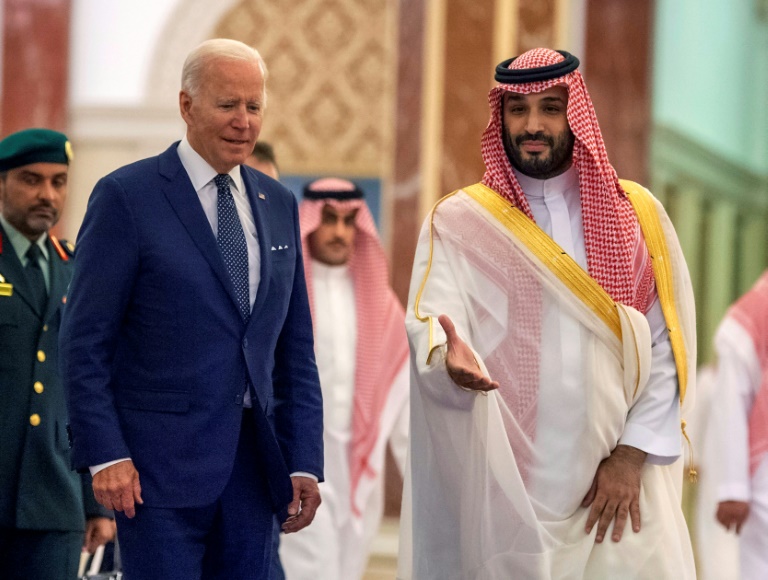
But his cordial “fist bump” greeting with Prince Mohammed in July left a bitter taste for some activists and their families, and their visit to Washington was tinged with both disillusionment and determination to keep the pressure on.

Sanaa Seif, sister of Alaa Abdel Fattah, Egypt’s most notorious detainee who has been on hunger strike for more than six months, told AFP she was “disappointed” that while US officials were “very sympathetic… it doesn’t translate to anything tangible.”

Pressure from Washington could, however, have an impact on the Egyptian government as well as on the British authorities and push them to act more forcefully, she argued. From his cell, her brother, sentenced to five years in prison for “spreading false information,” became a British citizen this year.

– ‘Imprisoned for tweets’ –

In the run-up to the global climate summit known as COP27 next month in Egypt, Palestinian Ramy Shaath, who was imprisoned for more than 900 days in Egypt, has called on the United States to ensure that this climate conference does not serve as “greenwashing” for the regime.

“The level of oppression is becoming devastating” in Egypt, he said, noting that NGOs say the country holds some 60,000 political prisoners.

Yet al-Sissi remains susceptible to foreign pressure.

“He definitely looks at the US and the European Union as the main source of support, the main source of income, main source of weaponry, and he’s susceptible to their small criticism,” Shaath said, adding that he wishes such criticism would become “more vocal.”

Egypt receives more than $1 billion a year in direct US military aid.

Lina al-Hathloul, the sister of Loujain al-Hathloul, a Saudi women’s rights activist released from prison in 2021 but still banned from leaving the country, also told US officials that “the only concrete solution (was) to stop encouraging a dictator,” referring to the crown prince.

“You have leverage,” she urged them.

Before Biden’s trip to Jeddah in mid-July, “we were clear with our message: If the administration is going to visit our countries without putting clear conditions when it comes to human rights, it will get worse and our oppressors will feel emboldened,” Lina al-Hathloul told AFP.

“They promised us that it was not going to happen” in this way, she added, but the situation in Saudi Arabia is “clearly worse than before.”

“Everyone is afraid,” she said. “People are imprisoned for tweets.”

In September, in front of the United Nations General Assembly, Biden assured that “the United States will always promote human rights… around the world,” and that “the future will be won by those countries that unleash the full potential of their populations.”

But his “fist bump” diplomacy, which was supposed to mark a new beginning with Riyadh, showed its limits in another area Wednesday with the announcement that Saudi-led oil exporters group Opec+ was going to cut its production.

“Biden sold his human rights principles for the Saudi crown prince’s promise to increase oil production,” blasted Kenneth Roth, the former head of non-governmental organization Human Rights Watch. “So Joe Biden, was it worth it?”

Biden pardons thousands for cannabis possession

US President Joe Biden pardoned thousands of Americans convicted of marijuana possession Thursday in a major new step towards destigmatizing the drug — and fulfilling a promise to his supporters a month before midterm elections.

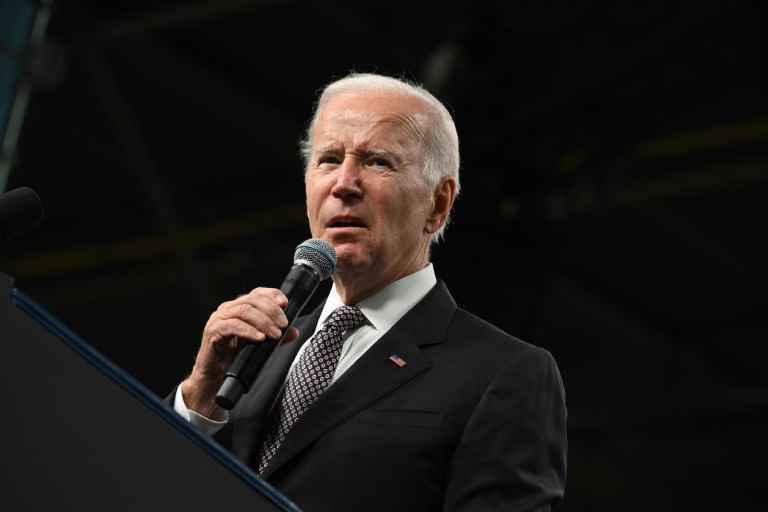
“I am announcing a pardon of all prior federal offenses of simple possession of marijuana,” Biden said.

Biden did not call for fully decriminalizing cannabis, saying that “limitations on trafficking, marketing and under-age sales should stay in place.”

Instead, he homed in individual possession of a substance that the government health authorities estimate was used by at least 18 percent of the population in 2019 — and which is already permitted by multiple state governments for recreational or medical purposes.

In addition to the pardons, Biden instructed the departments of justice and health to determine whether cannabis should be reclassified as a less dangerous substance.

Officials told reporters that about 6,500 people are directly affected by convictions under federal marijuana statutes. Clemency will extend to thousands more convicted under laws in the federal capital, Washington.

However, Biden’s gesture aims to take the shift much further, putting pressure on state authorities everywhere to follow suit.

“I am urging all governors to do the same with regard to state offenses. Just as no one should be in a federal prison solely due to the possession of marijuana, no one should be in a local jail or state prison for that reason, either,” Biden said.

– Political impact –

The move was announced abruptly by video and in a written statement, with no previous build-up by the White House.

However, the impact is expected to be significant, both legally and politically, allowing Biden to seize the narrative on a trend toward decriminalization that swaths of the country have already embraced.

Ahead of the November 8 midterms, where his Democrats are struggling to hold onto even partial control of Congress, Biden has now satisfied a key demand from racial justice activists angered at the way enforcement of cannabis laws often targets ethnic minorities.

“As I often said during my campaign for president, no one should be in jail just for using or possessing marijuana. Sending people to prison for possessing marijuana has upended too many lives and incarcerated people for conduct that many states no longer prohibit,” Biden said.

He noted that non-white people are disproportionately affected by marijuana possession convictions, which in addition to sometimes including jail time can unleash years of legal fallout, creating difficulties in getting work and education.

The third measure announced was an instruction for federal health and justice officials to “review expeditiously how marijuana is scheduled under federal law.”

Currently, federal law lumps marijuana alongside what are widely accepted to be far more dangerous narcotics such as heroin and LSD. It is in a group higher than the relatively modern — and hugely addictive — drugs fentanyl and methamphetamine.

Senate leader Chuck Schumer, a key Biden ally who is fighting to try and keep the chamber under Democratic control in November, said the president’s move recognized that the so-called “war on drugs” has been “a war on people and particularly people of color.”

Derrick Johnson, president of the NAACP, a leading civil rights organization, said on Twitter: “We applaud President Biden.”

“Correcting unequal treatment — including marijuana reform — has been a priority issue for the NAACP for decades.”

Judge halts Twitter-Musk case, sets Oct. 28 deadline to close deal

A US judge on Thursday suspended litigation in the saga over Elon Musk’s proposed $44-billion takeover of Twitter, giving the parties until October 28 to finalize the on-again, off-again megadeal.

Delaware Judge Kathaleen McCormick, ruling on a Musk request to freeze the case that had drawn a biting retort from Twitter, said a trial originally scheduled to begin in 11 days could be rescheduled for next month if a deal is not finalized.

“If the transaction does not close by 5 pm on October 28, 2022, the parties are instructed to contact me by email that evening to obtain November 2022 trial dates,” McCormick said in the order.

The move buys time for a potential reconciliation between two parties that began squabbling as soon as Musk sealed an agreement in April to purchase the influential social media site for $54.20 per share.

With an October 17 trial date on Twitter’s breach-of-contract suits against Musk looming, the unpredictable Tesla boss did an about-face on Tuesday, reviving his $44-billion takeover plan on condition the Delaware court halt the lawsuit against him.

Twitter said Tuesday it expects to close the buyout deal at the $54.20 price in a statement that did not address Musk’s demands over freezing the litigation.

Legal briefs filed earlier Thursday shed further light on prickly proceedings characterized by mutual distrust.

“There is no need for an expedited trial to order Defendants to do what they are already doing and this action is now moot,” said a filing prepared by Musk’s attorneys that alluded to his latest offer.

“Yet, Twitter will not take yes for an answer. Astonishingly they have insisted on proceeding with this litigation, recklessly putting the deal at risk and gambling with their stockholders interests.”

The filing said Twitter had opposed a suspension on the “theoretical possibility” of lack of financing for the transaction, adding that Musk has access to financing to close the deal “on or around October 28.”

-‘Trust us’ this time –

Twitter refuted those arguments, noting that Musk’s side had still not committed to a closing date and calling Musk’s latest appeal “an invitation to further mischief and delay,” Twitter attorneys said in a filing to the Delaware court.

“‘Trust us,’ they say, ‘we mean it this time,'” Twitter lawyers said in a brief that described Musk as seeking an “indefinite” time frame to close the deal.

“The obstacle to terminating this litigation is not, as Defendants say, that Twitter is unwilling to take yes for an answer. The obstacle is that Defendants still refuse to accept their contractual obligations.

“Until Defendants commit to close as required, Twitter is entitled to its day in court to… prove Defendants’ breaches so as to ensure complete relief in the event the closing should for any reason not occur,” they said.

Analysts say the litigation provides leverage to Twitter against the risk of another shift by Musk.

US media have reported that the talks are stuck in part on Musk’s assertion that the deal is contingent on billions of dollars in debt financing by major banks.

Twitter “thought they had a deal before,” said Adam Badawi, a law professor at the University of California, Berkeley. “So to actually accept something from (Musk), it’s going to have to be as ironclad as it possibly can.”

But experts were eyeing the latest court twist as beneficial for Musk.

“I think it’s definitely an advantage to him. I mean, he obviously very much wanted to delay this,” Ann Lipton, a law professor at Tulane University, told AFP.

But she noted the advantage would shift to Twitter should Musk not seal the deal by October 28.

“If somehow that doesn’t happen, I think that Twitter will have a stronger case that he’s been acting in bad faith all along, which… justifies whatever equitable remedies would be appropriate for that,” Lipton added.

A serial entrepreneur made rich through his success with Tesla electric cars, Musk began to step back from the Twitter deal soon after it was agreed.

Musk said in July he was canceling the purchase because he was misled by Twitter concerning the number of fake “bot” accounts, allegations rejected by the company.

Twitter, meanwhile, has sought to prove Musk was contriving excuses to walk away — simply because he changed his mind.

Musk’s potential stewardship of the influential social media site has sparked worry from activists who fear he could open the gates to more abusive and misinformative posts.

Shares of Twitter, which surged on Tuesday’s news of Musk’s reversal, fell 3.7 percent to $49.39.

Judge halts Twitter-Musk case, sets Oct. 28 deadline to close deal

A US judge on Thursday suspended litigation in the saga over Elon Musk’s proposed $44-billion takeover of Twitter, giving the parties until October 28 to finalize the on-again, off-again megadeal.

Delaware Judge Kathaleen McCormick, ruling on a Musk request to freeze the case that had drawn a biting retort from Twitter, said a trial originally scheduled to begin in 11 days could be rescheduled for next month if a deal is not finalized.

“If the transaction does not close by 5 pm on October 28, 2022, the parties are instructed to contact me by email that evening to obtain November 2022 trial dates,” McCormick said in the order.

The move buys time for a potential reconciliation between two parties that began squabbling as soon as Musk sealed an agreement in April to purchase the influential social media site for $54.20 per share.

With an October 17 trial date on Twitter’s breach-of-contract suits against Musk looming, the unpredictable Tesla boss did an about-face on Tuesday, reviving his $44-billion takeover plan on condition the Delaware court halt the lawsuit against him.

Twitter said Tuesday it expects to close the buyout deal at the $54.20 price in a statement that did not address Musk’s demands over freezing the litigation.

Legal briefs filed earlier Thursday shed further light on prickly proceedings characterized by mutual distrust.

“There is no need for an expedited trial to order Defendants to do what they are already doing and this action is now moot,” said a filing prepared by Musk’s attorneys that alluded to his latest offer.

“Yet, Twitter will not take yes for an answer. Astonishingly they have insisted on proceeding with this litigation, recklessly putting the deal at risk and gambling with their stockholders interests.”

The filing said Twitter had opposed a suspension on the “theoretical possibility” of lack of financing for the transaction, adding that Musk has access to financing to close the deal “on or around October 28.”

-‘Trust us’ this time –

Twitter refuted those arguments, noting that Musk’s side had still not committed to a closing date and calling Musk’s latest appeal “an invitation to further mischief and delay,” Twitter attorneys said in a filing to the Delaware court.

“‘Trust us,’ they say, ‘we mean it this time,'” Twitter lawyers said in a brief that described Musk as seeking an “indefinite” time frame to close the deal.

“The obstacle to terminating this litigation is not, as Defendants say, that Twitter is unwilling to take yes for an answer. The obstacle is that Defendants still refuse to accept their contractual obligations.

“Until Defendants commit to close as required, Twitter is entitled to its day in court to… prove Defendants’ breaches so as to ensure complete relief in the event the closing should for any reason not occur,” they said.

Analysts say the litigation provides leverage to Twitter against the risk of another shift by Musk.

US media have reported that the talks are stuck in part on Musk’s assertion that the deal is contingent on billions of dollars in debt financing by major banks.

Twitter “thought they had a deal before,” said Adam Badawi, a law professor at the University of California, Berkeley. “So to actually accept something from (Musk), it’s going to have to be as ironclad as it possibly can.”

But experts were eyeing the latest court twist as beneficial for Musk.

“I think it’s definitely an advantage to him. I mean, he obviously very much wanted to delay this,” Ann Lipton, a law professor at Tulane University, told AFP.

But she noted the advantage would shift to Twitter should Musk not seal the deal by October 28.

“If somehow that doesn’t happen, I think that Twitter will have a stronger case that he’s been acting in bad faith all along, which… justifies whatever equitable remedies would be appropriate for that,” Lipton added.

A serial entrepreneur made rich through his success with Tesla electric cars, Musk began to step back from the Twitter deal soon after it was agreed.

Musk said in July he was canceling the purchase because he was misled by Twitter concerning the number of fake “bot” accounts, allegations rejected by the company.

Twitter, meanwhile, has sought to prove Musk was contriving excuses to walk away — simply because he changed his mind.

Musk’s potential stewardship of the influential social media site has sparked worry from activists who fear he could open the gates to more abusive and misinformative posts.

Shares of Twitter, which surged on Tuesday’s news of Musk’s reversal, fell 3.7 percent to $49.39.

US judge blocks new New York gun controls

A US federal judge blocked the enforcement of New York’s new gun law Thursday, undermining for the second time this year the state’s efforts to control a key factor in rising homicides.

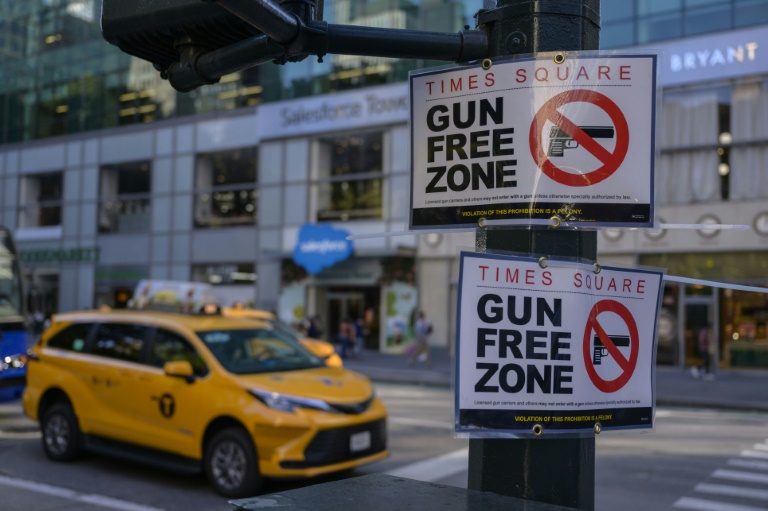
The judge accepted a petition to place a temporary stay on the state law passed on July 1 and implemented on September 1 that tightly restricted carrying guns in “sensitive places” such as Times Square in New York City, bars, schools and playgrounds.

The new law was passed after the Supreme Court — in a landmark ruling on June 23 — overturned New York’s previous gun laws, saying they unlawfully limited a person’s right to carry a firearm in public.

But gun rights advocates said the new law, even though tailored to follow the Supreme Court ruling, in practice impinged on their constitutional rights to free speech and to possess firearms.

Judge Glenn Suddaby apparently agreed, awarding the gun rights advocates a stay, or temporary block, on the new law while their lawsuit over it proceeds.

The ruling is the latest chapter in the fight over the state’s gun laws tightly limiting permission to carry a firearm outside the home. 

In the newest version after the Supreme Court ruling, the state law required a person seeking a public handgun license to demonstrate “good moral character,” a process that included vetting their social media accounts, providing four character references and taking 18 hours of firearms training.

It also set a long list of “sensitive locations” where firearms could not be carried.

The judge agreed that these requirements were unlawfully onerous and broad, and that Times Square and other sensitive locations did not merit special protection.

Suddaby said the new law still gives New York officials too much power to reject gun permit applicants by forcing them to go to lengths to prove they were of good moral character, rather than assuming they were in the absence of contradictory information.

“We are grateful to Judge Suddaby for his quick action to restore the right of the people to keep and bear arms,” said Erich Pratt, the senior vice president of Gun Owners of America.

New York Governor Kathy Hochul said they were weighing an appeal against the stay. 

“I will continue to do everything in my power to combat the gun violence epidemic and protect New Yorkers,” she said in a statement.

But the plaintiffs in the case, supported by Gun Owners of America, could then pursue their arguments to the Supreme Court, where the majority justices have already made clear they generally endorse a constitutional right to carry arms.

Easter Island blaze chars famous moai statues

A forest fire that tore through part of Easter Island has charred some of its fabled monumental carved stone figures, known as moai, authorities said Thursday. 

“Nearly 60 hectares (148 acres) were affected, including some moai,” Carolina Perez, cultural heritage undersecretary, said in a Twitter post. 

On Easter Island, which lies some 3,500 kilometers (2,175 miles) off the west coast of Chile, 100 hectares have been razed by flames since Monday, Perez said. The area around the Rano Raraku volcano, a UNESCO World Heritage Site, was the most affected. 

An estimated several hundred moai are in that area, as well as in the quarry where the stone used to carve the sculptures is extracted.

“The damage caused by the fire can’t be undone,” Pedro Edmunds, mayor of Easter Island, told local media. 

There is still no report on the total damage.

But the fire comes just three months after the island was reopened to tourism on August 5, after two years of closure due to Covid-19. 

Before the pandemic, Easter Island — whose main livelihood is tourism — received some 160,000 visitors a year, on two daily flights. 

But with the arrival of Covid-19 in Chile, tourist activity was completely suspended.

The island was long inhabited by Polynesian people, before Chile annexed it in 1888.

Kevin Spacey in court over 1980s sex misconduct claim

Five years after misconduct allegations ended his Hollywood career, Kevin Spacey appeared in a New York court Thursday to face fellow actor Anthony Rapp’s accusation that the disgraced Oscar winner sexually assaulted Rapp in 1986 when he was a minor.

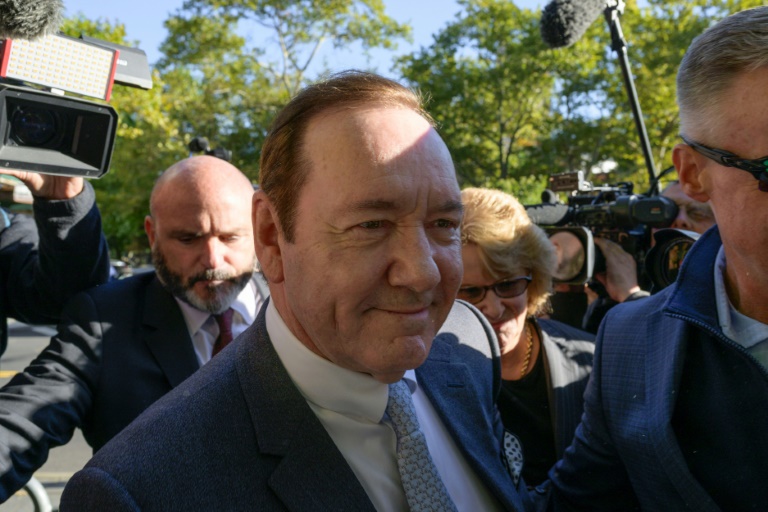
One of the first stars to be caught up in the global #MeToo reckoning over sexual abuse, the 63-year-old Spacey smiled as he sat in a blue suit, white shirt and light blue tie just steps away from his accuser in federal court in Manhattan.

“Star Trek: Discovery” star Rapp, now 50, filed a complaint in September 2020 against Spacey for advances and an alleged sexual assault at a party in Manhattan in 1986, when Rapp was 14 and Spacey was in his late 20s. He is seeking $40 million in damages.

The “House of Cards” actor, who built his worldwide fame since the 1980s in movies such as “The Usual Suspects” and “American Beauty,” has always denied allegations of sexual abuse.

But during arguments in the case presided over by Judge Lewis Kaplan, Rapp’s lawyer Peter Saghir told a jury of six men and six women that Spacey committed “unacceptable” acts against the teen Rapp “intentionally to satisfy the drive of his sexual desires.”

The alleged assault against Rapp “never should have happened,” Saghir continued. “He was 14 years old.”

– Global fame –

Spacey, whose full name is Kevin Spacey Fowler, has disappeared from public view after becoming caught up in the early days of #MeToo.

The movement exploded in October 2017, when more than 80 women in the movie industry accused — and ultimately brought down — the previously untouchable producer Harvey Weinstein.

At the end of the month, Rapp accused Spacey for the first time, in great detail, in an interview with BuzzFeed News.

The next day, on Twitter, Spacey presented his “sincerest apology” to Rapp for any “deeply inappropriate drunken behavior,” saying he did not recall the incident.

After a 2020 criminal charge of sexual assault was dismissed by a judge, Rapp filed a civil suit.

According to a court document, Rapp claims that during the 1986 party, Spacey lifted him up, and that his hand “grazed” his buttocks while doing so. Rapp claims Spacey then placed him back down on a bed and “briefly placed his own clothed body partially beside and partially across” the 14-year-old’s.

During his testimony 35 years after the incident, Rapp agreed there had been “no kissing, no undressing, no reaching under clothes, and no sexualized statements or innuendo,” during an incident that had lasted no more than two minutes. 

In court though, Rapp’s lawyer pressed the case, describing Spacey’s behavior as “wrong and frankly unacceptable.”

“This was not horseplay,” Saghir said.

– ‘An impartial jury’ –

Spacey’s lawyer Jennifer Keller told the jury, however, that such an assault “never happened at all.”

Keller said that in the decades since the encounter at Spacey’s apartment, Rapp “repeated the same false story (but) never repeated it to the police.”

Rapp repeated it for “attention, sympathy” because he never became an international star, according to Spacey’s lawyer.

Before the trial, Keller said Spacey would attend through its duration, expected to be less than two weeks.

“We look forward to his vindication by an impartial jury,” Keller previously told AFP in an email.

If found guilty, Spacey faces significant damages.

Kaplan had dropped Rapp’s initial charge of sexual assault, ruling it had been brought too late and was not covered by a New York state law on child protection, implemented in 2019.

Spacey has pleaded not guilty to charges of sexual assault of three men between March 2005 and April 2013 in Britain, and in 2019, charges against the actor of indecent assault and sexual assault were dropped in Massachusetts. 

US flies Russian cosmonaut to ISS as Ukraine conflict rages

A SpaceX capsule carrying a Russian crew member docked Thursday with the International Space Station on a NASA mission that carries significant symbolism amid the war in Ukraine.

The Crew Dragon spaceship “Endurance” blasted off Wednesday from Florida and rendezvoused with the orbiting research outpost some 30 hours later, docking at 5:01 pm Eastern Time (2301 GMT). 

“Crew-5 is happy to have finally arrived at the International Space Station,” said commander Nicole Mann, the first Native American woman in space. “We are looking forward to getting to work.”

Also aboard: Koichi Wakata of Japan, Josh Cassada of the United States and Anna Kikina of Russia, the only female cosmonaut currently in service.

Around two hours after docking, hatches will open allowing the crew to join seven others already on the station: two Russians, four Americans, and an Italian.

Two weeks ago, an American astronaut took off on a Russian Soyuz rocket for the orbital platform.

The long-planned astronaut exchange program has been maintained despite soaring tensions between the United States and Russia since Moscow’s invasion of Ukraine in February.

Ensuring the operation of the ISS has become one of the few remaining areas of cooperation between the United States and Russia.

During a post-launch briefing, Sergei Krikalev, head of the human space program at Roscosmos, hailed the occasion as the start of a “new phase of our cooperation,” evoking the historic Apollo-Soyuz mission of 1975, a symbol of detente at the height of the Cold War. 

Krikalev, a former cosmonaut respected by his American colleagues, has been on something of a charm offensive after the last head of Roscosmos, Dmitry Rogozin, earlier this year threatened to withdraw cooperation and let the ISS crash over US or European territory.

While Russia has announced plans for its own station, analysts believe it would be difficult to build in the next few years, and withdrawing from the ISS would effectively ground Moscow’s once-proud civilian space program.

US flies Russian cosmonaut to ISS as Ukraine conflict rages

A SpaceX capsule carrying a Russian crew member docked Thursday with the International Space Station on a NASA mission that carries significant symbolism amid the war in Ukraine.

The Crew Dragon spaceship “Endurance” blasted off Wednesday from Florida and rendezvoused with the orbiting research outpost some 30 hours later, docking at 5:01 pm Eastern Time (2301 GMT). 

“Crew-5 is happy to have finally arrived at the International Space Station,” said commander Nicole Mann, the first Native American woman in space. “We are looking forward to getting to work.”

Also aboard: Koichi Wakata of Japan, Josh Cassada of the United States and Anna Kikina of Russia, the only female cosmonaut currently in service.

Around two hours after docking, hatches will open allowing the crew to join seven others already on the station: two Russians, four Americans, and an Italian.

Two weeks ago, an American astronaut took off on a Russian Soyuz rocket for the orbital platform.

The long-planned astronaut exchange program has been maintained despite soaring tensions between the United States and Russia since Moscow’s invasion of Ukraine in February.

Ensuring the operation of the ISS has become one of the few remaining areas of cooperation between the United States and Russia.

During a post-launch briefing, Sergei Krikalev, head of the human space program at Roscosmos, hailed the occasion as the start of a “new phase of our cooperation,” evoking the historic Apollo-Soyuz mission of 1975, a symbol of detente at the height of the Cold War. 

Krikalev, a former cosmonaut respected by his American colleagues, has been on something of a charm offensive after the last head of Roscosmos, Dmitry Rogozin, earlier this year threatened to withdraw cooperation and let the ISS crash over US or European territory.

While Russia has announced plans for its own station, analysts believe it would be difficult to build in the next few years, and withdrawing from the ISS would effectively ground Moscow’s once-proud civilian space program.

US to rename military bases that honor Confederate figures by 2024

The United States will rename nine army bases that honor figures from the pro-slavery Confederacy by the beginning of 2024, Defense Secretary Lloyd Austin said on Thursday.

Nationwide protests against racism and police brutality that were sparked by the 2020 murder of George Floyd reignited calls to rename the bases, and Congress mandated that they be changed despite opposition from then-president Donald Trump.

“The names of these installations and facilities should inspire all those who call them home, fully reflect the history and the values of the United States, and commemorate the best of the republic that we are all sworn to protect,” Austin wrote in a memo on the decision.

The 2021 defense budget required the establishment of a commission to plan for the removal of Confederate-linked “names, symbols, displays, monuments, or paraphernalia” from defense department property, and gave the secretary three years to carry out its recommendations.

“I am committed to implementing all of the commission’s recommendations as soon as possible,” Austin said in the memo, adding that this will happen when a 90-day waiting period expires in December and will be completed “no later than January 1, 2024.”

The changes “will give proud new names that are rooted in their local communities and that honor American heroes whose valor, courage, and patriotism exemplify the very best of the United States military,” he wrote.

Trump opposed the renaming effort, tweeting in 2020 that his administration “will not even consider” changing the names of the bases, which “have become part of a Great American Heritage, and a history of Winning, Victory, and Freedom.”

He vetoed the defense bill, but Congress overrode it in a blow to the president, who by then had lost the 2020 election to Joe Biden.

All of the bases being renamed are located in Southern states that seceded from the United States and formed the Confederacy, which lost the 1861-1865 Civil War.

They include Fort Benning in Georgia, home to the US Army Infantry School, and Fort Bragg in North Carolina, home to the US Special Forces Command and the storied 82nd Airborne Division.

Fort Benning is currently named after brigadier general Henry Benning, an ardent secessionist who argued for the “superiority” of the white race.

The commission recommended it be renamed Fort Moore to honor US lieutenant general Hal Moore — who commanded American troops during their first major battle with North Vietnamese forces — and his wife Julia.

Fort Bragg, named for major general Braxton Bragg, an inept general who was relieved of command, is recommended to become Fort Liberty.

Close Bitnami banner
Bitnami