AFP

Deeply divisive Monroe biopic 'Blonde' hits Netflix

Destined to be one of the most divisive films of the year, Marilyn Monroe biopic “Blonde” finally lands on Netflix on Wednesday after more than a decade of troubled production.

While there is almost universal praise for the visceral lead performance by Ana de Armas, critics cannot agree whether the uncompromising, nearly three-hour film is an artistic tour de force or another cruel layer of exploitation perpetrated against the 20th century icon. 

For ID magazine, “Blonde” is “guttural, instinctive, anguished filmmaking that bends space, time, and every cinematic tool at its disposal in service of attaining emotional truth”.

Or viewers might take the position of the New Yorker’s Richard Brody, who called it “ridiculously vulgar”, seeing the endless torment that Monroe experiences on-screen as “a special kind of directorial sadism”.

There are certainly no punches being pulled by Australian director Andrew Dominik in his adaptation of the hit semi-fictional book of the same name by Joyce Carol Oates. 

From the trauma of a mentally unstable and violent mother, through her rape at the hands of a studio boss, to a particularly sordid scene with president John F Kennedy, Monroe’s life is depicted as one of relentless abuse and anguish. 

Dominik spent 11 years trying to get the film made, and has credited the #MeToo movement against sexual assault with finally generating interest in the story — though he reportedly fought long and hard with Netflix over long running time and graphic scenes. 

Armas told reporters at the Venice Film Festival, where the film premiered this month, that she had to go to “uncomfortable, dark and vulnerable” places for the role. 

“She was all I thought about, all I dreamed about, all I could talk about. She was with me, and it was beautiful,” she said. 

The crew filmed in the real locations where Monroe was born and died, with Dominik saying the shoot “took on elements of a seance”. 

– ‘Sense of awe’ –

It is a star-making turn for Armas, who worked for months with a vocal coach to overcome her Cuban accent and find a voice that could express Monroe’s character as well as her own unique intonations.

“On the first day of filming, I went home with this sense of awe that I had the privilege of actually working with Marilyn Monroe,” co-star Adrien Brody, who plays husband Arthur Miller, said in Venice.

Dominik’s films have often proved divisive. 

Many saw his previous biopic, “The Assassination of Jesse James by the Coward Robert Ford” starring Brad Pitt, who serves as a producer on “Blonde”, as a poetic masterpiece, but just as many found it dull and pretentious, and it flopped at the box office.

Dominik is unlikely to be bothered, however.

“Blonde” is “a demanding movie,” he told Screen Daily. “If the audience doesn’t like it, that’s the f—ing audience’s problem. It’s not running for public office.”

NPR were among several outlets saying the film is “an exercise in exploitation, not empathy”. 

But Vogue said a lot of the initial shock may fade over time. 

“History will be kind to ‘Blonde’, a Hollywood biopic in real anarchy mode… (which) in time, could be considered a masterpiece.”

Rihanna to headline Super Bowl halftime show

Superstar Rihanna will headline the Super Bowl halftime show in February, the main event sponsor Apple Music announced Sunday.

The move marks a long-awaited return to performing for the singer, who had previously turned down the gig in protest.

“IT’S ON. @rihanna will take the stage for the first ever Apple Music Super Bowl Halftime Show on 2.12.23,” Apple Music said in a tweet featuring a photo of the musician’s raised hand holding a football.

Rihanna, 34, and the NFL tweeted the same image.

The Barbadian-born Robyn Rihanna Fenty in recent years has become a billionaire, parlaying her music achievements into successful makeup, lingerie and high-fashion brands.

She made history by becoming the first Black woman to head a fashion house for the French powerhouse LVMH, which owns legacy brands including Fendi and Givenchy.

For the past few years, the singer behind the hits “Diamonds” and “Umbrella” has put music aside, at least publicly, to focus on her various businesses.

In January, she and rapper A$AP Rocky, 33, announced they were expecting a child with a set of glamorous snow-dusted images taken in Harlem.

They reportedly welcomed the baby, a boy, in May. No other details, including the child’s name, have been made public.

– Return to music –

Rihanna’s fierce fan base has been clamoring for her ninth album, “R9,” which she has said will be “reggae-infused” and has hinted since 2019 is nearly finished.

Performing at the Super Bowl is an about-face for the singer, who in 2019 confirmed reports to Vogue that she had turned down the NFL’s offer to play the coveted halftime show in solidarity with former player Colin Kaepernick.

Kaepernick, who has not played in the NFL since opting out of his contract with the San Francisco 49ers in March 2017, began kneeling in protest of social injustice and racial inequality during pre-game renditions of the US national anthem six years ago.

“I couldn’t dare do that. For what? Who gains from that? Not my people. I just couldn’t be a sellout. I couldn’t be an enabler,” she told the magazine in an interview.

Rihanna’s Super Bowl performance will follow an impeccably choreographed 2022 halftime show that featured rap legends including Dr. Dre, Snoop Dog and Eminem.

The 2021 halftime show featured Canadian artist The Weeknd, while Jennifer Lopez and Shakira performed the year before.

The halftime show has since 2019 been produced by Roc Nation, founded by New York rapper-turned-businessman Jay-Z.

Apple Music announced in September that it would be the main sponsor of the event, ousting Pepsi and reportedly paying $50 million for the privilege.

The 2022 Super Bowl, in which the Los Angeles Rams defeated the Cincinnati Bengals, drew an average of 112.3 million viewers on television and streaming, according to NBC Sports.

Canada counts damage after Fiona; Cuba and Florida brace for storm Ian

Parts of eastern Canada suffered “immense” devastation, officials said Sunday after powerful storm Fiona swept houses into the sea and caused major power outages, as the Caribbean and Florida braced for intensifying Tropical Storm Ian.

Canadian authorities have now confirmed two deaths caused when Fiona, then a post-tropical cyclone, tore into Nova Scotia and Newfoundland early Saturday.

Fiona had earlier claimed seven lives as it roared through the Caribbean at the start of a week of havoc.

Officials on Prince Edward Island on Sunday confirmed the death of one person there, though there were few details.

And officials have found the body of a 73-year-old woman believed to have been swept from her home in Newfoundland. She apparently was sheltering in her basement when waves broke through.

The storm packed intense winds of 80 miles (130 kilometers) per hour when it arrived with force rarely seen in eastern Canada, bringing torrential rain and waves of up to 40 feet (12 meters).

“The devastation is immense,” Nova Scotia Premier Tim Houston told reporters. “The magnitude of the storm is incredible.”

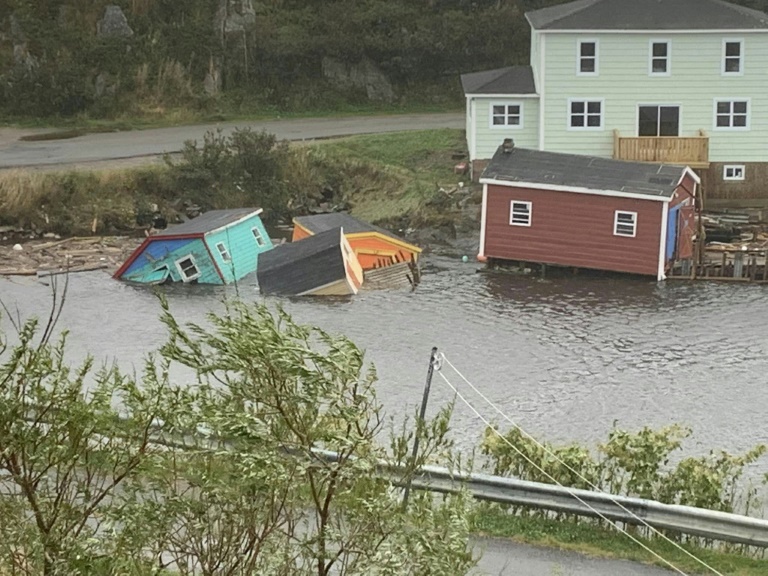
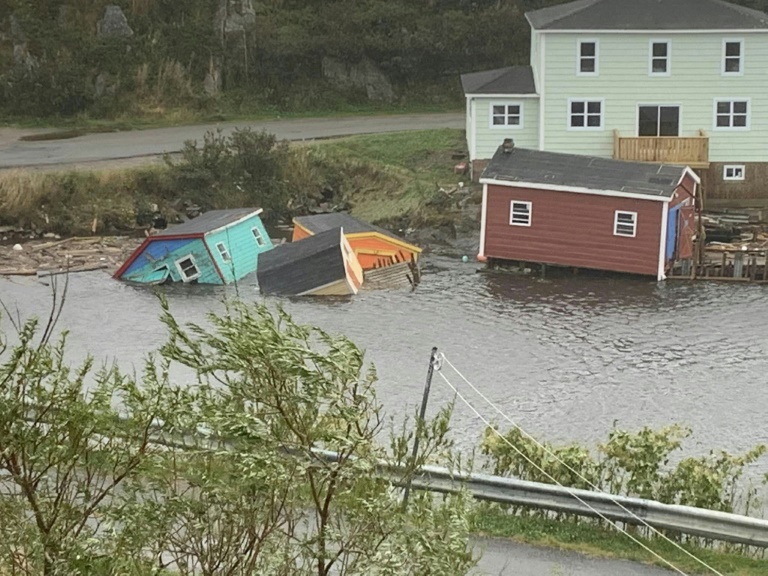
Storm surges swept at least 20 homes into the sea in the town of Channel-Port aux Basques, on the southwestern tip of Newfoundland.

Mayor Brian Button described “a total war zone” in the coastal community. 

Some 200 residents had been evacuated before the storm hit.

On Sunday, residents were reckoning with the damage.

“Some people have lost everything, and I mean everything,” Button told CBC News.

“The sea was taking back the land and we were getting separated. A lot of our homes are built along the coastline along the Atlantic Ocean. Down there, Fiona just wiped out parts of that,” he said. 

Tempers were fraying Sunday as residents tried to return to their homes — or what was left of them. 

“I know people are showing up at the barricades angry this morning and wanting to move in and go check up on their properties,” said Button in a live video on Facebook. 

“You’ve got to give us a little bit of time… Unfortunately, this is going to take days, could take weeks, could take months in some cases,” he said.

– ‘Incredible storm’ –

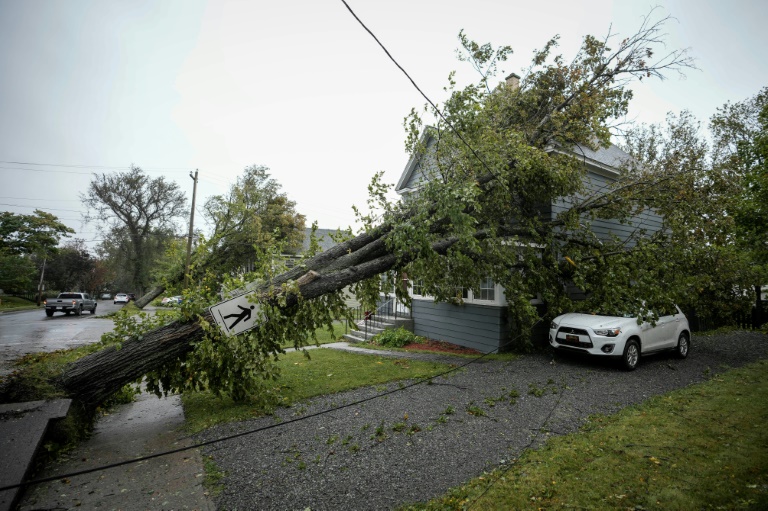
More than 300,000 people were still without electricity across five provinces Sunday after the storm felled trees, ripped roofs from buildings and damaged power lines, officials said. Hundreds of utility crews were working to restore power.

Nova Scotia premier Houston told CBC the Canadian military had been deployed to help clear trees and roads.

Emergency Preparedness Minister Bill Blair said the Canadian armed forces would also provide assistance to Newfoundland’s cleanup efforts. This is the third province to request federal military assistance, after Nova Scotia on Saturday and Prince Edward Island earlier Sunday.

Television images showed a long line of cars and people on foot queuing to get gas for generators in Cape Breton, an island off Nova Scotia, where dozens had spent the night in relief centers operated by the Canadian Red Cross.

On Prince Edward Island, Charlottetown Police Chief Brad MacConnell pleaded with residents to stay inside as recovery efforts continue.

“We ask people to stay home unless absolutely necessary,” he told CBC, adding that there’s “a lot of devastation” and hardly an area of the city that had not been significantly affected.

Prime Minister Justin Trudeau said on Twitter that he had met again with his Incident Response Group to ensure that “resources are available to help those affected by the storm.”

By Sunday, with a waning Fiona dissipating over the Labrador Sea, the country’s environmental agency said all warnings had been canceled.

– Ian to become major hurricane –

Further south, parts of the Caribbean as well as the US state of Florida were preparing for Tropical Storm Ian, which the US National Hurricane Center (NHC) said is forecast to become a hurricane on Monday and a major hurricane the following day.

Packing winds of near 60 miles per hour and getting stronger, the storm is expected to pass near the Cayman Islands, either near or over western Cuba, and then head toward Florida, the NHC said.

A hurricane warning is in effect for parts of Cuba — where the storm is forecast to “produce significant wind and storm surge” — as well as the British territory of Grand Cayman, according to the NHC. 

Florida’s Governor Ron DeSantis said Saturday that he had declared a state-wide emergency in preparation for the storm, warning on Twitter that “Floridians should take precautions.”

Authorities in several Florida municipalities including Miami, Fort Lauderdale and Tampa began distributing free sandbags to residents to help them protect their homes from the risk of flooding. 

“It’s never too early to prepare,” tweeted Jane Castor, the mayor of Tampa.

burs/st/bbk/wd/to

Canada counts damage after Fiona; Cuba and Florida brace for storm Ian

Parts of eastern Canada suffered “immense” devastation, officials said Sunday after powerful storm Fiona swept houses into the sea and caused major power outages, as the Caribbean and Florida braced for intensifying Tropical Storm Ian.

Canadian authorities have now confirmed two deaths caused when Fiona, then a post-tropical cyclone, tore into Nova Scotia and Newfoundland early Saturday.

Fiona had earlier claimed seven lives as it roared through the Caribbean at the start of a week of havoc.

Officials on Prince Edward Island on Sunday confirmed the death of one person there, though there were few details.

And officials have found the body of a 73-year-old woman believed to have been swept from her home in Newfoundland. She apparently was sheltering in her basement when waves broke through.

The storm packed intense winds of 80 miles (130 kilometers) per hour when it arrived with force rarely seen in eastern Canada, bringing torrential rain and waves of up to 40 feet (12 meters).

“The devastation is immense,” Nova Scotia Premier Tim Houston told reporters. “The magnitude of the storm is incredible.”

Storm surges swept at least 20 homes into the sea in the town of Channel-Port aux Basques, on the southwestern tip of Newfoundland.

Mayor Brian Button described “a total war zone” in the coastal community. 

Some 200 residents had been evacuated before the storm hit.

On Sunday, residents were reckoning with the damage.

“Some people have lost everything, and I mean everything,” Button told CBC News.

“The sea was taking back the land and we were getting separated. A lot of our homes are built along the coastline along the Atlantic Ocean. Down there, Fiona just wiped out parts of that,” he said. 

Tempers were fraying Sunday as residents tried to return to their homes — or what was left of them. 

“I know people are showing up at the barricades angry this morning and wanting to move in and go check up on their properties,” said Button in a live video on Facebook. 

“You’ve got to give us a little bit of time… Unfortunately, this is going to take days, could take weeks, could take months in some cases,” he said.

– ‘Incredible storm’ –

More than 300,000 people were still without electricity across five provinces Sunday after the storm felled trees, ripped roofs from buildings and damaged power lines, officials said. Hundreds of utility crews were working to restore power.

Nova Scotia premier Houston told CBC the Canadian military had been deployed to help clear trees and roads.

Emergency Preparedness Minister Bill Blair said the Canadian armed forces would also provide assistance to Newfoundland’s cleanup efforts. This is the third province to request federal military assistance, after Nova Scotia on Saturday and Prince Edward Island earlier Sunday.

Television images showed a long line of cars and people on foot queuing to get gas for generators in Cape Breton, an island off Nova Scotia, where dozens had spent the night in relief centers operated by the Canadian Red Cross.

On Prince Edward Island, Charlottetown Police Chief Brad MacConnell pleaded with residents to stay inside as recovery efforts continue.

“We ask people to stay home unless absolutely necessary,” he told CBC, adding that there’s “a lot of devastation” and hardly an area of the city that had not been significantly affected.

Prime Minister Justin Trudeau said on Twitter that he had met again with his Incident Response Group to ensure that “resources are available to help those affected by the storm.”

By Sunday, with a waning Fiona dissipating over the Labrador Sea, the country’s environmental agency said all warnings had been canceled.

– Ian to become major hurricane –

Further south, parts of the Caribbean as well as the US state of Florida were preparing for Tropical Storm Ian, which the US National Hurricane Center (NHC) said is forecast to become a hurricane on Monday and a major hurricane the following day.

Packing winds of near 60 miles per hour and getting stronger, the storm is expected to pass near the Cayman Islands, either near or over western Cuba, and then head toward Florida, the NHC said.

A hurricane warning is in effect for parts of Cuba — where the storm is forecast to “produce significant wind and storm surge” — as well as the British territory of Grand Cayman, according to the NHC. 

Florida’s Governor Ron DeSantis said Saturday that he had declared a state-wide emergency in preparation for the storm, warning on Twitter that “Floridians should take precautions.”

Authorities in several Florida municipalities including Miami, Fort Lauderdale and Tampa began distributing free sandbags to residents to help them protect their homes from the risk of flooding. 

“It’s never too early to prepare,” tweeted Jane Castor, the mayor of Tampa.

burs/st/bbk/wd/to

UAE agrees to supply Germany with gas, diesel as Scholz tours Gulf

The United Arab Emirates agreed Sunday to supply natural gas and diesel to Germany as part of an “energy security” deal to replace Russian supplies.

Emirati industry minister Sultan Ahmed Al Jaber called it a “landmark new agreement” that “reinforces the rapidly growing energy partnership between the UAE and Germany”, at a signing attended by German Chancellor Olaf Scholz, the UAE’s state news agency WAM reported.

Scholz signed the deal while on a Gulf tour that took him to the UAE, Saudi Arabia and Qatar hunting for new energy sources.

He met with Emirati President Sheikh Mohamed bin Zayed Al-Nahyan, who said on Twitter they had discussed “cooperation in areas including energy security, emissions reduction and climate action”. 

The German leader said he “welcomed” the “energy security” agreement, WAM said.

UAE state oil company ADNOC completed its first direct diesel delivery to Germany this month, and will “supply up to 250,000 tons of diesel per month in 2023”, it reported. 

The first delivery of 137,000 cubic metres of liquefied natural gas will be made in December at Germany’s new floating LNG import terminal at Brunsbuettel, near Hamburg, the RWE energy firm said in a statement.

ADNOC will make more LNG deliveries to Germany in 2023, WAM said. 

Scholz’s two-day Gulf tour aimed to seal new energy deals to replace Russian supplies and mitigate the energy crisis resulting from Moscow’s invasion of Ukraine. 

On Saturday, he met Saudi Crown Prince Mohammed bin Salman in Jeddah.

On Sunday afternoon, following his trip to the UAE, he held talks in Doha with Qatari Emir Sheikh Tamim bin Hamad Al-Thani on energy and investment, according to an official statement.

No deals were announced in Qatar however. The two countries are locked in tough talks on the length of contracts for LNG supplies, according to German media, and Scholz said he wanted to see progress.

Scholz said Qatar’s controversial rights record was improving but did not commit to attending the World Cup in the Gulf state that starts in November.

– Energy transition –

Scholz’s stop in the UAE included a tour of an environmental project at a mangrove park with Emirati climate change minister Mariam Almheiri. 

Almheiri said discussions would cover “climate action and economic growth” as well as energy supplies. 

“The UAE believes all three pillars must go hand in hand. We cannot look at one or two of these pillars separately,” she said.

The UAE, Saudi Arabia and Qatar have been critics of what they call unrealistic energy transition models they say have contributed to shortages that have hit Europe in the past two years.

Scholz told reporters in Abu Dhabi that his country had “made progress on a whole series of projects here in terms of the production and purchase of diesel and gas”, while adding it was determined to avoid energy dependence on Russia. 

“The fact that we are dependent on one supplier and also dependent on its decisions will certainly not happen to us again,” he said. 

“With the investments that we are now making in Germany, and that will become reality bit by bit next year, we will indeed have an infrastructure for gas imports for Germany, such that we are no longer directly dependent on the specific supplier at the other end of the pipeline, as we are with a pipeline connection.” 

Scholz ended the tour in Qatar one day after France’s TotalEnergies signed a new $1.5 billion deal to help expand Doha’s natural gas production. 

The German chancellor said such projects were “important”. 

“We have to ensure that the production of liquefied gas in the world is advanced to such an extent that the high demand that exists can be met — without having to fall back on the production capacities in Russia that have been used so far,” he said. 

Why are climate activists calling for reparations?

Pakistan’s catastrophic floods have led to renewed calls for rich polluting nations, which grew their economies through heavy use of fossil fuels, to compensate developing countries for the devastating impacts caused by the climate crisis.

The currently favored term for this concept is “loss and damage” payments,  but some campaigners want to go further and frame the issue as “climate reparations,” just as racial justice activists call for compensation for the descendants of enslaved people. 

Beyond the tougher vocabulary, green groups also call for debt cancellation for cash-strapped nations that spend huge portions of their budgets servicing external loans, rather than devoting the funds to increasing resilience to a rapidly changing planet. 

“There’s a historical precedent of not just the industrial revolution that led to increased emissions and carbon pollution, but also the history of colonialism and the history of extraction of resources, wealth and labor,” Belgium-based climate activist Meera Ghani told AFP.

“The climate crisis is a manifestation of interlocking systems of oppression, and it’s a form of colonialism,” said Ghani, a former climate negotiator for Pakistan. 

Such ideas stretch back decades and were first pushed by small island nations susceptible to rising sea levels —  but momentum is once more building on the back of this summer’s catastrophic inundations in Pakistan, driven by unprecedented monsoon rains. 

Nearly 1,600 were killed, several million displaced, and the cash-strapped government estimates losses in the region of $30 billion. 

– Beyond mitigation and adaptation –

Campaigners point to the fact that the most climate-vulnerable countries in the Global South are least responsible — Pakistan, for instance, produces less than one percent of global greenhouse emissions, as opposed to the G20 countries which account for 80 percent.

The international climate response currently involves a two-pronged approach: “mitigation” — which means reducing heat-trapping greenhouse gases — and “adaptation,” which means steps to alter systems and improve infrastructure for changes that are already locked in.

Calls for “loss and damage” payments go further than adaptation financing, and seek compensation for multiplying severe weather impacts that countries cannot withstand.

At present, however, even the more modest goal of adaptation financing is languishing. 

Advanced economies agreed to channel $100 billion to less developed countries by the year 2020 — a promise that was broken — even as much of the funding that was mobilized came in the form of loans.

“If our starting point is that the global North is largely responsible for the state of our planet today,” said Maira Hayat, an assistant professor of environment and peace studies at the University of Notre Dame in Indiana. 

“Then why should countries that have contributed little by way of GHG emissions be asking them for aid — loans are the predominant form –- with onerous repayment conditions?”

“If the language is upsetting for some, the next step should be to probe why that might be -– do they dispute the history? Or the present-day implications of accepting certain historical pasts?”

– Point scoring? –

Not all in the climate arena are convinced. 

“Beyond a certain rhetorical point-scoring that’s not going to go anywhere,” said Daanish Mustafa, professor in critical geography at King’s College London. 

While he also blames the Global North for the world’s current predicament, he says he is wary of pushing a narrative that may excuse the actions of the Pakistani leadership and policy choices they have taken that exacerbate this and other disasters.

The World Weather Attribution group of climate scientists found that climate change likely contributed to the floods. 

But the devastating impacts were also driven “by the proximity of human settlements, infrastructure (homes, buildings, bridges) and agricultural land to flood plains,” among other locally driven factors, they said.

Pakistan’s own emissions, while low at the global scale, are fast rising — with the benefits flowing to a tiny elite, said Mustafa, and the country should pursue an alternative, low-carbon development path rather than “aping the West” and damaging itself in the process. 

The case for “loss and damage” payments received a recent boost with UN chief Antonio Guterres calling for “meaningful action” on it at the next global climate summit, COP27 in Egypt in November.

But the issue is sensitive for rich countries — especially the United States, the largest emitter of GHGs historically — which fear it could pave the way for legal action and kept language regarding “liability and compensation” out of the landmark Paris agreement.

Netflix and Disney poised to shake up TV ad world

With the launch of cheaper, ad-supported subscriptions, Netflix and Disney+ are expected to bite into the revenue of traditional television channels as the streaming services look toward continued expansion.

After having long-shunned the notion of advertising on its platform, Netflix thisyear accelerated work on just such an offering as inflation prompts consumers to spend less and competition in the streaming television market intensifies.

Netflix is expected to launch an ad-supported subscription tier in early November, about a month before rival Disney+ does the same, according to US media reports.

“These launches are going to create the biggest premium advertising space in more than a generation,” said analytics company Samba TV senior vice president Dallas Lawrence.

“It’s going to be a major moment for advertisers.”

The windfall for Netflix and Disney+ could be considerable. Market tracker Statista forecasts that spending on television ads globally will hit $159 billion this year.

Insider Intelligence analyst Ross Benes estimates that advertising revenues from streaming could reach $30 billion in two years in the United States alone.

Global video sharing and online television platform YouTube saw $28.8 billion in ad revenue in 2021.

“Not long ago, everyone said subscriptions would kill ads,” said Kevin Krim, head of marketing analytics firm EDO.

“Now, we can see that is obviously not true.”

Some streaming television services such as NBCUniversal’s Peacock, Paramount+ and HBO Max already feature ad-supported offerings.

But Netflix and Disney+ — with 220 million and 152 million subscribers respectively — throwing their hats in the advertising ring could catch the attention of businesses interested in reaching television audiences, analysts said.

Netflix is looking to win over at least 40 million subscribers to its ad-subsidized tier by next year’s third quarter, according to an internal document cited by the Wall Street Journal.

When the time comes, Disney+ will transition its existing $7.99-per-month subscription tier to the ad-supported version, and the ad-free option will go for $10.99, the company has said.

– Threat to old-time TV –

Being able to reach Netflix or Disney+ viewers promises to help brands reconnect with audiences that have abandoned traditional “linear” television in favor of streaming entertainment, said nScreenMedia chief analyst and founder Colin Dixon.

“This actually gives advertisers access to people who they haven’t been able to reach in a while, in their most focused viewing time,” Dixon said

No matter when viewers with ad-based subscriptions choose to watch a show or film, the commercials will be there, waiting for them.

It will also afford advertisers the luxury placing ads directly with Netflix or Disney+ for viewers around the world, rather than having to negotiate numerous deals with channels or stations in various regions, Dixon added.

These new subscription tiers will put pressure on linear television service providers that have not yet entered into the streaming game, analyst Lawrence said.

Even major US studios such as CBS, NBC and Fox are expected to see TV ad money lured away by the prospect of matching marketing messages with winning content such as “Stranger Things” at Netflix or “Star Wars” at Disney+.

“When Netflix and Disney+ unlock that capability and allow advertisers to access the most premium inventory available on televisions, we’re going to go to a full stampede out of linear television and into streaming environments,” said Lawrence of Samba TV.

“It will probably drive down linear television advertising value.”

Along with reaching viewers wherever and whenever they stream television shows, ads on Netflix or Disney+ can provide marketers with more data than is available from what Samba called “old-fashioned TV,” he added.

Streaming television ads can also be targeted at individual viewers, noted Krim.

And, Netflix and Disney+ have a chance to create new advertising models, breaking long-held norms about advertising length or placement, and even involving partners in program creation.

So far, streaming television services do not seem a threat to digital ad revenue for the likes of Amazon, Facebook, Google or TikTok, with marketers expanding their overall budgets for reaching people online, according to analyst Benes.

Netflix and Disney poised to shake up TV ad world

With the launch of cheaper, ad-supported subscriptions, Netflix and Disney+ are expected to bite into the revenue of traditional television channels as the streaming services look toward continued expansion.

After having long-shunned the notion of advertising on its platform, Netflix thisyear accelerated work on just such an offering as inflation prompts consumers to spend less and competition in the streaming television market intensifies.

Netflix is expected to launch an ad-supported subscription tier in early November, about a month before rival Disney+ does the same, according to US media reports.

“These launches are going to create the biggest premium advertising space in more than a generation,” said analytics company Samba TV senior vice president Dallas Lawrence.

“It’s going to be a major moment for advertisers.”

The windfall for Netflix and Disney+ could be considerable. Market tracker Statista forecasts that spending on television ads globally will hit $159 billion this year.

Insider Intelligence analyst Ross Benes estimates that advertising revenues from streaming could reach $30 billion in two years in the United States alone.

Global video sharing and online television platform YouTube saw $28.8 billion in ad revenue in 2021.

“Not long ago, everyone said subscriptions would kill ads,” said Kevin Krim, head of marketing analytics firm EDO.

“Now, we can see that is obviously not true.”

Some streaming television services such as NBCUniversal’s Peacock, Paramount+ and HBO Max already feature ad-supported offerings.

But Netflix and Disney+ — with 220 million and 152 million subscribers respectively — throwing their hats in the advertising ring could catch the attention of businesses interested in reaching television audiences, analysts said.

Netflix is looking to win over at least 40 million subscribers to its ad-subsidized tier by next year’s third quarter, according to an internal document cited by the Wall Street Journal.

When the time comes, Disney+ will transition its existing $7.99-per-month subscription tier to the ad-supported version, and the ad-free option will go for $10.99, the company has said.

– Threat to old-time TV –

Being able to reach Netflix or Disney+ viewers promises to help brands reconnect with audiences that have abandoned traditional “linear” television in favor of streaming entertainment, said nScreenMedia chief analyst and founder Colin Dixon.

“This actually gives advertisers access to people who they haven’t been able to reach in a while, in their most focused viewing time,” Dixon said

No matter when viewers with ad-based subscriptions choose to watch a show or film, the commercials will be there, waiting for them.

It will also afford advertisers the luxury placing ads directly with Netflix or Disney+ for viewers around the world, rather than having to negotiate numerous deals with channels or stations in various regions, Dixon added.

These new subscription tiers will put pressure on linear television service providers that have not yet entered into the streaming game, analyst Lawrence said.

Even major US studios such as CBS, NBC and Fox are expected to see TV ad money lured away by the prospect of matching marketing messages with winning content such as “Stranger Things” at Netflix or “Star Wars” at Disney+.

“When Netflix and Disney+ unlock that capability and allow advertisers to access the most premium inventory available on televisions, we’re going to go to a full stampede out of linear television and into streaming environments,” said Lawrence of Samba TV.

“It will probably drive down linear television advertising value.”

Along with reaching viewers wherever and whenever they stream television shows, ads on Netflix or Disney+ can provide marketers with more data than is available from what Samba called “old-fashioned TV,” he added.

Streaming television ads can also be targeted at individual viewers, noted Krim.

And, Netflix and Disney+ have a chance to create new advertising models, breaking long-held norms about advertising length or placement, and even involving partners in program creation.

So far, streaming television services do not seem a threat to digital ad revenue for the likes of Amazon, Facebook, Google or TikTok, with marketers expanding their overall budgets for reaching people online, according to analyst Benes.

'Don't worry' tops box office amid reported cast conflict

It turns out that, all the noise aside, Olivia Wilde didn’t need to worry. The actor/director’s new film “Don’t Worry Darling” topped the North American box office this weekend, taking in an estimated $19.2 million, industry watcher Exhibitor Relations reported Sunday.

It was unclear whether middling reviews and reports of off-screen cast dissension — including between the director and actress Florence Pugh — had helped or hindered ticket sales. 

Regardless, the Warner Bros. film had “a very good opening, above average for an original romantic mystery,” according to analyst David A. Gross of Franchise Entertainment Research.

Last weekend’s top film, Sony’s “The Woman King,” sold $11.1 million in tickets but saw a 42 percent drop-off from its opening to place second. Oscar winner Viola Davis stars in the history-based tale of an all-female army of African warriors.

In third was the re-release of super-hit “Avatar” from director James Cameron. The 20th Century film took in an estimated $10 million — most of it on big Imax screens — for the Friday-through-Sunday period. 

Gross said that was only a “fair” opening, but he noted that the film was a slow starter in 2009 before going on to set an all-time record of $2.8 billion in global ticket sales.

The studio hopes the re-release will build a head of interest big enough to offset the huge $250 million budget of highly anticipated sequel “Avatar: The Way of Water,” due in December.

Fourth place went to another 20th Century film, “Barbarian,” at $4.8 million. The horror film stars Georgina Campbell and Bill Skarsgard.

And in fifth was A24’s blood-soaked slasher film “Pearl,” at $1.9 million. Mia Goth stars.

Rounding out the top 10 were:

“See How They Run” ($1.9 million)

“Bullet Train” ($1.8 million)

“DC League of Super-Pets” ($1.8 million)

“Top Gun: Maverick” ($1.6 million)

“Minions: The Rise of Gru” ($1 million)

Canada counts damage after Fiona; Cuba and Florida brace for storm Ian

Parts of eastern Canada suffered “immense” devastation, officials said Sunday after powerful storm Fiona swept houses into the sea and caused major power outages, as the Caribbean and Florida braced for intensifying Tropical Storm Ian.

Fiona, a post-tropical cyclone that had earlier killed seven people in the Caribbean, tore into Nova Scotia and Newfoundland on Saturday.

The storm packed hurricane-force winds of 80 miles (130 kilometers) per hour and brought torrential rain, as well as waves of up to 40 feet (12 meters).

“The devastation is immense in the province,” Nova Scotia Premier Tim Houston said in a press conference.

“So many trees down, power outages… The magnitude of the storm is incredible,” he said.

Storm surges swept at least 20 homes into the sea in the town of Channel-Port aux Basques, on the southwestern tip of Newfoundland, officials there said, with Mayor Brian Button describing “a total war zone” in the coastal community. 

Some 200 residents had been evacuated before the storm hit, though officials said police and the coast guard were searching for one missing 73-year-old woman amid fears she had been swept out to sea by the storm.

“The woman was inside her home when a wave struck the residence and destroyed a section of the basement. She has not been seen since,” the Royal Canadian Mounted Police told AFP.

The extreme weather kept a search from going ahead on Saturday, but rescuers were scouring the area from the sea, ground and air for the woman on Sunday, the RCMP said.

Meanwhile, residents were reckoning with the damage.

“Some people have lost everything, and I mean everything,” Button told CBC News.

“The sea was taking back the land and we were getting separated. A lot of our homes are built along the coastline along the Atlantic Ocean. Down there, Fiona just wiped out parts of that,” he said. 

Tempers were fraying Sunday as residents tried to return to their homes — or what was left of them. 

“I know people are showing up at the barricades angry this morning and wanting to move in and go check up on their properties,” said Button on Facebook Live. 

“You’ve got to give us a little bit of time… Unfortunately, this is going to take days, could take weeks, could take months in some cases,” he said.

– ‘Incredible storm’ –

More than 300,000 people were still without power across the region Sunday after the storm felled trees, ripped roofs from buildings and damaged power lines.

Nova Scotia premier Houston told CBC the Canadian military had been deployed to help clear trees and roads in the province.  

Television images showed a long line of cars and people on foot queuing to get gas for generators in Cape Breton, an island off Nova Scotia, where dozens had spent the night in relief centers operated by the Canadian Red Cross.

In Prince Edward Island, Charlottetown Police Chief Brad MacConnell pleaded with residents to stay inside as recovery efforts continue.

“We ask people to stay home unless absolutely necessary,” he told CBC, adding that there’s “a lot of devastation” and hardly an area of the city that had not been significantly impacted.

By mid-morning Sunday the storm was over Labrador, after having moved inland through southeastern Quebec.

The country’s environmental agency said all warnings had ended and that, after causing more than a week of havoc from the Caribbean to Canada, Fiona was finally set to dissipate over the Labrador Sea.

– Ian to become major hurricane –

Further south, parts of the Caribbean as well as the US state of Florida were preparing for Tropical Storm Ian, which the US National Hurricane Center (NHC) said is forecast to become a hurricane on Sunday and a major hurricane by late Monday.

A hurricane warning was in effect for Grand Cayman on Sunday, with Ian poised to brush past the British territory Monday on its way to western Cuba and then Florida by mid-week. 

Governor Ron DeSantis said Saturday that he had declared a state-wide emergency in preparation for the storm, warning on Twitter that “Floridians should take precautions.”

NASA called off the scheduled Tuesday launch of its historic uncrewed mission to the Moon in anticipation of the storm, and US President Joe Biden canceled planned trips to Fort Lauderdale and Orlando.

Authorities in several Florida municipalities including Miami, Fort Lauderdale and Tampa began distributing free sandbags to residents to help them protect their homes from the risk of flooding. 

“It’s never too early to prepare,” tweeted Jane Castor, the mayor of Tampa.

burs/st/bbk

Close Bitnami banner
Bitnami