AFP

Markets drop as central banks hike rates

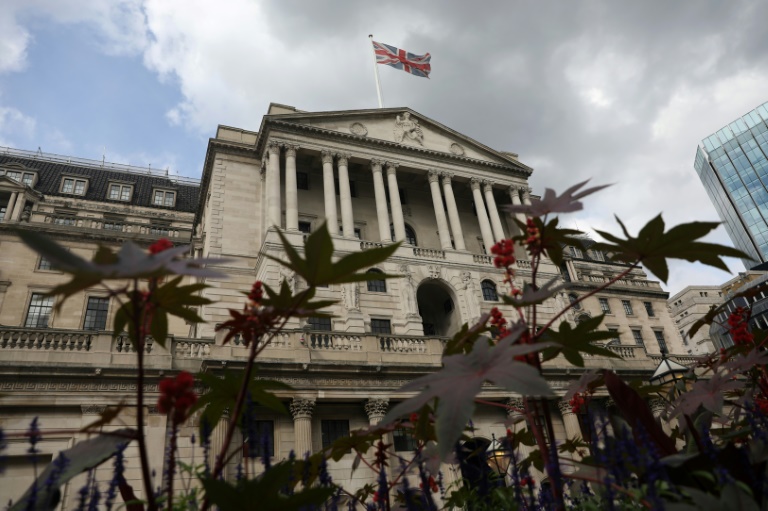
Stock markets retreated on Thursday after the US Federal Reserve and central banks in Europe unleashed more hefty interest rate hikes that aim to stomp out inflation but have raised fears of recession.

On Wall Street, the tech-rich Nasdaq led the major indices lower, falling 1.4 percent a day after the Fed’s aggressive rate hike sent equities tumbling the previous day.

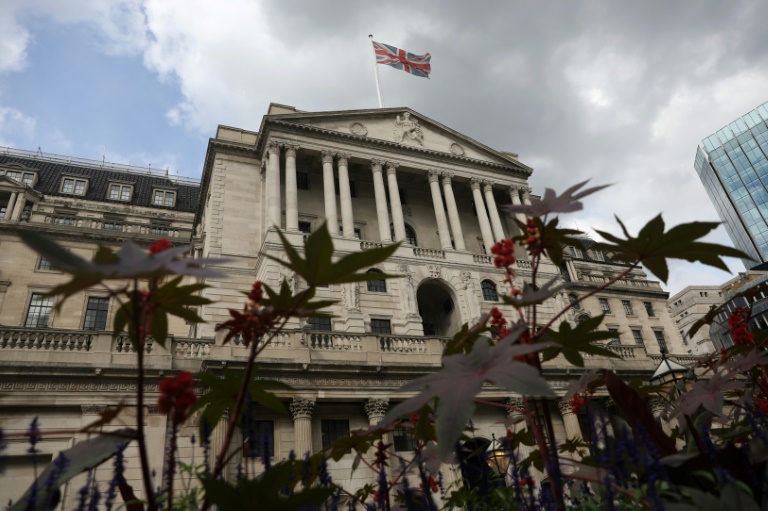
European markets finished lower, with London’s FTSE 100 down 1.1 percent after the Bank of England raised its policy rate again and signaled that the UK entered recession in the current quarter.

The BoE’s 0.5-percentage-point hike was smaller than the Fed’s third consecutive 0.75-point increase.

“Today has seen another bout of downside for stock markets throughout Europe and the US, with geopolitical and economic concerns providing a drag on risk assets once again,” Joshua Mahony, senior market analyst at online trading platform IG.

“On a week dominated by central banks, it was always going to be difficult to envisage a scenario where traders emerge with a positive outlook,” he added.

The world’s major central banks are rushing to ramp up rates to dampen red-hot consumer prices, but traders, and many economists, fear rising borrowing costs will trigger a global downturn.

While the Fed’s latest super-sized move was widely expected, there was some surprise at the central bank’s forecast that borrowing costs would likely be held above four percent throughout next year.

Fed Chair Jerome Powell reiterated his determination to focus on bringing down inflation — which is at a four-decade high — and accepted that the campaign would hit Americans hard.

“What hit home for market participants yesterday is that the Fed, steered by Fed Chair Powell, really means business now in restoring price stability, and if that means a hard landing for the economy, so be it,” said Briefing.com analyst Patrick O’Hare.

– Japan bucks the trend –

Switzerland and Norway also made hefty interest rate hikes on Thursday, two days after a massive increase in Sweden.

In Asia, Indonesia and the Philippines also tightened monetary policy but the Bank of Japan bucked the global trend as it left its status quo in place.

The dollar pared back gains after rising against other major currencies following the Fed’s rate decision.

The British pound briefly dived to a new 37-year low at $1.1212 but recovered after the BoE announcement.

The euro touched a new 20-year dollar low of $0.9809.

The yen, which has been plummeting due to the policy gap between the US and Japanese central banks, clawed back against the dollar after Japan’s Finance Ministry said it intervened in the market to support the currency.

– Key figures at around 2030 GMT –

New York – Dow: DOWN 0.4 percent at 30,076.68 (close)

New York – S&P 500: DOWN 0.8 percent at 3,757.99 (close)

New York – Nasdaq: DOWN 1.4 percent at 11,066.81 (close)

London – FTSE 100: DOWN 1.1 percent at 7,159.52 (close)

Frankfurt – DAX: DOWN 1.8 percent at 12,531.63 (close)

Paris – CAC 40: DOWN 1.9 percent at 5,918.50 (close)

EURO STOXX 50: DOWN 1.9 percent at 3,427.14 (close)

Tokyo – Nikkei 225: DOWN 0.6 percent at 27,153,83 (close)

Hong Kong – Hang Seng Index: DOWN 1.6 percent at 18,147.95 (close)

Shanghai – Composite: DOWN 0.3 percent at 3,108.91 (close)

Pound/dollar: DOWN at $1.1252 from $1.1270 Wednesday

Euro/dollar: UP at $0.9839 from $0.9837

Euro/pound: UP at 87.40 pence from 87.29 pence 

Dollar/yen: DOWN at 142.35 yen from 144.06 yen

Brent North Sea crude: UP 0.7 percent at $90.46 per barrel

West Texas Intermediate: UP 0.7 percent at $83.49 per barrel

burs-jmb/hs
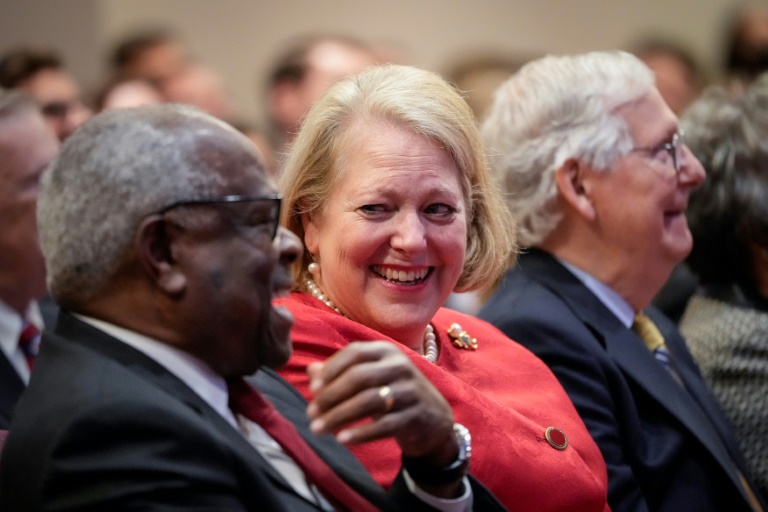
Clarence and Ginni Thomas: judge, activist and right-wing power couple

Clarence Thomas, the most conservative justice on the US Supreme Court, and his wife Ginni, an activist tied to Donald Trump’s bid to challenge his 2020 defeat, are adamant there is a firewall between their careers.

But with Ginni Thomas facing mounting questions over her role in the former president’s crusade, cracks are appearing in that wall.

Married for 35 years, the conservative Washington power couple are under new scrutiny after text messages and emails appear to show Ginni Thomas involved in possibly illegal efforts to keep Trump in the White House.

With Trump-related cases possibly headed to the high court, this has raised doubts that her husband Clarence Thomas can rule fairly and independently.

After stalling for months, Ginni Thomas is now expected to testify in the coming weeks to the House committee investigating the January 6, 2021 assault on Congress by Trump supporters seeking to overturn the election.

“Mrs. Thomas is eager to answer the committee’s questions to clear up any misconceptions about her work relating to the 2020 election. She looks forward to that opportunity,” her attorney, Mark Paoletta, told US media.

– Conservative influencers –

At 65, Ginni Thomas has wielded significant influence in ultra-conservative circles in Washington for years.

After Trump’s defeat in November 2020, communications show she encouraged officials in some states and the White House to reject Democrat Joe Biden’s victory.

Thomas exchanged at least 29 text messages with Trump’s chief of staff Mark Meadows in the weeks before January 6, urging him to not concede the election.

“Help This Great President stand firm, Mark!!!” she wrote in one.

“The majority knows Biden and the Left is attempting the greatest Heist of our History.”

On the morning of January 6 she attended a White House rally at which Trump urged Congress to reject Biden’s victory. But she has said that she left before the assault on the Capitol.

– Conflict of interest? –

In the same period, Thomas was the sole member of the nine-justice court to support a Trump-backed petition that sought to overturn the election results in a state.

And in January 2022, he again was the only justice to support a Trump petition to prohibit the release of White House records related to the January 6 Capitol assault.

Democrats say that, because of his wife’s involvement, Clarence Thomas has a deep conflict of interest and should recuse himself from cases related to Trump’s effort to reverse the election.

Ginni Thomas though insists that her activities don’t influence his.

“Like so many married couples, we share many of the same ideals, principles, and aspirations for America,” she told the Washington Free Beacon. 

“But we have our own separate careers, and our own ideas and opinions too. Clarence doesn’t discuss his work with me, and I don’t involve him in my work,” she said.

– ‘Trial by fire’ –

As prominent Washington figures and as an interracial, African American (him) and white (her) couple, the Thomases have weathered more than a few storms. 

The two were married in 1987, when she was an attorney at the US Chamber of Commerce. It was her first marriage, and his second.

In 1991 president George H.W. Bush chose Clarence Thomas, with his impeccable conservative credentials, to join the Supreme Court. 

In his confirmation hearing he was accused of sexually harassing a former assistant, Anita Hill.

As Ginni sat by his side during the explosive hearings, Clarence Thomas denied everything, claiming he was the victim of a “high-tech lynching.”

She called it a “trial by fire.”

The two have a close life together. Both are pious Catholics, and in summers hit the road for long trips in a massive recreational vehicle, which they take to campgrounds where few recognize him.

– Quiet on the court –

Wounded by the confirmation ordeal and his experiences as a relatively rare Black figure in the conservative space, Thomas spent most of his Supreme Court career in silence, speaking almost only through his votes and written opinions in thousands of cases.

But since Trump named three more conservatives to the court, giving them a solid 6-3 majority, Thomas has become more lively, and forceful.

He led a landmark judgement in June that enshrined the right of Americans to carry guns outside the home.

And when the court overturned a woman’s constitutional right to have an abortion in the same month, he went even farther than his colleagues, opining that there were no constitutional guarantees to contraception or same-sex marriage.

His opinions align closely with his wife’s activism. For example, Ginni Thomas has worked closely with anti-abortion groups. 

A strong believer in self-reliance, Clarence Thomas is opposed to programs, in college admissions for instance, which give Black and other disadvantaged minorities preferences over whites.

Ginni Thomas has taken similar stances: in the early 1990s as a Labor Department attorney she argued against making it law that women should be paid as much as men in comparable jobs.

Canada launches review of cannabis legalization four years on

Canada on Thursday launched a long-awaited review of its cannabis regulations, four years after becoming the first major economy to legalize its recreational use.

An expert panel led by Morris Rosenberg, a former deputy minister of justice, is to measure the impact of legalization on youth, Indigenous peoples and others, as well as the economy and an illicit market that the new regime was meant to displace.

The panel is also to examine regulatory burdens on the industry and determine if a separate framework for medical marijuana — which has been legal since 2001 — needed to be maintained in order to provide access to patients.

The mandated review, coming one year late due to the pandemic, is expected to take 18 months.

The industry has complained about what it calls exceptionally high taxes on cannabis, a glut of stores — both licensed and unlicensed — and restrictions on advertising and marketing that have made it harder to compete with the black market.

At a news conference, Health Minister Jean-Yves Duclos said preliminary data this year showed 69 percent of the cannabis market has moved from illicit sources to legal, regulated suppliers.

The review, he said, will help the government “strengthen the (cannabis) act so that it meets the needs of all Canadians while continuing to displace the illicit market.”

Addictions Minister Carolyn Bennett said, “We knew that young people are at increased risk of experiencing harms from cannabis, such as mental health problems including dependence and disorders related to anxiety and depression.”

Public awareness campaigns, she said, have made “young people more aware of the harms of consuming cannabis,” but their level of consumption has not fallen since legalization, as hoped. 

Rather, it has remained relatively stable, she said.

According to government data, 25 percent of the population, or 9.5 million Canadians, used cannabis in 2021, down slightly from the previous year.

They spent an average of Can$69 (US$51) on pot per month.

Water in asteroid dust offers clues to life on Earth

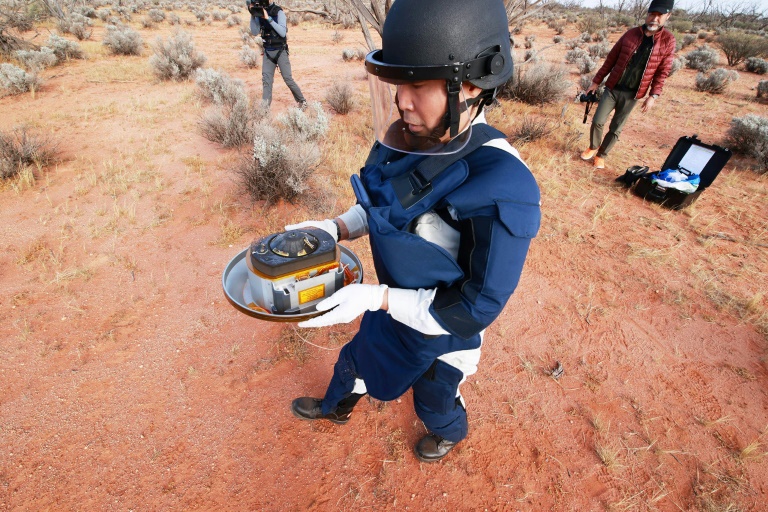
Specks of dust retrieved by a Japanese space probe from an asteroid some 300 million kilometres from Earth have revealed a surprising component: a drop of water, scientists said Friday.

The discovery offers new support for the theory that life on Earth was seeded from outer space.

The findings are in the latest research to be published from the analysis of 5.4 grams of rocks and dust gathered by the Hayabusa-2 probe from the asteroid Ryugu.

“This drop of water has great meaning,” lead scientist Tomoki Nakamura of Tohoku University told reporters ahead of the research’s publication in the journal Science on Friday.

“Many researchers believe that water was brought (from outer space) but we actually discovered water in Ryugu, an asteroid near Earth, for the first time.”

Hayabusa-2 was launched in 2014 on its mission to Ryugu, and returned to Earth’s orbit two years ago to drop off a capsule containing the sample.

The precious cargo has already yielded several insights, including organic material that showed some of the building blocks of life on Earth, amino acids, may have been formed in space.

The research published Friday says the team found a drop of fluid in the Ryugu sample “which was carbonated water containing salt and organic matter”, Nakamura said.

That bolsters the theory that asteroids like Ryugu, or its larger parent asteroid, could have “provided water, which contains salt and organic matter” in collisions with Earth, Nakamura said.

“We have discovered evidence that this (process) may have been directly linked to, for example, the origin of the oceans or organic matter on Earth.”

Nakamura’s team, comprising about 150 researchers — including 30 from the United States, Britain, France, Italy, and China — is one of the largest teams analysing the sample from Ryugu.

The sample has been divided among different scientific teams to maximise the chance of new discoveries.

Kensei Kobayashi, an astrobiology expert and professor emeritus at Yokohama National University who is not part of the research group, hailed the discovery.

“The fact that water was discovered in the sample itself is surprising,” given its fragility and the chances of it being destroyed in outer space, he told AFP.

“It does suggest that the asteroid contained water — in the form of fluid and not just ice — and organic matter may have been generated in that water.”

Russia begins troop mobilisation for Ukraine fight

Moscow began its mandatory troop call-up Thursday to try to bolster a stumbling war effort in Ukraine, with authorities saying thousands had volunteered even as Russian men fled the country to avoid being forced to fight.

Amateur footage posted on social media since President Vladimir Putin ordered the mobilisation of reservists on Wednesday purported to show hundreds of Russian citizens across the country responding to military summons.

The call-up came as Moscow-held regions of Ukraine are to vote in coming days on whether to become part of Russia in referendums that have been called an unlawful land grab by Kyiv and its allies. 

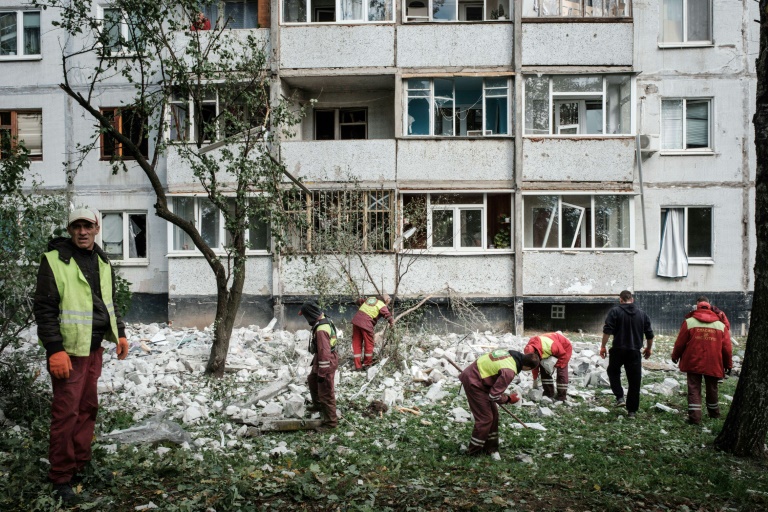
Moscow took these steps after Ukrainian forces seized back most of the northeastern Kharkiv region, which has been seen as a possible turning point in the seven-month war that had fallen into stalemate.

The Russian military said Thursday that at least 10,000 people had volunteered to fight in 24 hours since the order, but men also rushed to leave Russia before they were made to join.

“I don’t want to go to the war,” a man named Dmitri, who had flown to Armenia with just one small bag, told AFP. “I don’t want to die in this senseless war. This is a fratricidal war.”

– Annexation ‘vote’ –

Military-aged men made up the majority of those arriving off the latest flight from Moscow at the Armenian airport and many were reluctant to speak.

Yerevan has become a major destination for Russians fleeing since war began on February 24, drawing fierce international opposition that has aimed to isolate Russia.

US Secretary of State Antony Blinken on Thursday demanded Putin be held to account as he faced Russia in a Security Council session in which the United Nations catalogued abuses in Ukraine.

“We cannot — we will not — let President Putin get away with it,” Blinken told the Security Council in a special session as leaders met at the United Nations.

Russian Foreign Minister Sergei Lavrov — whom Blinken has refused to meet individually since the February invasion — lashed out at Western accusations.

“There’s an attempt today to impose on us a completely different narrative about Russian aggression as the origin of this tragedy,” Lavrov told the Security Council.

The confrontation on the diplomatic stage escalated as Kremlin-installed officials in Ukrainian regions controlled by Moscow’s forces vowed on Thursday to press ahead with annexation polls this week.

Four Russian-occupied regions of Ukraine — Donetsk and Lugansk in the east and Kherson and Zaporizhzhia in the south — announced that they would hold the votes over five days, beginning on Friday.

Vladimir Saldo, the Moscow-installed head of Kherson, which fell early into the Russian invasion, said the referendum would go ahead in his region regardless of the criticism.

“The date has been set. We have the green light. Voting begins tomorrow and nothing can prevent this,” he told Russian state-run media.

“People have been waiting and they’re demanding that this vote is held soon,” he added.

Western leaders convening in New York this week unanimously condemned the ballots. 

Speaking at the United Nations, US President Joe Biden accused Russian President Vladimir Putin of “shamelessly” violating the UN Charter with a war aimed at “extinguishing Ukraine’s right to exist as a state”.

– ‘Anyone would want to leave’ –

The integration of the war-scarred regions into Russia would represent a major escalation of the conflict, as Moscow could then try to say it was defending its own territory from Ukrainian forces.

After the votes were announced by his proxy officials in Ukraine, Putin announced that Russia would call up some 300,000 reservists to bolster the war effort and cautioned that Moscow would use “all means” to protect its territory.

Former Russian leader Dmitry Medvedev said in a statement on social media that those means included “strategic nuclear weapons”. He predicted the voting regions “will integrate into Russia”.

For most observers, the results of the concurrent votes are already a foregone conclusion and were rushed because Ukrainian forces were making sweeping gains in a counter-offensive to recapture the east.

The referendums are reminiscent of a similar ballot in 2014 that saw the Crimean Peninsula in Ukraine annexed by Russia. Western capitals said the vote was fraudulent and hit Moscow with sanctions in response.

Election officials in the Donetsk region, which has been partially controlled since 2014 by Moscow-backed separatists, said that voting would take place door-to-door for the first days. But it would only be possible in polling stations on the final day, Tuesday.

Putin’s move this week to call up reservists for Ukraine sparked small protests across Russia, resulting in more than 1,300 people being detained.

Flights out of Russia to neighbouring countries, mainly former Soviet republics that allow Russians visa-free entry, are nearly entirely booked and prices have skyrocketed, pointing to an exodus of Russians wanting to avoid going to war.

Looking lost and exhausted in the arrivals hall of the airport in the capital of Armenia, 44-year-old Sergei said he had fled Russia to escape being called up.

“The situation in Russia would make anyone want to leave,” he told AFP on condition of anonymity.

With plywood and prayers, Bermuda prepares for Hurricane Fiona

Bermudians covered storefronts and stocked up on candles, food and water while Hurricane Fiona churned towards the Atlantic island Thursday as a powerful Category 4 storm, after leaving a trail of destruction across the Caribbean.

The Bermuda Weather Service said the center of Fiona was forecast to pass more than 110 miles (180 kilometers) to the west of the British territory on Friday morning at around 5:00 am (0700 GMT), but with a storm of that strength and size, residents were taking no chances. 

“This storm is going to be worse than the last one,” Richard Hartley, owner of the Torwood Home store in the capital, Hamilton, told AFP as he and his wife covered the shop’s cedar-lined windows with metal sheets. 

“The wind is going to come straight in from the south. So this corner is very exposed to the winds,” he explained.

Fiona is a Category 4 hurricane, the second highest level on the Saffir-Simpson scale. The US National Hurricane Center (NHC) said the storm was packing maximum sustained winds of near 130 miles per hour, with higher gusts.

Hurricane force winds extend more than 70 miles from the storm’s eye, and tropical storm force winds up to 200 miles, the NHC said.

A hurricane warning was in effect in Bermuda Thursday morning, with the NHC predicting up to four inches (10 centimeters) of rain and “large and destructive” waves and storm surge. 

The British territory of some 64,000 people is no stranger to hurricanes — but it is also tiny, just 21 square miles and one of the most remote places in the world, 640 miles from its closest neighbor, the United States.

That means there is nowhere to evacuate to when a big storm hits.

“You have to live with it because you live here, you can’t run anywhere because it’s just a little island,” said JoeAnn Scott, a shopworker in Hamilton.

Bermudians try to “enjoy it as it comes,” she said. “And pray and pray. That’s what we do, pray and party,” she added with a laugh. 

– Construction ‘built to last’ –

Because of the island’s isolation, preparations are taken seriously even when widespread damage is not expected.

Many of the boats docked at Bermuda’s Dinghy Club and Yacht Club were taken out of the water earlier in the week, outdoor furniture at homes and restaurants was taken inside, and the storm shutters bordering windows on most houses were checked. 

Public schools will be closed on Friday, and the government announced that buses will stop running later Thursday afternoon. The Royal Bermuda Regiment was on standby to help with clearing operations.

In addition to laying in supplies of candles and food, some Bermudians were also drawing buckets of water from the tanks at the side of their homes.

There is no fresh water source on the island, so all buildings have white, lime-washed roofs that are used to catch rainwater that is directed into tanks as the main water supply. It is then pumped into homes using electricity. 

Bermuda, whose economy is fueled by international finance and tourism, is wealthy compared to most Caribbean countries, and structures must be built to strict planning codes to withstand storms. Some have done so for centuries. 

“The construction is really built to last, and we don’t see the devastation ever that the Caribbean has experienced over the years,” shop owner Hartley’s wife, Elaine Murray, said.

Fiona killed four people in Puerto Rico earlier this week, according to US media, while one death was reported in the French overseas department of Guadeloupe and another in the Dominican Republic. 

President Joe Biden has declared a state of emergency in Puerto Rico, a US territory that is still struggling to recover from Hurricane Maria five years ago.

In the Dominican Republic, President Luis Abinader declared three eastern provinces to be disaster zones.

Farther north in Bermuda, residents continued to watch Fiona closely in case the storm veers further east in the coming hours — but islanders were calm. 

“I’ve been through a lot of hurricanes, so no, I’m not worried,” said resident Rochelle Jones.

But if things do go wrong, Bermudians will “all come out together and we help each other,” she said. 

Markets drop as central banks hike rates

Stock markets retreated on Thursday as the US Federal Reserve and several of Europe’s central banks unleashed more hefty interest rate hikes that aim to stomp inflation but raise fears of recession.

On Wall Street, the Dow Jones Industrial Average was off 0.4 percent in late morning trading, with the broader S&P 500 and tech-heavy Nasdaq Composite down further.

European markets finished lower, with London’s FTSE 100 down 1.1 percent after the Bank of England raised its rate again to combat inflation and signalled that the UK entered recession in the current quarter.

The BoE’s 0.5-percentage-point hike was smaller than the US Federal Reserve’s third consecutive 0.75-point increase.

“Today has seen another bout of downside for stock markets throughout Europe and the US, with geopolitical and economic concerns providing a drag on risk assets once again,” Joshua Mahony, senior market analyst at online trading platform IG.

“On a week dominated by central banks, it was always going to be difficult to envisage a scenario where traders emerge with a positive outlook,” he added.

The world’s major central banks are rushing to ramp up rates to dampen red-hot global consumer prices, but traders fear rising borrowing costs will herald recession.

While the Fed’s 0.75-percentage-point rise was widely expected, there was some surprise at the central bank’s forecast that borrowing costs would likely be held above four percent throughout next year.

Fed chairman Jerome Powell reiterated his determination to focus on bringing down inflation — which is at a four-decade high — and accepted that the campaign would hit Americans hard.

“What hit home for market participants yesterday is that the Fed, steered by Fed Chair Powell, really means business now in restoring price stability, and if that means a hard landing for the economy, so be it,” said Briefing.com analyst Patrick O’Hare.

– Japan bucks the trend –

Switzerland and Norway also sprang hefty interest rate hikes on Thursday, two days after a super-sized increase in Sweden.

In Asia, Indonesia and the Philippines also tightened monetary policy but the Bank of Japan bucked the global trend as it left its status quo in place.

The dollar pared back gains after rising against other major currencies following the Fed’s rate decision.

The British pound briefly dived to a new 37-year low at $1.1212 but recovered after the BoE announcement.

The euro touched a new 20-year dollar low of $0.9809.

The yen, which has been plummeting due to the policy gap between the US and Japanese central banks, clawed back against the dollar after Japan’s finance ministry said it intervened in the currency market.

Oil prices extended recent gains after Russian President Vladimir Putin announced a partial mobilisation of the Russian army and made a veiled threat to use nuclear weapons against the West.

– Key figures at around 1530 GMT –

New York – Dow: DOWN 0.4 percent at 30,055.94 points

EURO STOXX 50: DOWN 1.9 percent at 3,427.14

London – FTSE 100: DOWN 1.1 percent at 7,159.52 (close)

Frankfurt – DAX: DOWN 1.8 percent at 12,531.63 (close)

Paris – CAC 40: DOWN 1.9 percent at 5,918.50 (close)

Tokyo – Nikkei 225: DOWN 0.6 percent at 27,153,83 (close)

Hong Kong – Hang Seng Index: DOWN 1.6 percent at 18,147.95 (close)

Shanghai – Composite: DOWN 0.3 percent at 3,108.91 (close)

Pound/dollar: DOWN at $1.1256 from $1.1270 Wednesday

Euro/dollar: DOWN at $0.9821 from $0.9837

Euro/pound: DOWN at 87.24 pence from 87.29 pence 

Dollar/yen: DOWN at 142.25 yen from 144.06 yen

Brent North Sea crude: UP 0.9 percent at $90.63 per barrel

West Texas Intermediate: UP 0.9 percent at $83.69 per barrel

burs-rl/lth

Markets drop as central banks hike rates

Stock markets retreated on Thursday as the US Federal Reserve and several of Europe’s central banks unleashed more hefty interest rate hikes that aim to stomp inflation but raise fears of recession.

On Wall Street, the Dow Jones Industrial Average was off 0.4 percent in late morning trading, with the broader S&P 500 and tech-heavy Nasdaq Composite down further.

European markets finished lower, with London’s FTSE 100 down 1.1 percent after the Bank of England raised its rate again to combat inflation and signalled that the UK entered recession in the current quarter.

The BoE’s 0.5-percentage-point hike was smaller than the US Federal Reserve’s third consecutive 0.75-point increase.

“Today has seen another bout of downside for stock markets throughout Europe and the US, with geopolitical and economic concerns providing a drag on risk assets once again,” Joshua Mahony, senior market analyst at online trading platform IG.

“On a week dominated by central banks, it was always going to be difficult to envisage a scenario where traders emerge with a positive outlook,” he added.

The world’s major central banks are rushing to ramp up rates to dampen red-hot global consumer prices, but traders fear rising borrowing costs will herald recession.

While the Fed’s 0.75-percentage-point rise was widely expected, there was some surprise at the central bank’s forecast that borrowing costs would likely be held above four percent throughout next year.

Fed chairman Jerome Powell reiterated his determination to focus on bringing down inflation — which is at a four-decade high — and accepted that the campaign would hit Americans hard.

“What hit home for market participants yesterday is that the Fed, steered by Fed Chair Powell, really means business now in restoring price stability, and if that means a hard landing for the economy, so be it,” said Briefing.com analyst Patrick O’Hare.

– Japan bucks the trend –

Switzerland and Norway also sprang hefty interest rate hikes on Thursday, two days after a super-sized increase in Sweden.

In Asia, Indonesia and the Philippines also tightened monetary policy but the Bank of Japan bucked the global trend as it left its status quo in place.

The dollar pared back gains after rising against other major currencies following the Fed’s rate decision.

The British pound briefly dived to a new 37-year low at $1.1212 but recovered after the BoE announcement.

The euro touched a new 20-year dollar low of $0.9809.

The yen, which has been plummeting due to the policy gap between the US and Japanese central banks, clawed back against the dollar after Japan’s finance ministry said it intervened in the currency market.

Oil prices extended recent gains after Russian President Vladimir Putin announced a partial mobilisation of the Russian army and made a veiled threat to use nuclear weapons against the West.

– Key figures at around 1530 GMT –

New York – Dow: DOWN 0.4 percent at 30,055.94 points

EURO STOXX 50: DOWN 1.9 percent at 3,427.14

London – FTSE 100: DOWN 1.1 percent at 7,159.52 (close)

Frankfurt – DAX: DOWN 1.8 percent at 12,531.63 (close)

Paris – CAC 40: DOWN 1.9 percent at 5,918.50 (close)

Tokyo – Nikkei 225: DOWN 0.6 percent at 27,153,83 (close)

Hong Kong – Hang Seng Index: DOWN 1.6 percent at 18,147.95 (close)

Shanghai – Composite: DOWN 0.3 percent at 3,108.91 (close)

Pound/dollar: DOWN at $1.1256 from $1.1270 Wednesday

Euro/dollar: DOWN at $0.9821 from $0.9837

Euro/pound: DOWN at 87.24 pence from 87.29 pence 

Dollar/yen: DOWN at 142.25 yen from 144.06 yen

Brent North Sea crude: UP 0.9 percent at $90.63 per barrel

West Texas Intermediate: UP 0.9 percent at $83.69 per barrel

burs-rl/lth

Fossil fuels make up 90% of Middle East air pollution: study

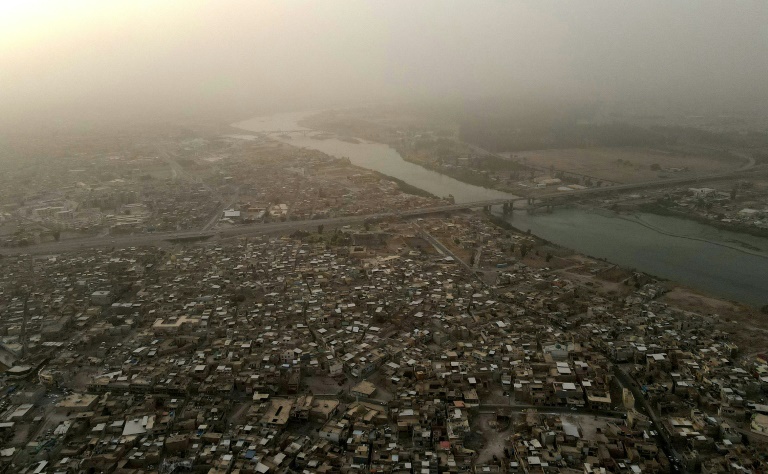
More than 90 percent of harmful air pollution in the Middle East and parts of North Africa comes from fossil fuels, according to research Thursday that showed the region “permanently exceeded” dangerous air quality levels.

The World Health Organization this year said the MENA region had some of the poorest air quality on Earth. 

The long-standing assumption was that the smog choking most of the region’s cities was primarily composed of desert sand, given their location on the world’s “dust belt” where there are frequently more than 20 major sand storms each year. 

In 2017, an international team of researchers set off on an epic voyage across the eastern Mediterranean, through the Suez Canal and around the Gulf, using specialised equipment to analyse air quality and particulate matter on shore. 

They found that the vast majority of small particles — which can penetrate deep into the lungs, resulting in greater health risk — were manmade, mainly from the production and use of fossil fuels. 

Writing in the journal Communications Earth & Environment, they showed how the region is blanketed in particularly harmful compounds such as sulphur dioxide, which is a direct result of oil extraction.

Emissions from container vessels in one of the busiest shipping lanes in the world also contributed to the smog. 

“We have refineries such as those in Saudi Arabia and the United Arab Emirates that are a big source of air pollution as well as ships on the Red Sea, and in the Suez Canal region,” said Jos Lelieveld, lead study author from Germany’s Max Planck Institute for Chemistry.

“So the combination of all of these means that the air is much more polluted than what most people hope it to be.”

The team used health and mortality metrics to calculate the number of excess deaths caused by air pollution in the MENA region annually.

The percentage of fossil-fuel driven mortality varied between nations, with 5.9 percent of deaths in Cyprus attributable to air pollution versus 15.9 in Kuwait.

This is a far higher mortality rate than in other industrialised regions. The US and Germany, for example, have 3 percent and 3.7 percent mortality due to air pollution, respectively.

Region-wide, the team calculated that air pollution from fossil fuel use caused one in eight deaths, noting that air quality there “permanently exceeded” WHO guidelines.

“It is very comparable with things that are really of great concern, for example, tobacco smoking and high cholesterol, which are major health risks in the region,” Lelieveld told AFP.

“And the realisation of this in the region is practically zero.”

He said that while governments in the region counted on fossil fuel production for the majority of their income, the time would come when the health costs due to pollution compounded growing pressure to decarbonise their economies. 

“They’re not stupid, they know that fossil fuels will end at some point,” said Lelieveld.

“I’m hoping this is an additional incentive.”

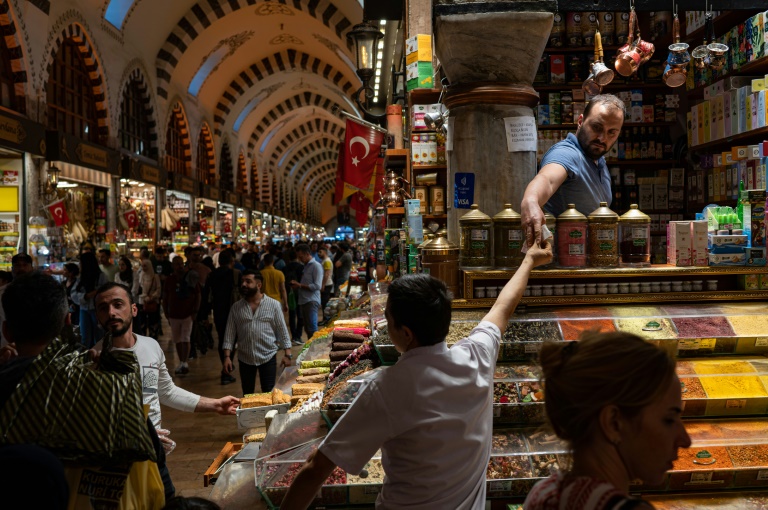
Inflation-hit Turkey cuts rate for second month

Turkey’s troubled lira on Thursday plumbed new lows after the central bank cut its policy rate for the second straight month  despite annual inflation reaching 80 percent and still edging higher.

The central bank lowered its benchmark rate to 12 from 13 percent and blamed skyrocketing consumer prices on external factors such as the global jump in the cost of energy and food caused by Russia’s invasion of Ukraine.

The decision highlights Turkish policymakers’ strong focus on economic growth nine months before a general election that polls show President Recep Tayyip Erdogan is on track to lose.

Turkey has gone the opposite direction of most other central banks worldwide which are raising rates to combat cost of living crises.

The US Federal Reserve and its European peers announced hefty hikes this week.

Erdogan’s unflinching focus on growth at all costs has put the lira under massive pressure and exposed Turkey’s once-vibrant banking sector to new risks.

The lira established a new historic low of 18.41 against the dollar before recovering some its losses after the announcement.

The central bank’s cut was in direct response to data showing that Turkey’s industrial production and retail sales were both starting to slow.

“Since the beginning of July, leading indicators have been pointing to a slowdown in growth due to the weakening foreign demand,” the central bank said.

“Leading indicators for the third quarter continue pointing to loss of momentum in economic activity due to the decreasing foreign demand.”

– ‘I am an economist’ –

Erdogan rejects conventional economics and believes that inflation can be brought under control by cutting interest rates.

“I am an economist,” Erdogan told US television this week. 

“Currently, there are countries which feel threatened by inflation of even eight or nine percent. We have 80 percent,” he said.

“And in my country, the shelves are not empty in the markets.”

Turkey’s inflation rate is now the highest since 1998.

Erdogan’s two-decade rule was built on a pledge to create a new middle-class and end the corruption and mismanagement that plagued successive governments in the 1980s and 1990s.

But his Islamic-rooted party and its hard-right nationalist allies now face the real possibility of losing their parliamentary majority in next year’s polls.

Erdogan himself is expected to struggle in a likely second round runoff against any of his potential opposition rivals.

The Turkish leader has responded to the economic crisis by radically changing his foreign policy and making up with many of his former rivals in the petrodollar-rich Arab world.

Additional deals with Russia have helped shore up Turkey’s dwindling foreign currency reserves and potentially given Erdogan enough breathing room to ride out the economic storm until June.

– ‘Managed markets’ –

Analysts at Fitch Ratings said they expect the central bank to end its era of unconventional economics and start raising rates after the election.

But there is little concensus on whether the central bank intends to take its rate any lower — and what damage this might inflict.

“The latest note does not rule out further reduction in the policy rate,” ING Bank’s chief Turkey economist Muhammet Mercan noted.

Liam Peach at Capital Economics said he expected the lira to drop to 24 against the dollar by the end of the year.

“Further cuts are likely to be more gradual going forward,” Peach wrote in report.

Others said the Turkish policy rate was so far below inflation that any further moves would need to be massive to have any real economic effect.

“The Turkish central bank’s policy rate really has little real meaning these days, given inflation at 80 percent plus,” said BlueBay Asset Management analyst Timothy Ash.

“The managed markets in Turkey are now aimed at engineering Erdogan’s re-election.”

Close Bitnami banner
Bitnami