AFP

Twilight of the Tigris: Iraq's mighty river drying up

It was the river that is said to have watered the biblical Garden of Eden and helped give birth to civilisation itself.

But today the Tigris is dying.

Human activity and climate change have choked its once mighty flow through Iraq, where — with its twin river the Euphrates — it made Mesopotamia a cradle of civilisation thousands of years ago.

Iraq may be oil-rich but the country is plagued by poverty after decades of war and by droughts and desertification.

Battered by one natural disaster after another, it is one of the five countries most exposed to climate change, according to the UN.

From April on, temperatures exceed 35 degrees Celsius (95 degrees Fahrenheit) and intense sandstorms often turn the sky orange, covering the country in a film of dust.

Hellish summers see the mercury top a blistering 50 degrees Celsius — near the limit of human endurance — with frequent power cuts shutting down air-conditioning for millions.

The Tigris, the lifeline connecting the storied cities of Mosul, Baghdad and Basra, has been choked by dams, most of them upstream in Turkey, and falling rainfall. 

An AFP video journalist travelled along the river’s 1,500-kilometre (900-mile) course through Iraq, from the rugged Kurdish north to the Gulf in the south, to document the ecological disaster that is forcing people to change their ancient way of life.  

– Kurdish north: ‘Less water every day’ –

The Tigris’ journey through Iraq begins in the mountains of autonomous Kurdistan, near the borders of Turkey and Syria, where local people raise sheep and grow potatoes.

“Our life depends on the Tigris,” said farmer Pibo Hassan Dolmassa, 41, wearing a dusty coat, in the town of Faysh Khabur. “All our work, our agriculture, depends on it.  

“Before, the water was pouring in torrents,” he said, but over the last two or three years “there is less water every day”.

Iraq’s government and Kurdish farmers accuse Turkey, where the Tigris has its source, of withholding water in its dams, dramatically reducing the flow into Iraq.

According to Iraqi official statistics, the level of the Tigris entering Iraq has dropped to just 35 percent of its average over the past century.  

Baghdad regularly asks Ankara to release more water. 

But Turkey’s ambassador to Iraq, Ali Riza Guney, urged Iraq to “use the available water more efficiently”, tweeting in July that “water is largely wasted in Iraq”.

He may have a point, say experts. Iraqi farmers tend to flood their fields, as they have done since ancient Sumerian times, rather than irrigate them, resulting in huge water losses.

– Central plains: ‘We sold everything’ –

All that is left of the River Diyala, a tributary that meets the Tigris near the capital Baghdad in the central plains, are puddles of stagnant water dotting its parched bed.

Drought has dried up the watercourse that is crucial to the region’s agriculture.  

This year authorities have been forced to reduce Iraq’s cultivated areas by half, meaning no crops will be grown in the badly-hit Diyala Governorate. 

“We will be forced to give up farming and sell our animals,” said Abu Mehdi, 42, who wears a white djellaba robe.  

“We were displaced by the war” against Iran in the 1980s, he said, “and now we are going to be displaced because of water. Without water, we can’t live in these areas at all.”

The farmer went into debt to dig a 30-metre (100-foot) well to try to get water. “We sold everything,” Abu Mehdi said, but “it was a failure”. 

The World Bank warned last year that much of Iraq is likely to face a similar fate. 

“By 2050 a temperature increase of one degree Celsius and a precipitation decrease of 10 percent would cause a 20 percent reduction of available freshwater,” it said. 

“Under these circumstances, nearly one third of the irrigated land in Iraq will have no water.”

Water scarcity hitting farming and food security are already among the “main drivers of rural-to-urban migration” in Iraq, the UN and several non-government groups said in June.

And the International Organization for Migration said last month that “climate factors” had displaced more than 3,300 families in Iraq’s central and southern areas in the first three months of this year.

“Climate migration is already a reality in Iraq,” the IOM said.

– Baghdad: sandbanks and pollution –

This summer in Baghdad, the level of the Tigris dropped so low that people played volleyball in the middle of the river, splashing barely waist-deep through its waters.

Iraq’s Ministry of Water Resources blame silt because of the river’s reduced flow, with sand and soil once washed downstream now settling to form sandbanks.

Until recently the Baghdad authorities used heavy machinery to dredge the silt, but with cash tight, work has slowed.

Years of war have destroyed much of Iraq’s water infrastructure, with many cities, factories, farms and even hospitals left to dump their waste straight into the river.

As sewage and rubbish from Greater Baghdad pour into the shrinking Tigris, the pollution creates a concentrated toxic soup that threatens marine life and human health.

Environmental policies have not been a high priority for Iraqi governments struggling with political, security and economic crises.

Ecological awareness also remains low among the general public, said activist Hajer Hadi of the Green Climate group, even if “every Iraqi feels climate change through rising temperatures, lower rainfall, falling water levels and dust storms,” she said.

– South: salt water, dead palms –

“You see these palm trees? They are thirsty,” said Molla al-Rached, a 65-year-old farmer, pointing to the brown skeletons of what was once a verdant palm grove.

“They need water! Should I try to irrigate them with a glass of water?” he asked bitterly. “Or with a bottle?” 

“There is no fresh water, there is no more life,” said the farmer, a beige keffiyeh scarf wrapped around his head.

He lives at Ras al-Bisha where the confluence of the Tigris and Euphrates river, the Shatt al-Arab, empties into the Gulf, near the borders with Iran and Kuwait.

In nearby Basra — once dubbed the Venice of the Middle East — many of the depleted waterways are choked with rubbish.

To the north, much of the once famed Mesopotamian Marshes — the vast wetland home to the “Marsh Arabs” and their unique culture — have been reduced to desert since Saddam Hussein drained them in the 1980s to punish its population.

But another threat is impacting the Shatt al-Arab: salt water from the Gulf is pushing ever further upstream as the river flow declines.

The UN and local farmers say rising salination is already hitting farm yields, in a trend set to worsen as global warming raises sea levels.

Al-Rached said he has to buy water from tankers for his livestock, and wildlife is now encroaching into settled areas in search of water.

“My government doesn’t provide me with water,” he said. “I want water, I want to live. I want to plant, like my ancestors.”

– River delta: a fisherman’s plight – 

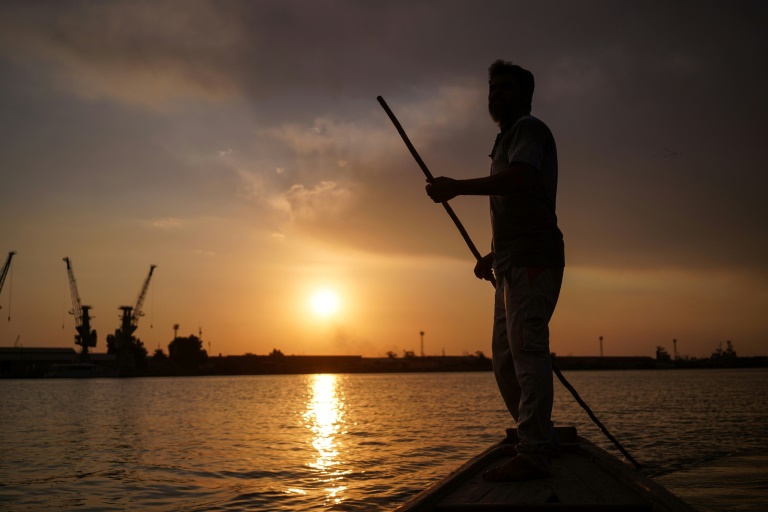
Standing barefoot in his boat like a Venetian gondolier, fisherman Naim Haddad steers it home as the sun sets on the waters of the Shatt al-Arab. 

“From father to son, we have dedicated our lives to fishing,” said the 40-year-old holding up the day’s catch.

In a country where grilled carp is the national dish, the father-of-eight is proud that he receives “no government salary, no allowances”.

But salination is taking its toll as it pushes out the most prized freshwater species which are replaced by ocean fish.

“In the summer, we have salt water,” said Haddad. “The sea water rises and comes here.”

Last month local authorities reported that salt levels in the river north of Basra reached 6,800 parts per million — nearly seven times that of fresh water.

Haddad can’t switch to fishing at sea because his small boat is unsuitable for the choppier Gulf waters, where he would also risk run-ins with the Iranian and Kuwaiti coastguards.

And so the fisherman is left at the mercy of Iraq’s shrinking rivers, his fate tied to theirs. 

“If the water goes,” he said, “the fishing goes. And so does our livelihood.”
Zelensky blames Russia as world vows response to food shortages

Global leaders called Tuesday for urgent efforts to address global food insecurity amid fears of disastrous harvests next year, as Ukraine’s president blamed Russia for the crisis and sought the world’s “toughest reaction” against Moscow.

On the sidelines of the United Nations General Assembly, ministers from the European Union, United States, African Union and Spain met on food shortages which are seen as a key factor in conflicts and instability.

Appearing by video link was Ukraine’s Volodymyr Zelensky, who directly accused Moscow of willingly triggering a food crisis.

“Any state that provokes famine, that tries to make access to food a privilege, that tries to make the protection of nations from famine dependent on… the mercy of some dictator — such a state must get the toughest reaction from the world,” Zelensky said.

He blamed Russian blockades and other “immoral actions” for slashing exports from Ukraine, a major agricultural producer.

“Russia must bear responsibility for this,” he said.

Spanish Prime Minister Pedro Sanchez said Russian President Vladimir Putin, with his February invasion of Ukraine, “is trying to blackmail the international community with food.”

“There is no peace with hunger and we cannot combat hunger without peace,” Sanchez said. 

The Group of Seven major industrial powers at a June summit in Germany promised $5 billion to fight food insecurity but German Chancellor Olaf Scholz said there was still “great urgency.”

“The Russian war of aggression has caused and accelerated a multidimensional global crisis. Countries in the Global South with prior vulnerabilities have been hit hardest,” Scholz said.

President Joe Biden will address the General Assembly on Wednesday and announce new US aid, Secretary of State Antony Blinken said.

In his own address Tuesday, French President Emmanuel Macron said his country will finance shipments of Ukrainian wheat to Somalia which is facing risk of famine.

Ukraine is one of the world’s largest grain producers and the Russian invasion sent global prices soaring.

Russia has cast blame on Western sanctions, an assertion denounced by Washington which says it is not targeting agricultural or humanitarian goods.

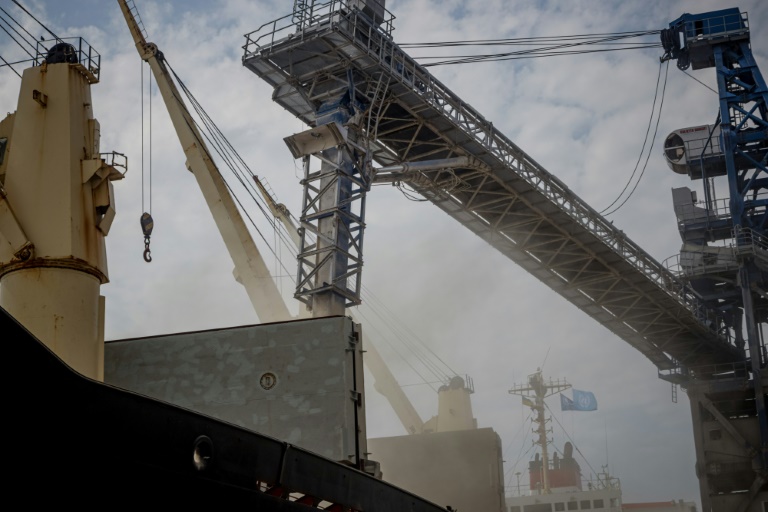
Turkey and the United Nations in July brokered a deal between Russia and Ukraine to allow ships with grain to sail through the blockaded Black Sea.

Putin has recently criticized the deal, pointing to shipments that have headed to Europe. US officials say some of the grain is then processed and sent to poorer countries.

“Despite some of the misinformation that continues to come from Moscow, that grain and other food products are getting where they need to go to the countries most in need, predominantly in the Global South,” Blinken said.

“It’s also helped lower food prices around the world. So it needs to keep going, it needs to be renewed. That is urgent.”

– Long-term fears –

Concerns are also mounting on the long-term impacts. A recent report by the Ukraine Conflict Observatory, a non-governmental US group, found that around 15 percent of Ukraine grain stocks have been lost since the invasion began.

And experts warn that disruptions in fertilizer shipments could seriously impede future harvests worldwide.

“It’s very clear that the current food supply disruption and the war in Ukraine is having an impact on the next harvest,” said Alvaro Lario, incoming president of the International Fund for Agricultural Development.

“There’s one or two harvests per year, and already we’re seeing that it’s going to be devastating for next year,” he told AFP, warning that the impact could be “much worse” than Covid.

He called for longer-term action, which would entail billions of dollars of investment, to ensure stability of food supply chains and adapt to a warming climate.

“We know the solutions and we have the institutions to make that happen. What is currently lacking is the political will, in terms of the investment,” he said.

UN Secretary-General Antonio Guterres said recently that the world had enough food in 2022 but that the problem was distribution.

If the situation does not stabilize this year, in 2023 “we risk to have a real lack of food,” he said.

Under pressure, Trump revives QAnon cult — around himself

Ensnared in legal probes as he mulls a second White House run in 2024, Donald Trump is injecting new life into the fading QAnon conspiracy cult — whose members have embraced him as a new icon.

While the anonymous founder of the conspiracy — known only as “Q” — has disappeared from view, a Trump rally last weekend in Ohio clearly showed that it remains a force, behind the former president.

Trump’s supporters solemnly thrust their index fingers into the sky as he ended his speech to the electronic strains of a song identified by Media Matters, a progressive research group, as “Where We Go One We Go All,” or WWG1WGA — the QAnon motto.

The Republican ex-president used the same work in an August 9 video released right after the FBI raid on his Florida home. And he has played it elsewhere, with QAnon followers taking note online.

Meanwhile Trump has increasingly amplified QAnon postings on his Truth Social network. On September 13 he reposted a doctored picture of himself with a prominent “Q” on his lapel.

QAnon’s original followers subscribed to bizarre theories of a Democratic satanic child sex abuse network — an outlandishness summed up by images of one of them invading the US Capitol in a shamanic headdress.

But experts say the movement is now embracing more Trump-centric theories of election denialism and the notion of an unaccountable Washington “deep state” — ideas central to Trump’s “Make America Great Again” or MAGA movement.

The overlap between QAnon and MAGA is now “hard to distinguish,” said Rachel Goldwasser, who researches right-wing extremism at the Southern Poverty Law Center.

Trump is now “sort of the hero of the conspiracy theory,” she said.

– Absence of ‘Q’ –

The QAnon movement took root in 2017 with cryptic posts on the fringes of social media by the anonymous “Q”. 

Followers, who by 2020 numbered hundreds of thousands, embraced the belief that the world was controlled by a secret cabal of the rich and powerful, and groundless conspiracy theories about Covid-19.

Many would attend Trump reelection rallies carrying  “QAnon” banners and wearing “Q” t-shirts. Trump didn’t endorse them, but never distanced himself either.

After Trump lost the election, and particularly after the January 6 attack on the US Capitol by his supporters, the movement lost momentum. “Q” messages stopped, and a person associated with the website where they had appeared urged followers to move on and accept new President Joe Biden.

Pushed off mainstream social media, QAnon followers turned to Telegram and then, when it launched in February 2022, Truth Social, in numbers far diminished.

But the movement has refocused around Trump’s campaign to convince people he was defeated due to fraud. QAnon-ists promoted the same conspiracy theories as Trump, analysts say, and explicit mentions of QAnon itself dwindled.

“The most impactful way the ideology has evolved is in its connection with things like election denialism,” said Alyssa Kann, who researches domestic violent extremism at the Atlantic Council’s Digital Forensic Research Lab.

– Influencers –

This has been helped by QAnon influencers, who organized events focused on Trump’s complaints. 

John Sabal, formerly known online as “QAnon John,” held a large “Patriot Voice” rally in Dallas, Texas last year and plans another in November. Advertised speakers: former Trump attorney Rudy Giuliani and former aide George Papadopoulos.

Trump’s one-time national security advisor Michael Flynn — who once made a video with his family swearing the WWG1WGA oath — has criss-crossed the country promoting Trump and Trump-backed election candidates and the same conspiracy theories.

He doesn’t openly mention QAnon, but also doesn’t shy away, often using the QAnon-favored phrase “the storm is coming.” A video taken at a September 18 fundraising event in California shows Flynn and others being entertained by a woman singing the words “where we go one we go all.”

– Trump goes full-Q –

It’s not exactly clear why Trump abandoned his arm’s-length treatment of QAnon, but the timeline matches the rise in legal threats against him, which he ascribes to a political campaign by the Biden administration, and his effort to get allies elected to state and national office in November. 

He and his broader circle are threatened by a criminal probe into the attack on the Capitol.

And the recent surge of Q-references follows August’s FBI raid on his Mar-a-Lago estate in a national security investigation.

While pointing fingers skyward was not a gesture until now associated with QAnon, the sight at Trump’s rally in Ohio startled many observers.

“When you combine the characteristics of a cult with all the trappings of a religion, you get a very volatile, dangerous scenario on your hands,” Frank Figliuzzi,  a former FBI counterintelligence official, told MSNBC.

Mass stranding kills 14 whales in Australia

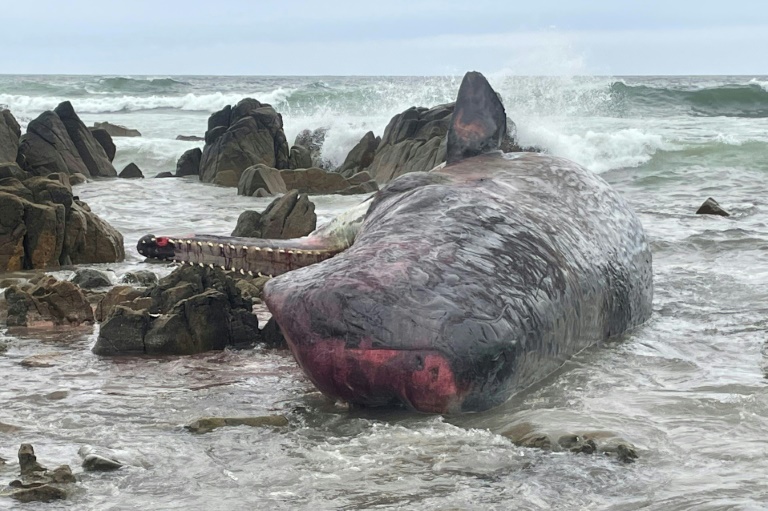
Australian wildlife investigators were on Wednesday trying to piece together why more than a dozen young male sperm whales died in a mass stranding on a remote beach in the state of Tasmania.

The 14 whales were discovered beached on King Island earlier this week, off Tasmania’s north coast.

Biologists and a veterinarian from the state’s conservation agency have travelled to the small island to investigate, with an aerial survey finding no other stranded whales.

The young whales’ deaths may be a case of “misadventure”, wildlife biologist Kris Carlyon from the state government conservation agency told the local Mercury newspaper.

“The most common reason for stranding events is misadventure, they might have been foraging close to shore, there might have been food and possibly they were caught on a low tide,” Carlyon said.

“That’s the theory at the moment.”

He said the whales likely beached themselves on Sunday, before being found dead on Monday.

Mass strandings of whales were “infrequent but certainly not unexpected” in the region, Carlyon told The Mercury.

In 2020, Tasmania experienced Australia’s largest-ever mass stranding when 470 whales became stuck in the state’s west.

More than 300 pilot whales died during that stranding, despite the efforts of dozens of volunteers who toiled for days in Tasmania’s freezing waters to free them.

The reason for mass whale strandings remains mysterious, but some experts theorised the 2020 pod may have gotten lost after feeding close to the shoreline or by following one or two whales that strayed.

'Gentle soul' Griner's fate on USA minds at basketball World Cup: coach

Coach Cheryl Reeve admitted Wednesday the fate of “gentle soul” Brittney Griner was weighing heavily on the USA team at the basketball World Cup in Sydney and the jailed star’s number 15 jersey would not be worn at the tournament.

Griner, a standout when they won gold at the Tokyo Olympics last year, would normally be with the squad as they attempt to claim a fourth straight title and 11th overall, starting Thursday against Belgium.

But the 31-year-old is instead in a Russian prison, sentenced to nine years in a penal colony after being arrested at a Moscow airport in February for possessing vape cartridges with a small amount of cannabis oil.

Reeve said Griner would be “top of mind” throughout the 10-day tournament, and revealed players had been in touch with her to send messages of support.

“The mindset is just trying to stay strong for her and doing what we can,” Reeve said, describing Griner as “a gentle soul, just full of love”.

She added that players had been able to communicate with their teammate via email, sending “messages of love and support and strength”.

“It’s on their minds every day. It’s heavy, it is really, really heavy especially as we participate in this USA basketball competition,” she added. 

“She’s such a big part of many of our lives, so it’s challenging.”

No USA team member will don Griner’s number 15 jersey in Sydney.

“To keep Brittney top of mind, no one will wear the number 15. That will be the first way to honour her and keep her in our thoughts,” said Reeve.

– Release talks –

US President Joe Biden met Griner’s wife, Cherelle Griner, last week as top officials work to bring the player home, with Moscow saying last month it was ready to discuss a prisoner swap.

A White House statement released afterwards did not include details about the status of talks with Russia, but National Security Council spokesman John Kirby said “discussions are ongoing” to secure Griner’s release.

“People are hard at work and I think the biggest thing is that we know it’s top of mind for many, many people that are a part of this process and they’re working very, very hard to try and get Brittney home,” said Reeve.

When she was arrested, the two-time Olympic gold medallist and Women’s NBA champion had been in Russia to play for the professional Yekaterinburg team, during her off-season from the Phoenix Mercury.

She pleaded guilty to the charges, but said she did not intend to break the law or use the banned substance in Russia.

Griner had testified that she had permission from a US doctor to use medicinal cannabis to relieve pain from her many injuries, and had never failed a drug test. The use of medical marijuana is not allowed in Russia.

Breanna Stewart, the Most Valuable Player at the last World Cup, said that winning another title would be the best way to honour Griner and keep her in the conversation.

“While we’re waiting for her to come home, one of the biggest things we can do is win a gold medal for her while we’re here and keep her at the forefront of everything we do,” said the Seattle Storm star on the same call.

“It’s more than what’s just happening in these 10 days, it’s continuing the momentum that we have to always make sure she is in the spotlight until she’s home. We miss her.”

Hertz to buy some 175,000 GM EVs through 2027

US rental car giant Hertz will buy up to 175,000 electric vehicles from General Motors by the end of 2027, the companies announced Tuesday, as the auto industry grapples with concerns over climate change and petroleum dependency.

First deliveries, which will consist of BOLT EVs and EUVs, should take place in the first quarter of 2023, according to the joint statement.

Subsequent purchases will depend on how fast General Motors (GM) ramps up production of electric vehicles. The automaker says it plans to manufacture one million a year in North America by 2025. 

Hertz will be able to select from GM’s Chevrolet, Buick, GMC, Cadillac and BrightDrop EV brands, according to the press release.

“With the vehicle choice, technology and driving range we’re delivering, I’m confident that each rental experience will further increase purchase consideration for our products and drive growth for our company,” GM CEO Mary Barra said.

Hertz, which is aiming for one-quarter of its fleet to be comprised of electric vehicles by 2024, has already signed agreements for 100,000 Teslas and 65,000 Polestars, an electric car firm controlled by Sweden’s Volvo and its Chinese owner Geely.

While gasoline-powered cars still dominate US roads, auto giants are unveiling more and more EVs as they pump billions of dollars in investment in a bid to wrest control of a growing market from Tesla and newer upstarts.

In addition to its agreement with Hertz, GM announced Tuesday it has entered into a partnership with the Environmental Defense Fund to ensure that at least 50 percent of its new vehicles sold by 2030 are zero emitting.

The end goal is to eliminate all tailpipe emissions from passenger vehicles sold by GM by 2035, Barra said.

Hertz to buy some 175,000 GM EVs through 2027

US rental car giant Hertz will buy up to 175,000 electric vehicles from General Motors by the end of 2027, the companies announced Tuesday, as the auto industry grapples with concerns over climate change and petroleum dependency.

First deliveries, which will consist of BOLT EVs and EUVs, should take place in the first quarter of 2023, according to the joint statement.

Subsequent purchases will depend on how fast General Motors (GM) ramps up production of electric vehicles. The automaker says it plans to manufacture one million a year in North America by 2025. 

Hertz will be able to select from GM’s Chevrolet, Buick, GMC, Cadillac and BrightDrop EV brands, according to the press release.

“With the vehicle choice, technology and driving range we’re delivering, I’m confident that each rental experience will further increase purchase consideration for our products and drive growth for our company,” GM CEO Mary Barra said.

Hertz, which is aiming for one-quarter of its fleet to be comprised of electric vehicles by 2024, has already signed agreements for 100,000 Teslas and 65,000 Polestars, an electric car firm controlled by Sweden’s Volvo and its Chinese owner Geely.

While gasoline-powered cars still dominate US roads, auto giants are unveiling more and more EVs as they pump billions of dollars in investment in a bid to wrest control of a growing market from Tesla and newer upstarts.

In addition to its agreement with Hertz, GM announced Tuesday it has entered into a partnership with the Environmental Defense Fund to ensure that at least 50 percent of its new vehicles sold by 2030 are zero emitting.

The end goal is to eliminate all tailpipe emissions from passenger vehicles sold by GM by 2035, Barra said.

Israeli researchers find opium residue in 3,500-year-old pottery

Israeli archaeologists said Tuesday they had discovered opium residue in 3,500-year-old pottery pieces, providing evidence to support the theory that the drug was used in ancient burial rituals.

The joint investigation by the Israel Antiquities Authority and Weizmann Institute of Science began in 2012 when excavations in the central Israeli town of Yehud revealed a series of Late Bronze Age graves.

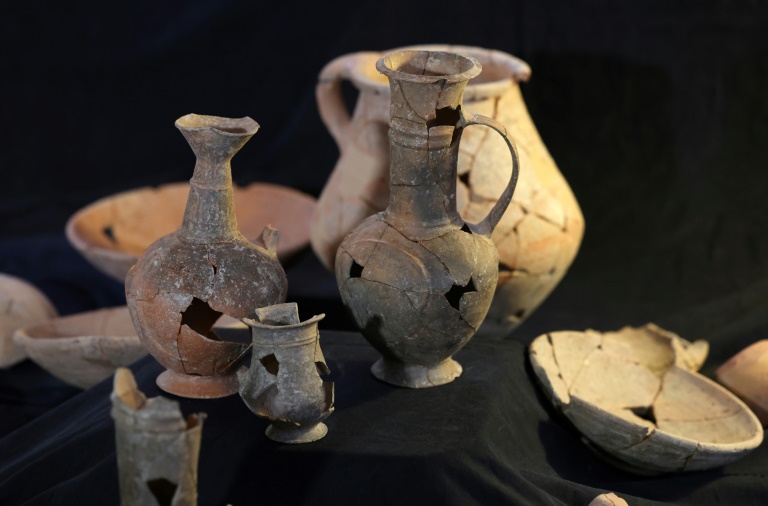
Researchers found pottery vessels at the site that resembled poppy flowers — from which opium is derived — dating back to the 14th century BC.

They then examined whether they had served as containers for the drug, which earlier writing had suggested was used in burial rituals in Canaan, and found “opium residue in eight vessels”, the researchers said in a statement.

These were likely “placed in graves for ceremonial meals, rites and rituals performed by the living for their deceased family members”, said Ron Be’eri, an archaeologist with the antiquities authority.

During these ceremonies, “family members or a priest on their behalf” would “attempt to summon the spirit of their dead relatives… and enter an ecstatic state by using opium”, Be’eri said.

But he acknowledged that much remained unknown about its use in ancient times. “We can only speculate what was done with opium,” he said.

Moscow-held Ukraine regions to vote on annexation by Russia

Moscow-held regions of Ukraine will urgently vote on annexation by Russia, separatist officials said Tuesday, as Kyiv’s troops wrest back territory captured by the Kremlin’s forces.

Pro-Russia authorities in the eastern Donetsk and Lugansk regions, as well as in the southern Kherson and Zaporizhzhia regions, said they would hold the vote over five days beginning Friday this week.

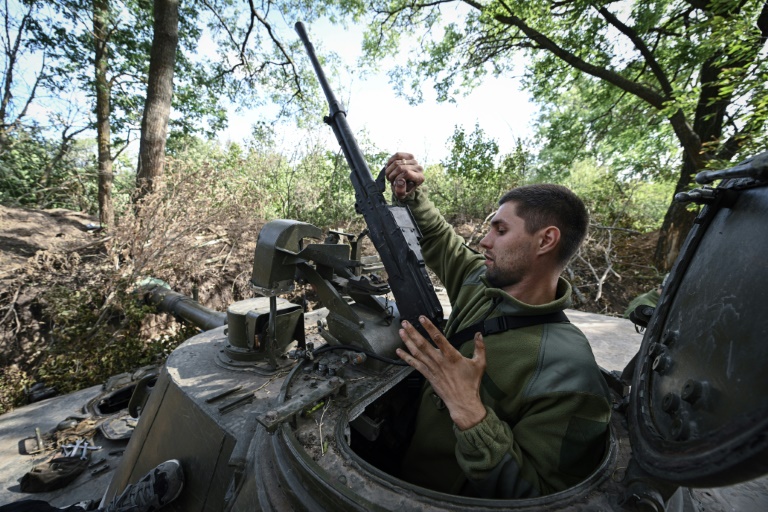
The regions are on the frontlines of a sweeping Ukrainian counter-offensive that has seen Kyiv’s forces retake hundreds of towns and villages that had been controlled by Russia for months.

Their integration into Russia would represent a major escalation of the conflict as Moscow could try to say it was defending its own territory from Ukrainian forces.

Washington, Berlin and Paris denounced the ballots and said the international community would never recognise the results while NATO said the votes marked a “further escalation” of the war.

Ukrainian President Volodymyr Zelensky hailed his western allies for their condemnation of the Russian move. 

“I thank all the friends and partners of Ukraine for their massive and firm condemnation of Russia’s intentions to organise yet more pseudo-referendums,” said Zelensky, who will speak to the UN General Assembly by video-link on Wednesday.

He said he will address “new facts of Russian atrocities” that are being recorded, noting that locals in territories recaptured by Ukrainian forces have been showing “where the occupiers had torture rooms, where they hid the bodies of the murdered, testify about collaborators.”

Kyiv said the “sham” referendums were meaningless and vowed to “eliminate” threats posed by Russia, saying its forces would keep retaking territory regardless of what Moscow or its proxies announced.

Denis Miroshnichenko, a separatist leader in the Lugansk region, said pro-Moscow lawmakers had voted to hold the vote from September 23 to 27.

Shortly afterwards, a news portal associated with separatist authorities in Donetsk said the region would hold a ballot over the same dates.

Large parts of the industrial Donbas area — made up of Donetsk and Lugansk — have been controlled by Moscow-backed separatists since 2014, after nationwide demonstrations ousted a Kremlin-friendly Ukrainian president.

– ‘Restore historical justice’ –

Russia at the time annexed the Crimean peninsula on the Black Sea from Ukraine with a vote that was criticised by Kyiv and the West, which imposed sanctions in response.

Authorities in the southern Kherson region of Ukraine also announced Tuesday they would hold a vote over the same dates.

“The incorporation of the Kherson region into the Russian Federation will secure our territory and restore historical justice,” said the Moscow-installed head of that region, Vladimir Saldo.

He echoed a phrase used earlier in the day by Russia’s former president and prime minister Dmitry Medvedev, who invoked correcting historical wrongs but also said the votes would bolster Russian forces.

“Encroachment into Russian territory is a crime and if it is committed, that allows you to use all possible force in self-defence,” Medvedev, now the deputy chairman of Russia’s security council, said on social media. 

Pro-Moscow authorities in Ukraine’s Zaporizhzhia region — home to Europe’s largest nuclear power plant — also announced they would hold a vote on the region’s “territorial allegiance”.

– ‘Sham’ votes –

German Chancellor Olaf Scholz denounced the “sham” votes and said they must be rejected by the international community. 

French President Emmanuel Macron called them a “travesty”, saying Russia’s invasion harked back “to the age of imperialism and colonies”.

White House National Security Advisor Jake Sullivan said the referendums were “an affront to the principles of sovereignty and territorial integrity”.

“The United States will never recognize Russia’s claims to any purportedly annexed parts of Ukraine,” he said.

The votes come at a decisive moment.

Ukraine’s forces in the east are now pushing towards the village of Bilogorivka whose capture by Russia in May decimated Moscow’s forces as they crossed the Siverskyi Donets river nearby.

Political analyst Tatiana Stanovaya said the vote announcements were a direct result of the success of Ukraine’s eastern counter-offensive.

Putin, she said, wants to threaten the full use of Russia’s military, including nuclear weapons, in defending Russian territory, including newly annexed regions.

“Putin does not want to win this war on the battlefield. Putin wants to force Kyiv to surrender without a fight,” she said.

The head of Russian state-media group, RT, Margarita Simonyan said the announcements marked either “the eve of our imminent victory or the eve of nuclear war”.

Speaking with newly appointed foreign ambassadors in Moscow on Tuesday ahead of the opening of the UN General Assembly, Putin said Russia would pursue its “sovereign course.” 

Dire warnings of the consequences of the conflict on global food security prompted world powers to convene at the assembly, with the United States, the European Union, the African Union and Spain meeting at ministerial level on food prices.

Russia and Ukraine are major grain producers and the war has severely disrupted exports, sending prices skyrocketing and hitting developing nations especially hard.

US Secretary of State Antony Blinken said “profound food insecurity” affected more than 200 million people worldwide.

Most pregnancy-related deaths in US are avoidable: CDC

Four out of five pregnancy-related deaths in the United States could be avoided, a new report by the nation’s top public health agency says, as mothers in the country face a comparatively high mortality rate, especially among Black women.

The study analyzed the cases of around 1,000 women who died between 2017 and 2019 due to pregnancy or related complications, up to a year after childbirth, the Centers for Disease Control and Prevention (CDC) said.

“The report paints a much clearer picture of pregnancy-related deaths in this country,” said Wanda Barfield, director of the CDC’s reproductive health division.

Some 22 percent of deaths occurred during pregnancy, 25 percent on the day of delivery or in the following week, and 53 percent up to a year later.

The leading cause identified, in 23 percent of cases, was mental health problems, including suicide or drug overdoses, followed by hemorrhage (14 percent), and heart problems (13 percent). 

The deaths were analyzed by local-level expert committees, including gynecologists and mental health professionals, which were tasked with formulating recommendations. 

These committees had “access to a diversity of information to fully understand the circumstances surrounding each death and determine whether there was a causal association with pregnancy,” the CDC’s David Goodman told AFP. 

Pregnancy and its consequences can, for example, aggravate a mental illness, make access to psychiatric treatment difficult, or even cause pain leading to substance abuse or self-harm. 

A death was considered avoidable if there was “at least a chance” that it could be avoided by “one or more reasonable changes” within the health care system, or on the part of the patient or her community.

Among the measures recommended to address the problem were furthering access to health insurance, improving pre- and post-natal care, as well as better transportation options to be able to access care.

The maternal death rate has been increasing in the United States for years, and ranks as one of the worst among industrialized nations. 

In 2020, it stood at 23.8 deaths per 100,000 births, according to data published in February.

But underneath that figure lies stark inequalities: the death rate per 100,000 births was 55.3 among Black mothers, versus 19.1 for white women.

Close Bitnami banner
Bitnami