AFP

UN raises alarm on Red Sea oil tanker 'time-bomb'

The UN appealed Tuesday for the last $14 million needed to try and prevent a stricken oil tanker from triggering a disaster off Yemen that could cost $20 billion to clean up.

The decaying 45-year-old FSO Safer, long used as a floating storage platform and now abandoned off the rebel-held Yemeni port of Hodeida, has not been serviced since Yemen was plunged into civil war more than seven years ago. 

If it breaks up, it could unleash a potentially catastrophic spill in the Red Sea.

David Gressly, the United Nations’ resident and humanitarian coordinator in Yemen, leads UN efforts on the Safer.

“Less then $14 million is now needed to reach the $80 million target to start the emergency operation to transfer oil from the Safer to a safe vessel,” said Gressly’s communications advisor Russell Geekie.

“We’re deeply concerned. If the FSO Safer continues to decay, it could break up or explode at any time,” he told reporters in Geneva, via video-link from Sanaa.

“The volatile currents and strong winds from October to December will only increase the risk of disaster. If we don’t act, the ship will eventually break apart and a catastrophe will happen. It’s not a question of if, but when.”

He said the result would potentially be the fifth largest oil spill from a tanker in history, with the clean-up costs alone reaching $20 billion.

The Safer contains four times the amount of oil that was spilled by the 1989 Exxon Valdez disaster, one of the world’s worst ecological catastrophes, according to the UN.

“It would unleash an environmental, economic and humanitarian catastrophe,” said Geekie.

The ship contains 1.1 million barrels of oil. The UN has said a spill could destroy ecosystems, shut down the fishing industry and close the lifeline Hodeida port for six months.

The Safer is unusable, is fit only for scrappage and nothing on it works, said Geekie.

“This is a ticking time bomb,” he warned.

“You don’t want to go and smoke a cigarette on the deck, I can tell you that much.”

UN raises alarm on Red Sea oil tanker 'time-bomb'

The UN appealed Tuesday for the last $14 million needed to try and prevent a stricken oil tanker from triggering a disaster off Yemen that could cost $20 billion to clean up.

The decaying 45-year-old FSO Safer, long used as a floating storage platform and now abandoned off the rebel-held Yemeni port of Hodeida, has not been serviced since Yemen was plunged into civil war more than seven years ago. 

If it breaks up, it could unleash a potentially catastrophic spill in the Red Sea.

David Gressly, the United Nations’ resident and humanitarian coordinator in Yemen, leads UN efforts on the Safer.

“Less then $14 million is now needed to reach the $80 million target to start the emergency operation to transfer oil from the Safer to a safe vessel,” said Gressly’s communications advisor Russell Geekie.

“We’re deeply concerned. If the FSO Safer continues to decay, it could break up or explode at any time,” he told reporters in Geneva, via video-link from Sanaa.

“The volatile currents and strong winds from October to December will only increase the risk of disaster. If we don’t act, the ship will eventually break apart and a catastrophe will happen. It’s not a question of if, but when.”

He said the result would potentially be the fifth largest oil spill from a tanker in history, with the clean-up costs alone reaching $20 billion.

The Safer contains four times the amount of oil that was spilled by the 1989 Exxon Valdez disaster, one of the world’s worst ecological catastrophes, according to the UN.

“It would unleash an environmental, economic and humanitarian catastrophe,” said Geekie.

The ship contains 1.1 million barrels of oil. The UN has said a spill could destroy ecosystems, shut down the fishing industry and close the lifeline Hodeida port for six months.

The Safer is unusable, is fit only for scrappage and nothing on it works, said Geekie.

“This is a ticking time bomb,” he warned.

“You don’t want to go and smoke a cigarette on the deck, I can tell you that much.”
Afghan family rebuilds far from home after US drone strike

The damage inflicted by a United States drone that killed 10 members of Aimal Ahmadi’s family in the Afghan capital can still be seen in the courtyard of his home a year after the strike.

The 32-year-old, whose daughter was among those killed, left Afghanistan with some of his family members, moving to a refugee camp in Qatar from where they now expect to be evacuated to the US for a future far from home.

“I don’t wish that any human being would go through what we went through, it’s terrible, unimaginable”, Ahmadi told AFP from Qatar.

On August 29, 2021, Ahmadi’s three-year-old daughter Malika, his brother Ezmarai, who had worked for an American charity, and several of his nephews and nieces were killed in the strike. 

The 10 family members, including seven children, were near a family car when they were mistakenly targeted by a US drone.

The family were the last civilian deaths linked to US forces recorded in the chaotic days before American troops left Afghanistan on August 30 last year, allowing the Taliban to fully take control of the country.

A few days after the drone strike the Pentagon acknowledged that it had made a “mistake” in wrongly identifying the family’s white Toyota as an Islamic State (IS) target.

The Pentagon did not punish the service members involved in the incident.

“There was not a strong enough case to be made for personal accountability,” said Pentagon spokesman at that time, John Kirby.

The US administration is currently helping relocate members of the family, Ahmadi said.

The drone hit came three days after an IS suicide bomb attack at Kabul airport killed more than 150 people — including 13 US troops — significantly raising tensions in the last days of US withdrawal.

An estimated 188 civilians have been killed by US forces by mistake in Afghanistan since 2018, according to the American military.

– Compensation-

A year after the strike, the modest two-storey house on a narrow street in the Khwaja Bughra neighbourhood in the north of Kabul is now inhabited by only a dozen distant relatives. 

Several other relatives of the victims fled the scene of the tragedy, which still bears the scars of the attack.

Blown out by the explosion, the windows have now been repaired, the walls of the courtyard rebuilt and others repainted. 

But on the floor, tiles are still missing where the drone strike hit. 

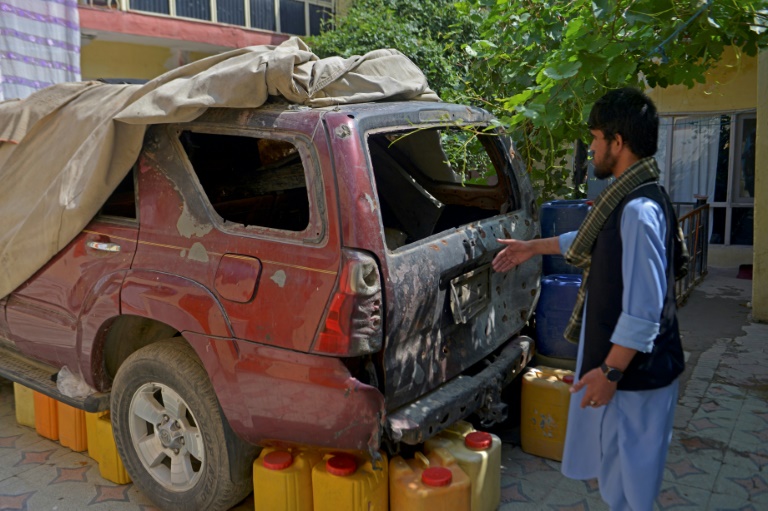
The family’s second vehicle -– almost completely burned by the blast -– still lies in the middle of the yard under a tarp.

“We didn’t want to get rid of it in memory of the victims and because it saved lives by protecting the women inside the house from the shrapnel,” said Ahmadi’s 20-year-old nephew, Nasratullah Malikzada, who is now in charge of maintaining the house.

As he passed a gate where portraits of the 10 victims have been hung, the young Afghan said the situation is “very sad”.

“It is God’s will, what has happened has happened, we can’t go back. God will punish those responsible in the afterlife,” he said.

Washington’s announcement that it would pay the family compensation sparked interest in the family and among relatives, given the economic distress felt across the country.

Following the drone strike, Ahmadi lost his job working with foreign companies and one of his two other brothers was threatened by strangers who had heard about the expected compensation.

But to this day, the family has not received any money from the US and they have hired a lawyer to defend their interests, Ahmadi said.

The lawyer was not reachable for comment.

In an exhausted tone, Ahmadi said he is confident that the US government will compensate his family.

As soon as he completes the paperwork for his evacuation, he hopes to join his two brothers who are already in the US.

His ailing sister, who remains in Afghanistan and is also hoping to be evacuated, has left home for a safe place in Kabul.

“I hope that a better future awaits me,” said Ahmadi.

In shadow of abandoned US airbase, Bagram's economy withers

For years, the sprawling military base at Bagram, just north of Kabul, was a potent symbol of the United States’ two decades of war in Afghanistan.

The sprawling complex included an air base that was the linchpin of the US invasion; a prison where rights groups allege widespread violations occurred; and a residential area that featured swimming pools, cinemas and spas.

But weeks before Washington officially ended its military presence in Afghanistan last August, US troops left the airbase in the dead of night.

Today, the military base is occupied by the Taliban, who took over the country in a swift offensive as US forces were exiting.

The US departure from Bagram has also seen the collapse of the economy in the nearby town of the same name, an illustration of how Afghanistan’s fortunes were so heavily tied to the war and foreign aid.

“Today, I’m jobless. I don’t know much about politics, but the exit of US forces from the base is a big economic loss,” said Saifulrahman Faizi, one of the town’s 80,000 residents.

Faizi earned $30 a day when he was employed at the base, at a time when hundreds would queue for hours outside the compound in the hope of getting work.

“Now, nobody goes there. Everything has just crashed, everybody is struggling”, he said.

– Shuttered shops –

Nowhere is the town’s economic collapse more evident than in the main market.

It is marked by rows of shuttered shops and warehouses, and those that remain open have seen sales plummet. 

Shah Wali, a 46-year-old grocery store keeper, said he used to earn an income of between 20,000 and 30,000 Afghanis ($230 and $340). 

Today, he can barely pay his rent.

“With the Islamic Emirate (Taliban) coming to power, peace has returned but business has gone,” Wali told AFP, clutching his prayer beads.

At the peak of the US invasion, Bagram was home to tens of thousands of troops and contractors, with the town serving as a hub for tons of supplies that would service the base.

The airfield was first built by the Americans for their Afghan ally during the Cold War in the 1950s.

The Soviet Union vastly expanded it after the Red Army invaded Afghanistan in 1979.

After their withdrawal, the base was controlled by the Moscow-backed government, and later by the shaky mujahideen administration during the 1990s civil war.

With the Taliban seizing power last year, the airfield is now under their control.

– ‘Empty town’ –

When the US military pulled out, it took much of its military hardware home, but tons of civilian equipment was left behind. 

For several months, the town managed to thrive on a booming scrap business, but residents say that now that, too, is dying.

Shops that sold used gym equipment, generators, air conditioners and spare car parts are either shut or receive few orders.

Several houses are now deserted, their residents having moved to Kabul or elsewhere in search of work.

Many who had worked at the base have also fled the country, fearing reprisals from the Taliban.

“Half the people have gone, the town feels so empty,” said Faizi.

In shadow of abandoned US airbase, Bagram's economy withers

For years, the sprawling military base at Bagram, just north of Kabul, was a potent symbol of the United States’ two decades of war in Afghanistan.

The sprawling complex included an air base that was the linchpin of the US invasion; a prison where rights groups allege widespread violations occurred; and a residential area that featured swimming pools, cinemas and spas.

But weeks before Washington officially ended its military presence in Afghanistan last August, US troops left the airbase in the dead of night.

Today, the military base is occupied by the Taliban, who took over the country in a swift offensive as US forces were exiting.

The US departure from Bagram has also seen the collapse of the economy in the nearby town of the same name, an illustration of how Afghanistan’s fortunes were so heavily tied to the war and foreign aid.

“Today, I’m jobless. I don’t know much about politics, but the exit of US forces from the base is a big economic loss,” said Saifulrahman Faizi, one of the town’s 80,000 residents.

Faizi earned $30 a day when he was employed at the base, at a time when hundreds would queue for hours outside the compound in the hope of getting work.

“Now, nobody goes there. Everything has just crashed, everybody is struggling”, he said.

– Shuttered shops –

Nowhere is the town’s economic collapse more evident than in the main market.

It is marked by rows of shuttered shops and warehouses, and those that remain open have seen sales plummet. 

Shah Wali, a 46-year-old grocery store keeper, said he used to earn an income of between 20,000 and 30,000 Afghanis ($230 and $340). 

Today, he can barely pay his rent.

“With the Islamic Emirate (Taliban) coming to power, peace has returned but business has gone,” Wali told AFP, clutching his prayer beads.

At the peak of the US invasion, Bagram was home to tens of thousands of troops and contractors, with the town serving as a hub for tons of supplies that would service the base.

The airfield was first built by the Americans for their Afghan ally during the Cold War in the 1950s.

The Soviet Union vastly expanded it after the Red Army invaded Afghanistan in 1979.

After their withdrawal, the base was controlled by the Moscow-backed government, and later by the shaky mujahideen administration during the 1990s civil war.

With the Taliban seizing power last year, the airfield is now under their control.

– ‘Empty town’ –

When the US military pulled out, it took much of its military hardware home, but tons of civilian equipment was left behind. 

For several months, the town managed to thrive on a booming scrap business, but residents say that now that, too, is dying.

Shops that sold used gym equipment, generators, air conditioners and spare car parts are either shut or receive few orders.

Several houses are now deserted, their residents having moved to Kabul or elsewhere in search of work.

Many who had worked at the base have also fled the country, fearing reprisals from the Taliban.

“Half the people have gone, the town feels so empty,” said Faizi.

In shadow of abandoned US airbase, Bagram's economy withers

For years, the sprawling military base at Bagram, just north of Kabul, was a potent symbol of the United States’ two decades of war in Afghanistan.

The sprawling complex included an air base that was the linchpin of the US invasion; a prison where rights groups allege widespread violations occurred; and a residential area that featured swimming pools, cinemas and spas.

But weeks before Washington officially ended its military presence in Afghanistan last August, US troops left the airbase in the dead of night.

Today, the military base is occupied by the Taliban, who took over the country in a swift offensive as US forces were exiting.

The US departure from Bagram has also seen the collapse of the economy in the nearby town of the same name, an illustration of how Afghanistan’s fortunes were so heavily tied to the war and foreign aid.

“Today, I’m jobless. I don’t know much about politics, but the exit of US forces from the base is a big economic loss,” said Saifulrahman Faizi, one of the town’s 80,000 residents.

Faizi earned $30 a day when he was employed at the base, at a time when hundreds would queue for hours outside the compound in the hope of getting work.

“Now, nobody goes there. Everything has just crashed, everybody is struggling”, he said.

– Shuttered shops –

Nowhere is the town’s economic collapse more evident than in the main market.

It is marked by rows of shuttered shops and warehouses, and those that remain open have seen sales plummet. 

Shah Wali, a 46-year-old grocery store keeper, said he used to earn an income of between 20,000 and 30,000 Afghanis ($230 and $340). 

Today, he can barely pay his rent.

“With the Islamic Emirate (Taliban) coming to power, peace has returned but business has gone,” Wali told AFP, clutching his prayer beads.

At the peak of the US invasion, Bagram was home to tens of thousands of troops and contractors, with the town serving as a hub for tons of supplies that would service the base.

The airfield was first built by the Americans for their Afghan ally during the Cold War in the 1950s.

The Soviet Union vastly expanded it after the Red Army invaded Afghanistan in 1979.

After their withdrawal, the base was controlled by the Moscow-backed government, and later by the shaky mujahideen administration during the 1990s civil war.

With the Taliban seizing power last year, the airfield is now under their control.

– ‘Empty town’ –

When the US military pulled out, it took much of its military hardware home, but tons of civilian equipment was left behind. 

For several months, the town managed to thrive on a booming scrap business, but residents say that now that, too, is dying.

Shops that sold used gym equipment, generators, air conditioners and spare car parts are either shut or receive few orders.

Several houses are now deserted, their residents having moved to Kabul or elsewhere in search of work.

Many who had worked at the base have also fled the country, fearing reprisals from the Taliban.

“Half the people have gone, the town feels so empty,” said Faizi.

Want to save carbon and land? Study suggests wooden cities

Housing people in homes made from wood instead of steel and concrete could save more than 100 billion tonnes of carbon emissions while preserving enough cropland to feed a booming population, research suggested Tuesday.

More than half of people globally currently live in cities and this proportion is set to rise markedly by 2050. 

According to some estimates, the infrastructure needed to accommodate up to 10 billion people by mid-century could exceed that constructed since the dawn of the industrial era.

That places a huge emphasis on emissions from construction, one of the most polluting sectors and historically one of the trickiest to decarbonise. 

Were all new construction projects carried out using steel and concrete, that could claim up to 60 percent of Earth’s remaining carbon budget for 2C of warming — that is, how much pollution the global economy can produce and still stay within the Paris Agreement temperature guardrail. 

Scientists in Germany and Taiwan wanted to see how much carbon could be saved if firms switched to wood to build new homes instead.

They used an open-source land use model to simulate four different building scenarios: one with conventional materials like cement and steel, and three with additional demand for timber.

They also analysed how additional high wood demand could be satisfied, where it could be produced, and the impacts new tree plantations might have on biodiversity and crop production. 

They found that housing people in timber homes could avoid more than 100 billion tonnes of CO2 by 2100 — that’s around 10 percent of the remaining 2C carbon budget, equivalent to nearly three years of global emissions.

Wood is known to be the least carbon-intensive building material as trees absorb CO2 as they grow, explained the study lead author Abhijeet Mishra, from the Potsdam Institute for Climate Impact Research (PIK).

“Production of engineered wood releases much less CO2 than production of steel and cement,” he said. “Engineered wood also stores carbon, making timber cities a unique long-term carbon sink.”

He said that engineered wood was the ideal material for constructing “mid-rise” buildings — between four and 12 stories — to house growing urban populations.

The study, published in the journal Nature Communications, found that around 140 million hectares — an area larger than Peru — would be needed to grow new trees to meet the increased demand under the timber-led building scenario. 

But the team calculated that these new plantations could be established on existing areas of harvest forest, and so not impact food supply by eating into crop land. 

“We need farm land to grow food for the people –- using it to grow trees could potentially cause competition for the limited land resources,” said co-author Florian Humpenoder, from PIK.

The authors concluded that planting the necessary additional plantations was possible but would require “strong governance and careful planning” from governments in order to limit their impact on biodiversity.

Want to save carbon and land? Study suggests wooden cities

Housing people in homes made from wood instead of steel and concrete could save more than 100 billion tonnes of carbon emissions while preserving enough cropland to feed a booming population, research suggested Tuesday.

More than half of people globally currently live in cities and this proportion is set to rise markedly by 2050. 

According to some estimates, the infrastructure needed to accommodate up to 10 billion people by mid-century could exceed that constructed since the dawn of the industrial era.

That places a huge emphasis on emissions from construction, one of the most polluting sectors and historically one of the trickiest to decarbonise. 

Were all new construction projects carried out using steel and concrete, that could claim up to 60 percent of Earth’s remaining carbon budget for 2C of warming — that is, how much pollution the global economy can produce and still stay within the Paris Agreement temperature guardrail. 

Scientists in Germany and Taiwan wanted to see how much carbon could be saved if firms switched to wood to build new homes instead.

They used an open-source land use model to simulate four different building scenarios: one with conventional materials like cement and steel, and three with additional demand for timber.

They also analysed how additional high wood demand could be satisfied, where it could be produced, and the impacts new tree plantations might have on biodiversity and crop production. 

They found that housing people in timber homes could avoid more than 100 billion tonnes of CO2 by 2100 — that’s around 10 percent of the remaining 2C carbon budget, equivalent to nearly three years of global emissions.

Wood is known to be the least carbon-intensive building material as trees absorb CO2 as they grow, explained the study lead author Abhijeet Mishra, from the Potsdam Institute for Climate Impact Research (PIK).

“Production of engineered wood releases much less CO2 than production of steel and cement,” he said. “Engineered wood also stores carbon, making timber cities a unique long-term carbon sink.”

He said that engineered wood was the ideal material for constructing “mid-rise” buildings — between four and 12 stories — to house growing urban populations.

The study, published in the journal Nature Communications, found that around 140 million hectares — an area larger than Peru — would be needed to grow new trees to meet the increased demand under the timber-led building scenario. 

But the team calculated that these new plantations could be established on existing areas of harvest forest, and so not impact food supply by eating into crop land. 

“We need farm land to grow food for the people –- using it to grow trees could potentially cause competition for the limited land resources,” said co-author Florian Humpenoder, from PIK.

The authors concluded that planting the necessary additional plantations was possible but would require “strong governance and careful planning” from governments in order to limit their impact on biodiversity.

Musk cites whistleblower to justify scrapping Twitter deal

Elon Musk’s lawyers have filed a fresh notice to terminate his $44 billion buyout of Twitter, citing whistleblower testimony by the platform’s former security chief as “distinct” justification for scrapping the deal.

The termination letter, made public Tuesday, argued that the allegations made by Peiter Zatko would, if true, place Twitter in violation of the initial takeover agreement.

The billionaire Tesla founder has been locked in a bitter legal battle with the social messaging platform since announcing in July that he was pulling the plug on his purchase of the company following a complex, volatile, months-long courtship.

Musk’s decision was partially founded on the allegation that he had been misled by Twitter concerning the number of bot accounts on its platform — a charge strongly denied by the company which is suing the tycoon to compel him to go through with his buyout at the agreed price.

Zatko’s testimony in August had appeared to bolster Musk’s argument, referencing “extreme, egregious” gaps in the platform’s online protections and accusing Twitter of significantly underestimating the number of fake and spam accounts.

In their new termination notice — sent to Twitter and filed with the Securities and Exchange Commission — Musk’s lawyers said the Zatko revelations illustrated “far-reaching misconduct” at Twitter that would likely have “severe consequences” for future business.

As such, they provide “additional and distinct bases to terminate the Merger Agreement,” the letter said.

In a written response, Twitter echoed its previous assertion that Zatko’s testimony was “riddled with inconsistencies and inaccuracies” and rejected the argument that it was in breach of the agreement.

“Twitter intends to enforce the Agreement and close the transaction on the price and terms agreed upon,” the company said.

The legal fight is gathering speed as preparations begin for a five-day trial in October in Delaware’s Chancery Court, which specializes in complex, high-stakes business battles.

Billions of dollars are at stake, but so is the future of Twitter, which Musk has long insisted should allow any legal speech — an absolutist position that has sparked fears the network could be used to incite violence.

Twitter won some early legal skirmishes in the case, including a fast-track trial date, and its stock had risen as analysts predicted the platform would prevail.

But a US judge last week told Twitter to surrender more data to Musk on the key issue of fake accounts, and the billionaire hopes Zatko’s whistleblower complaint could further turn the tide in its favor.

According to Dan Ives of Wedbush Securities, Zatko’s accusations, just weeks away from trial, are “a huge potential win for Musk which could complicate the Twitter case.”

Zatko was hired in late 2020 by the founder and former boss of Twitter, Jack Dorsey, after a massive hack that saw the accounts of major users including Joe Biden, Barack Obama, reality star Kim Kardashian and Musk himself compromised.

Before joining Twitter, Zatko held senior positions at Google and payments processing firm Stripe as well as DARPA, the technological research arm of the Pentagon.

Musk cites whistleblower to justify scrapping Twitter deal

Elon Musk’s lawyers have filed a fresh notice to terminate his $44 billion buyout of Twitter, citing whistleblower testimony by the platform’s former security chief as “distinct” justification for scrapping the deal.

The termination letter, made public Tuesday, argued that the allegations made by Peiter Zatko would, if true, place Twitter in violation of the initial takeover agreement.

The billionaire Tesla founder has been locked in a bitter legal battle with the social messaging platform since announcing in July that he was pulling the plug on his purchase of the company following a complex, volatile, months-long courtship.

Musk’s decision was partially founded on the allegation that he had been misled by Twitter concerning the number of bot accounts on its platform — a charge strongly denied by the company which is suing the tycoon to compel him to go through with his buyout at the agreed price.

Zatko’s testimony in August had appeared to bolster Musk’s argument, referencing “extreme, egregious” gaps in the platform’s online protections and accusing Twitter of significantly underestimating the number of fake and spam accounts.

In their new termination notice — sent to Twitter and filed with the Securities and Exchange Commission — Musk’s lawyers said the Zatko revelations illustrated “far-reaching misconduct” at Twitter that would likely have “severe consequences” for future business.

As such, they provide “additional and distinct bases to terminate the Merger Agreement,” the letter said.

In a written response, Twitter echoed its previous assertion that Zatko’s testimony was “riddled with inconsistencies and inaccuracies” and rejected the argument that it was in breach of the agreement.

“Twitter intends to enforce the Agreement and close the transaction on the price and terms agreed upon,” the company said.

The legal fight is gathering speed as preparations begin for a five-day trial in October in Delaware’s Chancery Court, which specializes in complex, high-stakes business battles.

Billions of dollars are at stake, but so is the future of Twitter, which Musk has long insisted should allow any legal speech — an absolutist position that has sparked fears the network could be used to incite violence.

Twitter won some early legal skirmishes in the case, including a fast-track trial date, and its stock had risen as analysts predicted the platform would prevail.

But a US judge last week told Twitter to surrender more data to Musk on the key issue of fake accounts, and the billionaire hopes Zatko’s whistleblower complaint could further turn the tide in its favor.

According to Dan Ives of Wedbush Securities, Zatko’s accusations, just weeks away from trial, are “a huge potential win for Musk which could complicate the Twitter case.”

Zatko was hired in late 2020 by the founder and former boss of Twitter, Jack Dorsey, after a massive hack that saw the accounts of major users including Joe Biden, Barack Obama, reality star Kim Kardashian and Musk himself compromised.

Before joining Twitter, Zatko held senior positions at Google and payments processing firm Stripe as well as DARPA, the technological research arm of the Pentagon.

Close Bitnami banner
Bitnami