AFP

Facebook bans major US anti-vaccine group

Facebook-owner Meta said Thursday it had kicked one of the most influential US anti-vaccination groups off the social media network for spreading Covid-19 misinformation.

The Children’s Health Defense (CHD), which has been a critic of Covid vaccines, immediately accused Meta of stifling its free speech rights.

“Facebook is acting here as a surrogate for the federal government’s crusade to silence all criticism of draconian government policies,” CHD founder Robert Kennedy Jr., nephew of late president John F. Kennedy, said in a press release.

Meta spokesperson Aaron Simpson told AFP that the group’s accounts at Facebook and Instagram were shuttered on Wednesday. The ban came after repeated violations of Meta’s misinformation rules.

CHD said its social media accounts were followed by hundreds of thousands of people, and claimed the action by Meta came as a surprise.

In a release, the group shared a screen capture showing messages stating the accounts were suspended for violating Meta policies regarding “misinformation that could lead to real world harm.”

CHD contended that the ban could be related to a lawsuit it filed against Meta accusing the tech giant of infringing free speech rights by relying on US Centers for Disease Control regarding what Covid-19 information is scientifically backed.

The anti-vaccine group has appealed a lower court ruling against it in the litigation, according to legal filings.

Facebook bans major US anti-vaccine group

Facebook-owner Meta said Thursday it had kicked one of the most influential US anti-vaccination groups off the social media network for spreading Covid-19 misinformation.

The Children’s Health Defense (CHD), which has been a critic of Covid vaccines, immediately accused Meta of stifling its free speech rights.

“Facebook is acting here as a surrogate for the federal government’s crusade to silence all criticism of draconian government policies,” CHD founder Robert Kennedy Jr., nephew of late president John F. Kennedy, said in a press release.

Meta spokesperson Aaron Simpson told AFP that the group’s accounts at Facebook and Instagram were shuttered on Wednesday. The ban came after repeated violations of Meta’s misinformation rules.

CHD said its social media accounts were followed by hundreds of thousands of people, and claimed the action by Meta came as a surprise.

In a release, the group shared a screen capture showing messages stating the accounts were suspended for violating Meta policies regarding “misinformation that could lead to real world harm.”

CHD contended that the ban could be related to a lawsuit it filed against Meta accusing the tech giant of infringing free speech rights by relying on US Centers for Disease Control regarding what Covid-19 information is scientifically backed.

The anti-vaccine group has appealed a lower court ruling against it in the litigation, according to legal filings.

NBA confidently resumes global games after pandemic hiatus

Japan’s Rui Hachimura and France’s Killian Hayes will have the chance to play before their home-nation fans with the NBA Global Games resuming next month after a two-year layoff due to the Covid-19 pandemic.

Pre-season contests are set for Japan and Abu Dhabi while Paris and Mexico City will host regular-season games as the NBA, with nearly 70 percent of social media followers from outside the United States, sends superstars to thrill its worldwide audience.

“We’re so excited to be bringing our live games back to our fans around the world,” NBA deputy commissioner Mark Tatum told AFP on Thursday.

“It’s a way for us to bring cultures together, to bring people together and to bring our fans together.”

Though NBA game telecasts were already viewed by fans in 214 nations and in more than 50 languages last season, Tatum says the return to live games overseas is “an important part of our business strategy.”

“There’s nothing like going to an NBA game for the hundreds of millions of fans around the world and we want fans to experience the game live.”

The NBA, with 25 percent of players from outside the United States, felt that this season teams could comfortably and confidently return overseas after a two-year hiatus due to Covid-19.

“It has been very difficult over the last two years with the pandemic,” Tatum said. “Our first and foremost concern is to have games where we can conduct them in a safe and secure manner.”

The NBA, with 97 percent of players and 100 percent of staff vaccinated, consulted doctors, medical specialists and officials in each city before finalizing the global schedule.

“We’ve learned, as the world has learned, to move on with Covid and this is the right time,” Tatum said. “We’re able to bring back the games. We’re confident we can keep everyone safe and healthy.”

That includes the Milwaukee Bucks, led by Giannis Antetokounmpo, and Atlanta Hawks playing the first NBA games in the Arabian Gulf when they meet for pre-season games October 6 and 8 in Abu Dhabi.

“They have got a world-class facility,” Tatum said. “They know how to do it well.”

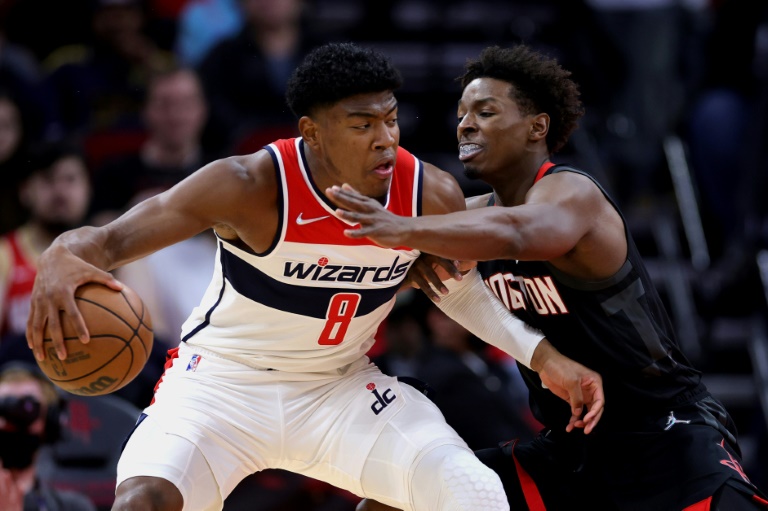
The reigning NBA champion Golden State Warriors will visit Japan for pre-season games September 30 and October 2 against Washington, which boasts Japanese forward Hachimura.

“With the pride they have for him, it’s going to be huge there,” Tatum said. “These things mater. It’s going to excite people.”

Tatum expects much the same thrill when the Chicago Bulls meet Hayes and the Detroit Pistons in a regular-season game at Paris on January 19.

“For Killian Hayes to play in his home country is going to be tremendous,” Tatum said.

He also expects NBA fans from across Europe to attend the Paris matchup, which also features Chicago’s two-time NBA All-Star Nikola Vučević of Montenegro.

The Miami Heat and San Antonio Heat will meet in Mexico City in a regular-season game on December 17.

– NBA eyes India, Africa –

More global games are in the works, Tatum said, noting, “There are more markets that want games than we can have them.”

“The world is a big place. We’ve played in a lot of places but there are still a lot of opportunities.”

Germany, Italy and Greece are among several European possibilities while London has hosted several contests.

In total, the league has played 205 games in 20 nations outside US and Canadian cities since 1978.

“At some point we will be back in India,” Tatum said, adding, “I could see pre-season, regular-season games in Africa.”

In the 2019-20 season, the last before the pandemic struck, the NBA played pre-season contests in India, Japan and China and regular-season games in Mexico and France.

Last season, the NBA had a record 121 international players from 40 nations, with 18 from Canada and seven from Germany.

The past four NBA Most Valuable Player awards were won by Serbian Nikola Jokic of the Denver Nuggets in 2022 and 2021 and Greek star Antetokounmpo of Milwaukee in 2019 and 2020.

Those two and Cameroonian star big man Joel Embiid of Philadelphia were last season’s three MVP finalists, another first for global NBA talent.

Apple warns of flaw that lets hackers into iPhones, Macs

Apple is warning of a flaw that is allowing hackers to seize control of iPhones, iPads and Mac computers, and is urging users to install emergency software updates.

Patches were released Thursday and Wednesday by the tech titan to fix what it described as a vulnerability hackers already knew about and may be taking advantage of.

“Apple is aware of a report that this issue may have been actively exploited,” the Silicon Valley-based company said.

Apple did not disclose whether it had information regarding the extent to which the issue has been exploited.

The technical description indicated that a hacker could use the flaw to take control of devices, accessing any of its data or capabilities.

Patches were released for iPhones, iPads and Mac computers running on operating systems with the vulnerability.

US judge sentences wildlife trafficker to more than 5 years in jail

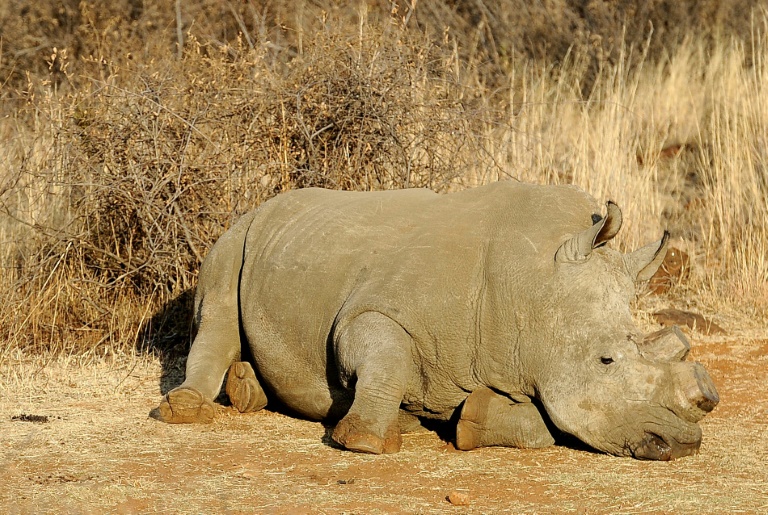
A US judge sentenced an extradited Liberian man to 63 months in prison for conspiring to traffic millions of dollars’ worth of horns and ivory from endangered rhinoceros and elephants, federal prosecutors said Thursday.

Moazu Kromah, a Uganda resident, was extradited from the west African country to the United States in June 2019, pleading guilty in March of this year to one count of conspiracy to commit wildlife trafficking and two counts of wildlife trafficking, the office of the US Attorney for the Southern District of New York, Damian Williams, said in a statement.

The trafficking plot involved the illegal poaching of more than around 35 rhinoceros and more than 100 elephants.

Williams praised the more than five-year sentence handed down by US District Judge Gregory H. Woods. 

“Today’s sentence demonstrates that those who are responsible for the decimation of global populations of endangered and threatened animals protected by international agreements will face serious consequences,” he said. 

Kromah, 49, and accomplices had buyers in the United States and Southeast Asia, trafficking some 190 kilograms (nearly 420 pounds) of rhinoceros horns and at least some 10 tons of elephant ivory from East African countries between roughly 2012 and 2019.

The estimated average retail value of the rhinoceros horn and elephant ivory was at least around $3.4 million and $4 million respectively.

During the investigation, law enforcement agents intercepted multiple packages bound for Manhattan buyers containing rhinoceros horns.

They concealed some of the animal parts in pieces of art such as African masks and statues, the New York investigators say. 

Poaching is fueled by a seemingly insatiable demand for rhino horn in Asia, where people pay huge sums for a substance — coveted as a traditional medicine — that is composed mainly of keratin, the same substance as in human nails.

Kromah is one of five men accused of being part of the criminal enterprise. 

Kenyan Mansur Mohamed Surur was extradited to the United States last year and pled guilty to trafficking and drug dealing charges, according to a June statement from Williams’s office.

Guinean Amara Cherif is also in US custody and pled guilty to the charges against him in April this year. 

Co-defendants Badru Abdul Aziz Saleh and Abdi Hussein Ahmed have reportedly been arrested.

US judge sentences wildlife trafficker to more than 5 years in jail

A US judge sentenced an extradited Liberian man to 63 months in prison for conspiring to traffic millions of dollars’ worth of horns and ivory from endangered rhinoceros and elephants, federal prosecutors said Thursday.

Moazu Kromah, a Uganda resident, was extradited from the west African country to the United States in June 2019, pleading guilty in March of this year to one count of conspiracy to commit wildlife trafficking and two counts of wildlife trafficking, the office of the US Attorney for the Southern District of New York, Damian Williams, said in a statement.

The trafficking plot involved the illegal poaching of more than around 35 rhinoceros and more than 100 elephants.

Williams praised the more than five-year sentence handed down by US District Judge Gregory H. Woods. 

“Today’s sentence demonstrates that those who are responsible for the decimation of global populations of endangered and threatened animals protected by international agreements will face serious consequences,” he said. 

Kromah, 49, and accomplices had buyers in the United States and Southeast Asia, trafficking some 190 kilograms (nearly 420 pounds) of rhinoceros horns and at least some 10 tons of elephant ivory from East African countries between roughly 2012 and 2019.

The estimated average retail value of the rhinoceros horn and elephant ivory was at least around $3.4 million and $4 million respectively.

During the investigation, law enforcement agents intercepted multiple packages bound for Manhattan buyers containing rhinoceros horns.

They concealed some of the animal parts in pieces of art such as African masks and statues, the New York investigators say. 

Poaching is fueled by a seemingly insatiable demand for rhino horn in Asia, where people pay huge sums for a substance — coveted as a traditional medicine — that is composed mainly of keratin, the same substance as in human nails.

Kromah is one of five men accused of being part of the criminal enterprise. 

Kenyan Mansur Mohamed Surur was extradited to the United States last year and pled guilty to trafficking and drug dealing charges, according to a June statement from Williams’s office.

Guinean Amara Cherif is also in US custody and pled guilty to the charges against him in April this year. 

Co-defendants Badru Abdul Aziz Saleh and Abdi Hussein Ahmed have reportedly been arrested.

Stocks mostly up as markets digest Fed rate signals

US and European stock markets mostly rose on Thursday as investors digested US economic data and Federal Reserve signals that it will maintain its aggressive monetary-tightening policy to combat inflation. 

European equities closed higher after seesawing earlier in the day.

Wall Street indices had a similar day, opening lower, amid expectations the market would need to “digest” recent gains, but eventually inching higher after a few swings.

“It’s meandering in low volume for sure,” said Art Hogan, chief market strategist at B Riley Wealth Management, adding that there has been relatively light economic news.

“We’re in the summer doldrums,” he said. “I’m not surprised to see this market action the way it is.”

Major Asian markets finished the day in the red.

Investors digested minutes of the Fed’s July meeting, in which central bankers remained committed to raising interest rates further to quell rising prices, but agreed that there would also come a time to slow the pace of the hikes.

The minutes show that a “September pivot is not in the cards,” said a Barclays note.

“The July minutes indicated more concerns about softening activity and downside risks to growth than communicated at the meeting,” Barclays said. “However, these concerns were outweighed by risks of sustained inflation, which, in the committee’s view, warrant further tightening to bring policy to a restrictive stance by year-end.”

Wall Street investors also digested US industry data showing that existing home sales fell sharply in July, the sixth consecutive monthly decline amid higher borrowing costs.

Other data in focus were better-than-expected initial jobless claims, and manufacturing activity in the very industrialized Philadelphia area, which was back in the green in August after two straight months of contraction.

Oil prices, meanwhile, rallied by more than 2.5 percent on rising skepticism that a nuclear deal between Iran and western governments could imminently boost oil exports.

Elsewhere, Norway’s central bank raised interest rates by half a percentage point to 1.75 percent, and flagged another hike in September.

Turkey’s central bank, meanwhile, stunned the markets by lowering its main interest rate even as inflation soared to a 24-year high — the opposite approach of other countries facing rising prices.

Turkish President Recep Tayyip Erdogan subscribes to the unorthodox belief that high interest rates cause inflation rather than rein it in.

– Key figures at around 2030 GMT –

New York – Dow: UP 0.1 percent at 33,999.04 (close)

New York – S&P 500: UP 0.2 percent at 4,283.74 (close)

New York – Nasdaq: UP 0.2 percent at 12,965.34 (close)

London – FTSE 100: UP 0.4 percent at 7,541.85 (close) 

Frankfurt – DAX: UP 0.5 percent at 13,697.41 (close)

Paris – CAC 40: UP 0.5 percent at 6,557.40 (close)

EURO STOXX 50: UP 0.6 percent at 3,777.38 (close)

Tokyo – Nikkei 225: DOWN 1.0 percent at 28,942.14 (close)

Hong Kong – Hang Seng Index: DOWN 0.8 percent at 19,763.91 (close)

Shanghai – Composite: DOWN 0.5 percent at 3,277.54 (close)

Euro/dollar: DOWN at $1.0095 from $1.0180 Wednesday

Pound/dollar: DOWN at $1.1937 from $1.2048

Euro/pound: UP at 84.56 pence from 84.50 pence

Dollar/yen: UP at 135.88 yen from 135.05 yen

Brent North Sea crude: UP 3.1 percent at $96.59 per barrel

West Texas Intermediate: UP 2.7 percent at $90.50 per barrel

Rushdie stabbing suspect pleads not guilty to attempted murder

The man accused of stabbing Salman Rushdie at a literary event pleaded not guilty on Thursday to attempted murder and assault charges at a court hearing in upstate New York.

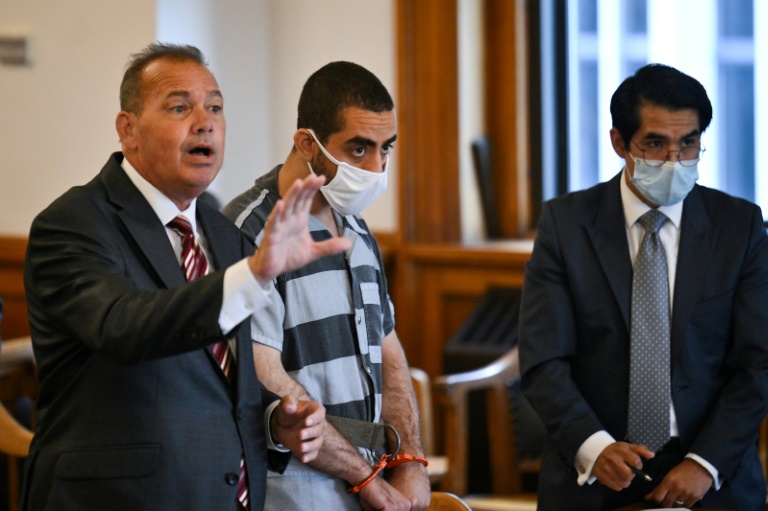
Cuffed and wearing a black and white striped prison outfit, Hadi Matar, 24, was answering to a grand jury indictment after he allegedly stormed the stage at last Friday’s event and stabbed Rushdie repeatedly in the neck and abdomen — leaving the British author in critical condition.

The judge ordered Matar remain detained without bail. 

Following the attack, Rushdie was airlifted to a nearby hospital for emergency surgery.

His condition remains serious but the 75-year-old has shown signs of improvement, and he has been taken off a ventilator.

The prize-winning writer spent years under police protection after Iranian leaders called for his killing over his portrayal of Islam and the Prophet Mohammed in his 1988 novel “The Satanic Verses.”

He was about to be interviewed as part of a lecture series at the Chautauqua Institution when a man rushed the stage and stabbed him repeatedly in the neck and abdomen.

Matar was wrestled to the ground by staff and audience members at the lecture, before police took him into custody.

His lawyer, public defender Nathaniel Barone, insisted on the presumption of innocence until proven guilty.

He also warned against litigating the case in the press, voicing concern over an interview with Matar that the New York Post published this week.

In it Matar told the tabloid he was “surprised” that Rushdie had survived the attack.

“I don’t like the person. I don’t think he’s a very good person,” he said of the author. “I don’t like him. I don’t like him very much.”

Barone said these kinds of interviews could render it impossible to assemble an impartial jury.

“Maybe, just maybe, prospective jurors hear about certain things that are always in the back of their mind,” Barone said to reporters.

According to prosecutor Jason Schmidt, such an interview could work against the defense: “Anytime there’s a statement you’re looking at the possibility of, you know, an admissions against interest.”

Judge David Foley agreed to the defense’s request to issue a temporary gag order, which bars the parties from discussing the case in interviews with the press.

– Continued threat to life –

Police and prosecutors have provided scant information about Matar’s background or the possible motivation behind the attack.

Matar’s family appears to come from the village of Yaroun in southern Lebanon, though he was born in the United States, according to a Lebanese official.

Rushdie, who was born in India in 1947, moved to New York two decades ago and became a US citizen in 2016.

Despite the continued threat to his life, he was increasingly seen in public — often without noticeable security.

In an interview given to Germany’s Stern magazine days before Friday’s attack, he had described how his life had resumed a degree of normality following his relocation from Britain.

Iran this week denied any link with Rushdie’s attacker but blamed the writer himself for “insulting” Islam in “The Satanic Verses.”

“By insulting the sacred matters of Islam… Salman Rushdie has exposed himself to the anger and rage of the people,” said Iranian Foreign Ministry spokesman Nasser Kanani said.

In Washington, US State Department spokesman Ned Price described Iran’s stance as “despicable.”

Algeria fire crews rein in blazes that left 38 dead

Algerian firefighters on Thursday brought under control a string of forest blazes that have killed at least 38 people including 12 who died in a bus trapped by the flames.

Deadly fires have become an annual scourge in Algeria, where climate change has turned large areas of forest into a tinderbox in the blistering summer months.

Authorities have been accused of being ill-prepared, with few firefighting aircraft available despite record casualties in last year’s blazes and a cash windfall from gas exports amid soaring global energy prices.

Fire service spokesman Farouk Achour told AFP late Thursday that 16 fires were still burning across seven districts but that those in the worst-hit eastern areas, El Tarf and Souk Ahras, were under control.

In Souk Ahras, a large crowd gathered to mourn five members of the same family who perished in the flames.

The justice ministry launched an inquiry after Interior Minister Kamel Beldjoud suggested some of the fires were deliberately started, and authorities on Thursday announced four arrests of suspected arsonists.

At least 38 people have been killed including more than 10 children and 10 firefighters, according to multiple sources, including local journalists and the fire service.

Most were in the El Tarf region near Algeria’s eastern border with Tunisia, an area which has been sweltering in 48 degree Celsius (118 Fahrenheit) heat.

At least 200 more people have suffered burns or respiratory problems, according to various Algerian media. 

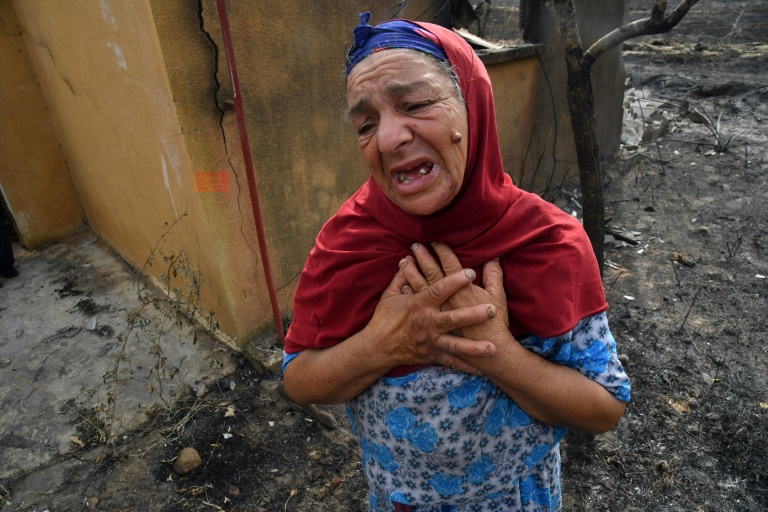
Algerian television showed people fleeing burning homes, women carrying children in their arms. 

A journalist in El Tarf described “scenes of devastation” on the road to El Kala, a northeastern seaport.

“A tornado of fire swept everything away in seconds,” he told AFP by telephone. 

An AFP team in El Kala saw burned-out cars, exhausted people and charred trees amid the strong smell of smoke.

A witness, who asked not to be named, said 12 people had burned to death in their bus as they tried to escape when the fire ripped through an animal park.

Takeddine, a worker at the park who declined to give his full name, said staff had helped families with young children to escape as fire surrounded the park.

“Nobody came to help us, neither the fire service nor anyone else,” he told AFP. 

One of his colleagues died in the process, he added.

– Authorities criticised –

A medic in El Kala said 72 people had been admitted to the city’s hospital, where nine had died and another nine remained in intensive care.

Associations across Algeria called for donations of money and medical supplies to help the victims.

The fire service said Thursday afternoon that 1,700 firefighters had been deployed to battle the fires, of which 24 were still raging.

A journalist in the mountainous area of Souk Ahras told AFP that a huge blaze in a forest nearby had sparked panic in the city of half a million people, where nearly 100 women and 17 newborn babies had to be evacuated from a hospital.

The scenes were reminiscent of fires last year which killed at least 90 people and seared 100,000 hectares (247,000 acres) of forest and farmland in the country’s north.

That disaster provoked criticism of authorities over the lack of firefighting aircraft.

Algeria had agreed to buy seven such aircraft from Spanish firm Plysa, but cancelled the contract following a diplomatic row over the Western Sahara in late June, according to specialist website Mena Defense.

Authorities have rented a Russian water bomber, but it broke down and is not expected to be operational again until Saturday, Interior Minister Kamel Beldjoud said. 

The civil protection service and the army have access to several firefighting helicopters.

– ‘The forest is weakened’ –

Experts have called for a major effort to bolster the firefighting capacity of Africa’s biggest country, which has more than four million hectares of forest.

One specialist, who asked not to be named, told AFP that in the 1980s the country had 22 Grumman aircraft for battling forest fires but that they had been “sold on the cheap, without any alternative solution being proposed”.

Since early August, fires have destroyed more than 800 hectares of forest and 1,800 hectares of woodlands, according to Beldjoud.

On Thursday, Prime Minister Aimene Benabderrahmane defended the government’s response, saying that the country had ordered four new firefighting aircraft — but that they would not be available until December.

He added that strong winds had exacerbated the blazes and said authorities were “deploying all their means” to extinguish them.

Retired academic and forestry expert Rafik Baba-Ahmed said in a video published on social media that “winds of over 90 kilometres (55 miles) per hour make the work of water bombers difficult if not impossible”.

He said bad land management had added to the problem.

“Today, the forest is weakened. It has been chipped away at,” he said.

Oil prices fall but inflation stays high

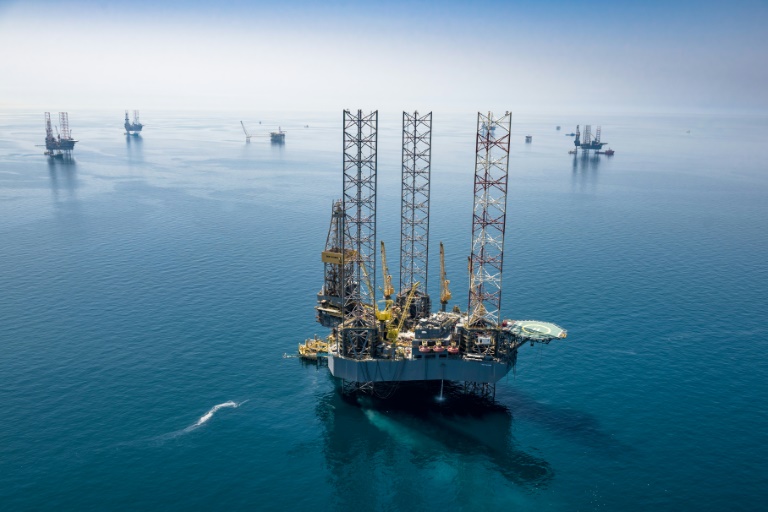
Oil prices have dropped by a quarter since June and could fall further if a nuclear deal is reached with Iran as it would bring more crude to the market, yet inflation remains stubbornly high.

Crude prices soared to $140 per barrel in early March after Moscow invaded Ukraine, raising fears that Western sanctions would drastically cut supplies from Russia, a major producer and exporter.

But traders are now concerned about demand due to various factors, including fears of recession, a strong dollar and weak Chinese oil imports during the country’s Covid lockdowns, said Giovanni Staunovo, commodities analyst at UBS bank.

Oil prices are set in dollars, so any rise in the currency makes barrels more expensive for importers using other currencies.

In China, “oil demand has taken a hit as processing of crude imports were weak in July” although stockpiles still rose, said Geordie Wilkes, analyst at Sucden.

The price of Brent, the international benchmark, has dropped to $95 while WTI, the main US contract, is at around $90 — and fuel prices at the pump have fallen in the United States.

But UBS expects Brent prices to climb back to around $125 by the end of the year as Russia exports fall, Chinese imports rise and Western countries stop tapping their strategic reserves, Staunovo said.

– Iran wildcard –

The market, however, could fall again if Tehran reaches a nuclear deal that would allow the country to raise its exports, which are currently restricted by sanctions.

This could add around one million barrels per day to the market.

“Iran was able to bring capacity back online fast last time and this shocked the market,” Wilkes said.

The European Union and United States said Tuesday they were studying Iran’s response to a “final” draft agreement on reviving the 2015 nuclear accord with major powers.

“Our view continues to be that a deal is still unlikely in the short term,” said experts at investment firm Goldman Sachs in a note, adding that Tehran can live with a reduced volume of exports as long as prices remain high.

“An announcement by Iran indicating willingness to entertain nuclear talks is likely intended to draw out further ongoing discussion in our view, before more disruptive counter-measures are potentially taken by the US and its allies,” the Goldman Sachs experts said.

“The US is similarly incentivized to draw out negotiations given stricter sanctions enforcement would exacerbate the oil shortage.”

Iran’s return to the market would lower prices by $5 to $10 per barrel in 2023, according to the experts.

– ‘The world has changed’ –

While lower crude prices have eased the pain at the pump, analysts say it may not be enough to tame inflation that has reached decades high in many countries and raised fears of recession.

Natural gas prices have surged as Russia has slashed supplies to Europe.

Inflation in Britain accelerated to 10.1 percent in July, pushed up by rising food prices. They rose by 8.9 percent in the eurozone in July.

While consumer prices have eased in the United States — slowing to 8.5 percent in July from 9.1 percent in June — they remain at an elevated level.

“The world has changed,” Andrew Kenningham, Europe analyst at research firm Capital Economics, told AFP.

“We used to have a very simple way to look at the price of energy and electricity in Europe based on the price of oil. Now we have a much more complex equation with different trends for oil, gas and electricity,” he said.

In Europe, the recent drop in crude prices should take 0.5 percentage points off inflation, said Holger Schmieding, chief economist at Berenberg.

Small drops “mattered” when inflation was under two percent “but not when inflation is at nine percent”, Kenningham said.

Close Bitnami banner
Bitnami