AFP

US envoy hopeful on Lebanon-Israel sea border talks

A US envoy on Monday expressed optimism that Lebanon and Israel could move towards a maritime border deal to settle competing claims over offshore gas fields.

The dispute escalated in early June after Israel moved a production vessel near the Karish offshore field, which is partly claimed by neighbour Lebanon.

This prompted Beirut to call for the resumption of US-mediated negotiations on the demarcation dispute.

“I remain optimistic that we can make continuous progress as we have over the last several weeks and I look forward to coming back to the region and being able to make the final arrangements,” envoy Amos Hochstein told reporters after meeting Lebanon’s top leaders.

Hochstein, on his second visit in less than two months, is carrying an Israeli proposal in response to a demarcation offer made by Lebanon, where officials also expressed optimism over a potential deal. 

On Monday, he met with President Michel Aoun, Prime Minister Najib Mikati and parliament speaker Nabih Berri at the presidential palace. 

He also met separately with caretaker Foreign Minister Abdallah Bou Habib who called the progress in talks “potentially exceptional”.

“Negotiations are still ongoing, and they have almost reached their conclusion,” Bou Habib told a local broadcaster after the meeting.

Parliament’s deputy speaker Elias Bou Saab who attended Monday’s meeting called the talks “positive”.

“The gap… has narrowed, and the time period separating us from the return of the American mediator to Beirut will be short,” he said, quoted in a statement issued by the presidency.

“God willing, we will see results in the next few weeks,” added Bou Saab, tasked by the president with following up on negotiations. 

– Qana field –

Lebanon and Israel, whose border is UN-patrolled, have no diplomatic relations. 

They had resumed maritime border negotiations in 2020 but the process was stalled by Beirut’s claim that the map used by the United Nations in the talks needed modifying.

Lebanon initially demanded 860 square kilometres (330 square miles) in the disputed maritime area but then asked for an additional 1,430 square kilometres, including part of the Karish field.

Israel claims the field lies in its waters and is not part of the disputed area subject to ongoing negotiations.

A Lebanese official in mid-June said Beirut had made a new offer to Hochstein, holding back on demands for territory where Israel planned to imminently extract gas.

Beirut was pushing for the country’s maritime border to exclude Karish and include the whole of a nearby field instead, the official told AFP at the time.

An Israeli official on Sunday said Israel’s offer on the original disputed zones was a “compromise to both sides” and would allow Lebanon to develop “the Sidon reservoir”, known as the Qana field, while safeguarding Israel’s interests.

After meeting Hochstein, Lebanon’s foreign minister said his country was demanding the right to develop “all of Qana”, without concessions.

– ‘Pay dearly’ –

On July 2, Israel said it had downed three drones launched by Lebanon’s Iran-backed Hezbollah that were headed towards the Karish gas field.

The Iran-backed Shiite Muslim movement on Sunday released a short video it said showed surveillance of several Israeli-chartered energy infrastructure ships.

Hezbollah’s chief Hassan Nasrallah had threatened attacks if Israel proceeds with gas exploration in the disputed area.

On Sunday, Nasrallah said Hezbollah will determine its next step based on the outcomes of the latest talks.

“We’re paying no attention to Nasrallah’s threats,” Ram Ben Barak, head of the Israeli foreign and defence committee told public broadcaster Kan radio on Monday.

“But if Nasrallah dares to do anything to Israel’s gas rigs, Lebanon –- and Hezbollah -– will pay dearly.”

Israel and Hezbollah last fought a devastating war in 2006.

Richer childhood friends boost future income, Facebook data shows

An analysis of 21 billion Facebook friendships shows that children from poorer homes are likely to earn more later in life if they grow up in areas where they can become friends with wealthier kids.

It has long been believed that having rich friends can help children rise up out of poverty, but previous research has had small sample sizes or limited data, according to two studies published in the journal Nature on Monday.

So a team of US-based researchers turned to Facebook, the world’s largest social database, with its nearly three billion users offering unprecedented scale and precision to examine the issue.

They analysed the privacy-protected data of 72  million US Facebook users aged between 25 and 44  years. The Facebook friendships were used to represent real-world friendships.

The researchers used an algorithm to rank users by socio-economic status, age and region, among other factors.

They then measured how much richer and poorer people interacted with each other and created the term “economic connectedness” to represent the share of a person’s friends who were above or below the average socio-economic level.

They then compared this measure with previous research into children’s ability to escape poverty in every US zip code.

The results were “strikingly similar”, said Raj Chetty, an economist at Harvard University and the lead author of the two studies.

The first paper showed that economic connectedness “is one of the strongest predictors of economic mobility that anyone has identified to date,” Chetty said.

The second paper sought to find out why children from richer or poorer backgrounds are more likely to make friends in some areas than others.

– Let’s be friends –

The researchers found two major factors. One was how much the two groups are exposed to each other — for example whether they attend different high schools or live in separate neighbourhoods.

Even if wealthy and non-wealthy students did go to the same school, however, they still might not hang out with each other — a factor the researchers called friending bias.

Around half of social disconnection between the rich and poor was due to lack of exposure to each other, the study found.

“But the remaining half is explained by friending bias,” Chetty said.

The findings showed that US policies aimed at reducing economic segregation between schools and regions were important but “not enough,” he added.

Where richer and poorer children meet has a major influence on whether they become friends — meaning that institutions play a major role, the study found.

For example, friendships in religious institutions like churches were “much more likely to cut across class lines,” Chetty said.

The data on exposure and friending bias was published on socialcapital.org on Monday, with researchers hoping it will prompt authorities across the United States to act.

Chetty predicted that similar results would likely be found in other countries, urging researchers and governments worldwide to access their own Facebook data.

Noam Angrist of Oxford University and Bruce Sacerdote of Dartmouth College in New Hampshire said the research represented “an important contribution that will enable a deeper understanding of social capital”.

“A sensible next step is to extend Chetty and colleagues’ monumental data creation and analysis to countries beyond the United States,” they wrote in a linked comment in Nature. 

Richer childhood friends boost future income, Facebook data shows

An analysis of 21 billion Facebook friendships shows that children from poorer homes are likely to earn more later in life if they grow up in areas where they can become friends with wealthier kids.

It has long been believed that having rich friends can help children rise up out of poverty, but previous research has had small sample sizes or limited data, according to two studies published in the journal Nature on Monday.

So a team of US-based researchers turned to Facebook, the world’s largest social database, with its nearly three billion users offering unprecedented scale and precision to examine the issue.

They analysed the privacy-protected data of 72  million US Facebook users aged between 25 and 44  years. The Facebook friendships were used to represent real-world friendships.

The researchers used an algorithm to rank users by socio-economic status, age and region, among other factors.

They then measured how much richer and poorer people interacted with each other and created the term “economic connectedness” to represent the share of a person’s friends who were above or below the average socio-economic level.

They then compared this measure with previous research into children’s ability to escape poverty in every US zip code.

The results were “strikingly similar”, said Raj Chetty, an economist at Harvard University and the lead author of the two studies.

The first paper showed that economic connectedness “is one of the strongest predictors of economic mobility that anyone has identified to date,” Chetty said.

The second paper sought to find out why children from richer or poorer backgrounds are more likely to make friends in some areas than others.

– Let’s be friends –

The researchers found two major factors. One was how much the two groups are exposed to each other — for example whether they attend different high schools or live in separate neighbourhoods.

Even if wealthy and non-wealthy students did go to the same school, however, they still might not hang out with each other — a factor the researchers called friending bias.

Around half of social disconnection between the rich and poor was due to lack of exposure to each other, the study found.

“But the remaining half is explained by friending bias,” Chetty said.

The findings showed that US policies aimed at reducing economic segregation between schools and regions were important but “not enough,” he added.

Where richer and poorer children meet has a major influence on whether they become friends — meaning that institutions play a major role, the study found.

For example, friendships in religious institutions like churches were “much more likely to cut across class lines,” Chetty said.

The data on exposure and friending bias was published on socialcapital.org on Monday, with researchers hoping it will prompt authorities across the United States to act.

Chetty predicted that similar results would likely be found in other countries, urging researchers and governments worldwide to access their own Facebook data.

Noam Angrist of Oxford University and Bruce Sacerdote of Dartmouth College in New Hampshire said the research represented “an important contribution that will enable a deeper understanding of social capital”.

“A sensible next step is to extend Chetty and colleagues’ monumental data creation and analysis to countries beyond the United States,” they wrote in a linked comment in Nature. 

Stock markets waver, oil prices sink

Stock markets wobbled on Monday as investors track a raft of corporate earnings reports while oil prices sank over concerns about Chinese demand.

London’s FTSE 100, the Paris CAC 40 and Frankfurt DAX were flat in afternoon trading after drifting higher earlier in the day.

Wall Street opened lower on the first day of August following a strong month in July.

Asian stock markets finished higher despite another disappointing reading on the health of the Chinese economy.

The closely watched Purchasing Managers’ Index of manufacturing activity shrank in July on the back of weak demand and the strict zero-Covid measures imposed in parts of the country.

While sweeping curbs have eased in major hubs such as Shanghai and Beijing, sporadic lockdowns in other cities and towns have kept businesses and consumers worried with few signs of the policy easing.

The China data sent oil prices sharply lower, with the international benchmark, Brent, slipping just under $100 per barrel while the main US contract, WTI, fell by five percent to around $94.

“Oil prices were under pressure after weak Chinese manufacturing figures which really show the continuing impact of lockdowns on the country’s economy,” said AJ Bell investment director Russ Mould.

“China remains one of the biggest consumers of oil and other commodities.” Mould said.

Traders are also waiting for another output decision by the OPEC+ group of major crude-producing nations on Wednesday.

– ‘Bullish’ HSBC –

In corporate news, Asia-focused lender HSBC provided another boost with a “bullish” outlook, alongside its intention to revert to quarterly shareholder dividends next year.

HSBC shares jumped by seven percent percent in the British capital. 

Other major corporate earnings reports this week include those from oil giant BP, US ride-hailing firm Uber, Japanese automaker Toyota and Chinese tech giant Alibaba.

Last week, strong earnings from US titans Amazon and Apple sparked healthy Wall Street gains and eased concerns about the economic impact of surging inflation and rising rates.

That came after investors took Federal Reserve chief Jerome Powell’s comments Wednesday to indicate the US central bank could start slowing down its monetary tightening, providing a much-needed boost to stocks.

The Bank of England is expected to deliver a bumper 0.5-percentage-point interest rate hike this Thursday to combat rocketing inflation.

“Sharp hikes by the US Federal Reserve and European Central Bank in July make it all the more likely that it will pull the trigger on an outsize rate hike,” Markets.com analyst Neil Wilson told AFP.

Global central banks are ramping up borrowing costs in an attempt to get a handle on runaway consumer price inflation.

– Key figures at around 1340 GMT –

London – FTSE 100: FLAT at 7,422.33 points

Frankfurt – DAX: FLAT at 13,491.18

Paris – CAC 40: FLAT at 6,446.18

EURO STOXX 50: DOWN 0.1 percent at 3,703.75

New York – Dow: DOWN 0.4 percent at 32,723.31

Tokyo – Nikkei 225: UP 0.7 percent at 27,993.35 (close)

Hong Kong – Hang Seng Index: UP 0.1 percent at 20,165.84 (close)

Shanghai – Composite: UP 0.2 percent at 3,259.96 (close)

Euro/dollar: UP at $1.0255 from $1.0228 Friday

Pound/dollar: UP at $1.2260 from $1.2189 

Euro/pound: DOWN at 83.64 pence from 83.89 pence

Dollar/yen: DOWN at 131.93 yen from 133.25 yen

Brent North Sea crude: DOWN 3.9 percent at $99.94 per barrel

West Texas Intermediate: DOWN 5.0 percent at $93.64 per barrel

burs/lth/raz

Stock markets waver, oil prices sink

Stock markets wobbled on Monday as investors track a raft of corporate earnings reports while oil prices sank over concerns about Chinese demand.

London’s FTSE 100, the Paris CAC 40 and Frankfurt DAX were flat in afternoon trading after drifting higher earlier in the day.

Wall Street opened lower on the first day of August following a strong month in July.

Asian stock markets finished higher despite another disappointing reading on the health of the Chinese economy.

The closely watched Purchasing Managers’ Index of manufacturing activity shrank in July on the back of weak demand and the strict zero-Covid measures imposed in parts of the country.

While sweeping curbs have eased in major hubs such as Shanghai and Beijing, sporadic lockdowns in other cities and towns have kept businesses and consumers worried with few signs of the policy easing.

The China data sent oil prices sharply lower, with the international benchmark, Brent, slipping just under $100 per barrel while the main US contract, WTI, fell by five percent to around $94.

“Oil prices were under pressure after weak Chinese manufacturing figures which really show the continuing impact of lockdowns on the country’s economy,” said AJ Bell investment director Russ Mould.

“China remains one of the biggest consumers of oil and other commodities.” Mould said.

Traders are also waiting for another output decision by the OPEC+ group of major crude-producing nations on Wednesday.

– ‘Bullish’ HSBC –

In corporate news, Asia-focused lender HSBC provided another boost with a “bullish” outlook, alongside its intention to revert to quarterly shareholder dividends next year.

HSBC shares jumped by seven percent percent in the British capital. 

Other major corporate earnings reports this week include those from oil giant BP, US ride-hailing firm Uber, Japanese automaker Toyota and Chinese tech giant Alibaba.

Last week, strong earnings from US titans Amazon and Apple sparked healthy Wall Street gains and eased concerns about the economic impact of surging inflation and rising rates.

That came after investors took Federal Reserve chief Jerome Powell’s comments Wednesday to indicate the US central bank could start slowing down its monetary tightening, providing a much-needed boost to stocks.

The Bank of England is expected to deliver a bumper 0.5-percentage-point interest rate hike this Thursday to combat rocketing inflation.

“Sharp hikes by the US Federal Reserve and European Central Bank in July make it all the more likely that it will pull the trigger on an outsize rate hike,” Markets.com analyst Neil Wilson told AFP.

Global central banks are ramping up borrowing costs in an attempt to get a handle on runaway consumer price inflation.

– Key figures at around 1340 GMT –

London – FTSE 100: FLAT at 7,422.33 points

Frankfurt – DAX: FLAT at 13,491.18

Paris – CAC 40: FLAT at 6,446.18

EURO STOXX 50: DOWN 0.1 percent at 3,703.75

New York – Dow: DOWN 0.4 percent at 32,723.31

Tokyo – Nikkei 225: UP 0.7 percent at 27,993.35 (close)

Hong Kong – Hang Seng Index: UP 0.1 percent at 20,165.84 (close)

Shanghai – Composite: UP 0.2 percent at 3,259.96 (close)

Euro/dollar: UP at $1.0255 from $1.0228 Friday

Pound/dollar: UP at $1.2260 from $1.2189 

Euro/pound: DOWN at 83.64 pence from 83.89 pence

Dollar/yen: DOWN at 131.93 yen from 133.25 yen

Brent North Sea crude: DOWN 3.9 percent at $99.94 per barrel

West Texas Intermediate: DOWN 5.0 percent at $93.64 per barrel

burs/lth/raz

Barcelona sell 25% of Barca Studios for 100m euros

Barcelona have sold 25 percent of Barca Studios, which manages the club’s digital business and audiovisual productions, to Socios.com for 100 million euros (102.5m dollars), club president Joan Laporta said on Monday. 

Club members had voted to allow the sale of 49 percent of the shares.

“For the moment, we have sold 25 percent to Socios.com,” Laporta said at the press conference to present Jules Kounde, bought for a reported 50m euros from Sevilla, as a Barcelona player. 

Earlier this summer, the deeply indebted club sold 15 percent of its La Liga TV revenue to the American investment fund Sixth Street in two tranches or a total of 400m euros before going on a transfer spree.

In addition to Kounde, Barcelona have bought Robert Lewandowski from Bayern Munich and Raphinha from Leeds and signed AC Milan midfielder Franck Kessie and Chelsea’s Danish central defender Andreas Christensen on free transfers.

While the deals with Sixth Street are for 25 years, the sale to the Socios.com platform is permanent. 

“It’s a sale for ever,” Laporta said. “There would be a way to recover this 25 per cent but for the moment this operation means the entry of a new partner, Socios.com, which has injected 100 million euros,” he said.

Socios.com is a platform that allows clubs to increase their interaction with fans and try to make more money from it, including the use of Fan Tokens, a kind of digital asset based on blockchain and cryptocurrencies. 

In its drive to raise money quickly, Barcelona has taken a 595m euro loan from investment bank Goldman Sachs and signed a sponsorship deal worth an estimated 435m euros with streaming service Spotify. 

In August 2021, Laporta announced that an audit of the club’s finances showed Barca faced an estimated debt of 1.35 billion euros.  

They allowed Lionel Messi to leave for Paris Saint-Germain in 2021 because they could not afford to keep the Argentine star, even on a reduced salary. 

Koerner seeking to put Credit Suisse on a straight path

Ulrich Koerner took over as Credit Suisse’s chief executive on Monday with the mammoth task of revitalising Switzerland’s second-biggest bank following a series of scandals.

Reputed to be more of a technocrat than a captain of the ship, his first mission as CEO will be to carry out a strategic review to try to put the bank back in good working order.

His predecessor Thomas Gottstein, who resigned on Wednesday, led Credit Suisse through two and a half years of turmoil but failed to see the group emerge from the storm.

New chairman Axel Lehmann, who rose through the ranks of the bank’s chief domestic rival UBS, highlighted Koerner’s in-depth knowledge of the sector at a pivotal moment when Credit Suisse must speed up its changes.

Koerner “is an experienced, transformational leader with an excellent judgement and has demonstrated to the board of directors that he understands the urgency of the task and the need to rebuild trust”, Lehmann told a press conference.

– Catalogue of woes –

In March 2021, the bank was rocked by the collapse of the British financial firm Greensill, in which some $10 billion had been committed through four funds, and then by the implosion of the US fund Archegos, which cost it more than $5 billion.

In October, it was also fined $475 million by the US and British authorities for its loans to state-owned companies in Mozambique.

In January, Antonio Horta-Osorio resigned as chairman after revelations that he broke Switzerland’s Covid-19 quarantine rules.

And in June, the bank was hit with a $2 million fine in a money laundering case linked to a Bulgarian cocaine network.

Given the scale of the task, the Swiss newspaper Tages-Anzeiger wondered if Koerner was the right man for the job.

Andreas Venditti, an analyst at Swiss investment managers Vontobel, told AFP: “He is probably not a CEO in the traditional sense. But in the current situation at Credit Suisse, what’s needed is probably not a visionary but someone hands-on who can restructure.

“Also he is almost 60, so it’s probably his last high-profile executive job. So he can execute without having to worry for what comes after.”

– ‘Like a machine’ –

A doctor in economics, Koerner began his career with the consulting firm McKinsey.

Koerner worked at Credit Suisse in various roles between 1998 and 2009, notably directing activities for the Swiss market, after which he switched to UBS until 2020.

The German and Swiss national returned to Credit Suisse in 2021 to turn around asset management after the Greensill affair.

He distinguished himself by his ability to carry out restructuring programmes. As head of operations at UBS, he notably transformed core functions at the headquarters “like a machine”, noted the Tages-Anzeiger.

But doubts remain over his people skills, the newspaper said.

“Koerner is a technocrat, not someone who motivates people,” one inside source told the daily.

And the Neue Zuercher Zeitung (NZZ) newspaper reported that he was “considered as someone of great intelligence”, who can come across as brusque or arrogant on first impressions, according to his colleagues.

However, this can “quickly dissipate” in favour of a more “engaging” personality, the NZZ added.

The Ethos foundation, which represents pension funds, said it hoped that Koerner, alongside Lehmann, “will finally manage to put the bank back on the right track” and “restore the confidence” of employees and investors.

Pelosi's Asia tour kicks off under Taiwan cloud

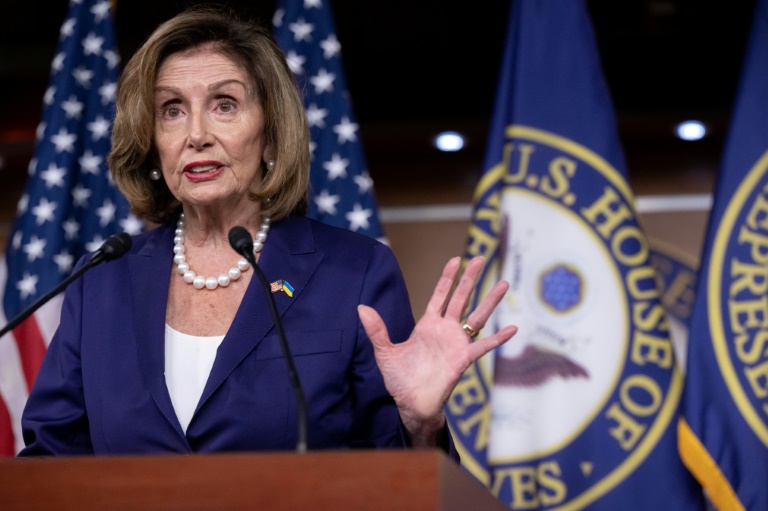
US House Speaker Nancy Pelosi on Monday kicked off an Asia tour that has been shrouded in secrecy following an escalation in tensions with China over Taiwan.

With no word if Pelosi will visit the island, she stopped first in Singapore, where Prime Minister Lee Hsien Loong urged her at a meeting to strive for “stable” ties with Beijing.

Her itinerary also includes Malaysia, South Korea and Japan, but a possible Taiwan visit has dominated attention in the run-up.

Reports about a plan to visit the island have enraged Beijing and caused unease in the White House with President Joe Biden trying to lower the temperature.

Beijing considers self-ruled Taiwan its territory — to be seized one day, by force if necessary — and said it would regard a Pelosi visit as a major provocation.

Pelosi’s office confirmed her Asia trip in a statement Sunday once her plane was in the air, following days of US media speculation and the speaker refusing to confirm her itinerary.

“The trip will focus on mutual security, economic partnership and democratic governance in the Indo-Pacific region,” it said, referring to the Asia-Pacific.

The statement did not mention Taiwan. But visits by US officials there are usually kept secret until delegations land.

And as speculation mounted, both CNN and Taiwan’s TVBS cited unnamed sources Monday to report that Pelosi does indeed plan to include the island on her Asia tour.

– ‘Bury all enemies’ –

The Global Times, China’s state-run tabloid, suggested that Pelosi might use “emergency excuses like an aircraft fault or refuelling” to land at a Taiwanese airport.

“If she dares to stop in Taiwan, it will be the moment to ignite the powder keg of the situation in the Taiwan Straits,” Hu Xijin, a former Global Times editor and now commentator, tweeted.

And the Chinese army’s Eastern Theater Command shared footage on social media site Weibo featuring a combat-ready army with fighters and helicopters taking off, amphibious troops landing on a beach and a stream of missiles raining down on various targets.

“We will bury all enemies who invade our territory,” a short text accompanying the footage read. 

“We’re ready to fight,” it added. “Advance towards a joint combat and a victorious war.”

Taiwan’s 23 million people have long lived with the possibility of an invasion but the threat has intensified under Chinese President Xi Jinping.

The United States maintains a policy of “strategic ambiguity” over whether it would militarily intervene were China to invade.

While it diplomatically recognises Beijing over Taipei, it also backs Taiwan’s democratic government and opposes any forced change to the island’s status.

American officials often make discreet visits to Taiwan to show support but a Pelosi trip would be higher-profile than any in recent history.

Taiwan’s government has remained silent on the prospect of a Pelosi visit and there has been minimal local press coverage. 

“I really hate what the Chinese are doing,” Hsu Ching-feng, a fruit vendor in Taipei, told AFP.

“But there’s nothing us common folks can do about it but ignore them. I will just ignore them.”

– ‘Wrong target’ –

As House speaker, Pelosi is second in line to the US presidency and one of the country’s most powerful politicians.

The last House speaker to visit was Newt Gingrich in 1997.

Biden and Xi had a tense phone call last week clouded by disagreements over Taiwan.

Xi issued an oblique warning to the United States not to “play with fire” over the island.

Speculation about Pelosi’s Taiwan plans has coincided with an uptick in military activity across the region.

US officials have sought to downplay the significance of a Pelosi visit, urging calm from Chinese leaders.

Kharis Templeman, a Taiwan expert at the Hoover Institution, said Beijing “misread US politics and screwed their signalling up” with its intense reaction.

“They picked the wrong target. Biden doesn’t control the Speaker or any other member of Congress,” he tweeted Sunday.

“They’ve drawn the line at the Speaker of the House, on a visit rich in symbolism but of limited practical value. And now it will be politically costly for either Pelosi not to go, or Xi not to respond with something dramatic.”

In Taiwan, there have been mixed views about the prospect of Pelosi visiting, but figures from both the ruling party and the main opposition have said the island should not cave to Chinese pressure.

“If Pelosi were to cancel or postpone the trip, it would be a victory for the Chinese government and for Xi as it would show that the pressure it has exerted has achieved some desired effects,” Hung Chin-fu, from Taiwan’s National Cheng Kung University, told AFP. 

Two dead in California's largest blaze this year

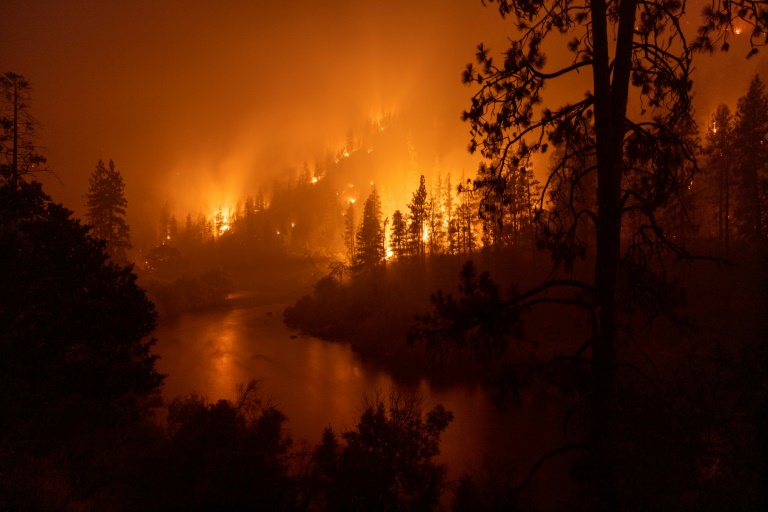
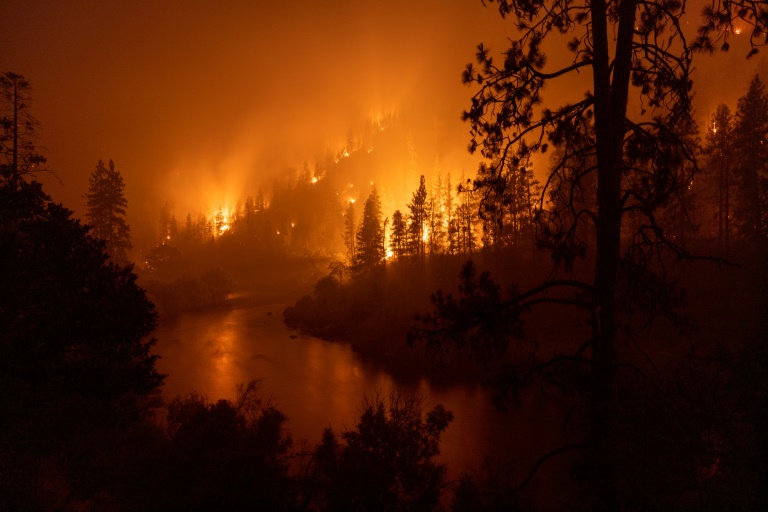
Firefighters in northern California were battling Monday to gain control over the state’s largest wildfire this year, which claimed two lives after exploding in size over the weekend and forcing thousands to evacuate their homes. 

Whipped up by strong winds and lightning storms, the McKinney Fire ripped through the state’s dry terrain Sunday to spread over some 52,500 acres of Klamath National Forest near the town of Yreka — and was zero percent contained as of Sunday night according to CalFire.

California and other parts of the western United States have been ravaged by huge and fast-moving wildfires in recent years, driven by years of drought and exacerbated by a warming climate.

The McKinney fire, which broke out Friday near the border with Oregon, is California’s largest wildfire so far this year — though it remains much smaller than last year’s Dixie Fire, which burned nearly one million acres.

According to the Siskiyou County Sheriff’s Office, firefighters on Sunday found two people dead inside a burned-out car on the driveway of a home in the community of Klamath River — in the fire’s path.

Speaking on ABC News, Sheriff Jeremiah LaRue said firefighters suspected the pair were caught in the fast-moving fire as they tried to flee.

California Governor Gavin Newsom has declared a state of emergency, saying the fire threatens “critical infrastructure.”

More than 2,000 residents of rural neighborhoods in the area were under evacuation orders, according to the California Office of Emergency Services, mostly in Siskiyou County.

Yreka resident Larry Castle told the Sacramento Bee newspaper that he and his wife had packed up a few possessions and their three dogs to leave for the night, as other fires in recent years had taught them the situation could turn “very, very serious.”

A spokeswoman for the Siskiyou County Sheriff’s Office, quoted by US media, said the fire had destroyed more than 100 structures — including homes, a grocery store and a community center — in the area surrounding Yreka, though it had not encroached upon the town of about 7,800 people.

“Surrounding areas should be ready to leave if needed. Please don’t hesitate to evacuate,” the county sheriff tweeted.

Highway 96 and McKinney Creed Road southwest of the Klamath River were closed to the public, CalFire said. 

Nearly 650 people were working to douse the blaze as of Sunday, the National Wildfire Coordinating Group said. 

Search and rescue teams evacuated 60 people who had been hiking the area’s popular Pacific Crest Trail, according to the sheriff’s department in Jackson County, Oregon.

CalFire said the cause of the McKinney fire was still under investigation.

The US Forest Service said thick smoke had helped to limit the growth of the fire on Sunday, but also meant that firefighters’ aircraft were “mostly grounded.”

Fire crews were working above Fort Jones and west of Yreka “to cut off the fire’s progress,” the USFS said.

The fast-spreading blaze comes just days after the Oak Fire near Yosemite National Park destroyed dozens of buildings and forced thousands to evacuate.

California, which is facing a punishing drought, still has months of fire season ahead of it.

Other parts of the world have also faced intense wildfires this year, as scientists say climate change is making heatwaves  more frequent and more intense, increasing the risk of fires.

On Sunday, both Portugal and France were tackling major forest fires as temperatures rose sharply in Europe.

In Portugal, a blaze broke out in the Mafra area, north of Lisbon, while in France at least four firefighters were seriously injured and motorways were closed.

Also over the weekend, hundreds of firefighters battled a blaze in eastern Germany, with four people injured.

Two dead in California's largest blaze this year

Firefighters in northern California were battling Monday to gain control over the state’s largest wildfire this year, which claimed two lives after exploding in size over the weekend and forcing thousands to evacuate their homes. 

Whipped up by strong winds and lightning storms, the McKinney Fire ripped through the state’s dry terrain Sunday to spread over some 52,500 acres of Klamath National Forest near the town of Yreka — and was zero percent contained as of Sunday night according to CalFire.

California and other parts of the western United States have been ravaged by huge and fast-moving wildfires in recent years, driven by years of drought and exacerbated by a warming climate.

The McKinney fire, which broke out Friday near the border with Oregon, is California’s largest wildfire so far this year — though it remains much smaller than last year’s Dixie Fire, which burned nearly one million acres.

According to the Siskiyou County Sheriff’s Office, firefighters on Sunday found two people dead inside a burned-out car on the driveway of a home in the community of Klamath River — in the fire’s path.

Speaking on ABC News, Sheriff Jeremiah LaRue said firefighters suspected the pair were caught in the fast-moving fire as they tried to flee.

California Governor Gavin Newsom has declared a state of emergency, saying the fire threatens “critical infrastructure.”

More than 2,000 residents of rural neighborhoods in the area were under evacuation orders, according to the California Office of Emergency Services, mostly in Siskiyou County.

Yreka resident Larry Castle told the Sacramento Bee newspaper that he and his wife had packed up a few possessions and their three dogs to leave for the night, as other fires in recent years had taught them the situation could turn “very, very serious.”

A spokeswoman for the Siskiyou County Sheriff’s Office, quoted by US media, said the fire had destroyed more than 100 structures — including homes, a grocery store and a community center — in the area surrounding Yreka, though it had not encroached upon the town of about 7,800 people.

“Surrounding areas should be ready to leave if needed. Please don’t hesitate to evacuate,” the county sheriff tweeted.

Highway 96 and McKinney Creed Road southwest of the Klamath River were closed to the public, CalFire said. 

Nearly 650 people were working to douse the blaze as of Sunday, the National Wildfire Coordinating Group said. 

Search and rescue teams evacuated 60 people who had been hiking the area’s popular Pacific Crest Trail, according to the sheriff’s department in Jackson County, Oregon.

CalFire said the cause of the McKinney fire was still under investigation.

The US Forest Service said thick smoke had helped to limit the growth of the fire on Sunday, but also meant that firefighters’ aircraft were “mostly grounded.”

Fire crews were working above Fort Jones and west of Yreka “to cut off the fire’s progress,” the USFS said.

The fast-spreading blaze comes just days after the Oak Fire near Yosemite National Park destroyed dozens of buildings and forced thousands to evacuate.

California, which is facing a punishing drought, still has months of fire season ahead of it.

Other parts of the world have also faced intense wildfires this year, as scientists say climate change is making heatwaves  more frequent and more intense, increasing the risk of fires.

On Sunday, both Portugal and France were tackling major forest fires as temperatures rose sharply in Europe.

In Portugal, a blaze broke out in the Mafra area, north of Lisbon, while in France at least four firefighters were seriously injured and motorways were closed.

Also over the weekend, hundreds of firefighters battled a blaze in eastern Germany, with four people injured.

Close Bitnami banner
Bitnami