AFP

Fed poised to attack inflation with another interest rate hike

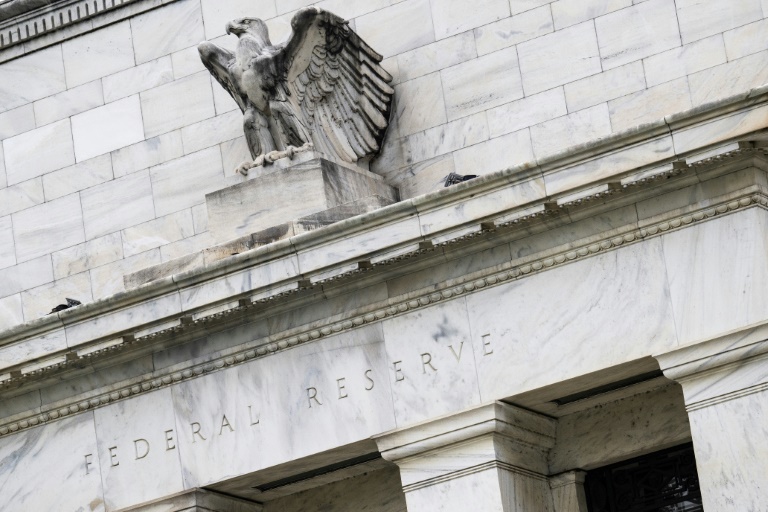
The Federal Reserve is set to announce another big interest rate increase on Wednesday, the fourth this year, in its ongoing battle to tamp down price pressures that have been squeezing American families.

US central bankers are hoping that their aggressive stance will start to cool red-hot inflation that topped nine percent in June, the highest in more than 40 years, without derailing the world’s largest economy.

President Joe Biden is paying the political cost for surging prices, which he blames mostly on Russia’s war in Ukraine, which has sent global food and energy prices soaring. 

Biden insists the American economy will avoid a recession, but even as his approval ratings have cratered, he has supported the Fed in its battle to quell inflation.

Fed Chair Jerome Powell and others have made it clear they are willing to risk a downturn and will keep raising interest rates until they see clear evidence inflation is moving back towards the two percent goal.

The policy-setting Federal Open Market Committee is widely expected to announce another three-quarter-point increase in the benchmark borrowing rate at the conclusion of its two-day policy meeting at 1800 GMT.

From zero at the start of the year, the Fed has raised the policy lending rate to a range of 1.5 to 1.75 percent, which has pushed mortgage rates higher and slowed housing sales for five straight months.

Economists say this has been the most aggressive Fed tightening cycle since the 1980s, when stagflation — a wage-price spiral and stagnant growth — crippled the US economy.

The challenge for policymakers is to quell inflation before it becomes dangerously entrenched, but without sending the world’s largest economy into a recession that would reverberate around the globe.

While prices have continued to rise, with home prices hitting a new record, there are signs the pace of the increases has begun to slow, which may allow the central bank to ease up on its rate increases.

Global oil prices are trending down, with the US benchmark WTI falling to below $95 a barrel from its peak of more than $123 in March, and gasoline prices at the pump have fallen 69 cents from the record of just over $5 a gallon in mid-June.

– Recession risk –

Meanwhile, the job market has remained strong, consumer demand has not fallen dramatically, and surveys show inflation expectations in the months ahead have started to trend lower.

Policymakers want to engineer a “soft landing,” taming inflation without causing a downturn, but economists warn they face an increasingly narrow path to success and it would be easy to overshoot by being too aggressive.

“The Fed is now stuck between a rock and a hard place, with no easy way out without the economy feeling pain,” KPMG chief economist Diane Swonk said in an analysis, noting that “Powell has started to underscore that reality by admitting a recession could occur.”

In fact, it is rare that the central bank moves so decidedly without causing a downturn, and there are signs of concern among Fed policymakers.

Kansas City Fed President Esther George dissented at the June meeting, saying she preferred a smaller half-point rate hike and warning that going too fast could be “unsettling” and raise recession fears.

GDP in the first quarter contracted 1.6 percent, and the first reading on the April-June period is due out Thursday. Though the consensus forecast calls for modest growth, many economists expect a downturn. 

Two quarters of negative growth are generally considered a recession, although that is not the official criteria.

But Fed Governor Christopher Waller said he was prepared to move even faster, with an unheard-of full point increase if inflation continued to accelerate.

Swonk said the Fed “is in uncharted waters,” so “uncertainty and disagreement about the course of rate hikes is a natural consequence.”

Fed poised to attack inflation with another interest rate hike

The Federal Reserve is set to announce another big interest rate increase on Wednesday, the fourth this year, in its ongoing battle to tamp down price pressures that have been squeezing American families.

US central bankers are hoping that their aggressive stance will start to cool red-hot inflation that topped nine percent in June, the highest in more than 40 years, without derailing the world’s largest economy.

President Joe Biden is paying the political cost for surging prices, which he blames mostly on Russia’s war in Ukraine, which has sent global food and energy prices soaring. 

Biden insists the American economy will avoid a recession, but even as his approval ratings have cratered, he has supported the Fed in its battle to quell inflation.

Fed Chair Jerome Powell and others have made it clear they are willing to risk a downturn and will keep raising interest rates until they see clear evidence inflation is moving back towards the two percent goal.

The policy-setting Federal Open Market Committee is widely expected to announce another three-quarter-point increase in the benchmark borrowing rate at the conclusion of its two-day policy meeting at 1800 GMT.

From zero at the start of the year, the Fed has raised the policy lending rate to a range of 1.5 to 1.75 percent, which has pushed mortgage rates higher and slowed housing sales for five straight months.

Economists say this has been the most aggressive Fed tightening cycle since the 1980s, when stagflation — a wage-price spiral and stagnant growth — crippled the US economy.

The challenge for policymakers is to quell inflation before it becomes dangerously entrenched, but without sending the world’s largest economy into a recession that would reverberate around the globe.

While prices have continued to rise, with home prices hitting a new record, there are signs the pace of the increases has begun to slow, which may allow the central bank to ease up on its rate increases.

Global oil prices are trending down, with the US benchmark WTI falling to below $95 a barrel from its peak of more than $123 in March, and gasoline prices at the pump have fallen 69 cents from the record of just over $5 a gallon in mid-June.

– Recession risk –

Meanwhile, the job market has remained strong, consumer demand has not fallen dramatically, and surveys show inflation expectations in the months ahead have started to trend lower.

Policymakers want to engineer a “soft landing,” taming inflation without causing a downturn, but economists warn they face an increasingly narrow path to success and it would be easy to overshoot by being too aggressive.

“The Fed is now stuck between a rock and a hard place, with no easy way out without the economy feeling pain,” KPMG chief economist Diane Swonk said in an analysis, noting that “Powell has started to underscore that reality by admitting a recession could occur.”

In fact, it is rare that the central bank moves so decidedly without causing a downturn, and there are signs of concern among Fed policymakers.

Kansas City Fed President Esther George dissented at the June meeting, saying she preferred a smaller half-point rate hike and warning that going too fast could be “unsettling” and raise recession fears.

GDP in the first quarter contracted 1.6 percent, and the first reading on the April-June period is due out Thursday. Though the consensus forecast calls for modest growth, many economists expect a downturn. 

Two quarters of negative growth are generally considered a recession, although that is not the official criteria.

But Fed Governor Christopher Waller said he was prepared to move even faster, with an unheard-of full point increase if inflation continued to accelerate.

Swonk said the Fed “is in uncharted waters,” so “uncertainty and disagreement about the course of rate hikes is a natural consequence.”
In first return to Washington, Trump hints at 2024 White House run

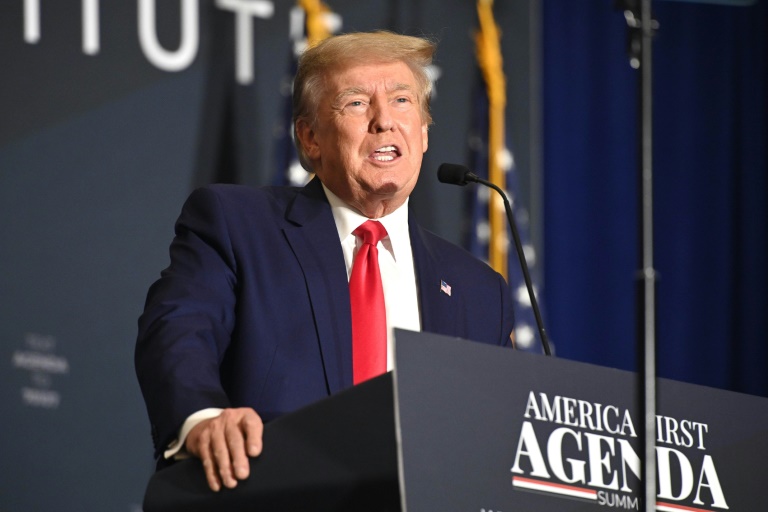
Donald Trump returned to Washington on Tuesday for the first time since leaving the White House 18 months ago, delivering a fiery speech sprinkled with strong hints he may run for president again in 2024.

The 76-year-old Trump stopped short of declaring his candidacy, but laid out what he believed should be the priorities for the “next Republican president.”

“I always say I ran the first time and I won, then I ran a second time and I did much better,” Trump said. “We may just have to do it again. We have to straighten out our country.

“I look forward to laying out many more details in the weeks and months to come.”

Several hours before Trump took the stage at the right-wing America First Policy Institute, his former vice president, Mike Pence, who is also considering a White House run in 2024, addressed a different conservative audience in Washington.

Speaking at the Young America’s Foundation conference, Pence said Americans must look to the future not the past and played down differences with Trump.

“Elections are about the future,” Pence said. “I came today not to look backwards but to look forward.

“I don’t know that the president and I differ on issues,” he said. “But we may differ on focus.”

Trump’s 90-minute address to the conservative America First Policy Institute echoed many of the themes of his victorious 2016 campaign, including illegal immigration and crime.

Trump repeated his false claims that he won the 2020 election and denounced the House committee investigation into the January 6 attack on the US Capitol by his supporters as the work of “political hacks and thugs.”

“If I renounced my beliefs, if I agreed to stay silent, if I stayed at home and just took it easy, the persecution of Donald Trump would stop immediately,” he said. “But that’s not what I will do. I can’t do that.

“They really want to damage me so I can no longer go back to work for you,” he said.

“And I don’t think that’s going to happen,” he added, prompting chants from the crowd of “Four more years!”

– ‘Cesspool of crime’ –

Trump lashed out repeatedly at Democratic President Joe Biden, blaming him for the country’s ills.

“We are a nation in decline,” he said. “We are a failing nation.”

“Inflation is the highest in 49 years,” Trump said “Gas prices have reached the highest in the history of our country.”

He accused Biden of allowing an “invasion” by millions of migrants crossing the southern border.

“The next Republican president must immediately implement every aspect of the Trump agenda that achieved the most secure border in history,” he said.

Trump said the United States “is now a cesspool of crime.”

“We have blood, death and suffering on a scale once unthinkable,” he said. “Democrat-run cities are setting all-time murder records.”

He accused Biden of having “surrendered in Afghanistan,” and allowing Russia to invade Ukraine.

“It would never ever, ever have happened if I was your commander-in-chief,” he said.

Since taking his last Air Force One flight from Washington to Florida on January 20 last year, Trump has remained the country’s most polarizing figure, continuing his unprecedented campaign to sow doubts about his 2020 election loss to Biden.

For weeks, Washington has been riveted by hearings in Congress about the January 6 storming of the Capitol by a Trump mob and his attempts to overturn the election.

With Biden’s approval rating currently below 40 percent and Democrats forecasted to lose control of Congress in November midterm elections, Trump is apparently bullish that he could ride the Republican wave all the way to the White House in 2024.

On the Democratic side, fury at Trump is also providing energy in the run-up to the midterms.

The House committee hearings have laid out evidence that Trump oversaw nothing less than an attempt to break US democracy, first through trying to rig electoral procedures behind the scenes and finally in encouraging a mob to attack legislators certifying his loss.

In an interview with NBC broadcast Tuesday, Attorney General Merrick Garland did not rule out legal action against Trump.

“We pursue justice without fear or favor. We intend to hold everyone — anyone — who is criminally responsible for events surrounding January 6, or any attempt to interfere with the lawful transfer of power from one administration to another, accountable,” he said.

Biden — facing chatter that at 79 he is too old to be thinking about seeking a second term in 2024 — pushed back hard against Trump’s criticism.

“Call me old fashioned, but I don’t think inciting a mob that attacks a police officer is ‘respect for the law,'” Biden tweeted.

 “You can’t be pro-insurrection and pro-cop — or pro-democracy, or pro-American.”

Blinken non-committal as slain Palestinian journalist's family seeks US probe

The family of slain Palestinian-American journalist Shireen Abu Akleh on Tuesday pressed Secretary of State Antony Blinken to demand accountability from Israel but the US administration balked at calls to open its own probe.

The top US diplomat invited relatives of the veteran Al Jazeera reporter, who was killed on May 11 as she covered an Israeli raid in the occupied West Bank, for a meeting in Washington after they unsuccessfully tried to see President Joe Biden on his visit to the region earlier this month.

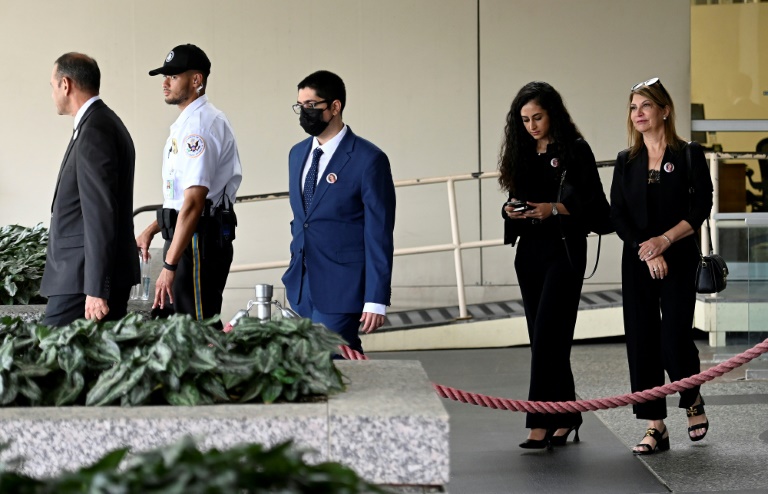
“We are continuing to call for accountability and for justice for Shireen,” Lina Abu Akleh, the journalist’s 27-year-old niece, told AFP outside the State Department after nearly an hour-long meeting with Blinken.

“If there is no accountability for Shireen’s murder, then this in a way gives a green light for other governments to kill American citizens,” she said.

Lina Abu Akleh, who was joined by the slain journalist’s brother, said that Blinken acknowledged the family’s concerns about a lack of transparency and promised “to establish a better channel of communication.”

But she said he “did not commit to anything” on the family’s calls for an independent US investigation into the death of the leading Palestinian journalist, who also held US citizenship.

The United States on July 4 released a statement saying Abu Akleh was likely shot by Israeli fire but that there was no evidence her killing was intentional, and that the bullet was too damaged for a conclusive finding.

The family demanded a retraction of the statement, which was based in part on US reviews of the separate Israeli and Palestinian probes.

– ‘Accountability’ –

Blinken, in a tweet after the meeting, said that Abu Akleh’s “fearless journalism earned her the respect of audiences around the world.”

“I expressed my deepest condolences and commitment to pursue accountability for her tragic killing,” Blinken said.

But asked about the family’s demands for a fresh US probe, State Department spokesman Ned Price pointed to the July 4 statement.

“We believe that by publishing the findings, it speaks to our commitment to pursuing an investigation that is credible, an investigation that’s thorough and, importantly, an investigation that culminates in accountability,” Price told reporters.

He said that the Israeli Defense Forces have “the ability to implement processes and procedures to avoid non-combatant casualties” and “to see to it that something like this cannot happen again.”

Israel has angrily rejected suggestions it deliberately targeted a journalist. It initially said that Palestinian fire could have killed Abu Akleh, who was wearing a vest that clearly identified her as a reporter, before backtracking.

Israel says it is still probing her death, leading some Palestinians to allege a stalling tactic.

Blinken has publicly criticized Israel for using force at her funeral, when police grabbed Palestinian flags and pallbearers struggled not to drop her casket.

The family is also meeting US lawmakers who have been pressing for the FBI or other US agencies to launch an investigation into her death.

“If we allow Shireen’s killing to be swept under the rug, we send a message that the lives of US citizens abroad don’t matter, that the lives of Palestinians living under Israeli occupation don’t matter, and that the most courageous journalists in the world, those who cover the human impact of armed conflict and violence, are expendable,” Shireen’s brother Tony Abu Akleh said in a statement before the meetings.

Twitter shareholders to vote on Musk buy in September

Twitter on Tuesday urged shareholders to endorse the $44 billion deal Elon Musk made to buy the online podium, setting a vote on the merger for September 13.

The firm is locked in a legal battle with the mercurial Tesla boss over his effort to walk away from the agreement, and a judge has called for a trial to begin in October.

“Twitter believes that Mr. Musk’s purported termination is invalid and wrongful, and the merger agreement remains in effect,” chief executive Parag Agrawal and board chairman Bret Taylor said in a copy of a letter to investors filed with the US Securities and Exchange Commission.

“Your vote at the special meeting is critical to our ability to complete the merger.”

Twitter shareholders were assured that they will be able to attend the meeting online, and vote remotely.

Twitter’s board unanimously recommended that shareholders vote in favor of Musk buying the company for $54.20 per share under the terms of a deal inked in April.

“We are committed to closing the merger on the price and terms agreed upon with Mr. Musk,” Tuesday’s letter said.

Twitter shares ended the formal trading day Tuesday at $39.34.

The company last week blamed disappointing quarterly earnings results on “headwinds,” including uncertainty imposed on the company by Musk’s chaotic buyout bid. 

The social giant reported that the number of “monetizable” daily active users — those who can be shown advertising — increased by 8.8 million to 237.8 million. 

Twitter’s results covered the period ending in June, and so don’t include Musk’s move in July to try to “terminate” the deal on the argument that the platform was not forthcoming about its tally of fake accounts.

The social media network has countered by saying Musk already agreed to the deal and can’t back out now.

A court in the eastern US state of Delaware agreed to a fast-track trial on whether to force the billionaire to complete the buyout.

Billions of dollars are at stake, but so is the future of Twitter, which Musk has said should allow any legal speech — an absolutist position that has sparked fears the network could be used to incite violence.

Twitter shareholders to vote on Musk buy in September

Twitter on Tuesday urged shareholders to endorse the $44 billion deal Elon Musk made to buy the online podium, setting a vote on the merger for September 13.

The firm is locked in a legal battle with the mercurial Tesla boss over his effort to walk away from the agreement, and a judge has called for a trial to begin in October.

“Twitter believes that Mr. Musk’s purported termination is invalid and wrongful, and the merger agreement remains in effect,” chief executive Parag Agrawal and board chairman Bret Taylor said in a copy of a letter to investors filed with the US Securities and Exchange Commission.

“Your vote at the special meeting is critical to our ability to complete the merger.”

Twitter shareholders were assured that they will be able to attend the meeting online, and vote remotely.

Twitter’s board unanimously recommended that shareholders vote in favor of Musk buying the company for $54.20 per share under the terms of a deal inked in April.

“We are committed to closing the merger on the price and terms agreed upon with Mr. Musk,” Tuesday’s letter said.

Twitter shares ended the formal trading day Tuesday at $39.34.

The company last week blamed disappointing quarterly earnings results on “headwinds,” including uncertainty imposed on the company by Musk’s chaotic buyout bid. 

The social giant reported that the number of “monetizable” daily active users — those who can be shown advertising — increased by 8.8 million to 237.8 million. 

Twitter’s results covered the period ending in June, and so don’t include Musk’s move in July to try to “terminate” the deal on the argument that the platform was not forthcoming about its tally of fake accounts.

The social media network has countered by saying Musk already agreed to the deal and can’t back out now.

A court in the eastern US state of Delaware agreed to a fast-track trial on whether to force the billionaire to complete the buyout.

Billions of dollars are at stake, but so is the future of Twitter, which Musk has said should allow any legal speech — an absolutist position that has sparked fears the network could be used to incite violence.

Russia doing better than expected despite sanctions: IMF

Despite damaging Western sanctions imposed on Moscow in the wake of the invasion of Ukraine, Russia’s economy appears to be weathering the storm better than expected as it benefits from high energy prices, the IMF said Tuesday.

The sanctions were meant to sever Russia from the global financial system and choke off funds available to Moscow to finance the war.

But the International Monetary Fund’s latest World Economic Outlook upgraded Russia’s GDP estimate for this year by a remarkable 2.5 percentage points, although its economy is still expected to contract by six percent.

“That’s still a fairly sizable recession in Russia in 2022,” IMF chief economist Pierre-Olivier Gourinchas told AFP in an interview.

A key reason that the downturn was not as bad as expected was that “the Russian central bank and the Russian policymakers have been able to stave off a banking panic or financial meltdown when the sanctions were first imposed,” he said.

Meanwhile, rising energy prices are “providing an enormous amount of revenues to the Russian economy.”

After starting the year below $80 a barrel, oil prices spiked to nearly $129 in March before easing back to under $105 on Tuesday for Brent, the key European benchmark, while natural gas prices are rising again and approaching their recent peak.

While major economies including the United States and China are slowing, the report said, “Russia’s economy is estimated to have contracted during the second quarter by less than previously projected, with crude oil and non-energy exports holding up better than expected.” 

Meanwhile, despite the sanctions, Russia’s “domestic demand is also showing some resilience” due to government support.

But Gourinchas said “there is no rebound” ahead for Russia. “In fact,” the IMF is “revising down the Russian growth in 2023,” 1.2 points lower than the April forecast for a contraction of 3.5 percent.

The penalties already in place, as well as new ones announced by Europe, mean “the cumulative effect of the sanctions is also growing over time,” he said.

The report indicates Europe is facing the brunt of the fallout from sanctions given its reliance on Russia for energy. The situation could worsen dramatically if Moscow cuts off gas exports, and once the European Union imposes a ban on Russian oil delivered by sea starting next year.

New York asks WHO to re-name 'stigmatizing' monkeypox

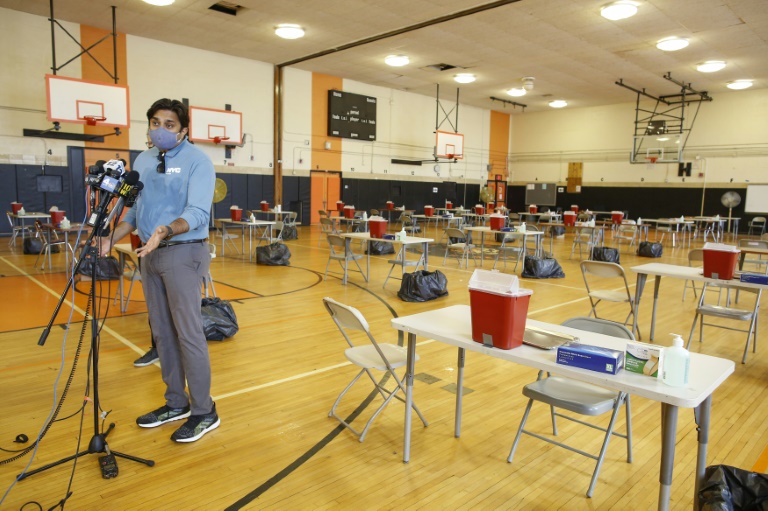
New York City asked the World Health Organization (WHO) on Tuesday to rename the monkeypox virus to avoid stigmatizing patients who might then hold off on seeking care.

New York has seen more cases of the disease, which the WHO declared a global health emergency over the weekend, than any other city in the United States, with 1,092 infections detected so far.

“We have a growing concern for the potentially devastating and stigmatizing effects that the messaging around the ‘monkeypox’ virus can have on… already vulnerable communities,” New York City public health commissioner Ashwin Vasan said in a letter to WHO chief Tedros Adhanom Ghebreyesus dated Tuesday. 

The WHO had floated the idea of changing the name of the virus, which is related to the eradicated smallpox virus, during a press conference last month, a proposal Vasan mentioned in his letter. 

Vasan referenced the “painful and racist history within which terminology like (monkeypox) is rooted for communities of color.”

He pointed to the fact that monkeypox did not actually originate in primates, as the name might suggest, and recalled the negative effects of misinformation during the early days of the HIV epidemic and the racism faced by Asian communities that was exacerbated by former president Donald Trump calling Covid-19 the “China virus.”

“Continuing to use the term ‘monkeypox’ to describe the current outbreak may reignite these traumatic feelings of racism and stigma — particularly for Black people and other people of color, as well as members of the LGBTQIA+ communities, and it is possible that they may avoid engaging in vital health care services because of it,” Vasan said.

Anyone is susceptible to contracting monkeypox, which has long been endemic in Central and Western Africa, but so far its spread in Europe and the United States has been mostly concentrated among men who have sex with other men. 

The first symptoms can include a fever and fatigue, followed a few days later by a rash that can turn into painful, fluid-filled skin lesions, which may last for a few weeks before turning into scabs that then fall off.

No deaths have been reported so far in Europe or the United States.

More than 16,000 confirmed cases have been recorded in 75 countries so far this year, the WHO said on Monday.

A limited number of doses of a smallpox vaccine found to protect against monkeypox, called Jynneos, have been administered in New York, mostly to gay and bisexual men. 

Saudi prince to sign deal for 'cheaper energy' in Greece

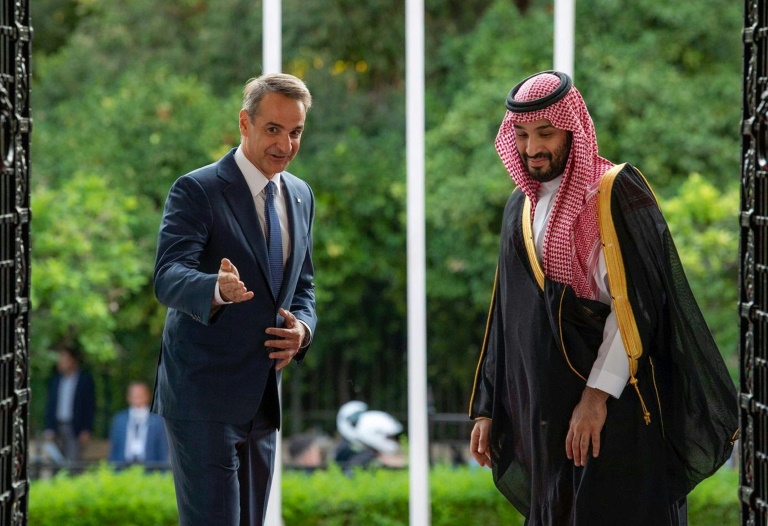
Saudi Crown Prince Mohammed bin Salman announced upcoming bilateral projects on a visit to Greece Tuesday, including for a power cable between both countries to provide Europe with “cheaper renewable energy”.

Prince Mohammed landed in Greece on Tuesday on his first Europe trip since the killing of Saudi journalist Jamal Khashoggi, and is set to head to France later in the week.

“I believe we have… historical opportunities, that we are going to finalise a lot of it today,” Prince Mohammed said at a press conference with Prime Minister Kyriakos Mitsotakis in the capital Athens.

This would include linking electricity grids to “provide Greece and southwest Europe through Greece with… much cheaper renewable energy,” he added.

The Greek foreign ministry said agreements on maritime transport, energy and defence technology among other things were due to be signed on Wednesday.

Khashoggi’s killing and dismemberment by Saudi agents in the kingdom’s Istanbul consulate in October 2018 brought the powerful crown prince international condemnation.

Prince Mohammed’s trip to Europe comes less than two weeks after US President Joe Biden visited the Saudi city of Jeddah for a summit of Arab leaders and met one-on-one with the prince, greeting him with a fist bump.

That move sealed Biden’s retreat from a presidential election campaign pledge to turn the kingdom into a “pariah” over the Khashoggi affair and wider human rights controversies.

– ‘Isolation’ over –

US intelligence agencies determined that Prince Mohammed, Saudi Arabia’s de facto ruler, had “approved” the operation that led to Khashoggi’s death, though Riyadh denies this, blaming rogue operatives.

Prince Mohammed’s stay in Europe represents a “highly symbolic move past his post-Khashoggi isolation”, said Kristian Ulrichsen, a research fellow at the Baker Institute at Rice University.

“While there has not been any formal coordination of policy in the ‘West’ against Mohammed bin Salman since 2018, the fact is that he has not visited any European or North American country since Khashoggi’s killing,” Ulrichsen said.

Prince Mohammed has also received a recent boost from Turkish President Recep Tayyip Erdogan, who visited Saudi Arabia in April, then welcomed Prince Mohammed in Ankara in June.

Erdogan had enraged the Saudis by vigorously pursuing the Khashoggi case, opening an investigation and briefing international media about the lurid details of the killing.

But with ties on the mend, an Istanbul court halted the trial in absentia of 26 Saudi suspects linked to Khashoggi’s death, transferring the case to Riyadh in April.

– Oil focus –

After Russia’s invasion of Ukraine triggered a spike in energy prices earlier this year, Saudi Arabia came under pressure from the United States and European powers to pump more oil.

Elevated oil prices have been a key factor in inflation in the US soaring to 40-year highs, putting pressure on the Biden administration ahead of mid-term elections later this year.

But the world’s biggest crude exporter has resisted pressure to open the supply taps, citing its commitment to production schedules determined by the OPEC+ exporting bloc it co-leads with Russia.

In May, Saudi Foreign Minister Prince Faisal bin Farhan stated that the kingdom had done what it could for the oil market.

Last week French President Emmanuel Macron received the new president of the energy-rich United Arab Emirates, Sheikh Mohamed bin Zayed Al-Nahyan, in Paris.

During that trip officials announced a deal between French energy giant Total Energies and UAE state oil company ADNOC “for cooperation in the area of energy supplies”.

Energy will probably be on the agenda again when Prince Mohammed goes to France, though it is unlikely the kingdom will change its position on oil production, said Huda al-Halisi, vice chair of the foreign affairs committee of the Saudi Shura Council, an advisory body.

“We’re on a set path and we need to see it through,” Halisi told AFP, while stressing there are many opportunities for deals on sustainable energy and other efforts to combat climate change.

Security concerns are also likely to get a lengthy hearing, Halisi said. 

Those include regional rival Iran’s nuclear programme and Tehran’s role in Yemen, where a truce is currently set to expire in early August between Iran-backed Huthi rebels and a Saudi-led military coalition supporting the internationally recognised government.

Google-parent Alphabet's profit slips as growth slows

Google-parent Alphabet reported Tuesday its profit and revenue slipped as the internet giant’s long sizzling ad revenue growth cooled, but the market seemed relieved the news wasn’t worse.

Big tech firms are grappling with multiple problems, from inflation to the war in Ukraine, and results in general for the quarter have not been great so far.

Alphabet’s revenue in the latest quarter grew 13 percent to $69.7 billion, with its global search and cloud computing services bringing in most of the money — but this was under analysts’ expectations.

“I think it’s a good time to sharpen our focus,” Alphabet chief executive Sundar Pichai told an earnings call. “It’s a chance to digest and make sure we are working on the right things.”

Net income at Alphabet fell 13 percent year-over-year to $16 billion in the latest quarter, but the flow of online ad dollars that fuels the company’s fortunes has slowed as inflation, war and other troubles vex the overall economy.

“Google’s earnings miss this quarter proves it’s not immune to the challenges facing the digital advertising industry at large,” said analyst Evelyn Mitchell.

“Still, with its tremendous market share in search advertising, Google is relatively well positioned to weather the rough waters that lie ahead,” she added.

The internet giant’s stock was up about 4.5 percent in after-hours trading, as the market appeared relieved by the results.

– Slowing hiring –

Google was also paying more to acquire online “traffic” from which it makes money, the earnings report showed.

Meanwhile, revenue from ads on video-sharing platform YouTube was up only slightly in the quarter. Google has looked to YouTube as a source of growth as people spend growing amounts of time looking at online videos.

“In the second quarter our performance was driven by Search and Cloud,” Pichai said.

Earnings season has gotten off to a rough start with less than stellar news from both Netflix and Snapchat’s parent firm, a decidedly different world than seen during the pandemic surge.

Netflix reported last week losing subscribers for the second quarter in a row as the streaming giant battles fierce competition and viewer belt tightening, but the company assured investors of better days ahead.

The loss of 970,000 paying customers in the most recent quarter was not as big as expected, and left Netflix with just shy of 221 million subscribers.

The company said in its earnings report that it had expected to gain a million paid subscribers in the current quarter.

At the same time, Snapchat’s owner announced plans last week to “substantially” slow recruitment after bleak results wiped some 30 percent off the stock price of the tech firm, which is facing difficulties on several fronts.

Snap reported that its loss in the recently ended quarter nearly tripled to $422 million despite revenue increasing 13 percent under conditions “more challenging” than expected.

In addition to current troubling economic conditions, analysts pointed to longer term issues for Google.

“The revenue is showcasing that they are reaching near saturation of their market,” said analyst Rob Enderle. “Their opportunity to grow is going to decrease over time.”

According to Insider Intelligence, Google is expected to reap nearly $175 billion in net ad revenue in 2022, or 29 percent of the global digital ad pie. 

Alphabet, with more than 174,000 employees worldwide, has recruited throughout the pandemic, but it recently announced a slowdown in hiring for the rest of the year.

“Although we expect the pace of headcount growth to moderate next year, we will continue hiring for critical roles, particularly focused on top engineering and technical talent,” said chief financial officer Ruth Porat. 

Many other tech companies have decided to lay off staff, including Netflix and Twitter, or slow the pace of hiring, such as Microsoft and Snap. 

Close Bitnami banner
Bitnami