AFP

Wildfires ravage Spanish region twice in a month

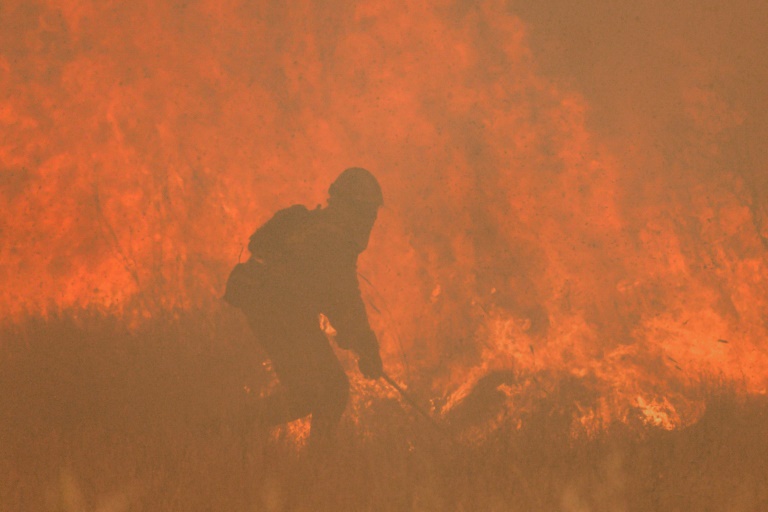
Just a month after a huge wildfire ravaged Spain’s northwestern province of Zamora, flames are once again consuming swathes of the region as locals helplessly watch their land being destroyed.

A column of smoke can be seen some 30 kilometres (18 miles) away as it billows into the sky, obscuring the landscape.

Antonio Puga cried as he observed the desolate scene, saying he felt “desperate and helpless” as flames surrounded his village of Pumarejo de Tera. 

“We could have avoided all this,” said Puga, who is in his sixties.

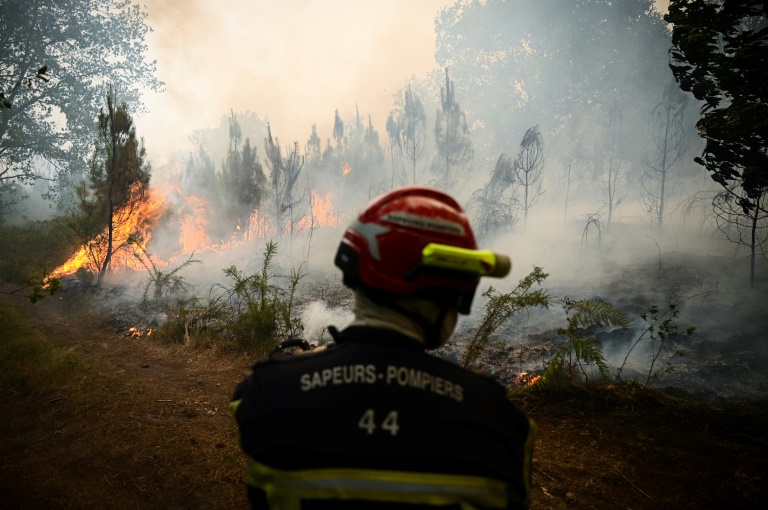
In front of him fires devour the fields, making them crackle. A relentless wind revives embers and ignites pine trees.

A helicopter ferried water from a nearby river and dumped it on the smouldering fields.

Some 6,000 people from around 30 localities in this rural region have been evacuated from their homes since Sunday.

The wildfires have claimed two lives — that of a firefighter near the village of Losacio and a shepherd whose body was found in a nearby town.

They are by far the largest of the dozens of blazes raging across Spain amid a scorching heatwave affecting much of Western Europe.

– ‘Already too late’ –

In June, a wildfire ravaged nearly 30,000 hectares (75,000 acres) in Sierra de la Culebra, a wooded mountain range near the border with Portugal that is known for its population of wolves.

It was the biggest fire in Spain since 2004.

Desperate locals try to help firefighters stamp out the flames by carrying hoses or transporting water with their tractors. But they are furious with the authorities.

“Firefighters arrived late, the helicopters were there this morning, then they left at 3 pm and now we only have one,” said Puga.

Alberto Escade, a 48-year-old technician, was upset to see three fire trucks leave the area.

“They keep saying they are overwhelmed,” he said.

“They arrive and then they say: It’s already too late, it’s lost.’ They are ordered to take care of inhabited areas,” he added.

Local authorities respond to the criticism by saying the priority is saving human lives.

The former mayor of the village, Isabel Blanco, is also upset.

A month ago a wildfire ravaged one side of the road, she said as she pointed to the charred vegetation on the right. And now its ravaged the land on the other side.

Firefighters were “a little late in coming,” the 52-year-old said.

– ‘Forgotten Spain’ –

She sees this as a symptom of the neglect which rural depopulated regions like Zamora — often referred to as “forgotten Spain” — suffer, a recurring political theme in the country.

In Zamora, thousands of people spent the night on cots at a reception centre sent up for evacuees. 

Many declined to speak to the media, their minds consumed by fear that their homes won’t survive the flames.

Daniel Santamaria, 21, said he was on vacation at his grandparents’ house when the approaching flames forced him to flee in a hurry with only a backpack.

He recalls how ash-filled raindrops “left black spots as they fell”.

Sitting just a few metres (feet) away, Luis Rivero, 76, said he will not forget “the strong wind which carried everything away in its path” and fanned the flames.

Laura Gago, a 36-year-old beekeeper from the village of Escober de Tabara, said between sobs that she has “not yet had the strength” to check on her 700 hives but estimates that “90 percent of her production is burnt”.

“We can’t do anything against nature, the wind, the temperatures, the drought. Climate change is here. It’s not going to go away,” she added.
Rare twin giraffes born in Kenya

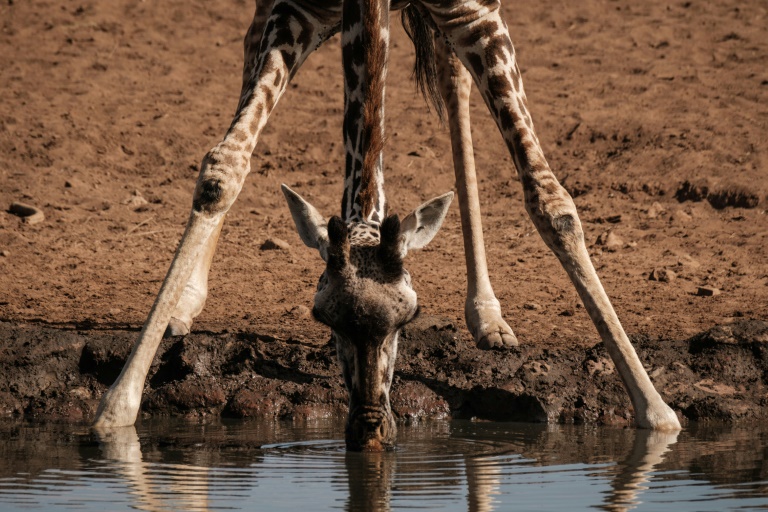
Rare twins have been born to a Maasai giraffe in Nairobi’s national park, the Kenyan wildlife minister said Tuesday.

“This is an extremely rare occurence,” Najib Balala said on Twitter in a post accompanied by a picture of the mother watching over her offspring.

The world’s tallest species was listed as “vulnerable to extinction” on the International Union for Conservation of Nature’s 2016 Red List of threatened wildlife.

Only about 117,000 giraffe remain in the wild, according to the Giraffe Conservation Foundation. It said the numbers of the gentle long-necked giant in Africa have plummeted by 30 percent over the last 30 years, describing it as a “silent extinction”.

Kenya is home to three subspecies of giraffe, the Maasai, the reticulated and the Rothschild.

Nairobi National Park lies just seven kilometres (four miles) from the heart of the Kenyan capital, and is a tourist magnet for its wildlife including lions, leopards, rhinos and buffalos which graze against a backdrop of distant skyscrapers.

At 15 months, giraffes have one of the longest gestation periods for mammals. They give birth standing up, which means their calves drop just under two metres (six feet) to the ground. 

This startling introduction to life gets them up and running around in less than an hour. A newborn calf is bigger than the average adult human. 

Only a handful of twin births have been documented worldwide with most often not surviving. 

In the wild, giraffes can live up to 25 years, while in captivity they can survive more than 35 years.

Sri Lanka's political crisis: What happens next?

Sri Lanka’s parliament elects a new president on Wednesday to replace Gotabaya Rajapaksa, who last week fled to Singapore and resigned following months of protests over the country’s financial meltdown.

AFP looks at how cash-strapped Sri Lanka ended up in its worst-ever economic crisis, and what comes next in its complicated, corrupt and sometimes violent political system.

– Why did Rajapaksa flee? –

Sri Lanka’s financial woes were triggered by the coronavirus pandemic but exacerbated by mismanagement under Rajapaksa’s government. 

The country has been unable to finance even the most essential imports since late last year, and has since defaulted on its debt.

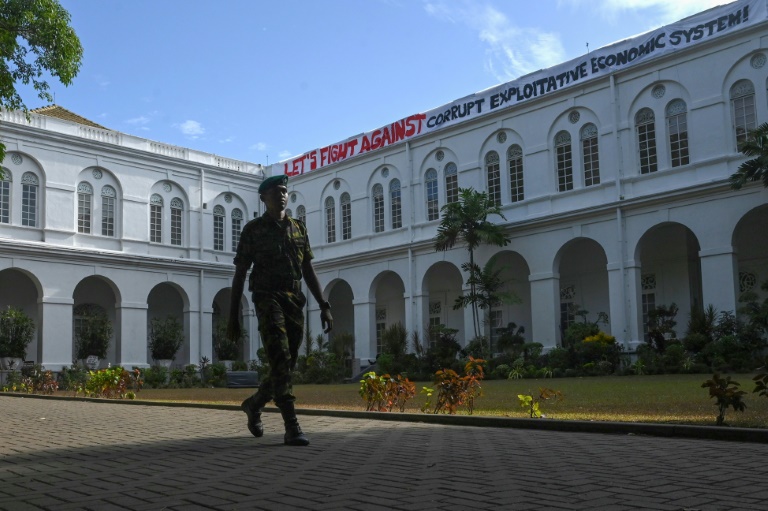
Discontent had been mounting for months over severe food and fuel shortages, record inflation and lengthy power cuts. 

Even Rajapaksa’s closest allies began abandoning him, and when protesters overran his official residence in Colombo this month, he was forced to flee to a navy base and then to Singapore in fear for his life.

– Wasn’t Rajapaksa a popular leader? –

Rajapaksa was dubbed “The Terminator” for ruthlessly crushing Tamil rebels as head of the defence ministry during his elder brother Mahinda’s presidency between 2005 and 2015.

He was loved by the country’s Sinhala Buddhist majority, but loathed by Tamils and Muslims who saw him as a war criminal, a racist and an oppressor of minorities.

When inflation crossed 50 percent, and with four out of five people forced to cut back on food because of acute shortages, the ethnically divided nation united in its opposition to Rajapaksa.

– What happened after he fled? –

Rajapaksa formally quit on July 14, just two years and eight months into his five-year term, with Prime Minister Ranil Wickremesinghe automatically elevated as the acting leader under the country’s constitution.

Wickremesinghe is serving as a stop-gap until Wednesday, when the 225-seat parliament elects one of its members to lead the country for the balance of Rajapaksa’s term.

– How does the election work? –

The 225 MPs will rank the three candidates in order of preference in a secret ballot.

Candidates need more than half the vote to be elected. If no-one crosses the threshold on first preferences, the candidate with the lowest support will be eliminated and their votes distributed according to second preferences.

The secret ballot gives MPs a freer hand than an open poll, and previous elections have seen allegations of bribes offered and accepted in exchange for votes.

During a constitutional crisis in October 2018, some MPs said they had been offered $3.5 million in cash and apartments abroad for their support.

– Who is leading the race? –

Acting President Wickremesinghe, 73, a pro-Western six-time prime minister, appears to be the front-runner.

He has secured support from the leadership of the Rajapaksas’ SLPP, which is still the largest single bloc in parliament, and his hardline stance against protesters has gone down well with MPs who have been at the receiving end of mob violence.

The SLPP has more than 100 seats and Wickremesinghe would almost certainly be elected if party discipline holds.

– Who are the other candidates? –

The SLPP is fractured so that party dissident and former media minister Dullas Alahapperuma, 63, is a serious challenger.

The main opposition leader Sajith Premadasa, 55, has teamed up with Alahapperuma in a pact that would see him named prime minister if their ticket succeeds.

It is an unlikely pairing. Alahapperuma was a journalist and rights campaigner in the late 1980s, when Premadasa’s late father Ranasinghe ruled the country with an iron fist.

A distant third candidate is leftist leader Anura Dissanayake, whose coalition has just three parliamentary seats.

– What does this mean for IMF talks? –

Despite their differences, Sri Lanka’s political parties are united in their support for ongoing talks with the International Monetary Fund, with Wickremesinghe saying a bailout is urgently needed.

Sri Lanka declared itself bankrupt in mid-April when the government defaulted on its $51 billion foreign debt.

But the political crisis has interrupted the negotiations, and the IMF said last week that it hoped the unrest would be resolved soon so they could resume.

No political party in the current parliament has a clear majority.

Even if the country could afford to hold a fresh election, Tamil legislator Dharmalingam Sithadthan pointed out that a strong mandate was not always a guarantee of stability or success.

“We had Gotabaya with a record 6.9 million votes and what did he do?” Sithadthan told AFP. “He was a total failure.”

Venice pushes tourists to drink from fountains and shun plastic

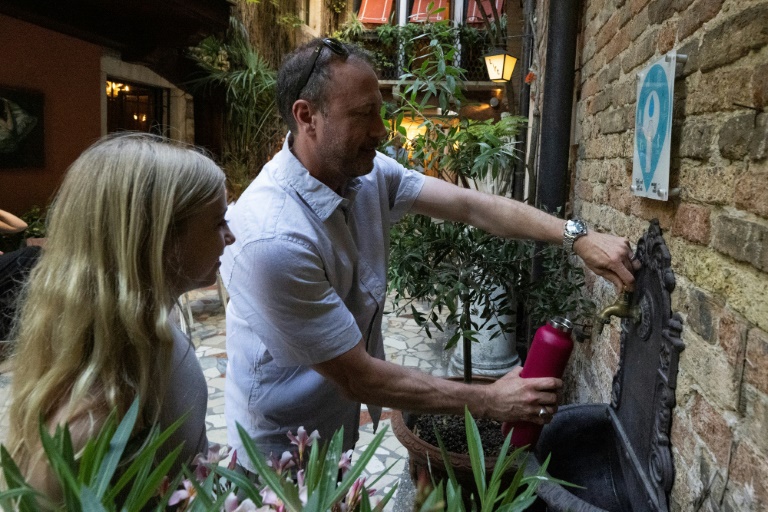
A few steps from Venice’s St. Mark’s Square, a little girl fills her water bottle at a courtyard fountain, a haven of peace far from the hordes of tourists. 

“Plastic bottles are super annoying to me,” said 11-year-old Keira from Tucson, Arizona. “There is so much plastic in the ocean and everywhere.” 

Her father, Charlie Michieli, also believes in swapping plastic for refillable bottles: “You can go through quite a lot, especially on a long trip… litres and litres and litres of plastic bottles.”

In Venice, which welcomes millions of visitors each year, tourism contributes to between 28 and 40 percent of garbage production depending on the season, according to local government data — including piles and piles of plastic water bottles. 

To combat the waste, local authorities now promote the use of refillable water bottles by calling tourists’ attention to the vast network of drinking water fountains dotting the squares and alleys of the watery city. 

“In the historic centre, there are 126 fountains spread over the area, they’re easy to find, there’s one nearly every 100 metres (330 feet),” said architect Alberto Chinellato in his city hall office overlooking the Rialto Bridge.

To make things even easier, water distribution company Veritas has launched an app showing a map with all the nearest fountains.  

“Encouraging the use of free drinking water certainly produces less waste… but also brings fewer bottles in the historic centre, which means less pollution and less transport”, said Chinellato. 

Leaving Chinellato’s office, AFP observed an empty plastic water bottle bobbing between two gondolas on the Grand Canal — underscoring that the battle against plastic is far from being won.

– Little blue drop –

At the centrally located Hotel Flora, owner Gioele Romanelli has also decided to contribute to the crusade against plastic by educating his guests. 

“We simply had a card printed on which we pointed out the fountains of Venice with a little blue drop,” said Romanelli, proudly displaying a copy on a small bistro table. 

“Not only with a refillable bottle, but also by recycling a small (plastic) water bottle you can keep all day,” said the 49-year-old hotelier. 

At check-in, guests are briefed about Venice’s “good water”.

“They are sometimes surprised to learn that the water in Venice is drinkable,” he said. 

“With this small gesture, our customers can actively participate in the battle against plastic,” he said, seeing it as a way, in a city with “an insane number of tourists”, to give them a certain sense of responsibility. 

In addition to the card marking the city’s fountains, the hotel has done away with single-dose shampoo and shower gel bottles in the rooms in favour of refillable dispensers.

At breakfast, plastic is something of the past, with the hotel now using small glass containers for muesli, dried fruit and yogurt, Romanelli said.

Venice is quickly recovering its tourist traffic following the coronavirus pandemic that robbed it of its economic lifeline. 

But after reaching a total of 5.5 million visitors in 2019 — eclipsing the city centre’s 50,000 inhabitants — officials are trying to limit arrivals. 

From January, day visitors will pay a tax they’ve been able to avoid until now by not staying overnight. 

The tax, priced between 3-10 euros (around $3-$10) depending on the number of crowds, will be payable online on a dedicated website. 

It will provide visitors with a QR code needed for entry at the various entry points to the historic centre.

Markets drop as Apple report fans economic worries

Most stocks fell Tuesday after a Wall Street sell-off fuelled by fresh recession worries following a report that Apple planned to ease back on spending due to uncertainty over the economic outlook.

The drop across most markets in Asia also came as oil held a Monday surge caused by fading expectations that Joe Biden had convinced Saudi Arabia to pump more to ease a supply crisis and temper prices.

The losses among equities ate into Monday’s gains, which came after a forecast-beating US retail sales report suggested consumers — the key driver of growth — remained resilient despite decade-high inflation and rising interest rates.

And analysts warned that with the earnings season just getting under way, there could be more pain ahead for investors as firms report falling profits or warn about the outlook.

In a sign of concern among big-cap firms about an economic slowdown or recession, Bloomberg News said tech titan Apple was pulling back on hiring and some investments. 

The news follows similar belt-tightening moves by other Silicon Valley giants including Alphabet, Amazon and Facebook parent Meta.

“With Apple putting up their hand and acknowledging they have too many staff, it is a clear sign of caution from the mega-cap heavyweight giants amid an uncertain time,” said SPI Asset Management’s Stephen Innes.

“Investors are hoping for a ‘kitchen-sink’ quarter where corporates flush out all the bad news at once — but I am not sure that will happen, and I think this makes it difficult to put an absolute bottom on the equity selloff.”

The report led to a reversal on Wall Street, with all three main indexes ending in negative territory, having enjoyed most of the day well up.

Asia and Europe struggled Tuesday.

Hong Kong, Sydney, Seoul, Singapore, Taipei, Wellington and Bangkok all fell, though Tokyo rose as investors there returned from a long weekend to play catch-up with Monday’s regional rally. Mumbai, Manila and Jakarta also rose, while Shanghai was marginally higher.

London, Paris and Frankfurt all fell in the morning.

Innes added that markets were likely to face pressure for some time as central banks continue to lift borrowing costs to fight inflation, risking an economic downturn.

“The probability of recession is dominating US discussions, as inflation might have peaked in June while the Fed still has a couple of massive hikes ahead before possibly pausing,” he said.

“We always hear that the rate hikes are in the price, but they are always a shock when the market actualises the reality, especially when they are of the jumbo variety.”

The Fed’s fast monetary policy tightening has sent the dollar soaring against most other currencies, hitting parity with the euro last week. However, the single currency has strengthened this week ahead of a European Central Bank rate hike, with speculation growing that it will announce a half-point lift.

On Tuesday the dollar briefly hit a record high above 80 rupees, with the Indian unit hammered by massive outflows of capital as the economy struggles.

While some are predicting inflation may have reached its peak, oil prices — the key driver of soaring prices — remain elevated, despite recent losses.

Both main contracts edged up after rocketing more than five percent Monday on expectations that Riyadh will not open up the taps further, with Biden’s plea seeming to have fallen on deaf ears.

Traders are also keeping a nervous eye on Europe, where a 10-day maintenance shutdown of the Nord Stream 1 pipeline from Russia is due to come to an end.

Many fear Vladimir Putin will keep it shut down in retaliation for sanctions imposed on Moscow for its invasion of Ukraine. That would deal another blow to the already creaking eurozone economy and could send crude prices soaring.

Supply fears are trumping worries about a demand hit in China from another possible lockdown in Shanghai as officials struggle to contain another Covid-19 outbreak.

– Key figures at around 0810 GMT –

Tokyo – Nikkei 225: UP 0.7 percent at 26,961.68 (close)

Hong Kong – Hang Seng Index: DOWN 0.9 percent at 20,661.06 (close)

Shanghai – Composite: FLAT percent at 3,279.43 (close)

London – FTSE 100: DOWN 0.4 percent at 7,197.32

Euro/dollar: DOWN at $1.0249 from $1.0146 on Monday

Pound/dollar: DOWN at $1.2018 from $1.1950 

Euro/pound: UP at 85.25 pence from 84.88 pence

Dollar/yen: UP at 137.65 yen from 138.13 yen

West Texas Intermediate: UP 0.5 percent at $103.06 per barrel

Brent North Sea crude: UP 0.4 percent at $106.65 per barrel

New York – Dow: DOWN 0.7 percent at 31,072.61 (close)

Europe burns as heatwave set to break UK temperature record

A fierce heatwave sweeping western Europe was on Tuesday set to smash Britain’s all-time temperature record, as swathes of the continent wilted under a scorching sun which has fed ferocious wildfires and stretched emergency services.

Forecasters in the UK have for days been predicting the current national record of 38.7 degrees Celsius (102 degrees Fahrenheit), registered in 2019, would be broken Tuesday and 40C breached for the first time. 

The meteorological agency, the Met Office, said it had provisionally been the warmest night on record heading into the day, after temperatures remained above 25C in most places.

Meanwhile Monday’s 38.1C reached in Suffolk, in eastern England, made it the UK’s third-hottest day ever, as Wales broke its record temperature after the mercury climbed to 37.1C.

Experts blame climate change for the latest unprecedented heatwave, and note the more frequent extreme weather will only worsen in years to come.

It is playing havoc with Britain’s transport network, as some rail lines close Tuesday and other services are hampered.

“A lot of our infrastructure is just not built for this temperature,” Transport Secretary Grant Shapps told Sky News.

Across the Channel in France, a host of towns and cities recorded their highest-ever temperatures on Monday, the national weather office said.

Saint-Brieuc, on the Channel coast, hit 39.5C beating a previous record of 38.1C, and the western city of Nantes recorded 42C, beating a decades-old high of 40.3C, set in 1949.

Firefighters in France’s southwest were still struggling in the crushing heat to contain two massive fires that have caused widespread destruction.

For nearly a week now, armies of firefighters and  waterbombing aircraft have battled blazes that have mobilised much of France’s firefighting capacity.

– Holiday makers evacuated –

Ireland saw Monday temperatures of 33C in Dublin — the highest since 1887 — while Belgium is expecting temperatures of 40C and over.

The heatwave is the second to engulf parts of Europe in recent weeks.

European Commission researchers said nearly half (46 percent) of EU territory was exposed to warning-level drought. Eleven percent was at an alert level, and crops were already suffering from lack of water.

Blazes in France, Greece, Portugal and Spain have destroyed thousands of hectares of land.

An area nine kilometres (5.5 miles) long and eight kilometres wide was still ablaze near France’s Dune de Pilat, Europe’s highest sand dune, turning picturesque landscapes, popular campsites and pristine beaches into a scorching mess.

The blaze was literally “blowing things up” with its ferocity, said Marc Vermeulen, head of the local fire service. “Pine trunks of 40 years are bursting.”

A total of 8,000 people were evacuated from near the dune Monday as a precaution, while changing winds blew thick smoke into residential areas, officials said.

Hurriedly packing her car, Patricia Monteil said she would go to her daughter’s home nearby. “But if that goes up in flames too, I don’t know what to do.”

Around 32,000 tourists or residents have been forced to evacuate in France, many to emergency shelters.

On Monday evening, prosecutors in the southwest city of Bordeaux said a man suspected of having started one of the fires had been taken into custody.

In Spain, a fire burning in the northwestern province of Zamora claimed the life of a 69-year-old shepherd, regional authorities said. On Sunday, a fireman died in the same area.

Later Monday an office worker in his fifties died from heatstroke in Madrid.

Authorities have reported around 20 wildfires still raging from the south to Galicia in the far northwest, where blazes have destroyed around 4,500 hectares of land. 

– Heatwave gets political –

The fires in Portugal claimed two more lives in the northern Vila Real region, after a car carrying two villagers crashed as they appeared to be trying to flee a fire zone, officials said.

“We found the car and these two people, aged around 70 years, completely burnt,” said the mayor of Murca, Mario Artur Lopez. The victims were from the nearby village of Penabeice.

Almost the entire country has been on high alert for wildfires despite a slight drop in temperatures, which last Thursday hit 47C — a record for July.

The fires have already killed two other people, injured around 60 and destroyed between 12,000 and 15,000 hectares of land there.

Back in Britain, the heatwave has permeated the race to replace outgoing prime minister Boris Johnson.

Despite the record temperatures, some of the Conservative MP candidates have suggested they may not keep 2050 emissions reduction targets and green energy subsidies, as they bid to differentiate themselves from their rivals.

Johnson himself has faced criticism for not taking it seriously enough after he failed to attend several emergency meetings on the crisis.

He instead hosted a farewell party at his state-funded country retreat on Sunday.

The extreme temperatures saw flights temporarily suspended Monday at Luton Airport near London and at Royal Air Force base Brize Norton due to “defects” on the runway.

Trains were cancelled and schools closed in some areas.

Right-wing tabloid the Daily Mail took aim at the country’s response to the situation, claiming “snowflake Britain had a meltdown” on its front page.

In Brighton, on England’s south coast, bank worker Abu Bakr put the heatwave in perspective.

“I come from Sudan,” he said. “Forty, forty-five degrees is just the norm. This is as good as it can be.”

burs-jj/bp

N.Macedonia weathers bruising path to uncertain EU future

After years of setbacks, letdowns, and the change of its name, North Macedonia on Tuesday opened European Union membership talks even as unrest grows at home with a nationalist movement threatening to upend the process.

Over the weekend, the country’s government announced it had reached a compromise with Bulgaria in a long-running dispute that had served as an effective roadblock to the onset of talks for EU membership.

On Tuesday, officials from North Macedonia  take the first symbolic step in Brussels to kickstart the accession process with European Commission President Ursula von der Leyen announcing the launch of talks. 

The 17-year journey has been bruising, sapping many in the country of any enthusiasm for joining the bloc, according to North Macedonia’s President Stevo Pendarovski.

The president was among a chorus of political leaders who backed the recent French-mediated deal that paved the way for ending the deadlock with Bulgaria over historic grievances, which calls for constitutional changes among other measures. 

The agreement was the latest in a long line of bureaucratic hurdles and political compromises for North Macedonia since it became a formal candidate to join the EU in 2005. 

“From the standpoint of the procedure and the way that many in Europe — especially Bulgaria in the past two years — are treating us, it’s a clear humiliation,” Pendarovski told AFP during a recent interview in the capital Skopje.

– ‘Soft spot’ – 

And even as Pendarovski lent his support to the agreement accepted over the weekend, he admitted that patience with the EU was wearing thin in his country and more widely in the Balkans.

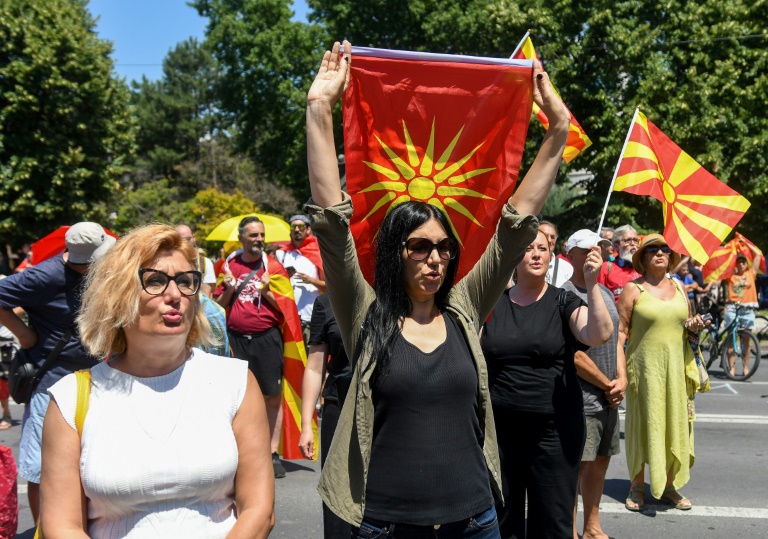
Protests have been growing in recent weeks in North Macedonia, with the country’s opposition rallying thousands to fight back against any new compromises with Bulgaria and the EU. 

“Throughout the Western Balkan nations, Euro enthusiasm is dropping very sharply,” said Pendarovski.

“Speaking precisely about North Macedonia, in the past 18 months we have seen a drop of 25 percent.”

But abandoning a European future would leave countries like North Macedonia, with its population of just 1.8 million, particularly vulnerable to geopolitical headwinds in an increasingly polarised world, Pendarovski argued.

If North Macedonia and other Balkan countries remain outside the EU, then the region will be a “soft spot” vulnerable to penetration by “malign powers”, including Russia, said Pendarovski.

But the longer they wait to join the bloc, the more anti-European voices gain traction and fan the flames of unrest in places like North Macedonia. 

“I am afraid that maybe some populist movements will come to power and some anti-European leaders will take power in Skopje and that’s certainly not going to be good for the pan-European idea,” said the president.

– A new deal –

Since declaring independence from Yugoslavia in 1991, North Macedonia has faced a litany of obstacles from its Balkan neighbours over historical grievances. 

Despite the hurdles, the country pressed on in its fight for international acceptance, culminating with the official change of its name in 2018 to settle a decades-long dispute with Greece that cleared the path to NATO membership. 

But the door to the EU remained firmly closed, thanks to a brief delay initiated first by France followed by an outright veto from Bulgaria over a raft of disputes involving history and language. 

The unexpected move by Sofia was a heavy blow for many in North Macedonia. 

And even as governments came and went in both Sofia and Skopje, North Macedonia’s pathway to the EU remained blocked. 

The weekend’s agreement has offered a way forward through a range of measures including constitutional changes and amendments to North Macedonia’s education curriculum on certain historical points. 

But even with the start of talks, the ruling government faces a political minefield ahead. 

Lacking a two-thirds majority to amend the constitution, the agreement will likely stall in parliament, possibly triggering more political infighting and fuelling new bouts of unrest.

“While the temptation might be great to push through a bad deal now to bring movement in the already stuck process, the proposal as it stands now is likely to achieve the opposite, more stagnation, more frustration, and even destabilisation,” wrote North Macedonia’s former foreign minister Nikola Dimitrov and analyst Florian Bieber in an editorial published last week.

In the capital Skopje, protesters have been taking to the streets for weeks, and members of the right-wing opposition and leftists have joined forces to block any new compromise. 

“We do not know what to say anymore, how many more agreements will there be?” said protester Marjanco Stoilkovski, 48, outside the parliament in Skopje during a recent demonstration. 

“We have changed the name and now they are asking for something else,” added Skopje resident Vesna Nikolova. “It is very humiliating.”

Court battle to open in Musk, Twitter buyout fight

Elon Musk and Twitter will face off Tuesday in the first court hearing over the Tesla chief’s move to abandon their $44 billion buyout deal, a case with massive stakes for both sides.

Twitter wants a judge to force Musk to complete the purchase, which he is trying to scrap over his allegations the social media platform misled him about its tally of fake accounts.

Billions of dollars are at stake, but so is the future of the platform that Musk has said should allow any legal speech, an absolutist position that has sparked fears the network could be used to incite violence.

The hearing in the eastern state of Delaware is set to include arguments over Twitter’s push for a September trial date, which is aimed at limiting the uncertainty plaguing the firm.

“Questions have been raised about Twitter’s future, and they don’t want this to drag on for very long,” said Carl Tobias, a University of Richmond law professor. 

Musk’s legal team has filed papers arguing that date is far too soon for such a complex matter, and instead proposed mid-February.

Twitter lawyers noted the deal is supposed to close toward the end of October, just six months after Musk launched an unsolicited bid that the company’s board first resisted but then supported.

The world’s richest person has backed away from the deal in recent months as tech stocks have tumbled, and Twitter’s value has fallen well below the $54.20 per share he offered.

– Musk willingness to fight –

Rather than Silicon Valley, where Twitter is based, the company has lodged its lawsuit against Musk in Delaware.

The firm is incorporated in the tiny state like scores of other companies, and the case will happen in the Delaware Chancery Court that has deep experience in business disputes.

“The Chancery Court, which handles most of these matters, is very expert in corporate law, and more particularly, mergers and acquisitions. So this is the place to go,” Tobias added.

Kathaleen McCormick, the judge overseeing the case, comes with a no-nonsense reputation.

She also reportedly has the distinction of previously ordering a reluctant buyer into completing a corporate merger.

A forced closing of the Twitter deal is a scenario that some analysts consider possible.

“(Wall) Street and legal experts across the board view Twitter as having a ‘strong iron fist upper hand,’ heading into the Delaware court battle after months of this fiasco and nightmare,” analyst Dan Ives wrote last week.

He also noted less likely options include Musk paying a $1 billion breakup fee and being able to walk away, or winning outright on his fake-account argument.

After pausing the deal in May, Musk’s lawyers announced in July he was “terminating” the agreement because of skepticism over Twitter’s false or spam accounts tally and allegations the firm was not forthcoming with details.

Tuesday’s hearing will be just the first step in what could be a lengthy legal fight that could end in a trial, but also a settlement.

“Musk has shown his willingness to take things all the way to the end in Delaware court,” said Adam Badawi, a University of California at Berkeley law professor.

“I think settling is not necessarily his instinct.”

Court battle to open in Musk, Twitter buyout fight

Elon Musk and Twitter will face off Tuesday in the first court hearing over the Tesla chief’s move to abandon their $44 billion buyout deal, a case with massive stakes for both sides.

Twitter wants a judge to force Musk to complete the purchase, which he is trying to scrap over his allegations the social media platform misled him about its tally of fake accounts.

Billions of dollars are at stake, but so is the future of the platform that Musk has said should allow any legal speech, an absolutist position that has sparked fears the network could be used to incite violence.

The hearing in the eastern state of Delaware is set to include arguments over Twitter’s push for a September trial date, which is aimed at limiting the uncertainty plaguing the firm.

“Questions have been raised about Twitter’s future, and they don’t want this to drag on for very long,” said Carl Tobias, a University of Richmond law professor. 

Musk’s legal team has filed papers arguing that date is far too soon for such a complex matter, and instead proposed mid-February.

Twitter lawyers noted the deal is supposed to close toward the end of October, just six months after Musk launched an unsolicited bid that the company’s board first resisted but then supported.

The world’s richest person has backed away from the deal in recent months as tech stocks have tumbled, and Twitter’s value has fallen well below the $54.20 per share he offered.

– Musk willingness to fight –

Rather than Silicon Valley, where Twitter is based, the company has lodged its lawsuit against Musk in Delaware.

The firm is incorporated in the tiny state like scores of other companies, and the case will happen in the Delaware Chancery Court that has deep experience in business disputes.

“The Chancery Court, which handles most of these matters, is very expert in corporate law, and more particularly, mergers and acquisitions. So this is the place to go,” Tobias added.

Kathaleen McCormick, the judge overseeing the case, comes with a no-nonsense reputation.

She also reportedly has the distinction of previously ordering a reluctant buyer into completing a corporate merger.

A forced closing of the Twitter deal is a scenario that some analysts consider possible.

“(Wall) Street and legal experts across the board view Twitter as having a ‘strong iron fist upper hand,’ heading into the Delaware court battle after months of this fiasco and nightmare,” analyst Dan Ives wrote last week.

He also noted less likely options include Musk paying a $1 billion breakup fee and being able to walk away, or winning outright on his fake-account argument.

After pausing the deal in May, Musk’s lawyers announced in July he was “terminating” the agreement because of skepticism over Twitter’s false or spam accounts tally and allegations the firm was not forthcoming with details.

Tuesday’s hearing will be just the first step in what could be a lengthy legal fight that could end in a trial, but also a settlement.

“Musk has shown his willingness to take things all the way to the end in Delaware court,” said Adam Badawi, a University of California at Berkeley law professor.

“I think settling is not necessarily his instinct.”

Ghana IMF loan outcry pressures government over economy

Ghanaian trader Mohammed Biney was already struggling when the government passed a new tax on electronic money transactions this year to try to revive the economy.

With Ghana now buckling under nearly 30 percent inflation, the Accra shoe seller was shocked when the government announced in July it would have to seek help from the IMF.

President Nana Akufo-Addo once promised “Ghana Beyond Aid” to keep his West African country off foreign aid dependency.

But a sudden U-turn over an IMF credit has sparked fierce debate over his economic management as Ghana struggles with the highest costs of living in two decades.

“You can’t impose taxes on us under the guise of saving the economy and then overnight come and tell us you’re going to the IMF,” trader Biney told AFP.

“I think they ran out of ideas.” 

Hit by the global pandemic and fallout from the Russian war in Ukraine on fuel and food prices, Ghana is in talks with International Monetary Fund to help stabilise its public finances.

But the decision prompted fears IMF-imposed austerity measures will force the end to Akufo-Addo’s social programmes and hurt Ghanaians already struggling with soaring costs.

A new opposition-led protest movement and unions threatening strikes over hardships have added pressure on the government just as an IMF team begins initial talks.

Saddled with heavy debt, limited access to fresh funds and few revenue options, the government says the IMF offers short-term help.

Ghana’s Deputy Finance Minister Abena Osei-Asare said after the pandemic eroded economic gains, the IMF deal would help with balance of payments and open the door to new financing while protecting social programmes.

“People don’t have an understanding of the sort of engagement we’re going to have with the IMF that’s why they are a bit apprehensive,” she told AFP.

– Soaring inflation –

Ghana’s economic data is not rosy. Growth slowed this year while inflation broke two decade highs at 29.8 percent in June, driven by transport and food costs.

Ghana’s debt to GDP ratio — a measure of what it owes against what it produces — rose from 65 percent to 80 percent during the pandemic, the IMF says.

Moody’s credit agency in February downgraded its outlook on Ghana’s bonds, citing the government’s liquidity and debt challenges.

“Ghana’s fiscal and debt vulnerabilities are worsening fast amid an increasingly difficult external environment,” the IMF said after the team’s visit this month.

“An IMF-supported program aims to provide space for Ghana to implement policies.”

This deal will be the 18th time Ghana has gone to the IMF after completing a three-year accord in 2019 which saw $918 million in support.

Just in May, Finance Minister Ken Ofori-Atta said an IMF deal was not an option, with the government preferring “home-grown” solutions. 

One of those, Ghana’s new electronic transaction tax or E-levy, was meant to help raise $900 million in much-needed revenue along with spending cuts.

But the tax was widely criticised and as people curtailed electronic payments, the E-levy has also fallen far short of revenue estimates.

Gabby Otchere-Darko, a leading ruling party member, tweeted in June the tax had only generated 10 percent of estimated revenues. 

“Given the situation that we find ourselves… we have no option,” John Kwakye, the director of research at the Accra-based IEA think tank, said of the IMF deal. 

“Going to the IMF was to build on our credibility.”

– Electoral fallout? –

But even with elections still two years away, an IMF deal will likely have political fallout.

Teaching unions went on strike earlier this month until the government agreed to cost of living allowances. Other public sector workers are threatening action.

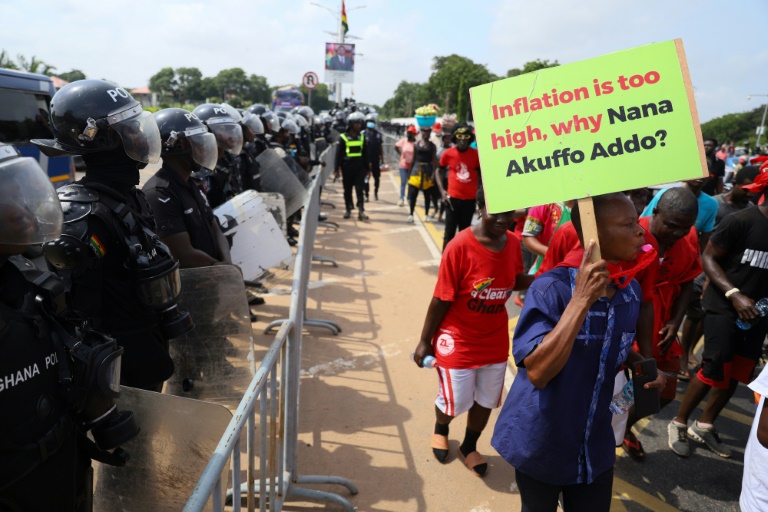
A “Fix the Country” movement, which holds regular if small protests, has been joined by another group “Arise Ghana”. Last month its rally over economic hardships led to clashes with the police.

“The solution to Ghana’s problems doesn’t lie in Washington,” Yaw Baah, Secretary General of the Trades Union Congress (TUC) said. “This is a tragic mistake by the government.” 

Eurasia Group’s Africa head Amaka Anku told clients the IMF programme will make it harder for Akufo-Addo’s New Patriotic Party to argue they are better economic managers. 

That may weaken the position of likely NPP candidate for 2024 Vice President Mahamudu Bawumia though his probably opponent National Democratic Congress or NDC leader and ex-president John Mahama also faces challenges.

“Bottom-line, this makes for a very close election in 2024,” Anku said.

Already the opposition has hit out.

“President Akufo-Addo and Dr. Mahamudu Bawumia should take full responsibility for incompetently managing the economy,” said NDC lawmaker Haruna Iddrisu.  

“The government must come clean and tell us what the people of Ghana should expect instead of blaming Ukraine and Russia.”

Close Bitnami banner
Bitnami