Africa Business

Congolese warlord Ntaganda to serve sentence in Belgium

Convicted Congolese warlord Bosco Ntaganda has been transferred from the International Criminal Court to Belgium to start a 30-year sentence for war crimes, the tribunal said Wednesday.

Ntaganda, 49, dubbed the “Terminator”, was convicted by the ICC in 2019 of leading a reign of terror in the northeastern Democratic Republic of Congo in the early 2000s.

“Mr Bosco Ntaganda was transferred to… the Kingdom of Belgium to serve his sentence of imprisonment at the Leuze-en-Hainaut prison,” the Hague-based ICC said in a statement.

Belgium is the former colonial power of the DRC.

“The ICC relies on the support from states for the enforcement of its sentences and is highly appreciative of the voluntary cooperation of the Belgian government in this case,” the court’s registrar Peter Lewis said.

The Rwandan-born Ntaganda was convicted of five counts of crimes against humanity and 13 counts of war crimes, including murder, sexual slavery, rape and using child soldiers.

Ntaganda was the first person to be convicted of sexual slavery by the court. Many of the other charges related to massacres of villagers in the mineral rich Ituri region of DR Congo.

Prosecutors portrayed him as the ruthless leader of ethnic Tutsi revolts amid the civil wars that wracked the DRC after the 1994 genocide of Tutsis in neighbouring Rwanda.

Formerly a Congolese army general, Ntaganda became a founding member of the M23 rebel group, which was eventually defeated by Congolese government forces in 2013.

Later that year he became the first-ever suspect to surrender to the ICC, when he walked into the US embassy in the Rwandan capital Kigali.

Ntaganda — known for his pencil moustache and a penchant for fine dining — insisted that the “Terminator” nickname, referring to the films starring Arnold Schwarzenegger as a relentless killer robot, did not apply to him.

Ntaganda’s sentence was upheld on appeal last year.

Activists file case against Meta over Tigray hate posts

An Ethiopian man whose father was murdered during the country’s war has joined a lawsuit against Meta that is seeking $1.6 billion from Facebook’s parent company for allegedly fanning hate speech in Africa. 

The case filed in Kenya’s High Court on Wednesday by two individuals and a rights group says Meta responded inadequately to hateful content on its platform, especially in relation to the war in Ethiopia’s northern Tigray region.

One petitioner said his father, an ethnic Tigrayan, had been targeted by racist messages on Facebook before his murder in November 2021, and the social media giant had failed to move quickly to remove these posts.

“If Facebook had just stopped the spread of hate and moderated posts properly, my father would still be alive,” said Abrham Meareg, who is also Tigrayan and an academic like his father.

“I’m taking Facebook to court so no one ever suffers as my family has again. I’m seeking justice for millions of my fellow Africans hurt by Facebook’s profiteering –- and an apology for my father’s murder.”

His lawyer, Mercy Mutemi, said Facebook took a month to respond to Abrham’s appeals for the content to be taken down. 

“Why did it take over a month to take down a post that calls for the murder of somebody?” she said.

Mutemi said Facebook acknowledged the content violated community standards but a year later one of the violent posts was still online.

Another petitioner is Fisseha Tekle, an Ethiopian researcher for Amnesty International and a Tigrayan, who has written about the war and faced a torrent of online abuse.

The international community has condemned hate speech and dehumanising rhetoric during the two-year conflict, which has seen all sides accused of atrocities amid warnings of ethnic cleansing.

– ‘Inhumane’ working conditions –

Meta spokesperson Ben Walters said the company was yet to be served with the lawsuit, but had “strict rules which outline what is and isn’t allowed on Facebook and Instagram.”

“We’ve removed misinformation when there is a risk it may contribute to physical harm for a long time,” he told AFP in a statement. 

“In Ethiopia, we have identified and are removing a number of pre-reviewed harmful claims and out of context imagery that make false allegations about the perpetrators, severity or targets of violence in Ethiopia.”

The Katiba Institute, a Kenyan rights group and another petitioner to the lawsuit, is seeking changes to Facebook’s algorithm.

Inciteful, hateful and dangerous posts “spark conversation, attract reactions and shares as well as motivate back-and-forth discussion in the comments section,” read the petition seen by AFP.

It also accused Meta of “inhumane” working conditions for its overstretched content moderators in Nairobi tasked with overseeing eastern and southern Africa, a vast region covering 500 million people.

The petitioners claim this resulted in “systematic discrimination” against African Facebook users, citing the platform’s swift response by comparison to the attack on the US Capitol by supporters of former US president Donald Trump on January 6, 2021.

The petitioners are asking the court for the establishment of a 200-billion Kenyan shillings ($1.6-billion) compensation fund for victims of hate and violence incited on Facebook.

In late 2021, Rohingya refugees sued Facebook for $150 billion, claiming the social network failed to stem hate speech directed against them.

The Rohingya, a mainly Muslim minority, were driven from Myanmar in 2017 into neighbouring Bangladesh by security forces in a crackdown now subject to a UN genocide investigation.

AFP is involved in a partnership with Meta providing fact-checking services in Asia-Pacific, Europe, the Middle East, Latin America and Africa.

Once a star, Ghana battles economic crisis

The packing machine at Nakobs’ Pac factory in the outskirts of Ghana’s capital Accra is running at full pace, churning out sachets of treated drinking water.

But all is not well at Nakobs’. Like other small businesses in Ghana these days, owner Daniel Tekyi is struggling.

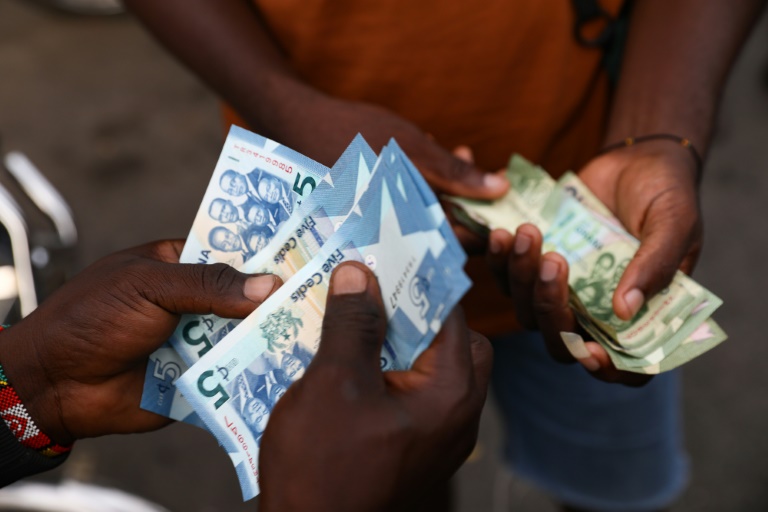
With inflation at over 50 percent, the currency worth half what it was last year, fuel prices doubling and debt payments gobbling up more than half the government’s revenues, Ghana is battling its worst economic crisis in decades.

Ghana signed a $3 billion bailout deal with the International Monetary Fund on Tuesday in a bid to shore up public finances, but economic stability is still a way off.

“It would be better for us to close the factory,” said Tekyi. “We really don’t know when this crisis is going to end.”

Once applauded as a rock of economic stability and security in a region plagued by coups and jihadist wars, Ghana has steadily lost investor confidence.   

Like much of the continent, Ghana slowly emerged from the pandemic only to face the fallout of the war in Ukraine and the surge in fuel and food costs.

Facing a crunch in payments, President Nana Akufo-Addo this year reversed course from his “Ghana Beyond Aid” concept and entered talks with the IMF for a bailout.

Already, the government has announced a 2.5 percent increase in VAT and a freeze on public worker hires to help cut costs and hike revenues. A debt restructuring is underway.

With an IMF team in Accra, Finance Minister Kenneth Ofori-Atta promised the credit deal, debt swap and a reform package would restore investor confidence and steer the economy out of “grave times”.

But many Ghanaians are bracing for potential austerity before any stability returns, with the impact of new taxes and spending cuts.

How Ghana’s government emerges may also have political fallout. Elections are two years away with Akufo-Addo stepping aside and ruling New Patriotic Party or NPP allies already jostling for position for primaries in early 2023.

The government has to find ways to mitigate any impact from reforms, especially on public sector employment and high taxes, economist Daniel Anim Amarteye said. 

“If that is not done, it could be politically fatal,” he said.

– Dimmed star –

Ghana’s economic story was brighter a few years ago. Before the pandemic, the West African state was a star with fast growth rates, growing oil production and strong investor interest.

But its high level of debt was a looming problem. 

Since the start of the year, its cedi currency has lost half its value, which has helped increase its debt burden by $6 billion, with warnings Ghana risked a default.

A major part of the IMF agreement is bringing the country back to debt sustainability through a restructuring, calling on investors to exchange bonds for new ones maturing later. 

IMF approval of the $3 billion loan will depend on its success. Officials say they have the means to help offset any impact on local banks or pension funds — major holders of domestic bonds.

But Ghana’s major labour movement, the Trades Union Congress, is already rumbling over the deal’s potential impact on workers’ pensions. 

Opposition National Democratic Congress has been quick to blame Akufo-Addo’s government for ballooning debt, even trying and failing to censure the finance minister.  

“No matter how the IMF programme turns out and how they can turn the corner, the records will show that they took us to 40 percent inflation, the records will show the market was closed to us, the markets will show the cedi depreciated 54 percent,” said NDC lawmaker Isaac Adongo.

Akufo-Addo’s government spent heavily on social programmes such as free high schools. But his ruling New Patriotic Party says the crisis is all about external shocks — Covid and Russia’s war in Ukraine.

“Assuming Covid didn’t happen, what would our story be?” NPP communications director Richard Ahiagbah told AFP.

– Daily struggle –

Testifying before parliament last month, Ofori-Atta apologised to Ghanaians for their pain, but officials dismissed NDC charges of mismanagement.

But political calculations are not a luxury Patience Tesonkeh can afford. 

Stung by the soaring price of cooking gas, the single mother switched to cheaper charcoal to cook. Her usual weekly shopping budget no longer stretches to all her family’s needs.

“I withdrew 300 cedis ($20) thinking I would get everything I needed but I couldn’t,” she said on a recent trip to buy rice, fish and yams at a market in her Accra neighbourhood.

Unionised traders and shopkeepers in the capital also closed their businesses last month in a three-day protest over rising living costs.

For factory owner Tekyi the numbers just don’t add up. Production and transport now total 5.8 cedis per water bag. But he can only sell them for five. 

“We planned closing our factory because we are not making any profit,” he said.

“But we had a second thought that if we close and we lay off our workers, how can they also survive? So for now, we are producing and making a loss.”


S.African opposition vow to pursue Ramaphosa over scandal

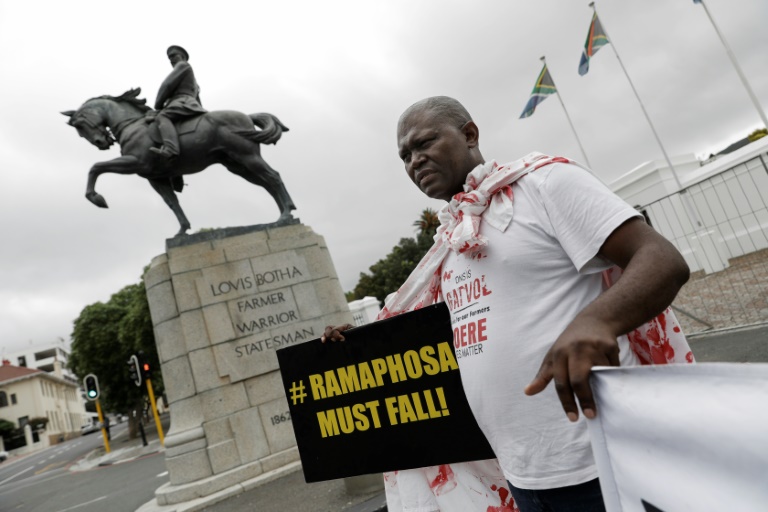
South African opposition parties vowed Wednesday to challenge a vote in parliament that rejected an impeachment inquiry against President Cyril Ramaphosa that could have forced his removal from office.

Ramaphosa, 70, on Tuesday easily survived a vote in the National Assembly that could have initiated proceedings to remove him from office over allegations he concealed a theft of several million dollars at his cattle and game farm in 2020.

Lawmakers voted 214 to 148 against proceeding with an inquiry that critics feared could politically destabilise Africa’s most industrialised country.

But South Africa’s opposition parties vowed not to let the case die, saying they would challenge the decision.

The African Transformation Movement, which tabled the motion that led to the creation of an inquiry panel that concluded Ramaphosa may be guilty of misconduct, said it would appeal to the high court in Cape Town on Monday.

“The decision by parliament not to investigate, we view that as irrational,” party leader Vuyolwethu Zungula, told AFP.

“We are going to court to challenge the decision,” he added.

The Democratic Alliance, the country’s main opposition party, said it was weighing its legal and parliamentary options.

“We are not prepared to allow the matter to just simply go without any further exploration,” party lawmaker Siviwe Gwarube told AFP.

Economic Freedom Fighters, a leftist group and the second largest opposition party, called for a “judicial review on an urgent basis” of the parliament’s vote, dismissing the open ballot system as “flawed and characterised by fear”.

Ramaphosa — championed as a graft-busting saviour after his corruption-stained predecessor Jacob Zuma — survived Tuesday’s vote thanks to support from the African National Congress (ANC) that has ruled South Africa since the end of Apartheid.

The ANC holds 230 of the National Assembly’s 400 seats.

The scandal began when a former spy boss filed a complaint with police in June, accusing Ramaphosa of having the burglars kidnapped and bribed into silence instead of reporting the matter to the authorities.

The president has not been charged with any crime and has denied wrongdoing. He did acknowledge the theft of $580,000 in cash that was stashed under sofa cushions at his farm — a safer place, his employees said, than the office safe.

Dirty Durban ocean waters vex South Africa tourist trade

Untreated sewage flowing into the Indian Ocean has hoteliers in tourist hotspot Durban up in arms as South Africa gears up for the holiday season. 

The city’s sewer system was badly damaged by deadly floods — the worst in living memory — that hit the southeastern KwaZulu-Natal province earlier this year. 

In April, Durban shut all beaches after high levels of E.coli, a bacteria that can cause diarrhoea, fever and vomiting, were found in the water. 

Some started reopening in July but as of Wednesday, with the southern hemisphere’s summer knocking on the door, water readings from four of about two dozen beaches still showed critically high levels of E.coli.

Popular for its idyllic beaches and game and nature reserves, Durban — South Africa’s third-largest city — is usually a magnet for both local and international tourists. 

“The reaction from the municipality has been at a snail’s pace,” said Brett Tungay, a leader of hospitality trade group FEDHASA. 

“Resorts and hotels have taken a huge impact. And of course that then has knock-on effects on all the restaurants and tourism activities in the city.”

The floods, in which more than 400 people died, added to years of disrepair, according to Janet Simpkins, director of environmental group Adopt a River. 

“Sewer lines and infrastructure have not been maintained. Upgrades have not been done. And so our entire sewer system is overburdened,” she said.

Earlier this month the opposition Democratic Alliance challenged the mayor to take a dip at a beach the party said was prematurely re-opened. 

Mayor Mxolisi Kaunda of the ruling African National Congress (ANC) did go for a swim, but at a different beach. 

Authorities in eThekwini, the municipality that includes Durban, said this week they have been fixing sewerage pump stations and one of the water treatment plants causing the problem. 

“The repair work to our sanitation infrastructure is progressing very well,” eThekwini spokesman Msawakhe Mayisela told AFP. “There is a huge likelihood that all beaches will be open soon.”

Mayisela said the health of the public was the city’s priority adding it had moved “with speed” to start repairs after the floods.

“Our city is open for business,” Mayisela said.

Dirty Durban ocean waters vex South Africa tourist trade

Untreated sewage flowing into the Indian Ocean has hoteliers in tourist hotspot Durban up in arms as South Africa gears up for the holiday season. 

The city’s sewer system was badly damaged by deadly floods — the worst in living memory — that hit the southeastern KwaZulu-Natal province earlier this year. 

In April, Durban shut all beaches after high levels of E.coli, a bacteria that can cause diarrhoea, fever and vomiting, were found in the water. 

Some started reopening in July but as of Wednesday, with the southern hemisphere’s summer knocking on the door, water readings from four of about two dozen beaches still showed critically high levels of E.coli.

Popular for its idyllic beaches and game and nature reserves, Durban — South Africa’s third-largest city — is usually a magnet for both local and international tourists. 

“The reaction from the municipality has been at a snail’s pace,” said Brett Tungay, a leader of hospitality trade group FEDHASA. 

“Resorts and hotels have taken a huge impact. And of course that then has knock-on effects on all the restaurants and tourism activities in the city.”

The floods, in which more than 400 people died, added to years of disrepair, according to Janet Simpkins, director of environmental group Adopt a River. 

“Sewer lines and infrastructure have not been maintained. Upgrades have not been done. And so our entire sewer system is overburdened,” she said.

Earlier this month the opposition Democratic Alliance challenged the mayor to take a dip at a beach the party said was prematurely re-opened. 

Mayor Mxolisi Kaunda of the ruling African National Congress (ANC) did go for a swim, but at a different beach. 

Authorities in eThekwini, the municipality that includes Durban, said this week they have been fixing sewerage pump stations and one of the water treatment plants causing the problem. 

“The repair work to our sanitation infrastructure is progressing very well,” eThekwini spokesman Msawakhe Mayisela told AFP. “There is a huge likelihood that all beaches will be open soon.”

Mayisela said the health of the public was the city’s priority adding it had moved “with speed” to start repairs after the floods.

“Our city is open for business,” Mayisela said.

Pope says spend less on Christmas, give to Ukraine

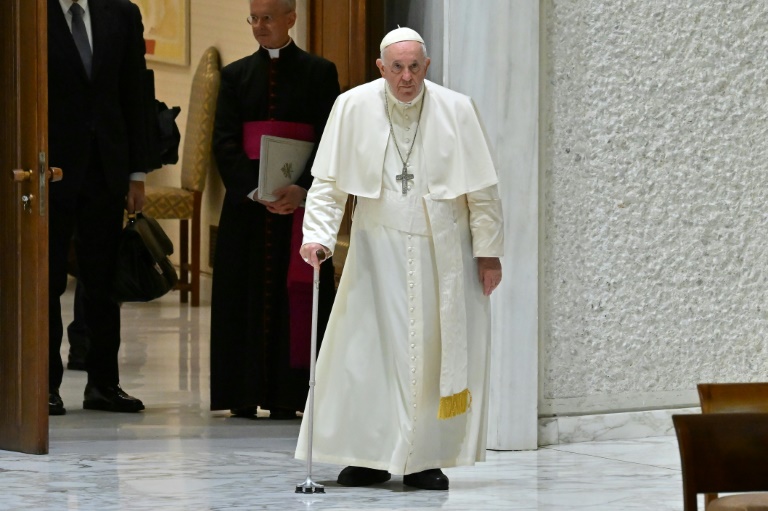
Pope Francis on Wednesday called on people to spend less on Christmas presents and celebrations, and donate the money saved to those in war-ravaged Ukraine.

“It is nice to celebrate Christmas. But let’s lower the level of Christmas spending a bit,” Francis said in his weekly general audience at the Vatican.

“Let’s have a more humble Christmas, with more humble gifts. Let’s send what we save to the Ukrainian people, who need it,” he said.

Nearly 10 months into the war, hardship from the fighting has compounded as winter sets in and Russia pounds Ukraine’s energy infrastructure.

Missile strikes have been crippling — resulting in the periodic loss of electricity, heating, water and phone service across swathes of Ukraine.

The Ukrainians “are suffering so much. They are hungry, cold. So many people are dying because there are no doctors or nurses,” the pope said.

On Tuesday, Ukraine’s Western allies pledged an additional one billion euros ($1.1 billion) in emergency winter aid to help the country withstand Russia’s onslaught.

Rolling red carpet to Africans, US warns of 'destabilizing' China, Russia

The United States warned Tuesday that China and Russia were destabilizing Africa with their growing inroads as it rolled out the red carpet to the continent’s leaders and pledged billions of dollars in support.

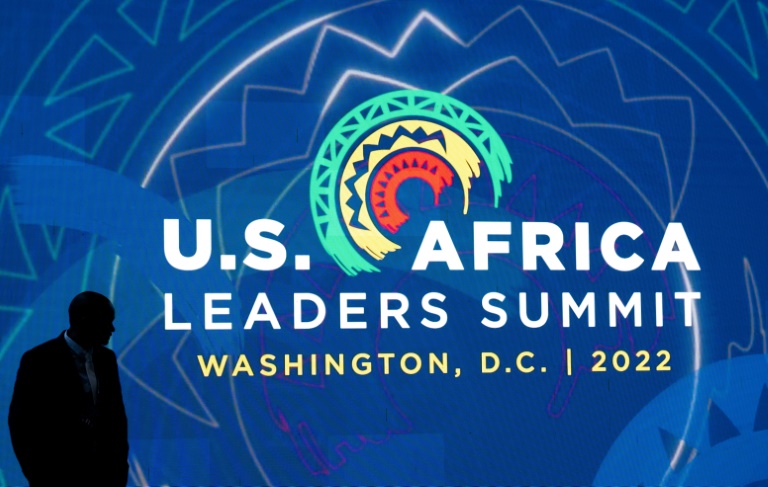
Forty-nine African leaders flew into the Washington cold for the first continent-wide summit with the United States in eight years as President Joe Biden seeks to use personal diplomacy to win back influence.

Defense Secretary Lloyd Austin, at a panel with several African presidents at the start of the three-day summit, charged that US rivals had a different approach.

Austin said China was expanding its footprint in Africa “on a daily basis” through its growing economic influence.

“The troubling piece there is they’re not always transparent in terms of what they’re doing and that creates problems that will be eventually destabilizing, if they’re not already,” Austin said.

Russia was “continuing to peddle cheap weapons” and deploying “mercenaries across the continent,” he added.

“And that is destabilizing as well.”

But the Biden administration has been careful not to present Africans with an us-or-them choice, believing it is futile to try to turn the tide on China’s massive infrastructure spending.

– Health and space cooperation –

Biden plans to unveil $55 billion for Africa over three years. In one of the first announcements, the White House said the United States would invest $4 billion by the 2025 fiscal year to train African health workers, a rising priority for Washington since the Covid-19 pandemic.

The summit also brought in NASA, with Nigeria and Rwanda becoming the first African nations to sign the Artemis accords, a US-led bid for international cooperation on traveling to the Moon, Mars and beyond.

The Artemis accords, which already include European allies, Japan and several Latin American powers, come as China rapidly expands its own lunar program and as tensions with Russia threaten its post-Cold War work with the United States on space.

China has rejected criticism of its role in Africa, with its ambassador in Washington, Qin Gang, saying the continent should not be a place for “major powers’ competition.”

In Beijing, Chinese foreign ministry spokesman Wang Wenbin told reporters on Wednesday that Washington “should respect the will of the African people and take concrete actions to help Africa’s development, instead of concentrating its efforts on smearing and attacking other countries.”

The US-Africa summit is the first since Barack Obama invited leaders in 2014, with his successor Donald Trump making no secret of his lack of interest in Africa.

Security remains a major focus of the United States, which has used the summit to focus on some of the continent’s hotspots.

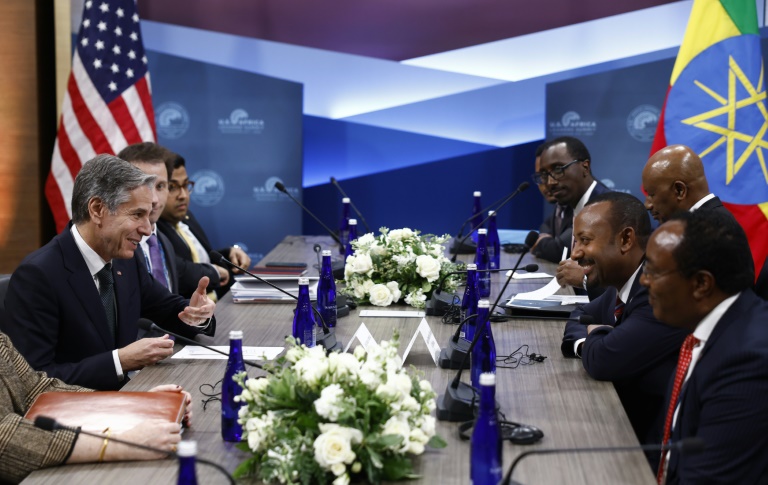
Ethiopian Prime Minister Abiy Ahmed, a onetime US ally whose relations with Washington soured sharply over the Tigray war that broke out two years ago, paid his first visit to Washington since the conflict.

Meeting him inside central Washington’s convention center, Secretary of State Antony Blinken voiced hope over an agreement signed last month in South Africa between Ethiopia’s government and Tigrayan rebels.

“We have, I think, a historic moment for the country,” Blinken told him.

– Climate and security –

The United States also announced another $411 million in assistance for Somalia where a new assessment found “catastrophic” hunger, even though the United Nations said aid has averted a full-blown famine.

The Horn of Africa has been devastated by five consecutive failed rainy seasons, with Somalia already struggling after decades of turbulence and Al-Shabaab jihadist rebels.

“These climate shocks have weakened the society,” Somali President Hassan Sheikh Mohamud said, ahead of expected announcements by Biden on climate efforts in Africa.

Democratic Republic of Congo President Felix Tshisekedi, in talks with Blinken, blamed climate change for floods that have killed some 100 people in the capital Kinshasa.

In Somalia, Mohamud also claimed successes against the rebels, days after Somali forces seized the key town held by jihadists since 2016 with the help of US air strikes and an African Union force.

But he warned that military means alone were insufficient.

“I have been telling my colleagues today that engaging with the society and the community is what makes these terrorists like a fish that has run out of water; they cannot exist without a community,” he said.

The Biden administration has stressed working with the African Union, both on the security and diplomatic fronts.

Biden during a speech Wednesday is expected to outline US support for the African Union to gain a formal berth in the Group of 20 club of major economies, months after he threw support behind a permanent African seat on the UN Security Council.

African Union chief Moussa Faki Mahamat hailed US support but warned that there was still far more focus on fighting extremists in the Middle East.

“This double standard has had disastrous consequences for Africa and for peace and democracy in the world,” he said.

DR Congo Tutsis face threats, prejudice amid rebel crisis

Sitting in a small courtyard in Goma, eastern DR Congo, a 55-year-old Tutsi woman joked darkly that she would be killed if she spoke under her real name. 

She fled to the city last week after a militia leader known as General Janvier, an opponent of the Tutsi-led M23 rebel group, arrived in her town of Kitschanga.

“We saw children with machetes and guns saying they’d come to kill the Tutsis,” said the woman, in a poor Goma neighbourhood of clapboard houses on the Rwandan border. 

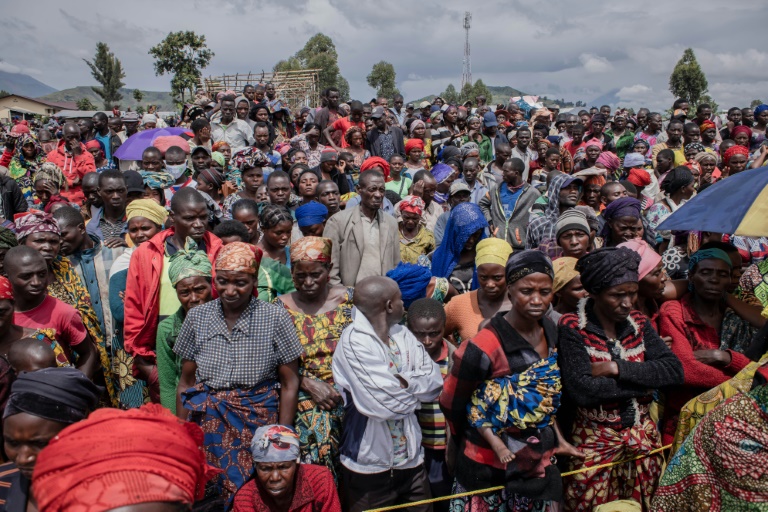
The M23 has advanced across North Kivu province in recent weeks, winning victories over the army as well as other militias and forcing hundreds of thousands to flee in its wake. 

The Democratic Republic of Congo accuses its smaller neighbour Rwanda of backing the M23, something UN experts and US officials agree with — although Kigali denies it.

Knife-edge tensions have escalated pressure on Congolese Tutsis, whose history is contested in the central African nation. 

Many assume that Tutsis support the M23, for example, or perceive them as Rwandan implants rather than native Congolese.

The government in Kinshasa has repeatedly argued against tribalism and stressed that the Rwandan government alone is to blame for the M23 crisis. 

But the reality in the east of the country, about a thousand miles (1,600 kilometres) from the capital, is often different. 

AFP interviewed six Congolese Tutsis who had recently arrived in Goma, mostly from Kitschanga in North Kivu’s Masisi territory. 

Five said they had fled death threats from militias.

“It hurts me,” said the 55-year-old Tutsi woman, who explained that all her relatives were Congolese but her children were accused of being Rwandans at school. 

“Our children ask us: What’s Rwanda?”

– Cut off your nose –

The sense of injustice is widely shared. A 36-year-old Tutsi mother of two, who’d also recently fled to Goma, told AFP she wanted the same rights as everyone else. 

She fiddled nervously with her wedding ring as she described why she left Kitschanga. “Militiamen notice your nose and threaten to cut it off with a knife,” she said. 

Tutsis are often stereotyped as having straight noses.

The woman — speaking in the Kinyarwanda language native to Rwandans as well as many Congolese Tutsis and Hutus — said militiamen also looted her home after she fled. 

“They say every Tutsi is an M23,” she said. “It’s terrible.”

The M23 first leapt to international prominence in 2012 when it captured Goma, before being driven out and going to ground. 

But the rebels took up arms again late last year, claiming the DRC had failed to honour a pledge to integrate them into the army. 

They’ve since seized swaths of territory and come within about 20 miles (12 kilometres) of Goma, a key hub of over a million people. 

The M23 advance has also driven a wave of virulent anti-Tutsi hate speech on social media, with calls for them to depart for Rwanda and worse.

Emmanuel Runigi Kamanzi, the president of a North Kivu livestock farmers’ association, said his Tutsi ancestors arrived in the region in the middle ages. 

“This is our home,” he added, decrying extremist attitudes  fanned by Mai-Mai militias and so-called Nyatura armed groups that claim to represent Congolese Hutus.

Nyatura means “those who strike mercilessly” in Kinyarwanda.

– ‘Uproot us’ –

In public statements, the M23 has frequently accused other armed groups as well as government forces of targeting Tutsis. 

But Lieutenant-Colonel Guillaume Ndjike, the Congolese army spokesman in North Kivu, said soldiers have not attacked Tutsis and that the allegations are “excuses put forward by the Rwandan army”. 

M23 fighters have themselves committed alleged atrocities. 

The rebels killed 131 civilians and raped 27 women and girls in two neighbouring villages in late November, according to a preliminary UN probe. 

Congolese Tutsi leaders have also condemned the M23. 

David Karambi, the president of a North Kivu Tutsi association, told reporters in December that recent massacres could not even be “committed by animals,” for example.

Many Congolese Tutsis interviewed by AFP said they felt unfairly blamed, and in danger.

In a Goma district where many Tutsis recently fled, a 27-year-old woman said Mai-Mai and Nyatura members had threatened “to kill us as they did to Tutsis in Rwanda”. 

“This war, it’s to uproot us,” she said, eyes downcast.

Youth of African diaspora consider climate solutions at US summit

A group of young Black Americans and their peers from African countries on Tuesday highlighted their common anxieties over climate change, shared as members of the global African diaspora. 

They were gathered at the African and Diaspora Young Leaders Forum in Washington, held on the sidelines of the Biden administration’s US-Africa Leaders Summit, in which some 50 leaders from the continent are participating this week. 

Michael Regan, the first Black American head of the US Environmental Protection Agency, called on the people in attendance to throw themselves into humanity’s fight against a warming world. 

“Young people have always been at the forefront of movements to change, and the environmental movement is absolutely no exception,” he said. 

“Your generation is leading the charge and fighting to secure a healthier, more just tomorrow.”

For activist Wafa May Elamin, society must “allow young people to really take charge” to tackle the “massive” climate challenges ahead. 

Elamin, a 30-year-old Sudanese-American, said she had been waiting for such an event for “a really long time” — the most recent iteration of this summit was organized eight years ago, during Barack Obama’s presidency. 

Other attendees of Tuesday’s meeting, which was organized by the National Museum of African American History and Culture, included Vice President Kamala Harris, the first Black, South Asian and female US vice president, and Ghanaian President Nana Akufo-Addo.

– ‘Guardians of our planet’ –

Speaking at the convention, actress and activist Sabrina Elba — a United Nations goodwill ambassador for the International Fund for Agricultural Development — said the environmental conservation of the immense African continent is especially close to the hearts of people whose ancestors came from Africa.

Elba recalled how her mother, who immigrated from Somalia to Canada, instilled in her a remembrance of their ancestral home: “As early as I can remember, she would say ‘give back, give back, give back, give back to the continent, so we can go back.'”

It was this relationship to Africa that inspired Elba — whose husband, the British actor Idris Elba, also spoke Tuesday — to get involved with the UN.

“It only took one visit back home to see a drought or famine or people really being affected by an issue that they have very little output towards,” she said. 

For her, the priority is to support the people living in areas in need of preservation.

“These people are the custodians of our planet,” she said.

– ‘Not a monolith’ –

But according to Elamin, funding for the fight against climate change is not distributed fairly. 

Regan acknowledged the unequal realities of working for a better planet.

“Countries should be required, in some way, shape or fashion, to ensure certain resources absolutely reach those who have been disproportionately impacted,” the EPA director said.

Jamaji Nwanaji-Enwerem, a doctor and assistant public health professor of environmental health at Emory University in Atlanta, was among those in attendance.

“African is not a monolith,” the 32-year-old said.

“So being able to just hear the stories and hear about other people’s experiences goes a long way in helping to develop solutions that are meaningful for all of us,” she explained. 

As the attendees discussed such possible solutions, Regan announced the United States would allocate $4 million for Peace Corps volunteers to work on projects combatting climate change in 24 Sub-Saharan African countries. 

“Are we doing enough? No. Should we be doing more? Yes, but in a democracy, it’s slow,” he said. 

Close Bitnami banner
Bitnami