Africa Business

US to ban Sudan officials who hold up post-coup transition

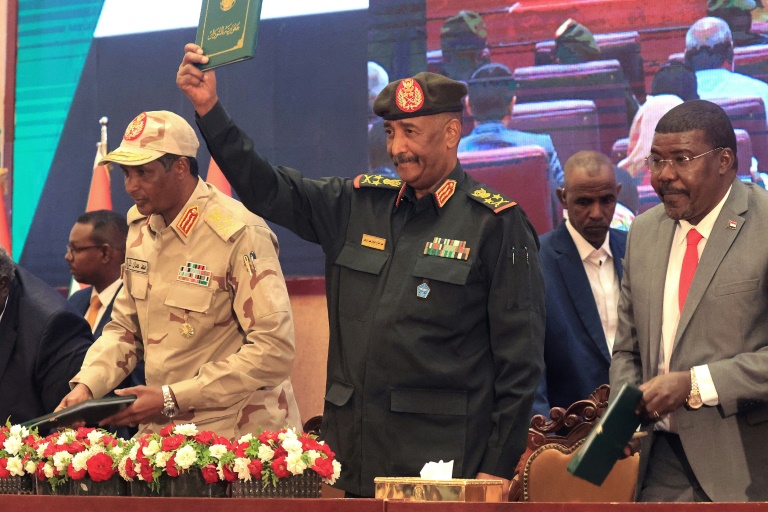
The United States said Wednesday it would bar visas to any current or former Sudanese officials who hold up a transition to democracy, hoping to boost a tentative deal between the military and civilians.

Secretary of State Antony Blinken voiced US support for the initial agreement announced Monday, which some pro-democracy protesters see as falling short on specifics and timelines.

“Recognizing the fragility of democratic transitions, the United States will hold to account spoilers — whether military or political actors — who attempt to undermine or delay democratic progress,” Blinken said in a statement.

The ban would also apply to immediate family members of any current or former officials targeted. The State Department did not list who would be affected.

“We once again call on Sudan’s military leaders to cede power to civilians, respect human rights and end violence against protesters,” Blinken said.

“At the same time, we urge representatives of Sudan’s civilian leaders to negotiate in good faith and place the national interest first.”

Longtime dictator Omar al-Bashir was ousted in April 2019 following massive youth-led protests but the army chief, Abdel Fattah al-Burhan, in October last year derailed the transition by carrying out a military coup.

The United States following the coup suspended $700 million in aid that was meant to help Sudan cope economically as it moves toward democracy.

The latest US step is an expansion of visa restrictions imposed during the first stage of Sudan’s democratic transition.

Killer of S.African anti-apartheid hero Hani freed on parole

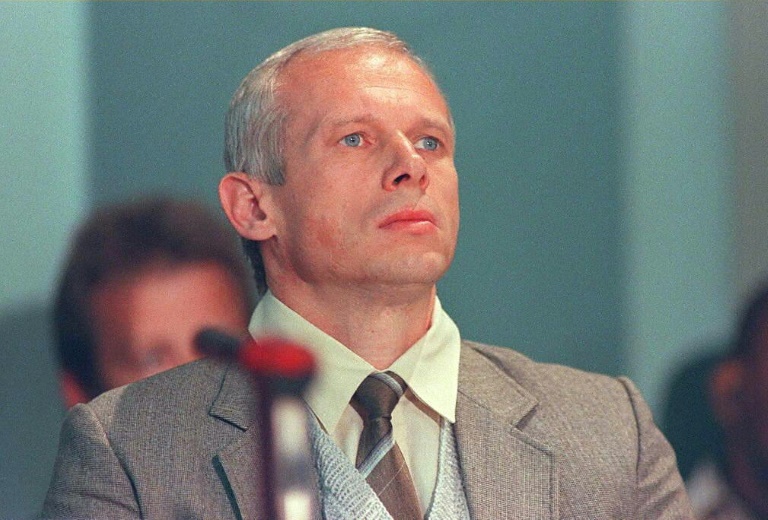
South Africa on Wednesday released on parole Janusz Walus, a far-right Polish immigrant who in 1993 assassinated anti-apartheid hero Chris Hani and nearly plunged the country into civil war.

His release — bitterly contested by groups that fought white-minority rule — had been postponed after he was stabbed by a fellow inmate inside prison.

Justice and Correctional Services Minister Ronald Lamola “has placed… Walus on parole under strict conditions with effect from Wednesday,” the government said in a statement. 

A spokesman confirmed that this meant the 69-year-old had been released, in line with a decision by the Constitutional Court.

“He will serve two years under community corrections in line with the parole regime upon which he is released,” the statement said.

Last month’s court decision was described as “diabolical” by Hani’s widow and unleashed angry protests by the ruling African National Congress (ANC) and its apartheid-era ally, the South African Communist Party, which Hani had led.

A week after the ruling, Walus was stabbed while queueing for food in the jail. 

His release, which according to the court order should have taken effect by December 1, was delayed while he received treatment.

Walus shot dead Hani, a hugely popular figure and fierce opponent of white rule, in the driveway of his home in eastern Johannesburg, and in front of his 15-year-old daughter. 

At that time, negotiations to end apartheid were entering their final phase. 

The murder led to protests and rioting in black townships, almost plunging South Africa into a race war. 

Then-ANC president Nelson Mandela appeared on national television to appeal for calm, a move that helped ease tensions and open the way to South Africa’s first multi-racial elections the following year.

“There is no question that offender Walus is a polarising figure in our budding constitutional democracy, and that his release has understandably re-opened wounds,” the ministry said.

His “actions sought to derail the democratic project at its most critical, formative stage,” it declared.

– ‘Sad day’ –

Hani’s widow, Limpho, declined to comment when contacted by AFP on Wednesday.

But a senior ANC official, Panyaza Lesufi, who is the premier of South Africa’s most populous province, Gauteng, said it was “a sad day” to hear that Walus had walked out of jail.

“That murderer doesn’t deserve to leave prison,” Lesufi told journalists. “He must go and rot where he will rot.”

Walus immigrated to South Africa from then-communist Poland in 1981 at the height of apartheid rule.

He and his accomplice Clive Derby-Lewis, who supplied the gun, were arrested soon after the attack.

The pair were sentenced to death but the punishment was later commuted to life imprisonment after the death penalty was abolished by the post-apartheid government.

Derby-Lewis was released in 2015 on medical parole after 22 years in jail. He died of lung cancer in 2016, aged 80.

Walus will serve his parole in South Africa, government declared. It is unclear if he will be allowed to return to Poland at the end of the two parole years. 

ANC has condemned “white supremacist and neo-Nazi groups in Poland” that had celebrated the parole decision.

Sao Tome PM believes 'extrajudicial executions' occurred after coup bid

The prime minister of the tiny West African state of Sao Tome and Principe said “extrajudicial executions” occurred after the army thwarted a coup last month.

“We have had, from our point of view, an attempted coup d’etat. The armed forces stopped this attempt,” Prime Minister Patrice Trovoada said during a visit to Portugal, the archipelago’s former colonial power.

“After the end of the operation, some hours afterwards, there were what we think were extrajudicial executions, the execution of people who were key witnesses,” he said in an interview published Wednesday by the Portuguese agency LUSA.

“At the very least, there was a failure in command. People placed under the responsibility of the armed forces cannot die — they are in detention,” he said.

After meeting Portuguese President Marcelo Rebelo de Sousa, Trovoada also said judicial investigators, who have requested help from Portugal, had been asked to produce a “preliminary report” on what happened by the end of the year.

The authorities have previously said four people were killed after military headquarters in the capital Sao Tome came under a gun attack on the night of November 24.

But images have circulated on social media purportedly showing several detainees being tortured by men in uniform.

The turbulent episode has rocked the reputation of Sao Tome, a nation off the coast of central West Africa, for stability since it gained independence in 1975.

– ‘Acts of treason’ –

On November 25, Trovoada said four people had been arrested after a six-hour gun battle at military headquarters.

Two other people, described by those detained as the “sponsors” of the attempted coup, were later arrested, he said.

They were opposition leader Delfim Neves, who is the outgoing speaker of the National Assembly, and a former mercenary and opposition figure named Arlecio Costa.

But two days afterwards, the armed forces chief of staff said three of the detainees had died of injuries following an “explosion,” as well as Costa, who had died after he “jumped from a vehicle”.

Twelve soldiers who “took part” in the attempted coup had also been arrested, the chief of staff said.

Neves was released on bail on November 30 and later held a press conference in which he said the accusations against him were a “sham” aimed at destroying him.

“The accuser (the fourth detainee) was left alive to say that Delfim Neves was one of the ringleaders behind this plot,” he charged.

Photos and videos have been circulating online, purportedly showing men in military uniform brutally interrogating and torturing three detainees. AFP has not been able to independently verify the images.

On December 1, the government ordered an investigation into allegations that soldiers committed “cruel, degrading and inhumane acts.”

Armed forces chief Olinto Paquete also announced he was resigning, saying he could not “accept such atrocities and acts of treason that harm the homeland.”

Mozambique ex-president's son, ex-spy bosses jailed for 12 years for graft

A Mozambican court on Wednesday sentenced two ex-spy bosses and the son of a former president to 12 years each for their part in a corruption scandal in which the government concealed huge debts, triggering financial havoc.

Among 19 defendants accused in the country’s biggest graft scandal were ex-president Armando Guebuza’s son, Ndambi Guebuza; former head of security and intelligence, Gregorio Leao; and an ex-economic intelligence chief who headed three state-owned firms that illicitly borrowed billions, Antonio do Rosario.

Eight defendants were acquitted while the rest were handed terms ranging between 10 and 12 years.

“The crimes committed have brought consequences whose effects will last for generations,” said Judge Efigenio Baptista, addressing a packed courtroom in the grounds of a high-security jail in the capital Maputo.

The scandal arose after state-owned companies in the impoverished country illicitly borrowed $2 billion (1.9 billion euros) in 2013 and 2014 from international banks to buy a tuna-fishing fleet and surveillance vessels. 

The money went directly to three companies managed by Rosaro, who called himself a “super CEO” during the trial.

The government masked the loans from parliament and the public. 

When the “hidden debt” finally surfaced in 2016, the International Monetary Fund (IMF) and other donors cut off financial support, triggering a sovereign debt default and currency collapse. 

An independent audit found $500 million of the loans had been diverted. The money remains unaccounted for.

– ‘Desire for luxury’ –

Handing down the sentences Baptista said the scam had “aggravated the impoverishment of thousands of Mozambicans.” 

“The country became famous for the worst reasons,” he said. “As high officials of the state they should have been (its) guardians.”

Leao and do Rosario were found guilty of embezzlement and abuse of power, while Guebuza was convicted for embezzlement, money laundering and criminal association, among other charges. 

Ex-president Guebuza, who had been in office when the loans were contracted, testified at the trial. 

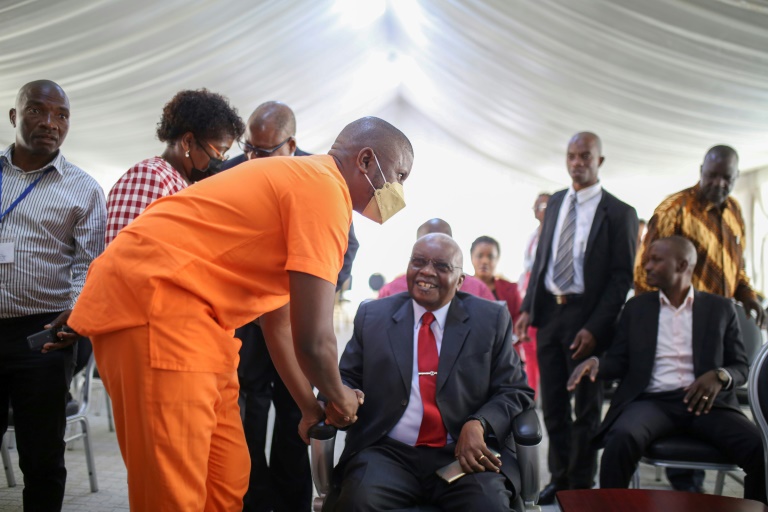
Wearing a black sweater over an orange prisoner jumpsuit, his son stood up as the judge read the verdict.

Baptista said Ndambi Guebuza acted deliberately “to exert influence on his father” and get the government to approve the purchase of the vessels. 

He took a $33-million bribe that went to satisfy his “desire for luxury”, the judge said, listing some of the assets the former president’s son acquired with the money. 

Among them were 15 luxury cars including Ferraris, Maseratis, BMWs and Rolls-Royces, and a 10-million rand ($590,000) mansion in a high-end suburb of Johannesburg, in neighbouring South Africa.

Besides being sentenced to jail, the younger Guebuza was ordered to pay a fine of 162,000 meticais ($2,500). 

Former presidential advisor Renato Matusse was also sentenced to 12 years in jail. 

– Global scale –

The ruling was welcomed by local civil society groups.

“It is a fair sentence,” said Borges Nhamirre, a researcher with anti-graft watchdog Public Integrity Center. 

The trial started in August last year and ran until March. It was broadcast live on local TV and radio stations. 

Dozens of people, including activists and civil campaigners, sat in the courtroom, a makeshift facility set up in a white marquee to accommodate defendants, their lawyers and other parties. 

The scandal exposed corruption on a global scale and sparked legal cases across three continents. Swiss bank Credit Suisse was fined $475 million last year over its part in issuing the loans.

Former finance minister Manuel Chang — who signed off the loans — has been held in South Africa since 2018, pending extradition to the US for allegedly using the US financial system to carry out the fraudulent scheme.

When the loans were taken out, Mozambique’s star was rising after two decades of democratic and market-led reforms and the discovery of huge gas reserves off its Indian Ocean coast.

But the scandal — which involved money equivalent to about 12 percent of the gross domestic product — tipped the nation into the worst economic crisis in its history. 

In March, the IMF awarded $456 million in credit to Mozambique, the first such aid awarded since the scandal erupted, to support economic recovery and public debt reduction programmes.

Mozambique ex-president's son, ex-spy bosses jailed for 12 years for graft

A Mozambican court on Wednesday sentenced two ex-spy bosses and the son of a former president to 12 years each for their part in a corruption scandal in which the government sought to conceal huge debts, triggering financial havoc.

The former head of security and intelligence, Gregorio Leao; the head of the economic intelligence division, Antonio do Rosario; and ex-president Armando Guebuza’s son, Ndambi Guebuza, were among 19 defendants accused in the country’s biggest graft scandal.

Eight defendants were acquitted while the rest were handed terms ranging between 10 and 12 years in a verdict that took the judge a week to read out.

“The crimes committed have brought consequences whose effects will last for generations,” said Judge Efigenio Baptista, addressing a packed courtroom located in the grounds of a high-security jail in the capital Maputo. 

The scandal arose after state-owned companies in the impoverished country illicitly borrowed $2 billion (1.9 billion euros) in 2013 and 2014 from international banks to buy a tuna-fishing fleet and surveillance vessels. 

The government masked the loans from parliament and the public. 

When the “hidden debt” finally surfaced in 2016, the International Monetary Fund (IMF) and other donors cut off financial support, triggering a sovereign debt default and currency collapse. 

An independent audit found $500 million of the loans had been diverted. The money remains unaccounted for.

– ‘Desire for luxury’ –

Handing down the sentences Baptista said the scam had “aggravated the impoverishment of thousands of Mozambicans.” 

“The country became famous for the worst reasons,” he said. “As high officials of the state they should have been (its) guardians.”

Leao and do Rosario were found guilty of embezzlement and abuse of power, while Guebuza was convicted for embezzlement, money laundering and criminal association, among other charges. 

Former president Guebuza, who had been in office when the loans were contracted, testified at the trial, but was not seen in court on Wednesday.  

Wearing a black sweater over an orange prisoner jumpsuit, his son stood up as the judge handed out the verdict.

During the proceedings, Baptista said Ndambi Guebuza acted deliberately “to exert influence on his father” and get the government to approve the purchase of the vessels. 

He took a $33-million bribe that went to satisfy his “desire for luxury” the judge said, listing some of the assets the former president’s son acquired with the money. 

They included luxury cars and a 10-million rand ($590,000) mansion in neighbouring South Africa.

Besides being sentence to jail, the younger Guebuza was ordered to pay a fine of 162,000 meticais ($2,500). 

Former presidential advisor Renato Matusse was also sentenced to 12 years in jail. 

– Global scale –

The trial started in August last year and ran until March. It was broadcast live on local TV and radio stations. 

Dozens of people, including anti-corruption activists and civil campaigners, sat in the courtroom, a makeshift facility set up in a white marquee to accommodate defendants, their lawyers and other parties. 

The debt scandal exposed corruption on a global scale and sparked legal cases across three continents. Swiss bank Credit Suisse was fined $475 million last year over its part in issuing the loans.

Former finance minister Manuel Chang — who signed off the loans — has been held in South Africa since 2018, pending extradition to the US for allegedly using the US financial system to carry out the fraudulent scheme.

When the loans were taken out, Mozambique’s star was rising after two decades of democratic and market-led reforms and the discovery of huge gas reserves off its Indian Ocean coast.

But the scandal — which involved money equivalent to about to 12 percent of the gross domestic product of one of the poorest countries in the world — tipped the nation into the worst economic crisis in its history. 

In March, the IMF awarded $456 million in credit to Mozambique, the first such aid awarded since the scandal erupted. 

The funds are to help support economic recovery and policies to reduce public debt.

Killer of S.African anti-apartheid hero Hani freed on parole

South Africa on Wednesday released on parole Janusz Walus, a far-right Polish immigrant who in 1993 shot dead anti-apartheid hero Chris Hani, after a postponement due to an attack inside prison.

Justice and Correctional Services Minister Ronald Lamola “has placed offender… Walus on parole under strict conditions with effect from Wednesday,” the government said in a statement. 

A spokesman confirmed that this meant Walus had been released, in line with a decision by the Constitutional Court.

“He will serve two years under community corrections in line with the parole regime upon which he is released,” the statement said.

Last month’s court decision sparked fierce protests from the ruling African National Congress (ANC) and its ally in the struggle against apartheid, the South African Communist Party, which Hani had led.

Walus was being held at the Kgosi Mampuru II Correctional Centre in Pretoria prior to the court’s announcement.

But a week after the ruling, he was stabbed by another inmate while queueing for food. His release, which should have taken effect by December 1, was delayed while he received treatment.

Walus shot dead Hani, a hugely popular figure and fierce opponent of white rule, in his driveway just as negotiations to end apartheid were entering their final phase. 

The murder almost plunged South Africa into a race war. 

“There is no question that offender Walus is a polarising figure in our budding constitutional democracy, and that his release has understandably re-opened wounds,” the ministry said.

His “actions sought to derail the democratic project at its most critical, formative stage,” it declared.

Walus immigrated to South Africa from then-communist Poland in 1981 at the height of the white-minority apartheid rule.

He and his accomplice Clive Derby-Lewis, who supplied the gun, were arrested soon after the attack.

The pair were sentenced to death but the punishment was later communited to life imprisonment after the death penalty was abolished by South Africa Africa’s post-apartheid government.

Derby-Lewis was released in 2015 on medical parole after 22 years in jail. He died of lung cancer in 2016, aged 80.

The home affairs ministry has said Walus will serve his parole in South Africa and not be allowed to return to Poland given the “heinous crime committed.” 

Hunger, cholera stalk displacement camps near east DR Congo city

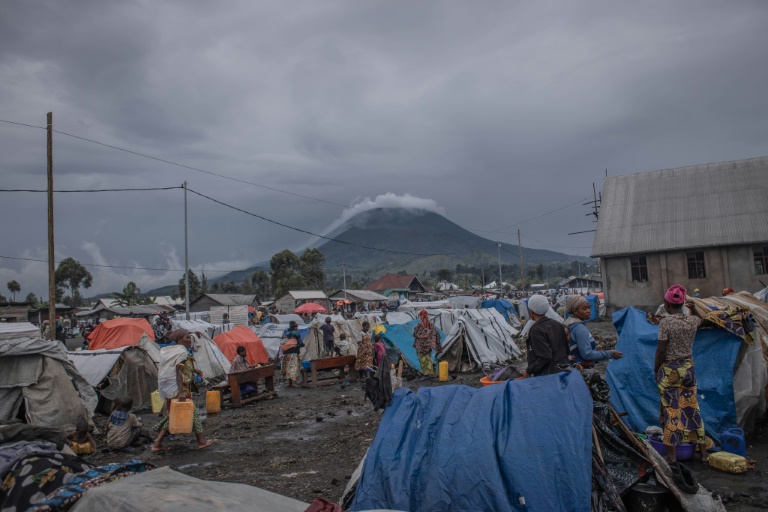
Thousands of tiny makeshift shelters hug the road leading north out of Goma, a symptom of the vast humanitarian crisis gripping DR Congo’s turbulent east.

Since late October, many tens of thousands of people have flocked towards the relative safety of the city, fleeing the advance of the M23 rebel group.

The most vulnerable have settled near the roadside, packed inside tents cobbled together from sticks and tarpaulin on fields of lava spouted from the looming volcano Mount Nyiragongo.

Despite aid efforts, all of the displaced people interviewed by AFP complained of hunger, and several described having to fight for food. Cholera, a consequence of poor hygiene, has also broken out.

“I don’t know where to find food,” said Suzanne Niramivumbi Kavakura, a small 90-year-old woman, wrapped in a colourful shawl and headscarf. 

Sitting outside her hutch-like shelter, she recounted how she fled her native Rugari, in North Kivu province, as fighting approached six weeks ago. 

Kavakura’s grandchildren found her on the road and they fled south together to Kanyaruchinya, a hillside area overlooking Goma which is now thronged with displaced people and serried rows of tents.

Precise numbers are hard to come by, but according to International Organisation for Migration (IOM) figures from late November, over 140,000 people are camping in the Nyiragongo area north of the city of two million, or sleeping in churches and schools.

Pelagie Ngayabaseka, a 54-old woman with her infant grandchild swaddled to her back, said there wasn’t enough food to go around.

“If you don’t have the strength to fight, you won’t get anything,” she said, as dozens of young children crowded around her.

– ‘Exponential dimensions’ –

The M23, a predominantly Congolese Tutsi rebel group, lay dormant for years.

But it took up arms again late last year and in June seized Bunagana, a strategic town on the border with Uganda. 

After a brief period of calm, the rebels went on the offensive again in October, capturing swathes of North Kivu province and forcing hundreds of thousands to flee.

“The scale (of the humanitarian crisis) completely changed after this offensive,” said Anne-Sylvie Linder, head of the International Committee of the Red Cross in North Kivu.

Fighting in the province displaced about 370,000 people by November 28, according to the IOM, compared to about 90,000 in late October.

Conditions in camps such as Kanyaruchinya are shocking, Linder added, explaining that aid organisations are struggling to respond to the massive movement of people. 

Among myriad other problems, there is little fresh water in Kanyaruchinya and the rocky lava field makes digging adequate latrines impossible. 

Most of the displaced people sleep with just a blanket laid over the rocks. Regular downpours due to the Democratic Republic of Congo’s rainy season make conditions all the more wretched. 

Cholera has also recently broken out, with 21 confirmed cases as of Monday, according to a humanitarian official who requested anonymity. 

“Cases have tripled every week for three weeks,” said Marie-Pierre Poirier, UNICEF’s west and central Africa director, during a visit to Kanyaruchinya the same day.

The growing numbers of displaced people is a problem taking on “exponential dimensions,” she warned.

– ‘We need to go home’ –

Theo Musekura, the president of a displaced people’s committee, said about 50 people had already died of illnesses such as cholera, malaria and diarrhoea.

A local hospital offers treatment, but “there are too many people,” he said. 

Eighty percent of the displaced people in Kanyaruchinya are Congolese Hutus from the Rutshuru area of North Kivu, Musekura estimated.

“They fled because when the M23 comes, they kill people,” the 48-year-old said matter-of-factly.

The danger remains close by. Kanyaruchinya lies several kilometres (miles) from the front line, which has been quiet in recent weeks.

Standing in drizzle by the roadside in Kibati — just north of Kanyaruchinya and about 10 kilometres (six miles) from the front — Adela Mufasano said she and her children needed to go home.

“The kids sleep on the rocks,” the 54-year-old said. “When the rain comes, it’s a catastrophe”.

Andre Bahati Musarumu, watching men play cards in front of a tent in Kanyaruchinya, also said he wanted the situation to end. 

“We want to go home to look for food,” said the 60-year-old, who fled with eight children.

“The government needs to decide between negotiation and war.”

Mozambique ex-president's son, ex-spy bosses jailed for 12 years for graft

A Mozambican court on Wednesday sentenced two ex-spy bosses and the son of a former president to 12 years each for their part in a corruption scandal in which the government sought to conceal huge debts, triggering financial havoc.

The former head of security and intelligence, Gregorio Leao; the head of the security service’s economic intelligence division, Antonio do Rosario; and ex-president Armando Guebuza’s son Ndambi Guebuza were among 19 defendants accused in the country’s biggest graft scandal.

“The crimes committed have brought consequences whose effects will last for generations,” said Judge Efigenio Baptista. 

The scandal arose after state-owned companies in the impoverished country illicitly borrowed $2 billion (1.9 billion euros) in 2013 and 2014 from international banks to buy a tuna-fishing fleet and surveillance vessels. 

The government masked the loans from parliament and the public. 

When the “hidden debt” finally surfaced in 2016, the International Monetary Fund (IMF) and other donors cut off financial support, triggering a sovereign debt default and currency collapse. 

An independent audit found $500 million of the loans had been diverted. The money remains unaccounted for.

Handing down the sentence following after a week of reading the verdicts, the judge said the scam “aggravated the impoverishment of thousands of  Mozambicans.” 

“The country became famous for the worst reasons,” he said. 

Leao and do Rosario were found guilty of embezzlement and abuse of power, while Guebuza was convicted for embezzlement, money laundering and criminal association among other charges. 

Kenya drought leaves wildlife gasping for breath

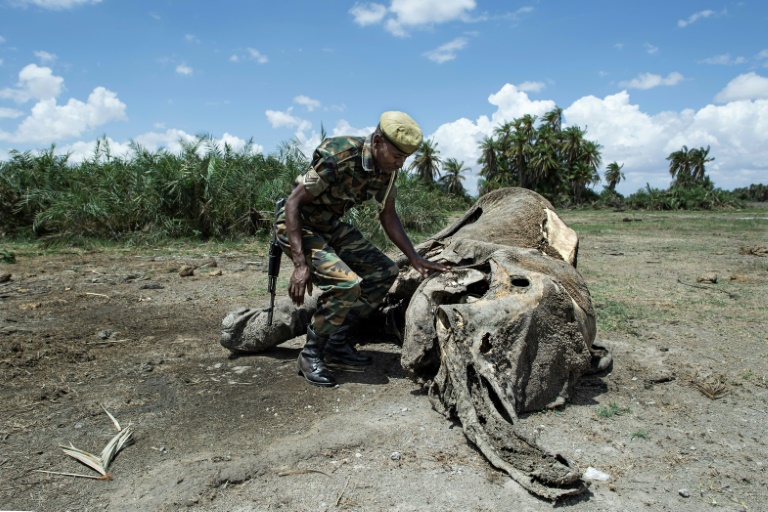
As he peers at the carcass of the young elephant, Kenyan park ranger Josphat Wangigi Kagai says such disturbing sights have become all too familiar — a reflection of the vicious drought sweeping across the Horn of Africa.

“I used to wear a face mask because of the smell of rotting animals, but now I am used to it,” the 37-year-old told AFP, his voice thick with sadness.

In southern Kenya’s famed Amboseli National Park, flanked by the majestic Mount Kilimanjaro, the signs of the drought are everywhere.

The earth is dry and cracked, animal bones lie along the trails and emaciated trees with yellowing leaves bear witness to the impact of the worst drought in 40 years.

Its latest victim was just seven years old — far shy of the species’ usual life expectancy of six decades.

“For the past few weeks, we’ve been doing this almost every day,” he said, using an axe to remove the animal’s tusks to prevent poachers from taking them.

“It makes me feel so sad,” said the Kenya Wildlife Service (KWS) ranger, who has worked in the park since 2016.

– ‘Everything is wiped out’ –

Poor rainfall since late 2020 has devastated the Horn of Africa, raising fears of a famine in Somalia and plunging around four million Kenyans — nearly 10 percent of the population — into hunger.

Wildlife has also paid a heavy price, with 205 elephants, 512 wildebeest, 381 zebras and 12 giraffes dying from the drought between February and October this year, according to Tourism Minister Peninah Malonza.

The pastoralists living in Amboseli — a park whose popularity is rivalled only by the vast Maasai Mara — know the damage caused by climate change first hand.

“Before the drought you could see herds of elephants roaming around this area, they are nowhere to be seen now,” said Kelembu Ole Nkuren, a Maasai shepherd who has called Amboseli home since birth.

“Everything is being wiped out right now, zebras, wildebeests, giraffes, elephants. I have never seen such a huge number of dead wildlife,” the 35-year-old told AFP, surrounded by the rotting remains of buffaloes, antelopes and other animals.

“If the drought goes on like this, it will wipe out the remaining cattle, elephants, all the animals,” he warned.

– Relief measures –

According to Norah Njiraini of the Amboseli Trust for Elephants, more than 100 tuskers — out of a total of 2,000 — have died since June in the park, which borders Tanzania.

The last time elephants suffered such a devastating fate was in 2009, she told AFP.

“In 2009, we lost the female adults… this year is different because we are losing the young ones,” she said. 

The memory of that drought still haunts many in Amboseli.

This time, the KWS is taking efforts to ensure that the animals have a better chance of survival.

In Amboseli, wildlife can feed on hay supplied every two days by park rangers.

In Tsavo East National Park, about 140 kilometres (85 miles) to the north, KWS has drilled wells so animals have water to drink.

Despite these measures, that park lost 54 elephants between February and October this year.

Even with some recent showers, few expect conditions to really improve anytime soon, with forecasts indicating yet another failed rainy season on the way.

The economic consequences for the tourism-dependent nation are not lost on park officials.

“When we have visitors coming to the country, our main backbone is basically wildlife tourism,” the director of Tsavo East, Kenneth Ochieng, told AFP. 

“So when the numbers depreciate, it becomes the concern of every Kenyan.”

Despite the grim forecast, he remains hopeful, he said.

“The problems we are going through are man-made and the solutions should also be man-made.”

Senegal's opposition leader faces rape accuser in court hearing

Senegal’s opposition leader was questioned Tuesday in a Dakar court hearing over rape accusations, lawyers told local media, in a closely followed case.

Ousmane Sonko — who came third in Senegal’s presidential election in 2019 — has enjoyed a rapid political rise thanks in part to his popularity with young people and has declared himself a candidate for the 2024 elections.

However, he has also suffered legal troubles. Most notably he has been accused of rape by Adji Sarr, an employee of a beauty salon where Sonko went for a massage.

Sonko has denied the charge.

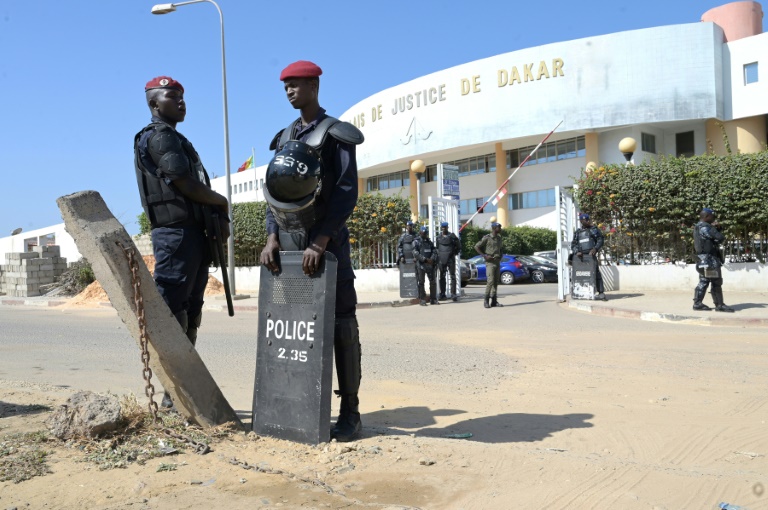
Both sides accused the other of refusing to answer questions at a hearing before an investigating judge at a Dakar courthouse, according to comments they made to the local media. A large security detail was deployed around the building during the hearing.  

Sonko’s lawyer Henri Gomis told reporters that it was “up to (the plaintiffs) to bring evidence of the accusations of rape”. 

“They have not given any evidence,” he said at the end of the hearing. “The case must be dismissed.”

Sarr’s lawyer said it was Sonko who was not being cooperative. 

“Ousmane Sonko refused to answer the questions of the prosecution and the lawyers,” El Hadji Diouf said, adding that “the evidence will come out” if a trial is set. 

Sarr told reporters at the court she was disappointed Sonko had refused to speak. 

“He did not answer the head of the judges, lawyers and prosecutors. I answered their questions,” she said.

Sonko has described the rape accusation as part of a “plot” to torpedo his 2024 candidacy.

The polarising politician is considered a populist firebrand by his critics. 

Sonko’s supporters hail his efforts to speak up on corruption and social elitism, as well as slamming the economic and political grip of multinational firms and Senegal’s former colonial power, France. 

His indictment in March 2021 triggered violence in which around a dozen people were killed.

Senegal has a general reputation for stability in a region where political turbulence is widespread.

In recent years, several other prominent opponents of the president have had their political careers cut short by legal cases.

Authorities have denied any misuse of state institutions in the legal proceedings against Sonko.

Close Bitnami banner
Bitnami