Africa Business

EU agrees ban on imports driving deforestation

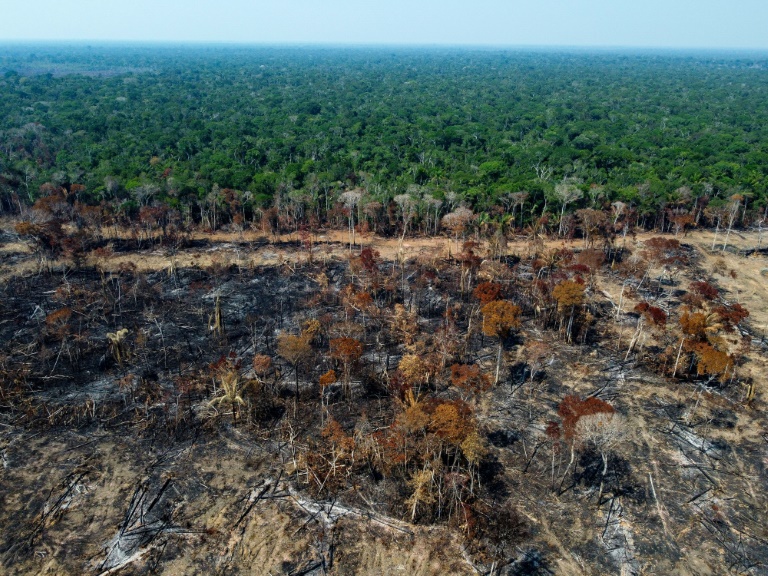
The European Union reached an agreement Tuesday to ban the import of products including coffee, cocoa and soy in cases where they are deemed to contribute to deforestation.

The draft law, which aims to ensure “deforestation-free supply chains” for the 27-nation EU, was hailed by environmental groups as “groundbreaking”.

It requires companies importing into the EU to guarantee products are not produced on land that suffered deforestation after December 31, 2020, and that they comply with all laws of the source country.

The scope encompasses palm oil, cattle, soy, coffee, cocoa, timber and rubber as well as derived products such as beef, furniture and chocolate.

Illegal production has spurred massive deforestation in countries such as Brazil, Indonesia,  Malaysia, Nigeria, the Democratic Republic of Congo, Ethiopia, Mexico and Guatemala.

The United Nations’ Food and Agriculture Organization estimates that an aggregate area of land bigger than the European Union, or some 420 million hectares (more than one billion acres), has been deforested around the world over the past three decades.

The European Union is the second-biggest market for consumption of the targeted products after China. 

Pascal Canfin, chairman of the European Parliament’s environment committee, hailed the agreement, and how its impact would feed through to everyday items Europeans consume.

“It’s the coffee we have for breakfast, the chocolate we eat, the coal in our barbecues, the paper in our books. This is radical,” he said.

– ‘Historic’ –

The environmental lobby group Greenpeace called the draft law, agreed between the European Parliament and EU member states, “a major breakthrough”.  

Another, WWF, called it “groundbreaking” and “historic”.

“This regulation is the first in the world to tackle global deforestation and will significantly reduce the EU’s footprint on nature,” the WWF said in a statement.

Both groups called on the EU to go further, by expanding the scope of the law to include savannahs, such as Brazil’s Cerrado, which are also under threat by encroaching ranchers and farmers.

Greenpeace noted that financial institutions extending services to importing companies would not initially come under the new law, but that they would come under review two years later.

Both the European Council — representing the EU countries — and the European Parliament now have to officially adopt the agreed law. Big companies would have 18 months to comply, while smaller ones would get a longer grace period.

“The new law will ensure that a set of key goods placed on the (European Union) market will no longer contribute to deforestation and forest degradation in the EU and elsewhere in the world,” the European Commission said in a statement. 

“The battle for climate and biodiversity is accelerating,” French President Emmanuel Macron tweeted.

– Big fines –

The parliament said in a statement that the law opened the way for technology such as satellite monitoring and DNA analysis to verify the provenance of targeted imports.

High-risk exporting countries would have nine percent of products sent to the EU checked, while lower-risk ones would have lower proportions scrutinised.

Companies found violating the law could be fined up to four percent of annual turnover in the EU.

The legislation would be reviewed one year after coming into force, to see whether it should be extended to other wooded land.

Another review at the two-year mark would have the commission considering whether to expand it to cover other ecosystems and commodities, as well as financial institutions.
'Around 300' dead in east DR Congo massacre

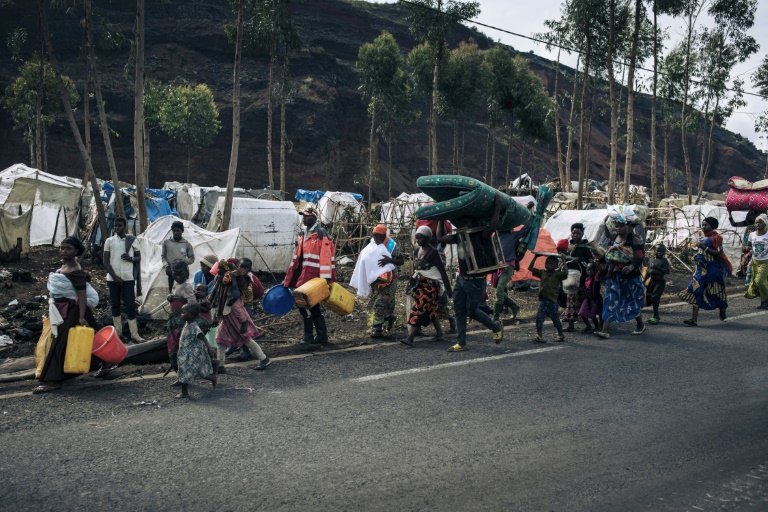
Around 300 people died in an attack on villagers in eastern Democratic Republic of Congo last week blamed on the M23 rebel group, government minister Julien Paluku said on Monday.

The government has been locked in a months-long conflict with the notorious armed group M23 — with the latest violence coming just five days after a ceasefire was agreed between the rebels and Congolese forces.

The army originally accused the M23 insurgents of killing at least 50 civilians in Kishishe village in eastern North Kivu province last week, before the government put the number of dead at more than 100.

But Paluku and government spokesman Patrick Muyaya laid out updated figures for the deadly attack during a press briefing on Monday, citing data collated by civil society and communities in the region.

“We are looking at around 300 deaths” of “people known to be regular inhabitants of Kishishe,” industry minister Paluku said, saying the victims had no connection with militia groups.

“Every community has been able to record the people who died from units in Kishishe and its environs,” said Paluku, who was governor of North Kivu province from 2007 to 2019.

“One community alone has more than 105 deaths,” he added.

The rebel group has denied it was responsible and called the allegations “baseless” — although it said eight civilians were killed by “stray bullets” during clashes in the village on November 29.

All the fatalities were civilians and at least 17 believed to be children, Muyaya told reporters, saying there were fatalities recorded from a church and a hospital.

– M23 offensive –

The UN’s peacekeeping mission in DR Congo has led calls for an investigation after the government said 50 villagers had been massacred by a notorious armed group in the country’s troubled east.

Representatives for the United States and European Union said the killings were potential war crimes, while Human Rights Watch said UN troops should be deployed to protect survivors.

The government has said it is difficult to confirm the data because the area is still under rebel control.

Muyaya said consolidation work was underway to try and ascertain the full number of victims.

Residents who spoke to AFP by telephone said they had been ordered by the rebels to bury the victims in mass graves.

The March 23 movement, or M23, is a predominantly Congolese Tutsi rebel group that was dormant for years.

It took up arms again in November last year and seized the town of Bunagana on the border with Uganda in June. 

After a brief period of calm, it went on the offensive again in October.

Kinshasa accuses its smaller neighbour Rwanda of providing M23 with support, something that UN experts and US officials have also pointed to in recent months.

Kigali disputes the charge and has accused Kinshasa of collusion with the FDLR — a former Rwandan Hutu rebel group established in the DRC after the genocide of the Tutsi community in 1994 in Rwanda.

Talks between the two countries in the Angolan capital Luanda unlocked a truce agreement on November 23.

The ceasefire was scheduled to take effect on November 25. It should also have been followed by a pullout by the M23 two days later from territory it had seized, but this did not happen.

S.Africa's ruling ANC rallies around troubled Ramaphosa

South Africa’s National Assembly on Monday delayed by a week a keenly watched parliamentary vote that could lead to the impeachment of President Cyril Ramaphosa, as his party rallied around the embattled leader.

In an eventful day, Ramaphosa, who has been under heavy political pressure, mounted an 11th-hour legal bid to have a damning report on an alleged cover-up of a cash robbery at his farm annulled.

Top African National Congress leaders who had met to discuss his future vowed to stand by the president and oppose any motion seeking to remove him.

Parliament was due to debate and vote on the report on Tuesday in a session that could lead to his impeachment.

But during a late-night urgent meeting of the parliament’s programming committee, the lawmakers unanimously agreed that the unprecedented sitting was too important to be conducted in a hybrid format.

They agreed to meet on Tuesday December 13, said speaker Nosiviwe Mapisa-Nqakula, to allow time for lawmakers to travel to Cape Town to physically sit and vote through an open ballot and a roll call.

The delay is unlikely to change the stance of the ANC, which agreed earlier it “will not support that vote,” according to ANC interim secretary-general Paul Mashatile.

Mashatile said the decision to vote “against the adoption of the report” was reached after the ANC’s most senior leaders “fully and frankly” debated it.

Earlier Monday, Ramaphosa had filed a petition to the Constitutional Court seeking to have the investigative report “reviewed, declared unlawful and set aside”, according to court papers.

The report by an independent panel found that Ramaphosa “may have committed” serious violations and misconduct.

– Phala Phala –

The scandal erupted in June when South Africa’s former spy boss filed a complaint with the police alleging that Ramaphosa had concealed the 2020 theft of a huge haul of cash from his Phala Phala farm.

He accused the president of having organised for the burglars to be kidnapped and bribed into silence.

 Ramaphosa has denied any wrongdoing.

He said the cash — more than half a million dollars, stashed beneath sofa cushions — was payment for buffaloes bought by a Sudanese businessman. 

But his explanations did not convince the parliament-sanctioned independent panel, which raised questions about the source of the cash.

The parliament sitting is a step that could lead to a vote on forcing Ramaphosa from office.

To initiate an impeachment vote would require a simple majority in the National Assembly, where the ANC has 230 out of 400 seats. The impeachment vote itself would need a two-thirds majority to succeed.

In the meantime, “the president continues with his duties as president of the ANC and the republic,” said the ANC’s Mashatile.

Ramaphosa will Tuesday be in Cape Town, where parliament is based, to deliver a keynote address at the World Science Forum attended by hundreds of delegates.

– Not resigning –

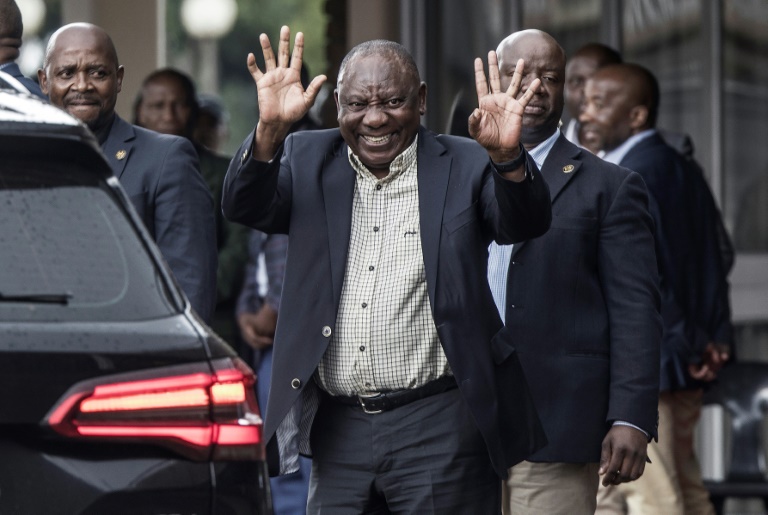
The president had insisted he would not resign after the special panel’s report, but his political future still remains uncertain. He briefly attended the ANC meeting which discussed the crisis.

He left shortly afterwards, smiling and waving to the media.

Forged by Nelson Mandela into the weapon that led the fight against apartheid, the ANC has been deeply divided by the affair, but after a pendulum swing a majority now seems to be backing Ramaphosa to remain.

The scandal comes at the worst possible time for him. 

On December 16, he will contest elections for the ANC presidency — a position that also holds the key to staying on as the nation’s leader.

A former mine union president who made a fortune in business in the post-apartheid era, Ramaphosa came to office in 2018 riding on a graft-free image after the corruption-tainted presidency of Jacob Zuma.

Although a police inquiry is ongoing, he has not so far been charged with any crime.

The second-largest opposition party, the Economic Freedom Fighters, said it was “disgusted and appalled by the decision of the rogue president”, to challenge the report.

But the ANC’s overwhelming majority in the National Assembly means that it is not even certain that parliament will vote to launch the removal procedure.

Guinea trial adjourned after ex-dictator pleads ill health

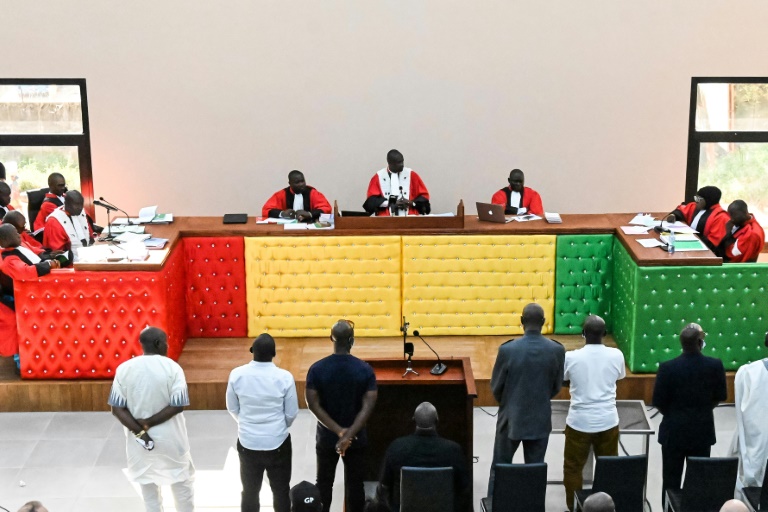
Proceedings in a trial over a 2009 massacre in Guinea were adjourned for a week on Monday after former dictator Moussa Dadis Camara said he was too ill to give testimony.

Survivors of the bloodbath and relatives of the dead had been eagerly awaiting the moment when Camara would take the stand.

But the former military ruler, who appeared at the bar in civilian clothes and walking with some difficulty, said he was unwell.

“With all the respect that I have for your distinguished tribunal, I have already informed the director of the penitentiary, the head doctor of the penitentiary, (that) I have been ill for some time,” Camara said.

He said he felt “completely weak, from malaria I caught”.

“I’m not above the law but quite sincerely I absolutely think that I can’t (testify) right now.”

Camara and 10 other former military and government officials are accused over the killing of 156 people and the rape of at least 109 women by pro-junta forces at a political rally in a Conakry stadium in September 2009.

They face charges ranging from murder to sexual violence, kidnappings, arson and looting. Camara himself is charged with “personal criminal responsibility and command responsibility.”

Chief judge Ibrahima Sory Tounkara said: “The court cannot force you to say or do something that you do not wish to do… If you say that you cannot give testimony, the court acknowledges this.”  

“You have a week, Mr. Camara,” he said, adjourning the trial until December 12.

The lawyer for Aboubacar Sidiki Diakite, a former aide de camp to Camara who has accused him of preparing the massacre, accused Guinea’s ex-leader of faking his illness.

“Our feeling is that Dadis is scared of appearing now because he has been confronted with the reality of the case. That is what leads him to completely fabricate an illness,” lawyer Lancine Sylla told reporters.

One of Camara’s lawyers said his client had been suffering from an exhausting bout of malaria for weeks and that he had the “absolute right” to rest.

– Assassination attempt –

Camara, at the time an unknown captain in the army, seized power in December 2008 shortly after the death of Guinea’s second post-independence president, General Lansana Conte, who had ruled for 24 years.

In December 2009, Camara was wounded in the head in an attempted assassination and headed to Morocco for medical treatment. 

He fled into exile in Burkina Faso, where he was indicted in July 2015 by Guinean magistrates for his alleged role in the stadium massacre.

The former strongman was detained on September 27, a day before the long-awaited trial began in a purpose-built court in the capital Conakry.

Sudan's military, civilian factions sign deal seeking to end crisis

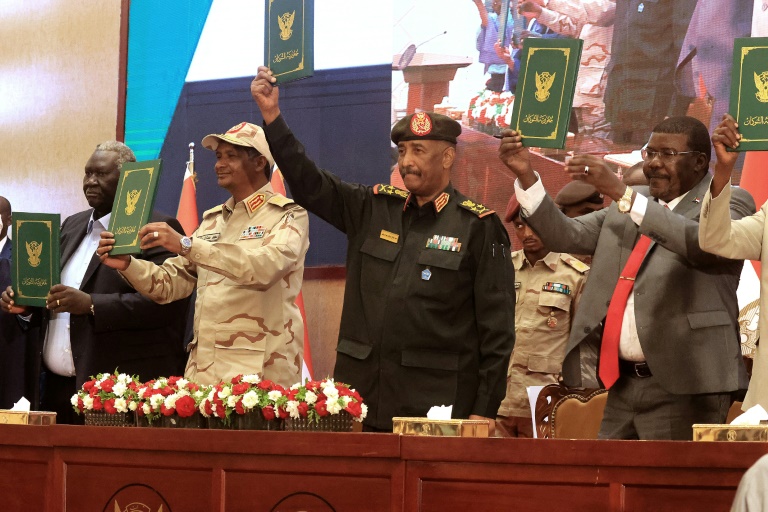
Sudan’s military and civilian leaders signed Monday an initial deal aimed at ending a deep crisis caused by last year’s military coup, prompting sceptical protesters to cry betrayal.

Army chief Abdel Fattah al-Burhan seized power in October 2021, derailing a rocky transition to civilian rule that began after the 2019 ouster of veteran autocrat Omar al-Bashir.

The past year has seen near-weekly protests and a crackdown that pro-democracy medics say has killed at least 121, a spiralling economic crisis exacerbated by donors slashing funding, and a resurgence of ethnic violence in several remote regions that has left over 800 people dead.

Divisions among civilian groups have deepened since the coup, with some urging a deal with the military while others insist on “no partnership, no negotiation”.

The deal was signed by Burhan, paramilitary commander Mohamed Hamdan Dagalo and multiple civilian groups, most notably the Forces for Freedom and Change (FFC) — the main civilian faction that was ousted in the coup.  

As the key players put pens to paper, hundreds of citizens rallied in Khartoum to protest against the deal, setting fire to tyres, erecting barricades and facing down water cannons.

“The settlement is betrayal” and the FFC “sold our blood,” demonstrators cried. 

“We reject this deal as it overlooked street demands for justice for the people killed since the coup,” said protester Mohamed Ali.

If the deal plays out as planned, the civilian signatories will agree on a prime minister who will steer the country through a 24-month transition.

– Thorny issues ahead –

UN Secretary General Antonio Guterres praised the agreement, urging signatories to work towards achieving a “lasting, inclusive political settlement”, spokesman Stephane Dujarric said.  

The initial deal was described as “welcome” by the United States and European Union in a joint statement from the “Friends of Sudan” group, which also included Britain, Canada, France, Germany, Japan, Norway and Saudi Arabia.

During the signing ceremony, paramilitary commander Dagalo reiterated the military’s purported commitment to exit the political scene, saying “it is essential to build a sustainable democratic regime”. 

Other signatories included the Islamist Popular Congress Party, a faction of the Democratic Unionist Party and some ex-rebel groups who signed a 2020 peace deal.

The agreement — based on a proposal by the Sudanese Bar Association — was negotiated in the presence of officials from the UN, Western diplomats as well as Saudi Arabia and the United Arab Emirates, according to the FFC.

UN special representative Volker Perthes, who said the agreement was the culmination of “sustained efforts” over the past year, urged factions to “immediately” start the second phase and strike a comprehensive deal. 

However, that part is far thornier, with observers questioning whether the military would be willing to give up economic interests — as stipulated — and wider powers that it views as its privileged domain.

Phase one of the deal “is a very low level commitment on Burhan’s part… allowing him to survive” politically, said Kholood Khair founder of the Confluence Advisory, a Khartoum-based think-tank.

But the signatories will likely face “a real political crisis as they start talking in earnest about security sector reforms, transitional justice (and) financial accountability,” she added. 

Monday’s signing comes months after Burhan pledged that the military would step aside and make way for factions to agree on a civilian government. 

Some of the former rebels who signed peace deals with Sudan in 2020 also voiced their opposition to Monday’s agreement.

Mohamed Zakaraia, spokesman for the ex-rebel Justice and Equality Movement, told AFP that it “will bring about dire consequences and further complicate the political scene”.

Chad jails 262 in mass trial after deadly protests

A Chadian court has handed jail terms of between two and three years to 262 people who were arrested after deadly protests in October, the public prosecutor said on Monday.

A total of 401 people had been put on trial in Koro Toro prison, a high-security jail located in the desert 600 kilometres (375 miles) from the capital N’Djamena.

Lawyers had boycotted proceedings on the grounds of the “illegal” transfer far from the public gaze for the trial. 

Of the others, 80 were given suspended terms and 59 were acquitted, prosecutor Moussa Wade Djibrine said.

The trial ended on Friday after four days, with only state TV having the right to provide coverage, and the sentences were announced on Monday after the prosecutor returned to the capital.

The defendants were charged with taking part in an unauthorised gathering, destroying belongings, arson and disturbing public order.

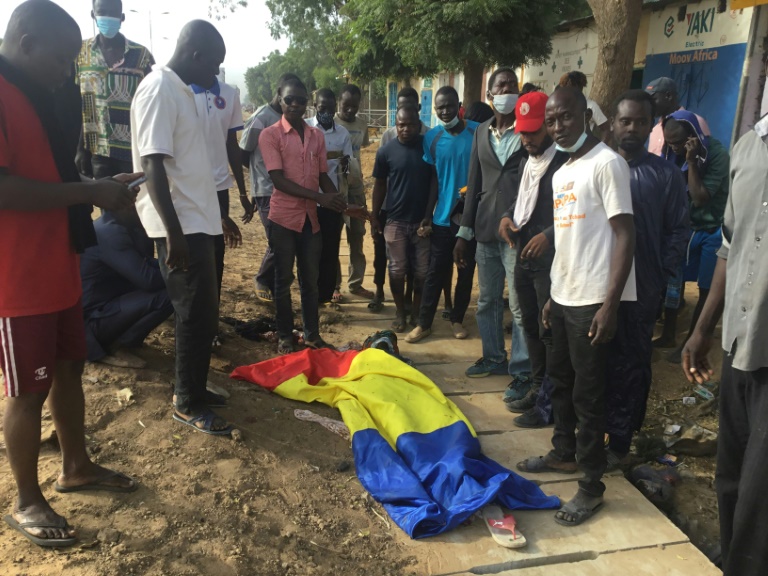
Around 50 people, including 10 members of the security forces, died when police opened fire on demonstrators in N’Djamena and several other cities on October 20, according to an official toll.

But opposition groups say the real count was much higher, and allege unarmed civilians were massacred.

Local and international NGOs, the European Union and the African Union condemned the bloody crackdown and the use of violence against civilians.

Chadian lawyers stopped working during and after the trial, with the Chad Bar Association calling it a “parody of justice” as the defendants were “kidnapped” and “deported” to Koro Toro.

The bar said it would appeal the court’s decision and resume work on Tuesday.

The protests had been called to mark the date when Chad’s ruling military had initially promised to cede power — a timeline that has now been extended by two years.

– ‘Insurrection’ –

Strongman General Mahamat Idriss Deby Itno accused the demonstrators of “insurrection” and attempting to stage a coup.  

Deby, 38, took power when his father, Idriss Deby Itno, who had ruled the arid Sahel state for 30 years, died during an operation against rebels in April 2021.

The authorities had previously said that 601 people, including 83 minors, were arrested in the N’Djamena area alone and taken to Koro Toro, a remote location two days by road from the capital.

Around 80 minors held there have been taken back to N’Djamena, where they will remain in a prison before appearing in a special court for children, the prosecutor said.

The Central Africa director for Human Rights Watch, Lewis Mudge, told AFP he was “concerned” for them after their long detention at Koro Toro far away from their families.

The state of emergency decreed in N’Djamena and other cities on the evening of October 20 was lifted on Monday.

Amnesty International has denounced what it said was the denial of the right to a fair and public trial, the preparation of a defence case and access to information.

The main leaders of Chad’s opposition now live in hiding or in exile.

S.Africa's ruling ANC rallies around troubled Ramaphosa

South Africa’s ruling ANC party rallied around embattled President Cyril Ramaphosa on Monday, on the eve of a keenly watched parliamentary vote that could lead to his impeachment.

In an eventful day, Ramaphosa, who has been under heavy political pressure, mounted an 11th-hour legal bid to have a damning report on an alleged cover-up of a cash robbery at his farm annulled.

Top African National Congress leaders who had met to discuss his future vowed to stand by the president and oppose any motion seeking to remove him.

“Should parliament proceed tomorrow, the ANC will not support that vote,” ANC interim secretary-general Paul Mashatile told reporters after day-long talks.

Mashatile said the decision to vote “against the adoption of the report” was reached after the ANC’s National Executive Committee “fully and frankly” debated it.

Earlier Monday, Ramaphosa filed a petition to the Constitutional Court seeking to have the investigative report “reviewed, declared unlawful and set aside”, according to papers made available to the media by his spokesman.

Parliament is scheduled on Tuesday to debate the report submitted last week by an independent panel which found that Ramaphosa “may have committed” serious violations and misconduct.

The parliament sitting is a step that could lead to a vote on forcing Ramaphosa from office.

To initiate an impeachment vote would require a simple majority in the National Assembly, where the ANC has 230 out of 400 seats. The impeachment vote itself would need a two-thirds majority to succeed.

In papers filed to the Constitutional Court Ramaphosa petitioned to have the report “reviewed, declared unlawful and set aside” and that “any steps taken by the National Assembly pursuant to the report are equally unlawful and invalid.”

The latest developments mean “the president continues with his duties as president of the ANC and the republic,” said Mashatile.

Ramaphosa will Tuesday be in Cape Town, where parliament is based, but will deliver a keynote address at the World Science Forum, which will be attended by hundreds of delegates.

The president has insisted he would not resign after the special panel’s report, but his political future remains uncertain. He briefly attended the ANC meeting which discussed the crisis.

He left shortly afterwards, smiling and waving to the media, having recused himself from the meeting, in line with standard practice for a person under discussion. 

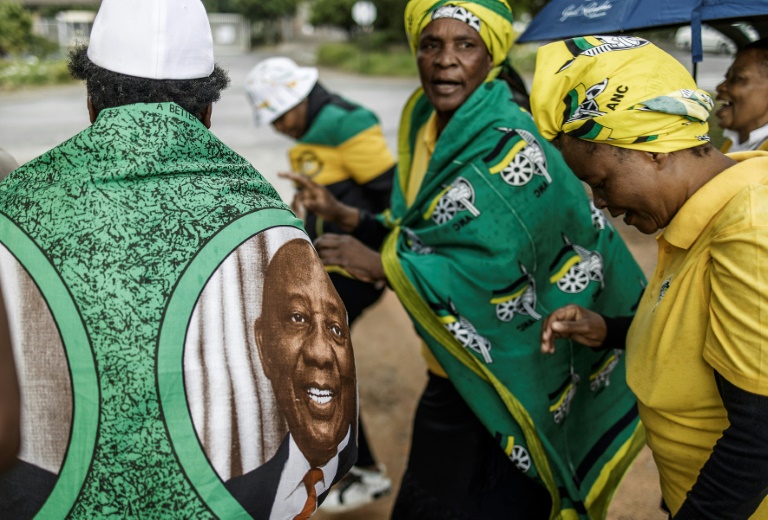
A small group of supporters and anti-Ramaphosa demonstrators gathered outside the meeting in the Johannesburg area of Nasrec.

Forged by Nelson Mandela into the weapon that led the fight against apartheid, the ANC has been deeply divided by the affair, but after a pendulum swing a majority now seems to be backing Ramaphosa.

– ‘Phala Phala’ –

The scandal has become known as the Phala Phala affair, named after Ramaphosa’s farm in the northeast of the country.

It began in June, when South Africa’s former spy boss filed a complaint with the police alleging that Ramaphosa had concealed the theft of a huge haul of cash from the estate.

He accused the president of having organised for the burglars to be kidnapped and bribed into silence. Ramaphosa has denied any wrongdoing.

He said the cash — more than half a million dollars, stashed beneath sofa cushions — was payment for buffaloes bought by a Sudanese businessman. 

But his explanations did not convince the independent panel, which raised questions about the source of the cash.

A police inquiry is ongoing, but he has not so far been charged with any crime.

The scandal comes at the worst possible time for Ramaphosa. 

On December 16, he will contest elections for the ANC presidency — a position that also holds the key to staying on as the nation’s leader.

A former mine union president who made a fortune in business in the post-apartheid era, Ramaphosa came to office in 2018 riding on a graft-free image after the corruption-tainted presidency of Jacob Zuma.

The second-largest opposition party, the Economic Freedom Fighters, said it was “disgusted and appalled by the decision of the rogue president”, calling Ramaphosa a “gangster” to challenge the report.

But the ANC’s overwhelming majority in the National Assembly means that it is not even certain that parliament will vote to launch the removal procedure.

Rebel attack in C.Africa leaves seven civilians dead

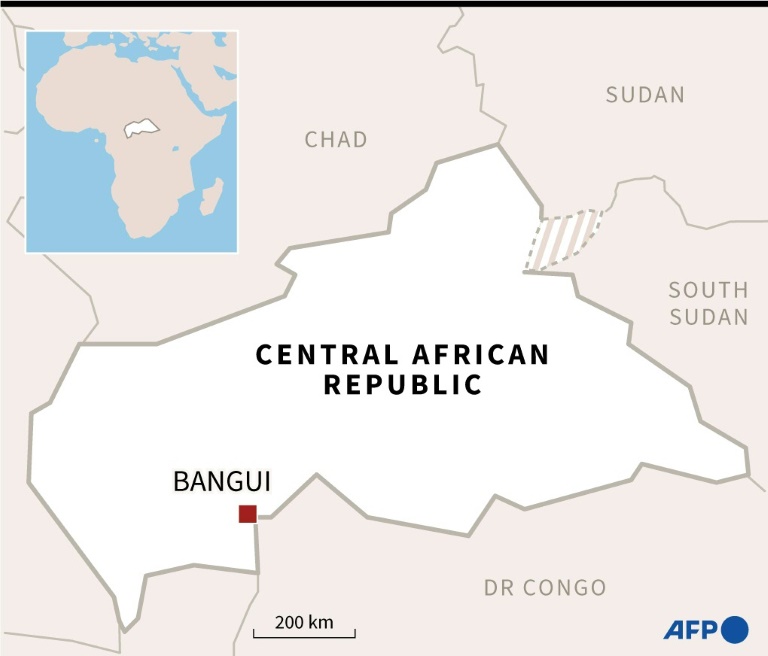
Fighting between the army and rebels over a town in the Central African Republic has left seven civilians dead and six injured, a local leader told AFP on Monday.

Members of major rebel group UPC launched an attack on Thursday near the town of Bakouma, around 480 kilometres (300 miles) east of the capital Bangui, local sub-prefect Pierre Gbake told AFP.

The victims were caught up in the attack as the rebels, coming from a town near the border with the Democratic Republic of Congo, tried to capture Bakouma before being repelled by the army, he added.

Civil war has plagued the CAR, one of the world’s poorest countries, since a Muslim-dominated armed coalition called the Seleka ousted former president Francois Bozize in 2013.

Bozize raised his own predominantly Christian and animist militias, known as the anti-Balaka, to regain power.

Civilians are often victims of the conflict, with the United Nations accusing all sides of perpetrating war crimes and crimes against humanity.

UPC spokesman Ousmanou Mohamadou did not confirm or deny his group was behind the attack, telling AFP the authorities “spend their time telling tales to the Central African people”.

But he added that taking Bakouma was “not ruled out” if the time was right.

The government did not respond to an AFP request for comment.

ANC says will oppose any parliament bid to oust Ramaphosa

South Africa’s ruling party on Monday warned it would not back any motion at an upcoming parliamentary debate that would lead to a vote for removing President Cyril Ramaphosa, under fire over a burglary scandal.

“Should parliament proceed tomorrow, the ANC will not support that vote,” African National Congress interim secretary-general Paul Mashatile told reporters after day-long talks among party leaders.

Parliament on Tuesday is set to debate a damning report by an independent panel probing allegations that Ramaphosa concealed a huge cash theft at his farm.

The three investigators questioned the source of the cash and said Ramaphosa “may have committed” serious violations and misconduct.

Tuesday’s sitting is a step that could lead to a vote on whether to impeach — remove — Ramaphosa from office.

To initiate an impeachment vote would require a simple majority in the National Assembly, where the ANC has 230 out of 400 seats. The impeachment vote itself would need a two-thirds majority to succeed.

Mashatile said “after a long debate” the ANC’s National Executive Committee resolved to vote “against the adoption of the report,” as the president had now launched a legal bid to annul its findings.

That means “the president continues with his duties as president of the ANC and the republic,” it said.

He said the ANC however agreed that Ramaphosa must “be held accountable” by the party and that investigations underway by the police and other organs should continue.

But the “president did not offer to resign nor did the NEC ask him to resign,” he added.

Earlier Monday, Ramaphosa filed a petition to the Constitutional Court seeking to have the investigative report “reviewed, declared unlawful and set aside,” according to papers made available to the media by his spokesman.

Ramaphosa also asked for any possible impeachment process to be blocked, saying “any steps taken by the National Assembly pursuant to the report are equally unlawful and invalid.”

Sudan's military, civilian factions sign deal seeking to end crisis

Sudan’s military and civilian leaders signed Monday an initial deal aimed at ending a deep crisis caused by last year’s military coup, prompting sceptical protesters to cry betrayal.

Army chief Abdel Fattah al-Burhan seized power in October 2021, derailing a rocky transition to civilian rule that began after the 2019 ouster of veteran autocrat Omar al-Bashir. 

The past year has seen near-weekly protests and a crackdown that pro-democracy medics say has killed at least 121, a spiralling economic crisis exacerbated by donors slashing funding, and a resurgence of ethnic violence in several remote regions.

Divisions among civilian groups have deepened since the coup, with some urging a deal with the military while others insist on “no partnership, no negotiation”.

The deal was signed by Burhan, paramilitary commander Mohamed Hamdan Dagalo and multiple civilian groups, most notably the Forces for Freedom and Change (FFC) — the main civilian faction that was ousted in the coup.  

As the key players put pens to paper, hundreds of citizens rallied in Khartoum to protest against the deal, setting fire to tyres, erecting barricades and facing down water cannons.

“The settlement is betrayal” and the FFC “sold our blood,” demonstrators cried. 

“We reject this deal as it overlooked street demands for justice for the people killed since the coup,” said protester Mohamed Ali.

If the deal plays out as planned, the civilian signatories will agree on a prime minister who will steer the country through a 24-month transition.

– Thorny issues ahead –

UN special representative Volker Perthes said the signing was “a culmination of the sustained efforts of Sudanese stakeholders over the past year to find a solution to the political crisis and restore constitutional order”.

The initial deal was described as “welcome” by the United States and European Union in a joint statement from the “Friends of Sudan” group, which also included Britain, Canada, France, Germany, Japan, Norway and Saudi Arabia.

UN High Commissoner for Human Rights Volker Turk hailed the accord as an “important first step toward a political agreement.” 

During the signing ceremony, Dagalo reiterated the military’s purported commitment to exit the political scene, saying “it is essential to build a sustainable democratic regime”. 

Other signatories included the Islamist Popular Congress Party, a faction of the Democratic Unionist Party and some ex-rebel groups who signed a 2020 peace deal.

The agreement — based on a proposal by the Sudanese Bar Association — was negotiated in the presence of officials from the UN, Western diplomats as well as Saudi Arabia and the United Arab Emirates, according to the FFC. 

Perthes urged Sudanese factions to “immediately” start the second phase to resolve the outstanding issues and reach a comprehensive deal. 

However, that part is far thornier, with observers questioning whether the military would be willing to give up economic interests — as stipulated — and wider powers that it views as its privileged domain.

Phase one of the deal “is a very low level commitment on Burhan’s part… allowing him to survive” politically, said Kholood Khair founder of the Confluence Advisory, a Khartoum-based think-tank.

But the signatories will likely face “a real political crisis as they start talking in earnest about security sector reforms, transitional justice (and) financial accountability,” she added. 

Monday’s signing comes months after Burhan pledged that the military would step aside and make way for factions to agree on a civilian government. 

Some of the former rebels who signed peace deals with Sudan in 2020 also voiced their opposition to Monday’s agreement.

Mohamed Zakaraia, spokesman for the ex-rebel Justice and Equality Movement, told AFP that it “will bring about dire consequences and further complicate the political scene”.

Close Bitnami banner
Bitnami