Africa Business

S.African leader braces to head off impeachment threat

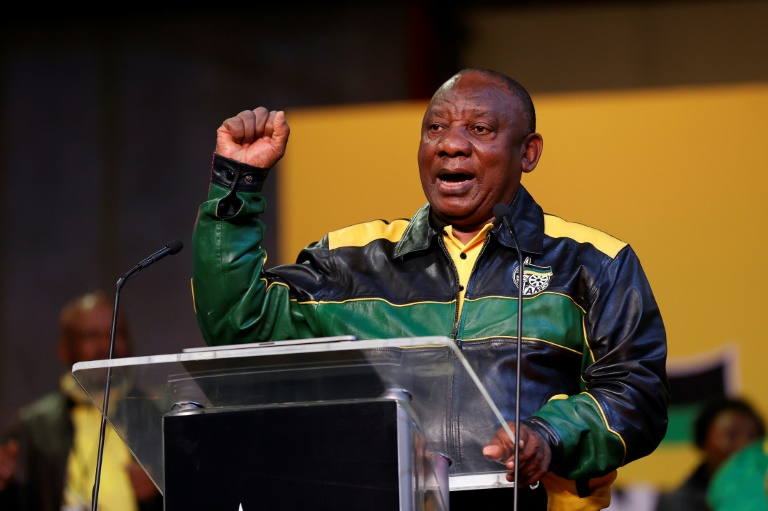
Cyril Ramaphosa may have insisted over the weekend he will not resign, but the South African president still faces a parliamentary vote Tuesday that could lead to his impeachment.

The ruling African National Congress (ANC) will meet Monday to discuss Ramaphosa’s fate after a parliamentary panel’s report last week said he might have acted illegally in covering up a burglary at his farm.

Despite deep divisions inside the party, there appears to be a majority backing the president.

There was pressure last week from some quarters for Ramaphosa to quit or be forced from office over what has become known as the Phala Phala affair, after the farm at the centre of the controversy.

But Ramaphosa looked relaxed and cheerful Sunday as he spoke to journalists outside a conference centre where some ANC delegates were already discussing the case against him.

With a smile, he explained he had been excluded from the meeting, agreeing that, in the circumstances, it was best for him not to take part.

He has been accused of having covered up the burglary of more than half a million dollars in cash from his farm in northeastern South Africa.

Last week’s report said the president “may have committed” serious violations and misconduct.

– Parliamentary scrutiny –

The president has been under fire since June, when a former spy boss filed a complaint with the police alleging that Ramaphosa had hidden the February 2020 burglary from the authorities.

He accused the president of having organised for the robbers to be kidnapped and bribed into silence.

Ramaphosa said a vast sum of cash stashed at the farm was payment for buffaloes bought by a Sudanese businessman. A police inquiry is ongoing, but he has not so far been charged with any crime.

And while Ramaphosa insists he is innocent of any wrongdoing his explanations did not convince the parliamentary panel, which consists of three lawyers who were appointed by parliament.

On Monday, the ANC’s highest body — the National Executive Committee (NEC) — meets to discuss the matter.

On Tuesday the report will go before parliament to be examined and there will be a vote on whether to launch an impeachment process against the president.

In South Africa, impeachment means removal from office.

The scandal, with its colourful details of more than half a million dollars in cash being hidden under sofa cushions, comes at the worst possible time for Ramaphosa. 

On December 16, he will contest elections for the ANC presidency — a position that also holds the key to staying on as the nation’s president.

– ‘Flawed’ report –

On Saturday Ramaphosa’s spokesman said the president would challenge the parliamentary report in court.

“President Ramaphosa is not resigning based on a flawed report, neither is he stepping aside,” said Vincent Magwenya.

“It is in the long-term interest… of our constitutional democracy, well beyond the Ramaphosa presidency, that such a clearly flawed report is challenged, especially when it’s being used as a point of reference to remove a sitting head of state,” he added.

A majority is needed to trigger the impeachment procedure — and if it is launched, it would take a two-thirds majority to remove the president from office.

Despite its divisions, the ANC has a comfortable majority in parliament.

“Ultimately the decision on impeachment would be a political one in parliament,” said a judicial source who requested anonymity.

US Presidents Bill Clinton and Donald Trump had “survived their impeachment processes because the necessary majorities couldn’t be found by their challengers”, the source pointed out.

Nor is it even certain that parliament will vote to launch the procedure.

As well as Ramaphosa, some legal experts have outlined flaws in the report.

They argue that without recourse to the ongoing criminal investigation it is based largely on hearsay, Ramaphosa’s statements, and the initial complaint lodged by an opponent of the president.
S.African leader braces to head off impeachment threat

Cyril Ramaphosa may have insisted over the weekend he will not resign, but the South African president still faces a parliamentary vote Tuesday that could lead to his impeachment.

The ruling African National Congress (ANC) will meet Monday to discuss Ramaphosa’s fate after a parliamentary panel’s report last week said he might have acted illegally in covering up a burglary at his farm.

Despite deep divisions inside the party, there appears to be a majority backing the president.

There was pressure last week from some quarters for Ramaphosa to quit or be forced from office over what has become known as the Phala Phala affair, after the farm at the centre of the controversy.

But Ramaphosa looked relaxed and cheerful Sunday as he spoke to journalists outside a conference centre where some ANC delegates were already discussing the case against him.

With a smile, he explained he had been excluded from the meeting, agreeing that, in the circumstances, it was best for him not to take part.

He has been accused of having covered up the burglary of more than half a million dollars in cash from his farm in northeastern South Africa.

Last week’s report said the president “may have committed” serious violations and misconduct.

– Parliamentary scrutiny –

The president has been under fire since June, when a former spy boss filed a complaint with the police alleging that Ramaphosa had hidden the February 2020 burglary from the authorities.

He accused the president of having organised for the robbers to be kidnapped and bribed into silence.

Ramaphosa said a vast sum of cash stashed at the farm was payment for buffaloes bought by a Sudanese businessman. A police inquiry is ongoing, but he has not so far been charged with any crime.

And while Ramaphosa insists he is innocent of any wrongdoing his explanations did not convince the parliamentary panel, which consists of three lawyers who were appointed by parliament.

On Monday, the ANC’s highest body — the National Executive Committee (NEC) — meets to discuss the matter.

On Tuesday the report will go before parliament to be examined and there will be a vote on whether to launch an impeachment process against the president.

In South Africa, impeachment means removal from office.

The scandal, with its colourful details of more than half a million dollars in cash being hidden under sofa cushions, comes at the worst possible time for Ramaphosa. 

On December 16, he will contest elections for the ANC presidency — a position that also holds the key to staying on as the nation’s president.

– ‘Flawed’ report –

On Saturday Ramaphosa’s spokesman said the president would challenge the parliamentary report in court.

“President Ramaphosa is not resigning based on a flawed report, neither is he stepping aside,” said Vincent Magwenya.

“It is in the long-term interest… of our constitutional democracy, well beyond the Ramaphosa presidency, that such a clearly flawed report is challenged, especially when it’s being used as a point of reference to remove a sitting head of state,” he added.

A majority is needed to trigger the impeachment procedure — and if it is launched, it would take a two-thirds majority to remove the president from office.

Despite its divisions, the ANC has a comfortable majority in parliament.

“Ultimately the decision on impeachment would be a political one in parliament,” said a judicial source who requested anonymity.

US Presidents Bill Clinton and Donald Trump had “survived their impeachment processes because the necessary majorities couldn’t be found by their challengers”, the source pointed out.

Nor is it even certain that parliament will vote to launch the procedure.

As well as Ramaphosa, some legal experts have outlined flaws in the report.

They argue that without recourse to the ongoing criminal investigation it is based largely on hearsay, Ramaphosa’s statements, and the initial complaint lodged by an opponent of the president.
Tunisians dream of moving to Germany as crisis bites

Germany is becoming a key destination for disillusioned young Tunisians despite a language barrier and the North African nation’s long history of ties with France.  

Europe’s biggest economy, with its low birth rate, is crying out for labour, and many Tunisians, exhausted by years of economic crisis, see an opportunity for a legal path to emigration. 

Numbers are still small but rising fast. Germany granted 5,474 work permits to Tunisians from January to October — up from 4,462 in the whole of last year and more than double the numbers for 2020.

The trend has been stimulated by the fact Germany has no quota restrictions for countries of origin and increasingly recognises foreign diplomas.

Germany “has a huge need for workers, not just in the health and IT sectors but also in hospitality, building, laying fibre-optic cables or driving heavy goods vehicles,” said Narjess Rahmani, a Berlin-based Tunisian who heads the immigration agency “Get In Germany”.

Some employers offer contracts to help ease the visa process and even pay for six months of language tuition to help their future workers.

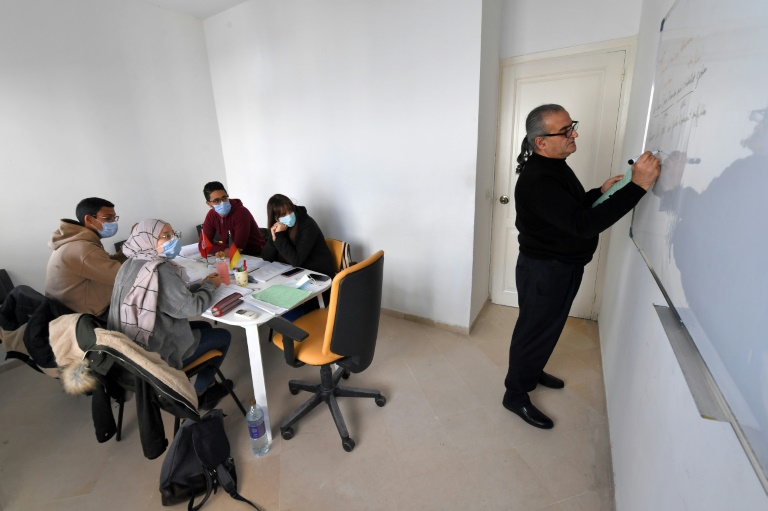
Yeft Benazzouz, who runs a language school in Tunis, said demand for German classes has risen sharply since 2020. 

“Before, I had groups of one or two people,” he said. “Now it’s gone up to six or seven.”

Yeft also teaches basic German cultural norms, including the line of advice that “puenktlich ist schon spaet” — “being on time is already late”. 

– High prices, few jobs –

Tunisia’s history as a French colony means its people are used to foreign languages, Rahmani said. “We are also very open to other cultures, through tourism and the cultural mix throughout our history.”

The language school’s students are often highly qualified, thanks to one of the Arab world’s most reputable education systems, but cursed by unemployment affecting 30 percent among young graduates.

Hydraulic engineer Nermine Madssia, 25, who wears a hijab, said she had chosen Germany over France, citing Islamophobia. 

She said she hoped to get “respect, consideration and a decent salary”, in contrast to Tunisia where the average pay is just 1,000 dinars (around 300 euros and dollars) per month. 

Even highly sought-after IT technicians can expect to earn a maximum of 2,000 dinars early in their careers.

Like many who hope to leave Tunisia, Nermine has had help from her parents in financing German lessons and the visa application.

“With the increase in the cost of living, a salary isn’t enough to start and support a family,” she said.

Inflation topped 9.0 percent year-on-year in October and Tunisia has endured years of economic crisis, pre-dating even the 2011 revolution that toppled dictator Zine El Abidine Ben Ali. 

With sluggish growth, vast public debt and many sectors closed off to new entrants, jobs are sparse, exacerbated by the Covid pandemic and fallout from the Ukraine war.

– Dangerous sea crossings –

President Kais Saied’s 2021 power grab, which has placed Tunisia’s decade-long democratic transition in doubt, has done little to improve economic confidence.

One in every two young people wants to leave, says the Tunisian Forum for Economic and Social Rights group.

Some leave legally — including more than 40,000 engineers and 3,300 doctors in the past five years — while many thousands more attempt dangerous journeys to Italy in makeshift boats, some drowning on the way.

Among the legal departees is Elyes Jelassi, 28, who packed a bottle of olive oil and some spices into his suitcase as he prepared for Germany.

As his family gathered in the town of Korba to wish him goodbye, he said he had never wanted to leave. 

But “after three years of studies and internships in several hospitals, I decided not to make a career in Tunisia,” he said.

Jelassi already has a job contract as a senior nurse in the German city of Wiesbaden, with free accommodation for the first six months. 

As well as a good salary, he said he expects to find better working conditions than in Tunisia, where the health system has been crippled by the pandemic and years of neglect.

“Our hospitals suffer from a lack of equipment, which causes conflict with patients,” he said. “It’s really stressful.”

He chose Germany over Canada, France or the Gulf because he already has friends there and will easily be able to further his studies. 

But he probably won’t stay there forever.

“I’d like to come back when I’m 50,” he said.

Egypt dusts off pyramids for fashion, pop and art shows

Egypt is using the ancient grandeur of its pyramids as a backdrop for modern pop concerts and fashion shows, hoping to boost its image, tourism and the luxury brand sector beloved by its moneyed elite.

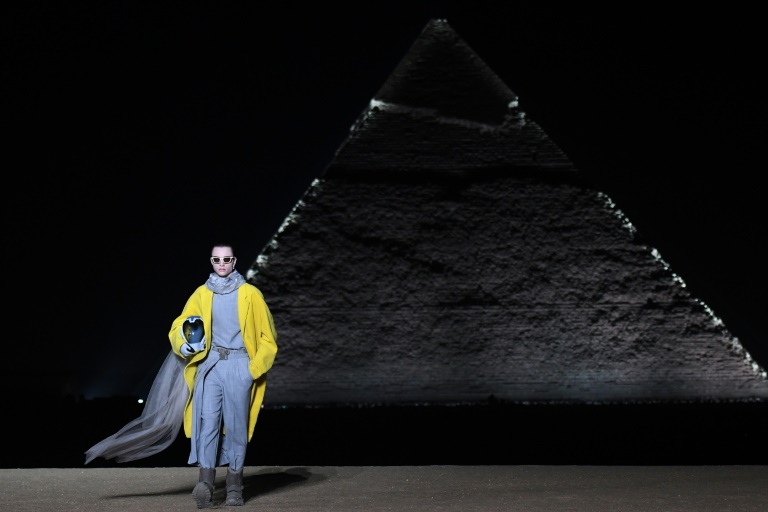
French fashion house Dior debuted its latest collection Saturday at the Giza pyramids, after Italian designer Stefano Ricci held a show at Luxor’s dramatic Temple of Hatshepsut in October.

Dior CEO Pietro Beccari told AFP the fashion house chose the pyramids as far more than “just a useless background”, drawing on Egyptian astrology for the collection named “Celestial”.

Before that, American pop bands Maroon 5 and the Black Eyed Peas performed at the Giza Necropolis, where contemporary art was also recently shown at the latest Art d’Egypte exhibition.

The modern cultural push is a new direction for Egypt’s image. 

Long a cultural powerhouse in the Arab world, with wildly popular singers and movie stars especially in its heyday in the 1950s-70s, Egypt has set its sights on its ancient heritage to attract the global spotlight once more. 

A harbinger of the new embrace of ancient culture and history was a “golden parade” last year of 22 pharaohs that crossed Cairo from an old to a new museum in a carnival-style grand spectacle.

It was part of a push by President Abdel Fattah al-Sisi’s government to revive tourism, which accounts for 10 percent of GDP and some two million jobs but has been hammered by political unrest, economic upheaval and the Covid pandemic.

– ‘Vital’ glamour –

Showcasing Egypt’s heritage in a new context “will encourage other brands and international cultural figures to come to Egypt,” said art historian Bahia Shehab.

Fashion photographer Mohsen Othman agreed that such glamorous events are “vital”.

Big brands like Dior “come in with a huge budget,” employ local talent and “support young creators who can put Egypt on the global fashion map”.

Iman Eldeeb, whose agency cast two Egyptian models for Saturday’s show, told AFP it was a “long-awaited step for the fashion world in Egypt”.

Egypt’s luxury goods sector has grown despite years of economic turmoil that saw the pound lose half its value in a 2016 currency devaluation.

Despite the downturn, Egypt, the Arab world’s most populous country, is home to 86,000 millionaires, according to the bank Credit Suisse.

“The richest one percent are enough to create demand,” said public relations specialist Ingy Ismail, who advises luxury brands. 

The boutiques in the shopping centres of Cairo’s chic new satellite cities, she said, are “up to the standards of international luxury brands”.

– ‘Young creative talent’ –

Egypt’s bubble of super rich has helped create a home-grown fashion design scene whose pioneers have recently ventured onto the catwalks of Milan and Paris.

At this year’s Paris Fashion Week, Cairo-based luxury brand Okhtein showed a resin-made bustier that evoked Egyptian alabaster at French fashion house Balmain’s show.

It was a rare success story for Egypt’s creative sector, where “most people are self-taught, working hard with scarce resources to try and meet international standards,” said Othman, the photographer.

Ismail said the country’s luxury clothing and jewellery market “has gone from under 100 Egyptian brands to more than 1,000 today”, fuelled by “a huge pool of young creative talent”.

International events offer rare exposure, but getting them to the country is still a challenge.

“It is a big step for the government to authorise Art d’Egypte and Dior to organise events at the foot of the pyramids,” the art show’s curator, Nadine Abdel Ghaffar, told AFP. 

Red tape and tight restrictions can still get in the way, she suggested, conceding that “the legislative framework is complicated”.

– Timeless marvels –

But “promoting the country’s culture” must be a priority, added Abdel Ghaffar, who believes a dedicated government body could better promote exhibitions, concerts, shows and even film production.

Shehab, the art historian, said many realise that Egypt, known for its timeless architectural marvels in the desert, needs to project an updated image of itself. 

“There’s more and more awareness about the need for soft power and for culture as a representation for the country,” she said, cautioning however that Egypt still requires “better infrastructure” to make this happen.

She even dared dream that Egypt could draw in Hollywood productions, if it only starts granting permits.

“We have lost count of the number of international productions that have resorted to shooting in Morocco, Jordan or Saudi Arabia,” she said.

The latest Egypt-themed production was a Disney+ TV miniseries, Marvel Comics’ “Moon Knight,” for which two entire Cairo city blocks were built from scratch — on a set in Budapest.

W.African leaders agree to create regional force

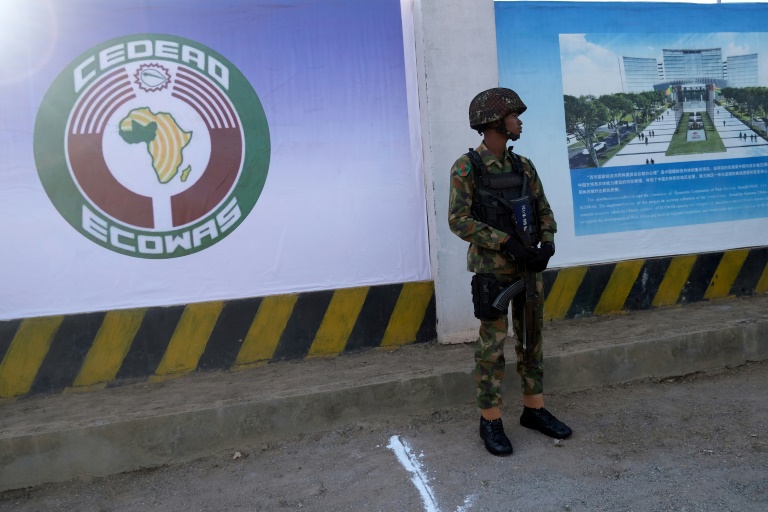
West African leaders agreed on Sunday to create a regional force to intervene against jihadism and in the event of coups, a senior official said.

Leaders of the Economic Community of West African States had decided to act to “take care of our own security in the region”, Omar Alieu Touray, president of the ECOWAS commission, told journalists at a summit in Nigeria.

They are “determined to establish a regional force that will intervene in the event of need, whether this is in the area of security, terrorism and restore constitutional order in member countries,” he added.

Mali, Guinea and Burkina Faso have all been hit by military coups in the last two years.

Several countries in the region are also suffering from the spread of jihadism, including Mali, Burkina Faso and Niger, and southwards to the Gulf of Guinea. 

National armies, largely powerless against the jihadist forces operating across borders, have been cooperating with external actors such as the UN, France and Russia.

But Touray said this decision would “restructure our security architecture”.

The modalities of the planned regional force will be considered by defence chiefs in the second half of 2023, Touray said.

The funding of the force must also be decided, but the ECOWAS official stressed that such an operation could not be solely dependent on voluntary contributions.

– Pressure on Mali –

Addressing another regional problem, the West African leaders told Mali’s ruling junta to release 46 Ivorian troops it has held since July.

“We ask the Malian authorities to release the Ivorian soldiers by January 1, 2023 at the latest,” said Touray, at the Abuja summit.

The Gambian diplomat said the West African bloc reserved the right to act if the soldiers were not released by January 1.

If Mali fails to do so, ECOWAS will impose sanctions, a West African diplomat told AFP.

Togolese President Faure Gnassingbe, who has been mediating between Mali and Ivory Coast on the issue, will travel to Mali to “demand” the release of the soldiers, the diplomat added.

The Ivorian troops were arrested on July 10 on their arrival at the airport in Mali’s capital Bamako.

Ivory Coast says the troops were sent to provide backup for the UN peacekeeping mission in Mali, MINUSMA, and are being unfairly detained. 

Mali says the troops are mercenaries and has placed them in custody on charges of attempting to harm state security. 

ECOWAS had decided at an extraordinary summit in September to send a high-level delegation to Mali to try to resolve the crisis. But no progress was reported from this mission.

– Coup-hit nations –

The West African leaders, concerned about instability and contagion, have been pressing for months for the quickest possible return to civilian rule in the three countries which have undergone coups in recent years.

Mali and Burkina Faso have both been severely shaken by the spread of jihadism.

All three countries have been suspended from the decision-making bodies of ECOWAS.

Leaders of the military juntas have pledged, under pressure, to step down after two years, allowing for a transition period during which they all say they want to “rebuild” their state.

ECOWAS has been looking to see what progress each nation has been making towards restoring constitutional order.

In Mali, “it is essential that constitutional order returns within the planned timeframe”, said Touray.

If Mali’s military meets the announced deadline of March 2024 — after months of confrontation with ECOWAS and a severe trade and financial embargo that has now been lifted — the “transition” will in fact have lasted three and a half years.

Touray urged the junta in Guinea to involve all parties and civil society in dialogue “immediately” on the process of restoring civilian rule.

The main political parties and much of civil society there have been boycotting the authorities’ offer of dialogue.

As for Burkina Faso, Touray expressed ECOWAS’s “serious concerns” about the security situation and the humanitarian crisis there, while pledging support for the country. 

Moroccans protest price hikes and 'repression'

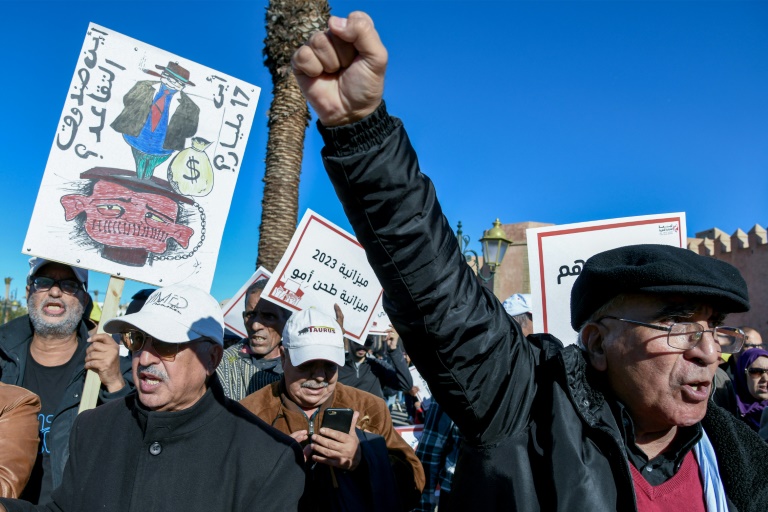
Protesters turned out in force to march in Morocco’s capital Rabat Sunday to denounce the “high cost of living and repression”, amid surging inflation and rising social discontent.

“The people want lower prices… The people want to eliminate despotism and corruption,” chanted the crowd, estimated by journalists to be around 3,000 people, the largest such rally in recent months.

Police put the turnout at between 1,200 and 1,500 people.

“We came to protest against a government that embodies the marriage of money and power,” said Younes Ferachine, a coordinator from the Moroccan Social Front (FSM) group of political parties and left-wing trade unions that organised the rally.

People converged from across Morocco for the protest, which was also called to highlight the cases of several jailed bloggers and journalists.

Hit by the economic impact of the Covid-19 pandemic and inflation, poverty levels are back to where they were in 2014, the government’s High Commission for Planning said in a recent report.

Consumer price inflation was 7.1 percent year-on-year in October, due in large part to surging food prices triggered partly by an intense drought that has hit farmers.

Faced with the recent protests, Prime Minister Aziz Akhannouch has lately promoted expanding medical coverage, with more than 10 million low-income Moroccans enrolling in recent weeks.

Moroccans protest price hikes and 'repression'

Thousands of protesters marched in Morocco’s capital Rabat on Sunday decrying the “high cost of living and repression”, amid surging inflation and rising social discontent.

“The people want lower prices… The people want to eliminate despotism and corruption,” chanted the crowd, estimated by journalists to be around 3,000 people, the largest such rally in recent months.

“We came to protest against a government that embodies the marriage of money and power,” said Younes Ferachine, a coordinator from the Moroccan Social Front (FSM) group of political parties and left-wing trade unions that organised the rally.

People converged from across Morocco for the protest, which was also called to highlight the cases of several jailed bloggers and journalists.

Hit by the economic impact of the Covid-19 pandemic and inflation, poverty levels are back to where they were in 2014, the government’s High Commission for Planning said in a recent report.

Consumer price inflation was 7.1 percent year-on-year in October, due in large part to surging food prices, triggered partly by an intense drought that has hit farmers.

Faced with the recent protests, Prime Minister Aziz Akhannouch has lately promoted expanding medical coverage, with more than 10 million low-income Moroccans enrolling in recent weeks.

Rebel commander says 65% of fighters have 'disengaged' from Tigray frontlines

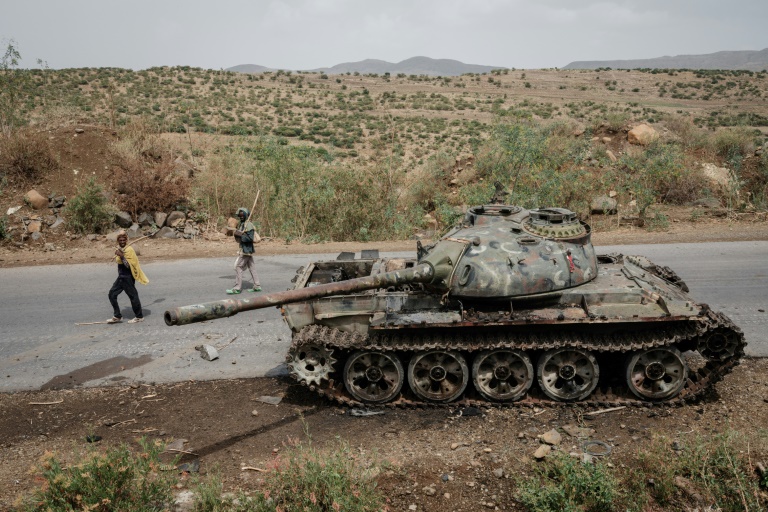
The commander-in-chief of the Tigray rebel forces has said that 65 percent of his forces have “disengaged”, a month after a ceasefire agreement over Ethiopia’s war-torn northern region.

The withdrawal and disarmament of Tigray’s forces is a key provision of the agreement signed early last month in South Africa to end the two-year conflict.  

“We have started disengagement and relocation of our forces from battlelines… out of our forces, 65 percent of them have passed through this process, disengaging from battlelines and moved to designated places,” General Tadesse Worede, chief of staff of Tigray’s fighters, told reporters on Saturday.

He did not specify the battlelines he was talking about or how far fighters had been withdrawn.

AFP was not able to independently verify the claims as Tigray remains inaccessible to journalists.

Tigray’s authorities had been resisting central rule for months when Ethiopian Prime Minister Abiy Ahmed accused their leadership of attacking federal army camps and sent troops into the region in 2020.

The conflict between the Tigray People’s Liberation Front (TPLF) and pro-Abiy forces — which include regional militias and the Eritrean army — has caused an untold number of deaths, forced more than two million people from their homes and driven hundreds of thousands to the brink of famine.

The two parties signed a peace deal in South Africa on November 2 that agreed to a cessation of hostilities and unfettered aid into Tigray, as well as the disarming of TPLF fighters and re-establishment of federal authority over Tigray.

But Tadesse said there were still “forces in the areas that don’t want peace”, apparently referring to Eritrean soldiers and other regional Ethiopian militia.

“The problems they are creating and the abuses they’re committing on the population isn’t secret, so we’ve paused to some extent (our disengagement) in some places (to prevent) them from entering into new areas and continuing their atrocities on the population.”

His troops would not “100 percent” disengage until the threat was reduced, he added.

The ceasefire makes no mention of the presence on Ethiopian soil or any possible withdrawal of Eritrean troops, who have backed Abiy’s forces and been accused of atrocities.

– Aid access –

Rebel fighters have “started collecting our heavy weaponry and putting it in one area”, he said.

According to an application agreement signed in the weeks following the Pretoria accord, the restitution of heavy weapons must be carried out simultaneously with the withdrawal of foreign and non-federal forces.

“There are currently no observers on the ground as per the peace agreement, so far there is no monitoring (mission), but we’re implementing the agreement as we should,” Tadesse said.

“In terms of implementing the peace agreement, we have moved one step forward,” he added.

The UN’s health agency said Friday that it still cannot get unfettered access to bring humanitarian aid into the war-torn region, and that just a trickle of aid had managed to get into Tigray so far.

World Health Organization officials also raised concerns for areas that are still under the control of troops from neighbouring Eritrea.

“That peace process has not yet resulted in the kinds of full access, unfettered access and the massive scale-up of medical and health assistance that the people of Tigray need,” WHO emergencies chief Michael Ryan told a press conference.

“We’ve been a long time waiting to get access to these desperate people.”

Restoring aid deliveries to Tigray was a key part of the agreement to end the two-year war that has killed untold numbers of people and unleashed a humanitarian crisis.

The region was isolated from the world for over a year, and faced severe shortages of medicines and limited access to electricity, banking and communications.

The UN’s World Food Programme said this week that an estimated 13.6 million people across Tigray and its neighbouring regions of Amhara and Afar were dependent on humanitarian aid as a result of the war.

World Cup host Qatar seeks to change minds on Islam

Proudly Muslim Qatar has taken advantage of the World Cup to reach out to the hundreds of thousands of visiting fans to change minds about Islam or even make conversions.

The Gulf emirate is the first Muslim nation to stage a football World Cup and its gas riches have endowed it with an array of grand mosques to pique the curiosity of visitors.

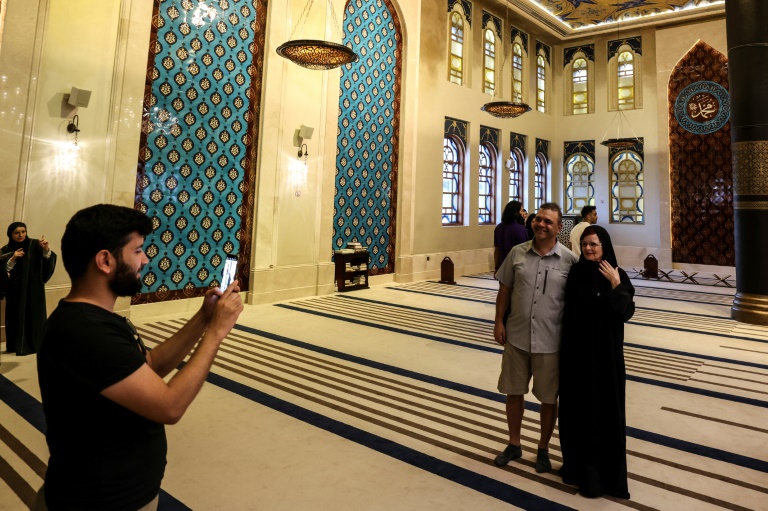
Canadian couple Dorinel and Clara Popa listened to the call to prayer at an Ottoman-style mosque in Doha’s Katara cultural district.

It is known as Doha’s Blue Mosque because of the sumptuous mosaics of blue and purple tiles on the walls. A guide took the couple on a tour of the elaborate interior dominated by a giant chandelier.

Dorinel Popa, a 54-year-old accountant, said the couple were taking a first look at Islam.  

“We have prejudice against the culture and the people,” because of a lack of exposure to others, he said.

– Coffee and faith –

“We have some thoughts in our heads and now maybe some of them will change,” added his wife, a 52-year-old doctor.

The Qatar Guest Center, which supervises the Blue Mosque, has brought dozens of Muslim preachers from around the world to Qatar for the tournament.

Outside the mosque there are booklets in different languages explaining Islam and the Prophet Mohammed, along with Arabic coffee and dates.

Syrian volunteer Ziad Fateh said the World Cup is “an opportunity to introduce millions of people to Islam” and change “misconceptions” about a religion that many in the West link to radicalism.

“We explain to people more about ethics, the importance of family bonding, and respect for neighbours and non-Muslims,” he added.

Near the mosque, volunteers managed a table aimed at visiting women with a sign saying: “Ask me about Qatar.” 

Those who stop are also offered Arabic coffee.

A Palestinian volunteer, Somaya, said most of the questions concerned “the veil, polygamy and whether women are oppressed in Islam.”

Qatar’s record on women’s and LGBTQ rights has been heavily scrutinised in connection with the World Cup.

Nearby, visitors can watch a five minute virtual reality tour of Islam.

The campaign is being pursued across Qatar.

– ‘Happiness’ in Islam –

In the Pearl district, where many expatriates live and frequent its expensive cafes and restaurants, murals have been painted with quotes from the Prophet Mohammed urging good morality.

Upscale shopping malls carry advertisements promoting Islam.

In the Souq Waqif market, where thousands of fans gather every day, free books and pamphlets are left in one alley with a sign saying: “If you’re looking for happiness… you will find (it) in Islam”.

Near the Souq, the Sheikh Abdulla bin Zaid Islamic Cultural Center is open 12 hours a day for tours.

Some Muslim leaders in Qatar have called for efforts to convert visiting football fans to Islam.

Sultan bin Ibrahim Al Hashemi, a professor of sharia law at Qatar University who heads the Voice of Islam radio station, said the World Cup should be used to find new converts as well as counter Islamophobia.

Hashemi told AFP that in his meetings with foreign fans: “I will offer them to convert to Islam.

“If I find the opportunity, I will offer them Islam with ease and grace, and if I do not find the opportunity, I will tell them that you are our guests and our brothers in humanity.”

But he stressed that Islam does not accept conversion through coercion.

Social media posts have claimed that hundreds of fans have changed faith but AFP’s fact-checking service has shown those claims are fake.

An official at Qatar’s ministry of religious endowments told AFP that the goal of the state was not “the number of converts to Islam, but rather the number of those who change their opinion about it.”

Fans said they found the idea of World Cup conversions absurd.

“It is a good opportunity to learn more about Islam,” said Petr Lulic, a 21-year-old Croatian in Qatar with his family. “But no one embraces a new religion during a football tournament.”

Rebel commander says 65% of fighters have 'disengaged' from Tigray frontlines

The commander-in-chief of the Tigray rebel forces has said that 65 percent of his forces have “disengaged”, a month after a ceasefire agreement over Ethiopia’s war-torn northern region.

“We have started disengagement and relocation of our forces from battlelines… out of our forces, 65 percent of them have passed through this process, disengaging from battlelines and moved to designated places,” General Tadesse Worede, chief of staff of Tigray’s fighters, told reporters on Saturday.

Tigray’s authorities had been resisting central rule for months when Ethiopian Prime Minister Abiy Ahmed accused their leadership of attacking federal army camps and sent troops into the region in 2020.

The conflict between the Tigray People’s Liberation Front (TPLF) and pro-Abiy forces — which include regional militias and the Eritrean army — has caused an untold number of deaths, forced more than two million people from their homes and driven hundreds of thousands to the brink of famine.

The two parties signed a peace deal in South Africa in November that agreed to a cessation of hostilities and unfettered aid into Tigray, as well as the disarming of TPLF fighters and re-establishment of federal authority over Tigray.

But Tadesse said there were still “forces in the areas that don’t want peace”, apparently referring to Eritrean soldiers and other regional Ethiopian militia.

“The problems they are creating and the abuses they’re committing on the population isn’t secret, so we’ve paused to some extent (our disengagement) in some places (to prevent) them from entering into new areas and continuing their atrocities on the population.”

His troops would not “100 percent” disengage until the threat was reduced, he added.

The ceasefire makes no mention of the presence on Ethiopian soil or any possible withdrawal of Eritrean troops, who have backed Abiy’s forces and been accused of atrocities.

– Aid access –

Rebel fighters had “started collecting our heavy weaponry and putting it in one area”, he said, adding there were currently no international monitors or observers present on the ground.

“But we’re implementing the agreement as we should, and the (monitors) can observe at whichever stage they arrive,” he added.

The UN’s health agency said Friday that it still cannot get unfettered access to bring humanitarian aid into the war-torn region, and that just a trickle of aid had managed to get into Tigray so far.

World Health Organization officials also raised concerns for areas that are still under the control of troops from neighbouring Eritrea.

“That peace process has not yet resulted in the kinds of full access, unfettered access and the massive scale-up of medical and health assistance that the people of Tigray need,” WHO emergencies chief Michael Ryan told a press conference.

“We’ve been a long time waiting to get access to these desperate people.”

Restoring aid deliveries to Tigray was a key part of the agreement to end the two-year war that has killed untold numbers of people and unleashed a humanitarian crisis.

The region was isolated from the world for over a year, and faced severe shortages of medicines and limited access to electricity, banking and communications.

The UN’s World Food Programme said this week that an estimated 13.6 million people across Tigray and its neighbouring regions of Amhara and Afar were dependent on humanitarian aid as a result of the war.

Close Bitnami banner
Bitnami