Africa Business

DR Congo accuses M23 rebels of civilian massacre, breaching truce

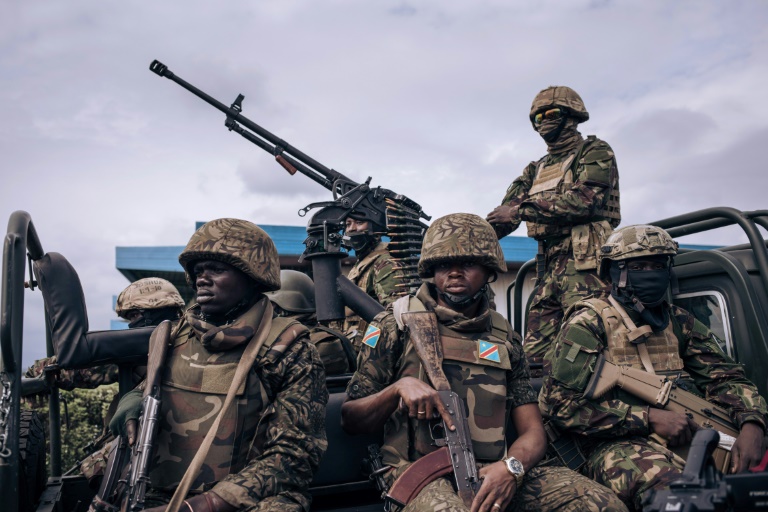
The Democratic Republic of Congo’s army on Thursday accused M23 insurgents of killing 50 civilians and breaching a five-day-old truce in the country’s restive east.

The rebel group issued a statement late Thursday denying the alleged massacre of civilians.

The ceasefire took effect in North Kivu province at the weekend following a summit between DRC and its neighbour Rwanda.

It was to have been followed by a rebel pull-out from captured territory, a withdrawal that has yet to take place.

General Sylvain Ekenge said the M23 group was “carrying out massacres… the most recent of which is that of 50 Congolese civilians, heinously murdered on Tuesday in Kishishe,” a village some 70 kilometres (40 miles) north of the eastern city of Goma.

Ekenge claimed that while Congolese forces had “scrupulously observed the truce”, the M23 had attacked government positions.

The M23 responded with a statement describing accusations of a massacre in Kishishe as “baseless allegations” and insisting that “it has never targeted civilian populations”.

Sources said earlier that fighting had resumed Thursday in Kirima in the same region, about 10 kilometres (six miles) from the town of Kibirizi.

Paul Lutibahwa, head of civil society groups for the Bambo region, said: “The rebels have crossed the bridge, heading for Kibirizi… there’s panic”.

A security official, speaking on condition of anonymity, accused the M23 of having breached the ceasefire and “carrying on looting and fighting”.

A DRC army officer, who also asked not to be identified, said: “The fighting is heavy — we are using heavy artillery.”

The M23’s military spokesman, Willy Ngoma, contacted by AFP, confirmed that there was fighting with the army.

– Resurgent force –

The March 23 movement, or M23, is a predominantly Congolese Tutsi rebel group that was dormant for years.

It took up arms again in November last year and seized the town of Bunagana on the border with Uganda in June. 

After a brief period of calm, it went on the offensive again in October, greatly extending the territory under its control and advancing towards the city of Goma.

Kinshasa accuses its smaller neighbour Rwanda of providing M23 with support, something that UN experts and US officials have also pointed to in recent months. 

Kigali disputes the charge, and in turn accuses Kinshasa of collusion with the FDLR — a former Rwandan Hutu rebel group established in the DRC after the genocide of the Tutsi community in 1994 in Rwanda. 

Talks between the two countries in the Angolan capital of Luanda unlocked a truce agreement on November 23.

The ceasefire was scheduled to take effect on Friday, November 25 at 1600 GMT and be followed by a pull-out by the M23 two days later.

A parallel initiative has been undertaken by the East African Community (EAC), a seven-nation regional bloc that includes Rwanda.

It has decided to deploy a regional force to help stabilise the region, for which Kenyan troops are already deployed in Goma, and on November 28 launched peace talks, to which the M23 are not invited.

– Troubled region –

Until Thursday’s violence, there had been no fighting between government forces and the M23, although the rebels had clashed with local militia, especially in the Bambo area, where civilian casualties were reported.

The Vatican, meanwhile, announced that Pope Francis would visit the DRC and South Sudan from January 31 to February 5.

His trip to the two violence-plagued countries had been planned for July this year but was postponed because of treatment for knee pain.

His stay in the DRC from January 31 to February 3 will take place in Kinshasa and no longer include Goma. 

The site that had been chosen for a papal mass, located 15 kilometres (nine miles) north of Goma, is currently occupied by a forward position of the armed forces.

Scores of armed groups roam eastern DRC, making it one of Africa’s most violent regions.

Many are legacies of two wars before the turn of the century that sucked in countries from the region and left millions dead.

Demonstrators protesting perceived international indifference to the crisis rallied in Goma early Thursday. Another march staged by the Catholic church took place in Bukavu, in neighbouring South Kivu province.
S.Africa's Ramaphosa in talks with ANC as future hangs in balance

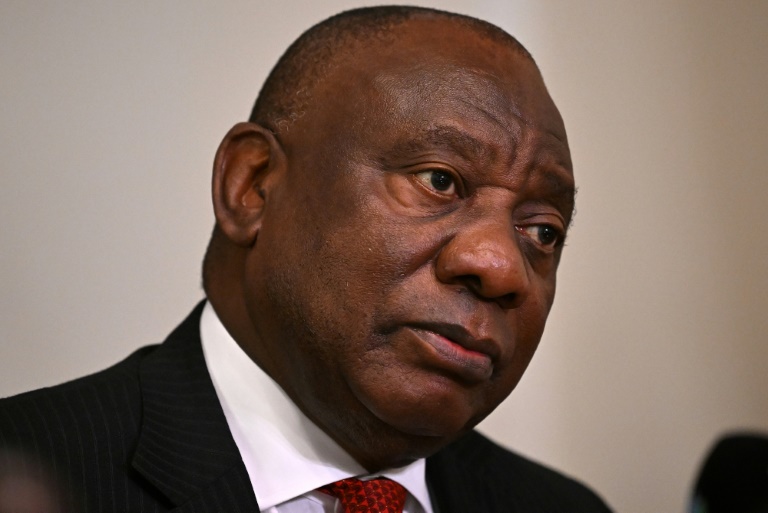
President Cyril Ramaphosa was in talks with South Africa’s ruling party late Thursday as pressure mounted for him to quit or be forced from office over a cash burglary at his farm that he allegedly covered up.

Ramaphosa “is looking at a number of options and… consulting with a number of role players” in the African National Congress (ANC), presidential spokesman Vincent Magwenya told journalists.

The talks were unfolding on the eve of an emergency session of the party’s decision-making body to discuss the escalating crisis. 

“All options are on the table,” Magwenya said.

He said an announcement from Ramaphosa was “imminent”, without adding when exactly it would be made.

But the president was not “panicking” and his decision would not be “rushed”, Magwenya said.

It would be made in the interest of the country and the government’s “stability”.

The national currency, the rand, fell nearly three percent earlier as Ramaphosa cancelled a scheduled question-and-answer session in parliament following publication of a report into the scandal.

A group representing business organisations expressed “serious concern” that Ramaphosa may have “transgressed various laws”. 

“This is a significant crisis for our country and poses high risks that will see further erosion of confidence,” said Business Unity South Africa.

Opposition politicians and critics of Ramaphosa fired a volley of demands that he resign.

– Impeachment risk –

Ramaphosa has been under fire since June, when a former spy boss filed a complaint with the police, alleging Ramaphosa had hidden a burglary at his farm at Phala Phala in northeastern South Africa from the authorities.

Instead, he allegedly organised for the robbers to be kidnapped and bribed into silence.

The vast sum stashed at the farm has cast a dark shadow over Ramaphosa’s bid to portray himself as graft-free after the corruption-stained era of Jacob Zuma.

A three-person inquiry on Wednesday submitted a report to parliament in which it concluded Ramaphosa “may have committed” serious violations and misconduct.

The report will be examined by parliament on December 6.

That debate could open the way to a vote on impeaching Ramaphosa — a term that in South Africa means to remove from office.

Ramaphosa, in his submission to the panel, steadfastly denied any wrongdoing.

But the scandal, complete with details of more than half-a-million dollars stashed beneath farm cushions, has come at the worst possible moment for him.

On December 16, he contests elections for the ANC presidency — a position that also holds the key to staying on as national president.

The ANC said in a statement that its National Executive Committee would hold urgent talks at 1200 GMT Friday.

Ramaphosa took office at the helm of Africa’s most industrialised economy in 2018 promising to root out corruption which had taken root in state institutions.

He now risks becoming the third ANC leader forced out since the party came to power after the end of apartheid in 1994.

Impeachment means the removal of a sitting president through a vote supported by at least two-thirds of lawmakers.

Grave violation of the constitution, serious misconduct or inability to perform the functions of office are the permitted grounds for an impeachment motion.

Ramaphosa’s predecessor Zuma dodged four impeachment votes until his ANC party forced him to resign over graft in 2018.

The ANC also forced Thabo Mbeki out of office in 2008 in the middle of a power struggle.

– Cash in sofa –

South Africans have been riveted by details from the investigation, particularly over $580,000 in cash stolen from beneath sofa cushions at the president’s ranch.

The sum was payment made by a Sudanese citizen who had bought buffaloes.

Farm staff initially locked the money in an office safe, said Ramaphosa. 

But a manager then decided that the “safest place” to store it would be under the cushions of a sofa inside Ramaphosa’s residence at the farm, he said. 

Ramaphosa said accusations against him were “without any merit” and asked the panel not to take the matter “any further”.

But the panel concluded that Ramaphosa had failed to report the theft directly to police, acted in a way inconsistent with his office and exposed himself to a conflict between his official responsibilities and his private business, it said.

Sao Tome to probe 'inhumane acts' in aftermath of attempted coup

Sao Tome on Thursday ordered an investigation into allegations that soldiers committed “cruel, degrading and inhumane acts” against detainees accused of seeking to mount a coup in the tiny African state.

Four people were killed on Friday last week when the military thwarted an attempt to seize power, according to the authorities.

Prime Minister Patrice Trovoada said four people had been arrested after a six-hour gun battle at army headquarters. 

The detainees had identified opposition leader and former parliament speaker Delfim Neves, as well as a former mercenary and opposition figure named Arlecio Costa, as the “sponsors” of the operation, he added.

The authorities then arrested Neves and Costa.

The same day, photos and videos were circulated widely online, purportedly showing men in military uniform brutally interrogating and torturing three of the detainees, as well as Costa. AFP was unable to independently verify the footage.

Just two days later, the armed forces chief of staff said three of the four detainees had died of wounds sustained in an “explosion” and that Costa had died after he “jumped from a vehicle”.

The government ordered “the judicial authorities to investigate cruel, degrading and inhumane acts carried out against individuals at army headquarters images of which have shocked and outraged society,” news agency STP-Press quoted it as saying.

The government said the alleged violations were carried out against “individuals implicated in the coup attempt and assault against army headquarters” on Friday last week.

On Thursday evening, armed forces chief of staff Olinto Paquete said he was resigning.

He mentioned the sharing of shocking images, and said he could not “accept such atrocities and acts of treason that harm the homeland”.

– Coup a ‘sham’? –

Neves on Wednesday said accusations that he sought to mount a coup were a “sham” and a bid to destroy him.

“All this is just a sham, a show… aimed at physically eliminating people who can be politically troublesome, which includes me,” he said at a press conference, after being released on bail on Tuesday.

Trovoada dismissed those accusations on Thursday afternoon.

“What would be the point of the government organising a coup d’etat against itself just 15 days after taking power?” he asked. 

Sao Tome and Principe is a Portuguese-speaking archipelago off central Africa that has a strong reputation for democracy and stability.

But details about what happened on Friday and the following days remain unclear.

Several people and NGOs from Sao Tome have questioned what they call “grey areas” in the timeline of events.

“They killed the living proof” of what had happened, Neves said, referring to Costa and the three dead detainees.

“The accuser (the fourth detainee) was left alive to say that Delfim Neves was one of the ringleaders behind this plot,” he charged.

“If people hadn’t mobilised quickly to get me out of the barracks at 5:30 a.m., Delfim Neves would have been dead the following day as well.”

– Failed presidential bid –

Costa once served in a notorious South African mercenary outfit, the Buffalo Battalion, which was disbanded at the end of apartheid in 1993. He had been previously accused of an attempted coup in Sao Tome in 2009.

The government has also announced it will launch investigations into the coup bid.

The European Union on Tuesday added to pressure for transparency, saying the probe should “shed light on the facts… in line with human rights and democratic values”.

Neves lost his position as speaker on November 11 when the new National Assembly was installed following elections in September.

The vote was won with an absolute majority by Trovoada’s centre-right Independent Democratic Action (ADI) party. He returned to the top job for a third time.

The ADI is one of two major parties that have vied to run the nation since independence from Portugal in 1975, along with the Movement for the Liberation of Sao Tome and Principe-Social Democratic Party (MLSTP-PSD).

Neves last year also failed to be elected president, a largely symbolic job, losing to the ADI’s Carlos Vila Nova.

He arrived in third place and alleged “massive electoral fraud” had taken place.

S.Africa's Ramaphosa in talks with ANC as impeachment pressure builds

President Cyril Ramaphosa was in talks with South Africa’s ruling party late Thursday as pressure mounted for him to quit or be forced from office over a cash burglary at his farm that he allegedly covered up.

Ramaphosa “is looking at a number of options and… consulting with a number of role players” in the African National Congress (ANC), presidential spokesman Vincent Magwenya told journalists.

The talks were unfolding on the eve of an emergency session of the party’s decision-making body to discuss the escalating crisis. 

The national currency, the rand, fell nearly three percent earlier as Ramaphosa cancelled a scheduled question-and-answer session in parliament following publication of a report into the scandal.

Opposition politicians and critics of Ramaphosa fired a volley of demands that he resign.

“The President has to step aside now and answer to the case,” said senior cabinet minister Nkosazana Dlamini-Zuma, who ran unsuccessfully against Ramaphosa as ANC leader in 2017.

“His best course of action remains immediate resignation,” said the leftist opposition Economic Freedom Fighters (EFF).

Ramaphosa has been under fire since June, when South Africa’s former spy boss filed a complaint with the police.

It alleged Ramaphosa had hidden a burglary at his farm at Phala Phala in northeastern South Africa from the authorities.

Instead, he allegedly organised for the robbers to be kidnapped and bribed into silence.

The vast sum stashed at the farm has cast a dark shadow over Ramaphosa’s bid to portray himself as graft-free after the corruption-stained era of Jacob Zuma.

– Impeachment risk –

A three-person inquiry on Wednesday submitted a report to parliament in which it concluded Ramaphosa “may have committed” serious violations and misconduct.

The report will be examined by parliament on December 6.

That debate could open the way to a vote on impeaching Ramaphosa — a term that in South Africa means to remove from office.

Ramaphosa, in his submission to the panel, steadfastly denied any wrongdoing and warned of the “interest of the stability of government and that of the country.”

But the scandal, complete with details of more than half-a-million dollars stashed beneath cushions at the farm, has come at the worst possible moment for him.

On December 16, he contests elections for the presidency of the ANC — a position that also holds the key to staying on as national president.

The ANC’s National Executive Committee is due to hold urgent talks on Friday, party spokesman Pule Mabe said..

Ramaphosa took office at the helm of Africa’s most industrialised economy in 2018 on a promise to root out corruption.

He now risks becoming the third ANC leader forced out since the party came to power after the end of apartheid in 1994.

Impeachment, in South Africa, means the removal of the president. 

Section 89 of the constitution empowers the National Assembly to remove a sitting president provided the vote is supported by at least two-thirds of lawmakers. 

Serious violation of the constitution, serious misconduct or inability to perform the functions of office are the permitted grounds for an impeachment motion.

Ramaphosa’s predecessor Zuma survived four impeachment votes until his own party, the ANC, forced him to resign over graft in 2018.

The ANC also forced Thabo Mbeki out of office in 2008 in the middle of a power struggle.

– Cash in sofa –

The South African public has been riveted by details from in the investigation, particularly over $580,000 in cash that was stolen from beneath sofa cushions at his ranch.

The sum was payment made by a Sudanese citizen who had bought buffaloes, Ramaphosa said.

Farm staff initially locked the money in an office safe, he said. 

But a manager then decided that the “safest place” to store it would be under the cushions of a sofa inside Ramaphosa’s residence at the farm, he said. 

Ramaphosa told the inquiry that the accusations against him were “without any merit” and asked it not to take the matter “any further.”

But the panel concluded that Ramaphosa had failed to report the theft directly to police.

He had acted in a way inconsistent with holding office and exposed himself to a conflict between his official responsibilities and his private business, it said.

Release of S.Africa's anti-apartheid hero killer delayed

The scheduled release from prison of the killer of South African anti-apartheid hero Chris Hani has been postponed until he has recovered from stab wounds he received this week, the authorities said Thursday.

Janusz Walus, a far-right immigrant from Poland who shot Hani dead in 1993, had been due to be released by Thursday after he was granted parole by the country’s top court.

The decision sparked fierce protests from the ruling African National Congress (ANC) and its ally in the struggle against apartheid, the South African Communist Party (SACP).

“By agreement between his legal representatives and the state attorney, the matter of Mr Walus’ parole will only be finalized after he has received the necessary medical clearance from medical team,” justice ministry spokesman Chrispin Phiri said in a statement. 

Walus is being held at the Kgosi Mampuru II Correctional Centre in Pretoria.

He was attacked by another inmate earlier this week while queueing for food.

Hani, a hugely popular figure and fierce opponent of white rule, was killed in his driveway just as negotiations to end apartheid were entering their final phase. 

The murder almost plunged South Africa into a race war. 

Walus was quickly arrested after the killing and handed the death sentence — a punishment that was commuted to life imprisonment after the death penalty was abolished in post-apartheid South Africa.

The Constitutional Court on November 21 granted Walus parole and gave the prison service 10 days in which to release him.

Walus “was convicted of (a) very serious crime… cold-blooded murder,” Chief Justice Raymond Zondo said.

He “seemed to have been intent on derailing the attainment of democracy by this country,” Zondo said. 

Even so, he said, the law entitled Walus to parole.

The SACP, which Hani used to head, has petitioned the court to go back on its ruling.

Pope to visit DR Congo, S. Sudan in early 2023

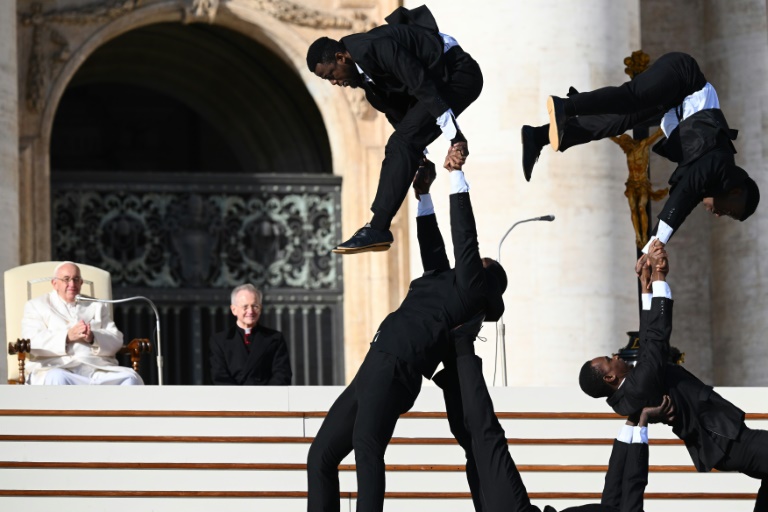
Pope Francis will visit the Democratic Republic of Congo and South Sudan early next year, a trip previously postponed due to problems with his knee, the Vatican said Thursday.

The 85-year-old pontiff will visit Kinshasa during his trip to DRC from January 31 to February 3, before heading to Juba in South Sudan from February 3 to 5.

On the second leg, he will be joined by the Archbishop of Canterbury, Justin Welby, and the Moderator of the General Assembly of the Church of Scotland, Iain Greenshields. 

It will be the pontiff’s fifth visit to the African continent since being elected head of the worldwide Catholic church in 2013. 

The trip was initially planned for July this year but was postponed “at the request of his doctors”, the Vatican said at the time, as the pope underwent treatment for knee pain.

There had also been concerns about security in visiting two countries plagued by violence, according to Italian media reports.

– Commitment to peace –

South Sudan, the world’s newest nation, has suffered from chronic instability since independence in 2011, including a brutal five-year civil war.

The Vatican has been directly involved in efforts to end the conflict, with Pope Francis himself kissing the feet of rival leaders Salva Kiir and Riek Machar in an extraordinary moment in 2019.

It was at the same retreat that he agreed to go to South Sudan with the archbishop and the moderator.

The Church of Scotland said that during the visit to Juba, the three men would “meet local church representatives, civil war victims living in a displaced persons camp and lead a large open-air prayer vigil for peace”.

“The purpose of the visit is to renew a commitment to peace and reconciliation and stand in solidarity with millions of ordinary people who are suffering profoundly from continued armed conflict, violence, floods and famine,” it said.

Archbishop of Canterbury Welby said the three religious leaders “share a deep desire to stand in solidarity with the people of South Sudan”.

– Programme reduced –

The DRC, which Pope John Paul II visited in 1985, is struggling to contain dozens of armed groups in the east of the vast nation.

The pope — who in recent months has used a wheelchair — had initially planned to visit Goma, in the war-torn east of DRC, but this stop has been removed from the new programme.

Carlos Ndaka, auxiliary bishop of Kinshasa, told AFP he welcomed the visit of pope “with great joy”.

However, “it hurts us very much that for security reasons the pope cannot go to Goma, for a visit to comfort our brothers who suffer because of the war”, he said.

Instead, the pontiff will meet with victims from the east in Kinshasa. 

About 40 percent of the estimated 100 million inhabitants of DRC are Catholic. Another 35 percent are Protestant or affiliated to Christian revivalist churches, nine percent are Muslim, and 10 percent follow the Kimbanguist Congolese church.

The country has a secular government, but religion is omnipresent in most people’s lives and the Catholic Church has at times played a leading role in local politics.

The pope’s trip will be the 40th abroad of his papacy.

Sao Tome to probe 'inhumane acts' in aftermath of attempted coup

Sao Tome on Thursday ordered an investigation into allegations that soldiers committed “cruel, degrading and inhumane acts” against detainees accused of seeking to mount a coup in the tiny African state.

Four people were killed on Friday last week when the military thwarted an attempt to seize power, according to the authorities.

Prime Minister Patrice Trovoada said that four people had been arrested after a six-hour gun battle at army headquarters. 

He said the detainees had identified opposition leader and former parliament speaker Delfim Neves, as well as a former mercenary and opposition figure named Arlecio Costa, as the “sponsors” of the operation.

The authorities then arrested Neves and Costa.

The same day, photos and videos were circulated widely online, purportedly showing men in military uniform brutally interrogating and torturing three of the detainees, as well as Costa. AFP was unable to independently verify the footage.

Just two days later, the armed forces chief of staff said that three of the four detainees had died of wounds sustained in an “explosion” and that Costa had died after he “jumped from a vehicle”.

“Trovoada’s government, in view of the gravity of the acts and an outburst of human rights violations, has ordered the justice ministry… to ask the judicial authorities to investigate cruel, degrading and inhumane acts carried out against individuals at army headquarters images of which have shocked and outraged society,” news agency STP-Press quoted it as saying.

The government said the alleged violations were carried out against “individuals implicated in the coup attempt and assault against army headquarters” on Friday last week.

– Coup a ‘sham’? –

Neves on Wednesday said accusations that he sought to mount a coup were a “sham” and a bid to destroy him.

“All this is just a sham, a show… aimed at physically eliminating people who can be politically troublesome, which includes me,” he said at a press conference, after being released on bail on Tuesday.

The justice ministry and public prosecutor’s office did not reply to an AFP request on Wednesday to say whether Neves had been charged, and if so for what.

Sao Tome and Principe is a Portuguese-speaking archipelago off central Africa that has a strong reputation for democracy and stability.

But key details about what happened on Friday and the following days remain murky.

In recent days, several people and NGOs from Sao Tome have questioned what they call “grey areas” in the timeline of events.

“They killed the living proof” of what had happened, Neves said, referring to Costa and the three dead detainees.

“The accuser (the fourth detainee) was left alive to say that Delfim Neves was one of the ringleaders behind this plot,” he charged.

“If people hadn’t mobilised quickly to get me out of the barracks at 5:30 a.m., Delfim Neves would have been dead the following day as well.”

– Failed presidential bid –

Costa once served in a notorious South African mercenary outfit, the Buffalo Battalion, which was disbanded at the end of apartheid in 1993. He had been previously accused of an attempted coup in Sao Tome in 2009.

The government has also announced it will launch investigations into the attempted coup.

The European Union on Tuesday added to pressure for transparency, saying the probe should “shed light on the facts… in line with human rights and democratic values.”

Neves lost his position as speaker on November 11 when the new National Assembly was installed following elections in September.

The vote was won with an absolute majority by Trovoada’s centre-right Independent Democratic Action (ADI) party. He returned to the top job for a third time.

The ADI is one of two major parties that have vied to run the nation since independence from Portugal in 1975, along with the Movement for the Liberation of Sao Tome and Principe-Social Democratic Party (MLSTP-PSD).

Neves last year also failed to be elected president, a largely symbolic job, losing to the ADI’s Carlos Vila Nova.

He arrived in third place and alleged “massive electoral fraud” had taken place.

Algeria's Rai music makes UN cultural charts

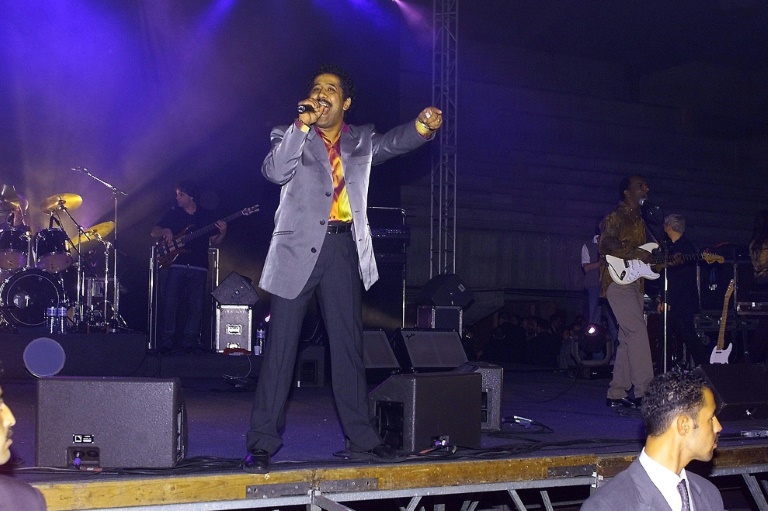
Raucous, expressive and revolutionary: Algeria’s Rai music took its place on the United Nations’ list of intangible cultural heritage on Thursday.

“New inscription on the #IntangibleHeritage List: Rai, popular folk song of #Algeria,” UN cultural agency UNESCO announced in a tweet.

Rai, whose biggest stars include Cheb Khaled and Cheb Mami, emerged in the closing decades of French colonial rule in Algeria, confronting social taboos and dealing with themes such as love, freedom, despair and the struggle against social pressures. 

It was originally a rural art form, with singers performing poetic texts in vernacular Arabic, accompanied by a traditional band.

But from the 1980s onwards, it surged in popularity, centring around the western city of Oran.

The city hosted Algeria’s first Rai festival in 1985 and the next year the genre reached France, home to a large Algerian diaspora.

That took singers including Cheikha Rimitti to global fame and attracted the attention of major record labels.

In 1992, Cheb Khaled became the first artist from the Maghreb region of North Africa to reach the global Top 50 with his song “Didi”.

But the same year, Algeria descended into a devastating decade-long war between authorities and jihadist militants, who assassinated several Rai singers including the star of “sentimental Rai”, Cheb Hasni.

As the violence faded in the early 2000s, Rai began to struggle for its place amid other genres including hip hop and R&B, as well as being hit by scandal with Cheb Mami’s conviction for violence against his ex-girlfriend.

But this year it saw a new breath of life with the phenomenal success of Franco-Algerian DJ Snake’s “Disco Maghreb”, a tribute to the emblematic Oran record company at the heart of the genre. 

Impeachment pressure builds on S.Africa's Ramaphosa

Pressure mounted Thursday for President Cyril Ramaphosa to quit or face removal from office over a cash burglary at his farm that he allegedly covered up.

As the ruling African National Congress (ANC) announced it would convene emergency talks on Friday, a source close to Ramaphosa told AFP that the embattled president “is having a look at all the options.” 

Ramaphosa cancelled a scheduled questions-and-answered session in parliament on Thursday.

The national currency, the rand, fell nearly three percent as the crisis escalated.

Opposition politicians and critics of Ramaphosa fired a volley of demands that he resign.

“The President has to step aside now and answer to the case,” said senior cabinet minister Nkosazana Dlamini-Zuma, who ran unsuccessfully against Ramaphosa as ANC leader in 2017.

“His best course of action remains immediate resignation,” said the leftist opposition Economic Freedom Fighters (EFF).

South Africa’s largest opposition party, the Democratic Alliance, called for an early election, saying the country faces a “seismic shift.”

Ramaphosa has been under fire since June, when South Africa’s former spy boss filed a complaint with the police.

It alleged that Ramaphosa had hidden a burglary at his farm at Phala Phala in northeastern South Africa from the authorities.

Instead, he allegedly organised for the robbers to be kidnapped and bribed into silence.

The vast sum stashed at the farm has cast a dark shadow over Ramaphosa’s bid to portray himself as graft-free after the corruption-stained era of Jacob Zuma.

– Impeachment risk –

A three-person inquiry on Wednesday submitted a report to parliament in which it concluded Ramaphosa “may have committed” serious violations and misconduct.

The report will be examined by parliament on December 6.

That debate could open the way to a vote on impeaching Ramaphosa — a term that in South Africa means to remove from office.

Ramaphosa, in his submission to the panel, steadfastly denied any wrongdoing and warned of the “interest of the stability of government and that of the country.”

But the scandal, complete with details of more than half a million dollars stashed beneath cushions at the farm, has come at the worst possible moment for him.

On December 16, he contests elections for the presidency of the ANC — a position that also holds the key to staying on as national president.

The embattled leader’s spokesman had earlier told AFP Ramaphosa was “likely” to give an address Thursday, but gave no details.

The ANC’s National Executive Committee — the party’s decision-making body — is due to hold urgent talks on Friday, party spokesman Pule Mabe told reporters.

Ramaphosa took office at the helm of Africa’s most industrialised economy in 2018 on a promise to root out corruption.

He now risks becoming the third ANC leader forced out since the party came to power after the end of apartheid in 1994.

Impeachment, in South Africa, means the removal of the president. 

Section 89 of the constitution empowers the National Assembly to remove a sitting president provided the vote is supported by at least two-thirds of lawmakers. 

Serious violation of the constitution, serious misconduct or inability to perform the functions of office are the permitted grounds for an impeachment motion.

Ramaphosa’s predecessor Zuma survived four impeachment votes until his own party, the ANC, forced him to resign over graft in 2018.

The ANC also forced Thabo Mbeki out of office in 2008 in the middle of a power struggle.

– Cash in sofa –

The South African public has been riveted by details from in the investigation, particularly over $580,000 in cash that was stolen from beneath sofa cushions at his ranch.

The sum was payment made by a Sudanese citizen who had bought buffaloes, Ramaphosa said.

Farm staff initially locked the money in an office safe, he said. 

But a manager then decided that the “safest place” to store it would be under the cushions of a sofa inside farm Ramaphosa’s residence, he said. 

Ramaphosa told the inquiry that the accusations against him were “without any merit” and asked it not to take the matter “any further.”

But the panel concluded that Ramaphosa did not report the theft directly to police.

He had acted in a way inconsistent with holding office and exposed himself to a conflict between his official responsibilities and his private business, it said.

DR Congo army and M23 rebels in new clashes

Fighting with heavy weapons erupted between government forces and M23 insurgents in eastern Democratic Republic of Congo on Thursday, shaking a five-day-old truce, security sources and rebels said.

The ceasefire took effect in North Kivu province at the weekend following a summit between DRC and its neighbour Rwanda.

It was to have been followed by a rebel pullout from captured territory, a withdrawal that has yet to take place.

The sources said fighting resumed Thursday in Kirima, about 10 kilometres (six miles) from the town of Kibirizi.

“Fighting resumed this morning between the FARDC and the M23,” said Paul Lutibahwa, head of civil society groups for the Bambo region. The FARDC stands for the armed forces of the DRC.

“The rebels have crossed the bridge, heading for Kibirizi… there’s panic,” he said, an account confirmed by a representative of civil groups there, who said that people were fleeing.

A security official, speaking on condition of anonymity, accused the M23 of having breached the ceasefire and “carrying on looting and fighting”.

A DRC army officer, who also asked not to be identified, said: “The fighting is heavy — we are using heavy artillery.”

The M23’s military spokesman, Willy Ngoma, contacted by AFP, confirmed that there was fighting with the army.

– Resurgent force –

The March 23 movement, or M23, is a predominantly Congolese Tutsi rebel group that was dormant for years.

It took up arms again in November last year and seized the town of Bunagana on the border with Uganda in June. 

After a brief period of calm, it went on the offensive again in October, greatly extending the territory under its control and advancing towards the city of Goma.

Kinshasa accuses its smaller neighbour Rwanda of providing M23 with support, something that UN experts and US officials have also pointed to in recent months. 

Kigali disputes the charge, and in turn accuses Kinshasa of collusion with the FDLR — a former Rwandan Hutu rebel group established in the DRC after the genocide of the Tutsi community in 1994 in Rwanda. 

Talks between the two countries in the Angolan capital of Luanda unlocked a truce agreement on November 23.

The ceasefire was scheduled to take effect on Friday, November 25 at 1600 GMT and be followed by a pullout by the M23 two days later.

A parallel initiative has been undertaken by the East African Community (EAC), a seven-nation regional bloc that includes Rwanda.

It has decided to deploy a regional force to help stabilise the region, for which Kenyan troops are already deployed in Goma, and on November 28 launched peace talks, to which the M23 are not invited.

– Troubled region –

Until Thursday’s violence, there had been no fighting between government forces and the M23, although the rebels had clashed with local militia, especially in the Bambo area, where civilian casualties were reported.

The Vatican, meanwhile, announced that Pope Francis would visit the DRC and South Sudan from January 31 to February 5.

His trip to the two violence-plagued countries had been planned for July this year but was postponed because of treatment for knee pain.

His stay in the DRC from January 31 to February 3 will take place in Kinshasa and no longer include Goma. 

The site that had been chosen for a papal mass, located 15 kilometres (nine miles) north of Goma, is currently occupied by a forward position of the armed forces.

Scores of armed groups roam eastern DRC, making it one of Africa’s most violent regions.

Many are legacies of two wars before the turn of the century that sucked in countries from the region and left millions dead.

Protestors protesting perceived international indifference to the crisis rallied in Goma early Thursday.

Another march staged by the Catholic church took place in Bukavu, in neighbouring South Kivu province.
Close Bitnami banner
Bitnami