Africa Business

'Girl with a Pearl Earring' back on display in Dutch museum

Johannes Vermeer’s masterpiece “Girl with a Pearl Earring” was back on display at a museum in The Hague on Friday, a day after being targeted by climate activists.

Three men were arrested on Thursday after they glued themselves to the Dutch master’s famous 1665 painting at the city’s Mauritshuis museum during peak visiting hours.

“We are glad to say that at 3:30 pm (1330 GMT) the ‘Girl with a Pearl Earring’ was put back in her rightful spot in the Mauritshuis by members of our staff,” the museum said.

“We are incredibly grateful that The Girl remained undamaged and is back in her familiar place so quickly,” museum director Martine Gosselink added.

Vermeer’s work — which has inspired a best-selling novel and a Hollywood movie — was examined in the museum’s conservation studio and found to be undamaged, the museum added.

The climate activists, three Belgians in their forties, were arrested shortly after the incident, which stunned visitors and forced museum staff to cordon off the area.

Social media images showed a man wearing a “Just Stop Oil” T-shirt gluing his head to the glass protecting the canvas, while another glued his hand to the wall and a third emptied out a tin of what appeared to be tomato soup.

The climate activists said they had not intended to damage the painting, which Gosselink described as very vulnerable.

Just Stop Oil, which wants urgent action to stop global warming making the planet unliveable, explained on its website that it had begun using shock tactics targeting iconic works of art to make people think about what they considered precious and how to protect it.

“It enables a conversation,” the coalition of anti-fossil fuel groups said.

“There’s an apocalyptic, climate-driven famine in Somalia, which hasn’t pushed me to say anything. But I’m venting my anger now over a work of art in a gallery. Does any of this add up? What do I really value here?”

The stunt at the Mauritshuis comes after activists threw soup at Vincent van Gogh’s “Sunflowers” at the National Gallery in London on October 14 and smeared mashed potato over a Claude Monet painting in Germany. Both canvasses were protected by glass and were undamaged.

jhe/gil
Nigeria beefs up security after US, UK 'terror' warning

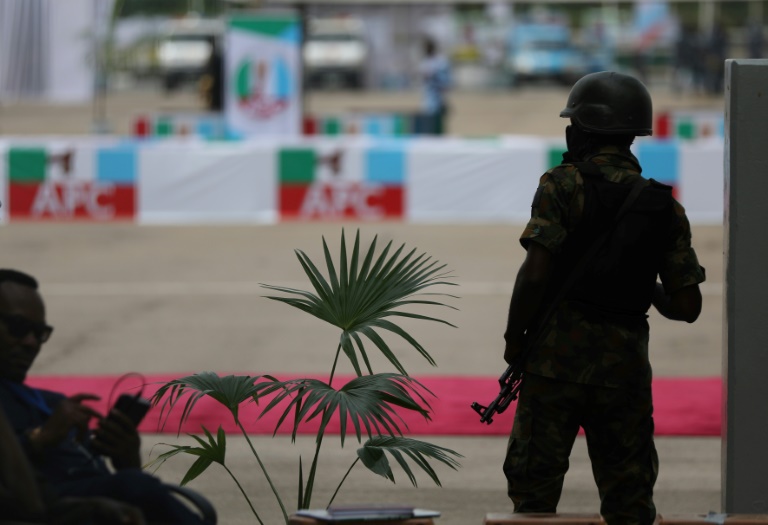
Nigeria on Friday said it had beefed up security and called for the public to be vigilant but calm after the United States and Britain warned of a high “terror” threat in the capital Abuja.

Without giving details on any specific threat, the US on Thursday ordered diplomats’ families to leave Abuja due to what it called a “heightened risk of terrorist attacks.”

Residents of the Federal Capital Territory (FCT) have been on high alert since Sunday, when several Western embassies changed their travel advisories citing an elevated risk of attack in Abuja.

Nigerian troops are fighting jihadist insurgents mostly in the northeast, though there are small cells in other parts of the country. 

Militants linked to the Islamic state group claimed several attacks near the capital in the past six months, including a mass jailbreak in July.

The incident in Kuje, in which more than 400 inmates including dozens of suspected jihadists escaped, had prompted Buhari to say he was “disappointed” with his intelligence services.

But since then, “security measures have been reinforced in and around the FCT,” a statement from President Muhammadu Buhari’s office said on Friday, citing “heightened monitoring and interception of terrorist communications.”

“Terror is a reality the world over. However, it does not mean an attack in Abuja is imminent,” it added.

The president said he gave his “assurances that the government is on top of the security situation.”

“Attacks are being foiled. Security agents are proactively rooting out threats to keep citizens safe –- much of their work unseen and necessarily confidential.”

While he ordered “additional precautionary measures be put in place,” Buhari said that “the recent changes in travel advice from the US and UK governments should not be a cause for panic.”

On Thursday, Nigerian police instructed “all strategic police managers in charge of commands and tactical formations within the country to beef up security in their respective jurisdictions, especially in the FCT.”

– Soft targets –

The Inspector General of Police Usman Alkali Baba said “all emergency numbers” should be activated to help insure “a 24/7 prompt response with combatant officers and men on standby.”

The statement came as the US State Department ordered the departure of diplomatic dependents from Abuja. 

It initially said in a statement on Thursday that non-emergency government employees and their families had been ordered to leave. On Friday, the State Department clarified that the order to evacuate applied to families and not employees, who had however been authorised but not ordered to go.

“Terrorists may attack with little or no warning,” targeting malls, markets, hotels, places of worship, restaurants, bars or schools, the State Department said in its country summary for Nigeria.

The United States, Britain, Australia and Canada had issued warnings last weekend, although the three latter countries had not ordered any evacuation of staff or their families as of Friday.

Separately, the US warned this week of a possible “terrorist” attack in South Africa’s largest city Johannesburg.

Some European embassies and international organisations have not updated their risk assessments or travel advisories for Nigeria.

“We have no crisis to manage, we are managing the panic,” a senior security manager with an international organisation based in Abuja told AFP, asking to remain anonymous.

“We don’t know what the motive is (behind the US evacuation). We are taking some precautionary measures/actions, but activities are normal,” he added.

On Thursday, Jabi Lake Mall, a major shopping centre in Abuja was temporarily shut down for unspecified security reasons.

Nigeria’s military is stretched thin, with soldiers deployed throughout most of the West African nation of some 200 million people.

The last time a jihadist group — Boko Haram — attacked the city centre was in 2014.

In addition to the ongoing terrorism threat, the capital is also surrounded by states with rampant banditry — gangs of gunmen who kidnap and kill with no ideological motivation.

Analysts have warned that insecurity could worsen with the start of political campaigning for the general election to replace Buhari next year.

Kenya charges police with crimes against humanity over 2017 violence

In a landmark decision, Kenyan prosecutors said on Friday they would charge police officers with crimes against humanity over a deadly crackdown on post-election protests in 2017.

The charges cover rape, murder and torture and include the case of a six-month-old baby girl whose death became a symbol of police brutality during the bloody election aftermath.

“This is the first case of crimes against humanity charged under Kenyan domestic law using the International Crimes Act and also the first criminal prosecution of electoral-related sexual violence,” the director of public prosecutions (DPP) Noordin Haji said, without disclosing the numbers of police being charged.

The police crackdown following the disputed presidential election in August 2017 saw dozens of people killed over a four-month period.

The Kenya National Commission on Human Rights documented 94 deaths during the crisis as well as 201 cases of sexual violence and over 300 injuries -– the majority of which were attributed to security forces.

“The attacks were planned, coordinated and not random,” the DPP statement said, saying various offences such as torture, rape and sexual violence “were committed by or under the authority of senior national police officers”.

The baby, Samantha Pendo, died after being beaten by police during a raid on her house as protests flared in the western city of Kisumu.

Extra-judicial killings are rife in Kenya, and justice is rare with few examples of police being held to account.

– ‘Groundbreaking’ decision –

The new UN High Commissioner for Human Rights, Volker Turk, welcomed the “groundbreaking” decision, saying it was “an important advance towards accountability for gross human rights violations in Kenya.”

The move “is a positive step towards justice and accountability for survivors and families of victims, including in the context of electoral violence, and can strengthen prevention of future violations,” Turk said in a statement. 

A Kenyan inquest in 2019 had found five police commanders liable for Pendo’s death.

Kenyan police are often accused by rights groups of using excessive force and carrying out unlawful killings, especially in poor neighbourhoods.

They have also been accused in the past of running hit squads targeting those — including activists and lawyers — investigating alleged rights abuses by police.

The 2017 protests erupted after victory was declared for then president Uhuru Kenyatta, angering supporters of his rival, the veteran opposition leader Raila Odinga.

The result was annulled by the Supreme Court after a challenge by Odinga, but he boycotted the rerun which was won by Kenyatta.

According to Missing Voices, a campaign group focused on extrajudicial killings in Kenya, there have been 1,264 deaths at the hands of police since it began collecting data in 2017.

Take your pick: Aye-aye joins ranks of snot-eaters

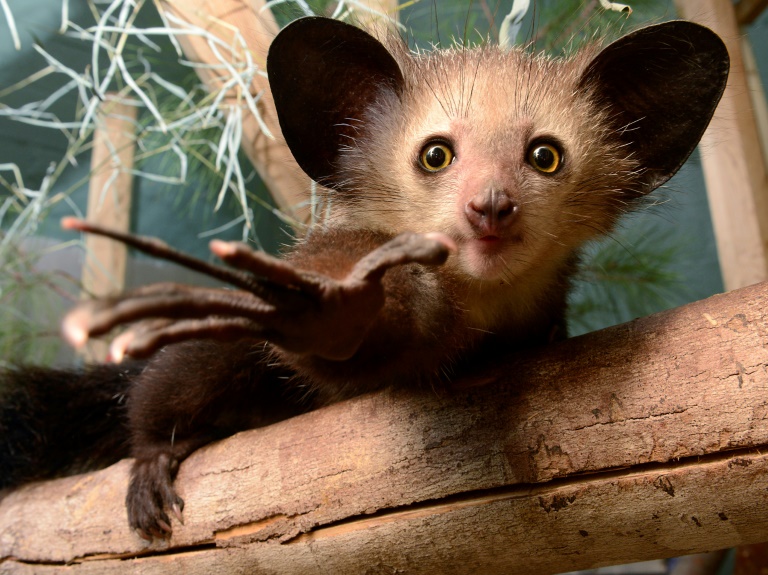
When scientists caught the aye-aye on video using its strangely thin, eight-centimetre-long middle finger to deeply pick its nose, it pointed towards a larger mystery: why exactly do some animals eat their own snot?

The footage resulted in research which names the aye-aye, a peculiar nocturnal lemur with big ears found only in Madagascar, as the 12th primate who picks their nose. 

It joins an illustrious group that includes gorillas, chimpanzees, macaques — and of course humans.

Anne-Claire Fabre, an assistant professor at Switzerland’s University of Bern and lead author of a study published in the journal Zoology this week, told AFP that the researchers stumbled on the discovery “by chance”.

She said they were “surprised” by the behaviour of a female aye-aye named Kali, who was being filmed at the Duke Lemur Center in North Carolina in 2015.

In the video, “the aye-aye inserts the entire length of its extra-long, skinny and highly mobile middle finger into the nasal passages and then licks the nasal mucus collected”, the peer-reviewed study said.

“This video brings the number of species known to pick their nose to twelve,” it said, adding that they all have “fine manipulative skills”.

The middle fingers of aye-ayes are not only long and thin, but also have a unique ball and socket joint they use to knock on wood to locate grubs.

After seeing the video, “the first thing I was wondered is where this finger is going”, said Fabre, who is also an associate scientist at London’s Natural History Museum.

So the researchers used a CT scan of an aye-aye’s skull to reconstruct the finger’s journey, finding it probably went down the throat.

“There is no other possibility. Otherwise it would have gone into the brain and then they die,” Fabre said.

The researchers compared the finger’s probing to a very deep Covid test.

– ‘Gross’ – 

But finding out exactly why aye-ayes — or other primates — pick their noses proved a more difficult task.

The scientists reviewed the existing literature and found that “most of it was jokes”, Fabre said.

They did find one study which suggested that nose-picking could spread bacteria in a harmful manner. 

Another said that eating snot could stop bacteria from sticking to teeth, so it might be good for oral health.

So why is there so little research on nose picking?

“I think it’s just something that people didn’t think about because it’s considered to be gross,” Fabre said. However she added that lots of research has been done about coprophagia — animals eating their own excrement — which could also be considered gross.

The aye-aye, the world’s largest nocturnal primate, is highly endangered — in part because it is seen as a bad omen in its native Madagascar, she said.

Take your pick: Aye-aye joins ranks of snot-eaters

When scientists caught the aye-aye on video using its strangely thin, eight-centimetre-long middle finger to deeply pick its nose, it pointed towards a larger mystery: why exactly do some animals eat their own snot?

The footage resulted in research which names the aye-aye, a peculiar nocturnal lemur with big ears found only in Madagascar, as the 12th primate who picks their nose. 

It joins an illustrious group that includes gorillas, chimpanzees, macaques — and of course humans.

Anne-Claire Fabre, an assistant professor at Switzerland’s University of Bern and lead author of a study published in the journal Zoology this week, told AFP that the researchers stumbled on the discovery “by chance”.

She said they was “surprised” by the behaviour of a female aye-aye named Kali, who was being filmed at the Duke Lemur Center in North Carolina in 2015.

In the video, “the aye-aye inserts the entire length of its extra-long, skinny and highly mobile middle finger into the nasal passages and then licks the nasal mucus collected”, the peer-reviewed study said.

“This video brings the number of species known to pick their nose to twelve,” it said, adding that they all have “fine manipulative skills”.

The middle fingers of aye-ayes are not only long and thin, but also have a unique ball and socket joint they use to knock on wood to locate grubs.

After seeing the video, “the first thing I was wondered is where this finger is going”, said Fabre, who is also an associate scientist at London’s Natural History Museum.

So the researchers used a CT scan of an aye-aye’s skull to reconstruct the finger’s journey, finding it probably went down the throat.

“There is no other possibility. Otherwise it would have gone into the brain and then they die,” Fabre said.

The researchers compared the finger’s probing to a very deep Covid test.

– ‘Gross’ – 

But finding out exactly why aye-ayes — or other primates — pick their noses proved a more difficult task.

The scientists reviewed the existing literature and found that “most of it was jokes”, Fabre said.

They did find one study which suggested that nose-picking could spread bacteria in a harmful manner. 

Another said that eating snot could stop bacteria from sticking to teeth, so it might be good for oral health.

So why is there so little research on nose picking?

“I think it’s just something that people didn’t think about because it’s considered to be gross,” Fabre said. However she added that lots of research has been done about coprophagia — animals eating their own excrement — which could also be considered gross.

The aye-aye, the world’s largest nocturnal primate, is highly endangered — in part because it is seen as a bad omen in its native Madagascar, she said.

Ramaphosa farm scandal probe could take two years: S.African watchdog

Investigations by South Africa’s ombudswoman into a scandal involving a 2020 burglary at President Cyril Ramaphosa’s farmhouse that allegedly found a haul of dollar bills stashed inside furniture could take at least two years, she said Friday.

The scandal erupted in June after a former national spy boss filed a police complaint, alleging that Ramaphosa concealed some four million dollars in cash and arranged for the burglars to be kidnapped and questioned, and then bribed them into silence.

“Ours is not a political calendar,” but “we would like to finalise our investigation before two years,” said interim ombudswoman Kholeka Gcaleka, whose office is known as the Public Protector.

“We must trace leads, involving multiple state organs, we cannot take any shortcuts. It needs to be a legally sound report to stand the test of scrutiny,” she said at a news conference organised for foreign correspondents.

Her office, along with the police, is probing a case which has raised accusations of money-laundering and corruption by the 69-year-old president.

Initially the watchdog sent 31 questions to Ramaphosa, giving him two weeks to respond. 

“He asked for an extension, I granted this in view of the magnitude and complexity of the investigation,” said the 41-year-old ombudswoman.

Two investigators in her office are dedicated full-time on the probe, she said. 

The public protector’s office is an independent state institution provided for in the constitution.

It investigates and reports on “any misconduct or malfeasance within the government with no fear, no favour or prejudice,” said Gcaleka.

The farm saga has brewed into one of the biggest storms in Ramaphosa’s career.

The former trade union leader and business tycoon rose to the presidency in 2018, benefiting from a graft-free image after the corruption-stained era of his former boss, Jacob Zuma.

He is expected to seek re-election as leader of the ruling African National Congress (ANC) at a crunch conference at the end of the year.

A special parliamentary committee last week started investigations as to whether the scandal renders Ramaphosa liable for impeachment. 

He has acknowledged that a burglary took place but denies kidnapping and bribery. 

He has also disputed the amount of money involved and said the cash came from legitimate sales of game from his animal-breeding farm.

Global warming palpable for 96% of humans: study

Whether they realised it or not, some 7.6 billion people — 96 percent of humanity — felt global warming’s impact on temperatures over the last 12 months, researchers have said.

But some regions felt it far more sharply and frequently than others, according to a report based on peer-reviewed methods from Climate Central, a climate science think tank.

People in tropical regions and on small islands surrounded by heat-absorbing oceans were disproportionately impacted by human-induced temperature increases to which they barely contributed.

Among the 1,021 cities analysed between September 2021 and October 2022, the capitals of Samoa and Palau in the South Pacific have been experiencing the most discernible climate fingerprints, the researchers said in the report, released on Thursday.

Spiking temperatures in these locations were commonly four to five times more likely to occur than in a hypothetical world in which global warming had never happened. 

Lagos, Mexico City and Singapore were among the most highly exposed major cities, with human-induced heat increasing health risks to millions.

Researchers at Climate Central, led by chief scientist Ben Strauss, looked for a way to bridge the gap between planetary-scale global warming — usually expressed as Earth’s average surface temperature compared to an earlier reference period — to people’s day-to-day experience.

“Diagnosing climate fingerprints lets people know that their experiences are symptoms of climate change,” Strauss told AFP. “It represents a signal and shows we must adapt.”

Using seven decades of high-resolution daily temperature data from the European Centre for Medium-range Weather Forecasts (ECMWF) and two dozen climate models, Strauss and his team created a tool — the Climate Shift Index. 

The tool calculates the likelihood that unusually warm weather at a specific location on any given day is due to climate change.

In 26 cities, for example, at least 250 of the 365 days from October 2021 saw temperature increases that were at least three times more likely due to climate change.

– ‘Unfair and tragic’ –

Most of these cities were in east Africa, Mexico, Brazil, small island states, and the Malay Archipelago — a string of some 25,000 islands belonging to Indonesia and the Philippines. 

“The effect of warming is much more noticeable in the equatorial belt because there has been historically less temperature variability there,” Strauss told AFP. 

This is why even a relatively modest rise in local temperatures brought on by global warming registers so clearly on the index, he explained. 

“Island temperatures are strongly shaped by the temperature of the ocean around them,” said Strauss, who has also mapped the projected impacts of sea level rise on coastal areas worldwide. 

“To see that small island states have essentially already lost their historical climates — even as they face losing their land from rising seas — feels very unfair and tragic.”

The urgent need for money to help vulnerable tropical nations adapt to climate impacts will be squarely on the table when nearly 200 countries meet in 10 days for United Nations climate talks in Egypt. 

Rich nations have yet to honour a decade-old pledge to ramp up climate financing for developing nations to $100 billion per year, even though the UN’s climate advisory panel, the IPCC, estimates that annual adaptation costs could hit one trillion dollars by 2050 if warming continues apace.

The map-based climate shift index tool can be found here: https://csi.climatecentral.org/csi-contour-map/tavg/2022-10-27/

Burkina violence displaces 4,000 in Togo

More than 4,000 people have been displaced this year in northern Togo after the security climate worsened following jihadist attacks in neighbouring Burkina Faso, the government said.

Togo and its West African coastal neighbours Benin, Ghana and Ivory Coast are facing increased spillover and risk of attacks from jihadists operating across their frontiers with Niger and Burkina Faso.

“In total, 789 households representing 4,175 displaced people have been identified — including populations from neighbouring countries who took refuge in Togolese territory,” communications minister and government spokesman Akodah Ayewouadan said on television late Thursday.

Ayewouadan said the government was providing support including psychological care and education of displaced students in schools in host communities. 

“The objective is first to secure these people, to ensure they continue to live in decent conditions and to eventually help their return,” he said.

Among the displaced are Togolese who have fled their villages and also Burkinabe residents who had crossed the border to escape jihadist attacks. 

The National Agency for Civil Protection (ANPC) in June identified in the prefecture of Tone in far north of Togo, more than 600 Burkinabe from Madjoari, in the south-east of Burkina Faso.

Togo has suffered at least five terrorist attacks, including two deadly assaults since November 2021 in the far north of the country.

The country was hit in mid-July by a bloody attack carried out by “unidentified armed individuals”, according to the army, which did not communicate a precise toll, speaking of “several dead and a few wounded”. 

Neighbouring Benin earlier this month said its army foiled a “terrorist” attack in the country’s northwest, killing eight gunmen suspected of operating from across the northern frontier.  

Benin’s security forces have faced more than a dozen militant incursions since last year, as concerns mount over the spread southward of Islamic State group and Al Qaeda-linked violence from the Sahel.

US terror alert in S.Africa 'unfortunate': Ramaphosa

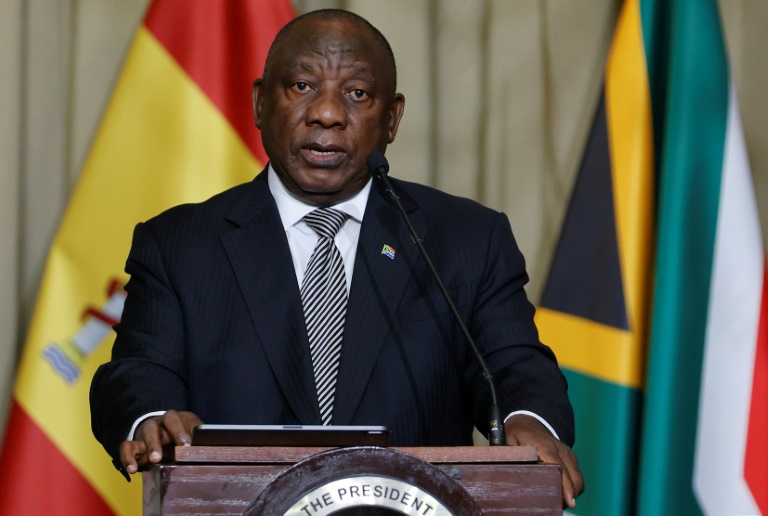
South Africa’s President Cyril Ramaphosa on Thursday regretted as “unfortunate” the US embassy’s issuing of a warning of a possible weekend “terrorist” attack in the country without consulting his government.

The US embassy on Wednesday posted the alert on its website and identified the potential target as Sandton, a suburb in the country’s financial hub of Johannesburg.

Sandton, a collection of high-end shops and lofty office blocks and banks, is commonly referred to as the richest square mile on the African continent.

The alert said the attack could occur there on Saturday.

“It is quite unfortunate the US issued that type of warning without having any type of discussion with us,” Ramaphosa said during a press conference.

“Any form of alert will come from the government of the republic of South Africa and it is unfortunate that another government should issue such a threat as to send panic amongst our people,” said Ramaphosa.

He was answering a question during a joint press conference with the visiting Spanish Prime Minister Pedro Sanchez.

Ramaphosa said Pretoria is “working around the clock to verify and to look very closely at this message that came from the United States”.

– Parade proceeding –

The embassy said the US government had “received information that terrorists may be planning to conduct an attack targeting large gatherings of people at an unspecified location in the greater Sandton area of Johannesburg”.

The alert was quickly shared on social media and on WhatsApp groups across Johannesburg.

Pretoria had on Wednesday appeared to downplay the alert, calling it “part of the US government’s standard communication to its citizens”.

Asked about Ramaphosa’s criticism, a US State Department spokesperson did not respond directly but said the United States believed it was critical to issue alerts “in real time”.      

“We take seriously our commitment to provide US citizens with clear, timely and reliable information about every country in the world so they can make informed travel decisions,” the spokesperson said.

Several alerts have been issued about possible imminent attacks in South Africa in recent years, but none have materialised.

A respected local news website, News24, cited unnamed sources Thursday suggesting that a gay parade slated for Saturday in Sandton and a comedy show by a leading South African comedian of Jewish descent could have been the potential targets.

Organisers of the Johannesburg Pride vowed to forge ahead with the parade, which is returning after a two-year break due to Covid-19 pandemic restrictions.

The event “has not been directly threatened, nor have we received any communication from outside parties other than what the media assumed via the US embassy’s website,” they said in a statement.

“Gay pride began as a defiant campaign, and we will not be subjected to any threats based on sexual orientation and gender identity. We believe that all lives matter,” they said.

“It is critical for us to occupy the space we intend to occupy on October 29. We must take to the streets and… assert our visibility,” they added.

– ‘Very concerned’ –

The News24 website said ongoing peace talks between warring Ethiopian parties in the capital Pretoria had also been “flagged by South Africa’s intelligence agencies as a potential target”.

“We are very concerned about terrorism,” Foreign Minister Naledi Pandor said Thursday.

“Our security organs are paying attention to this matter.”

South Africa is helping neighbouring Mozambique fight an Islamist insurgency and has deployed more than 1,000 troops there since July last year.

The US embassy on Sunday also issued a security alert in Nigeria, urging US citizens there to limit their movements due to an “elevated risk of terror attacks in Nigeria, specifically in Abuja”.

After the United States and Britain issued a similar security alert in 2016, South Africa reacted angrily to what it described as “attempts to generate perceptions of government ineptitude, alarmist impressions and public hysteria on the basis of a questionable single source”.

NGOs demand Senegal's president renounce a third term

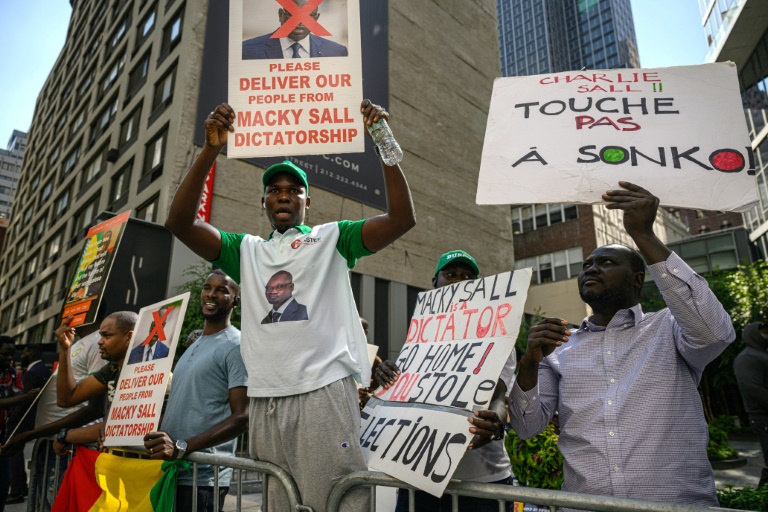
A number of Senegalese associations on Thursday urged President Macky Sall to dispel doubts and publicly declare that he would not run for a third term, which they say could sow “chaos”. 

Sall, who was elected in 2012 and re-elected in 2019, has for months remained vague on whether or not he intends to seek a third mandate in 2024.

The constitution stipulates that a president cannot serve more than two consecutive terms.

But the president’s supporters argue that a 2016 constitutional revision has reset the clock.

The opposition promises fierce resistance if Sall, who is currently president of the African Union, does seek another term. 

In a statement Thursday, human rights and democracy organisations pointed to the “particularly tragic” consequences of attempts to force third terms elsewhere in Africa — an issue that in Guinea and Ivory Coast has led to explosive violence.

The non-governmental organisations said they wanted to “avoid a scenario of chaos” in a country known for political stability compared to the rest of the region.

“To avoid such a catastrophe, the consequences of which could be even more dramatic than those of 2012, we invite you, Mr. President, to make an open declaration to remove any ambiguity,” they wrote. 

In 2012, former president Abdoulaye Wade’s candidacy for a third term of office provoked violence that left several people dead.

“The limitation of mandates to two is unequivocal and definitively anchored in the fundamental law”, they added.

They also referred to past statements and commitments made verbally or in writing by Sall himself, noting that he had fought against Wade’s attempts at a third mandate a decade ago.

In that struggle, Sall was the “main beneficiary”, they said.

“We… solemnly invite you not to present your candidacy for the 2024 presidential election, out of respect for the word you have given and out of respect for the clear and unequivocal interpretation you have always given of our constitution”, they said.

Close Bitnami banner
Bitnami