Africa Business

Ethiopia starts power generation from second turbine at mega-dam

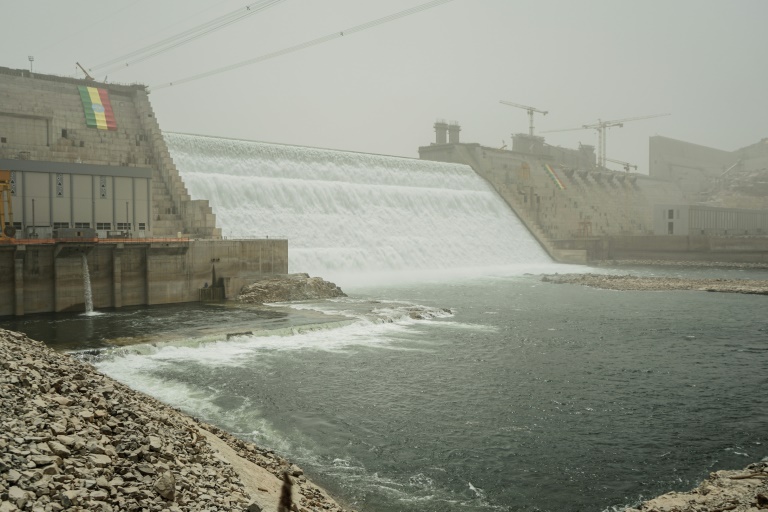
Ethiopian Prime Minister Abiy Ahmed kickstarted electricity production from the second turbine at its controversial mega-dam on the Blue Nile on Thursday, despite continuing objections by Egypt and Sudan over the project.

Abiy also confirmed that a third filling of the multi-billion dollar Grand Ethiopian Renaissance Dam (GERD) was under way, a development that led Egypt last month to protest to the UN Security Council.

Thursday’s move came even though there is still no agreement between Ethiopia and its downstream neighbours Egypt and Sudan about the GERD’s operations.

Abiy insisted that the third filling of the $4.2 billion dam — set to be the largest hydroelectric scheme in Africa — was not causing any water shortages for the two countries. 

“We have repeatedly told downstream countries, especially Egypt and Sudan, that by generating power we’re developing our economy, as well as (our desire) to see our citizens who live in the dark see light,” he said.

There was “no aim to sideline and harm” those countries, he added.

Ethiopia first began generating electricity at the dam in February. Currently, the two turbines, out of a total of 13 at the dam, are generating 750 megawatts of electricity.

The GERD is ultimately expected to produce more than 5,000 megawatts, more than doubling Ethiopia’s current output.

Last month, Egypt wrote to the Security Council voicing its objections to Ethiopia’s plans to fill the dam for a third year without a three-way agreement.

Cairo and Khartoum fear it could threaten their access to vital Nile waters and have demanded a written agreement between on the dam’s filling and operation.

The process of filling the GERD’s vast reservoir, which has a total capacity of 74 billion cubic metres, began in 2020.

The new US envoy for the Horn of Africa, Mike Hammer, discussed the project during visits to both Ethiopia and Egypt last month, saying Washington was “actively engaged” in supporting efforts to find a diplomatic solution to the dispute.

The 145-metre (475-foot) high structure straddles the Blue Nile in the Benishangul-Gumuz region of western Ethiopia, near the border with Sudan.

One million people displaced by drought in Somalia: UN

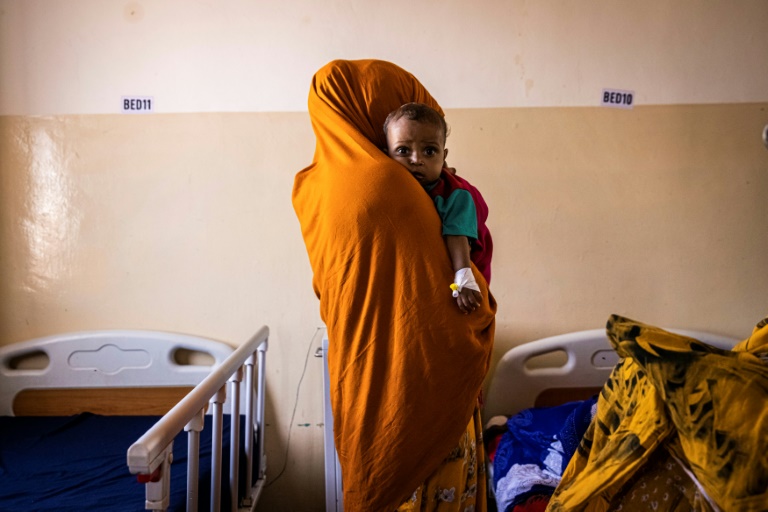
A historic drought in Somalia has now displaced one million people and left the country in the shadow of famine, the United Nations said Thursday.

More than 755,000 people have fled their homes but remain within the country’s borders, which, when added to those who have fled abroad, brings the total to a million, the UN refugee agency UNHCR and Norwegian Refugee Council (NRC) said Thursday.

Somalia and its neighbours in the Horn of Africa including Ethiopia and Kenya are gripped by the worst drought in more than 40 years after four failed rainy seasons that have decimated crops and livestock.

An expected fifth failed rainy season is set to displace many more families.

“This one million milestone serves as a massive alarm bell for Somalia,” said Mohamed Abdi, the NRC’s country director in Somalia.

“Starvation is now haunting the entire country. We are seeing more and more families forced to leave everything behind because there is literally no water or food left in their villages. Aid funding urgently needs to be ramped up before it is too late.”

The number of people facing crisis hunger levels in Somalia is expected to rise from some five million to more than seven million in the coming months, worsened by climate change and rising food prices driven by the Ukraine war, the UNHCR said.

On Friday, the UN’s Food and Agriculture Organization (FAO) warned of a major risk of famine in eight areas by September if crop and livestock production failure was widespread, commodity prices continued to rise and humanitarian assistance failed to reach the most vulnerable.

It said the world could not wait for famine to be formally declared before taking action to save lives.

However, aid agencies say there is a dire lack of funds.

“The Somalia situation was already one of the most underfunded before this latest crisis,” said Magatte Guisse, UNHCR’s representative in Somalia.

“We simply have insufficient resources. The international community must step up to save lives and support this humanitarian response.”

Conflict-wracked Somalia is particularly ill-equipped to cope with the situation, with a grinding Islamist insurgency limiting humanitarian access to parts of the country. Al-Shabaab militants have ratcheted up their attacks in recent months.

Blinken raises 'serious concerns' on rights in Rwanda talks

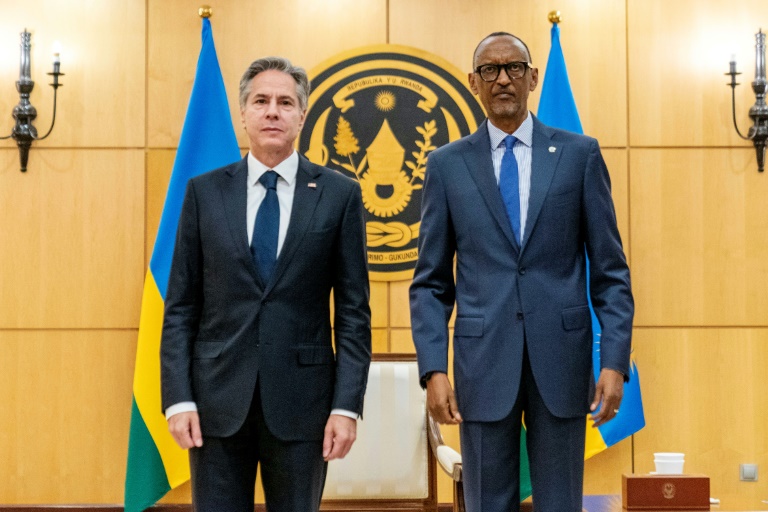
US Secretary of State Antony Blinken said he voiced “serious concerns” about human rights during talks on Thursday with Rwandan President Paul Kagame.

In particular, he said he raised the case of “Hotel Rwanda” hero Paul Rusesabagina, a fierce Kagame critic who was sentenced to a 25-year prison term last year on terrorism charges.

Blinken is in Rwanda on the final stop of a three-nation tour of Africa, as Washington seeks to counter a Kremlin charm offensive following a trip to the continent in July by Russian Foreign Minister Sergei Lavrov.

“As I told President Kagame, we believe people in every country should be able to express their views without fear of intimidation, imprisonment, violence or any other forms of repression,” Blinken told a joint press conference with Rwandan Foreign Minister Vincent Biruta.

Blinken also said he “underscored our concerns about the lack of fair trial guarantees provided to (Rusesabagina)”.

In May, the US State Department said Rusesabagina — who has US permanent residency — had been “wrongfully detained” by Kigali.

Rusesabagina, then a Kigali hotel manager, is credited with saving hundreds of lives during the 1994 genocide. His actions inspired the Hollywood film “Hotel Rwanda.”

The 68-year-old has been behind bars for more than 700 days since his arrest in August 2020 when a plane he believed was bound for Burundi landed instead in Kigali.

In a statement issued to coincide with Blinken’s visit, Rusesabagina’s family said his health was deteriorating, with a weak left arm and facial paralysis indicating that he may have had one or more strokes.

“We trust that if the US relationship with Rwanda is strong enough to be deserving of financial and trusted cooperation, then it is strong enough to push for the release of our father on humanitarian grounds,” it said.

– ‘Endangers regional stability’ –

Meanwhile, Blinken said he also discussed with Kagame “credible reports” that Rwanda continues to support the M23 rebel group and has its own forces inside the neighbouring Democratic Republic of Congo, claims repeatedly denied by Kigali.

“Any support or cooperation with any armed group in eastern DRC endangers local communities and regional stability and every country in the region must respect the territorial integrity of the others,” he added.

An unpublished independent investigation for the UN, seen by AFP last week, said Rwandan troops had attacked soldiers inside the DRC and aided M23 rebels, a primarily Tutsi Congolese rebel group.

The M23 has captured swathes of territory in eastern DRC in recent months, stoking tensions between Kigali and Kinshasa.

Ties between the two nations have been strained since the mass arrival in the eastern DRC of Rwandan Hutus accused of slaughtering Tutsis during the 1994 genocide, although there was a thaw after DRC President Felix Tshisekedi took office in 2019.

In a statement released Monday, Human Rights Watch had called on Blinken to “urgently signal that there will be consequences for the government’s repression and abuse in Rwanda and beyond its borders”.

“Failing to address Rwanda’s abysmal human rights record has emboldened its officials to continue to commit abuse, even beyond its borders,” said Lewis Mudge, HRW’s Central Africa director.

The rights watchdog urged Blinken “to highlight systematic human rights violations, including crackdowns on opponents and civil society, both within and across Rwanda’s borders.”

Rwandan opposition leader Victoire Ingabire echoed HRW’s calls, telling AFP that Blinken should raise the issue of journalists and politicians she said were in prison for challenging Kagame’s government.

“Blinken has to ask our government to open up political space to everyone who wants to be active in politics,” said Ingabire, who spent six years in jail on terrorism charges.

Cameroon troops 'summarily killed' 10 in crackdown: HRW

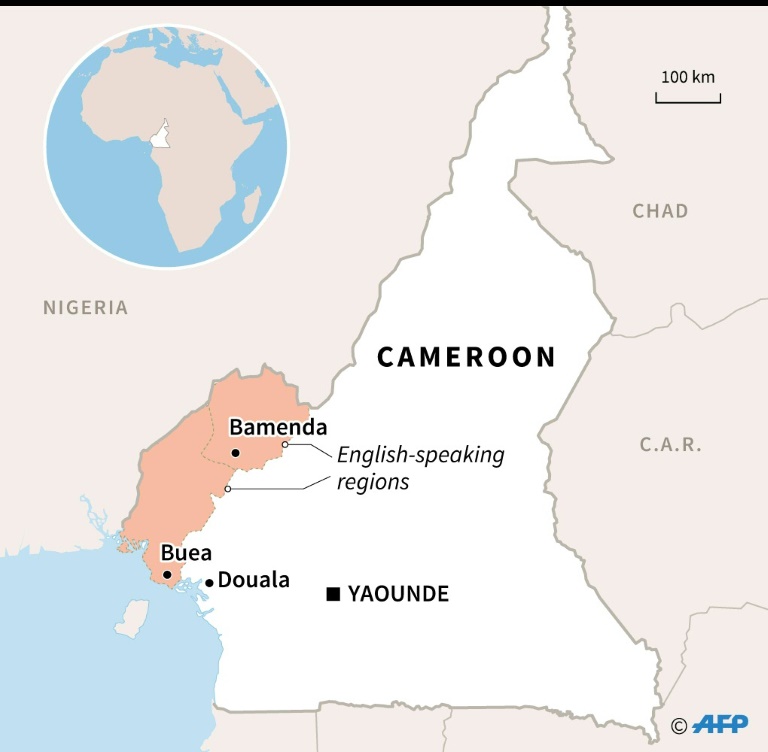
Troops in Cameroon’s Northwest Region have “summarily killed” at least 10 people in a crackdown against anglophone separatists, Human Rights Watch (HRW) said on Thursday.

Its report is the latest in a string of allegations by rights monitors in the battle between security forces and English-speaking militants demanding home rule in francophone-majority Cameroon.

“Cameroonian soldiers summarily killed at least 10 people and carried out a series of other abuses between April 24 and June 12, during counter-insurgency operations in the Northwest Region,” HRW said.

“The troops also burned 12 homes, destroyed, and looted health facilities, arbitrarily detained at least 26 people, and are presumed to have forcibly disappeared up to 17 others.”

The Northwest and neighbouring Southwest Region are home to most of Cameroon’s anglophones, who account for roughly a fifth of the country’s population.

In 2017, resentment at perceived discrimination snowballed into the declaration of an independent state — the “Federal Republic of Ambazonia,” an entity that is not recognised internationally.

The country’s veteran president Paul Biya, 89, who has ruled with an iron fist for nearly 40 years, responded with a crackdown.

The violence has claimed more than 6,000 lives and displaced around a million people, according to the International Crisis Group (ICG) think tank.

International monitors and the UN say that both sides have committed abuses, including crimes against civilians.

“Instead of protecting the population from threats posed by armed groups, the Cameroonian security forces have committed serious violations against civilians, causing many to flee their homes,” said Ilaria Allegrozzi, HRW’s specialist on Cameroon.

“Cameroonian authorities should conduct credible and impartial investigations into these serious abuses and hold the abusers accountable.”

A spokesman for the Cameroonian defence ministry said in response to a request from AFP that he would not comment on the report.

The Norwegian Refugee Council (NRC) in June placed the anglophone conflict in Cameroon as third highest on its list of the world’s 10 “most neglected” displacement crises.

It cited lack of international will to find solutions, a paucity of media coverage and insufficient funding of humanitarian needs.

White residents-only town booms in 'Rainbow Nation' South Africa

From a distance, Orania looks like any other small town in rural South Africa.

But once inside, the visitor is struck by an obvious difference. 

Everyone here is white. 

And in a country where menial work in wealthy areas is typically done by black employees, white people here mop supermarket floors, wield leaf blowers and harvest the nuts on pecan farms.

Orania residents are 100-percent white in a country that has declared an end to racial segregation.

The history of this incongruity dates back to 1991, when apartheid was in its death throes.

White Afrikaners — descendants of 17th-century Dutch colonisers — bought up 8,000 hectares (19,000 acres) of land on the banks of the Orange River, in the sparsely populated Karoo region.

Using an autonomous status under the post-apartheid constitution, they created a privately-owned town which has so far admitted only white inhabitants.

Today, Orania’s population has surged almost 10-fold, reaching around 2,500, and the economy is booming.

Old Cape Dutch-style houses hobnob with modern townhouses, separated by low or no walls, but kempt gardens. Children ride bicycles and adults jog freely on the clean streets.

Small orange-white-and-blue flags — the South African colours under apartheid — flutter in the afternoon wind at construction sites.

– ‘Not racist’ –

Sensitive to accusations of racism, residents insist they are not apartheid-era nostalgics but a community pursuing “freedom with responsibility”.

This means, in their view, a community that manages its own affairs, away from the crime, power cuts, dysfunctional local governance and other problems plaguing South Africa today.

“People see Orania and maybe see there are no black workers… and their first idea is ‘wow these guys must be racist’, that’s exactly not the case,” said Wynand Boshoff, 52, a pioneer resident.

In rich suburbs elsewhere in South Africa, manual jobs are done almost exclusively by black workers.

But Orania says it has broken with colonial- and apartheid-era labour practices. 

“We do our own work, from gardening to cleaning our houses, our own toilets to construction, everything,” said spokesman Joost Strydom.

Orania, he said, is the only community that shuns “the system of cheap black labour.”

– Autonomy –

Under South Africa’s constitution, Orania has the right to self-determination and operates autonomously from central government.

It has its own currency, the ora, pegged one-to-one to the rand.

The town is also seeking energy independence through solar, in a country largely powered by coal and deep into an energy crisis. 

Prospective residents are vetted and must have no criminal record.

“It’s like going into a marriage,” said Strydom, a 28-year-old born in the southeastern province of KwaZulu-Natal. 

Would-be residents must “share the values and subscribe” to the town’s goals, he said, insisting Orania was not “racist” or a “desperate grasp back to apartheid”.

Boshoff said there was nothing stopping any non-white Afrikaners from applying — only no-one ever did. 

“We haven’t found anybody,” he said.

– Boom –

Orania’s population has grown by up to 17 percent annually in recent years, and in 2021 new business creations were up by a quarter, said Strydom. Tourism is one of the main business activities, attracting an average 10,000 visitors annually. 

“Suddenly other communities are saying ‘how can we learn from you?’,” he said.

When AFP journalists were in Orania recently, some traditional royal emissaries from the Xhosa and Tswana ethnic groups were in town on a “diplomatic” visit.

“It was important for me to go… Whether right or wrong, there is a success story in there somewhere,” said Gaboilelwe Moroka, 40-year-old chief of the Barolong Boo Seleka, part of Tswana ethnic group in neighbouring Free State province. 

“It’s unfortunate these things are overly politicised,” she said. 

Boshoff, the grandson of the architect of apartheid Hendrik Verwoerd, argued that Afrikaners created Orania because they needed a place to call home.

“Every African tribe or clan has a place of its own which they use as a reference point,” said Boshoff, who is also a right-wing lawmaker in the national parliament.

Orania has “become part of the South African landscape”, he said, after delivering a Sunday morning sermon at a Dutch Reformed church.

– Afrikaner world –

Private towns such as Orania are not unusual, said municipality governance expert Sandile Swana.

“You are going to see more of these,” said Swana.

“The only difference with Orania is that they have chosen their own ethnic background and culture” as a pre-condition.

Another Afrikaner-only town, Kleinfontein, lies some 30 kilometres (18 miles) outside the capital of the “Rainbow Nation”, Pretoria.

South Africa’s first black president, Nelson Mandela, strove relentlessly to reconcile the deeply divided country.

He visited Orania in 1995 and had tea with Verwoerd’s widow. A white teaset they drank from is among the memorabilia neatly arranged in an unassuming white house where Betsie Verwoerd spent her last years.

Outside the church, Ranci Pizer, a 58-year-old former government worker who relocated to Orania from Pretoria in December, said she enjoyed having more social interaction with neighbours on the streets.

“It’s a community where I can express myself in my own culture,” she said.

A short drive up a hill is a collection of statues donated by people who no longer wanted anything to do with Afrikaner history after the fall of apartheid.

“Afrikaner history gets almost criminalised,” said Joost.

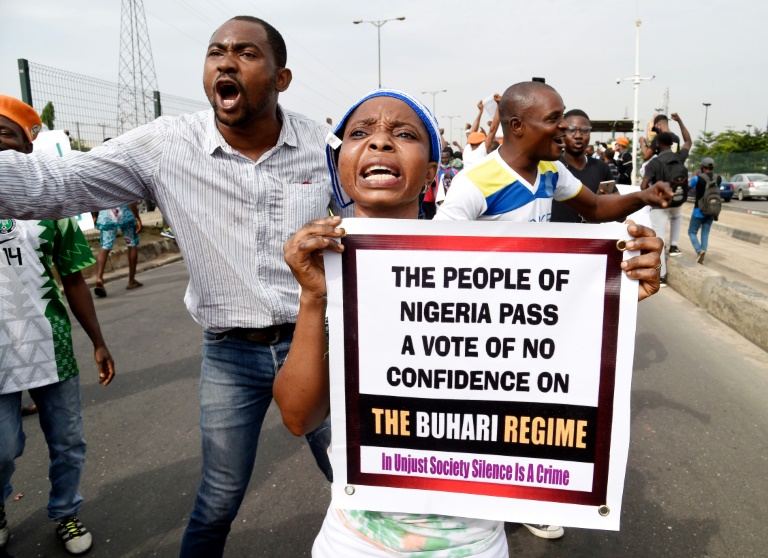
Nigeria's president under pressure as insecurity spirals

Mounting attacks from jihadists and criminal gangs, including a brazen assault close to the capital, are creating a headache for Nigerian President Muhammadu Buhari as he sees out his last six months in office.

Last month, the Islamic State group’s Nigerian affiliate ISWAP claimed a jailbreak outside just 20 kilometres (12 miles) from Abuja’s international airport, freeing hundreds of prisoners, including 64 jihadist commanders. 

Located in the centre of the country, the capital is far from the jihadists’ usual area of operations in the northeast — the city’s last major attack was back in 2015.

In the same month, a military checkpoint was attacked on the outskirts of the capital and a presidential security convoy was ambushed in the country’s northwest. 

At least 40 worshippers were killed in June in a Catholic church in southwestern Owo, and last week five people were killed in Kogi state, in the centre of the country, when gunmen opened fire on a bus.

Idayat Hassan, head of the Centre for Democracy and Development think tank, said security was now front and centre of public concerns.

“There is growing pressure from Nigerians across all walks of life on the need to address the insecurity plaguing the country,” he said.

“The problem currently is nowhere is safe in the country — and nobody, irrespective of class or position in life, is safe.”

– ‘Helpless’ Buhari –

Presidential elections are due to take place next February for a successor to Buhari. The former army general, first elected in 2015 and reelected in 2019, is scheduled to step down after two terms. 

One of Buhari’s big campaign promises was to end insecurity — and the relentless violence has left him politically exposed.

“Most of us have been supporters of Buhari because he is a general,” said a member of the ruling party, Chief Frank Kokori, a former labour leader and rights activist.

“We feel he is negligent (with) the security of the country, that is obvious, and he has to wake up because he has squandered his goodwill.”

A security source based in the northeast and who asked to remain anonymous, said “Buhari is in an unenviable position.”

“Naturally he is to take responsibility for any security failures as the head of government, but the truth is that he is helpless.” 

Despite hefty investments in the security apparatus, the situation has “continued to deteriorate,” he said.

Opposition lawmakers threw down the gauntlet last month, threatening to impeach Buhari if he failed to stem the violence. 

But the announcement is widely seen as an empty threat, given the ruling party’s parliamentary majority. 

Udo Jude Ilo, analyst and consultant with Thoughts and Mace Advisory, said the government had manifestly failed on the security issue.

He pointed to the holdup in March of a recently-inaugurated high-speed passenger train between Abuja and the northern city of Kaduna.

Eight people were killed, 26 were wounded and an unknown number were taken hostage.

“No-one was fired,” Ilo said. “The service chiefs are still there. It is unbelievable.”

– ‘Combustive’ mix –

Faced with a complex security crisis, the 79-year-old president has appeared aloof, multiplying foreign trips and communicating as much on his cabinet members’ birthdays as on the attacks themselves. 

All the while, criminal gangs known as “bandits” continue to wreak havoc across the northwest and centre, raiding villages and kidnapping residents every week. 

In the northeast, a 13-year-old jihadist insurgency that has already claimed more than 40,000 lives and displaced at least two million people is undimmed. The militants are even expanding south. 

Analysts have warned of links between bandits and jihadists — an alliance that could create even more troubles for the government and security agencies. 

Nigeria is also facing a dire economic outlook, with inflation rising on the back of the Covid pandemic and Russia’s invasion of Ukraine. 

Since 2015, when Buhari came to power, “there has not been a coherent policy to tackle not only insecurity but also the drivers of insecurity,” said Ilo. 

There is a “a combustive interaction of factors: the economy is doing badly, the country doesn’t have enough resources to pay its debts, inflation has been growing for months.”

A lack of jobs is also creating fertile ground for people to “become radicalised,” he warned. “It is a frightening combination.”

'Catastrophe': East DR Congo hospital overflows amid rebel fighting

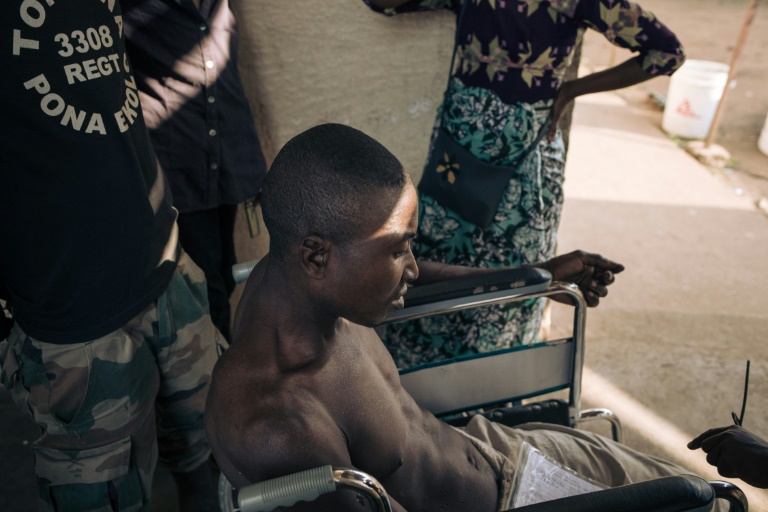
Dozens of bandaged patients lounge on beds in a hushed hospital ward in eastern Democratic Republic of Congo, groans of pain occasionally breaking the silence.

Rebels, soldiers and civilians make up the wounded — all victims of the latest flare-up in violence in eastern DRC’s North Kivu province.

After lying mostly dormant for years, the M23 rebel group resumed fighting late last year and has since captured swathes of territory in North Kivu.

The clashes have destabilised regional relations in central Africa, with DRC accusing its smaller neighbour Rwanda of backing the militia.

Despite denials from Kigali, an unpublished report for the United Nations seen by AFP this week also pointed to Rwandan involvement.

Until late March, M23 fighters staged hit-and-run attacks on Congolese troops. But then the conflict morphed into one of mutual artillery barrages, as the militia tried to prevent the government from recapturing lost territory.

One soldier in the hospital in the town of Rutshuru said he had come under shelling that lasted “for hours”. 

He was disembowelled by shrapnel some 20 kilometres (12 miles) away, in an area now in rebel hands.

Many on the ward — which reeked of sweat — were gravely wounded. Some had lost limbs in the brutal fighting. Others a jaw. 

Dozens of children were also being treated for severe malnutrition after being forced to flee the clashes.

AFP has not named patients or doctors in the hospital to protect their safety.

– ‘Two bullets in the arm’ –

A mostly Congolese Tutsi group, the M23 first leapt to prominence in 2012 when it briefly captured the eastern DRC city of Goma before being driven out.

But its dramatic recent resurgence and the sophistication of its attacks have drawn suspicion of Rwandan involvement, which the small central African country has repeatedly denied.

The head of the United Nations peacekeeping mission in the DRC, Bintou Keita, recently told the UN Security Council that the M23 rebels were behaving “more and more like a conventional army”. 

This week, independent experts also presented a report to the UN Security Council, arguing that Rwanda had both deployed its own troops in the DRC and coordinated with the M23. 

The upsurge in M23 violence triggered a wave of patriotic feeling across the DRC, with anti-Rwanda protests erupting nationwide in May and June. 

In the east, some people took up arms against the perceived invader.

“I took two bullets in the right arm,” said a scowling young man in the hospital, who had joined a militia to fight alongside Congolese soldiers. 

But he said he was attacked by another Congolese militia — not the M23 — while guarding a rear base, an example of chaotic battlefield conditions. 

“Everyone has their own agenda, there’s no collaboration between us,” the fighter said, as his wife stood nearby clutching a baby to her chest.

– ‘Impossible’ to go home –

The surgeons, anaesthetists and nurses working in the hospital find little rest. 

Doctors performed surgery on 271 patients in June alone, according to the hospital, with a third of that number receiving treatment for gunshot wounds. 

One surgeon, removing his blood-stained gloves after performing an operation, said that he and colleagues were being forced to prioritise care based on “chances of survival”.

“It’s very difficult,” he said, but noted that the situation had been far worse at the beginning of July. 

At the other end of the hospital, doctors were treating dozens of severely malnourished children.

Some of the weakest were hooked up to feeding tubes. Others had skin that peeled off in large shreds. 

Their cries mixed with the sound of whirring medical equipment. 

“It’s overflowing,” the supervisor of the ward said.

“If nothing is done in the next few weeks, there’ll be a catastrophe”.

Silence descends when the children are called outside to a cooking demonstration, accompanied by their parents.

Only the weakest, who lack the strength to cry, are left behind.

Exhausted doctors take advantage of the break to slump into plastic chairs and scroll through their smart phones. 

One of them asks a mother with her child whether she might return home soon.

“It’s impossible,” she said, pointing to the ongoing violence. “Please, you must continue to help us”.

Scarring for life: traditional practice fades in Sudan

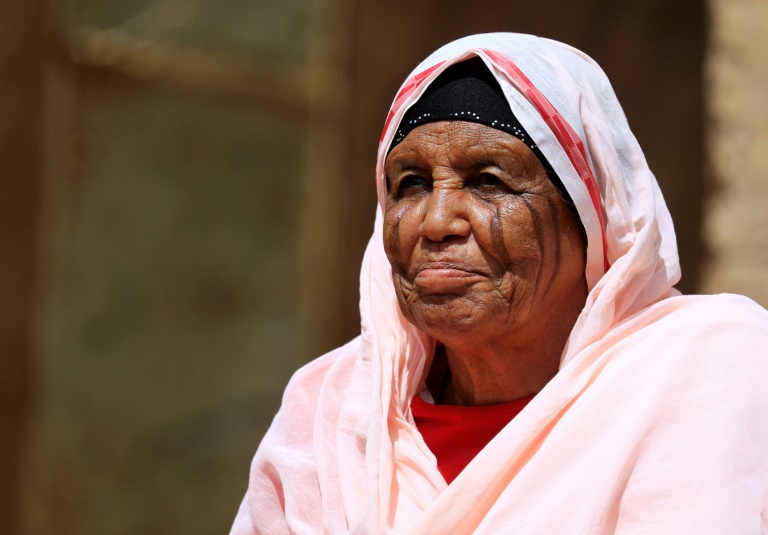
Kholoud Massaed of the Hadaria tribe in Sudan vividly recalls the day her face was scarred with a sharp blade, an ancient practice that was once common.

Now in her 80s, she still carries on each cheek the three lesion lines that have since darkened over time.

“They took me to a man who was known to carry out this practice. He did it with a small knife,” Massaed told AFP in her village of Om Maghad, some 66 kilometres (40 miles) south of Khartoum. 

“I was seven years old and I cried. They told me I should have these facial marks as it’s a sign of beauty.”

Tribal scarring, an ancient practice that used to be commonplace in Sudan, involves marking the skin, mainly to identify tribal affiliation or as a symbol of attractiveness.

It was also practised in Sudan, where according to Minority Rights Group roughly 30 percent of the population is believed to belong to African minorities, while the rest are Sudanese Arabs.

The practice has greatly reduced over the years, with many now viewing it as unsanitary, archaic and obsolete.

“People used to sing for it,” said Massaed. “It had great value in the past.”

For a long time, she struggled to come to terms with her scarring, and now she is grateful that the practice has been dying out.

When her own children came of age, Massaed refused to let them endure the same agonies.

“I didn’t take any of my children to be marked,” she said. “It’s a different time now.”

“Only old people still bear these markings, not the younger generations.”

Like Massaed, Fatma Ahmed of the Ja’aileen tribe bears similar lines on her face.  

“The pain lasted for weeks,” she said, adding that she used many traditional healing ointments to ease her suffering.

Communities in remote rural areas of Sudan have long struggled to access proper health care because of poor facilities and infrastructure.

Many men were also marked for life.

For males, these marks often varied from small vertical or horizontal lines on the cheeks to shapes resembling a “T” or “H”, according to Babiker Mohammed from the Mahas tribe.

“It was not a choice back then. It was inevitable,” said the 72-year-old.

“People just took children to the person known for marking faces, and he would mark the face according to their tribe name,” he said.

Mohammed said that he too refused to mark his own children.

“I’m probably from the last generation that had their faces marked” in Sudan, he said.

Idris Moussa Abdelrahman, who is from the Ja’aileen tribe, hopes the practice never returns.

“It’s a distortion and harms people for no reason.”

Kenya waits impatiently for results of close-fought vote

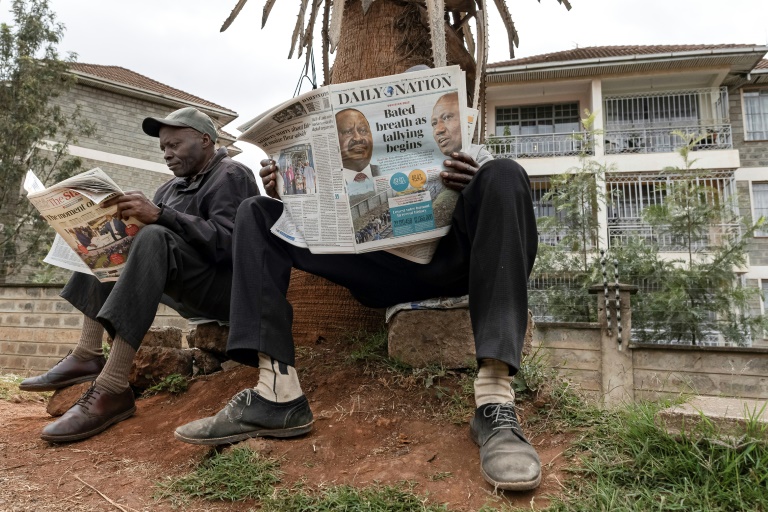
Kenyans on Wednesday were waiting for the results of the country’s presidential election after a largely peaceful poll, with preliminary results  suggesting a tight race while  low turnout pointed to growing frustration with the political elite.

Deputy President William Ruto and Raila Odinga, the veteran opposition leader now backed by the ruling party, have vowed to maintain calm following Tuesday’s poll, but the memory of past election-related violence remains fresh for many Kenyans.

With pressure building on the Independent Electoral and Boundaries Commission (IEBC), which has to declare the results by August 16, officials worked overnight to count votes under the watchful eye of observers.

The complicated process of verifying and tallying votes is expected to take days, and IEBC chairman Wafula Chebukati urged Kenyans to be patient, keen to avoid rigging allegations that have haunted previous polls.

As results trickled out, Amnesty International and several Kenyan civil society groups voiced concern about “rising levels of false or misleading information” being shared on social media.

They said in a statement that several posts by candidates and their supporters in the rival Odinga and Ruto camps had “intentionally sought to misinform the electorate and the public on the electoral process and the election results”.

Kenyans voted in a total of six elections on Tuesday, choosing a new president as well as senators, governors, lawmakers, woman representatives and some 1,500 county officials.

Despite an early show of enthusiasm with many voters queuing at polling stations before dawn, turnout was markedly lower than in previous years, suggesting that for some Kenyans at least, patience with the political establishment was running out.

In Ruto’s Rift Valley stronghold of Eldoret, Anthony Kemboi, a 24-year-old graduate, told AFP voter disillusionment was to blame.

“People did not turn out… as compared to the past because there have been fake promises” over the years, he said.

According to the latest IEBC figures, turnout was just over 65 percent, with voting still under way in Wajir county, where a gunfight forced officials to postpone the poll until Wednesday.

That compares with a final turnout of 78 percent in the disputed August 2017 election.

In the lakeside city of Kisumu — Odinga’s bastion — retired civil servant Koga Edward said younger Kenyans had simply failed to show up.

“Most of our youth, they are only good at participating in political rallies, but they don’t participate in the actual voting process,” the 65-year-old told AFP.

– ‘No longer care’ –

“Personally, I did not even vote because I no longer care,” said Caroline Mwangi, a 31-year-old waitress in Kenya’s capital Nairobi.

Politicians “tell the same old stories and they do nothing for us,” she said.

Others said they just wanted the election cycle to end so they could focus on putting food on the table in a country hit by skyrocketing inflation and an unemployment crisis. 

“The election was done yesterday, I am not interested in wasting more time on it,” said Celestine Muoki, a 28-year-old IT specialist.

“Let us move on.”

Gabrielle Lynch, professor of comparative politics at the University of Warwick in England, said the shrinking turnout was a consequence of politicians’ tendency to “promise a lot and then under-deliver”.

“Many Kenyans are… becoming unfortunately increasingly sceptical about the political class,” she told AFP.

Few Kenyans expect either Ruto or Odinga to accept the result without a challenge in a country where no presidential election outcome has gone uncontested since 2002.

Once the heir-apparent, Ruto, 55, found himself banished to the sidelines after President Uhuru Kenyatta — who cannot run again — joined hands with his former foe Odinga, 77, in a move that stunned the country.

Ruto has since cast himself as the champion of “hustlers” trying to survive in a country ruled by “dynasties” — the Kenyatta and Odinga families that have dominated Kenyan politics since independence from Britain in 1963.

– ‘Life is very hard’ –

With a third of Kenya’s population living in poverty, economic pressures weighed on voters even before the war in Ukraine sent the prices of essential goods soaring.

Some observers surmised that the economy could even surpass tribal affiliations as a key motivator for Kenya’s 22 million registered voters.

With two other candidates also in the race, Kenya could stage a run-off for the first time in its history, if neither Ruto nor Odinga wins more than 50 percent of the vote.

Kenya’s international partners are closely watching the election as a test of its stability in a region blighted by conflict.

Security is tight nationwide, with a view to preventing a repeat of the post-election violence that roiled Kenya after the 2007 and 2017 polls, and schools have been ordered to remain closed until Monday.

In deserted downtown Nairobi, Japeth Kigongi, a 25-year-old shoe shiner, told AFP he couldn’t even afford to travel to his home constituency to vote.

“Life has become very hard,” he said.

“Whoever will be chosen, I will back him so long as there’s peace.”

Two police officers killed in S.Leone as economic protest turns violent

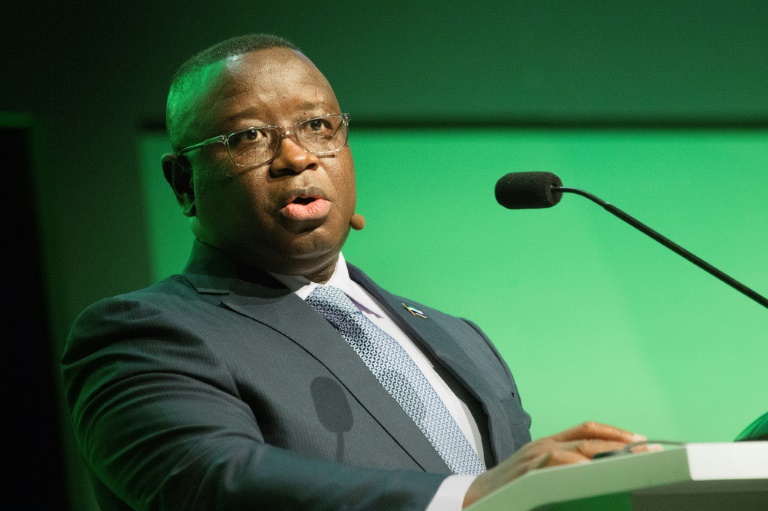
Two police officers were killed Wednesday in Sierra Leone after a protest against “economic hardship” descended into clashes between security forces and youth demanding the president resign, the police said.

“Two police officers, a male and female, were mobbed to death by protesters at the east end of Freetown this morning,” police spokesman Brima Kamara told AFP. 

Vice President Mohamed Juldeh Jalloh announced a nationwide curfew and said “innocent Sierra Leoneans including some security personnel” had been killed. 

Dozens of protestors had been arrested, police said.

A health worker at a hospital in Freetown said dozens of people had been injured.

In the Kissy neighbourhood in the east end of the city, demonstrators threw rocks and sticks at security forces, who fired tear gas in their direction, an AFP reporter saw.

Several protestors told AFP the security forces had also fired live bullets.

Protestors were heard chanting “Bio must go”, referring to President Julius Maada Bio, who is currently in the United Kingdom on a private visit.

The internet was temporarily blocked in Freetown on Wednesday afternoon, according to NetBlocks, a web monitoring group.

Demonstrations were also held in the city of Makeni and the town of Magburuka in the country’s Northern Province.

– ‘Economic hardship’ –

The Grassroots Women of Sierra Leone, a group of market traders, had called a “peaceful assembly” to “draw attention to the economic hardship and many issues that affect the women of Sierra Leone”, according to a letter to the inspector general of the police seen by AFP.

In a statement, the national security coordinator denied that any organisation had requested permission to demonstrate.

On Tuesday, the government said that it had directed the military to assist police in handling the “potentially volatile security situation”.

The risk of confrontation, it said, was stoked by “repeated social media incitements of the gullible population to embark on a countrywide violent demonstrations (sic) with the aim of subverting the peace and stability of the state”.

Women who had gathered in the city centre Wednesday morning, holding placards, later fled the scene as tensions rose.

Security forces dispersed the demonstrators, who fled to neighbourhoods in the east of the city.

The European Union and the British embassy in Sierra Leone issued appeals for “all sides” to refrain from violence.

The United Nations also expressed concerns over the “violent incidents”.

– Arrests –

In early July, female market traders and the opposition politician Femi Claudius Cole held a separate demonstration over the rising cost of living. 

Cole, the founder and head of the Unity Party, and some 50 other women were arrested but later released without charge. 

Denis Bright, chairman of the National Grand Coalition, another political party, was also arrested.

Sierra Leone’s eight million people live in one of the poorest nations in the world, ranking 182 out of 189 countries in the UN’s Human Development Index, a benchmark of prosperity.

Its economy, heavily dependent on minerals, was devastated by a civil war that ran from 1991 to 2002 and left about 120,000 dead.

Efforts at rebuilding were set back by an Ebola epidemic in 2014-2016, a fall in world commodity prices and the coronavirus pandemic — all of which have disrupted trade and investment and hit exports.

In July, the country slashed three zeros off its currency in a bid to restore confidence in the inflation-hit leone.

Bio succeeded Ernest Bai Koroma as president in 2018 after a tumultuous election campaign in which he campaigned against corruption and promised a better life for the poor, including free education for primary and high-school students.

The next general elections are slated for June 2023.

Close Bitnami banner
Bitnami