Africa Business

Top Zimbabwe author denies incitement charges at trial opening

Award-winning Zimbabwean novelist Tsitsi Dangarembga denied charges of inciting violence at the opening of her trial in Harare on Wednesday over a protest she made in July 2020 in which she called for reform. 

Dangarembga, 63, an author and filmmaker, took the stand after a magistrate dismissed her request to be allowed more time to prepare her defence. 

“We did not stop anybody or force anybody to engage in anything that we were doing,” Dangarembga told the court.

She staged the protest alongside a neighbour in the empty streets of the affluent Harare suburb of Borrowdale during the coronavirus lockdown. 

“We just walked on our own,” she said. 

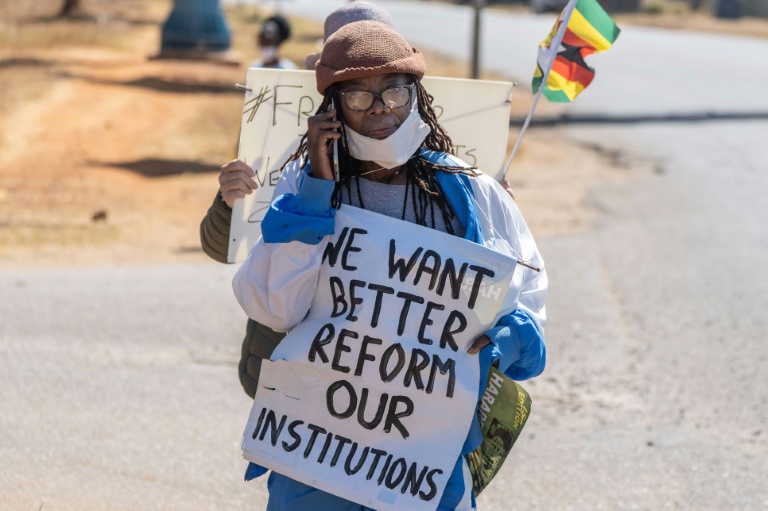
Dangarembga was stopped while holding a sign reading “We want better, reform our institutions”, while her neighbour held a placard calling for the release of detained journalist Hopewell Chin’ono, who faced similar charges of inciting violence. It also read “We want a better Zimbabwe for all”. 

Arbitrary arrests and a crackdown on dissent have worsened in Zimbabwe since President Emmerson Mnangagwa replaced long-time ruler Robert Mugabe in 2017, according to human rights groups.

Dangarembga told the court she did not address any members of the public or the press during the demonstration and was “minding my own business.”

“I wanted the peaceful words on the placards to speak for themselves,” she said. 

She denied resisting arrest, adding she only asked police to explain what she was being arrested for.

“There is a difference between expression and incitement,” she told the court, describing her actions as peaceful. 

Dangarembga is the author of three international award-winning novels, whose accolades include this year’s Windham-Campbell Prizes. 

Her 1988 groundbreaking debut novel “Nervous Conditions” was the first book published in English by a black Zimbabwean woman. 

Her trial is set to continue next week. 

Death toll from attack on Mali soldiers rises to 42: army

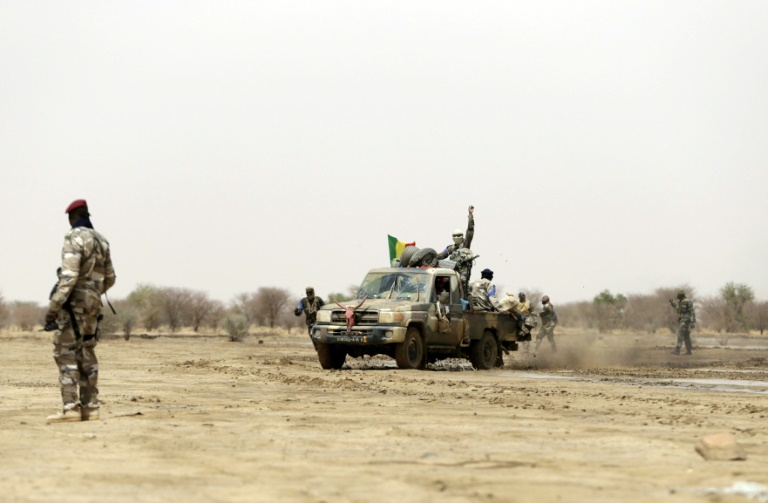
Forty-two Malian soldiers died in an attack at the weekend by suspected jihadists, the army said Wednesday in a document naming the fatalities, revising an earlier figure of 21 dead.

The toll is one of the bloodiest in Mali’s decade-long insurgency, which has spread from the north of the country to the centre and south and into neighbouring Burkina Faso and Niger.

The document was authenticated to AFP by several senior military officials.

The attack occurred on Sunday in the town of Tessit, in the troubled “three-border” region where the frontiers of the three nations converge.

On Monday, the army had said 17 soldiers and four civilians had died. Relatives of the victims, speaking on condition of anonymity, said that some of the civilians had been elected officials.

Monday’s statement also said that seven attackers had died, “probably members of the Islamic State in the Greater Sahara (ISGS) and benefiting from drone and artillery support and using explosives and an explosives-laden vehicle”.

The last time Mali’s armed forces sustained such losses was in a string of attacks in the same region in late 2019 and early 2020.

Hundreds of soldiers were killed in assaults on nearly a dozen bases, typically carried out by highly mobile fighters on motorbikes.

The raids prompted the Malian, Nigerien and Burkinabe forces to fall back from forward bases and hunker down in better-defended locations.

In January 2020, France and its Sahel allies agreed on a push against the ISGS at a summit in Pau, southwestern France.

Several of its leaders were targeted and killed, including its founder, Abu Walid Al-Sahraoui, but local people say the group has continued to recruit and carry out its operations.

– Hotspot –

Tessit is one of the hotspots in the three-border area.

The ISGS is fighting for control of the strategic, gold-rich area against an Al-Qaeda-linked alliance, the Support Group for Islam and Muslims (GSIM).

In March 2021, 33 soldiers were killed in an ISGS-claimed ambush as units were being rotated, and in February this year, around 40 civilians — suspected by the ISGS of being in league with Al-Qaeda — were massacred.

Mobile phone connections to the area have been frequently cut over the last few years and physical access is hard, especially during the mid-year rainy season.

Thousands have fled Tessit to the nearest large town, Gao, which is located some 150 kilometres (90 miles) to the north. 

Across the Sahel, the jihadist campaign has claimed thousands of lives and forced more than two million to flee their homes.

Sporadic cross-border attacks have also occurred in Ivory Coast, Togo and Benin to the south, amplifying fears of a jihadist push towards the Gulf of Guinea.

Tunisia body overturns president's sacking of judges

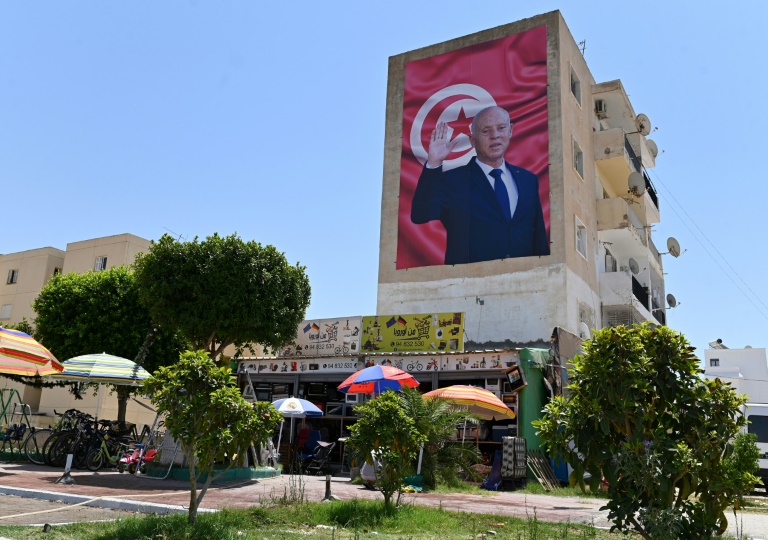
Tunisia’s judicial authorities on Wednesday revoked the sacking in early June by President Kais Saied of almost 50 judges, a court spokesman told AFP.

A June 1 presidential decree in the North African country saw Saied fire 57 judges, after accusing many of corruption and other crimes.

His move, which rights groups called “a deep blow to judicial independence”, sparked a nationwide strike by judges.

Fifty-three of those sacked — including some accused of “adultery” — had lodged appeals with the administrative court against Saied’s move.

A total of 46 judges’ sackings have been revoked, administrative court spokesman Imed Ghabri said, adding that the appeals of seven others had been rejected.

Two more were awaiting a decision, while a further two had not appealed, he told AFP.

Lawyer Kamel Ben Messoud said those concerned would be able to resume their duties once a copy of the ruling was obtained.

Ben Messoud told reporters that magistrates who were the subject of criminal proceedings did not benefit from the decision.

Saied’s decree saw the president grant himself the power to fire judges, and he duly sacked the 57, further cementing a power grab that began in July last year when he dismissed the government and suspended an elected parliament.

A coalition of 10 rights groups in a joint statement at the time called the dismissals “a frontal assault on the rule of law”.

Last month, Tunisia approved a new constitution granting Saied’s office unchecked powers after a poorly attended referendum in which voters overwhelmingly backed the document.

The vote came a year to the day after Saied sacked the government and suspended parliament in a dramatic blow to the only democracy to have emerged from the 2011 Arab Spring uprisings.

Raza out for golden duck as Zimbabwe lose ODI to Bangladesh

Sikandar Raza’s golden run ended with a golden duck as his Zimbabwe side lost by 105 runs to Bangladesh on Wednesday in a dead-rubber third one-day international in Harare.   

An unbeaten 85 by Afif Hossain lifted Bangladesh to 256-9 in 50 overs when put in to bat and Mustafizur Rahman then took 4-17 as Zimbabwe were all out for just 151 in 32.2 overs.

Pakistan-born Raza batted superbly in guiding Zimbabwe to a winning 2-0 lead in the series last weekend, hitting unbeaten knocks of 135 and 117 in superb run chases for two five-wicket victories. 

But the 36-year-old, whose childhood dream to be a fighter pilot in the Pakistan Air Force was dashed by an eyesight glitch, finally met his match in ODI debutant Ebadot Hossain.

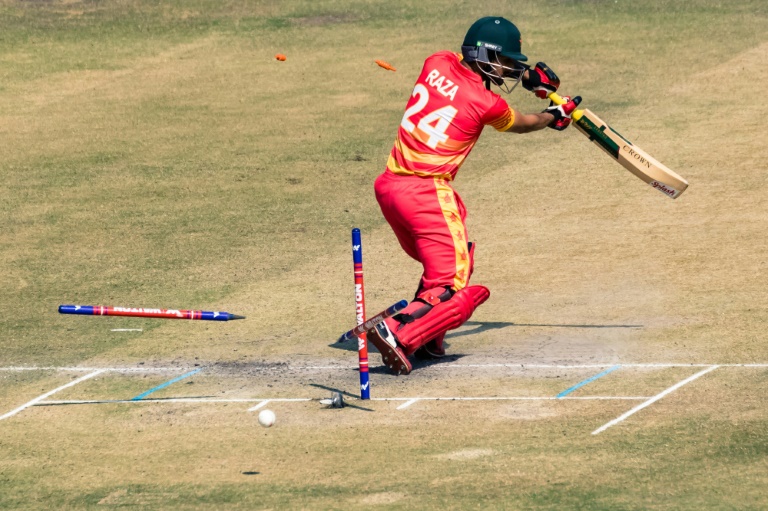
Facing his first ball with Zimbabwe reeling at 17-3, Raza fell victim to an inswinging yorker that flattened the middle and off stumps.

Zimbabwe were heading for a hiding as subsequent wickets fell cheaply until tail-enders Richard Ngarava and Victor Nyauchi came together and put on 68 for the final wicket. 

Unbeaten top scorer Ngarava made 34, including a six and six fours, while Nyauchi contributed 26.  

Apart from the four wickets of Mustafizur, Ebadot and Taijal Islam captured two each for the tourists.

Hossain faced 81 balls and struck two sixes and six fours as seventh-ranked Bangladesh — eight places above Zimbabwe — regained some pride at the end of the six-match visit to southern Africa.

Opener Anamul Haque was the other visiting batsman to post a half-century, scoring 76 before edging a Luke Jongwe delivery outside off stump to debutant wicketkeeper Clive Madande.

Like Afif, Anamul scored quicker than a run a ball in his innings, which included four sixes and six fours.

A cautious 39 from Mahmudullah Riyad was the other significant Bangladeshi knock as they reached their lowest total in the series having scored 303 runs in the first ODI and 290 in the second.

Jongwe and Brad Evans took two wickets each for Zimbabwe, who have won nine of 11 ODI and T20 matches since former captain Dave Houghton began a second stint as coach in June.

Before the ODI matches, Zimbabwe edged Bangladesh 2-1 in a T20 series after winning a thrilling final match by 10 runs.

After a brief break, Zimbabwe will host India in a three ODI series from August 18, also at Harare Sports Club.

Kenya waits impatiently for results of close-fought vote

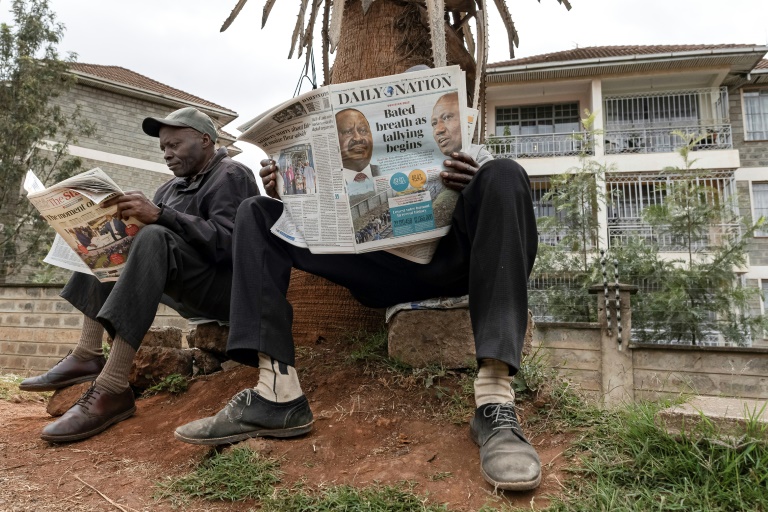
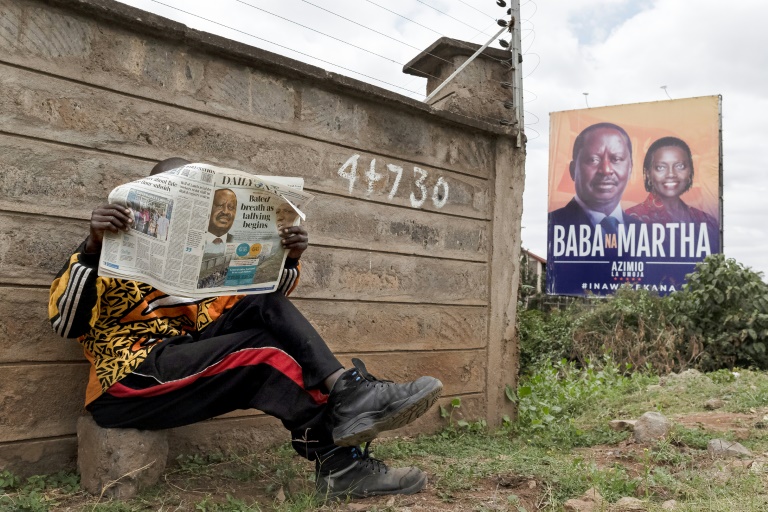
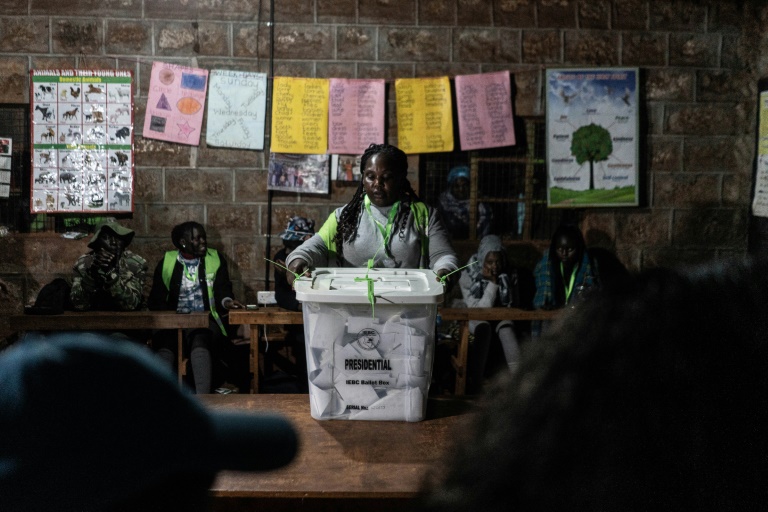
Kenyans on Wednesday were waiting for the results of the country’s presidential election after a largely peaceful poll, with preliminary results on television suggesting a tight race as low turnout pointed to growing frustration with the political elite.

Deputy President William Ruto and Raila Odinga, the veteran opposition leader now backed by the ruling party, have vowed to maintain calm following Tuesday’s poll, but the memory of past election-related violence remains fresh for many Kenyans.

With pressure building on the Independent Electoral and Boundaries Commission (IEBC), which has to declare the results by August 16, officials worked overnight to count votes under the watchful eye of observers.

The complicated process of verifying and tallying votes is expected to take days, and IEBC chairman Wafula Chebukati urged Kenyans to be patient, keen to avoid rigging allegations that have haunted previous polls.

Kenyans, some of whom lined up before dawn to cast their ballot, voted in six elections on Tuesday, choosing a new president as well as senators, governors, lawmakers, woman representatives and some 1,500 county officials.

But despite the early show of enthusiasm, turnout was markedly lower than in previous years, suggesting that for some Kenyans at least, patience with the political establishment was running out.

In Ruto’s Rift Valley stronghold of Eldoret, Anthony Kemboi, a 24-year-old graduate, told AFP voter disillusionment was to blame.

“People did not turn out… as compared to the past because there have been fake promises” over the years, he said.

According to the latest IEBC figures, turnout was just over 65 percent, with voting still under way in Wajir county, where a gunfight forced officials to postpone the poll until Wednesday.

That compares with a final turnout of 78 percent in the disputed August 2017 election.

In the lakeside city of Kisumu — Odinga’s bastion — retired civil servant Koga Edward said younger Kenyans had simply failed to show up.

“Most of our youth, they are only good at participating in political rallies, but they don’t participate in the actual voting process,” the 65-year-old told AFP.

– ‘No longer care’ –

“Personally, I did not even vote because I no longer care,” said Caroline Mwangi, a 31-year-old waitress in Kenya’s capital Nairobi.

Politicians “tell the same old stories and they do nothing for us,” she told AFP.

Others said they just wanted the election cycle to end so they could focus on putting food on the table in a country hit by skyrocketing inflation and an unemployment crisis. 

“The election was done yesterday, I am not interested in wasting more time on it,” Celestine Muoki, a 28-year-old IT specialist, told AFP.

“Let us move on.”

Gabrielle Lynch, professor of comparative politics at the University of Warwick in England, said the shrinking turnout was a consequence of politicians’ tendency to “promise a lot and then under-deliver”.

“Many Kenyans are… becoming unfortunately increasingly sceptical about the political class,” she told AFP.

Few Kenyans expect either Ruto or Odinga to accept the result without a challenge in a country where no presidential election outcome has gone uncontested since 2002.

Once the heir-apparent, Ruto, 55, found himself banished to the sidelines after President Uhuru Kenyatta — who cannot run again — joined hands with his former foe Odinga, 77, in a move that stunned the country.

Ruto has since cast himself as the champion of “hustlers” trying to survive in a country ruled by “dynasties” — the Kenyatta and Odinga families that have dominated Kenyan politics since independence from Britain in 1963.

– ‘Life is very hard’ –

With a third of Kenya’s population living in poverty, economic pressures weighed on voters even before the war in Ukraine sent the prices of essential goods soaring.

Some observers surmised that the economy could even surpass tribal affiliations as a key motivator for Kenya’s 22 million registered voters.

With two other candidates also in the race, Kenya could stage a run-off for the first time in its history, if neither Ruto nor Odinga wins more than 50 percent of the vote.

Kenya’s international partners are closely watching the election as a test of its stability in a region blighted by conflict.

Security is tight nationwide, with a view to preventing a repeat of the post-election violence that roiled Kenya after the 2007 and 2017 polls, and schools have been ordered to remain closed until Monday.

In deserted downtown Nairobi, Japeth Kigongi, a 25-year-old shoe shiner, told AFP he couldn’t even afford to travel to his home constituency to vote.

“Life has become very hard,” he said.

“Whoever will be chosen, I will back him so long as there’s peace.”

Tunisia body overturns president's sacking of judges

Tunisia’s judicial authorities on Wednesday revoked the sacking in early June by President Kais Saied of around 50 judges, judicial sources told AFP.

A June 1 presidential decree in the north African country saw Saied fire 57 judges, after accusing many of corruption and other crimes.

His move, which rights groups called “a deep blow to judicial independence”, sparked a nationwide strike by judges.

Fifty-three of those sacked — including some accused of “adultery” — had lodged appeals with the administrative court against Saied’s move.

The administrative court’s spokesman told reporters the suspension of the dismissals related to an unspecified number of judges, but a lawyer on a committee for those sacked said “about 50 judges” were affected.

Lawyer Kamel Ben Messoud added that those concerned would be able to resume their duties once a copy of the ruling was obtained.

Ben Messoud told media that remaining magistrates, the subject of criminal proceedings, did not benefit from the decision.

Saied’s June 1 decree saw the president grant himself the power to fire judges, and he duly sacked the 57, further cementing a power grab that began in July last year when he dismissed the government and suspended an elected parliament.

A coalition of 10 rights groups in a joint statement at the time called the dismissals “a frontal assault on the rule of law”.

Last month Tunisia approved a new constitution granting Saied’s office unchecked powers after a poorly attended referendum in which voters overwhelmingly backed the document.

The vote came a year to the day after Saied sacked the government and suspended parliament in a dramatic blow to the only democracy to have emerged from the 2011 Arab Spring uprisings.

CAF launches new Super League to boost clubs

The Confederation of Africa Football (CAF) on Wednesday launched a new lucrative $100 million Super League aimed at injecting financial muscle to the cash-strapped clubs on the continent.

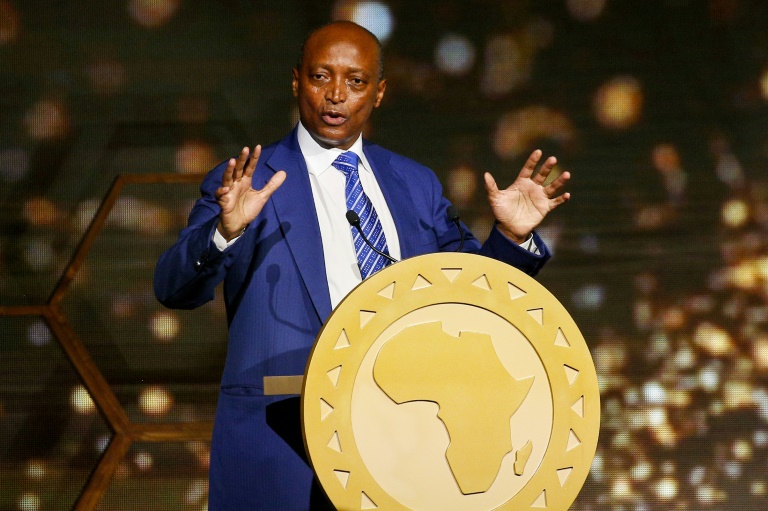
CAF president Patrice Motsepe announced the revolutionary competition which is supported by FIFA despite shooting down a similar initiative in Europe in 2021.

The first edition will be held in August 2023 and ends in May 2024, with an inital 24 clubs taking part in the maiden tournament but Motsepe did not say if it would replace CAF’s Champions League and the second-tier Confederation Cup.

“The African Super League is a very important initiative. One of the major problems in Africa is finance,” said Motsepe at the launch held in the northern Tanzania town of Arusha.

“The African Super League is one of the most exciting developments in the history of African football and the objective in terms of what we are trying to achieve is very clear: to make sure African club football is world class and competes with the best in the world,” added Motsepe.

“Our intention is to use the $100 million as prize money and to do that every year in the African Super League, so that the club which wins gets $11.5 million,” he added.

Motsepe said CAF will use some of the 50 million dollars from the Super League to make football attractive and ensure the best players remain in Africa and improve the quality of the sport on the continent which has lacked behind other continents.

“Each of the 24 clubs that will take part in the initial tournament will receive an annual contribution of three-and-half million dollars to buy players, pay for transport and player transfers.”

Motsepe appealed to African governments to help with the construction of CAF-approved stadiums to ensure every club play their football in their own countries.

Not everyone is excited about the Super League with Cape Town City FC owner John Comitis calling it a “super silly idea”.

“The Super League will kill African club football,” he warned. 

“You can switch off the lights on the domestic leagues.” 

Kenyan election: the next steps

Kenya is on tenterhooks as it awaits results from Tuesday’s election, which passed off relatively smoothly despite some issues with malfunctioning voter identification equipment, delays at polling stations and scattered incidents of violence.

But with the race currently too close to call between presidential frontrunners William Ruto and Raila Odinga and what could be a low turnout by Kenyan standards, the risk of yet another contested election is high.

No Kenyan presidential poll outcome has gone unchallenged since 2002, and memories are still raw of the bloodshed that erupted after disputes over two of the last three elections.

– The count –

Kenya’s Independent Electoral and Boundaries Commission must announce the results by August 16, but the longer the wait the greater the risk of tensions, analysts say.

“We call for patience among Kenyans as we undertake this rigorous exercise and also endeavour to complete this exercise as soon as possible,” IEBC chairman Wafula Chebukati said late Tuesday.

The process is complicated, with results from more than 46,000 polling stations across the country to be counted, cross-checked and tallied.

In addition to voting for president, Kenyans were also choosing new MPs, senators, women representatives as well as county governors and officials. 

Final presidential results will be announced at the IEBC’s national tallying centre, based at a tourist village known as the Bomas of Kenya.

It has been transformed into a virtual fortress, with no one admitted without accreditation and armed guards and sniffer dogs ensuring security.

The winner of the presidential race needs to secure 50 percent plus one vote and at least a quarter of the votes in 24 of the 47 counties.

If neither Odinga nor Ruto gets over the threshold, a run-off must be held within 30 days of the original election — something that would be a first in Kenyan history.

– Court petition –

Any challenge to the results must be made within seven days to the Supreme Court, the country’s highest judicial body.   

The court has a 14-day deadline to issue a ruling, and if it orders an annulment, a new vote must be held within 60 days.

If no candidate files a petition, the winner takes office two weeks after final results are announced. 

One scenario, albeit seen as the most unlikely, suggested that if there were multiple run-offs and petitions, there may not be a new president until late April or early May next year.

Ben Hunter, Africa analyst at risk intelligence group Verisk Maplecroft, said the court system in Kenya was one of the region’s most “robust”.

“If the result is contested, a candidate filing a petition with the Supreme Court would be a positive step because the alternative is calling supporters out in protest. 

“The court enjoys strong credibility and a legal process would act as a release valve for political tensions.”

The African Union, the European Union and the Commonwealth are among those that have sent observers to monitor the polls, along with several civil society groups.

– Past disputes –

Odinga, 77, ran unsuccessfully for the presidency in 1997, 2007, 2013 and 2017, claiming to have been robbed of victory in the last three elections. 

In a first for Africa, the Supreme Court annulled the August 2017 result after Odinga rejected the results, saying hackers broke into the electoral body’s database.

The court declared President Uhuru Kenyatta’s win null and void because of widespread “irregularities and illegalities” in the counting process and mismanagement by the IEBC.

Dozens of people were killed in what was blamed on police brutality in the chaos and acrimony that followed.

Kenyatta went on to win the rematch after a boycott by Odinga.

In the deadliest election violence, more than 1,100 people were killed and many thousands more displaced in bloodletting between rival tribes after the 2007 vote.

The clashes erupted after Odinga claimed incumbent Mwai Kibaki’s victory had been rigged.

Ruto and Kenyatta were charged by the International Criminal Court over the unrest but the cases were later dropped.

S.Africa finalising claims as mine massacre anniversary looms

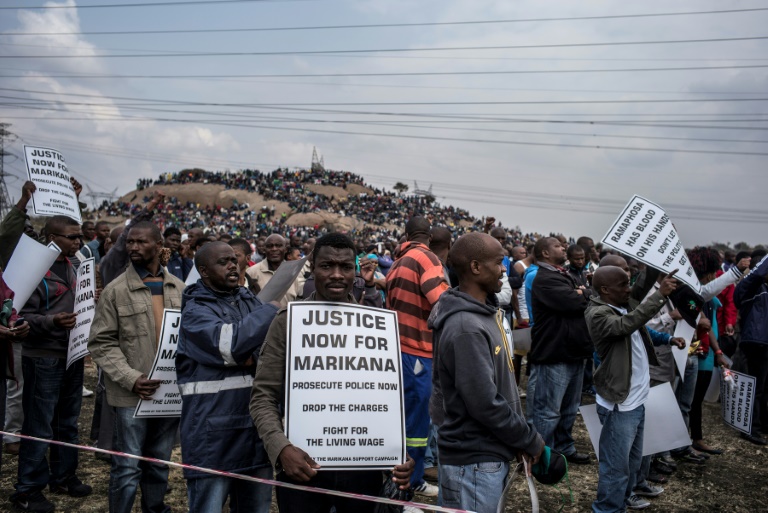
Outstanding claims of compensation from the massacre of 34 workers at a South African platinum mine a decade ago are likely to be settled this month, an official said on Wednesday.

Police gunned down 34 mineworkers and injured 78 others as they repressed a wildcat strike that had turned violent at the Marikana mine northwest of Johannesburg on August 16, 2012.

The massacre was the worst act of police violence since the end of apartheid, which had been legally dismantled 11 years earlier.

Solicitor-General Fhedzisani Pandelani announced that the last civil claims against the government were on track to be resolved before the end of August. 

Forty-eight claims remain, Pandelani told a press briefing in the capital Pretoria. 

“I can also give the assurance that to the extent that is possible, we could in fact be in a position to resolve all of those matters within this month,” he said.

Pandelani said the last cases hinged on the extent of personal injuries, medical examinations or actuarial calculations. 

Compensation claims directly related to miners who were killed had already been settled last year, with the state paying almost 76 million rand ($4.6 million) to the victims’ families, he said. 

He added it was “regrettable” it took so long to bring the cases to a close. 

South Africa marks the 10th anniversary of the massacre that shocked the nation on August 16. 

Tense Kenya awaits results of close-fought vote

Kenyans waited anxiously on Wednesday for the results of the country’s presidential election after a largely peaceful poll, with low turnout pointing to growing frustration with the political elite.

Preliminary results broadcast by Kenyan television suggest a tight race for the presidency between Deputy President William Ruto and Raila Odinga, the veteran opposition leader now backed by the ruling party.

Both men have vowed to maintain calm following Tuesday’s poll, but the memory of past election-related violence remains fresh for many Kenyans, who have urged political parties to accept the results.

With pressure building on the Independent Electoral and Boundaries Commission (IEBC), which has to declare the results by August 16, officials worked overnight to count votes and dispel rigging fears, as observers watched.

By 10:00 am (0700 GMT) on Wednesday, the national tallying centre had received nearly 95 percent of the presidential results forms transmitted from thousands of polling stations.

“We call for patience among Kenyans as we undertake this rigorous exercise and also endeavour to complete this exercise as soon as possible,” IEBC chairman Wafula Chebukati said in a late-night briefing.

Kenyans, some of whom lined up before dawn to cast their ballot, voted in six elections on Tuesday, choosing a new president as well as senators, governors, lawmakers, woman representatives and some 1,500 county officials.

Despite the early show of enthusiasm however, turnout was markedly lower than previous years, suggesting that for some Kenyans at least, patience with years of unfulfilled promises was running out.

According to latest IECB figures, turnout at 4:00 pm Tuesday, 10 hours after polling began, was just over 56 percent of the 22 million registered voters.

That compares with a final turnout in the disputed August 2017 election of 78 percent.

Some Kenyans said they just wanted the election cycle to end so they could focus on putting food on the table in a country hit by skyrocketing inflation and an unemployment crisis. 

“The election was done yesterday, I am not interested in wasting more time on it,” Celestine Muoki, a 28-year-old IT specialist, told AFP.

“Let us move on,” she said, echoing the exhaustion felt by many in Kenya.

– ‘Lack of faith in politicians’ –

But few Kenyans expect either Ruto or Odinga to accept the result without a fight, reflecting earlier polls in the East African nation where no presidential election outcome has gone uncontested since 2002.

Once the heir-apparent, Ruto, 55, found himself banished to the sidelines after two-term President Uhuru Kenyatta — who cannot run a third time — joined hands with his former foe Odinga, 77, in a move that stunned the country.

Since then, the wealthy businessman has cast himself as the champion of “hustlers” trying to survive in a country ruled by “dynasties” — the Kenyatta and Odinga families that have dominated Kenyan politics since independence from Britain in 1963.

With a third of Kenya’s population living in poverty, economic pressures weighed on voters even before the war in Ukraine sent the prices of essential goods soaring.

Prior to the election, some observers surmised that the economy could surpass tribal affiliations as a key factor driving voter behaviour, while others said politicians’ failure to tackle the crisis could keep people away from the ballot all together.

“Many Kenyans… have cited their lack of faith in politicians to improve their current economic circumstances as the main reason for not participating in the August polls,” Oxford Economics said in a note last week.

– ‘Calm and peaceful’ –

If neither Ruto nor Odinga wins more than 50 percent of the vote, Kenya will stage a run-off for the first time in its history.

Kenya’s international partners are closely watching the election in a country deemed a beacon of regional stability.

Local polls were suspended in several areas on Tuesday, triggering a protest in one case, but police said the electoral process had largely “remained calm and peaceful with no major incidents to report”.

Security is tight nationwide, with a view to preventing a repeat of the post-election violence that has hit Kenya in the past, and schools have been ordered to remain closed until Monday.

The 2007 poll was followed by politically motivated ethnic clashes that killed more than 1,100 people, while Odinga’s challenge to the 2017 election result was met with a heavy-handed police response that left dozens dead.

Close Bitnami banner
Bitnami