Africa Business

Mount Kenya: Where the next president could be chosen

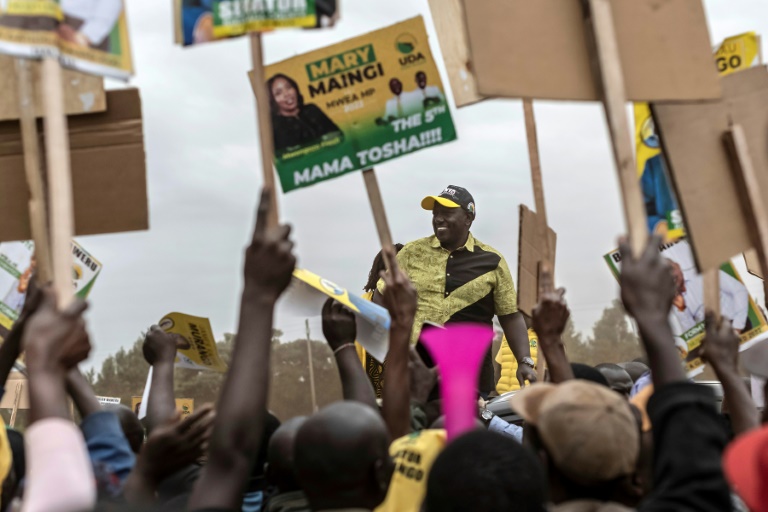
The helicopter lands in the middle of rice fields, heralding the arrival of Kenyan presidential candidate William Ruto as he seeks votes from the densely populated, politically influential heartland of Mount Kenya.

Located in the centre of the country and flanked by an extinct volcano that gives the vast region its name, Mount Kenya has long played a key role in presidential elections and this year is no exception.

As the underdog in the August 9 election, where he will face Raila Odinga, a veteran opposition politician who now has the backing of the ruling Jubilee party, Ruto and his team know that winning Mount Kenya is essential.

The 55-year-old has vowed to lift millions of Kenyans out of poverty, making “bottom-up” economic growth a major plank of his campaign. 

At the rally in Kirinyaga country, Nancy Njeri, a 78-year-old rice farmer, told AFP he had her vote.

“Ruto will bring changes in education, youth employment, he will ensure we have fertiliser to grow our rice, and many more things,” she said.

Kirinyaga governor Anne Waiguru predicted a huge victory for Ruto’s United Democratic Alliance (UDA) party in the region, telling AFP that he is “someone who is accepted by the people of Mount Kenya.”

“He has done a lot of groundwork in that regard,” the UDA politician said. 

Ruto, a businessman from the Kalenjin tribe who is currently serving as Kenya’s deputy president, was originally slated to succeed President Uhuru Kenyatta.

Instead, he found himself banished to the sidelines after his boss struck a deal with arch-rival Odinga.

Embittered but ambitious, Ruto launched a new party and began laying the foundation for his candidacy, focusing in particular on the region which is perhaps most representative of the complex politics that govern Kenya.

– Sacred Kikuyu land – 

It was a long shot for the Kalenjin leader, at least on paper.

Mount Kenya is the sacred land of the Kikuyu, Kenya’s largest ethnic group, who believe that God lives in the snow-capped volcano they call Kirinyaga. 

The fertile region, home to mango orchards and coffee plantations, also occupies a hallowed place in Kenyan history — the Mau Mau rebellion against the British Empire began here in 1952.

“From that time (onwards) there is this sense of entitlement that the Kikuyus have always had,” said analyst Herman Manyora, who favours Odinga.

Nearly six decades after independence in 1963, Mount Kenya continues to be at the heart of Kenyan politics.

Three of the country’s four presidents — Jomo Kenyatta, his son Uhuru, and Mwai Kibaki — are Kikuyu.

The economically powerful community has always backed its own people — a widespread phenomenon in Kenya, where the tribal vote has played a big role in previous elections.

Politicians have also exploited ethnic divides to deadly effect in 2007-2008, when Kenya witnessed a vicious bout of post-poll violence that pitted mainly Kikuyus against Luos and Kalenjins, leaving more than 1,100 dead.

But this year, Kikuyus — who account for around six million of Kenya’s 22 million voters — will have to choose between Ruto, a Kalenjin and Odinga, a Luo.

The alliance between Kenyatta and Odinga has ruffled feathers in Mount Kenya, where some have turned on their former leader, accusing him of abandoning “kihoto” (the Kikuyu concept of justice) by sidelining his deputy.

“We as the Kikuyus cannot be told who to support, Uhuru is a traitor,” George Mwaura, a 38-year-old motorcycle taxi driver, said at the Kirinyaga rally.

– The ‘Martha effect’ – 

But Odinga’s team insists that the 77-year-old will win a majority in the region, pointing to the selection of Kikuyu lawyer Martha Karua as his running mate.

The choice of Karua, a former justice minister nicknamed the “iron lady”, has “energised and excited the mountain”, said David Murathe, a prominent Kikuyu and vice-chairman of the Jubilee party.

Ruto’s running mate Rigathi Gachagua is also a Kikuyu who once served as Kenyatta’s personal aide, but Murathe said he lacked Karua’s credentials as a key player in Kenya’s pro-democracy movement.

Even accounting for a worst-case scenario, the Odinga-Karua ticket could expect to secure at least 60 percent of Mount Kenya’s votes, Murathe told AFP.

“I would not be surprised if Ruto gets the shock of his life” when the results are announced, he said.

Academic Macharia Munene also testified to the presence of the “Martha effect”, telling AFP: “There was a time it appeared to be all Ruto, about six-seven months ago.

“It’s declining, that overwhelming support. It’s been eroded,” he said.

“Whether the erosion is big enough to turn the tables is another matter.”
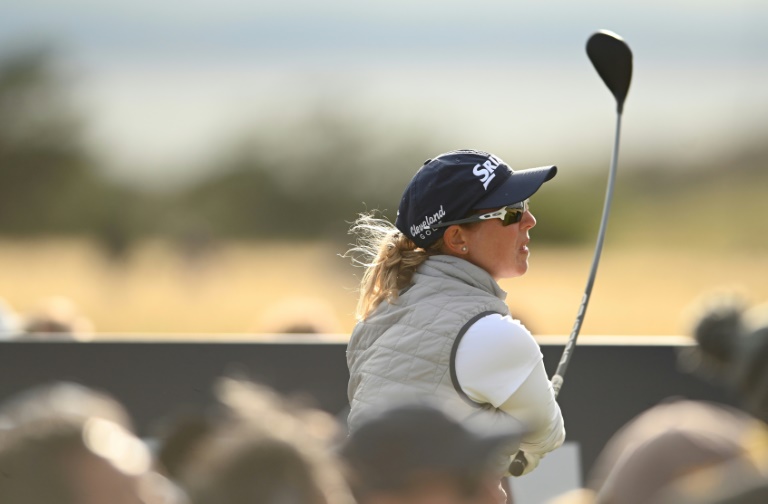
South Africa's Buhai seals 'life-changing' Women's British Open in play-off

South Africa’s Ashleigh Buhai survived a disastrous 15th hole to claim a “life-changing” victory in a marathon play-off against Chun In-gee in the Women’s British Open at Muirfield on Sunday.

Both players tied on 10 under par after 72 holes, and, in near total darkness, it was Buhai who eventually secured the final major of the season with a par four at the fourth extra hole, the 18th.

Chun bunkered her drive and took five, while Buhai got up and down from a greenside bunker, holing out from two feet for victory.

She was close to tears as husband David rushed onto the green and gave her a kiss and a loving hug.

“It’s been a lot of hard work over many years,” said the 33-year-old, who won the first of three South African Amateur titles when she was just 14.

Her professional career has never quite hit the same heights with three wins in Europe and two South African Opens. But she had never won an LPGA title until now, and a major at that to make it even more special.

Five ahead overnight, she had to survive a triple-bogey seven at the 15th – that dragged her back into a tie with Chun – before snatching the dramatic play-off win.

“I’m very proud of myself,” she continued. “I had to dig deep. But I was surprisingly calm in the play-off. Just tried to stay in the moment.

“Before I hit the bunker shot in the play-off, my caddie (Tanya Paterson) said ‘show them why you are ranked No.1 in bunkers this year’. It was great to do it.”

Gary Player (1959) and Ernie Els (2002), Buhai’s hero growing up, are South African winners of the Open Championship at Muirfield.

– Magnanimous Chun –

“I am so proud to join them as major winners at Muirfield,” Buhai continued. 

“It really is going to be life-changing.”

Chun was magnanimous in defeat.

The winner of three majors, including this year’s Women’s PGA Championship, said: “I never gave up, and gave it may all.”

The 27-year-old Korean added: “Ashleigh played a brilliant bunker shot and she deserved it. I am very happy for her.”

Buhai had looked in total control when she led by three shots with just four to play.

But she drove into a bunker at the 15th, hit out sideways into rough and then moved the ball just a few yards with her third shot on the way to a triple-bogey seven.

Now tied for the lead, she did well to par the final three holes for a 75 that matched Chun’s 10-under par total. The Korean closed with a round of 70.

Japan’s Hinako Shibuno, the 2019 winner, finished third on nine under after a final round 71.

American teenager Rose Zhang won the Smyth Salver for the leading amateur. She closed with a 73 for one over par.

Chad peace talks accord to be signed without key rebel group

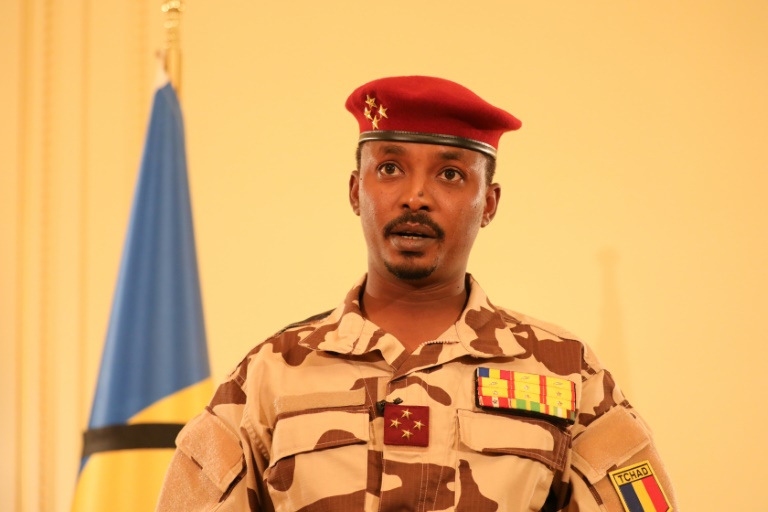
Chad’s military leader will sign a deal on Monday with more than 40 opposition groups to launch national peace talks, but the central African country’s main rebel outfit has refused to take part.

Under the accord, to be signed in the Qatari capital Doha, talks aimed at paving the way for a presidential election will start on August 20.

Since March, Qatar has been mediating between opposition groups and the military government of Mahamat Idriss Deby Itno, a general who seized power after his father died in a battle with rebels last year.

But the Front for Change and Concord in Chad (FACT), the main rebel group, said it would not sign the deal despite last-minute efforts by Qatar’s mediators.

In a statement released in Doha, FACT said it “rejects the accord that will be put to signatories on Monday”.

It added that participants in the national dialogue would not be treated equally and demanded a new committee be set up to organise the talks, as well as the release of rebel prisoners in government prisons.

“However FACT remains available for dialogue anywhere and anytime,” added the statement from the group, which is estimated to have between 1,500 and 2,000 fighters.

FACT fighters led the rebel offensive in which Deby’s father, Idriss Deby Itno, who had been president for 30 years, was killed.

Chad has had little stability since its independence in 1960, and the coming talks are being widely watched, as the country is seen as a key ally in international efforts to counter Islamic extremists fighting around the region.

Qatar’s foreign ministry said the talks, to be held in Chad’s capital, N’Djamena, would seek “inclusive national reconciliation”.

Some 42 of the 47 groups represented in the Doha talks will sign the accord, officials said. 

– Talks will ‘struggle’ without FACT –

The Doha accord commits signatories to a ceasefire during the N’Djamena talks.

The military government has also guaranteed the safety of rebel leaders who attend the talks.

Qatar had wanted FACT leader Mahamat Mahdi Ali to leave his desert camp in Libya to attend the signing.

But FACT and other groups say the guarantees were not strong enough. They have also demanded that Deby pledge in advance that he will not stand in any election.

Deby, 38, promised elections in 18 months when he seized power in April last year.

But his junta has retained the power to extend its “transitional” rule by 18 months. Deby faces pressure, however, from France, the European Union and the African Union to meet the October deadline.

“Getting this many groups to sign the accord is a good launchpad for the national dialogue, but it will struggle without outfits such as FACT,” said the head of one political group that has agreed to sign on Monday.

The Chadian government has said that more than 1,300 representatives of rebel groups, civil society, trade unions, political parties and government officials will attend the N’Djamena talks.

London museum to return looted Benin Bronzes to Nigeria

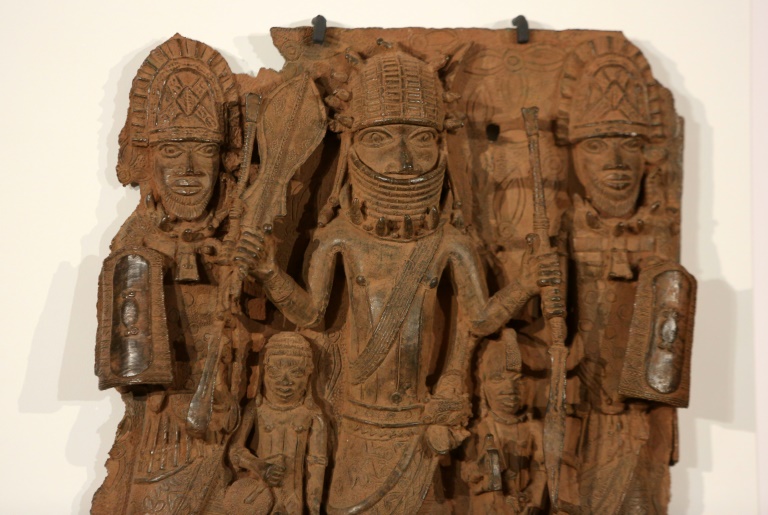
London’s Horniman Museum on Sunday said that it would return dozens of artifacts looted by British soldiers in Nigeria, including 12 of the famed Benin Bronzes.

“Ownership of 72 objects, which were forcibly removed from Benin City during the British military incursion in February 1897, will be transferred to the Nigerian government,” the museum said in a statement.

“The collection includes 12 brass plaques, known publicly as Benin bronzes. Other objects include a brass cockerel altar piece, ivory and brass ceremonial objects, brass bells, everyday items such as fans and baskets, and a key ‘to the king’s palace’,” it said.

Thousands of Nigeria’s so-called Benin Bronzes — 16th to 18th century metal plaques and sculptures — were looted from the palace of the ancient Benin Kingdom and ended up in museums across the US and Europe.

Nigeria has been negotiating their return and plans to build a museum in Benin City in southern Edo state, where it hopes to house the bronzes, some of the most highly regarded works of African art.

“The evidence is very clear that these objects were acquired through force, and external consultation supported our view that it is both moral and appropriate to return their ownership to Nigeria,” the museum quoted Eve Salomon, Chair of the Trustees of the Horniman Museum and Gardens, as saying.

The head of Nigeria’s National Commission for Museums and Monuments, Abba Tijani, welcomed the decision and said he was looking “forward to a productive discussion on loan agreements and collaborations.”

Apart from Britain, France, Belgium, the Netherlands and Germany have also received requests from African countries to return lost treasures.

Experts estimate that 85 to 90 percent of African cultural artifacts were taken from the continent. 

On July 1, Germany signed an agreement to begin sending back hundreds of Benin Bronzes to Nigeria, the biggest effort yet by a European country to return looted artworks.

Germany has around 1,100 of the artifacts, split between some 20 museums.

Mortar fire hits Somalia capital as parliament approves cabinet

Mortar shells struck residential neighbourhoods near the presidential palace in Somalia’s capital Mogadishu on Sunday shortly after parliament convened to approve the recently appointed cabinet, underlining the security challenges confronting the new government.

In addition to a looming famine, the Horn of Africa nation also faces a grinding Islamist insurgency, with Al-Shabaab militants ratcheting up their attacks in recent months.

On Sunday, as parliament met to approve Prime Minister Hamza Abdi Barre’s 75-member cabinet, which includes a former Al-Shabaab deputy leader, several rounds of mortar shells landed near the presidential palace, according to a security official and a witness.

“We have no recorded casualties so far as investigations are ongoing,” district security official Mohamed Abdifatah said.

One of the rounds damaged a medical facility in the area, according to an onlooker.

“One of the mortar rounds struck in the midst of the Xararyaale intersection and another hit a hospital close by,” Abdikadir Yare, a witness, said.

There was no immediate claim of responsibility for the attack, which came weeks after recently elected President Hassan Sheikh Mohamud hinted at his government’s willingness to negotiate with Al-Shabaab, saying it would only happen when the time was right.

A total of 229 legislators voted in favour of the new cabinet, with seven votes against and one abstention.

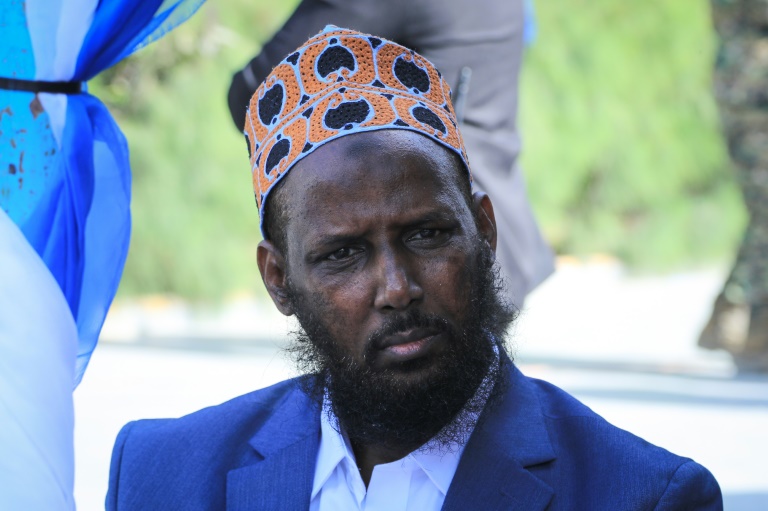
Former Al-Shabaab deputy leader and spokesman Muktar Robow, who once had a $5-million US bounty on his head, will be the new religion minister.

Robow, 53, publicly defected from the Al-Qaeda-linked militants in August 2017.

The US embassy in Mogadishu on Sunday congratulated Mohamud and Barre “on the confirmation of their selections for the new cabinet”. 

“The United States is eager to continue our engagement in support of #Somalia’s revival,” the embassy said on Twitter.

Soon after Mohamud’s election in May, US President Joe Biden ordered the re-establishment of a US troop presence in Somalia to help in the fight against Al-Shabaab, reversing a decision by his predecessor Donald Trump to withdraw most US forces.

Al-Shabaab has waged a bloody insurrection against the Mogadishu government for 15 years and remains a potent force despite an African Union operation against the group.

Its fighters were ousted from the capital in 2011, but continue to wage attacks on military, government and civilian targets.

In July, Mohamud said ending the violent insurgency required more than a military approach.

Blinken pays tribute to Soweto Uprising at start of Africa tour

US Secretary of State Antony Blinken kicked off a three-nation African trip Sunday paying tribute to the Soweto Uprising, a student protest whose tragic ending galvanised the world against the apartheid regime.

His visit comes as Washington scales up diplomacy to counter Russian influence on the continent and follows hot on the heels of an extensive tour of Africa by Russian Foreign Minister Sergei Lavrov.

For his first stop, the US top diplomat chose South Africa, a leader in the developing world, which has remained neutral in the Ukraine war, refusing to join Western calls to condemn Moscow, which had opposed apartheid before the end of white minority rule in 1994.

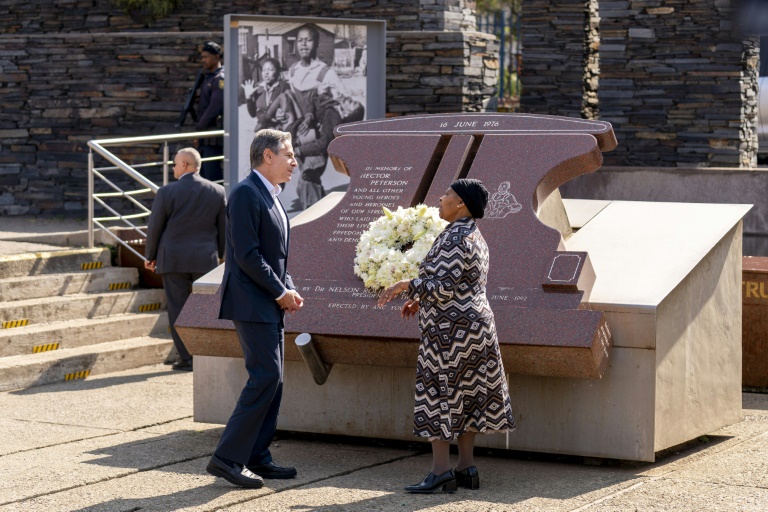
Blinken laid a wreath and toured the Hector Pieterson Museum, built in memory of students killed in a 1976 protest which became one of the watersheds in the anti-apartheid movement.

It was named after the 12-year-old boy who was the first to be shot and killed by police on June 16, 1976.

During the afternoon visit to Soweto township, the heartland of South Africa’s anti-apartheid struggle, Blinken was shown around the museum by Pieterson’s sister Antoinette Sithole.

“What’s so extraordinary about this museum is that it’s living history because it’s inspiring people to see the power that young people can have to make change,” Blinken said after the tour.

He made reference to the iconic black-and-white picture of a dying Hector Pieterson being carried away by a teary fellow student after security forces opened fire on the young protesters.

The photograph “probably did as much to open hearts and open minds and raise consciousness about apartheid and about the struggle for equality and freedom as anything”.

Pieterson’s story “really resonates because we have our own struggle for freedom and equality in the United States”, Blinken said.

Over 170 were gunned down when thousands of black students protested at being forced to study in Afrikaans, the language of the white-minority regime. 

Blinken will Monday hold talks with South African counterpart Naledi Pandor and also make a policy announcement on the US government’s new Africa strategy, Pretoria said in a statement.

– ‘Competition over’ Africa –

The two will “discuss ongoing and recent developments relating to the global geopolitical situation,” it said.

The US State Department last month said African countries were “geostrategic players and critical partners on the most pressing issues of our day”.

Vulnerable countries in Africa and elsewhere in the world have been hard hit by the fallout from the Ukraine war that has sent prices of fuel and food soaring.

Powerhouse South Africa belongs to a group of emerging economies called BRICS.

In June, Russian President Vladimir Putin urged BRICS countries –Brazil, Russia, India, China and South Africa — to cooperate in the face of “selfish actions” from the West.

For Fonteh Akum, head of the Pretoria-based think tank Institute for Security Studies, Blinken’s visit will help the US understand the southern African country’s position.

It will also aim “to bring South Africa further into the Western fold”, Akum told AFP. 

The US wants to “engage differently and… move towards understanding Africa’s agency in international relations and therefore the growth in diplomatic engagements,” the expert said. 

Blinken’s trip follows a visit by French President Emmanuel Macron to Benin, Cameroon and Guinea-Bissau late last month. 

Lavrov’s Africa trip took him to Congo-Brazzaville, Egypt, Ethiopia and Uganda.

That Blinken is coming after Lavrov and Macron, “basically shows that Africa is entering a phase within which there is another bout of great power competition over the continent,” said Akum.

It is Blinken’s second trip to Africa since his appointment early last year. 

He will visit the Democratic Republic of Congo later this week, with the aim of boosting support for sub-Saharan Africa’s biggest country as it battles to turn the page on decades of conflict.

Blinken’s tour will then wind up in Rwanda, which has seen a flare-up in tensions with DR Congo after it accused Rwanda of backing M23 rebels, a charge Kigali denies.

Samukonga, Williams win historic Commonwealth Games golds

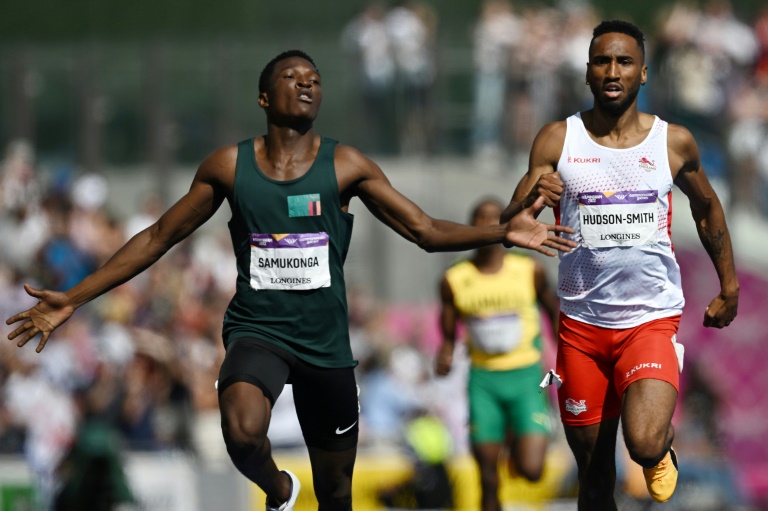
Zambian teenager Muzala Samukonga won his nation’s first-ever Commonwealth Games 400m title on Sunday as Sada Williams gave Barbados their first gold in the women’s event on the final day of athletics in Birmingham.

Samukonga, 19, who timed 44.66sec, exited the stadium in a wheelchair after tripping over a low advertising hoarding as he ran to collect his national flag.

England’s Matthew Hudson-Smith, who won bronze in the event at last month’s world championships, was forced to settle for silver.

The 27-year-old had set his hopes on gold but was sanguine after admitting recently that he had attempted suicide last year.

“It’s not the colour I wanted but you have to take the good with the bad,” he said. “If you asked me a year ago would I be able to do this I would have said ‘no’.”

The English athlete, seeing Samukonga crying on the podium during the medals ceremony, put his hand on his shoulder. 

Williams outclassed Victoria Ohuruogu, who  missed out on emulating her elder sister, 2008 Olympic gold medallist Christine, who won Commonwealth gold in 2006.

Williams, 24, who won bronze at the recent world championships, set a new Games record of 49.90sec, with Ohuruogu taking silver.

“It’s amazing (to be part of the Barbados team),” said Williams. “I am so proud of Jonathan (Jones who won bronze in the men’s 400m).

“I can’t begin to imagine (the reaction back home). Everybody’s probably going crazy right now.”

India also celebrated a historic gold, which adds gloss to a highly successful athletics competition for them in Birmingham.

Eldhose Paul hopped, skipped and jumped into Indian athletics folklore as he delivered their first triple jump title with a best mark of 17.03 metres while team-mate Abdulla Aboobacker Narangolintevida won silver.

India also won bronze in the men’s 10,000m walk. Sandeep Kumar finished third behind Canada’s Evan Dunfee (38min 36.37sec).

“The sporting culture in India is changing,” said the triumphant Paul, who added that athletes were getting more support from sports authorities in the country.

– ‘Really upset’ –

Australia took gold in the women’s javelin.

Recently crowned world champion Kelsey-Lee Barber won with her final throw (64.43m), dashing the dreams of her compatriot Mackenzie Little, with India Annu Rani taking bronze.

World champion and world record holder Tobi Amusan won the women’s 100m hurdles, breaking a 16-year-old Games record as she timed 12.30sec.

The 25-year-old defending champion was trailing behind Jamaica’s Olympic bronze medallist Megan Tapper but the Nigerian powered past her to ease home.

“To get the win and defend my title means everything to me,” said Amusan, who added even her father had accepted she made the right decision in focusing on her athletics.

“I was more into doing track,” she said. “He got really upset in the end. But he is an amazing man. He is proud of me.”

Devynne Charlton of the Bahamas took silver and England’s Cindy Sember won bronze while Tapper and her compatriot, 2015 world champion Danielle Williams, missed out on medals

The England 4x100m relay teams gave the home crowds something to cheer, winning the men’s race and finishing second behind Nigeria in the women’s event.

Scotland’s Eilish McColgan will be seeking to add 5,000m gold to her 10,000 title in the final session on Sunday evening.

Her team-mate, Laura Muir, bids to win gold in her favourite 1,500m event after taking bronze in Saturday’s 800m.

Intensity challenge for mighty Springboks before All Blacks rematch

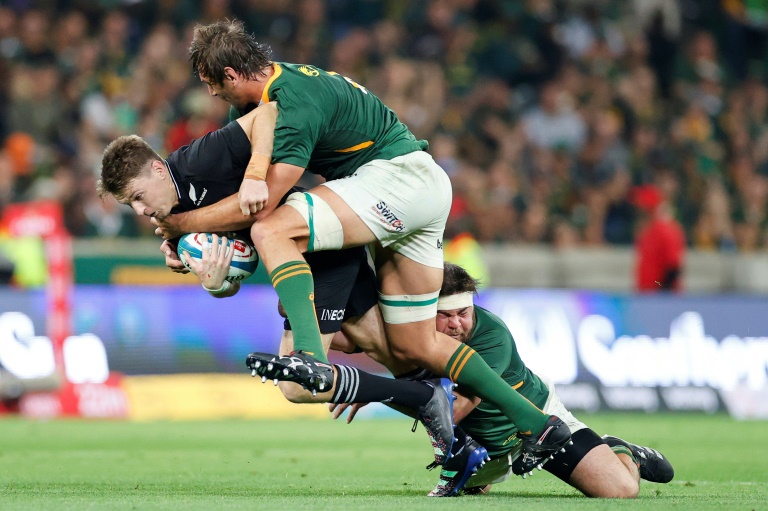
The front page headline on Sunday in South Africa’s biggest Afrikaans language newspaper screamed, “Best in a century” after the Springboks outplayed New Zealand 26-10 in the Rugby Championship opener this weekend.

It was South Africa’s biggest winning margin against the All Blacks since they won 17-0 in Durban in 1928 — and Rapport backed up their headline with three pages of rave reviews of the Springboks’ performance.

Hooker and man-of-the-match Malcolm Marx was given 10 out of 10 for his individual efforts and six other Springboks were awarded nine out of 10, including scrum-half Jaden Hendrikse, who came on to the field after just 43 seconds when Faf de Klerk was concussed.

The Springboks win heaped pressure on All Blacks coach Ian Foster, whose charges have lost five of their last six matches, including a home series against Ireland.

But Springbok coach Jacques Nienaber and captain Siya Kolisi were wary about proclaiming a new era of dominance against their long-time rivals.

The teams meet again at Ellis Park in Johannesburg on Saturday and the South Africans know that matching the intensity they showed in Mbombela will be a challenge.

Kolisi said the support of a packed 42,367 crowd had inspired his players, from the rousing rendition of the national anthem through to the final whistle.

“I just don’t know how South African people do it,” said Kolisi. “The way they turn up with everything that’s going on in our country.

– ‘Means the world to us’ –

“People who can still afford it, still come along and still fill up the stadium for us and it means the world to us as a team.

“It feels good, but we know the championship is not done yet. We have five more games to go but the next important one is next week.”

Nienaber was cagey when asked whether the Springboks would be able to reach the same heights two weeks in a row.

“If you don’t have intensity against the All Blacks, you are not going to do well,” he said. “Was it the highest intensity? I don’t know. I don’t think we’re the finished product yet.”

South Africa’s win was based on a dominant pack, ferocious defence and a pinpoint kicking game.

Springbok pressure forced the All Blacks to concede 12 penalties while there were only seven against the home side.

“We don’t see kicking as a way to relieve pressure,” said Nienaber. “We see it as a method of attack. Every single guy on the field played their role in making sure our kicking game functioned.”

Despite the result, Foster believed it was New Zealand’s most improved performance of the year.

“In some areas we really shifted our game forward. In a game dominated by defence, we defended well but our timing was out on the attack side,” he said.

“We always knew it was going to be tough, and we felt that tonight. But we’ve got to take some things we’ve made some big shifts in.

“We nullified a large part of their driving game and in that last quarter we were opening things up but started to snatch at a couple of balls, which is frustrating.”

De Klerk fitness doubt for Springboks after concussion injury

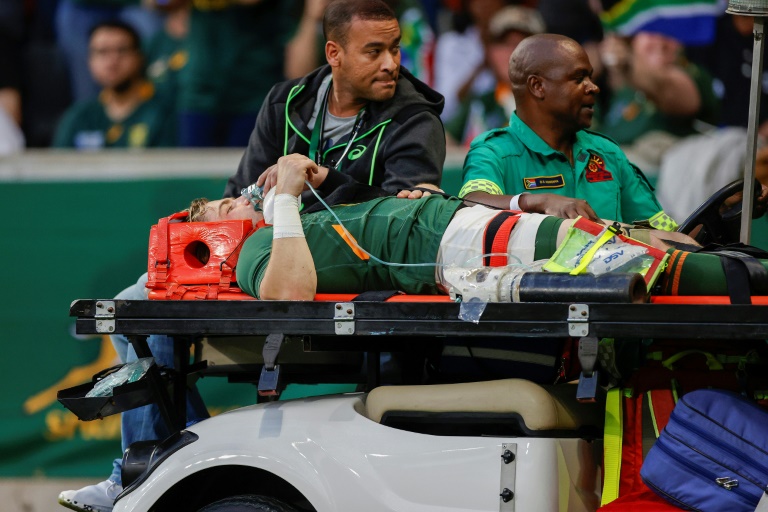
South Africa scrum-half Faf de Klerk and wing Kurt-Lee Arendse were due to have medical assessments on Sunday after both suffered head injuries during a 26-10 win over New Zealand in the opening Rugby Championship match.

“The team will undergo medicals today and we should have an update tomorrow,” said a team spokesperson.

The Springboks play the All Blacks again this Saturday in Johannesburg, but both World Cup winner De Klerk and newcomer Arendse are doubts.

De Klerk required lengthy treatment on the field after being knocked unconscious when his head collided with All Blacks wing Caleb Clarke’s knee just 43 seconds into the match in Mbombela on Saturday.

He failed a concussion test, which meant he could not return to the field, but emerged from the dressing room midway through the first half and waved to an applauding crowd before joining the Springboks bench.

Coach Jacques Nienaber had high praise for Jaden Hendrickse, who replaced De Klerk and had an outstanding match.

“I thought Jaden stepped up well,” said Nienaber. “We backed Jaden in the last Test match against Wales (in July) and he wasn’t nervous at all when he came on.”

Nienaber said he was not sure whether De Klerk would be fit for the Johannesburg Test.

“We’re fortunate that we have quality scrum-halves with players like Faf, Jaden, Cobus Reinach, Herschel Jantjies and Grant Williams. There’s a lot of competition in the squad.”

Slightly-built Arendse, playing only his second Test, proved a worthy replacement for the injured Cheslin Kolbe, scoring a try and showing courage in contesting high kicks and his tackling of much bigger opponents, including opposite number Clarke.

But Arendse misjudged an aerial challenge with Beauden Barrett late in the match, knocking himself out, causing Barrett to fall awkwardly and receiving a red card while being treated.

Nienaber said that if Arendse was ruled out by suspension or injury, a replacement would come from within the squad, with Jesse Kriel or Warrick Gelant able to take his place.

“We have options,” said Nienaber.

Kenya campaign ends but disinformation battle drags on

The campaign for Kenya’s presidential election has officially closed but the relentless — and dangerous — flow of disinformation continues online, as keyboard warriors battle to discredit rivals by sharing fake rigging claims, experts say.

Campaigners for the frontrunners, Deputy President William Ruto and veteran politician Raila Odinga, are circulating dozens of posts claiming that their opponent is engaged in “vote rigging plots”, said Benedict Manzin, a sub-Saharan Africa analyst at UK-based intelligence firm Sibylline.

“We are increasingly seeing false information which seeks to delegitimise the results of the election with widespread claims that the opposing side would only win through fraud and that they are attempting to steal the election,” Manzin told AFP.

In one case, a strategist for Ruto’s campaign accused Odinga’s team of trying to rig Tuesday’s poll because the 77-year-old urged the election commission to use a manual voter register instead of a digital one.

Meanwhile a pro-Odinga blogger tweeted that Ruto was attempting to steal the election, sharing a link to an unrelated video — since taken down — of a politician discussing an old scandal.

Mary Blankenship, a disinformation researcher at the University of Nevada, said the circulation of baseless fraud claims could cause real harm, especially in a country where past polls have been followed by an eruption of violence.

“It creates an avenue for either of the candidates to discredit the outcome of the polls, which could lead to unrest,” Blankenship told AFP.

She likened the situation to the 2020 US election when former president Donald Trump’s fraud claims culminated in an attack on the US Capitol by his supporters.

More than 1,100 people died in politically motivated inter-ethnic clashes in Kenya following the bitterly disputed 2007 elections.

A decade later, dozens died during a police crackdown on protests after the 2017 presidential poll which was later annulled by the Supreme Court due to “irregularities and illegalities”.

– Fabricated opinion polls –

Fact-checking organisations –- including AFP Fact Check -– have debunked hundreds of false and misleading claims about the Kenyan elections.

Both sides have sought to cast aspersions on their opponent’s educational qualifications, claiming that Odinga lied about studying engineering in Germany and that Ruto falsified his university grades. 

These claims were debunked by fact-checkers but trended on Twitter for days.

Mainstream media organisations have also been dragged into the fray, with impostor websites and social media pages mimicking genuine outlets used to spread falsehoods about candidates.

“We are constantly having to issue alerts to say this did not originate from our company,” said Citizen TV editor Waihiga Mwaura.

Fraudulent opinion polls have emerged as a major trend, with campaigners falsely attributing them to legitimate sources such as survey company GeoPoll and The Daily Nation newspaper.

There are “efforts to make different leaders look even more popular than they are, to create the impression they are winning the elections,” said Nic Cheeseman, a political scientist with the University of Birmingham.

“The main misinformation and disinformation we have seen in 2022 is quite similar to the 2017 elections,” Cheeseman told AFP, referring to “negative ethnic stereotyping” among other tactics.

An undercover expose by UK media revealed that British consulting firm Cambridge Analytica used the personal data of millions of Facebook users to target political ads — including some that preyed on ethnic fears — during President Uhuru Kenyatta’s successful campaigns in 2013 and 2017.

– Coded language –

Kenyan civil society groups and a state watchdog have warned that the barrage of disinformation poses a risk to democracy and called on social media platforms to act.

The authorities have also set up a special division to handle “election and hate speech-related offences”. 

“Part of what this misinformation and disinformation does is that it plays into the stereotypes, preconceived notions and the emotional aspect of voters,” said Mark Kaigwa, team leader at StopReflectVerify.com, a Kenyan organisation analysing disinformation.

“It is a way to energise people and rally them emotionally.”

While platforms like Facebook and TikTok say they are committed to rooting out disinformation and hate speech, observers are sceptical, not least because election influencers rely on codewords to amplify their messages.

“There is a lot of coded language… being used to mask or ensure that these social media platforms don’t identify such type of hate speech,” said Allan Cheboi, a senior investigator at Code for Africa, a data journalism and civic technology initiative.

For instance, some campaigners use the Swahili word “madoadoa” (“blemish”) to attack members of various communities in Kenya, Cheboi told AFP.

“Incitement starts online then results (in) violence in offline spaces,” he said.

Close Bitnami banner
Bitnami