Africa Business

Top Zimbabwe novelist defiant after acquittal bid fails

Award-winning Zimbabwean author and filmmaker Tsitsi Dangarembga will go on trial next week for inciting violence after staging a street protest, a court ruled on Thursday.

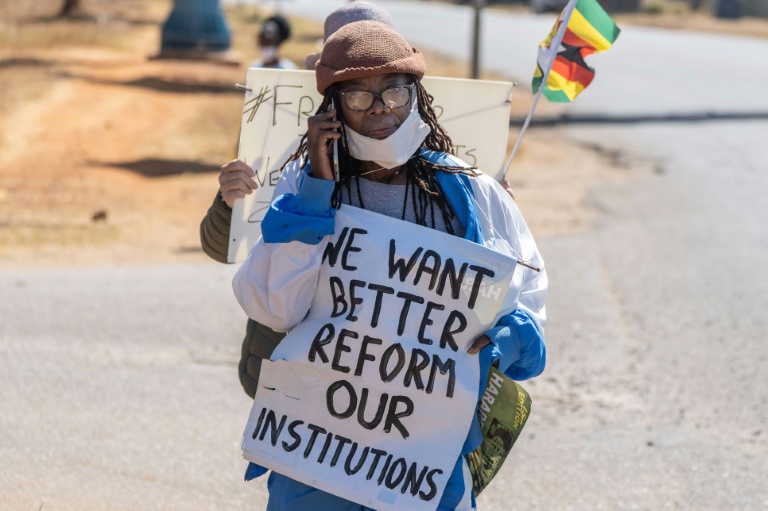
Dangarembga, 63, was arrested in July 2020 for staging an anti-government protest alongside her neighbour in the affluent Harare suburb of Borrowdale. 

She stood by the roadside holding a banner that read “We want better — reform our institutions” before being hauled into a police van. She was freed on bail a day later.

Dismissing her bid to have the charges dropped, magistrate Barbra Mateko said a trial was warranted because the message conveyed by the placard entailed “a possible breach of peace”.

She was ordered back to court on August 10.

Dangarembga said she was disappointed at the decision but remained defiant.

“l had hoped for a discharge of the case,” she told reporters outside the courtroom.

“Zimbabweans have the right to demonstrate and if an issue arises and l feel it needs demonstrating (against), l will surely do it again”.

An arrest warrant issued against her after she failed to appear in court due to illness, was cancelled last month.

Author of three international award-winning novels, Dangarembga first stepped into the international limelight in 1988 with her groundbreaking debut novel “Nervous Conditions,” the first book published in English by a black Zimbabwean woman. 

The work earned her the prestigious Commonwealth Writers’ Prize the following year.

She was one of this year’s winners of the Windham-Campbell Prizes.

Morocco's petro-PM faces heat over soaring fuel prices

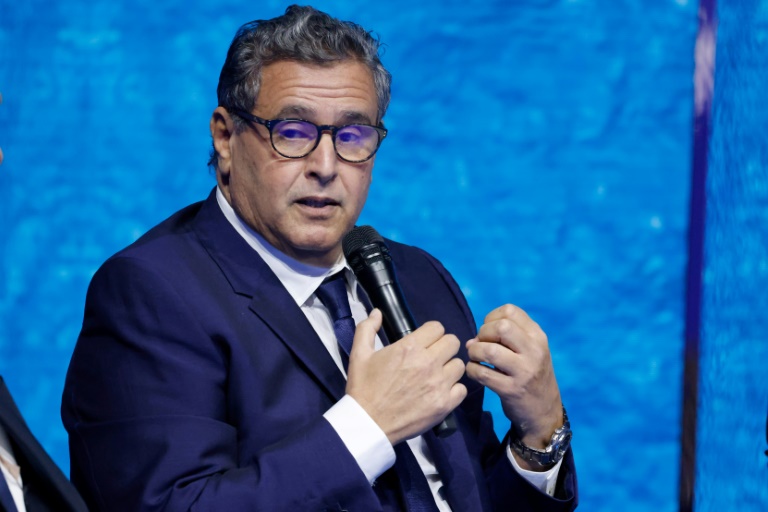
Morocco’s Prime Minister Aziz Akhannouch, a billionaire petrol baron, is facing a growing online campaign demanding he step down as fuel prices — and energy firms’ profits — surge.

The government of the North African kingdom, which is heavily reliant on oil imports, insists it is doing its best to ease the economic impact of Russia’s invasion of Ukraine and the ensuing shock to crude prices.

But that hasn’t stopped some 600,000 Facebook accounts sharing Arabic or French hashtags demanding that “Akhannouch quit”.

United Nations Secretary General Antonio Guterres has just slammed global energy giants reaping billions in windfall profits for their “grotesque greed” that was harming the world’s poorest and urged governments to tax them.

It is a sentiment shared widely in Morocco.

Many are calling on the government to halve fuel prices and impose a cap on the profits of petrol retailers — including the dominant player Afriquia, of which Akhannouch is the majority owner.

“This campaign’s focus on the prime minister in person reflects anger at the mix of money and politics which Akhannouch is seen as embodying,” said analyst Mohamed Chakir.

Critics see the premier as “part of the problem rather than as someone presenting solutions”, Chakir added.

Petrol prices in Morocco hit record highs of 18 dirhams ($1.80) for a litre of unleaded in June, fuelling overall inflation expected to top five percent this year, and adding to the misery of farmers hit by the worst drought in decades.

– ‘Exploiting the crisis’ –

While discontent has not spilt onto the streets, the online campaign against Akhannouch has been taken up by opposition parties and trade unions.

“Petrol companies are continuing to fleece Moroccans,” leading union the Democratic Confederation of Labour said in a statement, accusing the government of “silence”.

It also charged that fuel distributors are “exploiting the crisis to rack up immoral profits”.

Neither Akhannouch nor Afriquia or its rival fuel retailers have publicly responded to the campaign or the accusations — and Afriquia is not obliged to disclose its profits.

The government has sought to blame rising living costs on the war in Ukraine which has driven up fuel and food prices, accelerating inflation in many countries.

Akhannouch was named to head the government in September after his National Rally of Independents (RNI) thrashed the long-ruling Islamists in a parliamentary election.

He promised to improve living conditions and tackle social inequalities exacerbated by the coronavirus pandemic.

The 61-year-old is seen as close to King Mohammed VI and has a personal fortune worth some $2 billion according to Forbes.

– ‘Speculation, manipulation’ –

Morocco used to subsidise fuel, but this system was scrapped in late 2015 because it was seen as costing the state too much.

While the market was liberalised, this was meant to be accompanied by cash payouts to the most needy households — benefits that never materialised.

Many on social media are now calling for taxes on consumers at the pump to be slashed.

The government has not responded, although it said in March it would pay out some $206 million to help out transport workers operating some 180,000 vehicles, who had staged a national strike over spiralling fuel costs. 

It has also doubled subsidies on cooking gas, flour and sugar.

The country’s economic woes have not gone unnoticed by King Mohammed.

In an annual speech to the nation on Saturday, the monarch called for “mechanisms of national solidarity and a determined and responsible campaign against speculation and price manipulation”. 

Nor is this the first time Afriquia has faced pressure. 

The firm was among several major companies hit by a boycott in 2018 over a cost-of-living crisis when Akhannouch was agriculture minister. 

But following the latest criticisms, state news agency MAP has slammed a “tendentious” campaign, saying it was “fuelled by more than 500 fake accounts”.

That article sparked another storm on social media, with opposition MPs accusing MAP of pro-Akhannouch bias.

Italy's Salvini seeks anti-migrant votes on Lampedusa

Italian anti-immigrant leader Matteo Salvini on Thursday takes his campaign for September elections to the tiny island of Lampedusa, the landing point for thousands of migrants trying to reach Europe.

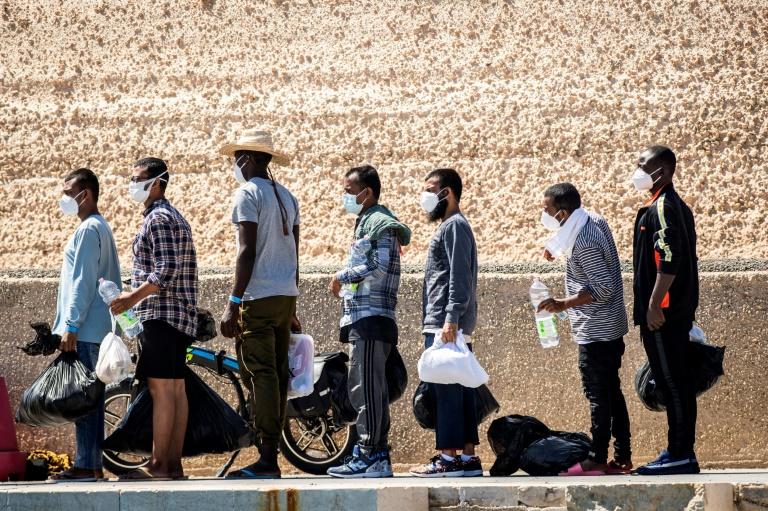
Dozens of overcrowded boats have arrived in and around Lampedusa in recent days from north Africa, some landing directly and others requiring rescue by the local coastguard.

As often in the summer months, when the sea is calmer, the island’s facilities are overwhelmed, with more than 1,500 people said to be in a reception centre designed for 350.

Salvini, who leads Italy’s League party, has made stopping the arrivals the cornerstone of his platform ahead of general elections on September 25, where he is expected to gain power as part of a right-wing alliance.

“Italy cannot accept tens of thousands of immigrants who only bring problems,” he said on Wednesday, adding: “Italy is not Europe’s refugee camp.”

Prime Minister Mario Draghi’s outgoing government last week organised a ferry to take migrants to Sicily three times a week, and AFP on Thursday morning saw dozens of migrants being taken in buses to the port.

Salvini has accused the government — which he helped bring down last month by withdrawing his support — of trying to hide the problem before he arrives.

“If you give us your trust again, we will go back to protecting our borders. Stop the landings!” his party tweeted Thursday.

– Trial for kidnapping –

When he was interior minister in 2019, Salvini blocked several charity rescue ships carrying migrants from disembarking in Italy, under his party’s “closed ports” policy.

The move saw him prosecuted in Sicily on charges of kidnapping and abuse of office, in an ongoing trial he has worn as a badge of honour.

But surveys suggest immigration is less of a concern for Italians than the rampant inflation squeezing already stagnant wages.

And Salvini’s League has in recent months been overtaken in the polls by Giorgia Meloni’s Brothers of Italy, who have also called for migrants to be stopped at the Libyan coast.

Her post-fascist party is topping opinion polls ahead of the election, and looks set to enter government in an alliance with Salvini and Silvio Berlusconi’s Forza Italia.

– Desperation –

Tiny Lampedusa is known for its gorgeous beaches, but its location closer to Tunisia than Sicily has put it on the front line of migration into Europe.

The central Mediterranean is the world’s deadliest migration route, with almost 20,000 deaths and disappearances since 2014, according to the International Organization for Migration (IOM).

Many of those who survive end up on Italy’s shores. The interior ministry has counted more than 42,000 migrant landings so far this year, up from almost 30,000 in the same period in 2021.

The numbers show no sign of slowing — rescue charities SOS Mediterranee, Doctors Without Borders (MSF) and Sea-Watch have picked up more than 1,000 people in the central Mediterranean in the past few days.

MSF’s ship Geo Barents, carrying 659 people on board, said Thursday it had finally been given permission to disembark in the mainland port of Taranto after nine days at sea.

“This prolonged period of blockage at sea is one of the longest ever experienced by our team. This must not happen again,” it wrote on Twitter.

It had previously reported that food rations were running low and that two people had tried to throw themselves overboard “in an act of desperation”.

Like Salvini, the charities have been the target of prosecution in Italy — but for alleged collusion with people traffickers, which they deny.

In a joint statement on Wednesday, SOS Mediterranee, MSF and Sea-Watch said they cannot cope with the numbers, urging the EU to resume search and rescue patrols — or warning more people would die.

Italy's Salvini seeks anti-migrant votes on Lampedusa

Italian anti-immigrant leader Matteo Salvini on Thursday takes his campaign for September elections to the tiny island of Lampedusa, the landing point for thousands of migrants trying to reach Europe.

Dozens of leaky, overcrowded boats have arrived in and around Lampedusa in recent days from north Africa, some landing directly and others requiring rescue by the local coastguard.

As often in the summer months, when the sea is calmer, the island’s reception centre has become overwhelmed, with more than 1,500 people said to be there this week, in a facility designed for 350.

Salvini, who leads Italy’s League party, has made stopping the arrivals the cornerstone of his platform ahead of general elections on September 25, where he is expected to gain power as part of a right-wing alliance.

“Italy cannot accept tens of thousands of immigrants who only bring problems,” he said on Wednesday, adding: “Italy is not Europe’s refugee camp.”

He accused Prime Minister Mario Draghi’s government — which he helped bring down last month by withdrawing his support — of trying to cover up the problem on Lampedusa before he arrives.

Interior Minister Luciana Lamorgese last week announced a ferry would take migrants to Sicily three times a week, to ease the overcrowding.

“The island is collapsing — in the next few hours, before my visit tomorrow and Friday, will they try to hide their failures again?” Salvini asked.

When he was interior minister in 2019, Salvini blocked several charity rescue ships carrying migrants from disembarking in Italy, under his party’s “closed ports” policy.

The move saw him prosecuted in Sicily on charges of kidnapping and abuse of office, in an ongoing trial he has worn as a badge of honour.

But surveys suggest immigration is less of a concern for Italians than the rampant inflation squeezing already stagnant wages.

And Salvini’s League has in recent months been overtaken in the polls by Giorgia Meloni’s Brothers of Italy, who have also called for migrants to be stopped at the Libyan coast.

Her post-fascist party is topping opinion polls ahead of the election, and looks set to enter government in an alliance with Salvini and Silvio Berlusconi’s Forza Italia.

– Desperation –

Tiny Lampedusa is known for its gorgeous beaches, but its location closer to Tunisia than Sicily has put it on the front line of migration into Europe.

The central Mediterranean is the world’s deadliest migration route, with almost 20,000 deaths and disappearances since 2014, according to the International Organization for Migration (IOM).

Many of those who survive end up on Italy’s shores. The interior ministry has counted more than 42,000 migrant landings so far this year, up from almost 30,000 in the same period in 2021.

The numbers show no sign of slowing — rescue charities SOS Mediterranee, Doctors Without Borders (MSF) and Sea-Watch have picked up more than 1,000 people in the central Mediterranean in the past few days.

MSF’s ship Geo Barents is currently carrying 659 people including more than 150 minors, but despite requests to Italy and Malta they have not yet been given a port to disembark them.

“For some of them, it is now the 7th day on board of the #GeoBarents. The situation is growing more precarious every day and the food rations are running low,” MSF tweeted Wednesday.

“Yesterday, two persons tried to throw themselves overboard in an act of desperation, including one person who made the attempt twice.”

Like Salvini, the charities have been the target of prosecution in Italy — but for alleged collusion with people traffickers, which they deny.

In a joint statement on Wednesday, SOS Mediterranee, MSF and Sea-Watch said they cannot cope with the numbers, urging the EU to step up — and warning that more people would die.

Togo battles to save forests as poverty threatens reserves

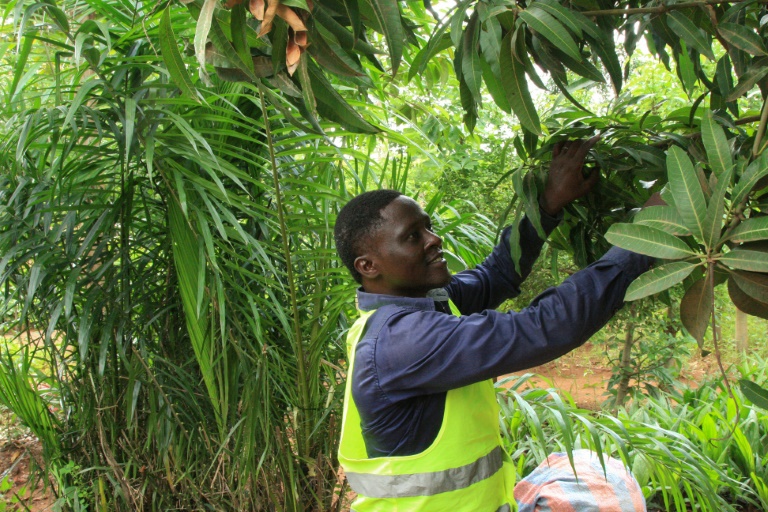
Day and night, Komlatse Koto watches over the forest near his village in southern Togo, hoping to prevent the diminishing patch of woodland from being turned bit by bit into a treeless clearing.

For years, inhabitants of Ando-Kpomey village, around 65 kilometres (40 miles) north of Togo’s capital Lome, have anarchically cut down trees for firewood and charcoal.

Koto and his fellow watchdogs are doing all they can to end the destruction, warning villagers that by harming the environment they also harm their own livelihoods.

“The development committee keeps a close watch,” said Koto, who for two years has guarded the forest surrounding his village of around 500 people.

Each year, the small West African nation suffers more than 3,500 hectares (9,600 acres) of forest degradation, representing more than five million destroyed trees, the environment ministry says.

That very high rate has accelerated in recent years, mostly because firewood is the main energy source for cooking in 90 percent of households. 

Gas is beyond their reach while other forms of energy are not widespread. 

Access to cooking gas for many Togolese has worsened since the Russian offensive in Ukraine, which made fuel and gas prices soar. 

“The situation is very critical. Inside the country, there is practically no forest left,” said Sebastien Balouki, director of the NGO Reboisons Vite le Togo (RVT) dedicated to reforestation.

“Everything has been destroyed for firewood and charcoal making. We must act quickly.”  

A forest code approved in 2008 provides for prison sentences ranging from one month to two years and fines of 20,000 to 1 million CFA francs (approximately $31 to $1,560) for offences committed. 

But in Togo, where 60 percent of the rural population live in the greatest poverty, it is difficult to enforce such a law.

“The penalties vary according to the extent of the destruction. But the text suffers in its application,” said a Togolese environment ministry official, who requested anonymity. 

Togo is not alone on the continent.

Nearly one billion Africans do not have access to a clean source of energy for cooking, according to a report by the Mo Ibrahim Foundation published in 2022. 

According to the same report, air pollution from wood smoke was also responsible for the premature death of half a million Africans each year.

– One billion plants –

Togo’s government is making efforts. A reforestation operation started on June 1, with the goal of planting least 23 million seedlings by the end of 2022. 

“The government has finally heard our cries, by decreeing a reforestation campaign,” said RVT’s Balouki.

The longer-term objective is to reach one billion plants by 2030.

NGOs and associations, state services and several large companies are mobilising for reforestation operations on open spaces in Lome and other areas in the country. 

“Our ambition is to achieve 25 percent forest cover,” according to the minister of environment and forest resources, Katari Foli-Bazi. 

“We have all the assets to succeed in this project, and our first strategy is mobilisation,” he said. 

To motivate the population, the government has rewarded in recent weeks the three best re-foresters from all regions of the country.

But reforestation is not enough without slowing deforestation, which is difficult when reliance on wood is so great.

– Improved stoves – 

As part of those efforts, authorities have embarked on a campaign to promote improved stoves — locally-made cookers that are very economical in charcoal consumption. 

The cookers are made using recycled galvanised sheet metal and ceramics. The government has distributed 1,500 in seven villages including Ando-Kpomey. 

The goal is to reach 10 more villages by 2025 and 500 by 2050. These stoves, produced locally and whose prices vary between 5,000 and 25,000 CFA francs, seem to have won over the villages where they are used.

“Today it is impossible to prohibit the use of charcoal in households: rather, an alternative is needed to reduce the impact of deforestation through the ecological management of the use of charcoal and firewood,” Balouki said.

“And experience has shown that improved stoves can significantly reduce pressure on trees.”

In Ando-Kpomey, energy-intensive cookers have already been abandoned, and their remains tossed out of homes are still visible here and there. 

Rebecca Agbogla now prepares meals on her improved stove placed on the ground in front of her hut. 

Even more than an ecological alternative, for Agbogla, it is above all a source of savings.

“I use twice, even three times less charcoal in one week than our terracotta cooker,” she said.

Election tech under spotlight as Kenya prepares to vote

Voting technology was introduced in Kenya to build trust and credibility around elections — but has sometimes had the opposite effect.

Here’s what to know as Kenya’s votes on August 9:

– Fingerprints and photographs – 

After the death of more than 1,100 people in violence after the 2007 election, technology was proposed as a way of bolstering transparency around polls and reducing the delay in announcing results, a major source of tension.

In the subsequent 2013 and 2017 elections, results were transmitted electronically, and biometrics used to register voters and identify them on polling day.

Biometric voter registration has been a success, boosting the electoral roll from 14.3 million in 2013 to 19.6 million in 2017 and 22.1 million in 2022.

On election day, voters provide their fingerprints for identification against a digital database, before casting their ballot in a traditional manner using a pen and paper.

Technology comes into play again when polling stations close and votes are counted.

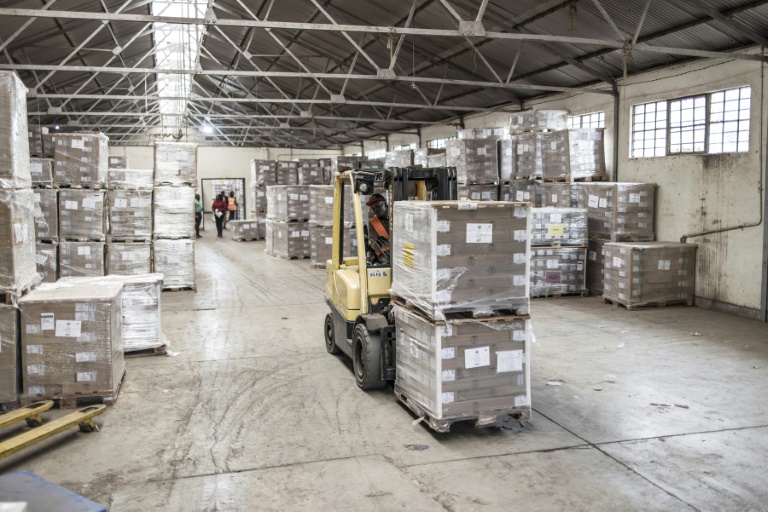
To limit the possibility of fraud, the official form displaying the outcome from each polling station will be photographed and transmitted digitally, instead of officials inputting the results manually as was the case in 2017.

The photographs are pooled at a constituency level, then forwarded to a national tally centre, where they are cross-checked against the original forms which are physically transported.

– Chequered history –

Kenya’s first stab at using voting technology in 2013 was not a success — the system broadly failed, forcing the election commission to return to manual methods. 

The fiasco damaged public trust in electoral technology. The opposition, led by Raila Odinga, said it was a deliberate act of sabotage by Uhuru Kenyatta, his presidential rival who won the vote.

During the next election in 2017, the biometric systems worked without a hitch, but problems in delivering the results electronically formed the basis of Odinga’s successful legal challenge to Kenyatta’s re-election.

The Odinga camp claimed, again, that technology had been manipulated to favour the incumbent.

OT-Morpho, the French company that supplied the voting systems, denied any manipulation or hacking had occurred.

But in a landmark ruling, Kenya’s highest court, citing irregularities in the transmission of results, invalidated Kenyatta’s victory and ordered a fresh vote.

An observation mission deployed by the European Union to monitor the vote noted an “improved use of technology, but insufficient capacity or security testing”.

– ‘Grey area’ – 

When the Independent Electoral and Boundaries Commission (IEBC) ran a test in June, less than half of the 2,900 polling stations successfully transmitted results.

Another rehearsal in July, across a reduced number of locations, saw a 92 percent rate, but the outcome didn’t inspire confidence.

“We have 46,233 polling stations… So that’s still a grey area. We don’t know with certainty that the system of transmission will work 100 percent,” said Mulle Musau from the Elections Observation Group, a Kenyan poll watchdog.

This year, nearly 1,300 polling stations are in areas with little to no internet coverage, an improvement on the last election when 11,000 locations were in the dark.

The IEBC says results will be transmitted from these locations by satellite, and that precautions are in place to avoid any failure.

More than 55,000 electronic machines used for identifying voters and sending results have been deployed across the country, and each is powered by two stand-alone batteries.

“It requires internet only when it is transmitting results. It is offline. It cannot be hacked,” said Justus Nyang’aya, an IEBC official. 

Election officials say back-up kits have been provided, and polling officers can fall back on manual methods, like a paper voter registry, as a last resort.

– Distrust and disinformation –  

“Technology has made our elections much more complex, much more unclear and therefore opaque,” Musau said.

“When they (voters) feel things are clouded… that is what becomes very dangerous. The biggest problem with our Kenyan elections is one word: trust.” 

British firm Smartmatic, which replaced OT-Morpho as the software provider for this election, has denied criticism that its technology — used in polls from Uganda to Venezuela and the Philippines — has flaws.

“Unfortunately, election processes, in general, are vulnerable to disinformation. Bad actors systematically disseminate lies to undermine elections by inciting fear, anxiety and distrust among voters and stakeholders,” a Smartmatic spokeswoman, Samira Saba, told AFP by email.

Episodes of criminality involving electoral technology have undermined public confidence in the security and reliability of these systems. 

In June, electoral officials said about one million voters had had their constituencies switched without their knowledge on the national database. 

The changes had been reversed on the registry and three electoral officers arrested, officials said, but the episode did not allay fears about the perceived opacity of these technologies.

Five things to know about Kenya

Kenya is an East African political and economic powerhouse, renowned for its iconic wildlife and stunning tropical beaches.

It has become a key player on the regional stage, but its economy has been hard hit by the Covid pandemic, a punishing drought and the fallout from the war in Ukraine.

As it heads to the polls on August 9, here are key facts about the country:

– End of Kenyatta era –

Kenya became independent from Britain on December 12, 1963, scarred by the 1952-1960 Mau Mau rebellion against colonial rule that left at least 10,000 people dead.

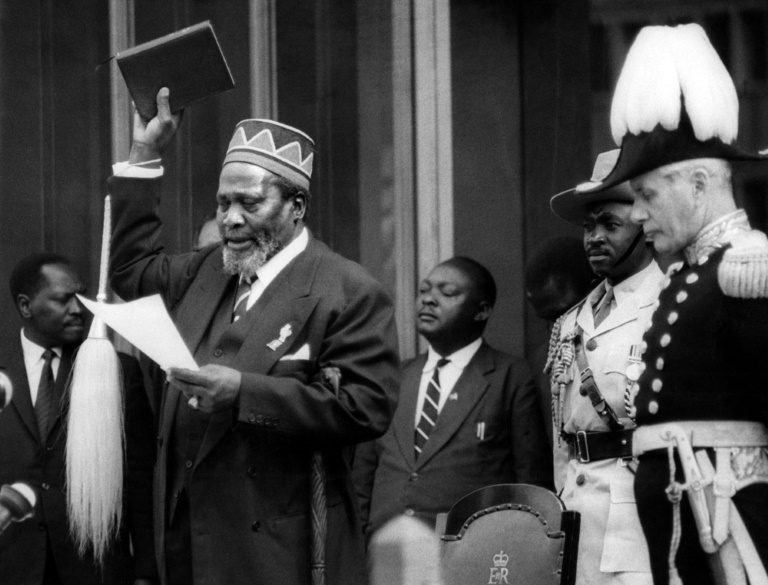
Independence struggle icon Jomo Kenyatta was appointed Kenya’s first post-colonial leader. He died in office in August 1978, succeeded by his vice president Daniel arap Moi.

In late 1991 Moi abandoned single-party rule and won presidential elections in 1992 and 1997.

Mwai Kibaki then swept into power in 2002 and went on to win re-election in 2007 against Raila Odinga, now one of the frontrunners on August 9.

Disputes over the 2007 vote count sparked the most serious political violence since independence, with more than 1,100 people killed in ethnic clashes.

Jomo Kenyatta’s son Uhuru Kenyatta defeated Odinga in the 2013 elections despite being charged by the International Criminal Court (ICC) over the violence.

The court dropped its case against him in 2014 and Kenyatta was re-elected in 2017, after the Supreme Court annulled his initial victory and Odinga boycotted the rerun.

Deputy President William Ruto, Odinga’s main rival next week, was also charged by the ICC but prosecutors abandoned the case in 2016.

– ‘Cradle of Mankind’ – 

Kenya attracted about 1.5 million visitors last year to its wildlife parks and idyllic Indian Ocean beaches.

From the Maasai Mara to Amboseli, Kenya boasts about 50 parks and reserves that are home to native wildlife including the so-called Big Five — lions, elephants, rhinos, leopards and buffalo — as well as giraffes, hippos and cheetahs.

The Rift Valley that stretches from Tanzania to Ethiopia via Kenya is also the site of major discoveries of fossils showing man’s evolution and has been dubbed the “Cradle of Mankind”.

The remains of hominids believed to be nearly six million years old have been found in Kenya.

– East African hub –

Kenya has a mostly Christian population of about 50 million, according to government figures, made up of more than 40 tribes, the largest being Kikuyu.

Along with Ethiopia, it is East Africa’s biggest economy with gross domestic product of just over $110 billion in 2021, according to the World Bank, and remains the region’s main trading hub.

Agriculture is the backbone of the economy, accounting for more than a fifth of GDP, with key exports including tea, coffee and flowers.

Kenya estimates its economy grew by 7.5 percent last year after shrinking 0.3 percent in 2020 as the pandemic threw hundreds of thousands of people out of work.

It is now grappling with a cost of living crisis, as prices of fuel and basic foodstuffs soar in a country where about a third of the population lives in poverty.

Kenya also suffers from endemic corruption. It was ranked 128th out of 180 countries on Transparency International’s 2021 corruption perceptions index, with the watchdog saying its fight against graft had “stagnated”.

– Athletics stars –

Kenya is renowned for its athletes, especially long-distance runners, with a raft of world championship medals and records.

Among its numerous stars are marathon world record holders Eliud Kipchoge and Brigid Kosgei and Africa’s fastest man over 100 metres, Ferdinand Omanyala.

Kenyan athletics is nevertheless struggling to rebuild a reputation tarnished by doping and corruption.

– Bloody attacks –

Kenya has suffered a string of terror attacks, the deadliest on August 7, 1998 when massive truck bombings against the US embassy in Nairobi killed 213 people and wounded 5,000. It was claimed by Al-Qaeda.

Kenya has also been targeted by the Al-Qaeda-linked Al-Shabaab since 2011 when the Kenyan military entered Somalia to fight the jihadists.

In September 2013, Islamist gunmen stormed Nairobi’s Westgate mall, killing at least 67 people. In April 2015 another Al-Shabaab attack killed 148 at a university in Garissa, eastern Kenya.

Kenya's Ruto: the chicken seller turned presidential 'hustler'

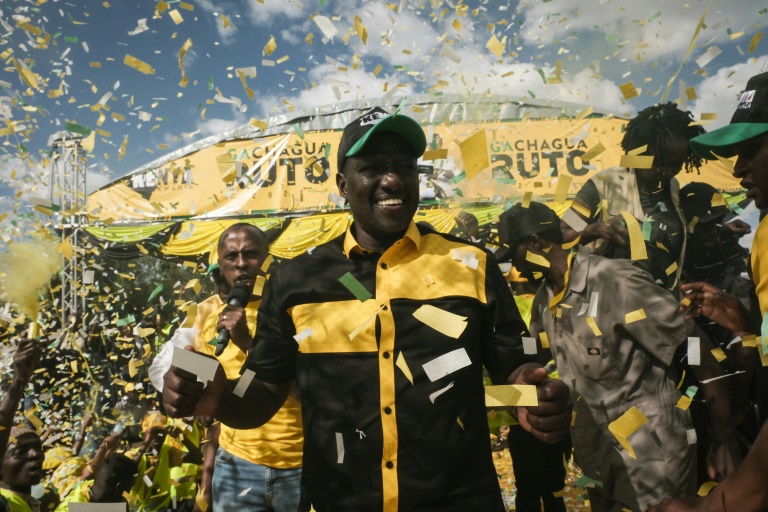
Kenya’s William Ruto, the sharp-suited deputy president now running for the top office, is one of the wealthiest men in the country but likes to portray himself as a champion of the poor and downtrodden.

Despite being dogged by corruption allegations going back years, the ruthlessly ambitious 55-year-old clawed his way to the corridors of power by playing on his religious faith and humble beginnings selling chickens by the roadside.

He has painted the August 9 poll, set to be a two-horse race between Ruto and veteran politician Raila Odinga, as a battle between ordinary “hustlers” and the elite “dynasties” that have dominated Kenyan politics for decades.

“We want everyone to feel the wealth of this country. Not just a few at the top,” Ruto said as he criss-crossed the country promoting his “bottom-up” economic plan. 

Ruto first dipped his toes into politics three decades ago, and has served as deputy president for nine years despite a very public and acrimonous falling out with his boss, the outgoing President Uhuru Kenyatta.

The rags-to-riches businessman is making his first stab at the presidency, a post he thought he had in the bag as a reward for supporting Kenyatta in the 2013 and 2017 elections.

It was a political marriage of convenience in the aftermath of deadly post-poll violence in 2007-2008 that largely pitted Kikuyus — Kenyatta’s tribe — against the Kalenjin, Ruto’s ethnic group.

Both men were hauled before the International Criminal Court accused of stoking the ethnic unrest but the cases were eventually dropped, with the prosecution complaining of a relentless campaign of witness intimidation.

– ‘Man on a mission’ –

Their so-called “Uhuruto” alliance began unravelling after Kenyatta stunned the nation in 2018 with a pledge to work with Odinga, his longtime arch-rival who is now running with the endorsement of the ruling Jubilee party.

“I’m a man on a mission,” Ruto declared last year, defying the president’s call for him to resign as they clashed over Kenyatta’s — now failed — bid to change the constitution.

Shifting allegiances between political leaders are common in Kenya, where Ruto himself had once lent his support to Odinga before switching to Kenyatta.

“Ruto is seen by many people to be one of the most effective strategists in Kenyan politics,” said Nic Cheeseman, a political scientist at the University of Birmingham.

“He’s someone with extensive experience of running campaigns, performing very well in campaigns, of seeing politics from both sides. He stood with Odinga, he stood with Kenyatta, he knows most of these figures intimately well, he knows their strengths and weaknesses.”

On the increasingly toxic campaign trail, Ruto’s venom is now directed as much at Kenyatta as his rival at the ballot box, blaming the government for the country’s economic woes and even accusing the president of threatening him and his family.

– ‘Perfect storm’ –

Clad in the bright yellow of his United Democratic Alliance, whose symbol is the humble wheelbarrow, Ruto has been reaching out to those suffering most from the Covid-induced cost of living crisis that has been aggravated by the war in Ukraine.

“I think what Ruto did that was clever is it’s the perfect time, he picked the perfect storm,” said Kenyan political analyst Nerima Wako-Ojiwa.

But she added: “A lot of people have this fear that if he enters leadership, he is going to be the kind of person that we cannot take out.”

Observers attribute Ruto’s aggressiveness to the fact he has had to struggle to get everything he has achieved in life from his lowly start in Kenya’s Rift Valley, the Kalenjin heartland.

“I sold chicken at a railway crossing near my home as a child… I paid (school) fees for my siblings,” he once said. “God has been kind to me and through hard work and determination, I have something.”

His fortune is now said to run into many millions of dollars, with interests spanning hotels, real estate and insurance as well as a vast chicken farm. 

A teetotal father of six who describes himself as a born-again Christian, Ruto seldom lets a speech go by without thanking or praising God or reciting from the Bible.

He first got a foot on the political ladder — and detractors claim, access to funds — in 1992. After completing studies in botany, he headed the YK’92 youth movement tasked with drumming up support for the autocratic then-president Daniel arap Moi, also a Kalenjin.

In 1997, when he tried to launch his parliamentary career by contesting a seat on his home turf of Eldoret North, Moi told him he was a disrespectful son of a pauper.

Undeterred, Ruto went on to clinch the seat, which he retained in subsequent elections.

His detractors say he siphoned money from the YK’92 project and used it to go into business, and allegations of corruption and land grabs still hang over him.

But he dismisses such claims, once telling local media: “I can account for every coin that I have.”

'Baba' Odinga: Kenya's diehard presidential hopeful

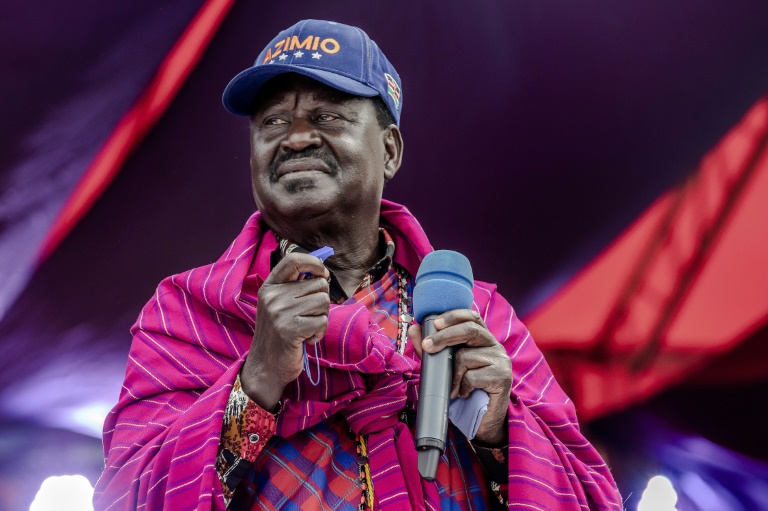
Raila Amolo Odinga, a veteran Kenyan political leader and one-time prime minister, has long cast himself as an anti-establishment firebrand, despite belonging to one of the country’s top political dynasties.

But his decision to strike an alliance with his arch-rival, President Uhuru Kenyatta, and secure the ruling party’s backing as he vies yet again for the top job in the August 9 elections, risks taking the shine off his brand.

The Kenyatta and Odinga families have dominated Kenyan politics since the country won independence from Britain in 1963.

Uhuru Kenyatta’s father Jomo was the East African nation’s first president while his rival Jaramogi Oginga Odinga — Raila’s father — served as vice president.

Now 77, Raila Odinga’s early years in politics saw him spend much of his time in prison or in exile as he fought for democracy during the autocratic rule of president Daniel arap Moi.

A member of the Luo tribe, he entered parliament in 1992 and ran unsuccessfully for the presidency in 1997, 2007, 2013 and 2017, claiming to have been cheated of victory in the last three elections. 

The 2007 polls in particular — which many independent observers also considered deeply flawed — cast a long shadow over Kenyan politics, unleashing a wave of ethnic violence that pitted tribal groups against each other and cost more than 1,100 lives.

Few therefore expected Odinga and Kenyatta to shake hands and draw a line under decades of vitriol in March 2018.

Known universally as “the handshake”, the pact stunned Odinga’s colleagues and supporters, effectively leaving Kenya without an opposition.

– ‘Nobody’s stooge’ –

When Kenyatta — a two-time president who cannot run for a third term — endorsed Odinga for the presidency earlier this year, observers speculated that Kenya’s best-known agitator had traded his autonomy for a chance to be in power.

Odinga has hit out at the claims, telling a press conference earlier this month that Kenyans “know that I am an independent person, that I am a person of conscience, and with very strong convictions.”

“I cannot be somebody else’s stooge or candidate.”

Odinga’s elevation came at the expense of Kenya’s Deputy President William Ruto, who found himself sidelined as the erstwhile foes drew closer.

It also came loaded with risks for the veteran leader, with Ruto now positioning himself as a politician looking to upend the status quo and stand up for the “hustlers” trying to make ends meet in a country ruled by “dynasties”.

“Raila is quite conscious that a lot of the support he enjoys is because he has been an anti-establishment figure for so long,” said Gabrielle Lynch, professor of comparative politics at the University of Warwick.

“The handshake has undermined that narrative,” she told AFP.

Odinga, who was born on January 7, 1945 and is fondly known as “Baba” or “daddy” in Swahili, is now caught in a complex balancing act.

“He has a lot of trust to build, especially in his main voting bloc,” Kenyan political analyst Nerima Wako-Ojiwa told AFP.

– Polarising politician –

While his supporters consider Odinga a much-needed social reformer, detractors see him as a rabble-rousing populist, unafraid to play the tribal card.

A charismatic speaker, he has a reputation for being stubborn and sometimes short-tempered.

In the eyes of some observers, his crowd-pleasing skills have diminished in recent years, attributed to advancing age and ill health.

With his speech notes in hand, he often stumbles and labours over his words — especially in English. Speaking off-the-cuff in his native Swahili however, he retains the ability to inspire.

Passionate about reggae, he has adopted South African star Lucky Dube’s song “Nobody can stop reggae” as an unofficial motto for his campaign in recent years.

An Arsenal fan, he credits his love of football for helping him develop a philosophical attitude towards the rough and tumble world of politics.

“You lose some, you win some. It is painful but that is the way to perfection,” he said in an interview with AFP last year.

Raised an Anglican, he later converted to evangelicalism and was baptised in a Nairobi swimming pool by a self-proclaimed prophet in 2009. 

The Bible even crept into Odinga’s 2017 campaign with his repeated promise to lead his followers to Canaan, the mythical “promised land”.

He studied engineering in communist former East Germany and named his eldest son Fidel, who died in 2015, after the Cuban revolutionary.

Although not as wealthy as Kenyatta or Ruto, Odinga sits at the head of a business empire with stakes in energy companies.

Married to his wife Ida for almost half a century, Odinga has three surviving children and five grandchildren.

Marijuana and snakes: the maverick shaking up Kenya's election

Once a street child in Nairobi and a grave digger in Britain, George Luchiri Wajackoyah barged onto the political scene with a “bhang”: vowing to legalise marijuana, breed snakes and sell hyena testicles to China to offset Kenya’s mammoth debt. 

Impulsive, immoderate, politically untested and at best comical, the 63-year-old does not fit the usual profile of a candidate for Kenya’s top job — he is often on the campaign trail in a tracksuit and bare feet.

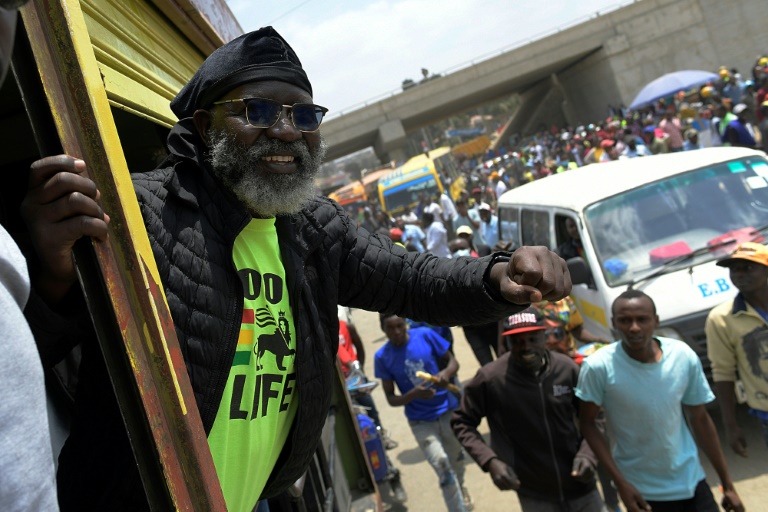
But the eccentric lawyer, who sports a grey beard and trademark durag (bandana), has shaken up the election race, becoming the unpredictable populist who may force Kenya’s first presidential run-off.

When his rusty campaign truck pulls up on a dusty roadside on the outskirts of Nairobi, a handful of young people gather, drawn by the reggae music blaring from speakers. 

Wajackoyah smiles and fist-bumps his supporters while chanting “bhang, bhang”, a reference to his pledge to legalise cannabis to ease Kenya’s $70-billion debt burden. 

Often gesturing with his fingers as if he is smoking, he promises to take his first puff when he wins the August 9 election. 

“I’ll be everybody’s president,” he says. “I’d like the people to do one thing: elect the person and not the party.”

– Escape to exile –

The jewellery-loving lawyer says he was pulled off the rubbish pits of Nairobi by world-renowned Kenyan conservationist and fossil hunter Richard Leakey and worshippers at a Hare Krishna temple. 

After high school in 1980, he enrolled in the police, rising through the ranks and then becoming a top spy during the autocratic regime of late president Daniel arap Moi. 

It was his investigation of the 1990 assassination of foreign minister Robert Ouko — one of Kenya’s most high-profile murders — that led to his arrest and torture, before he was forced into exile in Britain. 

There, he did menial jobs including digging graves to fund his education before returning to Kenya in 2010.

Wajackoyah claims he has 17 degrees, mostly in migration and refugee law, although this could not be verified.

Running on the Rastafarian-inspired Roots Party ticket, Wajackoyah has made legalising marijuana for recreational and medical use the cornerstone of his 10-point campaign agenda.

Marijuana is illegal in Kenya, but Wajackoyah says it has the potential to unlock billions of dollars, earning up to $76 billion annually.

The AFP digital investigations team has found this claim to be misleading. 

His manifesto also calls for Kenya to export hyena testicles, reputedly valued in Chinese medicine, and to sell dog and snake meat and venom — proposals that have irked wildlife campaigners.

“We will rear snakes. Each venomous snake farmer will earn an average of $6,000 per vial of anti-venom,” he declared. 

He also wants to hang the corrupt — a hot button issue that infects almost every level of society — and reduce the working week to four days.

“Anyone caught or found guilty of stealing public money will be hanged in public,” he said.

– ‘Deluded’ votes –

Wajackoyah has even spawned at least one lookalike and a host of copycat social media accounts.

Observers say although winning the presidency is a very long shot, Wajackoyah — who is married to an American citizen and has three children — could muster enough votes to trigger a second round between front-runners Raila Odinga and William Ruto.

“Wajackoyah is likely to frisk away a big chunk of the ‘deluded’ votes,” academic Michael Ndonye wrote in The Standard newspaper. 

“He is likely to take away a significant portion of voters who identify with his attention-grabbing queer politicking.”

Wajackoyah’s campaign has “captured the imagination of angry, disaffected youth in both urban and rural Kenya, cutting across all the regular ethnic, regional and party lines,” wrote Daily Nation columnist Macharia Gaitho. 

But speculation is rife that Wajackoyah is a political stooge. 

In June, while campaigning in Odinga’s lakeside stronghold of Kisumu, Wajackoyah told supporters if they don’t vote for him, they should consider the veteran opposition politician, who is now backed by the ruling party.

And just days before the election, he led a crowd in cheering for Odinga, saying: “I am here to join the pack of liberators and the person I look at is none other than Raila Odinga.”

Close Bitnami banner
Bitnami