Africa Business

'A dirty game': Young Kenyans shun election hype

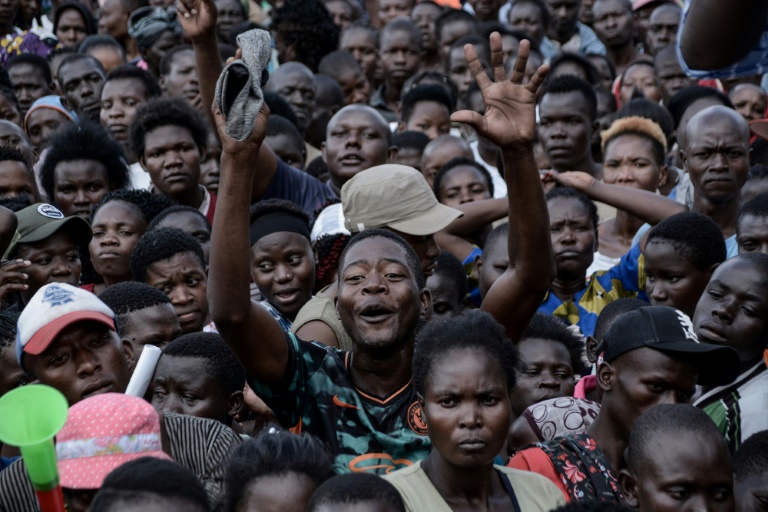
As a familiar campaign jingle brings the Kenyan crowd to their feet, Hellen Atieno joins her compatriots and sways to the catchy tune at a political rally in the lakeside city of Kisumu.

Just don’t expect the 23-year-old to vote.

“I have only come to the rally because there is money. I hope there will be something,” Atieno told AFP, referring to the widespread Kenyan practice of offering freebies to prospective voters. 

Currently without a job, the former fishmonger says she is so fed up with the country’s insular political class that she plans to stay home when Kenya votes on August 9 in parliamentary and presidential polls.

She is not alone.

The East African economic powerhouse ranks among the world’s youngest countries — three-quarters of Kenyans are aged under 34, according to government figures.

Many have no interest in participating in an electoral process they widely dismiss as corrupt and pointless.

The number of registered young voters has dropped five percent since the 2017 poll, in contrast to over-35s, whose tally has increased, Kenya’s election commission announced last month.

Over 22 million Kenyans are eligible to take part in this year’s polls, with young people accounting for less than 40 percent of that number, the Independent Electoral and Boundaries Commission (IEBC) said.

– ‘A dirty game’ –

Politicians have responded with a freebie bonanza, offering cash, umbrellas, shirts, caps and even packets of maize flour — a dietary staple — to anyone who attends their rallies.

The bribes — an electoral offence that can attract a fine of up to two million Kenyan shillings ($17,000) and/or a six-year jail term — are not new to Kenyan politics.

But galloping food inflation — made worse by the war in Ukraine — and an unemployment crisis have intensified the appetite for such handouts.

According to census figures published in 2020, about five million young Kenyans were out of work.

Brian Denzel has spent recent weeks hitting one rally after another, eager to pocket the cash on offer, even though the 19-year-old butcher has no plans to vote and sees politics as little more than “a dirty game”.

“Who will reject the free money that they are given?” he said, while waiting in line to collect 200 shillings ($1.70) from a local politician.

Kenya’s Interior Minister Fred Matiang’i even told reporters on Wednesday that the banks were running short of 100 and 200 shilling notes “because politicians are bribing villagers”.

In the months leading up to the polls, observers suggested that the youth factor could help heal Kenya’s often toxic tribal politics, with a younger electorate less likely to vote according to ethnic affiliations.

Yet, although young Kenyans are less tribally-minded, they also lack “ideological steadfastness”, Kisumu-based political analyst Francis Owuor told AFP.

“That conviction that normally comes with the political process is not there,” Owuor said.

“Everyone (is) to blame for this, both the people and the leaders, but again the leaders are the duty bearers, so they must take much of the blame.” 

– Disillusioned –

Thirty years after the emergence of multi-party democracy in Kenya, many are disillusioned by constant battles over the credibility of polls and disputed election results.

This year’s presidential vote is largely a two-horse race between Deputy President William Ruto, 55, and Raila Odinga, the 77-year-old veteran opposition leader who is now backed by the ruling party.

If both leaders accept the results, it will be a first for the country since 2002.

Amina Soud, manager for voter education at the IEBC, told AFP the election watchdog was “worried” by the increasing indifference shown by young people towards the political process.

“We did a lot of mobilisation during registration using all these tools and still voter apathy was too high,” Soud said, referring to the IEBC’s social media push to enlist new voters.

But exhorting youth to vote via campaigns on TikTok or comics in Sheng — a local slang popular with urban youth — does little to offer hope to a generation of Kenyans facing runaway inflation, corruption and unemployment.

“I don’t think I am going to vote,” 27-year-old salon owner Irene Awino Owino told AFP.

“I have no interest, because the government puts themselves first rather than us.”
Commonwealth Games set for glitzy launch in Birmingham

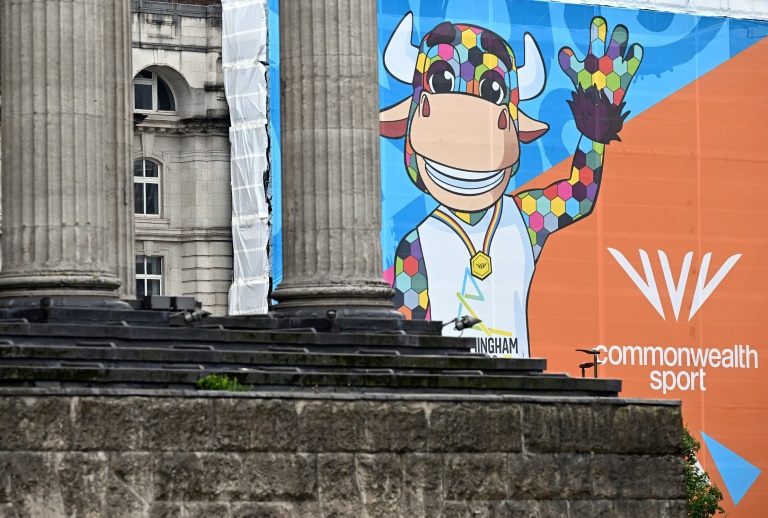
More than 5,000 athletes are primed for action in the English city of Birmingham from Friday at a Commonwealth Games lacking several track and field stars but still boasting elite performers.

Competitors from 72 nations and territories — many of which are former British colonies — will be vying for medals in 19 sports over a jam-packed 11 days in the Midlands.

Away from the marquee athletics and swimming events, women’s Twenty20 cricket makes its debut and 3×3 basketball will feature for the first time while sedate lawn bowls is a fixture.

There is an integrated para sports programme in some events.

The Games, held every four years, are often criticised as a quirky sporting relic but will be launched in style at Thursday’s opening ceremony, headlined by 1980s pop band Duran Duran, formed in Birmingham.

Sporting powerhouse Australia have topped the medals table at every Games since 1990 except in 2014, when England finished top in Glasgow — the last time the event was held on British soil.

England, Scotland, Wales and Northern Ireland compete as separate teams during the Commonwealths rather than as a combined British outfit.

In the pool, Emma McKeon, Ariarne Titmus, Kaylee McKeown and teenage sensation Mollie O’Callaghan will lead the charge for a star-studded Australian team.

Double Olympic champion Titmus, 21, opted out of the recent world championships in Budapest to keep herself fresh for Birmingham.

“I am so excited and I think we’ve got a great team going in. It’s insane the depth we have,” said the Commonwealth Games 400 metres and 800m freestyle champion. 

McKeon, 28, who won seven medals — including four golds — at last year’s Olympics in Tokyo, boasts a phenomenal Commonwealth Games record, with eight gold and four bronze medals in two appearances.

Headlining for England will be breaststroke superstar Adam Peaty, who missed the recent world championships with a foot injury.

“I feel really good in myself, I feel really good in my fitness,” he told Sky Sports. “But now it’s all about getting that cash out of the bank and seeing where I’m at.”

He said he was relishing competing in front of home fans.

“I was born in the Midlands, probably die in the Midlands, it’s my home.”

– Calendar clash –

The Commonwealth Games comes hot on the heels of the world athletics championships in Eugene, Oregon, which only finished on Sunday.

The worlds were rescheduled from last year after the coronavirus pandemic forced a delay to the Tokyo 2020 Olympics but that has created a headache for athletes in a crowded schedule.

Olympic champions Andre De Grasse, Kirani James and Neeraj Chopra will definitely be absent from Birmingham.

Chopra, who won javelin gold for India in Tokyo last year, said he was “hurt” at not being able to defend his Commonwealth title after suffering a groin strain during the world championships, where he won silver.

There are major doubts over the participation of Jamaican sprint trio Shelly-Ann Fraser-Pryce, Shericka Jackson and Elaine Thompson-Herah, who swept the 100m podium in Oregon.

Jackson, who previously suggested she would be competing in Birmingham, followed up her 100m silver at the worlds by running the second-fastest time in history in the 200m.

In another blow, British sprinter Dina Asher-Smith announced on Wednesday she had withdrawn from the England team due to a hamstring injury she sustained in Oregon “due to the short turnaround”.

But there will still be star power at the Alexander Stadium, with Australian high jumper Eleanor Patterson and javelin thrower Kelsey-Lee Barber arriving as newly minted world champions.

Jake Wightman, who shocked Norway’s Jakob Ingebrigtsen to win 1,500m gold in the United States, will be one of big draws for home fans in the absence of Asher-Smith, with Scottish Olympic silver medallist Laura Muir another major name.

Cricket last featured at the Commonwealth Games in 1998 but the women will take part for the first time in Birmingham, with Meg Lanning’s Australia hot favourites to win the T20 competition.

Former Tour de France winner Geraint Thomas will compete for Wales and Australian cycling sprint ace Caleb Ewan will also feature after a disappointing Tour.

Mark Cavendish, riding for the Isle of Man rather than under the British flag, will have something to prove after missing out on selection for the Tour de France this year.

Alarm as Earth hits 'Overshoot Day' Thursday: NGOs

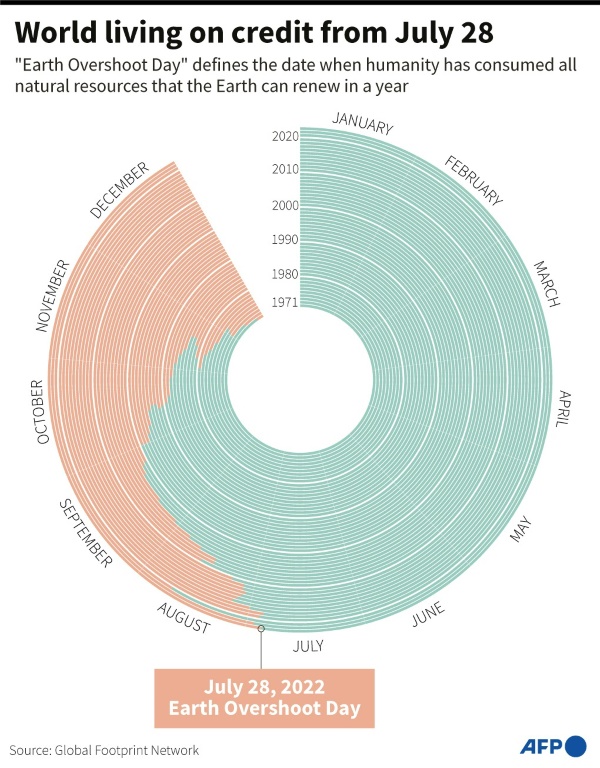
Mankind marks a dubious milestone Thursday, the day by which humanity has consumed all earth can sustainably produce for this year, with NGOS warning the rest of 2022 will be lived in resource deficit.

The date — dubbed “Earth Overshoot Day” — marks a tipping point when people have used up “all that ecosystems can regenerate in one year”, according to the Global Footprint Network and WWF.

“From January 1 to July 28, humanity has used as much from nature as the planet can renew in the entire year. That’s why July 28 is Earth Overshoot Day,” said Mathis Wackernagel, president of the Global Footprint Network.

He added: “The Earth has a lot of stock, so we can deplete Earth for some time but we cannot overuse it for ever. It’s like with money; we can spend more than we earn for some time until we’re broke.”

It would take 1.75 Earths to provide for the world’s population in a sustainable way, according to the measure, which was created by researchers in the early 1990s.   

Global Footprint Network said Earth Overshoot Day has fallen ever sooner over the last 50 years.

– Uneven burden –

In 2020, the date moved back three weeks due to the Covid-19 pandemic, before returning to pre-pandemic levels.

The burden is not evenly spread. If everyone lived like an American, the date would have fallen even earlier, on March 13, Wackernagel said.

The two NGOs point the finger at the food production system and its “considerable” ecological footprint.

“In total, more than half of the planet’s biocapacity (55 percent) is used to feed humanity,” the two NGOs said.

“A large part of the food and raw materials are used to feed animals and animals that are consumed afterwards”, said Pierre Cannet of WWF France.

In the EU, “63 percent of arable land… is directly associated with animal production”, he said.

“Agriculture contributes to deforestation, climate change by emitting greenhouse gases, loss of biodiversity and degradation of ecosystems, while using a significant share of fresh water,” the NGOs said.

Based on scientific advice, they advocate reducing meat consumption in rich countries. 

“If we could cut meat consumption by half, we could move the date of the overshoot by 17 days,” said Laetitia Mailhes of the Global Footprint Network.

“Limiting food waste would push the date back by 13 days, that’s not insignificant,” she added, while one-third of the world’s food is wasted.

US hopes for progress on Ethiopia peace talks after Kenya election

A senior US official voiced cautious hope Wednesday for a start of Ethiopian peace talks after next month’s election in neighboring Kenya, which has played a key diplomatic role.

Ethiopian Prime Minister Abiy Ahmed in June raised the possibility of talks with the Tigray People’s Liberation Front to try to end a brutal war that first erupted in northern Ethiopia in November 2020.

But Abiy said the African Union, based in Addis Ababa, should take the lead in mediation — a stance rejected by the rebels, who instead want to negotiate under Kenyan President Uhuru Kenyatta.

Molly Phee, the top US diplomat for Africa, played down the row, saying that Abiy had “positive relations” with Kenyatta but noting that Kenya holds elections on August 9.

“It’s our expectation that a natural focus on that event may be affecting the scheduling of these talks,” Phee told the Senate Foreign Relations Committee.

Mike Hammer, the new US envoy for the Horn of Africa, will travel to Ethiopia this week and “will be having discussions with the parties to see what we can do to move forward on those talks,” she said.

The conflict erupted when Abiy, a Nobel Peace Prize winner, sent in troops to topple the once-dominant Tigrayan rebels after an attack on the federal military. Untold numbers have died.

The United States accused Ethiopia, a longtime ally, of ethnic cleansing and President Joe Biden as of January 1 expelled sub-Saharan Africa’s most populous country from a key trade pact that offered duty-free access for most goods.

The decision galvanized the Ethiopian-American diaspora which has led a lobbying campaign to return the country to the pact, the African Growth and Opportunity Act.

“The freezing of AGOA impacts the people throughout Ethiopia. It doesn’t specifically punish the government. It hurts farmers, no matter where they live, and other entrepreneurs,” said Senator Chris Van Hollen of Maryland, which has a large Ethiopian-American community.

Phee said the Biden administration was “looking closely” at whether to restore Ethiopia’s participation and that “we are in a much better place” on addressing US concerns.

Russia 'one of last imperial colonial powers', says France's Macron

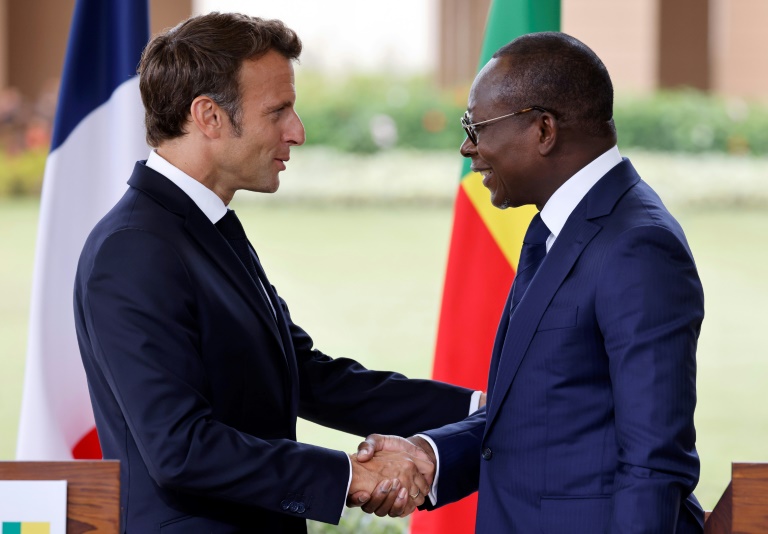
French President Emmanuel Macron, on a visit to Benin Wednesday, branded Russia “one of the last imperial colonial powers” for its invasion of Ukraine.

“Russia launched an offensive against Ukraine. It’s a territorial war, the likes of which we thought had disappeared from European soil.

“It’s a war from the early 20th, even the 19th century,” Macron said on the second leg of a trip to Africa to reset France’s relations with the continent, where many nations are former French colonies.

“I speak on a continent that has suffered colonial imperialism,” Macron added.

Delivering the broadside at a news conference with Benin President Patrice Talon, Macron said “Russia is one of the last imperial colonial powers”, because it had decided to “invade a neighbouring country to defend its interests”.

Russia sent troops into Ukraine on February 24, triggering a war that has killed thousands, displaced millions and sparked fears of a global food crisis over blocked grain exports.

Macron accused the Kremlin of launching “a new type of hybrid world war”.

“It decided that information, energy and food were military instruments placed at the service” of the war in Ukraine, he said.

Macron said he wanted to “describe what’s happening today in the baldest terms”.

He accused Russia of disruption through “disinformation”, describing it as “one of the countries to make the most forceful use of instruments of propaganda”. He referred specifically to the television channels Russia Today and Sputnik.

– Simultaneous Russian tour –

Russia has cut back on gas deliveries to western Europe and Ukrainian grain has remained blocked in ports since the start of the war, driving a surge in global prices for energy and cereals.

Russia’s energy giant Gazprom slashed its gas exports to Europe via the Nord Stream pipeline on Wednesday to about 20 percent of its capacity, German authorities have said.

Ukraine, meanwhile, says it had restarted operations at its Black Sea ports, a key phase to resuming grain exports under a UN-backed deal.

The French leader is on a tour of three African countries — Cameroon, Benin and Guinea-Bissau — that coincides with an African tour by Russian Foreign Minister Sergei Lavrov.

In Ethiopia on Wednesday, Lavrov urged a gathering of African diplomats not to back a US-led world order.

It is up to us to decide whether to have a “world where we have (the) so-called collective West… totally subordinated to the United States and feeling… that it has the right to decide when and how to promote its own interests, without following international law”, he said.

The West responded to Russia’s military incursion into Ukraine by imposing sanctions on Moscow.

In Addis Ababa, Lavrov accused the West of throwing its principles “down the drain… when they needed to do what they believe is to punish Russia”.

“I don’t have the slightest doubt that if need be, they will not hesitate to do the same in relation to any other country… which would irritate them,” he warned.

– French pledge of support –

In Cameroon on Tuesday, Macron said the archives on French colonial rule in Cameroon would be opened “in full” and asked historians to shed light on the period’s “painful moments”.

French colonial authorities brutally repressed armed Cameroonian nationalists before the country’s independence in 1960. 

Tens of thousands of supporters of the Union of the Peoples of Cameroon (UPC) party died at the hands of French colonial troops and of the first post-independence president, Ahmadou Ahidjo.

Macron also pledged that France, “acting in support and at the request of our African partners”, would stand by African countries facing security problems.

France is reconfiguring its posture in the Sahel after falling out with the military junta in Mali, the epicentre of a bloody 10-year-old jihadist campaign in the region.

After a pullout from Mali that is expected to be completed in the coming weeks, France’s Barkhane anti-jihadist force will have around 2,500 troops in the Sahel, just under half of the deployment at its peak, French officers say.

The force will also make a tactical shift, acting more in a support role for local forces as opposed to taking the lead, they say.

Benin's Talon defends jailing of political opponents

Benin President Patrice Talon on Wednesday dismissed criticism that his government was holding political prisoners after the jailing of two opposition leaders late last year.

The West African state sitting between Nigeria and Togo was long praised for its thriving multi-party democracy, but critics say freedoms have steadily eroded under Talon, a 64-year-old cotton magnate first elected in 2016.

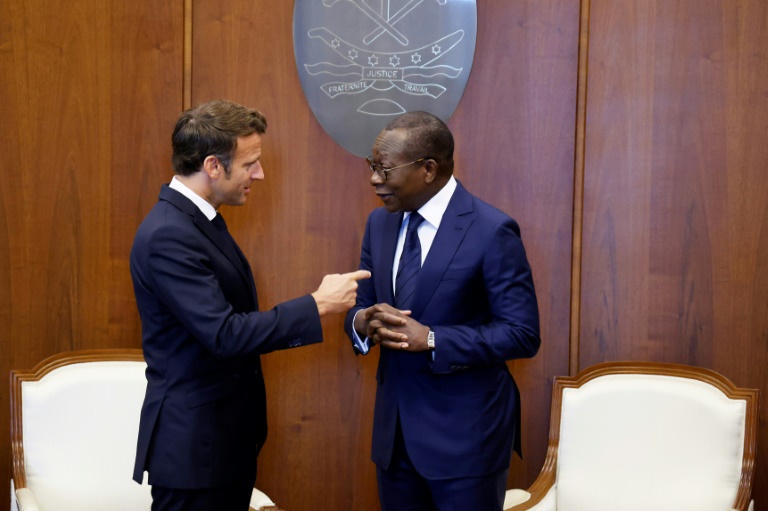
Talon was speaking during a one-day visit by President Emmanuel Macron to Benin’s economic capital Cotonou after the French leader had travelled to Cameroon.

“In Benin, there are no political detainees, no one is detained in Benin for their political opinion,” Talon said, answering questions from journalists with Macron at his side.

“But people are detained for having acted, for having committed offenses and crimes in the political field, that is true.”

Macron did not talk about the political situation in Benin during his speech.

Talon said it was possible that an amnesty or pardon may be given to detained opposition figures, when asked about releasing the two leaders.

“We have to be able to adjust the political situation so that it gives a good image, favourable to economic development,” Talon said.

“Our image is a little tarnished by the political situation that Benin has experienced lately. I am not ashamed of that.”

Benin opposition leader Reckya Madougou was sentenced in December to 20 years in prison for “terrorism” by a special court in the capital Porto-Novo after a brief trial that her attorneys condemned as a “political attack”.

Madougou was one of several Benin opposition leaders banned from running in last year’s April election when Talon won a second term with 86 percent of the vote.

A former justice minister, she was arrested in Cotonou in March — just weeks before the election — accused of financing an operation to assassinate political figures to prevent the vote and trying to “destabilise” the country.

Another opposition leader Joel Aivo, a professor who had been held for eight months, was also found guilty last December of money laundering and plotting against the state.

Both were tried by a special court dealing with terrorism and economic crimes, known as the CRIET. Critics say the court, created by Talon’s government in 2016, has been used crack down on his opponents.

Less than a week before the April election, a judge from the CRIET fled Benin denouncing political pressure to make rulings, in particular in the case of Madougou’s arrest.

Some opposition figures have fled the country while others have been disqualified from running in elections or targeted for probes by the government, critics say.

DR Congo tightens security in east after anti-UN unrest

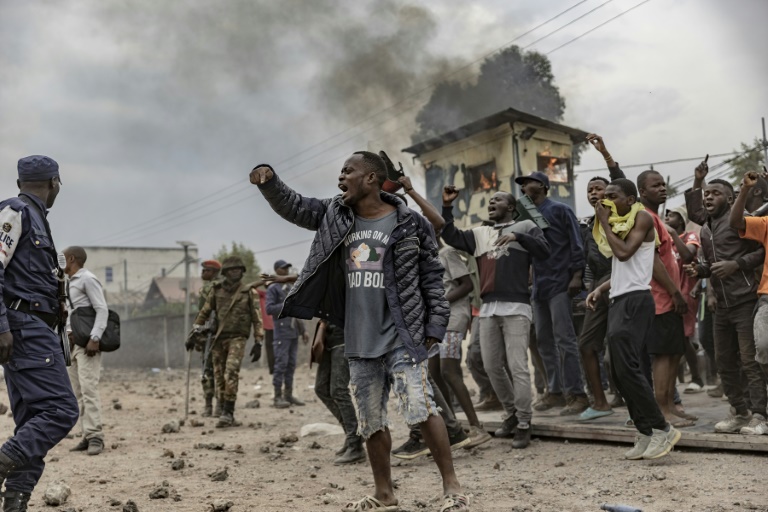
Soldiers and police officers were deployed across eastern DR Congo towns Wednesday after days of deadly anti-UN protests that have claimed at least 19 lives in the volatile region.

Calm appeared to have returned to several towns in North Kivu province, according to AFP reporters, after unrest broke out in the provincial capital Goma on Monday and quickly spread. 

Crowds had stormed a United Nations peacekeeping base and a supply centre in the city of Goma in North Kivu on Monday, looting valuables and chanting hostile slogans.

Three UN peacekeepers were then killed on Tuesday after protests spread, in an attack on their base in the town of Butembo.

Government spokesman Patrick Muyaya said during a televised news conference on Tuesday night that 12 protesters in total had been killed during the unrest, in addition to the peacekeepers. 

“In no case is violence justified,” he said. 

The UN mission in DRC, known as MONUSCO, has come under regular criticism in the troubled east, where many accuse it of failing to stop decades-old armed conflict. 

More than 120 armed groups roam the volatile region, where civilian massacres are common and conflict has displaced millions of people. 

Even as tensions began to dissipate in North Kivu on Wednesday, a deadly anti-UN protest erupted in the town of Uvira in neighbouring South Kivu province. 

Four people were killed, according to Uvira town hall spokesman Dominique Kalonzo — raising the total death toll from the anti-UN protests to 19.

Youngsters had attempted to besiege a MONUSCO base in the town on Wednesday morning, he said, before being dispersed by police officers firing warning shots. 

A bullet pierced a high-voltage cable, however, which collapsed on protesters about 100 metres (yards) from the UN base, Kalonzo said, killing four.

– ‘Very volatile’ –

On Wednesday, AFP correspondents saw tighter security in the North Kivu towns of Beni and Butembo, as well as in Goma, the provincial capital.  

Armed police and soldiers were patrolling Beni in jeeps and a highway leading out of the town towards several MONUSCO bases was heavily guarded.

Relative calm had also returned to Goma, where shops were beginning to open again as security forces deployed across the city.

In the town of Sake about 30 kilometres (18 miles) from Goma, Congolese police fired tear gas to deter protesters from approaching a UN base, which was ringed with soldiers and police officers. 

“We will protest until they leave,” said Jackson Kibuya, a protester in Sake, holding up a banner reading “Bye Bye MONUSCO”.  

On Tuesday, MONUSCO released a statement strongly condemning the attacks on its peacekeepers, which it called unjustifiable.  

Farhan Haq, a UN spokesman, also warned reporters in New York on Tuesday that the situation on the ground is “very volatile”.

– Rebel advances –

The latest protests come after the president of the senate, Modeste Bahati, told supporters in Goma on July 15 that MONUSCO should “pack its bags”.

They also coincide with the resurgence of the M23 — a militia that lay mostly dormant for years before resuming fighting last November. 

The rebels have since made significant advances in eastern Congo, including capturing the North Kivu town of Bunagana on the Ugandan border. 

The UN first deployed an observer mission to eastern Congo in 1999. 

In 2010, it became the peacekeeping mission MONUSCO — the United Nations Organization Stabilization Mission in the Democratic Republic of the Congo — with a mandate to conduct offensive operations.

It has a current strength of about 16,300 uniformed personnel, according to the UN. 

Botswana hits 'historic' UN goal against HIV: report

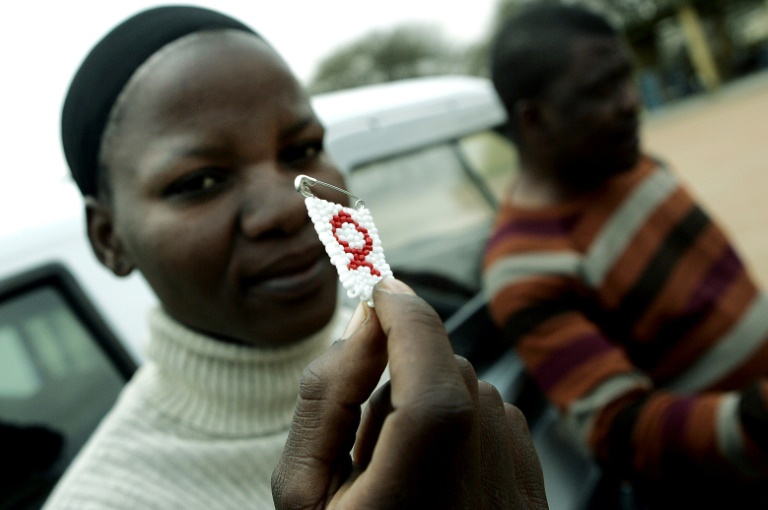
Botswana has become the second nation in the world, after Eswatini, to reach a landmark UN goal towards eradicating AIDS, researchers said Wednesday, in what health experts hailed as “stellar results”.

The country has met the so-called “95-95-95” target on HIV diagnosis, treatment and viral suppression several years early, according to a study published ahead of a global conference on the disease. 

About one in five people in Botswana live with the virus — one of the highest rates in the world — according to the UN AIDS agency (UNAIDS). 

The agency wanted 95 percent of HIV-positive people to know their status, 95 percent of those diagnosed on medication and 95 percent of those under treatment to show signs that the virus is being suppressed in their blood by 2025. 

But the study led by Botswana’s health ministry found the country had already met or surpassed all three thresholds, with a 95-98-98 score. The global average in 2020 was 84-87-90, UNAIDS says.

“Botswana is making historic new progress against HIV,” Sharon Lewin, president-elect of the International AIDS Society (IAS), told a virtual press briefing presenting the results.

The country is “well positioned to end its HIV epidemic by 2030. To put it simply, these are really stellar results.”

Madisa Mine, the study’s lead author and a Botswana government virologist, said the results were encouraging.

“We have translated a hopeless situation into a situation where now there is hope,” he said.

Now both the government and people on medication could look forward to Botswana one day becoming an AIDS-free country, Mine added.

That was a far cry from when he started working on the disease two decades ago, and it seemed the nation was “facing extinction” due to the high number of infections. 

– ‘Doable’ –

The paper, which has not yet been peer-reviewed or published in a journal, was based on interviews and blood tests from more than 14,000 people aged 15 to 64.

Another southern African country, the small landlocked kingdom of Eswatini, became the first country to reach the UN target in 2020, UNAIDS says.  

UNAIDS deputy executive director Matthew Kavanagh said Botswana’s progress was down to a series of factors, including government investment and the rapid adoption of self-testing. 

In 2002, Botswana became the first African country to offer free anti-retroviral drugs, which help contain the virus and prevent it from infecting others. 

And in 2019 the country of 2.3 million people decriminalised same-sex relationships — something that Kavanagh said “has helped to get more and more people into care”.

Botswana showed it was possible to rein in the disease, IAS president Adeeba Kamarulzaman said. 

“It’s not an easy feat. But what it shows is, it is doable with investment and political commitment, as well as communities working to deliver the needed services,” she told AFP from Montreal ahead of the 24th International AIDS Conference, which opens in the Canadian city on Friday. 

Globally, about 38 million people, including almost two million children, were living with HIV in 2020, and more than 600,000 died from AIDS-related illnesses, according to UNAIDS.

Eastern and southern Africa are the worst affected regions, accounting for more than half of all cases. 

Shadowy Al-Qaeda fighters heap pressure on Mali's junta

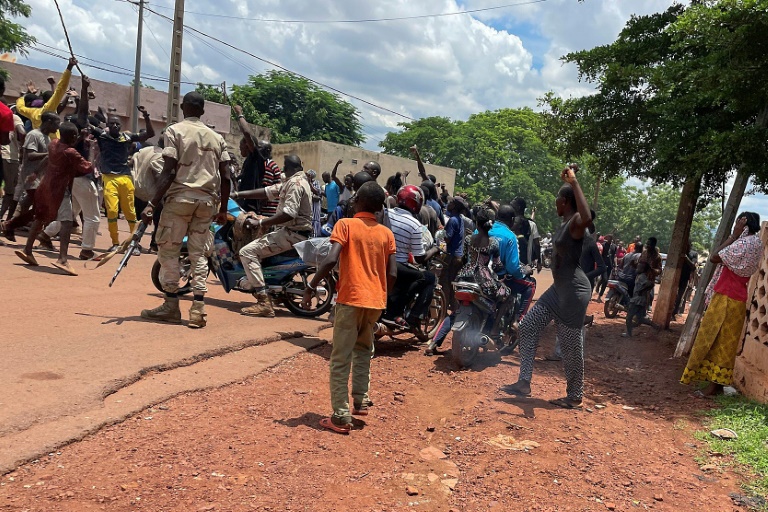
Al-Qaeda jihadists are tightening the screws on Mali’s military junta, extending their attacks to the south of the country and hitting a key garrison town on the outskirts of the capital.

Raids last week displayed coordination and operational complexity at a range that is unprecedented in the country’s decade-long jihadist campaign, say analysts.

Last Thursday, six attacks unfolded simultaneously at 5 am, striking the country’s troubled centre as well as the southern regions of Sikasso, Koulikoro and Kayes, which until now had never been targeted.

The following day, two explosive-laden vehicles smashed into the gates of an army building in Kati, a garrison town 15 kilometres (nine miles) from Bamako, killing a soldier.

The suicide raid was claimed by the Support Group for Islam and Muslims (GSIM), the main jihadist alliance in the Sahel and an Al-Qaeda affiliate, according to monitoring group SITE.

The operation was “a way of telling (the authorities) that they can strike anywhere,” a Malian analyst in the central town of Sevare told AFP.

The name of Kati has huge resonance in Mali. Its army base was the springboard for the country’s August 2020 coup and reputedly houses the country’s strongman, Colonel Assimi Goita, and Defence Minister Colonel Sadio Camara.

– ‘Corridor’ to south –

GSIM was created in 2017 from several groups — Al-Qaida in the Islamic Maghreb, an early pioneer of jihadism in the Sahel that was born in 2007, and Katiba Macina, Ansar Dine and Al-Mourabitoun, which were also led by veteran militants.

A UN-based expert in jihadist groups said the GSIM’s southward push emulated its successful “strategy of contagion” in the centre of the country.

Jihadists first struck the north of Mali in 2012, joining a regional insurgency.

After being scattered the following year by French forces, they regrouped, in 2015 launching attacks in the ethnically volatile centre and cross-border raids on Niger and Burkina Faso.

Across the three countries, thousands of civilians have been killed and more than two million have been displaced, and the economic damage has been devastating.

Heni Nsebia, a researcher at the Armed Conflict Location & Event Data Project (ACLED), said the recent attacks had had “modest results, bearing in mind the means that were deployed”.

However, they were also a potent demonstration of the GSIM’s powers of coordination, proving the organisation is not “just a coalition of disparate groups”, he said.

One insight that emerges is the “major freedom of movement” for jihadists between the centre and south of the country, demonstrating the GSIM’s influence over a vast area that includes the border with Burkina Faso, said Nsebia.

A recent report by UN specialists described a “southwards corridor” enabling GSIM to “extend towards the Atlantic coast” and countries on the Gulf of Guinea beyond Burkina Faso, notably Benin and Togo, where cross-border attacks have been rising.

GSIM’s targeted tactics contrast with those adopted by Islamic State jihadists in Mali, who are often blamed for indiscriminate massacres of civilians.

In areas where it wields special clout, such as the arid regions of the north, the GSIM tries to set up a parallel government to the state, say local sources.

They try to win over local people to their vision of a just and protective society, “proposing Islamic justice, access to health care and security”, said a security source in Timbuktu.

– ‘Mercenaries’ –

In early 2020, GSIM leader Iyad Ag Ghali declared he was willing to hold talks with the government in Bamako, as “between brothers”, provided France and the UN withdrew their forces.

Since then, Mali’s elected government has been replaced by a military one, and French troops are close to pulling out after the junta brought in Russian paramilitaries.

But these major shifts have not been followed by any sign of talks. In fact, violence has risen.

In central Mali, civilians are caught between the jihadists on one side and, on the side, the Malian security forces aided by suspected operatives from the pro-Kremlin Wagner group.

In June at least 132 villagers were massacred — an act that the authorities pinned on the GSIM’s Macina Katiba component, but which the GSIM has denied.

The organisation’s mouthpiece, in claiming the Kati attack, said on Saturday: “If you have the right to hire mercenaries to kill defenceless innocents, then we have the right to destroy and target you.”

President Ramaphosa vows equal pay for South Africa women after AFCON win

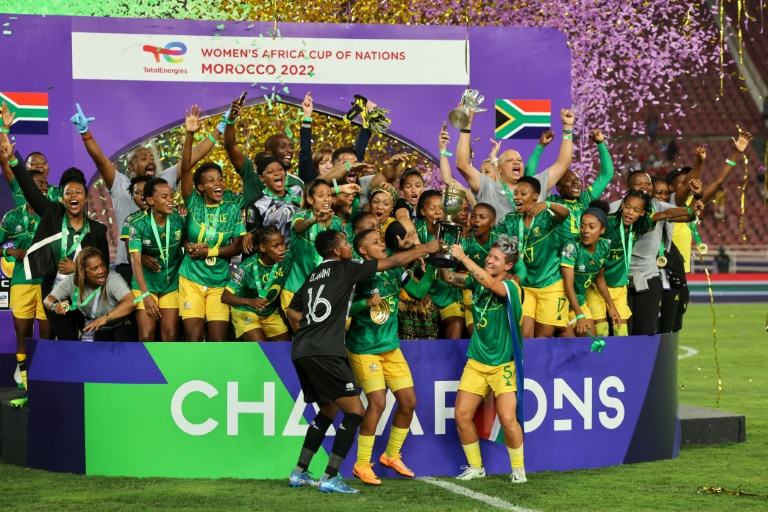
President Cyril Ramaphosa rolled out the red carpet for South Africa’s women on Wednesday, saying they deserved to be paid as much as their male counterparts after they won their first Africa Cup of Nations.

South Africa beat tournament hosts Morocco 2-1 in the final on Saturday in Rabat, thanks to a double from striker Hildah Magaia.

It was the first continental title for the side known as Banyana Banyana after five final defeats.

The victory has sparked a public debate around equal pay in the country, after it was reported the players would receive less money in prize bonuses than their male colleagues did for reaching the quarter-finals of the men’s tournament in 2019.

“Our hearts are filled with pride. They are bursting at the seams with a great deal of joy,” Ramaphosa said during a reception at the government’s Union Buildings in the capital.

“You deserve equal pay for equal work that you do,” he told the players, urging the country’s ministers of finance and sports to up the bonus.

“We need to give added remuneration to these young women who have made our country so proud. But having done so, we must then make sure that we eliminate the whole process of unequal pay out of our system.”

The team were met by jubilant fans as they landed back in Johannesburg on Tuesday.

Ramaphosa said the country should outlaw pay discrimination and embark on a programme to bridge the gender pay gap.

“You deserve the best. Welcome home, champions of Africa. You are the Golden Girls of our country. You are the queens of Africa,” he said.

“Whether they like it or they don’t like it, you are the queens.”

Close Bitnami banner
Bitnami