Africa Business

Tunisia president hails vote set to bolster rule

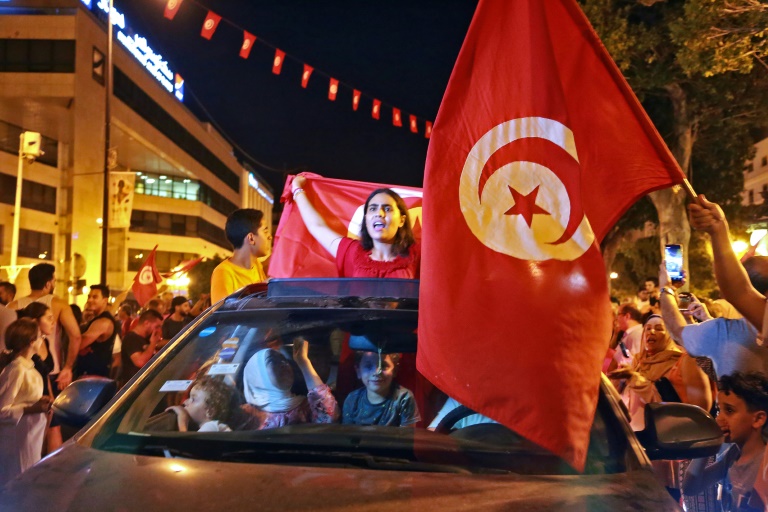
President Kais Saied said Tunisia had “entered a new phase” on Tuesday with a new constitution almost certain to pass in a referendum, concentrating almost all powers in his office.

Monday’s referendum came a year to the day after Saied sacked the government and suspended parliament in a dramatic blow to the only democracy to have emerged from the 2011 Arab Spring uprisings.

There had been little doubt the “Yes” campaign would win, and an exit poll suggested that votes cast — just a quarter of the 9.3 million electorate — were overwhelmingly in favour.

Most of Saied’s rivals called for a boycott, and while turnout was low, it was higher than the single figures many observers had expected — at least 27.5 percent according to the electoral board, controlled by Saied.

“Tunisia has entered a new phase,” Saied declared as he addressed celebrating supporters in downtown Tunis hours after polling stations closed.

“What the Tunisian people did… is a lesson to the world, and a lesson to history on a scale that the lessons of history are measured on,” he said.

The National Salvation Front, a coalition of Saied’s main opponents, said the draft constitution would enshrine in a “coup d’etat” and that “75 percent of Tunisians have refused to approve a putschist project”.

Saied, a 64-year-old law professor, dissolved parliament and seized control of the judiciary and the electoral commission on July 25 last year.

His opponents say the moves aimed to install an autocracy over a decade after the fall of dictator Zine El Abidine Ben Ali, while his supporters say they were necessary after years of corruption and political turmoil.

– Unchecked powers –

A poll of “Yes” voters by state television suggested “reforming the country and improving the situation” along with “support for Kais Saied/his project” were their main motivations for backing the constitution.

Thirteen percent cited being “convinced by the new constitution”.

Rights groups and legal experts have warned that the draft gives vast, unchecked powers to the presidency, allow him to appoint a government without parliamentary approval and make him virtually impossible to remove from office.

The charter “gives the president almost all powers and dismantles any check on his rule,” Said Benarbia, regional director of the International Commission of Jurists told AFP.

“None of the safeguards that could protect Tunisians from Ben Ali-type violations are there anymore,” he added.

Saied has repeatedly threatened his enemies in recent months, issuing video diatribes against unnamed foes he describes as “germs”, “snakes” and “traitors”.

On Monday, he promised “all those who have committed crimes against the country will be held accountable for their actions”.

Tunisia expert Youssef Cherif tweeted Tuesday that “most people voted for the man, or against his opponents, but not for his document.”

– ‘Back on the rails’ –

Analyst Abdellatif Hannachi said the results meant Saied “can now do whatever he wants without taking anyone else into account.”

“The question now is: what is the future of opposition parties and organisations?”

As well as remaking the political system, Monday’s vote was seen as a gauge of Saied’s personal popularity, almost three years since the political outsider won a landslide in Tunisia’s first democratic direct presidential election.

Hassen Zargouni, head of the Sigma Conseil group that gave the exit poll, said of the 7,500 voters questioned, 92-93 percent of them were in the “Yes” camp.

The turnout, projected at around 22 percent, was “quite good” given about two million people have been automatically added to electoral rolls since the 2019 legislative elections, he told AFP.

Participation in elections has gradually declined since the 2011 revolution, from just over half in a parliamentary poll months after Ben Ali’s overthrow to 32 percent in 2019.

Those who voted “Yes” on Monday did so primarily to “put the country back on the rails and improve the situation,” Zargouni said.
par/dv

Macron arrives in Cameroon on first leg of west Africa trip

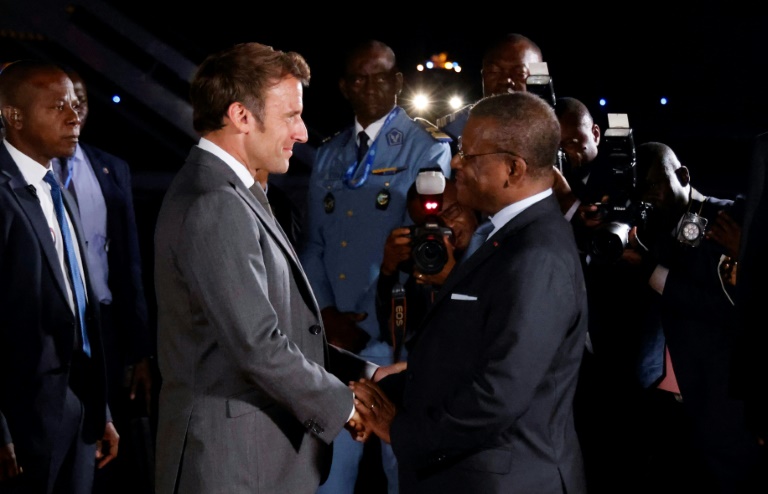
President Emmanuel Macron arrived late Monday in Cameroon at the start of a three-nation tour of western Africa as he seeks to reboot France’s post-colonial relationship with the continent.

Macron was welcomed at the airport in Yaounde at around 10:40 pm by Cameroonian Prime Minister Joseph Dion Ngute.

The first trip of his new term outside Europe, which will also take him to Benin and Guinea-Bissau, should allow Macron to “show the commitment of the president in the process of renewing the relationship with the African continent”, said a French presidential official, who asked not to be named.

Macron is due to hold talks Tuesday morning at the presidential palace with his counterpart Paul Biya, 89, who has ruled Cameroon with an iron fist for nearly 40 years.

They are expected to discuss security in Cameroon, which has been riven by ethnic violence and an insurgency by anglophone separatists who have been fighting for independence for two English-speaking provinces since 2017. Northern Cameroon has also seen attacks by Boko Haram jihadists.

Macron had provoked Biya’s indignation in 2020 after declaring he would apply “maximum pressure” on the president over “intolerable” violence in the West African country.

His visit comes at a time when former colonial power France has seen its influence decline in the face of China, India and Germany, particularly in the economic and commercial sectors.

After lunch with Biya and his wife Chantal, Macron will meet representatives of youth and civil society.

He will end the day in “Noah Village”, hosted by former tennis champion Yannick Noah, who is developing a leisure and education centre in a popular district of Yaounde, where he lives for several months a year.

Macron will move on Wednesday to Benin, which has faced deadly attacks from jihadists, who have spread from the Sahel to the Gulf of Guinea nations.

Benin was long praised for its thriving multi-party democracy. But critics say its democracy has steadily eroded under President Patrice Talon over the last half-decade.

On Thursday, Macron will finish his tour in Guinea-Bissau, which has been riven by political crises at a time when its president, Umaro Sissoco Embalo, is preparing to take the helm of the Economic Community of West African States.

All three countries have been criticised by activists over their rights records, but the Elysee has insisted that governance and rights issues will be raised, albeit “without media noise but in the form of direct exchanges between the heads of states”.

Saied supporters welcome vote on Tunisia constitution

Its detractors say Tunisia’s draft constitution will give President Kais Saied unchecked powers, but for voter Baya, that’s a welcome break from the country’s old political elite.

“They were in power for 10 years and did nothing. Let this man do his job!” the 54-year-old said after voting in a referendum on the charter on Monday.

“We believe in him and we’ll support him until the end.”

Monday marks a year since Saied sacked the government and froze parliament in a dramatic move against a system praised as the only democracy to emerge from the 2011 Arab uprisings — but also hobbled by chronic crises and corruption.

He has since tightened his grip on power and pushed to replace the North African country’s 2014 constitution with a document that would lock in his virtually unchecked powers.

Many of those voting were in their 40s and 50s, but student Aya, 23, was also in favour.

She hopes it will be “the starting point for real change, as the president will be able to implement the policy he sees as the most appropriate for the country’s interests”, she said.

Tunisians are facing growing poverty, surging inflation and high joblessness particularly among the young.

But Aya said she was “optimistic” that Saied could change things.

Initial figures after polling closed showed that almost 28 percent of eligible voters had cast ballots, beating expectations, and an exit poll suggested most had voted yes.

– Saied under fire –

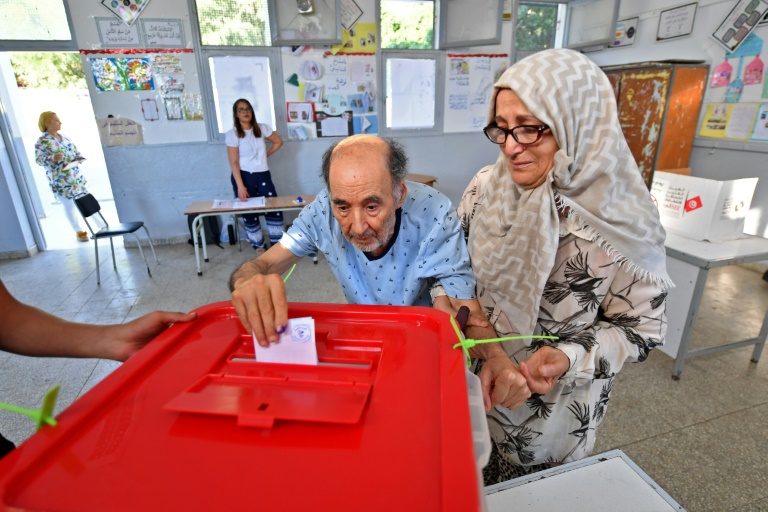
On Monday evening in the Lafayette district of central Tunis, voters steadily flowed through a polling station, where an official confirmed that there had been an uptick in attendance in the cooler early evening.

Chokri, who was helping his aged father reach a polling booth at a school in Tunis, said he agreed with the new charter.

“We approve of all these measures and that’s why we came today to give a big ‘Yes’ to Saied and his decisions,” the 45-year-old said.

Despite Tunisians having had just weeks to read or discuss the new constitution, few doubted the yes vote would win.

But observers also said voter turnout was key and would reflect Saied’s popularity.

Saied’s opponents, including the Islamist-inspired Ennahdha party that had dominated Tunisian politics since 2011, called for a boycott.

Saied came under fire for giving a speech on Monday urging a yes vote for “a new republic based on genuine freedom, justice and national dignity”, despite his own electoral law stipulating campaign silence until the polls closed.

One “no” voter, who asked not to be named, said those telling journalists they had voted in favour were “trying to intimidate others who reject this constitution”.

But for Majrya Hajja, 60, voting “yes” was “a duty”.

“Anyone who loves Tunisia must come and vote yes,” she said.

C.Africa floods kill 13, leave over 1,000 homeless

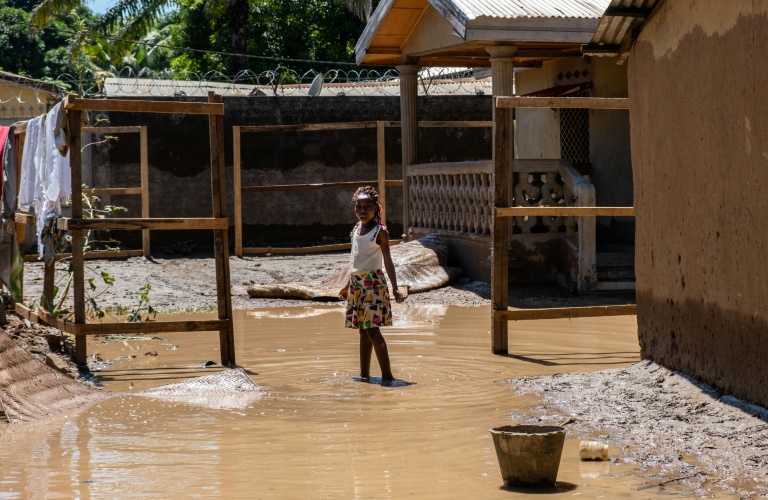
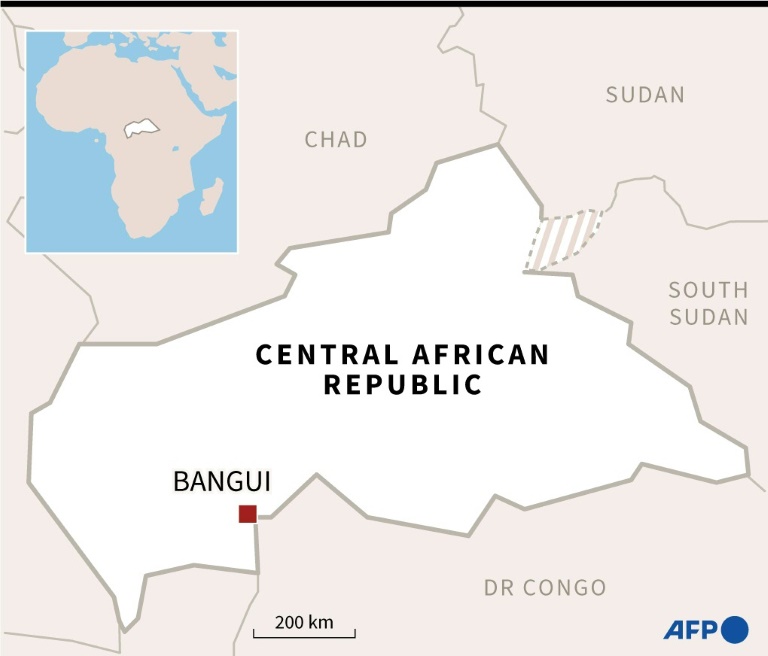
At least 13 people died and more than 1,000 were left homeless after heavy rainfall triggered floods in the Central African Republic last week, the Red Cross told AFP on Monday.

Local Red Cross chief Antoine Mbao Bogo said he was “surprised” at a toll he described as unprecedented in a country where flooding is frequent.

According to a provisional toll, nine people died in Bouchia in the south, three in the eastern town of Bria and one in the capital Bangui, he said.

People from more than 1,300 households are without shelter, with Bangui particularly affected, humanitarian action minister Virginie Baikoua told AFP.

The government has put in place a taskforce to map out the hardest-hit neighbourhoods with a view to improving infrastructure and preventing further such disasters, she added.

“I lost everything, I don’t even know where to go with my children,” Bangui resident Safiatou Ngbedi, who escaped from her home moments before it collapsed, told AFP.

Josue Djazoundou, a petrol seller in Bangui, was worried that water from his well had been contaminated by the overflowing toilets nearby.

“I only pray that the children don’t fall ill,” he said.

The CAR is one of the world’s poorest countries and more than half of its population requires humanitarian assistance, according to the World Bank.

In 2019, at least 28,000 people were left homeless by mass flooding after exceptionally heavy and continuous rainfall caused the Ubangi river and its tributaries to burst their banks.

Pro-government militia in C.Africa behind possible war crimes: UN

The UN on Monday accused government forces in the Central African Republic of training militias and working with private military companies behind possible war crimes and crimes against humanity.

A fresh report published by the United Nations human rights office and its so-called Multidimensional Integrated Stabilization Mission in CAR (MINUSCA) detailed a massacre in Boyo village in the south of the impoverished and war-torn country late last year.

Machete-wielding militia members killed at least 20 civilians in the week-long attack, while five women and girls were raped and 547 houses were burned and looted.

More than 1,000 villagers were forced to flee, while hundreds of others were held for days in the village mosque as the militia members threatened to kill them, the report said.

The report said most of the attackers were former members of the mainly Christian and animalist militia known as Anti-Balaka, but that dozens of local young recruits, members of private security companies and government forces also took part.

The attack appeared to have been aimed at punishing the Muslim community in the village, which was perceived as supportive of an armed group engaged in fighting the government, it said. 

The attack was one of the first instances when the government with private military companies “reportedly trained and armed locally recruited youth and created militias to enter villages under the control of armed groups”, the UN rights office said in a statement.

– ‘Horrific acts’ –

Local recruits, trained and guided by the army and foreign private military contractors, used their knowledge of the area to reach the village and identify their victims, it added.

The attack, it said, confirms documented trends “where foreign private military contractors, operating under the direction or with the consent and acquiescence of the government, use proxies to perpetrate attacks on the civilian population”. 

The report concluded that the acts perpetrated in Boyo may constitute war crimes and crimes against humanity.

“I strongly condemn these horrific acts,” UN rights chief Michelle Bachelet said in a statement.

“The government must put an end to all violations, whether by its forces, affiliated pro-Government militias, or foreign private military contractors, and hold all those directly and indirectly involved to account.” 

In their official response to the report, CAR authorities insisted the UN allegations were “not corroborated by the evidence”.

In a separate report, the UN rights office and MINUSCA also detailed systematic and widespread sexual violence by several armed groups affiliated with the Coalition of Patriots for Change (CPC), which has been seeking to overturn the government by force.

In regions that had come under CPC control, including Mbomou and Haute-Kotto prefectures, 245 women and girls had been victims of sexual violence between December 2020 and last March, the report said.

“Most of the victims, aged between eight and 55, were gang-raped,” the rights office said, adding that some were “kept as sexual slaves and repeatedly raped for days on end”.

“This unprecedented level of sexual violence in CAR is shocking and heart-breaking,” Bachelet said.

“These atrocities are utterly unacceptable and must be brought to an end immediately.”

Protesters storm UN base in eastern DR Congo city

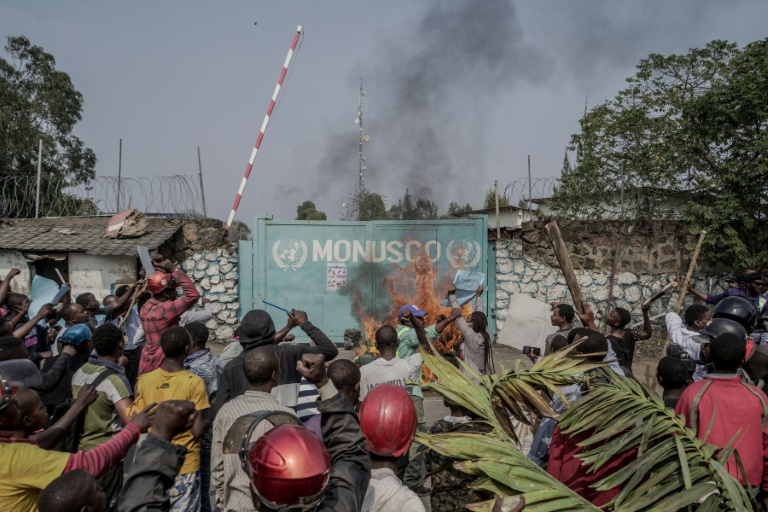
Protesters stormed a United Nations base in the eastern Congolese city of Goma on Monday, looting valuables and demanding the departure of peacekeepers from the region.

Hundreds of people blocked roads and chanted anti-UN slogans before breaking into the headquarters of the UN peacekeeping mission in Goma, an important commercial hub of North Kivu province.

The protesters smashed windows and looted computers, furniture and other valuables from the headquarters, an AFP journalist witnessed, while UN police officers fired tear gas in a bid to push them back.

Helicopters airlifted some UN officials from the overrun headquarters.

Protesters also stormed a UN logistical base on the outskirts of the city, where a student was shot in the leg. 

The UN peacekeeping mission in the Democratic Republic of Congo, known as MONUSCO, has come under regular local criticism for its perceived inability to stop fighting in the conflict-torn east.

More than 120 armed groups roam the volatile region, where civilian massacres are common and conflict has displaced millions of people. 

Ahead of Monday’s protest, the Goma youth branch of the ruling UDPS party released a statement demanding MONUSCO “withdraw from Congolese soil without conditions because it has already proved its incapacity to provide us with protection”. 

Khassim Diagne, the deputy special representative of the UN secretary general to MONUSCO, stated after the protest that “the incidents in Goma are not only unacceptable but totally counter-productive,” adding that the peacekeepers were in the region to protect civilians. 

He also told AFP that the people who had entered the base were “looters”. “We condemn them in the strongest terms,” he said.

– ‘What are they still doing here?’ –

The protest comes after the president of the Congolese senate, Modeste Bahati, told supporters in Goma on July 15 that MONUSCO should “pack its bags”. 

On Monday, protesters interviewed by AFP appeared to agree with the sentiment. 

“They said they don’t have the strength to fight the M23, now what are they still doing here?” said Shadrac Kambale, a motorbike-taxi driver, referring to a recently resurgent militia.

After lying mostly dormant for years, the group resumed fighting last November. 

The rebels have since made significant advances in eastern Congo, including capturing the North Kivu town of Bunagana on the Ugandan border. 

Sankara Bin, another protester, told AFP: “We don’t want to see MONUSCO walking in the streets of Goma, we don’t even want to see their planes flying over.”

The UN first deployed an observer mission to eastern Congo in 1999. It became the peacekeeping mission MONUSCO — the United Nations Organization Stabilization Mission in the Democratic Republic of the Congo — in 2010, with a mandate to conduct offensive operations.

It has a current strength of about 16,300 uniformed personnel and there have been 230 fatalities among them, according to the UN.

Seaweed onslaught disrupts S.Leone fishing and tourism

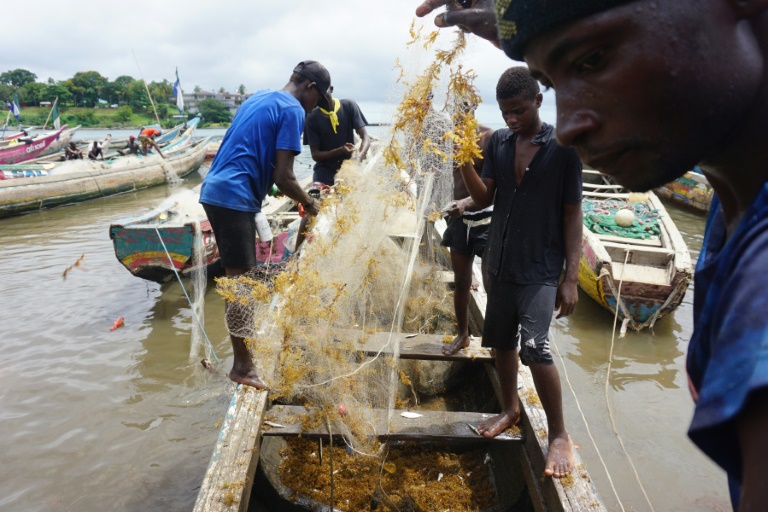
A mass of brown seaweed has for weeks choked the coastline of Sierra Leone’s capital Freetown, damaging fishing gear and disrupting tourism in a country otherwise known for its white-sand beaches.

The West African state has experienced the phenomenon several times in the past, but local people say the problem seems far worse this year.

“There is an unprecedented deposit this year,” Amidu Kamara, a fisherman at Freetown’s Tambakula wharf, told AFP.

He said dead seaweed had destroyed fishing nets and clogged boat engines.

“We have to move from one spot to the other to escape the seaweed, but it keeps coming”, he added.

The stuff is believed to come from the Sargasso Sea, in the middle of the Atlantic Ocean, according to Paul Lamin, a director at the government’s Environmental Protection Agency.

“My department received reports from other countries in West Africa where the seaweed was found in March and April this year, but in Sierra Leone it usually occurs during the rainy season and the quantity fluctuates on yearly basis,” he said.

– Business slow –

Normally, Lumley Beach in the west end of the city is packed with young people at the weekends. 

But nowadays it is desolate.

At the Sugarland Beach resort, manager Aruna Foday complained that rotting seaweed had hurt the bottom line.

“We are closing the bar and restaurant for now due to the heavy stench from the seaweed and hope to resume after the rains”, he said. “Business has been slow for us.”

Not all beach-goers were deterred, however.

Mohamed Bangura, 23, was kicking a football around with friends on a recent, overcast Sunday afternoon.

“We use our bare hands to clean up spaces to play football every weekend,” he said, noting that it nonetheless “stinks disgustingly”.

Though July and August — when seaweed normally tends to appear — is the low season for tourism, the National Tourist Board has nonetheless launched a clean-up effort.

“It’s a difficult task because the seaweed keeps coming on an hourly basis,” said general manager, Fatmata Kroma, who appealed for help from the community. 

She noted that man-made waste was also washing up on beaches and posing a further challenge to the tourism industry.

“The ocean is not a dustbin,” she said.

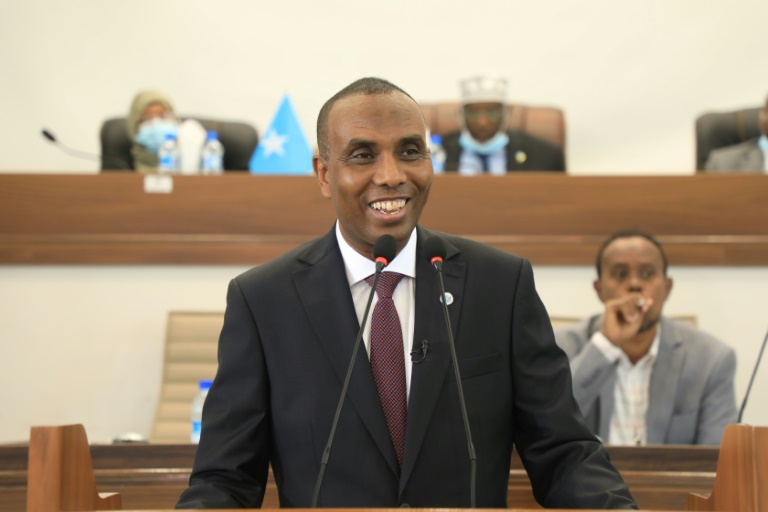
Somalia PM given 10 more days to form government

Somalia’s parliament agreed on Monday to give Prime Minister Hamza Abdi Barre more time to form a government, a month after his appointment in the troubled Horn of Africa nation.

Barre was initially expected to name a cabinet within 30 days of his appointment on June 25 but said the delays were due to the country’s protracted election process that culminated in May with the selection of Hassan Sheikh Mohamud as president.

“Today I continued engaging different segments of the Somali population to discuss the formation of my Council of Ministers,” Barre said on Twitter. 

“Somalia is at a crossroads and must move forward. We need to form an administration that can deliver the change and development our people urgently need.”

Observers have voiced hope that Mohamud’s presidency will draw the line under a political crisis that blighted the rule of his predecessor Mohamed Abdullahi Mohamed, better known as Farmajo, and threatened to plunge Somalia back into violent chaos.

Barre vowed to establish a government within 10 days after parliament approved the extension.

“The prime minister asked for an extension of 10 days, and this seemed credible because… the prime minister is in consultation with other stakeholders,” Mohamed Dhabancad, one of the legislators, told reporters.

The new government will face a host of challenges, including a looming famine and a grinding Islamist insurgency.

A crippling drought across the Horn of Africa has left about 7.1 million Somalis — nearly half the population — battling hunger, with more than 200,000 on the brink of starvation, according to UN figures.

The Al-Qaeda-linked Al-Shabaab also continues to flex its muscles by carrying out deadly attacks, underscoring the difficult task ahead for the country’s new leaders.

The militants were driven out of the capital Mogadishu in 2011 by an African Union force but still control swathes of countryside and frequently strike civilian and military targets.

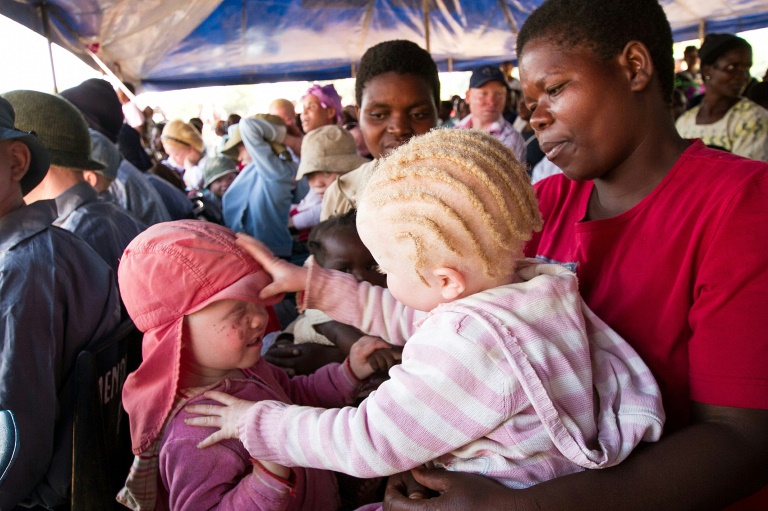
Mozambique arrests father planning to sell albino children

A father who wanted to sell his three albino children for use in witchcraft rituals was arrested in Mozambique before being able to close the deal, police said on Monday.

Police in the northwestern region of Tete, said three children aged nine to 16 were rescued at the weekend after an anonymous tip-off.  Their uncle was arrested alongside their father.

The pair allegedly planned to traffic the minors to neighbouring Malawi where they could be sold for the equivalent of about $40,000, local police spokesman Feliciano da Camara told a press conference.

Both men deny any involvement in the case.

“Investigations were carried out and it was possible to rescue (the) three minors… from captivity,” Câmara said.

Albinism, caused by a lack of melanin, the pigment that colours skin, hair and eyes, is a genetic anomaly that concerns hundreds of thousands of people across the globe.

Some sub-Saharan African countries have suffered a wave of assaults against albinos, whose body parts are sought for witchcraft practices in the belief that they bring luck and wealth.

On June 27, a court in Malawi sentenced a Catholic priest to 30 years and several other people to life over the 2018 murder of a man with albinism.

Judge Dorothy NyaKaunda Kamanga said Thomas Muhosha, who led a parish in Machinga, 100 kilometres (60 miles) northeast of Blantyre, had planned to traffic 22-year-old MacDonald Masambuka’s tissue.

The killing occurred at the height of a spree that saw over 40 people with albinism in Malawi murdered and scores of others assaulted.

One of the five convicted was the victim’s brother.

“The convicts took advantage of the deceased’s psychological need for love,” the judge said. 

“They lured him into believing that they had found a prospective wife for him and that they should go and meet her — that ended up being his death trap.”

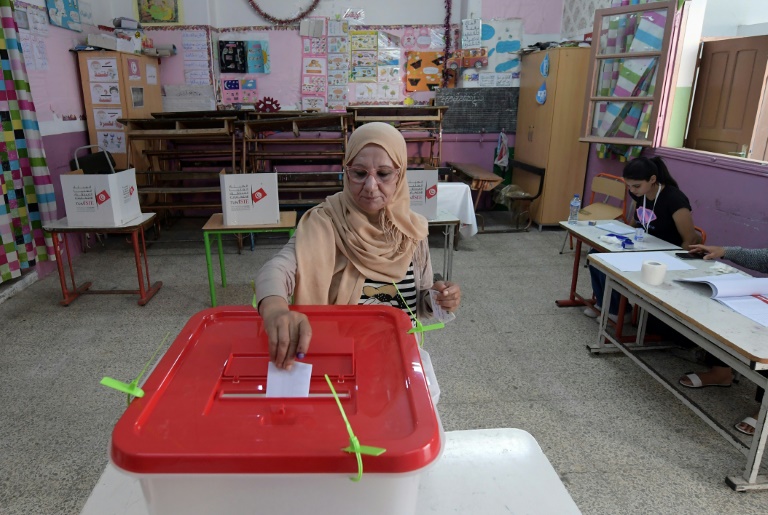
Tunisians vote on constitution set to bolster one-man rule

Tunisians voted Monday on a constitution seen as a key test for President Kais Saied, who promoted the charter that would give his office nearly unchecked powers in a break with the country’s democracy.

The referendum comes a year to the day after Saied sacked the government and froze parliament in a power grab that his rivals condemned as a coup against the only democracy to have emerged from the 2011 Arab Spring uprisings.

His moves were however welcomed by many Tunisians tired of a grinding economic crisis and a system they felt had brought little improvement to their lives in the decade since the overthrow of dictator Zine El Abidine Ben Ali.

Monday’s vote is widely expected to pass, but turnout will be seen as a test of Saied’s popularity after a year of increasingly tight one-man rule that has seen scant progress on tackling the North African country’s economic woes.

Speaking after voting got underway, Saied told journalists Tunisians faced a “historic choice”.

“Together we are founding a new republic based on genuine freedom, justice and national dignity,” he said. 

He also accused unnamed rivals of distributing money to persuade people not to vote, without giving evidence.

“We will not let Tunisia fall prey to those who are stalking it, from inside and out,” he said.

In the capital, six people waited to vote at a school turned into a polling station, the entrance guarded by two soldiers with assault rifles, alongside a posse of police.

“For me, the referendum is about protecting the country’s future,” said Tarik al-Jmaiei, 42, after casting his ballot.

– All eyes on turnout –

Some 9.3 million out of Tunisia’s 12 million people are eligible to take part, including around 356,000 who began voting overseas on Saturday. 

“The biggest unknown in this referendum is the turnout and whether it will be low or very low,” said analyst Youssef Cherif.

No minimum participation has been set for the constitution to pass, nor any provision made for a “no” result.

Saied’s critics have warned Tunisia risks sliding back towards dictatorship.

Opposition parties and civil society groups have called for a boycott, while the powerful UGTT trade union has declined to take a position.

Saied’s charter would replace a 2014 constitution that was a hard-won compromise between Islamist-leaning and secular forces after three years of political turmoil.

His supporters blame the hybrid parliamentary-presidential system it introduced, and the dominant Islamist-influenced Ennahdha party, for years of political crises and corruption.

Saied’s draft for the constitution was published this month with little reference even to an earlier draft produced by a committee he appointed himself.

Sadeq Belaid, a mentor of Saied who led the process, warned the president’s draft was far removed from that of the committee and risked creating a “dictatorial system”.

A slightly amended version did little to address such concerns.

The new text would place the head of state in command of the army, give him full executive control and allow him to appoint a government without parliamentary approval.

The president could also present draft laws to parliament, which would be obliged to give them priority.

– Revolutionary ‘correction’ –

The draft has been heavily promoted in state media, and billboards bearing the Tunisian flag have appeared exhorting people to vote “yes”.

“People don’t know what they’re voting on, or why,” Cherif said.

Saied, a 64-year-old law professor, won a landslide victory in 2019 presidential elections, building on his image as incorruptible and distanced from the political elite.

He has appeared increasingly isolated in recent months, limiting his public comments to official videos from his office — often diatribes against domestic foes he brands as “snakes”, “germs” and “traitors”.

He has vowed to protect Tunisians’ liberties and describes his political project as a “correction” and a return to the path of the revolution.

“Lots of young people, the marginalised and excluded, are on his side,” said political analyst Hamadi Redissi.

That popularity will continue to be tested in the coming months as Tunisians face soaring inflation, youth unemployment of 40 percent and a looming deal with the International Monetary Fund that observers have warned could lead to more economic pain.

Voting is set end at 10:00 pm (2100 GMT) and results are expected late Tuesday or early Wednesday.

Close Bitnami banner
Bitnami