Africa Business

Rare twin giraffes born in Kenya

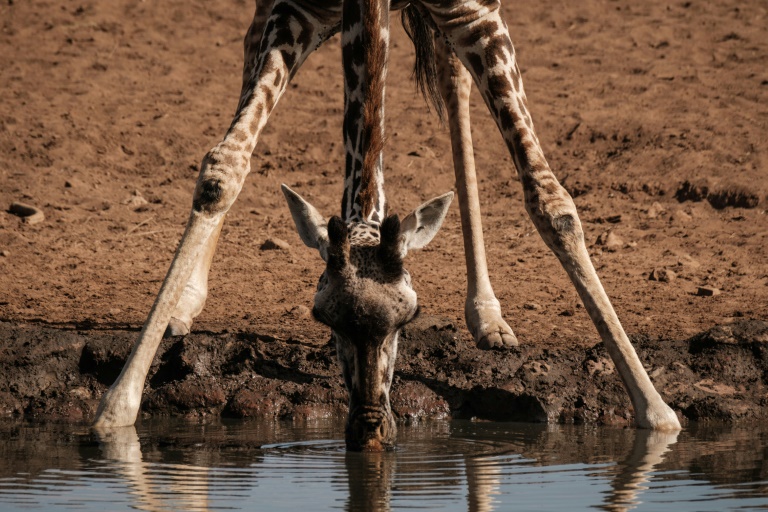
Rare twins have been born to a Maasai giraffe in Nairobi’s national park, the Kenyan wildlife minister said Tuesday.

“This is an extremely rare occurrence,” Najib Balala said on Twitter in a post accompanied by a picture of the mother watching over her offspring.

The world’s tallest species was listed as “vulnerable to extinction” on the International Union for Conservation of Nature’s 2016 Red List of threatened wildlife.

Only about 117,000 giraffe remain in the wild, according to the Giraffe Conservation Foundation. It said the numbers of the gentle long-necked giant in Africa have plummeted by 30 percent over the last 30 years, describing it as a “silent extinction”.

Kenya is home to three subspecies of giraffe, the Maasai, the reticulated and the Rothschild.

Nairobi National Park lies just seven kilometres (four miles) from the heart of the Kenyan capital, and is a tourist magnet for its wildlife including lions, leopards, rhinos and buffalos which graze against a backdrop of distant skyscrapers.

At 15 months, giraffes have one of the longest gestation periods for mammals. They give birth standing up, which means their calves drop just under two metres (six feet) to the ground. 

This startling introduction to life gets them up and running around in less than an hour. A newborn calf is bigger than the average adult human. 

Only a handful of twin births have been documented worldwide with most often not surviving. 

In the wild, giraffes can live up to 25 years, while in captivity they can survive more than 35 years.

Thousands of Sudan's Hausa protest after deadly clashes over land

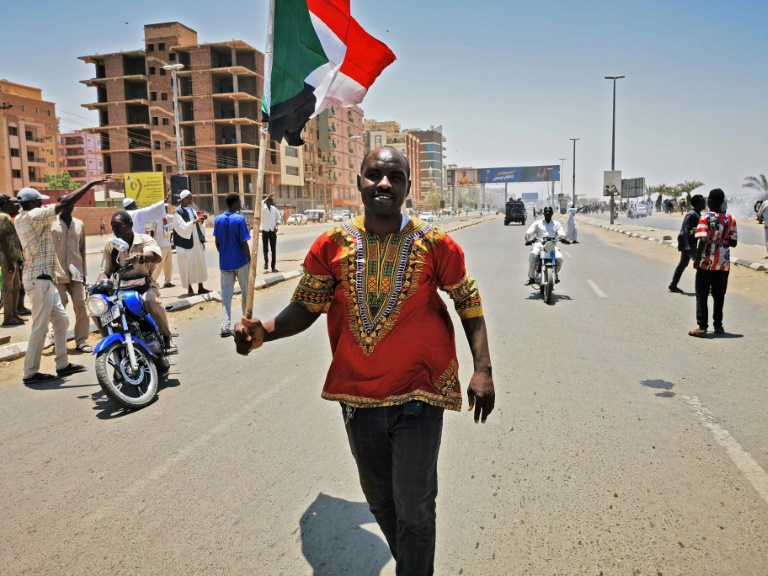
Thousands of Sudan’s Hausa people protested in multiple cities Tuesday, demanding justice for dozens of comrades killed in a deadly land dispute with a rival ethnic group in the country’s south.

The protests sparked by anger at the recent violence is the latest unrest to hit the northeast African nation, already reeling from months of mass demonstrations demanding the restoration of a transition to civilian rule following a military coup last year.

At least 79 people have been killed and 199 wounded since heavy fighting broke out last week between the Berti and Hausa groups in Blue Nile state, the health ministry says.

While the army has been deployed in Blue Nile and the fighting there quashed, protests have since erupted in other states, with marches on the streets of the capital Khartoum, as well as in the key eastern cities of Gedaref, Kassala and Port Sudan.

On Tuesday, Hausa protesters in Khartoum held up signs demanding “justice for the Blue Nile martyrs” and “no to the murder of Hausas”.

Fighting reportedly broke out on July 11 after Bertis rejected a Hausa request to create a “civil authority to supervise access to land”, a prominent Hausa member told AFP on condition of anonymity.

But a senior Berti leader said the group was responding to a “violation” of their land by the Hausas.

In Sudan, deadly clashes regularly erupt over land, livestock, access to water and grazing, especially in areas awash with weapons still struggling from the impact of decades of civil war.

– ‘Revenge’ –

Experts however say an October coup led by army chief Abdel Fattah al-Burhan has stroked a resurgence in ethnic violence.

In Gedaref, some 4,000 people marched chanting “Hausa are citizens too” and “revenge for the martyrs of the Blue Nile”.

Some 500 people also “blocked the highway” in the town of Al-Showak in Gedaref state, eyewitness Saleh Abbas told AFP.

In El Obeid, capital of North Kordofan state, some 3,000 marched on the streets chanting “the Hausa will win”, while in Port Sudan, on the Red Sea, thousands of Hausa gathered outside local government offices calling for “justice for the martyrs”.

In Kassala, authorities have banned public gatherings after thousands of Hausa demonstrators “set government buildings and shops on fire”, said Hussein Saleh, another witness.

Sudan, one of the world’s poorest countries and mired in an economic crisis that has deepened since Burhan seized power last year, has seen only rare interludes of civilian rule since independence.

Blue Nile, where the fighting erupted last week, was a key battleground of rebels trying to topple former president Omar al-Bashir during Sudan’s 1983-2005 civil war, with fighting resuming again in 2011.

After enormous protests against his rule, the army ousted Bashir in 2019.

The following year, a civilian-military power-sharing government reached a peace deal with key rebel groups, including from Blue Nile as well as the war-ravaged western Darfur region.

Darfur has also seen a renewed spike in deadly violence in recent months.

Pro-democracy activists have accused Sudan’s military and ex-rebel leaders who signed that peace deal of exacerbating ethnic tensions for political gain, claims they reject.

Initial blood tests inconclusive in S.Africa pub deaths

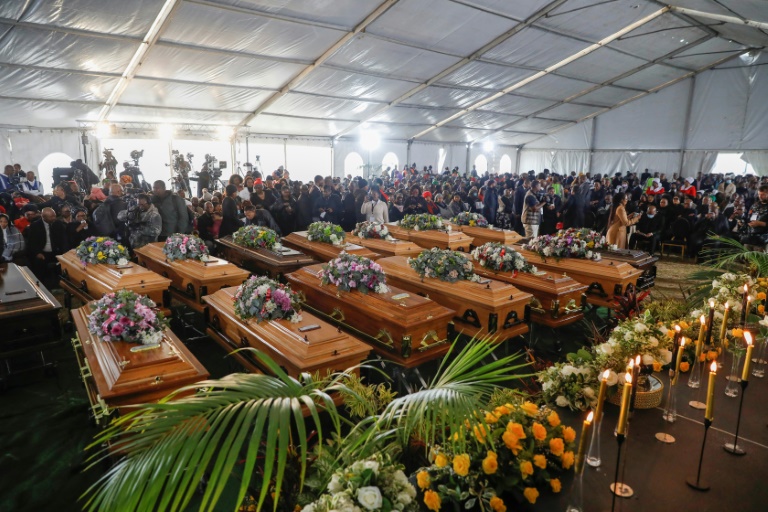
The deaths of 21 young people at a South African tavern more than three weeks ago remains a mystery as a preliminary toxicology report was inconclusive, provincial authorities said Tuesday.

Tests conducted by a Cape Town lab found alcohol and carbon monoxide in the victims’ blood but not at deadly levels, said Dr. Litha Matiwane from the Eastern Cape provincial department of health.

The lab also found methanol in the blood of all the victims, and further testing is underway to determine the levels, Matiwane said.

“What we found was for blood alcohol levels, levels ranged from 0.05 grams to 0.26 grams per 100 millilitres, which itself is not conclusive for lethal toxicology,” Matiwane told a televised media briefing from East London.

As for carbon monoxide, levels of the saturation of haemoglobin in the blood ranged from 3.3 to 21 percent, well below the lethal marker of 50 percent.

Twenty-one people aged between 14 and 20 were found dead on June 26 at the Enyobeni tavern in Scenery Park, a township in the coastal city of East London.

Survivors described a mad dash to escape the jam-packed premises and at least one person reported a suffocating smell. 

Thirty-one people were hospitalised with symptoms ranging from backache and tight chests to vomiting and headache.

A stampede has been ruled out as the cause of death. 

Additional toxicology tests are underway for other substances, but Matiwane said it was unclear when those results will be released as the lab is responsible for tests from across South Africa. 

Eastern Cape provincial leader Oscar Mabuyane said the government was working with families of the victims to ensure they had every support, and insisted the cause of the tragedy would be found.

President Cyril Ramaphosa has blamed the deaths on the “scourge of underage drinking” and vowed to crack down on “unscrupulous” bar keepers who flout regulations.

Since then, the bar’s 52-year-old owner and two employees aged 33 and 34 have been arrested for allegedly breaching alcohol sale regulations, police had said. 

The owner is expected to appear court on August 19 while the two employees have each been fined 2,000 rand ($118).

Police Minister Bheki Cele said connections between the tragedy in East London and subsequent tavern shootings around the country have been ruled out. 

“It’s criminality that has increased,” he said.

Nigeria state suspends chief after bandit is made a royal

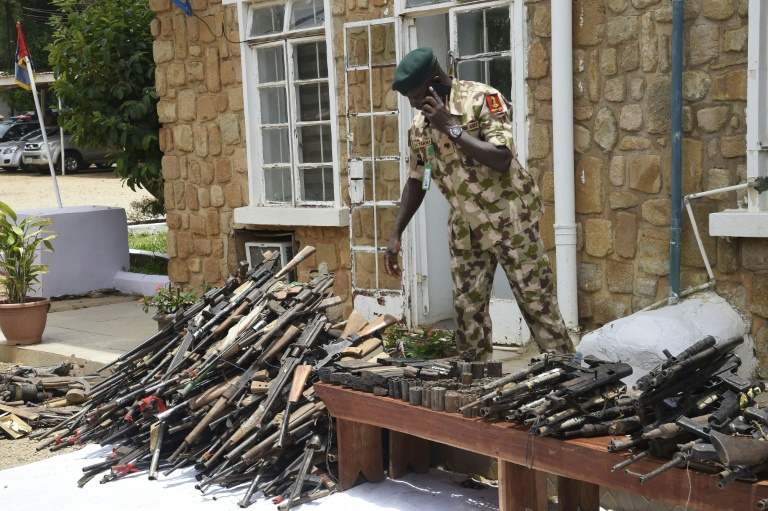
Authorities in northwest Nigeria’s Zamfara state have suspended a traditional chief after he conferred a royal title on a notorious gang leader wanted for deadly raids and kidnappings.

Parts of Nigeria’s northwest and central regions have been hit by heavily armed criminal gangs known as bandits, who loot villages and abduct and kill residents.

The central government has declared bandit militias to be terrorists but the gangs continue to defy the security forces with attacks and kidnappings.

On Saturday, the traditional emir in Zamfara’s Tsafe district sparked controversy by conferring alleged bandit kingpin Adamu Ada Aleru with the title of Sarkin Fulani, meaning a chief of the Fulani people, also called Peuls.

Nigeria’s traditional chiefs and emirs have no political authority, but are widely respected in their areas as custodians of local tradition and Islam. 

The ceremony at the emir’s palace came after an apparent peace deal with Aleru, highlighting the struggle rural communities face in bandit-infested regions.

Hundreds of Aleru’s comrades emerged from their bush hideouts on motorbikes to attend the ceremony, a palace source told AFP. 

The royal title has sparked outrage.

“Crowning a murderer is dancing on the corpses of the victims,” Senator Shehu Sani, a rights activist from the northwest, said in a tweet. 

On Sunday Zamfara state government announced that the emir would be suspended.

“Zamfara State Government has dissociated itself from the alleged turbaning of a Sarkin Fulani by the Emir of Birnin Yandoto of Tsafe Local Government Area,” the government said in a statement that did not mention Aleru. 

“State Executive Governor, Bello Mohammed Matawalle has directed for suspension of the Emir with immediate effect.” 

But a spokesman for the emir defended his actions, saying it was done in good faith to ensure peace in his region, which had suffered “unimaginable horror” from bandit attacks. 

“The title conferred on Aleru was to strengthen the existing peace to which he has played a central role,” Magaji Lawwali said.

“Before the peace agreement, we were under siege and our people were being killed and abducted for ransom on daily basis, but all these have stopped.” 

– Revered leader –

Aleru, 45, commands respect among gangs of bandits and controls hundreds of members, say security sources. 

“He is held in reverence by his men for his ruthlessness and is behind attacks in parts of Zamfara and Katsina state,” one said. 

In 2019, police in Katsina placed a five-million-naira ($12,000-) bounty on his head. 

Bandit attacks have continued despite military operations across the vast Rugu forest, which straddles the northwestern states of Zamfara, Katsina, Kaduna as well as central Niger state. 

Governments in the affected states have resorted to various strategies to try to end the violence, including amnesties, outlawing ransom payments and telecom blackouts to break communications between gangs. 

Authorities are also concerned about the growing links between bandits and jihadist groups from the northeast who are making inroads in the northwest-central region.

“People outside have no idea what we are going through and why we support giving Aleru the title,” said Tsafe resident Attahiru Yahaya.

“We live at the mercy of bandits who are well-armed and ruthless, attacking our communities at will without any intervention from the government.”

Yahaya said that since the peace agreement a few months ago, Aleru and his men had not conducted any attacks or kidnappings.

“We will support any move to maintain this,” he said. 

Rare twin giraffes born in Kenya

Rare twins have been born to a Maasai giraffe in Nairobi’s national park, the Kenyan wildlife minister said Tuesday.

“This is an extremely rare occurence,” Najib Balala said on Twitter in a post accompanied by a picture of the mother watching over her offspring.

The world’s tallest species was listed as “vulnerable to extinction” on the International Union for Conservation of Nature’s 2016 Red List of threatened wildlife.

Only about 117,000 giraffe remain in the wild, according to the Giraffe Conservation Foundation. It said the numbers of the gentle long-necked giant in Africa have plummeted by 30 percent over the last 30 years, describing it as a “silent extinction”.

Kenya is home to three subspecies of giraffe, the Maasai, the reticulated and the Rothschild.

Nairobi National Park lies just seven kilometres (four miles) from the heart of the Kenyan capital, and is a tourist magnet for its wildlife including lions, leopards, rhinos and buffalos which graze against a backdrop of distant skyscrapers.

At 15 months, giraffes have one of the longest gestation periods for mammals. They give birth standing up, which means their calves drop just under two metres (six feet) to the ground. 

This startling introduction to life gets them up and running around in less than an hour. A newborn calf is bigger than the average adult human. 

Only a handful of twin births have been documented worldwide with most often not surviving. 

In the wild, giraffes can live up to 25 years, while in captivity they can survive more than 35 years.

Ghana IMF loan outcry pressures government over economy

Ghanaian trader Mohammed Biney was already struggling when the government passed a new tax on electronic money transactions this year to try to revive the economy.

With Ghana now buckling under nearly 30 percent inflation, the Accra shoe seller was shocked when the government announced in July it would have to seek help from the IMF.

President Nana Akufo-Addo once promised “Ghana Beyond Aid” to keep his West African country off foreign aid dependency.

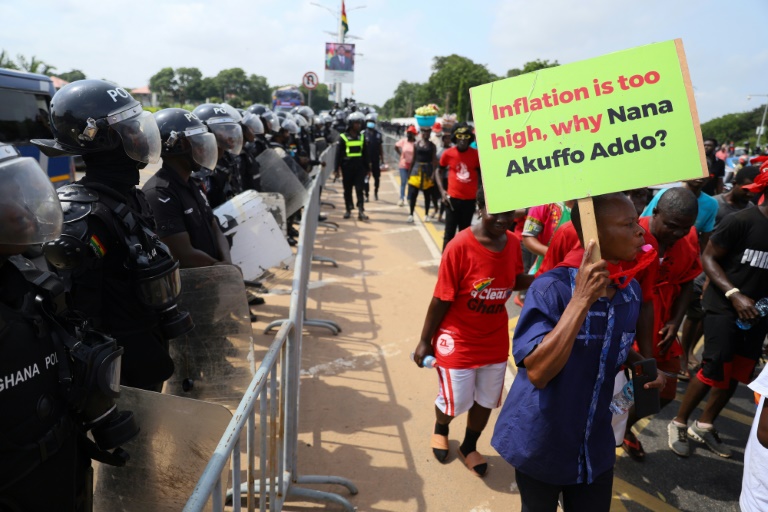
But a sudden U-turn over an IMF credit has sparked fierce debate over his economic management as Ghana struggles with the highest costs of living in two decades.

“You can’t impose taxes on us under the guise of saving the economy and then overnight come and tell us you’re going to the IMF,” trader Biney told AFP.

“I think they ran out of ideas.” 

Hit by the global pandemic and fallout from the Russian war in Ukraine on fuel and food prices, Ghana is in talks with International Monetary Fund to help stabilise its public finances.

But the decision prompted fears IMF-imposed austerity measures will force the end to Akufo-Addo’s social programmes and hurt Ghanaians already struggling with soaring costs.

A new opposition-led protest movement and unions threatening strikes over hardships have added pressure on the government just as an IMF team begins initial talks.

Saddled with heavy debt, limited access to fresh funds and few revenue options, the government says the IMF offers short-term help.

Ghana’s Deputy Finance Minister Abena Osei-Asare said after the pandemic eroded economic gains, the IMF deal would help with balance of payments and open the door to new financing while protecting social programmes.

“People don’t have an understanding of the sort of engagement we’re going to have with the IMF that’s why they are a bit apprehensive,” she told AFP.

– Soaring inflation –

Ghana’s economic data is not rosy. Growth slowed this year while inflation broke two decade highs at 29.8 percent in June, driven by transport and food costs.

Ghana’s debt to GDP ratio — a measure of what it owes against what it produces — rose from 65 percent to 80 percent during the pandemic, the IMF says.

Moody’s credit agency in February downgraded its outlook on Ghana’s bonds, citing the government’s liquidity and debt challenges.

“Ghana’s fiscal and debt vulnerabilities are worsening fast amid an increasingly difficult external environment,” the IMF said after the team’s visit this month.

“An IMF-supported program aims to provide space for Ghana to implement policies.”

This deal will be the 18th time Ghana has gone to the IMF after completing a three-year accord in 2019 which saw $918 million in support.

Just in May, Finance Minister Ken Ofori-Atta said an IMF deal was not an option, with the government preferring “home-grown” solutions. 

One of those, Ghana’s new electronic transaction tax or E-levy, was meant to help raise $900 million in much-needed revenue along with spending cuts.

But the tax was widely criticised and as people curtailed electronic payments, the E-levy has also fallen far short of revenue estimates.

Gabby Otchere-Darko, a leading ruling party member, tweeted in June the tax had only generated 10 percent of estimated revenues. 

“Given the situation that we find ourselves… we have no option,” John Kwakye, the director of research at the Accra-based IEA think tank, said of the IMF deal. 

“Going to the IMF was to build on our credibility.”

– Electoral fallout? –

But even with elections still two years away, an IMF deal will likely have political fallout.

Teaching unions went on strike earlier this month until the government agreed to cost of living allowances. Other public sector workers are threatening action.

A “Fix the Country” movement, which holds regular if small protests, has been joined by another group “Arise Ghana”. Last month its rally over economic hardships led to clashes with the police.

“The solution to Ghana’s problems doesn’t lie in Washington,” Yaw Baah, Secretary General of the Trades Union Congress (TUC) said. “This is a tragic mistake by the government.” 

Eurasia Group’s Africa head Amaka Anku told clients the IMF programme will make it harder for Akufo-Addo’s New Patriotic Party to argue they are better economic managers. 

That may weaken the position of likely NPP candidate for 2024 Vice President Mahamudu Bawumia though his probably opponent National Democratic Congress or NDC leader and ex-president John Mahama also faces challenges.

“Bottom-line, this makes for a very close election in 2024,” Anku said.

Already the opposition has hit out.

“President Akufo-Addo and Dr. Mahamudu Bawumia should take full responsibility for incompetently managing the economy,” said NDC lawmaker Haruna Iddrisu.  

“The government must come clean and tell us what the people of Ghana should expect instead of blaming Ukraine and Russia.”

Italy PM signs clutch of deal with Algeria president

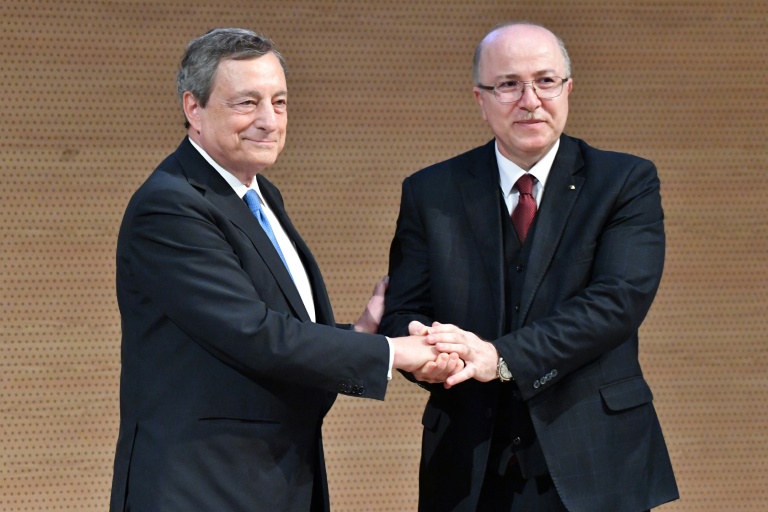
Italian Prime Minister Mario Draghi sealed 15 agreements with Algeria’s president Monday, ahead of the expected conclusion of another deal to boost gas deliveries and reduce Italy’s reliance on Russian supplies.

Draghi was received by President Abdelmadjid Tebboune, and the two went on to sign agreements and memorandums of understanding in areas ranging from energy to sustainable development, justice and micro-enterprises.

The energy agreement signed on Monday is “a testament to our determination to achieve even more in this domain,” Draghi said, ahead of the expected signing of an oil and gas supply deal between Algeria and a clutch of companies including Italian energy giant Eni.

“Tomorrow, an important agreement between (US energy firm) Occidental (Petroleum), Eni and (French oil company) Total providing significant volumes of natural gas” to Italy will be signed, Tebboune earlier told reporters at a joint news conference with Draghi.

This contract will allow “the development of a site situated in the Berkine perimeter, and which should generate more than a billion barrels” of hydrocarbons, a government source told AFP.

Tebboune said the deal was worth $4 billion.

The government source confirmed that Algeria will also increase gas exports to Italy by four billion cubic metres in the coming days, as part of a deal reported Friday.

Italy buys the majority of its natural gas from abroad, with some 45 percent of its imports historically coming from Russia.

But Rome has increasingly looked to Algeria, historically its second biggest supplier, to reduce that dependence after the war in Ukraine sparked sanctions against Moscow and sent energy prices soaring.

Algeria has therefore supplanted Russia to “become in recent months the biggest supplier of gas” to Italy, Draghi told reporters on Monday.

According to APS, Algeria was set to furnish Italy with a total of around 20 billion cubic metres of gas in 2022 as a whole, before the latest deal. 

Draghi previously visited Algeria in April, when he concluded a deal to progressively increase from 2022 Algerian deliveries to Italy through the Transmed pipeline by up to nine billion cubic metres per year in 2023-24. 

In May, Eni signed a memorandum of understanding with Algeria’s Sonatrach to boost gas exploration in the North African country.

The MoU “will allow Sonatrach and Eni to evaluate the gas potential and opportunities for accelerated development at specific fields already discovered by Sonatrach in Algeria”, Eni said at the time.

Algeria is Africa’s biggest gas exporter and supplies around 11 percent of the natural gas consumed in Europe. 

Forest fires contained in Morocco: authorities

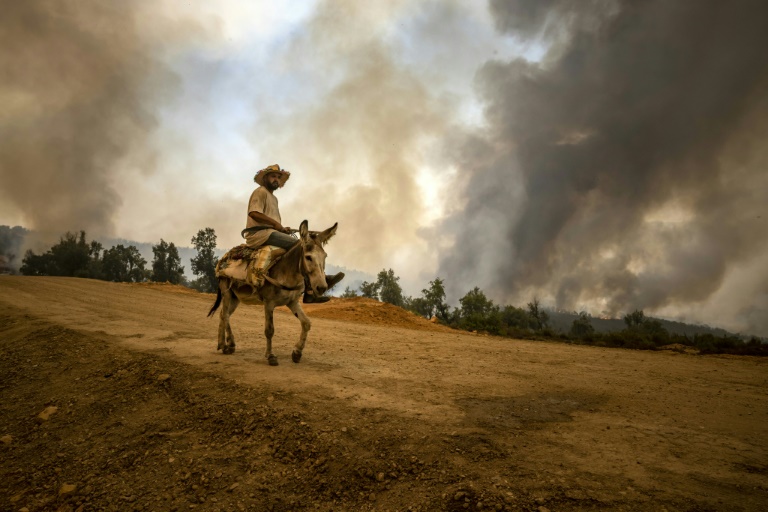
Devastating forest fires that broke out last week in forested areas of northern Morocco have been contained, authorities said Monday.

One of the last fires, which destroyed some 500 hectares (1,200 acres) — half of it forested — was tamed on Monday in Tetouan province, local authorities said. 

Firefighting teams had earlier brought blazes elsewhere under control, notably in Larache, the worst-affected province, where one person was killed.

Up to Sunday, fires had burned across 6,600 hectares, according to the national forests agency. 

Twenty villages, some in remote areas, had been evacuated. 

But with temperatures expected to reach between 41 and 46 degrees Celsius (around 105-114 degrees Fahrenheit) during the remainder of this week, according to the national meteorological office, there could be more to come. 

Said Chakri, an environmentalist quoted by national news agency MAP, said that “the reality of climate change” contributed to the devastation. 

A Turbo Thrush plane dispatched to douse the flames in Tetouan was forced to make an emergency landing on Sunday, without injury to the pilot.

A total of eight Turbo Thrush planes were deployed, alongside five Canadair planes, and some 2,000 personnel, including the civil defence, the gendarmerie and the army, were mobilised. 

Surveillance drones were also deployed for the first time, in order to spot fires. 

Morocco, experiencing severe drought, has been hit by heatwaves over the past month. 

On the other side of the Strait of Gibraltar, fires have also raged in southern Europe, from Spain and Portugal to Greece and France, where temperature records were broken on Monday.

Last year, a total of 2,782 hectares of Moroccan forest were destroyed by 285 fires that broke out between January and September, notably in the mountainous Rif region. 

Tunisia soldier killed in border clash with smugglers: ministry

A Tunisian soldier was killed Monday on the country’s southern border during a clash with smugglers trying to transfer vehicles from Libya to Algeria, the Tunisian defence ministry said.

“This afternoon, a military patrol operating in the militarised border area of Bourj al-Khadra responded to an attempted entry of six smuggled vehicles,” the ministry said.

The vehicle occupants opened fire and the patrol responded, prompting the attackers to flee, with one soldier left dead and another wounded in the shootout, the ministry added.

Fuel, food products, electronic equipment and other products are smuggled across the border regions between Libya, Tunisia and Algeria, with smugglers taking advantage in particular of chaos in Libya since the 2011 fall of longtime dictator Moamer Kadhafi in a 2011 NATO-backed uprising.

US promises $1.2 bn to feed Horn of Africa, urges others to help

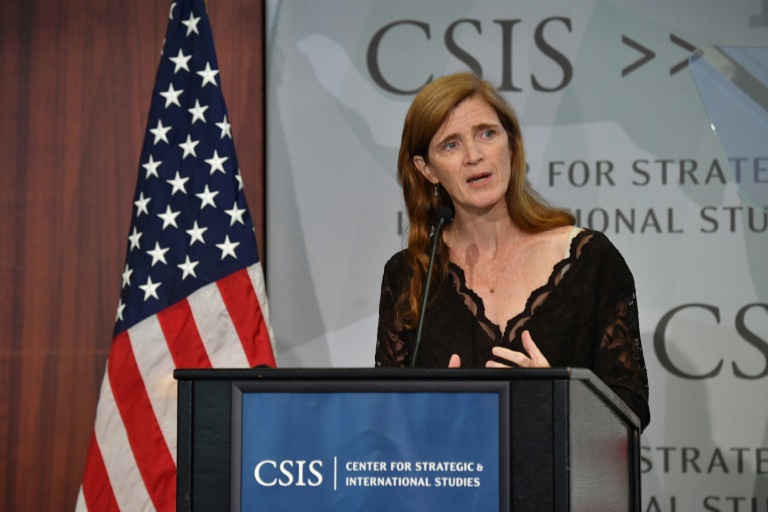
US aid chief Samantha Power on Monday promised $1.18 billion to help avert famine in the Horn of Africa and urged other nations including China to do more to fight a food crisis aggravated by Russia’s invasion of Ukraine.

Power voiced alarm that the war as well as climate change were worsening hunger around the world, just after a decade of progress had been “obliterated” by the Covid pandemic.

“Today we are confronting something even more devastating as not only are tens of millions more people facing that grave hunger, many of them are at risk of outright starvation,” she said at the Center for Strategic and International Studies.

Power, administrator of the US Agency for International Development, said the situation was especially dire in turbulent Somalia, conflict-hit Ethiopia and Kenya, the so-called Horn of Africa which is forecast to experience its fifth straight drought later this year.

Announcing a visit to the Horn of Africa this weekend, Power said that at least 1,103 children there are known to have died and some seven million other children are severely malnourished.

Power said the $1.18 billion in US aid would include emergency food — notably sorghum, a locally used grain more readily available than wheat — as well as a peanut-based supplement for malnourished children and veterinary services for dying livestock.

“Now we need others to do more, before a famine strikes, before millions more children find themselves on the knife’s edge,” she said.

Global prices of food have skyrocketed due to the war in Ukraine, a leading wheat exporter, with Russian warships blocking ports as Kyiv lays mines to avert a feared amphibious assault.

Power criticized the “sinister” policies of Russia but also pinned blame on China — seen by the United States as a leading global competitor — over its trade restrictions on fertilizer and “hoarding” of grain.

If China released fertilizer or grain to the global market or World Food Programme, it would “significantly relieve pressure on food and fertilizer prices and powerfully demonstrate the country’s desire to be a global leader and a friend to the world’s least developed economies,” she said.

She also issued a tacit criticism of India, which is seen by Washington as an emerging ally but has declined to shun historic partner Russia and has imposed its own export ban on wheat.

Praising Indonesia for lifting restrictions on palm oil, Power said, “We encourage other nations to make similar moves, especially since several of the countries instituting such bans have been unwilling to criticize the Russian government’s belligerence.”

“Countries that have sat out this war must not sit out this global food crisis,” she said.

Close Bitnami banner
Bitnami