Africa Business

Madrassas revive 'Golden Age' in Morocco's Fez

In the narrow streets of Fez’s Old City, Morocco’s first capital, centuries-old places of learning are being revived to promote moderation in Islam, as their founders originally intended.

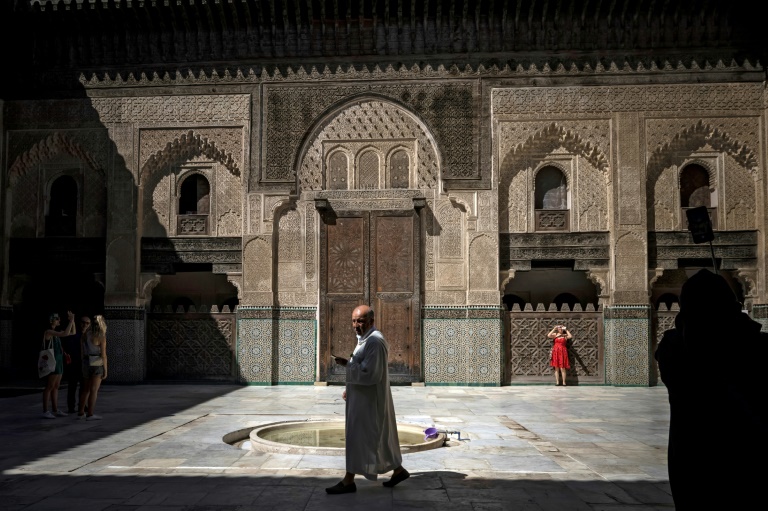
Studying at the 14th century Bou Inania madrassa (religious school), inside the UNESCO-listed walled city, offers a life “in the embrace of a venerable academic history”, according to student Moaz Soueif.

The Bou Inania madrassa is one of six such institutions to be renovated since 2017, under a program funded by Morocco’s government to preserve the city’s heritage and promote tourism.

Soueif, 25, shares the madrassa’s upper floor with around 40 students of the Qarawiyyin University, which was a world-leading spiritual and educational hub centuries before the European renaissance.

Adorned throughout with intricate inscriptions and mosaics, students are not Bou Inania’s only visitors. Tourists also flock to see the elegant open-air courtyard, graced by a central fountain and walls of carefully maintained tilework.

The madrassa sits just inside Bab Boujelloud, one of the Old City’s main entrances and a key landmark for tourists.

The nearby Cherratine and Attarine madrassas were also recently renovated for the benefit of tourists, who “usually say their time here feels spiritual and the Old City is really genuine”, according to guide Sabah Alawi.

Today, Fez serves as a monument to a highpoint of Islamic civilisation, the 13th and 14th centuries when Muslim rulers governed from Morocco to western China.

That period also represents a golden age in the city’s history, which had just been reinstated as Morocco’s capital after three centuries of being overshadowed by Marrakesh further south.

– Polymath pope –

Down a steep alley from Bou Inania lined with stalls selling traditional wares and local food, stands the Qarawiyyin mosque, built when the city was founded in the ninth century. 

It later became the heart of the university of the same name — one of the oldest in the world. 

Fez University history professor El-Haj Moussa Aouni said the city thrived in the 13th-14th centuries along with other centres across the Maghreb region — from Marrakech to Oran in Algeria and Kairouan in Tunisia.

The madrassas of Fez are “add-ons to the main university, which were used for teaching sciences such as maths, medicine, mechanics and music, as well as Islamic studies and literature”, he said.

The Qarawiyyin mosque has a large, roofless courtyard surrounded by pillars separating it from the covered sections, which are set aside for prayer and study.

The site is off-limits to tourists — although some take advantage of the doors being opened shortly before prayers to snap photos in the courtyard.

At the time of its establishment the university was one of the best in the world and hosted noted scholars such as Tunisian Ibn Khaldoun, seen as the founding father of sociology.

Another prominent figure believed to have studied there was Gerbert of Aurillac, a polymath who introduced Arabic numerals to Europe, is credited with inventing the mechanical clock, and later became Pope Sylvester II.

As well as preserving the city’s architectural treasures, the renovation work is part of Morocco’s wider efforts to promote moderation in Islam.

– Model of tolerance –

The scholars have left their mark on the city — such as at the Qarawiyyin library, home to some 4,000 manuscripts including an original donated by Ibn Khaldoun himself.

“It’s among the oldest libraries in the Islamic world,” said its rector Abdulfattah Boukachouf.

The 14th-century institution sits on a courtyard filled with the ringing of hammers of brass and silver workers. But in the reading room, last extended by Sultan Mohammed V — grandfather of the current King Mohammed VI — silence reigns.

In a corner, a team of women expertly restore delicate manuscripts.

Qarawiyyin University has started a new programme for post-graduate students who have excelled in writing and memorising the Koran.

Students cover “various Islamic studies, comparative religion, French, English and Hebrew, allowing them to understand other cultures”, said Soueif, from the northern town of Ksar El-Kebir.

“We should be a role model for tolerant Islam, at the same level of the great scholars who passed through here before us,” he said.
Tunisian president amends proposed constitution

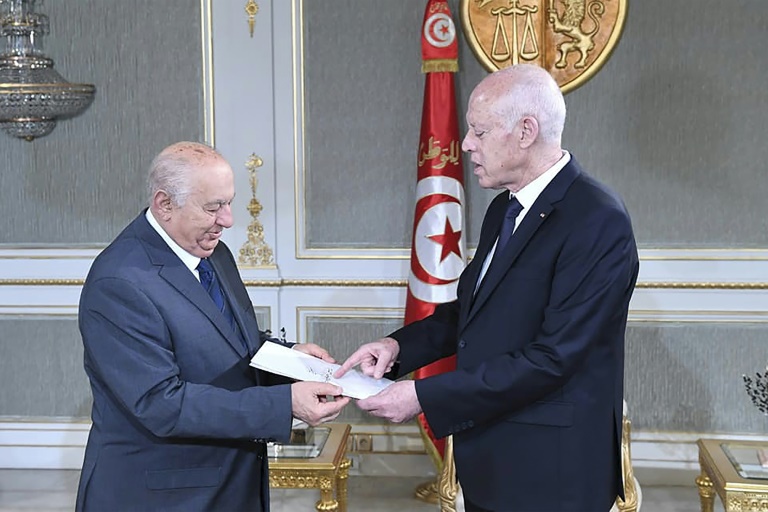
Tunisian President Kais Saied published an amended version of a draft constitution late Friday in an attempt to ward off criticism after the original was slammed for the nearly unlimited power it gave his office. 

The new constitution, which will be put to a referendum this month, is the centrepiece of Saied’s plan to remake the North African country’s political system. 

It was unveiled almost a year after Saied sacked the government, suspended parliament and seized wide-ranging powers in moves opponents have called a coup against the only democratic system to have emerged from the Arab Spring revolts.

The legal expert who oversaw the constitution’s drafting has disavowed it, saying it was “completely different” from what his committee had submitted and warning that some articles could “pave the way for a dictatorial regime”.

The amended draft, published around midnight Friday, makes changes to two articles, though it still retains a broad range of powers for the head of state.  

Hours before the new text was released, Saied announced in an official video that “clarifications needed to be added to avoid confusion and interpretation”.

Changes have been made to an article that stated Tunisia “is part of the Islamic community” and that “the State must work to achieve the objectives of Islam” — it now adds “within a democratic system”. 

The clause had been previously criticised for its ambiguity by those who advocated for a completely secular system, and international rights group Amnesty International had warned it could “provide a mandate to discriminate against other religious groups”. 

The other amendment is to an article about rights and freedoms, which now clarifies that “no restriction may be placed on the rights and freedoms guaranteed in this Constitution except by law and necessity imposed by a democratic order”.

The rest of the document remains largely unchanged. 

Saied wants a presidential system to replace the country’s 2014 constitution, which enshrined a mixed presidential-parliamentary system often beset by deadlock and marred by corruption.

Under his proposal, “the president of the republic carries out executive functions with help from the government”, whose chief would be appointed by the president and not subject to confidence votes in parliament.

The document would water down the role of parliament, creating a new parliamentary chamber for “regions and districts”, chiming with Saied’s long-held vision for a decentralisation of power. 

The president would be the head of the armed forces and be charged with naming judges, who would be banned from striking.

Some Tunisians have welcomed Saied’s moves against the sclerotic system that emerged from the revolt that toppled dictator Zien El Abidine Ben Ali in 2011.

But others have warned he is targeting political rivals and dragging the country back towards autocracy.

Libya traditional jewellery hangs on by silver thread

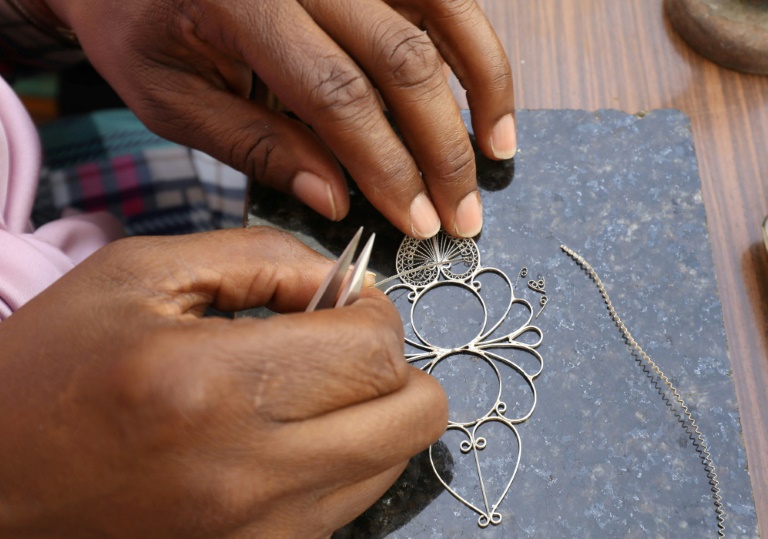
In Tripoli’s Old City, young Libyans weave delicate patterns with threads of silver and gold to create traditional filigree jewellery — reviving an art almost lost through decades of dictatorship and war.

Abdelmajid Zeglam is just 12 years old, but his minutely detailed creations are already selling fast in the streets around a Roman-era archway dedicated to emperor Marcus Aurelius. 

“I hesitated at first for fear of failing because I’m young, but my mum encouraged me,” Zeglam said.

He is the youngest of 20 or so students, around half of them female, studying at the Libyan Academy for Traditional Gold and Silver Crafts, in a building that once served as a French consulate to the Ottoman Empire.

Trainees learn about precious metal alloys before studying the art of filigree, in which beads and threads of the precious materials are woven into intricate designs then soldered together to create jewellery.

“I love it,” Zeglam said. “I want to become a petroleum engineer in the mornings and a jeweller in the afternoons.”

Mohamed al-Miloudi, a 22-year-old civil engineering student in a baseball cap, said he had not missed a class since signing up in September.

“It’s a hobby, but I’d like to make it into my trade,” he said.

The institute’s founder, Abdelnasser Aboughress, said filigree jewellery was an ancient tradition in the North African country.

“Craftsmen in the medina of Tripoli were trained by Jewish masters and later by Arabs, at the prestigious School of Arts and Trades” founded in the late 19th century, he said.

– Secret jewellers –

But generations of tradition were abruptly halted after Moamer Kadhafi took power in a 1969 coup.

The capricious ruler scrapped the constitution and established his “jamahiriya” — a medley of socialism, Arab nationalism and tribal patronage.

He also scrapped the private sector, seizing companies and confiscating their assets.

Overnight, self-employed artisans lost everything: their workshops, their livelihoods and their students. 

“The state reduced Libyan crafts to nothing and forced a generation of young apprentices, who should have taken up the baton, to instead leave the traditional crafts and join the army” or become civil servants, said Aboughress.

The 55-year-old was born just a few streets away in the medina, and despite Kadhafi’s ban, he took up the craft at the age of 15.

Along with his father, for decades he worked in secret on jewellery for trusted clients.

Now, he hopes to pass the craft on to younger generations, as well as fighting back against a tide of “lower-quality jewellery imported from Egypt and China (which) has flooded the market”.

Aboughress is working on a project to document and preserve as much of this cultural heritage as possible.

– ‘People with passion’ –

Student Fatima Boussoua hit out at the practice of selling old Libyan silver jewellery at cheap prices to be exported then melted down.

“It’s part of Libya’s artisanal heritage that’s disappearing!” she said. 

A dentist in her 40s who also teaches at the University of Tripoli, Boussoua has been training at the centre for the past year, hoping to master the craft.

“We should be training artists to preserve our heritage,” she said. “All it needs is people with passion.”

While becoming a true expert takes years of training, Aboughress’s students are already producing works for sale online or at the centre itself.

That said, he admits the project needs financial help to buy the expensive raw materials — as well as “moral support”.

He hopes that with enough resources, he will one day be able to set up a string of other workshops across Libya.

“It’s time to bring this craft back to life,” he said.

Burkina Faso's Damiba calls for 'unity' against jihadists

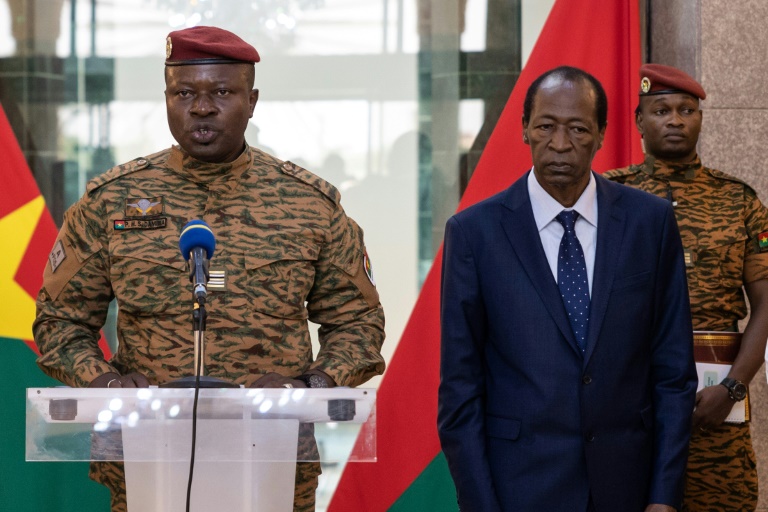
The head of Burkina Faso’s ruling junta Paul-Henri Sandaogo Damiba, speaking alongside ex-president Blaise Compaore, on Friday called for “social cohesion” to face jihadist violence plaguing the nation.

Damiba, who took power in a coup in January, made his appeal after inviting former leaders to attend a summit to “accelerate national reconciliation” and attempt to curb jihadist attacks that have rocked Burkina Faso since 2015.

But only two ex-leaders attended: Jean-Baptiste Ouedraogo, who was in office from 1982 to 1983, and Compaore, who served as president for 27 years until he was forced into exile in Ivory Coast following a popular uprising in 2014.

Compaore’s return home on Thursday for the first time in eight years to attend the summit has drawn widespread criticism.

Many have called for his arrest after he was sentenced in absentia to life in prison in April for his role in the assassination of his predecessor Thomas Sankara, a pan-African icon, during the coup that brought him to power in 1987.

Damiba said Friday’s meeting focused mostly on “the quest for lasting peace in our country”.

“It is only in social cohesion and unity that the forces fighting terrorism at this very moment will be even more determined and successful,” he added, with Compaore standing beside him.

“The urgency of preserving the existence of our homeland requires a synergy of actions that does not allow us to give ourselves the luxury of wasting any time in arguments,” Damiba said.

– ‘Shared peril’ –

Since 2015, Burkina Faso has been caught up in an escalating wave of violence attributed to jihadists allied to both al-Qaeda and the Islamic State group.

The violence has claimed more than 2,000 lives and forced 1.9 million people to flee their homes.

Compaore and Ouedraogo in their own statement called on Burkinabe people to “overcome political rifts” to rebuild the country and face what they described as the “shared peril” of the jihadist insurgency.

“There is an absolute urgency to reconquer occupied lands and restore the state’s authority,” they said.

Some 40 percent of the country lies outside the control of the government, a regional mediator said last month.

The other former leaders invited to attend Friday’s summit were Roch Marc Christian Kabore, who was overthrown in January, Isaac Zida, who briefly took office in 2014 and currently lives in exile in Canada, and Michel Kafando, who ruled from 2014 to 2015.

But none of them showed up.

– ‘Should be arrested’ –

Dozens of protesters demonstrated Friday morning outside Kabore’s home in Ouagadougou to prevent him from attending.

Members of Kabore’s party, the People’s Movement for Progress (MPP), were among those demonstrating.

“Should we sacrifice justice, the foundation of the republican pact, on the altar of a certain national reconciliation?” the MPP asked. 

Boukari Conombo, president of the Black Armband, a civil society movement, dismissed the new president’s attempt at reconciliation as “a farce”. 

“It’s not the role of Damiba who made a coup to reconcile people,” he told AFP.

The Patriotic Front, which includes some 20 organisations and political parties, said Compaore “should be immediately arrested and taken to prison”, as an international arrest warrant has been issued against him. 

“This reconciliation must not and cannot be achieved by establishing impunity or by making arrangements between politicians,” several trade unions, also present, said.

Among the other former presidents, Zida could not make it “for administrative reasons”, while Kafando could not “for health reasons”, according to Damiba.

Angola's authoritarian ex-president dos Santos dies in Spain

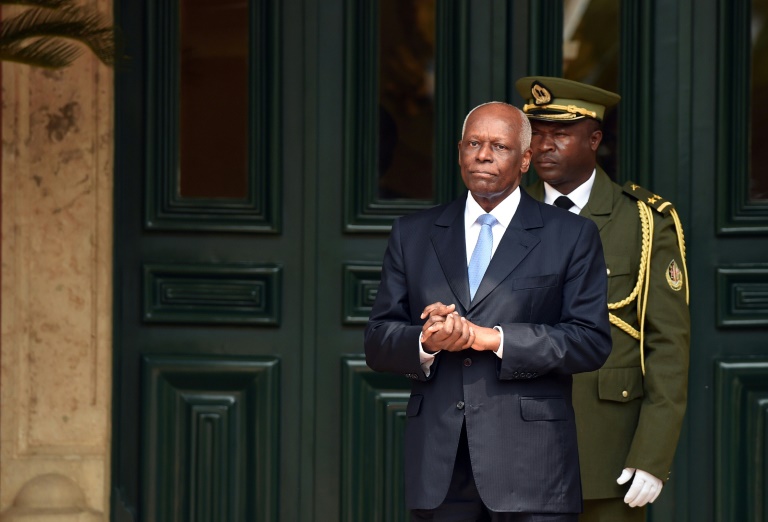
Jose Eduardo dos Santos, who ruled Angola with an iron fist for 38 years, died on Friday at a hospital in Barcelona after suffering cardiac arrest, the government said. He was 79.

Seldom seen in public, dos Santos was nonetheless a presence in daily life for as long as most Angolans could remember. He came to power in 1979, before stepping down in September 2017 after nearly four decades at the helm of the Portuguese-speaking, oil-rich state.

He maintained fierce control throughout the country’s devastating civil war, which ended in 2002, followed by an oil boom and recession in 2015.

With “great pain and consternation”, the Angolan government said dos Santos died at 11:10 am (1010 GMT) at the Teknon Medical Centre.

The government “presents its deepest feelings of sorrow to the bereaved family,” the statement read, describing the former leader as a “statesman of great historical stature” who led the country through very difficult times.

Angolan President Joao Lourenco, who is seeking re-election in August, said the country had suffered a “big loss”. He declared five days of national mourning, starting Saturday.

A presidential decree ordered flags to be flown at half-staff and the cancellation of “all shows and public demonstrations”. 

“This is very sad news… He has done a lot for the country,” said Luanda resident Santos Camuenho, a 40-year-old mason.

Dos Santos was admitted to hospital in Spain and placed in intensive care after suffering a cardiac arrest on June 23.

– Fears of foul play –

The government gave no explicit cause of death in its statement, and one of dos Santos’ daughters swiftly demanded the hospital retain his body for an autopsy over fears of foul play.

She asked the medical centre to “hold onto the body… until an appropriate autopsy is carried out on fears it could be transferred to Angola,” her lawyers said.

Angolan Foreign Minister Tete Antonio declined to comment on her accusations.

Welwitschia dos Santos, known as Tchize, had last Monday made a complaint to the Catalan regional police, alleging her father’s condition was the result of attempted murder.

According to the complaint, the 44-year-old believes her father’s wife, Ana Paula, and his personal physician are responsible for the deterioration in his health.

In Friday’s statement, her lawyers said the complaint included allegations relating to “attempted murder, failure to exercise a duty of care, injury resulting from gross negligence and disclosure of secrets by people close to him”.

Police confirmed receipt of the complaint and said they had opened an inquiry.

Born in the slums of Luanda, dos Santos was one of Africa’s longest-serving leaders, using his nation’s oil wealth to turn one of his children into a billionaire while leaving his people among the poorest on the planet.

– ‘Billions embezzled’ –

Dos Santos avoided the personality cult so often favoured by dictators, but instead used secretive and authoritarian tactics he learned during the Soviet era.

Despite controlling every aspect of Angolan life, he mismanaged his own transition away from power so badly that he ended up in temporary self-imposed exile, with a son in prison and a daughter facing international legal challenges.

When he stepped down, dos Santos handed over to former defence minister Lourenco, handpicked to replace him. 

But Lourenco quickly turned on his former master, starting an anti-corruption drive to recoup the billions he suspected had been embezzled under dos Santos.

Dos Santos’s son Jose Filomeno has been in prison since 2019 on corruption charges.

His eldest daughter Isabel was once named by Forbes as Africa’s richest woman, worth $3 billion (2.55 billion euros). She now faces a slate of investigations into her multinational business dealings.

South African President Cyril Ramaphosa paid tribute to dos Santos, saying his roots, exile and education in the USSR “resonate profoundly with the journey many South Africans in our own liberation movement experienced”.

– ‘Giant tree has fallen’ –

Portugal’s president Marcelo Rebelo de Sousa described him as a “decisive protagonist” in the relations with Angola’s former colonial power.

Former Portuguese prime minister and ex-head of the European Commission Jose Manuel Barroso recalled a leader of exceptional intelligence, who was able to guarantee Angolan national unity”.

For much of his time at the head of his MPLA party, dos Santos fought a civil war.

The conflict was a Cold War hotspot, with dos Santos receiving Soviet and Cuban backing while UNITA rebels had Washington and apartheid South Africa on their side.

Namibia’s president Hage Geingob called dos Santos an “outstanding revolutionary”.

“Another giant tree has fallen,” Geingob said. 

When the 27-year conflict ended in 2002, dos Santos led Angola away from hardline Marxism and fostered a post-war oil boom and foreign investment surge that transformed central Luanda.

“My heart is bleeding,” Nsimba Adao, a 39-year-old street vendor in Luanda, told AFP. “He brought us peace.”

ub-bur/ah/gw

Morocco 'detains' employees of French tycoon accused in sex case

Several employees of French insurance tycoon Jacques Bouthier, under arrest in Paris on charges of raping a minor, have been placed in Moroccan custody, a lawyer for the plaintiffs said Friday.

The employees appeared before the public prosecutor in the northern city of Tangiers earlier this week and a judge placed “five of them under a committal order”, while the sixth was released, lawyer Karima Salama told AFP.

Bouthier, 75 and one of France’s richest men, is ex-CEO of insurance group Assu2000, later renamed Vilavi.

He was indicted on May 21 and arrested by Paris prosecutors after a preliminary investigation into accusations of people trafficking and rape of a minor.

A Frenchman and five Moroccan suspects including two women are accused of “having recruited and psychologically groomed” women, said Salama, of the Moroccan Association for the Rights of Victims (AMDV).

“They also justified (Bouthier’s) conduct,” she said.

Several young Moroccan women filed a complaint against Bouthier last month, accusing him of various acts of “people trafficking, sexual harassment and verbal and moral violence” between 2018 and this year, according to Salama.

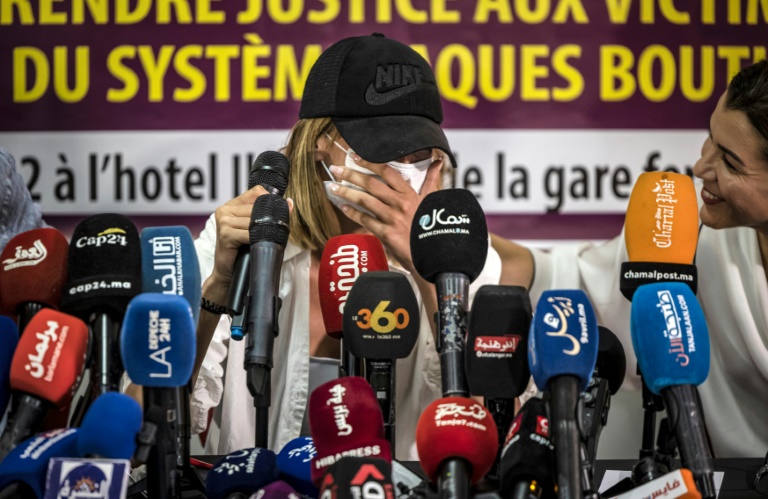
Some told a press conference at the time that they had faced repeated sexual harassment and intimidation as well as threats to their jobs, in a city where many struggle to find work.

The women said they had been sacked after refusing to “give in to harassment and blackmail” over their employment by Bouthier and other French and Moroccan executives.

Such public declarations are rare in Morocco, where sexual abuse victims often face social stigma.

AMDV appealed on Friday for any other victims to “break the wall of fear and actively be part of the fight against impunity for people who have gravely harmed their dignity as women”.

Bouthier is also being prosecuted in France for conspiracy to kidnap, kidnapping in an organised gang and possession of child pornography.

Guinea political leaders found not guilty

A Guinean judge on Friday found three political leaders not guilty of contempt of court over comments they had posted on social media criticising the prosecutor’s office and the military-appointed parliament.

The defendants — leaders of an influential political and civil society coalition, whose arrest Tuesday prompted two days of violent protests — were released Friday following a trial in Dixinn, a suburb of the capital Conakry.

Mamadou Billo Bah, rapper Alpha Midiaou Bah also known as Djanii Alfa, and Oumar Sylla are members of the National Front for the Defence of the Constitution (FNDC).

They were seized Tuesday during a press conference.

Sylla, also known as Fonike Mengue, and Bah were beaten and had their clothes torn by police officers, AFP witnessed.

The three were charged with “contempt of court and public injury.”

The prosecutor of the Conakry Court of Appeal, Alphonse Richard Wright, on Tuesday accused Sylla and Bah of “producing and disseminating through a computer system insulting remarks” against the junta-appointed parliament, the National Transitional Council (CNT).

The rapper, Alfa, had recently criticised comments made by the president of the CNT, before being threatened with arrest by the prosecutor, according to his lawyer.

On Friday, the prosecution told the defendants they were “sullying the country’s image on social media” but requested a dismissal of the case and the release of the defendents.

There has been widespread political condemnation of their heavy-handed arrests, which sparked protests in Conakry from Tuesday to Thursday in which 17 police officers were injured, according to the police.

Demonstrators burned tyres, set up barricades, knocked over bins and threw projectiles at the police, who tried to disperse them with tear gas.

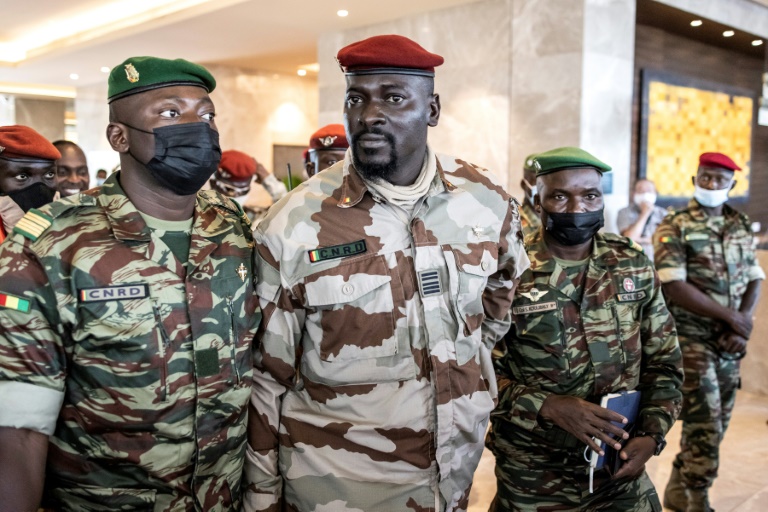
The protests were among the first against the administration of military ruler Mamady Doumbouya, who took power after a coup in September.

The FNDC coalition had previously been vocal against former president Alpha Conde, who was overthrown in the coup.

The junta in May banned any public demonstrations that could be construed as threatening public order.

The FNDC had initially called protests for June 23 but indicated they were prepared to give the transitional government a “chance” to set a proposed dialogue in motion.

However, their patience snapped after a meeting with the authorities, which the FNDC slammed as a “parody.”

Doumbouya has pledged to hand over power to elected civilians within three years.

The Economic Community of West African States (ECOWAS) rejected this timeline at a meeting on July 3 but did not announce new sanctions.

Guinea is currently suspended from the bodies of the 15-nation bloc. 

Angola's authoritarian ex-president dos Santos dies in Spain

Jose Eduardo dos Santos, who ruled Angola with an iron fist for 38 years, died on Friday at a hospital in Barcelona after suffering cardiac arrest, the government said. He was 79.

Seldom seen in public, dos Santos was nonetheless a presence in daily life for as long as most Angolans could remember, coming to power in 1979, before stepping down in September 2017 after nearly four decades at the helm of the Portuguese-speaking, oil-rich state.

He maintained fierce control throughout the country’s devastating civil war, which ended in 2002, followed by an oil boom and recession in 2015.

With “great pain and consternation” the Luanda government posted on Facebook confirmation of dos Santos’ death at 11:10 am (1010 GMT) at the Teknon Medical Centre.

“(The government) presents its deepest feelings of sorrow to the bereaved family,” the statement read, describing the former leader as a “statesman of great historical stature” who led the country through very difficult times.

Angolan President Joao Lourenco, who is seeking re-election in August, declared five days of national mourning, starting Saturday. 

A presidential decree ordered flags to be flown at half-staff and the cancellation of “all shows and public demonstrations”. 

“This is very sad news… he has done a lot for the country”, Luanda resident Santos Camuenho, a 40-year-old mason said.

Dos Santos was admitted to hospital in Spain and placed in intensive care after suffering a cardiac arrest on June 23.

– Fears of foul play –

The government gave no explicit cause of death in its statement and one of dos Santos’ daughters swiftly demanded the hospital retain his body for an autopsy over fears of foul play.

She asked the medical centre to “hold onto the body… until an appropriate autopsy is carried out on fears it could be transferred to Angola,” her lawyers said in a statement.

Welwitschia dos Santos, known as Tchize, had last Monday filed suit with the Catalan regional police, alleging her father’s condition was the result of attempted murder.

According to the complaint, the 44-year-old believes her father’s wife, Ana Paula, and his personal physician are responsible for the deterioration in his health.

In Friday’s statement, her lawyers said the complaint included allegations relating to “attempted murder, failure to exercise a duty of care, injury resulting from gross negligence and disclosure of secrets by people close to him”.

Police confirmed receiving the complaint and said they had opened an inquiry.

Born in the slums of Luanda, dos Santos was one of Africa’s longest-serving leaders, using his nation’s oil wealth to turn one of his children into a billionaire while leaving his people among the poorest on the planet.

– ‘Billions embezzled’ –

Dos Santos avoided the personality cult so often favoured by dictators, but instead used secretive and authoritarian tactics he learned during the Soviet era.

And for as much as he controlled every aspect of Angolan life, he mismanaged his own transition away from power so badly that he ended up in temporary self-imposed exile, with a son in prison and a daughter facing international legal challenges.

When he stepped down, dos Santos handed over to former defence minister Lourenco, handpicked to replace him. 

But Lourenco quickly turned on his erstwhile patron, starting an anti-corruption drive to recoup the billions he suspected had been embezzled under dos Santos.

Dos Santos’s son Jose Filomeno has been in prison since 2019 on corruption charges.

His eldest daughter Isabel was once named by Forbes as Africa’s richest woman, worth $3 billion (2.55 billion euros). She now faces a slate of investigations into her multinational business dealings.

South African President Cyril Ramaphosa paid tribute to dos Santos saying his    “humble beginnings, his militancy, his exile from the country of his birth and his education in the then Soviet Union resonate profoundly with the journey many South Africans in our own liberation movement experienced”.

Portugal’s president Marcelo Rebelo de Sousa described him as a “decisive protagonist” in the relations with Angola’s former colonial power.

“I remember him as someone of exceptional intelligence, who was able to guarantee Angolan national unity in an extraordinarily difficult geopolitical context”, ex-Portuguese Prime Minister Jose Manuel Barroso told Lusa news agency. 

The former head of the European Commission had in the early 1990s worked as a mediator during peace talks between Luanda and rebel groups. 

For much of his time at the head of his MPLA party, dos Santos fought a brutal civil war.

The conflict was a Cold War hotspot, with dos Santos receiving Soviet and Cuban backing while UNITA rebels had the United States and apartheid South Africa on their side.

Namibia’s president Hage Geingob called dos Santos an “outstanding revolutionary” who dedicated his life to the pursuit of freedom, justice and equality. 

“Today is a dark day for the African continent. Another giant tree has fallen,” Geingob said in a statement. 

When the 27-year conflict ended in 2002, dos Santos led Angola away from hardline Marxism and fostered a post-war oil boom and foreign investment surge that transformed central Luanda.

“My heart is bleeding,” Nsimba Adao, a 39-year-old street vendor in Luanda, told AFP. “He brought us peace.”

Watchdog reports 'extreme brutality' in Ethiopia conflicts

Ethiopians have been subjected to “extreme brutality and cruelty” by government forces and rebel groups active in violent conflicts across the country, a state-affiliated independent human rights watchdog said Friday.

The Ethiopian Human Rights Commission said its latest report documented violations including widespread murder and ethnic and sexual violence in the 12 months to June across Africa’s second-most populous nation.

“The report details a number of grave human rights violations committed both by state and non-state actors… carried out in extreme brutality and cruelty,” said chief commissioner Daniel Bekele, a former adviser with Amnesty International.

In the first annual summary of abuses in Ethiopia since Bekele’s appointment by parliament in 2019, the commission reported that women, children, the elderly and people with disability were not spared.

In addition to abuses by government forces, he said non-state actors in conflict zones were also responsible for serious atrocities, including ethnic and religiously motivated killings, looting, the destruction of property and forced displacement.

Ethiopia faces instability in several regions, notably Tigray where government forces and their allies have been mired in bloody conflict with the Tigray People’s Liberation Front (TPLF) rebel group since November 2020.

A violent rebellion also simmers in Oromia, the country’s largest and most populous region, where hundreds of mainly Amhara civilians were massacred by gunmen in recent weeks.

All parties to the conflict in Tigray were responsible for “serious international human rights and humanitarian law violations” including cruel, inhumane and degrading treatment against civilians and prisoners, Bekele said.

The commission also detailed instances of detainees being subject to unlawful treatment including extended pre-trial detention and beatings, some in police stations and unofficial holding centres.

Some continued to be detained in violation of court orders for their release on bail or innocence of charges.

Bekele said a state of emergency imposed across Ethiopia between November and February was marked by a significant spike in arbitrary arrests and illegal detentions.

He said the authorities had taken some “encouraging” steps towards accountability for the over-reach during this period.

“But it is probably not happening at the speed and transparency and efficiency we would like to see it happening,” he said.

The detention of reporters and other press workers for violations of the country’s media law was also very concerning, EHRC deputy chief commissioner Rakeb Messele told AFP. 

There had been “positive developments” undertaken by government authorities toward improving rights but without political solutions to conflict the fear was abuses would continue, she said.

Dos Santos: Angola's secretive, all-powerful, long-time ruler

Jose Eduardo dos Santos, who died Friday at the age of 79, ruled Angola for 38 years, using his nation’s oil wealth to turn his family into billionaires while leaving his people among the poorest on the planet.

He passed away Friday morning in a Barcelona hospital where he was admitted June 23 for cardiac arrest. 

During his reign, he avoided the personality cult so often favoured by dictators, but instead used secretive and authoritarian tactics he learned during the Soviet era.

And for as much as he controlled every aspect of Angolan life, he mismanaged his own transition away from power so badly that he ended up in temporary self-imposed exile, with a son in prison and a daughter facing international legal challenges.

Though seldom seen in public, he was a presence in daily life for as long as most Angolans could remember, maintaining fierce control over the country throughout its devastating civil war and its oil boom and bust.

Dos Santos first became president and leader of the ruling People’s Movement for the Liberation of Angola (MPLA) party in 1979. 

He was Africa’s second-longest-serving leader — one month shy of Equatorial Guinea’s Teodoro Obiang Nguema.

He handpicked his defence minister Joao Lourenco to succeed him. But as president, Lourenco embarked on a tough anti-corruption drive.

After decades of impunity, the dos Santos family and other top officials suddenly found their shadowy business dealings under intense scrutiny.

Dos Santos’s son Jose Filomeno is in prison since 2019 on corruption charges.

His daughter Isabel was once named by Forbes as Africa’s richest woman, worth $3 billion (2.55 billion euros). She now faces a slate of investigations into her multinational business dealings.

For much of his time at the head of his MPLA party, he fought a brutal civil war.

When the 27-year conflict with UNITA rebels ended in 2002, he presided over a country littered with landmines and among the poorest in the world.

The conflict was a Cold War hotspot, with dos Santos receiving Soviet and Cuban backing while UNITA had the United States and apartheid South Africa on its side.

After the war, he led Angola away from hardline Marxism and fostered a post-war oil boom and foreign investment surge that transformed central Luanda.

– ‘Instinct for survival’ – 

Dos Santos was “an accomplished and shrewd economic and political dealmaker with an instinct for political survival”, according to Alex Vines of the British think-tank Chatham House.

His first wife was Russian-born Tatiana Kukanova, who he met while studying and with whom he sired Isabel. He later married former air hostess Ana Paula, 18 years his junior.

From humble beginnings as the son of a bricklayer, dos Santos joined the MPLA as a teenager and rose quickly through party ranks as a fighter during Angola’s struggle for independence from Portugal.

After stints in Kinshasa and Brazzaville, he went to Azerbaijan to study petroleum engineering, returning fluent in Russian and French, in addition to his mother-tongue Portuguese.

In 1979, following the sudden death from cancer of Angola’s liberation president Agostinho Neto, dos Santos — then the planning minister — was sworn in as president.

A presidential election in 1992 was aborted ahead of a second-round vote when his battlefield rival Jonas Savimbi claimed the vote was rigged.

The civil war reignited until Savimbi was killed in 2002.

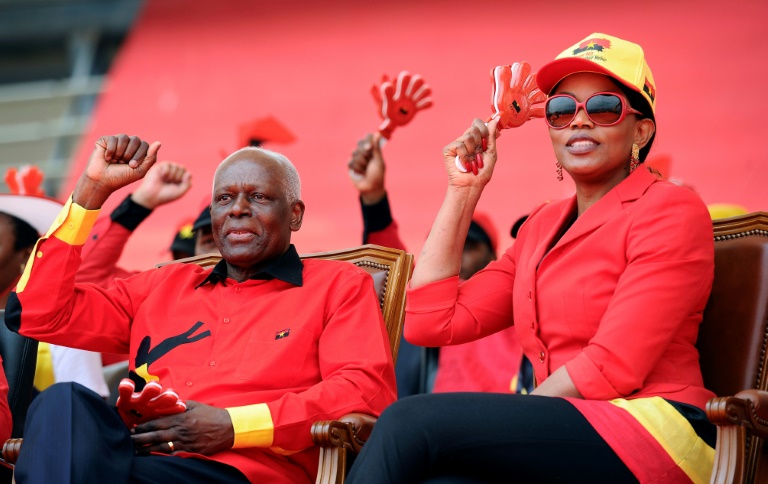
During the 2012 election campaign, dos Santos made a series of unexpected appearances at public rallies, wearing colourful T-shirts and promising better universities and jobs for young people.

But his policies remained little changed after the vote.

– Controlling presence –

He operated with few constraints as head of the military, police and cabinet, as well as being the president.

He handpicked senior judges and had MPLA allies in all public agencies, including the supposedly independent electoral commission.

Angola has become a major supplier of oil to China, and dos Santos built close ties with the Asian powerhouse.

Although he sought to present himself as a rock of stability, rights activists and opposition members accused him of systematic repression.

In a 2013 Brazilian television interview, he said his rule had been “too long, too long,” but added that decades of war “meant we couldn’t strengthen state institutions or even carry out the normal process of democratisation”.

Dos Santos reportedly received cancer treatment in Barcelona over several years. He left the country shortly after his retirement, spending two years in the Spanish city, both for medical treatment and to avoid a tightening legal net in Luanda.

While in power, and always immaculately dressed, he rarely travelled abroad on official business, but was said to enjoy music and poetry as well as cooking fish, and was once a keen footballer.

Close Bitnami banner
Bitnami