Africa Business

Tunisian street vendor serves success despite bureaucracy

Tunisian street vendors often complain of official harassment, but one sandwich maker-turned-social-media-star hopes his struggles against bureaucracy will motivate young entrepreneurs. 

Habib Hlila, 27, first set up a food van in the working-class Bab El Khadra district of Tunis in early April, selling sandwiches at the end of each day’s fast during the Muslim holy month of Ramadan. 

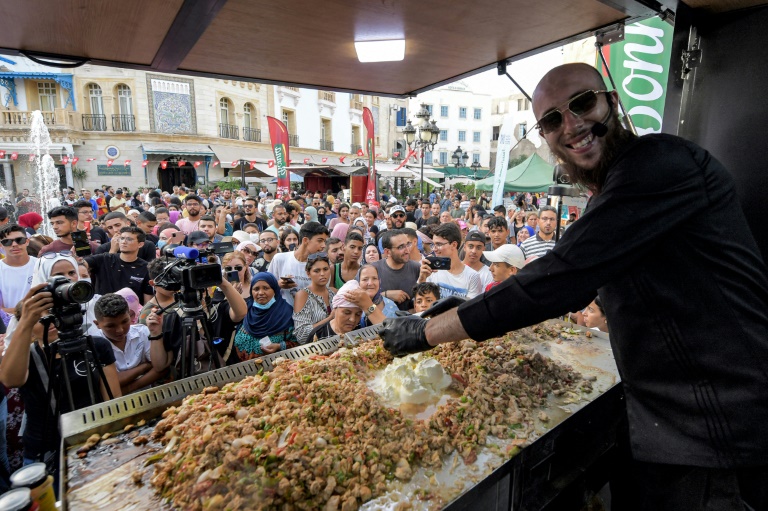
He quickly became a star of Tunisian street food, gaining a social media following as he used banter and theatrics to prepare his signature “El-Bey” sandwiches and grills, accompanied by his own special sauce.

As videos on social media helped his name spread, Hlila started drawing ever bigger crowds. But in late April, police detained Hlila and seized his truck on the basis that he had no licence to operate.

The operation was caught on camera and widely shared online, sparking anger among Tunisians who often complain of the obstacles authorities place in front of small businesses and everyday life.

Hlila rode a wave of public sympathy and started appearing on television to talk about his experience. 

The story drew comparisons to Mohamed Bouazizi, the Tunisian street vendor who set himself on fire following police harassment in 2010, triggering a nationwide revolt that toppled dictator Zine El Abidine Ben Ali and sparked the 2011 Arab Spring uprisings.

Hlila rejects the comparison, despite his own experience coming at a time that Tunisia faces crippling economic conditions and a political crisis that some have warned could return the country to dictatorship.

– Inspire unemployed youth –

“I’m not Bouazizi and I would never resort to acts of desperation in response to crises,” he told AFP. “I’ve decided to succeed and to be a source of motivation for the young.”

He says he wants to turn his experience into a positive story to inspire young Tunisians who often find it impossible to create a successful business in the face of suffocating bureaucracy.

After a long struggle, he finally managed to procure a licence to organise cooking shows across Tunisia — then retrieved his van and started up his sandwich business again.

Last Saturday, at an entrance to the Old City of Tunis, he held a show in a brand-new food truck worth more than $20,000, which he is paying off in instalments.

Wearing a black outfit dotted with small Tunisian flags, he held court for more than five hours in his first meeting with customers since his arrest.

– ‘Success story’ –

“Bravo to this young man who kept going despite the obstacles,” Naziha Bahloul, 51, told AFP as she queued to buy a sandwich. “He’s a good example to young people who only think of leaving the country. It’s a beautiful success story.”

But not everyone is inspired.

Bilel, an unemployed 31-year-old who, like many young Tunisians, wants to leave in search of a better life in Europe, said that Hlila “was able to go back to work because his case got media attention — it’s not the case for other young people.”

But Hlila said he wants “to prove to the young that you can reach your goals if you are determined. I want to tell them that you should never give up, despite the difficulties.”

Hlila’s interest in street food began in 2021 after helping a friend make sandwiches and he has succeeded despite not completing high school.

Handcarts and vans selling fast food are common in the Tunisian capital, but Hlila says the sector needs to be brought into the regular economy — something that could both create jobs and contribute to tourism.

“I have a lot of ideas to develop a project that could inspire unemployed youth,” he said.
DR Congo and Rwanda agree to 'de-escalate' tensions

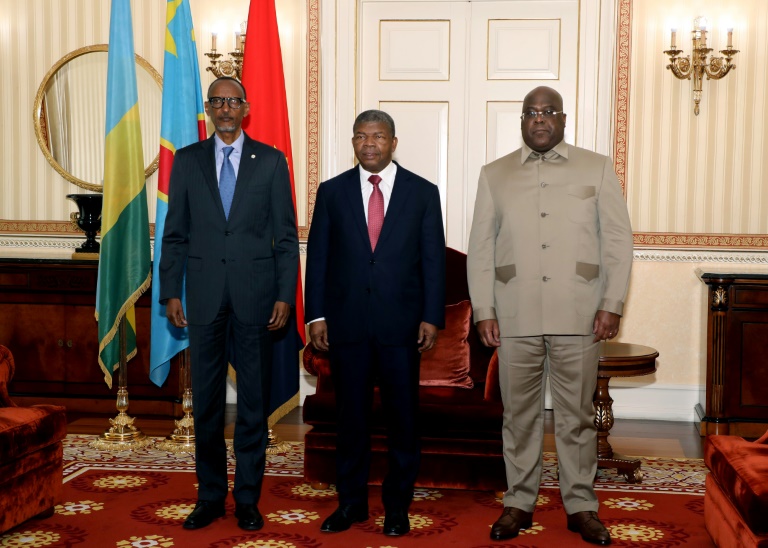
The Democratic Republic of Congo and Rwanda have agreed to a “de-escalation process” following weeks of rising tensions over rebel fighting in eastern DRC, the Congolese presidency said Wednesday after mediated talks.

But the talks mediator, Angolan President Joao Lourenco, went further announcing a “ceasefire” — although giving no details.

Violence has flared between the Congolese army and the M23 rebels and is ongoing. 

The DRC has repeatedly accused Rwanda of backing the M23, a charge the small central African country always denied.  

“I am pleased to announce that we have had positive results, in our view, in that we have agreed on a ceasefire, among other measures,” Lourenco said in remarks at the end of the mini-summit attended by Rwanda’s Paul Kagame and Congo’s Felix Tshisekedi in the Angolan capital Luanda.

A six-goal “roadmap” seen by AFP was established towards normalising diplomatic ties, including through ending hostilities involving the M23 and the Democratic Forces for the Liberation of Rwanda (FDLR), another rebel group active in eastern DRC.

“Defeat FDLR and its splinter groups which are at the origin of tensions between Rwanda and DRC and play a major role in the insecurity of the DRC in order to ensure that the threat to security ceases completely,” it said. 

The leaders are also aiming in the short-term to “create the conditions” for the return to DRC of former M23 fighters living in Rwanda. 

The announcements came after day-long talks intended to defuse the current tensions on the border between the two countries and bolster peace in the subregion. 

A mostly Congolese Tutsi rebel group, the M23 — or “March 23 Movement” — first leapt to prominence when it briefly captured the eastern Congolese city of Goma in 2012 before it was driven out in a joint UN-Congolese offensive.

After lying mostly dormant for years, the M23 resumed fighting last November after accusing the Congolese government of failing to honour an agreement to incorporate its fighters into the army. 

Fierce fighting has seen the rebels make significant advances in eastern Congo. Last month, M23 fighters captured the strategic town of Bunagana on the Congolese-Ugandan border, for example. 

At the end of Wednesday’s talks, the Congolese presidency said the three presidents had decided upon a “de-escalation process between the DRC and Rwanda”. 

This involves setting up a joint DRC-Rwanda committee, which is due to hold its first meeting in Luanda on July 12, as well as a roadmap for normalising relations. 

The M23 must cease hostilities under the roadmap, according to the Congolese presidency, and the “exploitation of natural resources in the region must be done in strict respect of the sovereignty of states”. 

Lourenco, who is also the chairman of the International Conference for the Great Lakes Region (ICGLR), mediated the talks at the request of the African Union after the violence grew into a diplomatic faceoff between the two neighbours.

The vast mineral-rich DRC is struggling to contain dozens of armed groups in the volatile east, many of which are a legacy of two regional wars a quarter of a century ago.

burs-ho/gw

Suspected jihadists storm Nigeria prison, free hundreds

Suspected jihadists using guns and explosives blasted their way into a prison near Nigeria’s capital, freeing dozens of their jailed comrades and hundreds of other inmates, the government said on Wednesday.

While the government blamed Boko Haram fighters, a catch-all term used sometimes by officials referring to jihadists, the Islamic State group claimed responsibility for the operation in a statement.

Tuesday night’s brazen attack on the outskirts of Abuja came just hours after an ambush on a presidential security convoy in the northwest, in a startling illustration of Nigeria’s security challenges.

Residents reported a series of loud explosions and gunfire late Tuesday around the Kuje medium-security prison just 40 kilometres (25 miles) away from the capital and the Aso Rock presidential villa.

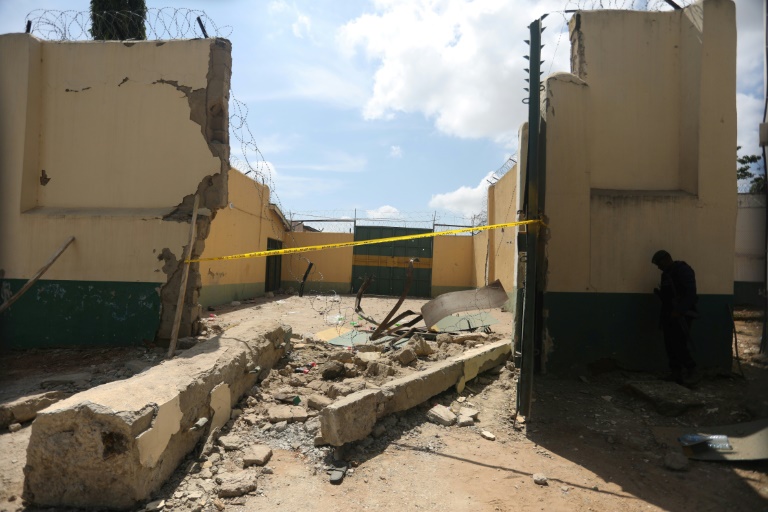
President Muhammadu Buhari on Wednesday briefly visited the prison, where the burnt-out wreckage of a bus and cars marked the scene of the attack, and yellow police tape was stretched across a destroyed section of the prison perimeter.

“I am disappointed with the intelligence system. How can terrorists organize, have weapons, attack a security installation and get away with it?” Buhari said in a statement after the visit.

The Nigerian leader, who has been under pressure over the country’s security challenges, was due to leave on an official trip to Senegal soon after the prison visit.

One security official was killed when the gunmen breached the jail using high-grade explosives.

“We understand they are Boko Haram, they came specifically for their co-conspirators,” senior interior ministry official Shuaibu Belgore told reporters on a visit to the prison.

Close to 600 inmates had been recaptured by Wednesday evening while less than 100 were still on the run, Nigeria’s correctional services spokesman Abubakar Umar said.

The Islamic State group’s propaganda channel Aamaq said its “fighters broke into a Nigerian government prison yesterday in the city of Kuje on the outskirts of Abuja after tearing down its walls, and they succeeded in liberating dozens of prisoners”.  

– ‘All escaped’ –

Defence Minister Bashir Magashi told reporters that Boko Haram militants had “mostly likely” carried out the attack and that all 64 jailed jihadists in the prison had escaped.

“None of them are inside the prison, they have all escaped,” he said.

Commanders of another jihadist group Ansaru, including the group’s chief Khalid Barnawi, had also been kept in Kuje prison since their conviction in 2017.

“We heard shooting on my street. We thought it was armed robbers,” one local Kuje resident said. “The first explosion came after the shooting. Then a second one sounded and then a third.”

Some prisoners surrendered while others were recaptured with military roadblocks set up around the penitentiary, officials said.

Security forces sent back around 19 recaptured inmates in a black van on Wednesday morning, an AFP correspondent at the site said.

Former top police commander Abba Kyari, who was being held in Kuje awaiting trial in a high-profile drug smuggling case, was still in custody, Umar said. 

– ‘Ambush positions’ –

Nigeria’s security forces are battling Boko Haram and Islamic State West Africa Province (ISWAP) jihadists in the country’s northeast, where the conflict has killed 40,000 people and displaced 2.2 million more.

The overstretched military is also fighting heavily armed criminal gangs known locally as bandits who terrorise communities in northwest and central states with raids and mass kidnappings for ransom.

In the country’s southeast, troops are dealing with separatist militias who demand an independent territory for the local ethnic Igbo people.

The Kuje prison raid took place soon after gunmen also ambushed an advance presidential security detail preparing for Buhari’s visit to his home state of northwestern Katsina.

Buhari was not in the convoy, but two officials were slightly wounded in the attack. It was not clear who was responsible.

“The attackers opened fire on the convoy from ambush positions but were repelled,” the presidency said in a statement.

Attacks on prisons in Nigeria have happened in the past, with gunmen seeking to free inmates.

More than 1,800 prisoners escaped last year after heavily armed men attacked a prison in southeast Nigeria using explosives.

The attackers blasted their way into the Owerri prison in Imo state, engaging guards in a gun battle before storming the prison. Imo state lies in a region that is a hotbed for separatist groups.

Burkina ex-president Compaore 'expected' home by weekend: govt

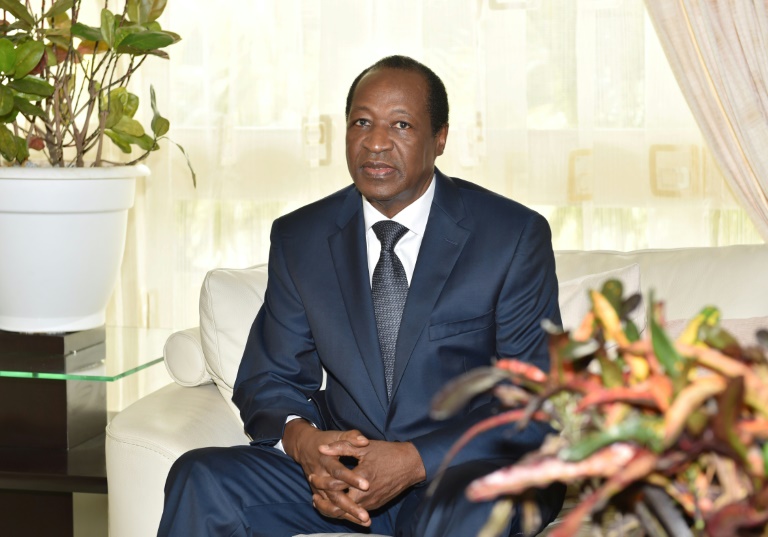
Burkina Faso’s former leader Blaise Compaore, who was forced into exile in 2014, is expected to return to Ouagadougou shortly for a summit of ex-presidents, a government spokesman said on Wednesday.

“By the end of the week, an important meeting between the former heads of state of Burkina Faso will be held towards accelerating the issue of reconciliation,” spokesman Lionel Bilgo said.

Compaore, 71, is “very likely and even expected” to attend, he added.

A source close to the government and Compaore’s entourage told AFP late Tuesday that he was to return to Burkina Faso to meet its military rulers this week.

The source said he was “due to arrive on Thursday or Friday for a short stay” and would “be received by the head of state in the framework of national reconciliation”.

A source in Compaore’s entourage confirmed the trip.

On Wednesday, Ivory Coast government spokesman Amadou Coulibaly said Burkinabe authorities had reached out.

“Burkina Faso has engaged in a reconciliation process… All arrangements are being made so that president Compaore actively participates,” he said.

There was no official announcement of when Compaore, who also holds Ivorian citizenship, would land.

– Controversial figure –

Compaore seized power in a coup in October 1987, on the same day that Burkina’s revolutionary leader Thomas Sankara — his former comrade-in-arms — was gunned down by a hit squad.

He went on to rule for 27 years before being forced out by popular protests, supported by the army, over his bid to stay in power. 

On April 6 this year, he was sentenced in absentia to life in prison by a military court for his role in Sankara’s assassination.

His return appears to be aimed at shoring up unity at a time when the ruling junta is struggling with a deep crisis.

The impoverished, landlocked Sahel state is being battered by a nearly seven-year-old jihadist campaign that has claimed several thousand lives and forced almost two million people from their homes.

Forty percent of the country is out of the government’s control, a representative of the regional bloc ECOWAS said last month.

In January, soldiers disgruntled at failures to stem the insurgency staged a coup, forcing out the elected president, Roch Marc Christian Kabore.

The new strongman, Lieutenant-Colonel Paul-Henri Sandaogo Damiba, was sworn in as president in March.

Damiba declared security to be his top priority but after a relative lull, attacks resumed, with the loss of hundreds of lives.

In June, 86 people were massacred in the northern border village of Seytenga while at least 34 people were killed in two attacks last weekend.

– Presidential talks –

The planned meeting of former leaders will “share energies and synergies… to effectively fight the tragedy striking us but also to reduce internal rifts,” said Bilgo.

Other former presidents invited to the talks are Jean-Baptiste Ouedraogo who was in power from 1982 to 1983, Isaac Zida who briefly took power in 2014 and is currently in exile in Canada, Michel Kafando who was in power from 2014 to 2015, and Kabore himself.

On Wednesday, Sankara’s lawyers called on judicial authorities to ensure Compaore was arrested as soon as he set foot in Burkina Faso.

In a statement, the president’s office said the talks were an “important meeting for the life of the nation” but “do not impede judicial action that has been undertaken against certain individuals.”

A source close to the president’s office said Compaore would be accommodated in a villa in Ouagadougou that had been used for Kabore when he was placed under a house arrest after the January coup.

Compaore supporters on social media have called for a show of support at Ouagadougou airport on Friday morning.

Suspected jihadists storm Nigeria prison, free hundreds

Suspected Boko Haram jihadists using guns and explosives blasted their way into a prison near Nigeria’s capital, freeing dozens of their jailed comrades and hundreds of other inmates, the government said on Wednesday.

Tuesday night’s brazen attack on the outskirts of Abuja came just hours after an ambush on a presidential security convoy in the northwest, in a startling illustration of Nigeria’s security challenges.

Residents reported a series of loud explosions and gunfire late Tuesday around the Kuje medium-security prison just 40 kilometres (25 miles) away from the capital and the Aso Rock presidential villa.

President Muhammadu Buhari on Wednesday briefly visited the prison, where the burnt-out wreckage of a bus and cars marked the scene of the attack, and yellow police tape was stretched across a destroyed section of the prison perimeter.

“I am disappointed with the intelligence system. How can terrorists organize, have weapons, attack a security installation and get away with it?” Buhari said in a statement after the visit.

The Nigerian leader, who has been under pressure over the country’s security challenges, was due to leave on an official trip to Senegal soon after the prison visit.

One security official was killed when the gunmen breached the jail using high-grade explosives.

“We understand they are Boko Haram, they came specifically for their co-conspirators,” senior interior ministry official Shuaibu Belgore told reporters on a visit to the prison.

Close to 600 inmates had been recaptured by Wednesday evening while less than 100 were still on the run, Nigeria’s correctional services spokesman Abubakar Umar said.

Boko Haram is one of the jihadist groups involved in Nigeria’s grinding 13-year conflict in the country’s northeast.

Nigerian officials sometimes also use “Boko Haram” as a general phrase to refer to jihadists or other armed groups.

– ‘All escaped’ –

Defence Minister Bashir Magashi told reporters that Boko Haram militants had “mostly likely” carried out the attack and that all 64 jailed jihadists in the prison had escaped.

“None of them are inside the prison, they have all escaped,” he said.

Commanders of another jihadist group Ansaru, including the group’s chief Khalid Barnawi, had also been kept in Kuje prison since their conviction in 2017.

“We heard shooting on my street. We thought it was armed robbers,” one local Kuje resident said. “The first explosion came after the shooting. Then a second one sounded and then a third.”

Some prisoners surrendered while others were recaptured with military roadblocks set up around the penitentiary, officials said.

Security forces sent back around 19 recaptured inmates in a black van on Wednesday morning, an AFP correspondent at the site said.

Former top police commander Abba Kyari, who was being held in Kuje awaiting trial in a high-profile drug smuggling case, was still in custody, Umar said. 

– ‘Ambush positions’ –

Nigeria’s security forces are battling Boko Haram and Islamic State West Africa Province (ISWAP) jihadists in the country’s northeast, where the conflict has killed 40,000 people and displaced 2.2 million more.

The overstretched military is also fighting heavily armed criminal gangs known locally as bandits who terrorise communities in northwest and central states with raids and mass kidnappings for ransom.

In the country’s southeast, troops are dealing with separatist militias who demand an independent territory for the local ethnic Igbo people.

The Kuje prison raid took place soon after gunmen also ambushed an advance presidential security detail preparing for Buhari’s visit to his home state of northwestern Katsina.

Buhari was not in the convoy, but two officials were slightly wounded in the attack. It was not clear who was responsible.

“The attackers opened fire on the convoy from ambush positions but were repelled,” the presidency said in a statement.

Attacks on prisons in Nigeria have happened in the past, with gunmen seeking to free inmates.

More than 1,800 prisoners escaped last year after heavily armed men attacked a prison in southeast Nigeria using explosives.

The attackers blasted their way into the Owerri prison in Imo state, engaging guards in a gun battle before storming the prison. Imo state lies in a region that is a hotbed for separatist groups.

Ethiopia parliament sets up body to probe mass killings

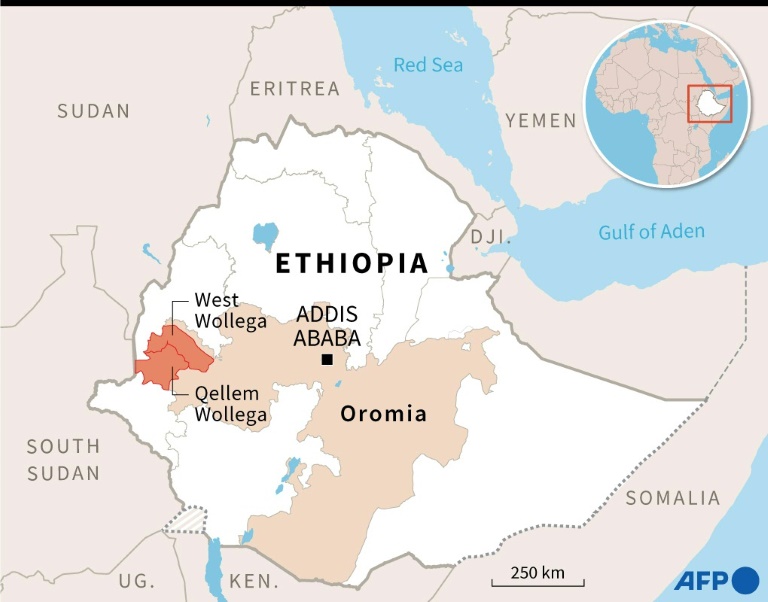
Ethiopian lawmakers decided on Wednesday to set up a committee to investigate “inhumane” acts against civilians, after reports of massacres in a restive area in the west of the country.

Parliament’s announcement came as the African Union called for a probe into killings in western Oromia and urged the Ethiopian authorities to ensure that citizens are protected.

The lower house said it had adopted a resolution to create a special committee to investigate “inhumane acts perpetrated against the citizens of our country”.

It said in a statement it condemned the “indiscriminate killings of civilians and security forces” in several regions, and that it had become necessary to “find a resolution”.

The committee would investigate the situation and come up with recommendations for further action, it said.  

Although the statement mentioned Oromia, it made no direct reference to the reported massacres targeting members of the ethnic Amhara community in the west of the region in recent weeks.

The Ethiopian authorities have accused the Oromo Liberation Army (OLA) of the bloodshed in Qellem Wollega and West Wollega, claims the rebel group has denied.

Meanwhile, AU Commission chair Moussa Faki Mahamat called for an investigation into the attacks that have cost the lives of hundreds of civilians, according to a statement from the pan-African body.

“He further urges the Federal Government of Ethiopia and regional authorities to undertake the necessary actions to protect all civilians, including minorities, and ensure that such incidents are prevented,” it said.

Inter-ethnic violence has been on the rise in recent months in Oromia — the largest and most populous region of Ethiopia.

The situation there has until now largely been overshadowed by the conflict in the north between federal forces and the Tigray People’s Liberation Front (TPLF) that erupted in November 2020.

Prime Minister Abiy Ahmed said there had been a “massacre” by the OLA on Monday in Qellem Wollega and vowed to eliminate the group, which like the TPLF is branded a terrorist organisation by the Ethiopian government.

The US-based Amhara Association of America said the attack targeted ethnic Amhara, while a survivor quoted by the regional state-run Amhara Media Corporation said at least 300 bodies had been collected in the village.

It was not possible to verify the information as access is restricted to the area in western Oromia, which borders South Sudan.

In a country comprising dozens of ethnic groups, the Amhara is the second largest after the Oromo.

Last month, the Ethiopian authorities accused the OLA of killing several hundred mainly Amhara people in the village of Tole in West Wollega.

Suspected jihadists raid Nigeria prison, free hundreds

Suspected Boko Haram jihadists using guns and explosives have blasted their way into a prison near Nigeria’s capital, freeing hundreds of inmates in an operation to release jailed comrades, the government said Wednesday.

Tuesday night’s brazen attack on the outskirts of Abuja came hours after an ambush on a presidential security convoy in the northwest, in a startling illustration of the struggle Nigeria faces to overcome a security crisis.

Residents reported loud explosions and gunfire late Tuesday near the Kuje medium-security prison just outside the capital.

President Muhammadu Buhari on Wednesday briefly visited the prison, where the burnt-out wreckage of a bus and cars marked the scene of the attack, and yellow police tape was stretched across a destroyed part of the prison perimeter.

“We understand they are Boko Haram, they came specifically for their co-conspirators,” senior interior ministry official Shuaibu Belgore told reporters on a visit to the prison.

He said around 300 inmates had been recaptured or had surrendered out of about 600 who had escaped initially.

Boko Haram is one of the jihadist groups involved in Nigeria’s grinding 13-year conflict in the country’s northeast.

But Nigerian officials sometimes use “Boko Haram” as a general phrase to refer to jihadists or other armed groups.

– ‘All escaped’ –

Defence Minister Bashir Magashi told reporters that Boko Haram militants had “mostly likely” carried out the attack and that all 64 jailed jihadists in the prison had escaped.

“None of them are inside the prison, they have all escaped,” he said.

Commanders of another jihadist group Ansaru, including the group’s chief Khalid Barnawi, had also been kept in Kuje prison since their conviction in 2017.

One security official was killed when the gunmen breached the jail using high-grade explosives.

“We heard shooting on my street. We thought it was armed robbers,” a local resident said. “The first explosion came after the shooting. Then a second one sounded and then a third.”

Some prisoners surrendered while others were recaptured with military roadblocks set up around the penitentiary.

Security forces sent back around 19 recaptured inmates in a black van on Wednesday morning, an AFP correspondent at the site said.

Former top police commander Abba Kyari, who was being held in Kuje awaiting trial in a high-profile drug smuggling case, was still in custody, corrections service spokesman Abubakar Umar said. 

– ‘Ambush positions’ –

Nigeria’s security forces are battling Boko Haram and Islamic State West Africa Province (ISWAP) jihadists in the country’s northeast, where the conflict has killed 40,000 people and displaced 2.2 million more.

The overstretched military is also battling heavily armed criminal gangs known locally as bandits who terrorise communities in the northwest and central states with raids and mass kidnappings for ransom.

In the country’s southeast, troops are dealing with separatist militias who demand an independent territory for the local ethnic Igbo people.

The Kuje prison raid took place soon after gunmen also ambushed an advance presidential security detail preparing for Buhari’s visit to his home state of northwestern Katsina.

Buhari was not in the convoy, but two officials were slightly wounded in the attack. It was not clear who was responsible.

“The attackers opened fire on the convoy from ambush positions but were repelled,” the presidency said in a statement.

Attacks on prisons in Nigeria have happened in the past, with gunmen seeking to free inmates.

More than 1,800 prisoners escaped last year after heavily armed men attacked a prison in southeast Nigeria using explosives.

The attackers blasted their way into the Owerri prison in Imo state, engaging guards in a gun battle before storming the prison. Imo state lies in a region that is a hotbed for separatist groups.

Fuel prices soar in Ethiopia as subsidies cut

Fuel prices soared in Ethiopia on Wednesday after the government reduced subsidies, adding to economic hardship for people already struggling with high inflation.

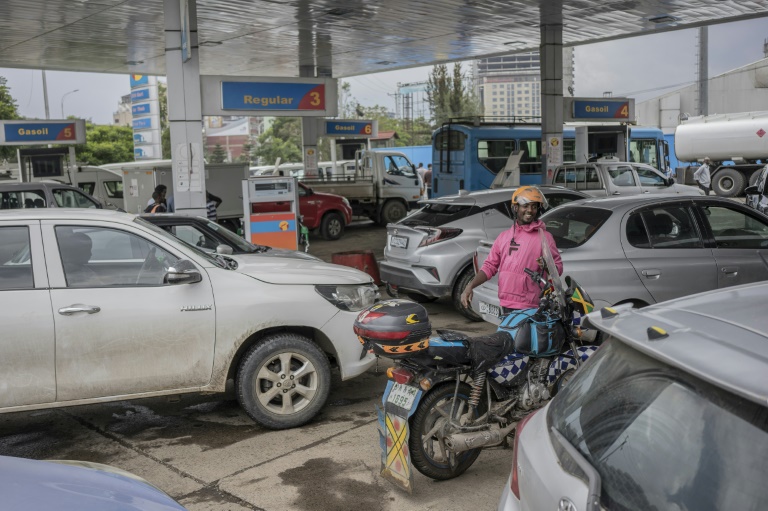
There were long queues at petrol stations in the capital Addis Ababa, with drivers reporting shortages as they tried to fill up their tanks.

The price of petrol at the pump jumped almost 30 percent to 48.83 biir (about 94 US cents) while diesel went up almost 40 percent to 49.02 birr under the new price regime that will run to August 6, the trade ministry said.

The federal government — which had already hiked prices in May — plans to lift fuel subsidies progressively, according to the Addis Fortune business newspaper.

Prices of fuel, food and other basic goods have rocketed globally because of the Ukraine war, hitting vulnerable countries in Africa and elsewhere.

The trade ministry said the cost of fuel for Ethiopian consumers should be almost double if it was calculated on current global prices.

“But considering the state the country is in, the government is covering 75 percent of the (price) difference while it was decided that the remaining 25 percent would be transferred to consumers,” it said.

Henok Girma, 26, said he had been waiting in line at a petrol station in Addis Ababa for an hour and a half.

“At most of the gas stations, there is a long queue. I don’t know what the problem but there is a shortage,” he said. 

“Whenever I want to fill up with gas, I will have to wake up early in the morning or wait like this for hours.” 

Businessman Mekibib Abebe added: “Sometimes you can wait for half a day and may not find fuel at the end.

“The obligation of the government is to provide fuel, or at least control how gas stations provide fuel properly.” 

The Horn of Africa country of more than 110 million people has seen inflation hovering at around 35 percent over the past six months, with food prices in particular registering a sharp rise.

The global surge in prices for basic goods has also eaten into the foreign exchange reserves of the largely importing nation.

In a report covering the first quarter of 2022, Ethiopian investment fund Cepheus Capital said that in December, foreign currency reserves at the central bank were at their lowest in a decade.

Imports of petroleum products in the first nine months of the 2021/2022 fiscal year had jumped by 75 percent to $2.2 billion, and those of cereals by 121 percent to $1.8 billion, it said.

Long winter: South Africans struggle with rolling blackouts

Unable to switch on lights or heaters, cook dinner or charge their phones, South Africans are spending their mid-winter evenings plunged in darkness and low-tech living.

Power outages, known here as load shedding, intensified late last month after strikes erupted at the nation’s monopoly energy provider Eskom, leaving coal plants unable to operate or undergo maintenance. 

Electricity cuts in South Africa are a notorious, years-old problem.

But the frequency of power losses — two to three times per day and lasting up to four hours at a time — is the worst since a bleak episode in December 2019, and many people are livid.

“It’s like we’re back to apartheid life, whereby we’re back to candles, paraffin stoves,” said Rebecca Bheki-Mogotho, a Johannesburg city employee.

Her comparison was with life under South Africa’s former segrationist regime, which deprived the black majority of basic infrastructure and services.

The leading economy on the continent, South Africa relies on coal to generate more than 80 percent of its electricity. 

The country has plenty of coal, but most of its plants are ageing, need repair or are scheduled to be decommissioned in the coming decades.

“We didn’t do what we should have done in the past five to 10 years,” energy analyst Clyde Mallinson told AFP. 

“We’ve got ourselves caught in a situation where we are desperately trying to plug what’s broken rather than get ahead of it.”

– 101 days of blackouts –

The wage dispute that compounded the crisis concluded Tuesday with Eskom employees accepting a seven percent increase, which the electricity provider said in a statement “will be a struggle for Eskom to afford.”

But even with workers back on the job, Eskom warned it would “still take some time” for the system to recover due to the backlog of maintenance.

The public entity is already laden with debt and struggling to recover from years of alleged mismanagement and corruption, which made it a key entity investigated during a four-year public inquiry into state graft.

To bridge the severe gap in supply, Eskom is relying on back-up gas turbines that blast through 14 litres of diesel (3.7 gallons) per second. Seven of these turbines were in operation Friday. 

The cost of using diesel as a substitute fuel has been stratospheric. 

Eskom CEO Andre de Ruyter said the company spent 1.54 billion rand ($93.8 million) in June alone — more than double its original budget. 

It has also spent more than double its annual budget for diesel only halfway into the year.  

The big splurge is still not enough to avoid outages that can cause havoc, from delays at intersections with downed traffic lights to faults at substations prolonging blackouts. 

In April, the company warned the country could see as many as 101 days of load shedding this year due to breakdowns.

– Delayed renewables –

At least 10,000 MW of renewable wind and solar energy should have been brought online since 2015 to keep pace with demand, Mallinson said. 

An intensive building strategy to make that up in the next two years would relieve the issue. 

“We have to build rapidly, like our lives depend on it,” Mallinson said. 

The mining industry, the country’s economic backbone, has begun investing in self-generation with renewables, Henk Langenhoven, chief economist at the trade grouping Minerals Council South Africa, told AFP.

“As the problems… with the core energy supply from Eskom are rising and the shortfalls are increasing, the pressure and the inclination to actually move that way is actually getting stronger,” Langenhoven said.

Eskom’s senior officials have similarly made repeated calls for the swift development of new energy sources. 

But in February, Energy Minister Gwede Mantashe declared coal would remain “a mainstay” for South Africa’s electricity mix for the “foreseeable future”. 

This comes despite South Africa being promised at least $8.5 billion from rich nations at the UN climate summit last November to aid its low-carbon transition.

The country’s energy burden is only expected to grow in the coming years. 

Power demands could triple by 2040 as transportation and other industries move to electrification, Mallinson said. 

Without rapid investment, load shedding will remain a fixture. 

S.Africa's Ramaphosa blames alcohol 'scourge' for tavern tragedy

South Africa’s president Wednesday blamed the “scourge of underage drinking” for the deaths of 21 people, mostly teens, in unclear circumstances at a township tavern last month, in an incident that shook the nation.

Speaking at a memorial service for the victims, President Cyril Ramaphosa vowed to crack down on “unscrupulous” bar keepers who flout regulations, putting profits before children’s lives, and suggested the drinking age be raised across the country.

“Children should not have been allowed into that place, they should not have been served alcohol,” Ramaphosa told a crowd gathered at a stadium in Scenery Park, a township in the coastal city of East London, where empty coffins were laid out to symbolise the loss.

“South Africa has one of the highest rates of problem drinkers in the world,” he said.

“We are now going to draw the line… We are losing our future generation to the scourge of underage drinking.”

South Africa banned alcohol sales nationwide during the coronavirus lockdown to ease the number of trauma cases in hospitals.

Eleven days after the youths’ bodies were discovered strewn in the Enyobeni tavern, the cause of the deaths remains a riddle. 

The police are yet to wrap up their investigation, although officials have ruled out a stampede, and autopsy results are still to be made public. 

“Somebody somewhere must answer” for the tragedy, Police Minister Bheki Cele declared at the memorial service.

– Waiting for closure –

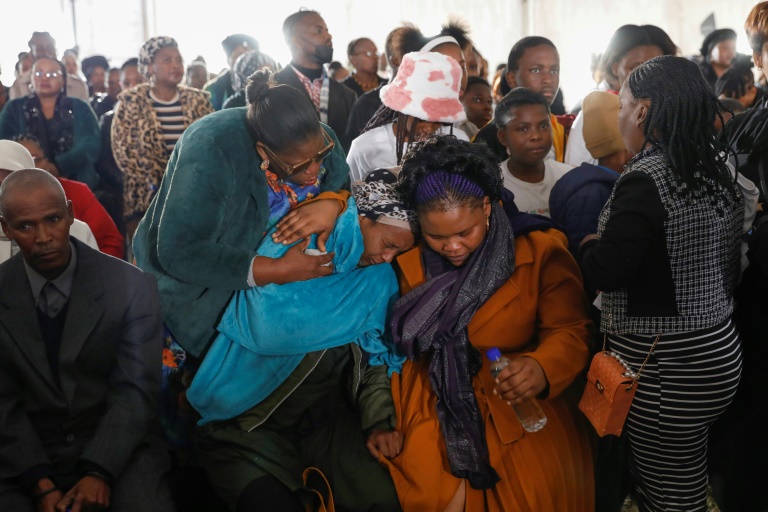
Scores of mourners filled a large marquee where the 19 coffins were laid out, and hundreds more gathered outside to follow the ceremony. 

Some broke down in tears, while others chanted prayers as a police band played the national anthem. 

Ramaphosa asked grieving families to allow time for police to finish their probe, while urging authorities to speed up the process. 

“The families do want closure. They want to know what happened to their children. Let’s not keep them waiting for far too long,” he said. 

The incident has drawn grief and anger in the country, which has long grappled with deep-rooted inequality and structural issues, and has one of the highest murder rates in the world. 

“Mr President… South Africa is tired,” a grieving relative said after reading an obituary from the podium. 

Undertakers said the caskets were empty. Most of the burials will occur this week.  

The youngsters died in what survivors have described as a battle to escape the jam-packed venue, with one reporting a suffocating smell. 

The grim discovery of their bodies was made on June 26.

The youngest was just 14 years and the oldest 20, according to birthdates listed on the memorial official programme distributed on Wednesday.

Cele had previously said the youngest was 13 and the oldest 17.

– ‘National crisis’ –

“As a nation we are hurt by what happened,” Oscar Mabuyane, the head of the Eastern Cape province where East London is located, said in an address. 

Drinking in South Africa is permitted for over-18s.

But in township taverns, which are often located close to family homes, safety regulations and drinking-age laws are not always enforced.

Nolitha Tsangani, a Scenery Park resident who lives near the Enyobeni tavern, said blame for the tragedy should be shared.

“We are all wrong… the parent is wrong, the child who is dead, I am sorry to say, is wrong,” she told AFP, though also pointing the finger of blame at the tavern owner and the police.

The tragedy has sparked calls for change.

“Alcohol… should never be a form of entertainment for our kids,” Lucky Ntimane, national convenor of the National Liquor Traders Association told the memorial service. 

Ramaphosa suggested a national debate on whether to increase the drinking age to 21, describing alcohol abuse as a “national crisis”. 

Close Bitnami banner
Bitnami