Africa Business

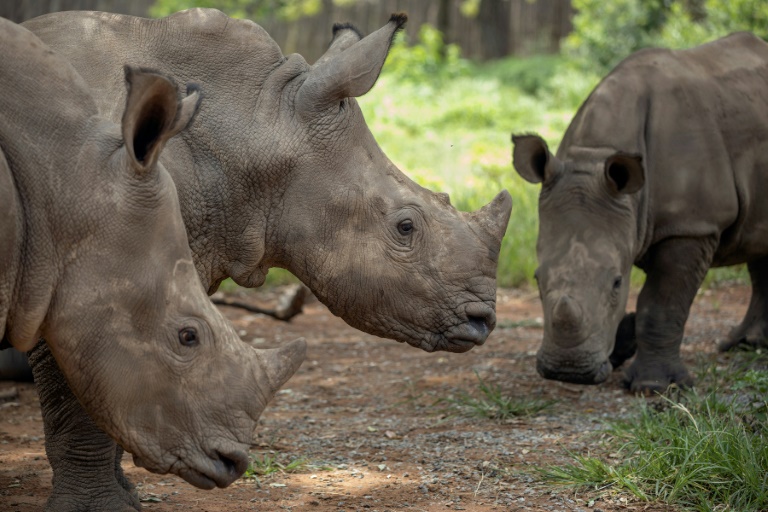
Rhinos killed, poachers arrested in S.Africa's Kruger Park

Three poachers suspected of killing several rhinos in South Africa’s Kruger National Park were arrested after they were tracked down by sniffer dogs, park officials said on Wednesday. 

Rangers flying over the park grounds spotted a carcass and an injured rhino on Friday morning after being alerted by a tourist who reported hearing gunshots, South African National Parks said in a statement. 

Two more dead rhinos were soon found in area, triggering the deployment of another helicopter, more rangers and dogs.

“The hounds indicated a specific area where three suspects were found and arrested,” the statement said.

The park, which borders Mozambique, is a tourist magnet.

The suspects, described as Mozambican nationals who were in the country illegally, carried a high-calibre hunting rifle, ammunition and horns from three rhinos.

The Kruger’s rhino population has fallen dramatically due to poaching. The park’s estimated tally in 2021 was 3,529 white and 268 black rhinos, down more than half compared to 2013, according to the nonprofit Save the Rhino International.

South Africa is home to nearly 80 percent of the world’s rhinos.

But it is also a hotspot for rhino poaching, driven by demand from Asia, where the horn is used in traditional medicine for its reputed therapeutic effect. 

Sudan coup leader sacks civilians as protesters rally again

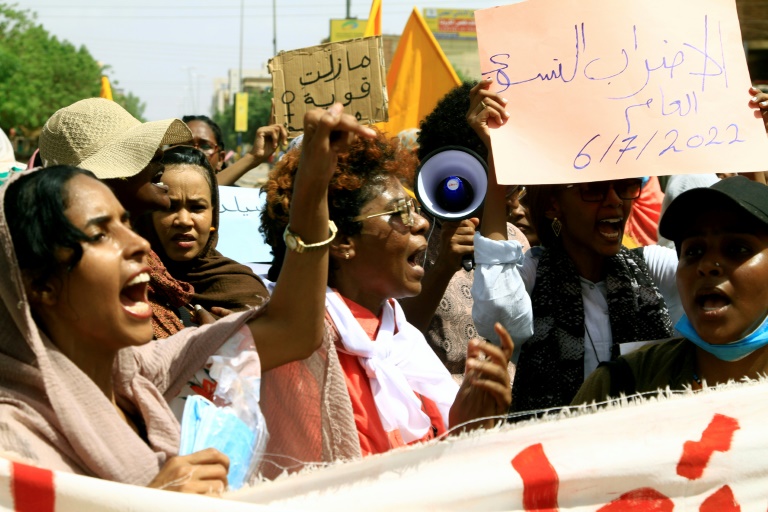
Sudan’s coup leader Abdel Fattah al-Burhan on Wednesday dismissed the last civilian members of his ruling body as part of a power shift he has proposed, but protesters who have rejected his pledge again took to the streets.

“The blood of the martyrs did not flow in vain,” hundreds of women protesters chanted in Khartoum about pro-democracy activists who have been killed in street violence, also demanding a return of “the soldiers to the barracks”.

Burhan — who grabbed power in a coup last October that drew international condemnation — in a surprise move Monday vowed to “make room” for civilian groups to form a new transitional government.

He also said that the ruling Sovereign Council he chairs would be disbanded and, in an apparent move to carry out the process, issued a decree relieving five little-known civilian members of their posts.

Several of them told local press that they had received no formal notification and were surprised to discover that their official vehicles had been taken away.

The transitional government uprooted by Burhan last year had been painstakingly forged between the military and civilian factions in 2019, following mass protests that prompted the army to oust longtime dictator Omar al-Bashir.

Sudan’s main civilian alliance, the Forces for Freedom and Change (FFC), have labelled Burhan’s latest move a “giant ruse” and “tactical retreat”.

They also called for “continued public pressure”, a call heeded by protesters who manned makeshift street barricades of rocks and tyres for a seventh straight day.

– ‘Wolf in sheep’s clothing’? –

Protesters have demanded a restoration of the transition to civilian rule despite repeated crackdowns by the security forces, who have in recent days fired live bullets, launched barrages of tear gas canisters and deployed water cannons, according to medics.

Burhan’s pledge Monday to step aside for a new civilian “government” was accompanied by another pledge — the establishment of a new “Supreme Council of the Armed Forces”. 

This body would be in charge of defence and security, he said, feeding into concerns among opponents that it would not be answerable to any government.  

Burhan said the new body would combine the regular army and the paramilitary Rapid Support Forces, a powerful unit commanded by his deputy, Mohamed Hamdan Daglo.

Key FFC member and ex-rebel Yasser Arman warned that Burhan’s “intention is to choose a prime minister who is a wolf in sheep’s clothing and takes his orders from the military council”.

Arman said that Burhan’s announcement was aimed at the “regional and international community, some of whose members are looking for quick solutions” including those who he warned are “prioritising stability over democracy”.

The FFC has so far refused to take part in talks with military leaders, despite pressure from international brokers that range from the United Nations to the African Union and regional bloc IGAD.

On Tuesday, following an IGAD emergency summit chaired by Burhan in Kenya, the bloc praised efforts to finding “lasting solutions to the political situation”, adding that it “appreciated the positive steps” taken by Sudan’s leaders.

– ‘Too early to tell’ –

Sudan has been rocked by near-weekly protests since the October coup, with thousands marching in multiple cities.

Pro-democracy medics said nine demonstrators lost their lives last Thursday, the deadliest violence so far this year, which brought to 114 the number killed in the crackdown since October.

Burhan’s announcement has been treated cautiously by international players, with UN Secretary General Antonio Guterres saying he hoped it would create “the opportunity …to reach an agreement that ultimately leads to a civilian-led transition to democracy”.

The United States said it was “too early to tell” the impact, with State Department spokesman Ned Price urging all sides to seek a solution towards “a civilian-led government” with “free and fair elections”.

Protesters argue that the army chief has made such moves before.

In November, a month after the coup, Burhan signed a deal with Abdalla Hamdok, the prime minister he had ousted in the power grab and put under house arrest, returning him to power.

But many people rejected that pact and took to the streets again, and Hamdok resigned in January warning that Sudan was “crossing a dangerous turning point that threatens its whole survival”. 

OPEC head Barkindo dies at 63 in 'shock' to oil cartel

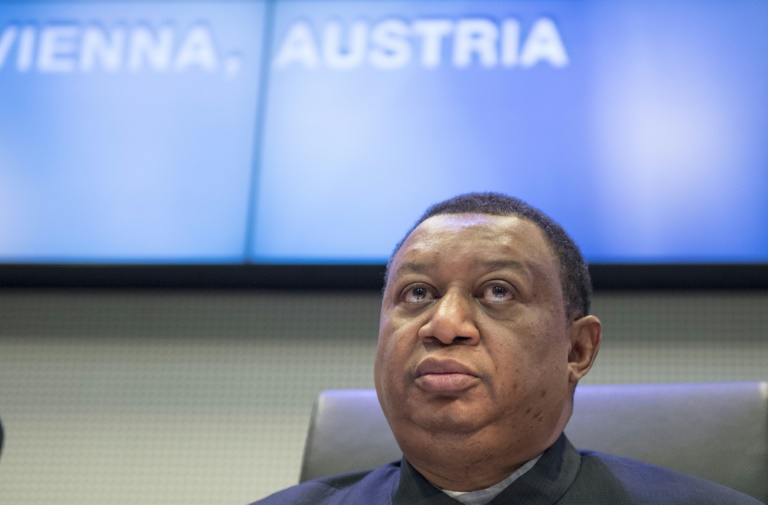
OPEC’s secretary general, Nigeria’s Mohammad Barkindo, has died at the age of 63, leaving the oil cartel in “shock” on Wednesday at a tumultuous time for the markets.

Barkindo had headed the Organization of the Petroleum Exporting Countries since 2016 and was scheduled to be replaced by Kuwait’s Haitham Al-Ghais next month. 

Under his stewardship, the cartel forged ties with Russia and nine other oil-producing countries to form a wider group known as OPEC+ in a bid to better stabilise oil markets.

After OPEC+ slashed output during the pandemic to boost prices, the 23-member group’s moves have not calmed markets — with record high prices — in recent months amid the war in Ukraine.

Barkindo died late Tuesday and will be buried on Wednesday in his home town of Yola, according to the Nigerian National Petroleum Corporation’s chief executive Mele Kyari.

“Certainly a great loss to his immediate family, the NNPC, our country Nigeria, the OPEC and the global energy community,” Kyari wrote, without providing any further details about the circumstances of Barkindo’s death.

– ‘Trailblazer’ –

“This tragedy is a shock to the OPEC Family,” Vienna-based OPEC tweeted.

“We express our sorrow and deep gratitude for the over 40 years of selfless service that… Barkindo gave to OPEC. His dedication and leadership will inspire OPEC for many years to come.”

In a statement, OPEC described Barkindo as “a trailblazer widely admired and respected throughout the globe. A dear friend to many.”

Only a few hours earlier, Barkindo — who had not shown any sign of being ill — had met Nigerian President Muhammadu Buhari in Abuja, where Buhari praised Barkindo’s “distinguished achievements at OPEC”. 

“You were able to successfully navigate the organisation through turbulent challenges,” Buhari had said.

Barkindo himself in a speech last year described serving as OPEC secretary general for two terms as an “honour of a lifetime”.

The OPEC secretary general does not wield any executive power, but is the cartel’s public face and frequently has to act as a diplomat to bring together the different, sometimes conflicting interests of the various member countries.  

For analysts, Barkindo’s death will not have an impact on OPEC’s strategy in the long-term.

“But in the short-to-medium run, it will increase uncertainty about OPEC’s next steps and add to the price volatility as he was a figure of unity for OPEC,” said Swissquote analyst Ipek Ozkardeskaya. 

Spi Asset Management analyst, Stephen Innes, described Barkindo as “a very important figurehead and a stabilising force behind OPEC.” 

“But his death is unlikely to change OPEC direction despite more outside politics entering the picture,” the expert said, predicting that his successor, Haitham Al-Ghais “augurs for the status quo given Kuwait close ties with Saudi Arabia, which wields the most influence” within the group.

– ‘True friend’ to Russia –

In a message to Nigeria’s Buhari, Russian leader Vladimir Putin hailed Barkindo’s “important” and “personal contribution” to the creation of OPEC+, saying Russia would remember him “as a true friend of our country”.

Russian Deputy Prime Minister in charge of Energy, Alexander Novak, said Barkindo “defended a constructive dialogue with our country”.

Iraqi Oil Minister Ihsan Ismail said in a statement that Barkindo “wanted to strengthen OPEC’s role in stabilising global markets and addressing challenges affecting the oil sector and the global economy.”

Born on April 20, 1959, Barkindo graduated from Ahmadu Bello University in Nigeria’s Kaduna State with a degree in political science.

He later obtained an MBA in finance and banking in the United States and studied petroleum economics at Oxford.

He became Nigeria’s representative at OPEC in 1986. Starting from 1992 he occupied a number of positions within NNPC, including as its head from 2009 to 2010. 

burs-jza/rl

Tunisia's 'Roger Federer': How Ons Jabeur became a tennis star

Fifteen years ago, Ons Jabeur’s young tennis sparring partner could see the Tunisian was destined for glory — even if he suffered a broken arm in the process.

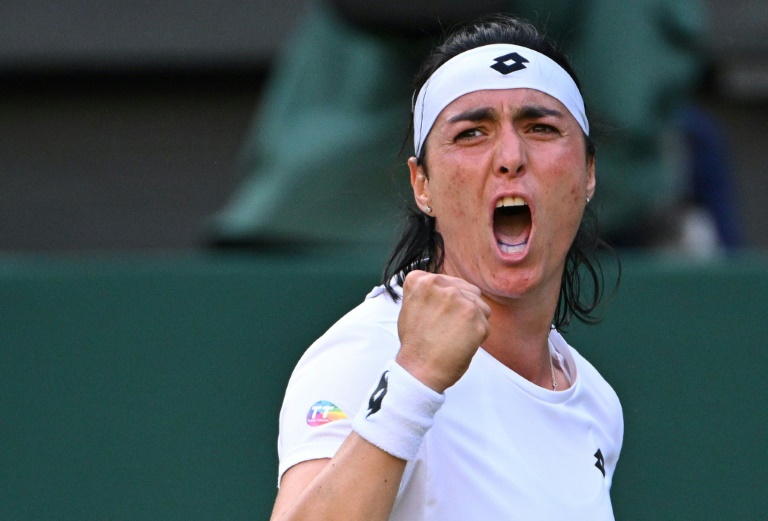
Omar Laabidi remembers being repeatedly beaten by a 12-year-old Jabeur, who will Thursday become the first Arab to play in a Grand Slam semi-final, at Wimbledon.

“We used to call her ‘Roger Federer’,” Laabidi said.

He was talking at the tennis club where it all began, in the North African country’s coastal town of Hammam Sousse.

“One time during a training match she hit a drop shot that I tried so hard to return that I broke my arm,” he said.

Jabeur had started by playing on courts belonging to local hotels but she soon joined the Tennis Club Hammam Sousse, which now bears a huge portrait of its most famous graduate.

Coach Nabil Mlika recalls training a talented girl “determined to stand out” against both female and male peers.

It is a determination that has taken her all the way to the world number two spot — one place behind Poland’s Iga Swiatek.

But Mlika, who trained a young Jabeur for 10 years, said there was a moment where she almost quit the sport.

“She had great ball control, to the point where other coaches tried to attract her to handball,” said the 55-year-old.

“Ons thought seriously about switching sports — but decided to stick to tennis.”

– ‘Queen of the drop shot’ –

The 27-year-old Tunisian’s fighting spirit has been on show throughout her career.

Despite crashing out in the first round of the French Open in May, she surged back to win the Berlin WTA singles title a few weeks later.

Her appearance in the Wimbledon semis — against close friend and “barbecue buddy” Tatjana Maria — comes just two weeks after she was forced to withdraw from the Eastbourne tournament, where she was partnering Serena Williams in the doubles, with a knee injury.

Jabeur, known to many Tunisians as “the minister for happiness”, was born in the southern coastal town of Ksar Hellal, one of four siblings.

She moved to the capital, Tunis, at the age of 12 to train at a highly rated state-backed sports club. 

She has been married to her physical trainer, and former fencer, Karim Kamoun, since 2015.

The right-hander is known for her stamina and the variety of her play.

“She hates playing at one pace,” said Mlika.  “She’s always trying to create a spectacle by switching up the game with shots that surprise her opponents, especially with drop shots.

“She’s really the queen of the drop shot.”

– ‘An example of hope’ –

Jabeur made a splash on the global scene in 2011, winning the girls’ singles at the French Open at the age of 16.

Laabidi also moved to Tunis around the same time as the adolescent Jabeur and joined the same academy, where they continued sparring.

“She was always fun and quickly got to know strangers,” he said.

“But she was always provocative and competitively debating on all subjects.”

Those who knew her as a teenager say she has changed little despite her growing fame. 

“She still runs around gathering up all the balls during training, which she’s been doing since she started playing,” said Mlika. 

Unsurprisingly, as her fame has spiralled membership levels have skyrocketed at her home club, from 320 in 2018 to more than 700 today.

For Yousra Koubaa, the mother of eight-year-old student Yasmine, Jabeur is “an example of hope, one we’re always showing to our children”.

Mlika says he uses photos of a young Jabeur to inspire his students today.

“She was a spark of enthusiasm, always moving and wanting to show that she was the best,” he said.

“She always put me in a difficult position because I had to balance between taking the training up a level, or waiting for her peers to catch up with her level and her pace.”

Fuel prices soar in Ethiopia as subsidies cut

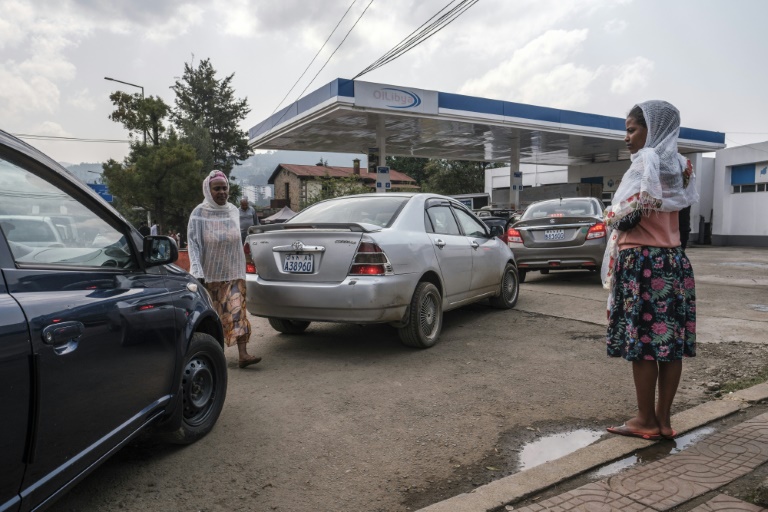
Fuel prices soared in Ethiopia on Wednesday after the government reduced subsidies, adding to economic hardship for people already struggling with high inflation.

The price of petrol at the pump jumped almost 30 percent to 48.83 biir (about 94 US cents) while diesel went up almost 40 percent to 49.02 birr under the new price regime that will run to August 6, the trade ministry said.

The federal government plans to lift fuel subsidies progressively, according to the Addis Tribune business newspaper.

Prices of fuel, food and other basic goods have rocketed globally because of the Ukraine war, badly hitting vulnerable countries in Africa and elsewhere.

The trade ministry said the cost of fuel for Ethiopian consumers should be almost double if it was calculated on current global prices.

“But considering the state the country is in, the government is covering 75 percent of the (price) difference while it was decided that the remaining 25 percent would be transferred to consumers,” it said.

The country of more than 110 million people has seen inflation hovering at around 35 percent over the past six months, with food prices in particular registering a sharp rise.

S.Africa honours 21 youngsters killed in tavern tragedy

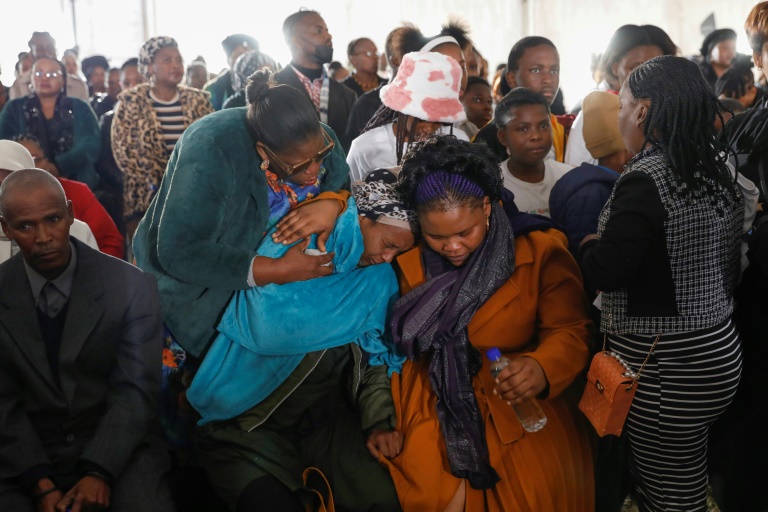
South Africa bade an emotional farewell on Wednesday to 21 people, mostly teens, who died in unclear circumstances at a township tavern last month, in an incident that deeply shook the nation.

President Cyril Ramaphosa joined more than a thousand people at a memorial service at a stadium in Scenery Park, a township in the coastal city of East London, where empty coffins were laid out to symbolise the loss.

Eleven days after the bodies were discovered in the Enyobeni tavern, the cause of the deaths remains a riddle. 

The police are yet to wrap up their investigation, although officials have ruled out a stampede, and autopsy results are still to be made public. 

“Somebody, somewhere must answer” for the tragedy, Police Minister Bheki Cele declared at the memorial service

Scores of mourners filled a large marquee where 19 coffins were laid out, and hundreds more people gathered outside to follow the ceremony. 

Some broke down in tears, while others chanted prayers as a police band played the national anthem. 

Undertakers said the caskets were empty. One family expected to bury their child after the service and the others would be buried later this week. Two of the victims had already been laid to rest, according to local media. 

The youngsters died in what survivors have described as a battle to escape the jam-packed venue, with one reporting a suffocating smell. 

The grim discovery of their bodies was made on June 26.

The youngest was just 14 years and the oldest 20, according to birthdates listed on the memorial official programme distributed on Wednesday.

Cele had previously said the youngest was 13 and the oldest 17.

The fatalities bore no visible signs of injury and officials have ruled out a stampede as the cause of death. 

– ‘Hope of our nation’ –

“As a nation we are hurt by what happened,” Oscar Mabuyane, the head of the Eastern Cape province where East London is located, said in an address. 

“(The) young people we are here to bury were the hope of their families and by extension the hope of our nation.” 

Drinking in South Africa is permitted for over-18s.

But in township taverns, which are often located close to family homes, safety regulations and drinking-age laws are not always enforced.

The tragedy has sparked calls for change. 

“Alcohol… should never be a form of entertainment for our kids,” Lucky Ntimane, national convenor of the National Liquor Traders Association told the memorial service. 

Nolitha Tsangani, a Scenery Park resident who lives near the Enyobeni tavern, said blame for the tragedy should be shared.

“We are all wrong… the parent is wrong, the child who is dead, I am sorry to say, is wrong,” she told AFP, as she also pointed the finger of blame at the tavern owner and the police.

OPEC secretary general Barkindo dies unexpectedly at 63

OPEC Secretary General, Nigeria’s Mohammad Barkindo, has died unexpectedly at the age of 63, it was announced on Wednesday, leaving the oil cartel without a head at a tumultuous time for the markets.

Barkindo had headed the Organization of the Petroleum Exporting Countries since 2016 and was scheduled to be replaced by Kuwait’s Haitham Al-Ghais next month. 

Under his stewardship, the cartel forged ties with 10 other oil-producing countries, such as Russia, to form a wider group known as OPEC+ in a bid to better tame global oil prices, rocked by the challenges of the coronavirus pandemic and more recently the war in Ukraine.  

“We lost our esteemed Dr (Mohammad) Sanusi Barkindo. He died at about 11:00 pm yesterday 5th July 2022,” the Nigerian National Petroleum Corporation’s chief executive Mele Kyari tweeted, without providing any further details about the circumstances of Barkindo’s death.

“Certainly a great loss to his immediate family, the NNPC, our country Nigeria, the OPEC and the global energy community. Burial arrangements will be announced shortly,” Kyari wrote.

“This tragedy is a shock to the OPEC Family,” Vienna-based OPEC tweeted.

“We express our sorrow and deep gratitude for the over 40 years of selfless service that… Barkindo gave to OPEC. His dedication and leadership will inspire OPEC for many years to come.”

Only a few hours earlier, Barkindo — who had not shown any sign of being ill — had met Nigerian president Muhammadu Buhari in Abuja, where Buhari praised Barkindo’s “distinguished achievements at OPEC. 

– ‘Trailblazer’ –

“You were able to successfully navigate the organisation through turbulent challenges,” Buhari had said.

In a statement, OPEC expressed its “immense sorrow and sadness” at the news, describing Barkindo as “a trailblazer widely admired and respected throughout the globe. A dear friend to many.”

Born on April 20, 1959, Barkindo graduated in political science and completed his studies in Oxford and Washington. 

He became Nigeria’s representative at OPEC in 1986. Starting from 1992 he occupied a number of positions within NNPC, and took over as the oil major’s chief executive in 2009/10. 

The OPEC secretary general does not wield any executive power, but is the cartel’s public face and frequently has to act as a diplomat to bring together the different, sometimes conflicting interests of the various member countries.  

For analysts, Barkindo’s death will not have an impact on OPEC’s strategy in the long-term.

“But in the short-to-medium run, it will increase uncertainty about OPEC’s next steps and add to the price volatility as he was a figure of unity for OPEC,” said Swissquote analyst, Ipek Ozkardeskaya. 

Spi Asset Management analyst, Stephen Innes, described Barkindo as “a very important figurehead and a stabilising force behind OPEC. 

“But his death is unlikely to change OPEC direction despite more outside politics entering the picture,” the expert said, predicting that his successor, Haitham Al-Ghais “augurs for the status quo given Kuwait close ties with Saudi Arabia, which wields the most influence” within the group.

Bomb kills two peacekeepers in northern Mali

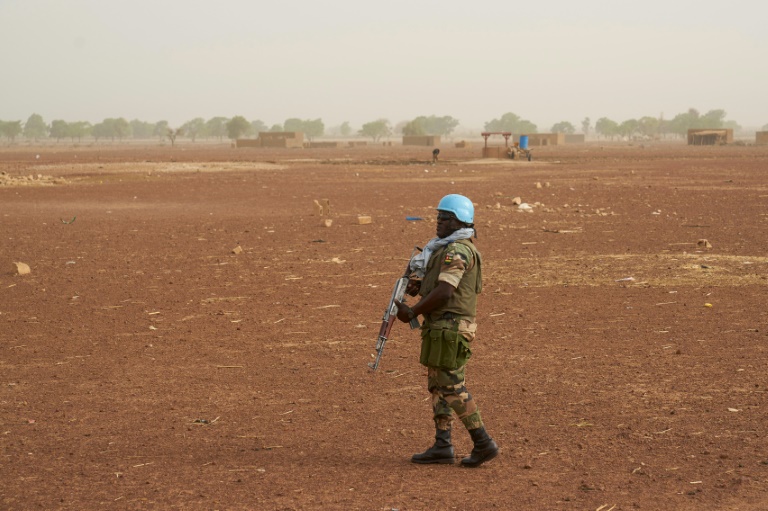
Two United Nations peacekeepers were killed and five were seriously injured Tuesday when their vehicle struck a bomb in northern Mali, the UN mission said.  

“This morning, an armoured vehicle in a MINUSMA supply convoy hit a mine on the Tessalit-Gao highway,” MINUSMA said. 

An official with the UN mission said both fatalities were Egyptian.

The injured were evacuated after a rapid intervention force was sent to the scene, the mission said in a statement. 

“MINUSMA strongly condemns this attack, which may constitute a war crime under international law, and notes with concern the frequent use by terrorist groups of improvised explosive devices to cripple the mission’s operations and impede the return to peace and stability,” it said. 

“Mines and improvised explosive devices in Mali affect UN personnel, Malian defence and security forces and the communities we serve without distinction.”

In New York, the UN Security Council also condemned the attack “in the strongest terms” and called on Malian authorities to launch an investigation, reiterating the warning that “attacks targeting peacekeepers may constitute war crimes under international law.”

MINUSMA — the United Nations Multidimensional Integrated Stabilization Mission in Mali — is one of the UN’s biggest peacekeeping operations, and one of its most dangerous.

It says 177 of its troops have died from hostile acts, including four in June. Eight peacekeepers were injured by a mine in the Timbuktu region on June 23.

MINUSMA’s full complement includes 13,289 military personnel and 1,920 police.

The force’s mandate was extended by the UN Security Council for 12 months on June 29.

However, it will be without French air support, which has been refused by Mali, whose ruling junta is at odds with France.

Jihadists joined a regional insurgency in northern Mali in 2012, and then extended their campaign to the centre of the country and neighbouring Burkina Faso and Niger.

Thousands of civilians have died, more than two million have fled their homes, and economic damage to countries that are among the poorest in the world has been severe.

Burkina ex-president Compaore due home in days: entourage

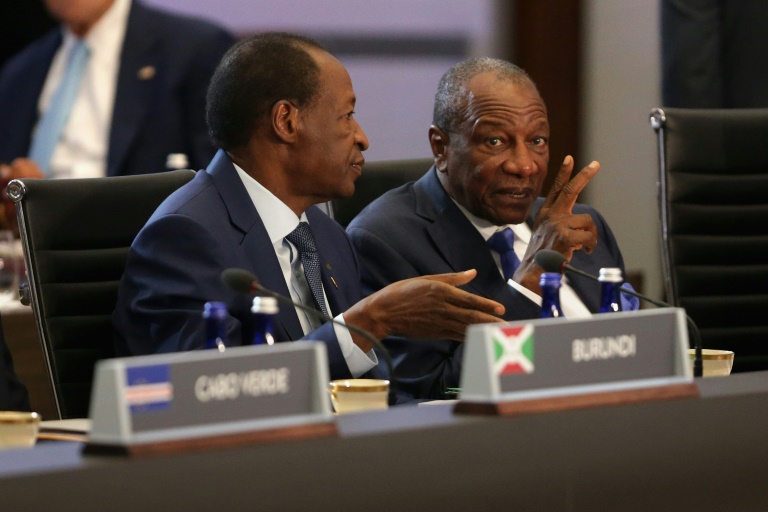
Burkina Faso’s ex-president Blaise Compaore, in exile since his ouster in 2014, will return home to meet military authorities this week, a source close to the government and his entourage told AFP Tuesday.

“He is expected at the end of the week, he is due to arrive on Thursday or Friday for a short stay” and will “be received by the head of state in the framework of national reconciliation,” the source said.

A source in Compaore’s entourage confirmed the trip.

An envoy of junta leader Paul-Henri Damiba, “met him last week in Abidjan to this end,” the source said, adding that Ivorian President Alassane Ouattara had also received him. 

During his stay, he will reside in a government villa where President Roch Marc Christian Kabore, who was overthrown in January, was placed under house arrest, the source said. 

“But if his definitive return is confirmed, he will have to return to his residence in Ziniare, his home village” northeast of Ouagadougou, they added. 

On social media, supporters of the former president called for a rally at Ouagadougou airport on Friday morning. 

It appears the junta is attempting to forge a united front in the fight against jihadist groups that have bloodied Burkina Faso since 2015 and whose increasingly deadly attacks have multiplied in recent weeks. 

Compaore was forced into exile in Ivory Coast in October 2014, a day after violent popular riots and under pressure from the army and the opposition, who opposed his bid to stay in power. 

On April 6, he was sentenced in absentia to life in prison at the end of a six-month trial before the military court in Ouagadougou, for his role in the assassination of his predecessor Thomas Sankara. 

The trial opened in October 2021, 34 years after the death of Sankara, a pan-African icon. 

Compaore’s lawyers denounced the trial as a “political trial”. 

The ex-president was suspected of being behind the assassination of his former comrade-in-arms and friend who came to power in a coup in 1983, which he has always denied.  

The death of Sankara was a taboo subject during Compaore’s 27-year rule.

22 Malian migrants died in boat disaster off Libya: UN

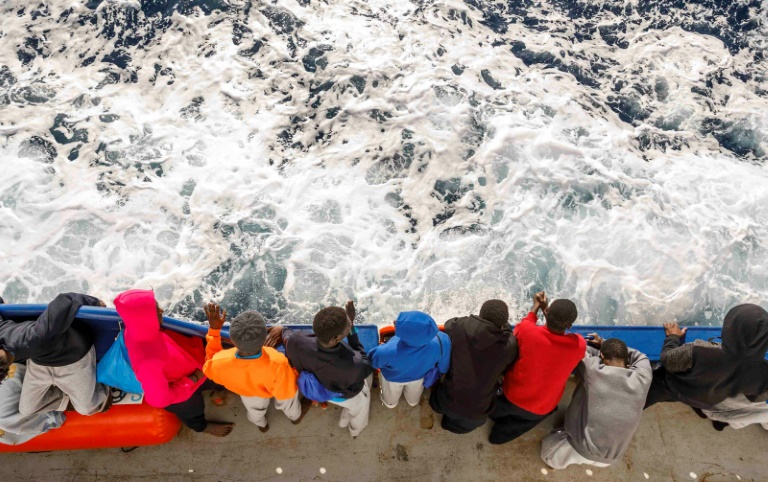
Twenty-two Malian migrants died in a boat disaster off the Libyan coast, the UN said Tuesday, citing survivors who reported victims drowning and dehydrating with three children reportedly among the dead.

After nine days at sea, 61 survivors, mostly from Mali, were rescued by the Libyan coastguard and brought back to shore, the UN’s International Organization for Migration said, with the toll confirmed by Mali’s expatriates ministry.

The migrants embarked from the Libyan city of Zuwara, near the Tunisian border, on a rubber boat, at around 1:00 am (2300 GMT) local time on June 22, said IOM spokeswoman Safa Msehli.

“After nine days at sea, they were picked up by the Libyan coastguard,” she said.

They were brought back to shore on Saturday.

“According to the survivors, 22 migrants, all from Mali, died during the journey. Reported causes of death are drowning and dehydration. Among the dead are three children,” said Msehli.

“The total number of survivors is 61, with the majority from Mali.”

Msehli said some of the migrants were in very bad health and so were taken to hospitals by the IOM.

“The remaining migrants were taken to Al Maya detention centre,” she said.

– ‘World’s deadliest migration route’ –

Libya has become a key route for irregular migration to Europe in the chaotic years since the 2011 overthrow and killing of dictator Moamer Kadhafi in a NATO-backed uprising.

While many have drowned at sea, thousands have been intercepted by the Libyan coastguard, which has been backed by Italy and the EU, and returned to Libya.

“The (expatriates) ministry offers its condolences in the name of the government to the affected families and to the Malian people for this tragedy,” Mali’s government said in a statement that called on the Malian people to “fight against irregular migration”.

The International Organization for Migration has said that nearly 2,000 migrants drowned or went missing in the Mediterranean in 2021, compared to 1,401 the previous year.

It is the world’s deadliest migration route, but people hoping to build a better life in Europe increasingly risk it.

Mali, which is currently under military rule, is chronically unstable and has been buffeted by internal challenges and regional jihadist forces.

Jihadists joined a regional insurgency in northern Mali in 2012, and then extended their campaign to the centre of the country and neighbouring Burkina Faso and Niger.

Thousands of civilians have died, more than two million have fled their homes and economic damage to countries that are among the poorest in the world has been severe.

Close Bitnami banner
Bitnami