Bloomberg

Fed Would Blunt Impact From A Digital Dollar as Banks Push Back

(Bloomberg) — The Federal Reserve is considering ways to blunt any impact on commercial bank deposits if the US government decides to issue a digital dollar, according to the central bank’s vice chair. 

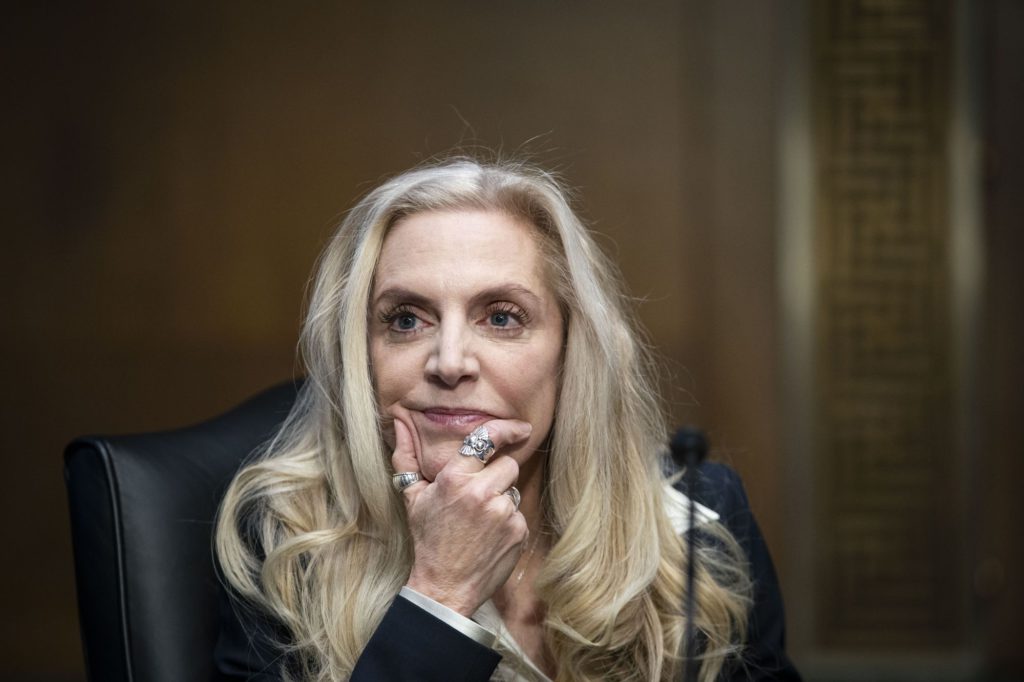
While some decline is unavoidable, the Fed is looking at ways to avoid a significant decrease in deposits, Lael Brainard said Thursday. Industry lobbying groups including the American Bankers Association and the Bank Policy Institute  have asked the government to hold off on launching a central bank digital currency, or CBDC, on concerns that it’d sap money from the banking system and make credit less available to businesses and households.

“There’s certainly a lot of consideration that we’ve been doing in terms of thinking about potential implications for deposits,” Brainard told lawmakers on the House Financial Services Committee. “Any future evolution of the financial system with digitalization is going to lead to some diminished use of cash and some diminution of bank deposits.”

That shift is already occurring, even absent a US CBDC, as people increasingly migrate to mobile payment apps, she pointed out. Still there are ways the US could design a CBDC to limit the impact, Brainard said. For instance, she said the government could set limits on the amount of CBDC holdings a person could have in an account. The ABA and BPI have said that’s unlikely to help much. 

The government could also avoid paying interest on CBDC accounts, which would give bank deposits a competitive edge, Brainard said. “There area a variety of ways people have been thinking about designing these so that they wouldn’t diminish deposits in the banking system,” she added. 

The Fed is currently reviewing comments it received on a discussion paper it released in January, laying out the pros and cons of a potential CBDC. The White House said in a March executive order on cryptocurrency policy that it was placing “highest urgency” on research and possible development of a US digital dollar. 

The central bank hasn’t decided whether to issue a US CBDC and has said it doesn’t intend to move forward without clear support from the executive branch and from Congress.

More stories like this are available on bloomberg.com

©2022 Bloomberg L.P.

Ethereum Founder Buterin Blasts DeFi Model in Terra Critique

(Bloomberg) — Ethereum founder Vitalik Buterin said there is no genuine investment that can get anywhere close to 20% returns per year while analyzing the implosion of the Terra blockchain which sent the crypto market into freefall earlier this month. 

The algorithmic stablecoin TerraUSD and its sister coin LUNA have been the major catalysts for the bear market, dropping to nearly zero dollars over the course of a few days and wiping out $60 billion in Terra coins alone. 

One of the stablecoin’s main attractions for investors had been its promised interest rate, set as high as 20% for UST deposits in the Terra blockchain-based lending project Anchor. 

“The greater level of scrutiny on defi financial mechanisms, especially those that try very hard to optimize for ‘capital efficiency’, is highly welcome,” Buterin said in a statement Thursday. “The greater acknowledgment that present performance is no guarantee of future returns (or even future lack-of-total-collapse) is even more welcome.”

The high-profile developer also explores viable mechanisms to maintain automated pure-crypto stablecoins’ pegs while appealing not to dismiss the entire category. He defines automated stablecoins by characteristics such as a completely decentralized targeting mechanism that tracks a price index, and unlike Tether and USDC does not rely on any asset custodians. 

Buterin also suggests more rigorously evaluating how safe systems are by looking at their steady state, as well as their pessimistic state to see how they perform under extreme conditions and whether they can safely wind down. He also warns of other risks associated with automated stablecoins such as technical glitches. 

More stories like this are available on bloomberg.com

©2022 Bloomberg L.P.

Musk’s Twitter Bankers Face Potential Hit on Riskiest Debt

(Bloomberg) — A group of banks led by Morgan Stanley that agreed to provide Elon Musk with $13 billion of debt financing for his acquisition of Twitter Inc. would risk taking a hit if they had to offload the financing to investors in the current risk-off market climate. 

The lenders forged a deal with Musk based on a maximum interest rate of 11.75% for the $3 billion unsecured portion of the financing package, which is expected to be replaced by a bond with ratings in the CCC tier, according to a person with knowledge of the matter. Yet the average yield on similarly rated junk securities soared past 12% last week as investors pulled back from risk amid fears over rampant inflation, a potential recession and the war in Ukraine.

Selling the debt at a yield above 11.75% would force the banks to incur a hit on the fees they will earn for underwriting the transaction, and could result in outright losses if the rate climbs above 12.125%, said the person, who asked not to be identified when discussing a private transaction.

Representatives for Morgan Stanley and the other members of the underwriting group — Bank of America Corp., Barclays Plc, Mitsubishi UFJ Financial Group Inc., BNP Paribas SA, Mizuho Financial Group Inc. and Societe Generale SA — declined to comment. Representatives for Musk’s family office and Twitter did not immediately respond to requests for comment.

The banks are under no pressure to offload any of the financing right now. Market conditions may improve over the coming months and even taking a loss on a portion of the deal does not necessarily make the entire financing unprofitable for the lenders. Adding to the uncertainty, Musk has repeatedly cast doubt over whether the acquisition will be completed, even though the parties had agreed to do so this year.

The Twitter buyout is one of the few pending acquisitions that was underwritten with large built-in buffers for banks and maximum rates guaranteed to borrowers, known as caps, well into the double digits for unsecured debt. Other financings including the buyout of Citrix Systems Inc., which were committed to earlier in the year when market conditions were less punishing, are at risk of saddling banks with much steeper losses, Bloomberg previously reported. 

Read more: Private Credit No Easy Fix for $15 Billion of Citrix Buyout Debt

Banks who agreed to finance Musk’s bid for Twitter have also taken comfort from the large amount of equity that is part of the overall financing. Musk is dropping plans to partially fund his purchase of Twitter with a margin loan tied to his Tesla stake and has boosted the size of the deal’s equity component to $33.5 billion, according to a regulatory filing Wednesday.

Yields on bonds with CCC ratings, the lowest rung of junk, soared near 12.4% on Monday, their highest since around July 2020, before dipping back to 11.95% on Wednesday, according to data compiled by Bloomberg. Appetite for new issues, meanwhile, has seized up, forcing borrowers with pending acquisitions to look at the private credit market to provide at least some of the debt to finance planned buyouts.

Read more: Confused by Musk’s Twitter LBO? Here’s What’s Weird: QuickTake

More stories like this are available on bloomberg.com

©2022 Bloomberg L.P.

PayPal Begins Cutting Staff as Its Push to Reduce Costs Ramps Up

(Bloomberg) — PayPal Holdings Inc. began laying off staffers who worked in risk management and operations this week as the firm seeks to shore up profits after growth in spending on its platform stagnated in recent quarters.

The company laid off dozens of staffers who worked in Chicago, Omaha, Nebraska and Chandler, Arizona, according to people familiar with the matter, who asked not to be identified discussing private information. PayPal this month also announced plans to permanently lay off more than 80 people in its headquarters in San Jose, California, according to filings with that state.

“PayPal is constantly evaluating how we work to ensure we are prepared to meet the needs of our customers and operate with the best structure and processes to support our strategic business priorities as we continue to grow and evolve,” PayPal said in a statement. 

Spending on PayPal’s platforms climbed just 15% in the first quarter to $323 billion, the smallest increase in at least five years, when supply chain disruptions hindered e-commerce purchases and more consumers returned to in-store shopping as the pandemic eased. The firm’s former parent company EBay Inc. has also been rapidly moving payments away from PayPal’s platform.

PayPal’s headcount has climbed in recent years and the firm ended last year with 30,900 employees, a 33% increased from pre-pandemic levels. 

The company said last month it was working to improve operating leverage — or the ability to grow revenue faster than expenses. Chief Executive Officer Dan Schulman said the company had started to simplify its operating model before the pandemic, but the explosion in volumes on its platform in the early days of the outbreak forced the company to put that work on hold. 

“We are now coming back to this work with renewed focus, energy and purpose,” Schulman vowed at that time. 

PayPal warned in a regulatory filing that it incurred $20 million in costs tied to its restructuring in the first three months of the year after it initiated a “strategic reduction of the existing global workforce.” Most of the costs were linked to severance and other employee benefits, PayPal said.

The company now expects to incur an additional $100 million in restructuring charges this year, though the job cuts will ultimately help the firm save about $260 million a year in employee-related costs, PayPal said.

“We are continuing to review our facility needs due to our new work models,” PayPal said in the filing. “The strategic actions and cash payments associated with this plan are expected to be substantially completed by the fourth quarter of 2022.”

More stories like this are available on bloomberg.com

©2022 Bloomberg L.P.

Midas Tech Investor at Center of $120 Billion Deal Spree

(Bloomberg) — Egon Durban, one of the top tech investors in the gilded world of private equity, has found himself at the center of a resurgence in dealmaking in the industry. 

When Elon Musk decided to make a play for Twitter Inc., one of his first calls was to Durban, a longtime friend who sits on the social networking firm’s board. Durban is also a director of VMware Inc., which announced Thursday it’s being bought by chipmaker Broadcom Inc. in one of the biggest-ever takeovers of a tech company. 

Durban’s deep connections with billionaires ranging from Musk to Michael Dell have ensured his rapid rise at Silver Lake, the investment firm he helps lead, and given him a front-row seat for the latest series of megadeals. All in, Silver Lake and major portfolio firms have been involved in more than $120 billion of deals during the last 12 months, according to data compiled by Bloomberg. 

Silver Lake has plowed money over the past year into everything from Alphabet’s self-driving car venture to data mining company Splunk. Durban has a long history with Twitter, helping broker peace talks with an activist investor in 2020 and agreeing to buy a $1 billion stake in the firm. 

He was also one of the main architects of Dell’s landmark $24 billion leveraged buyout in 2013 of the personal computer maker he founded. The plain-spoken Durban grew up in Texas, studying finance at Georgetown University before working as an investment banker at Morgan Stanley. He joined Silver Lake in 1999 as a founding principal and has watched its assets balloon to around $90 billion. 

In recent years, he’s helped push Silver Lake beyond its original tech focus to seal transactions in adjacent areas like media and sports. The firm invested in Hollywood talent agency company Endeavor Group Holdings Inc., where Musk was briefly a board member, as well as the owner of the New York Knicks basketball team. 

Durban has also built relationships over time with the movers and shakers in the oil-rich emirate of Abu Dhabi. Silver Lake invested in Sheikh Mansour bin Zayed Al Nahyan’s City Football Group Ltd., which controls professional sports clubs from Manchester to Melbourne. Durban is known to be close to Khaldoon Al Mubarak, the influential head of sovereign wealth fund Mubadala Investment Co., which bought a stake in Silver Lake in 2020.

There have also been missteps. Durban worked directly with Musk on his ill-fated plan to take Tesla Inc. private in 2018, which eventually collapsed and led to a shareholder lawsuit. 

And the Silver Lake executive got a rare public rebuke on Wednesday, when he failed to get enough votes to be re-elected to Twitter’s board at the company’s annual shareholder meeting. Advisory firm Institutional Shareholders Services Inc. had recommended against Durban’s re-election because he serves on too many other boards. 

(Updates with Abu Dhabi connections in seventh paragraph)

More stories like this are available on bloomberg.com

©2022 Bloomberg L.P.

Broadcom to Buy VMware for $61 Billion in Record Tech Deal

(Bloomberg) — Broadcom Inc. agreed to buy cloud-computing company VMware Inc. for about $61 billion in one of the largest technology deals of all time, turning the chipmaker into a bigger force in software. 

VMware shareholders can choose to receive either $142.50 in cash or 0.2520 shares of Broadcom stock for each VMware share, according to a statement on Thursday. The offer represents about a 44% premium to VMware’s closing price on May 20, the last trading day before Bloomberg News reported the takeover talks. 

The deal is the biggest takeover ever for a chipmaker and extends an acquisition spree for Broadcom Chief Executive Officer Hock Tan, who has built one of the largest and most diversified companies in the industry. VMware bolsters Broadcom’s software offerings — a key part of Tan’s strategy in recent years. He acquired corporate-software maker CA Technologies in 2018 and Symantec Corp.’s enterprise security business in 2019.

Broadcom’s offer — coming during a market downturn for tech stocks — has the support of key VMware shareholders Michael Dell and Silver Lake, and includes a so-called go-shop provision that allows VMware to solicit competing offers.

VMware shares gained 3.6% to $124.85 as of 12:45 p.m. in New York on Thursday. Broadcom rose 3.9% to $552.33.

Broadcom, one of the most valuable companies in the chip industry, sells components for everything from the iPhone to industrial equipment. But it’s seeing some of its biggest growth from data centers — the massive server hubs that power cloud-computing services — and bulking up on software helps it further serve that market.

The purchase adds to a run of deals for the global tech industry this year. Microsoft Corp. agreed in January to buy video game publisher Activision Blizzard Inc. for $69 billion. A consortium backed by Vista Equity Partners is acquiring software maker Citrix Systems Inc. for $13 billion, and Elon Musk announced a $44 billion buyout of Twitter Inc. in April. The largest previous deal involving a chip-maker was AMD Inc.’s $34.1 billion takeover of Xilinx Inc.

Tan had warned investors in March that he was on the hunt for deals, saying at the time that the company had the capacity for a “good size” acquisition. Bloomberg News first reported that the VMware talks were underway on May 22, and that company’s shares soared 25% the next day.

Slashing expenses has been a key part of Tan’s strategy when he buys companies. Broadcom cut the cost base at CA and the Symantec business by 60% to 70%, according to Sanford C. Bernstein.

“Building upon our proven track record of successful M&A, this transaction combines our leading semiconductor and infrastructure software businesses with an iconic pioneer and innovator in enterprise software,” said Tan in a statement.

VMware has faced slowing revenue growth — a rate that’s now below 10% a year — as its flagship virtualization software line matures. But it’s a reliable source of profitable sales, Broadcom software head Tom Krause said in an interview. 

“Is it a double-digit growth business? I don’t think so,” he said. But it’s sustainable, Krause said. “When I think about our model, that’s the kind of businesses we run and run very well.”

Krause said Broadcom will also evaluate where VMware is spending research-and-development funds, as well as some of the newer businesses that the software maker has acquired. But units like its security business and end-user computing unit relate well to some of Broadcom’s existing product lines, he said.

Broadcom has received commitments from a consortium of banks for $32 billion in new, fully committed debt financing to help fund the deal, and is expected to be completed in Broadcom’s fiscal year 2023. Broadcom will also assume $8 billion of VMware net debt. 

Broadcom was previously in talks to purchase SAS Institute Inc., a closely held software company valued at $15 billion to $20 billion. But those discussions ended last year without agreement.

Broadcom’s most ambitious takeover attempt ever also failed to gain traction. The company tried to buy rival chipmaker Qualcomm Inc. but had to walk away from the deal in 2018 after resistance from the Trump administration. Broadcom’s Singapore headquarters was an issue for regulators at the time, but the company has since switched its domicile to the US. It’s now based in San Jose, California, about 20 miles from VMware’s Palo Alto headquarters.

The VMware acquisition “doesn’t appear to be a deal that raises antitrust concerns,” said Bloomberg Intelligence analyst Jennifer Rie. “But with the current antitrust climate and the FTC’s mission to be more vigilant on merger reviews, this will probably get in-depth scrutiny.” While there could be some concern that the portfolio of products the combination would give Broadcom would allow it to bundle or tie products and services in an anticompetitive way, Rie said, she doesn’t think the Federal Trade Commission would go to court to try to block the deal.

VMware is a pioneering Silicon Valley company that was founded in 1998, the same year as Google. It invented virtualization software, which consolidated applications and workloads on a smaller number of server computers. The innovation made it easier for servers to handle more than one program.

Such software was valuable when businesses managed their own servers, but as companies began relying more on giant cloud providers, VMware’s role was less clear. It struggled to maintain growth and ultimately forged a partnership with Amazon.com Inc., one of the biggest providers of cloud storage and services.

Even with the challenges, VMware could become the “crown jewel of Broadcom’s software division,” according to Angelo Zino, an analyst at CFRA.

VMware has already changed hands before. In 2004, it was acquired by storage technology giant EMC Corp., which then sold a portion of its stake as part of VMware’s initial public offering three years later. The business passed to Dell Technologies Inc. when that company acquired EMC in 2016. 

VMware spun off from Dell last year, but Dell and private equity backer Silver Lake remain top investors in the software company.

Software would help decrease Broadcom’s reliance on chips. But its earlier forays into that market haven’t always been cheered by investors. Tan has argued that he looks for businesses that are “franchises” — ones that hold a strong market position and can be made more profitable without pouring in huge investments.

Chipmakers like Broadcom have enjoyed booming sales in recent years, fueled by the spread of semiconductors into more products — as well as by the need for work-from-home technology during the pandemic. But Tan has warned that the boom times probably won’t last. 

Even after giving a rosy sales forecast in March, Tan said that the semiconductor industry won’t be able to stay on its current trajectory. He expects the chip business to decelerate to historical growth rates of about 5%.

“If anyone tells you otherwise, don’t believe it, because it has never happened,” he said on a conference call at the time. Industry leaders claiming that the semiconductor industry can grow at the current rate for an extended period are “dreaming,” he said.

Broadcom is targeting mid single-digit revenue growth for VMware along with Ebitda margins of the whole business in the mid 60% range, Tan said on a call with analysts. “We see a lot of benefits in putting all these various franchises we have, hardware and software, under one umbrella,” he said.

Goldman Sachs Group and JPMorgan Chase & Co.  are advising VMware while Broadcom is working with Barclays Plc, Bank of America Corp., Credit Suisse AG, Citigroup Inc, Morgan Stanley and Wells Fargo & Co.

(Updates with executive comment on VMware’s business in 10th paragraph.)

More stories like this are available on bloomberg.com

©2022 Bloomberg L.P.

SPACs Make Flurry of Deals as Blank Checks Seek Something to Own

(Bloomberg) — Blank-check companies settled on deals to buy a members-only startup airline, a startup augmented reality firm and a company called Two Bit Circus this month as SPACs face pressing deadlines to strike deals or close shop.

At least 16 special-purpose acquisition company tie-ups have been announced so far in May, the most since December, chipping away at a backlog of nearly 600 SPACs that need something to buy. Almost half the targets aren’t expected to be profitable this year, according to merger presentations, which could hurt their prospects in a sector that’s been one of the market’s worst performers.

The deals have a combined enterprise value of about $15 billion, with micro-amusement park operator Two Bit Circus Inc. and zSpace Inc., a startup provider of augmented and virtual reality platforms, among the smallest targets at less than $200 million each. 

While the deals might be taken as a sign that blank checks are breaking their logjam, they’re just a dent in the more than $160 billion of target-needy SPACs, data compiled by SPAC Research show. The ones with profitless prospects also could feed concerns that SPACs will buy less-than-ideal candidates as acts of self-preservation.

SPACs are called blank checks because they raise money through a public offering with the goal of buying a private business that will be identified later. They have a limited time to complete a deal, typically about two years. If they don’t, the company must return the cash to shareholders, managers can lose their jobs and the sponsors can lose their entire investment.

Among this month’s deals:

  • Alpine Acquisition Corp., which debuted a year ago, is buying Two Bit Circus along with hotels owned by Atrium Hospitality LP and wrapping them together to create “an immersive story experience woven throughout the entire resort.” Completion is expected in the third quarter; they’re projecting positive net operating income in the first year.
  • Tuscan Holdings Corp. II ditched plans to take a cannabis company public, striking a deal instead with Surf Air Mobility Corp., a membership-based operator of private planes with plans to rely on electric engines. To get the deal done, Tuscan is seeking to extend the deadline on its original lifespan for a fifth time. The combined company projects it will generate $100 million in revenue for 2022 from all business units.
  • zSpace’s tie-up with EdtechX Holdings Acquisition Corp II was announced about a month before the SPAC’s June deadline. Its sponsors are planning to offer extra cash to shareholders to compensate them for however long the deal is held up.
  • Near Intelligence Holdings Inc.’s planned takeover by KludeIn I Acquisition Corp. came six months after reports surfaced about a bid for the provider of consumer behavior data. The deal was signed with less than two months until the SPAC’s deadline was set to run out. Near forecasts positive adjusted Ebitda as early as 2024.

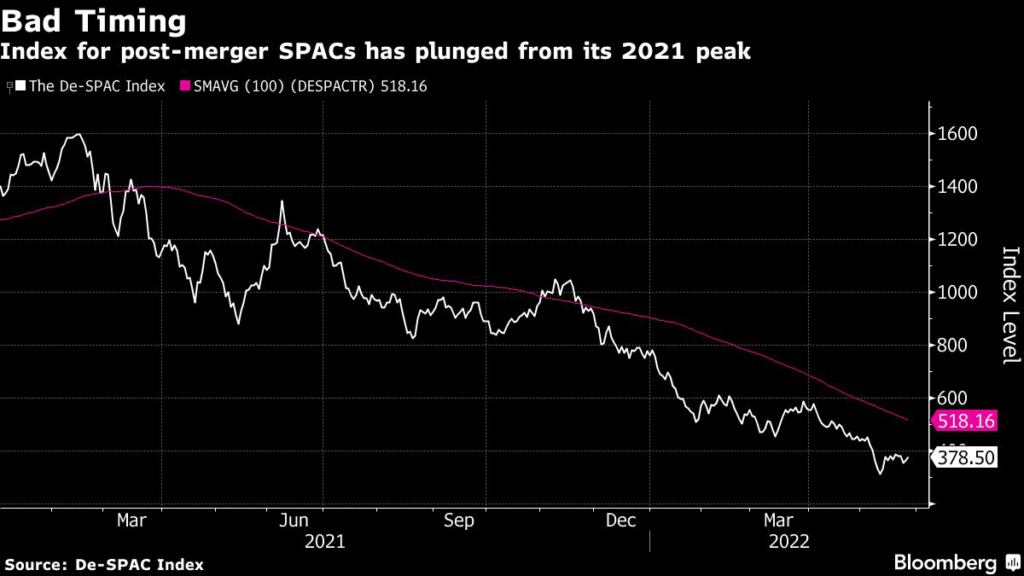
Traders have soured on firms that went public via SPAC merger, particularly those without proven business models or that are years from generating a profit. The De-SPAC Index, which tracks 25 companies that have completed such deals, is down 52% this year. 

Industry malaise drove at least 18 sponsors to withdraw or abandon filings for new SPACs this month, leaving 147 blank-check firms waiting in the wings to go public. Two SPACs that are currently trading have announced they will close shop and return cash to investors after being unable to find a deal.

More stories like this are available on bloomberg.com

©2022 Bloomberg L.P.
Top Gun: Maverick’s F-18 Flights Cost New Tom Cruise Film $11,374 an Hour

(Bloomberg) — The US Navy lent Tom Cruise F/A-18 Super Hornets for the new “Top Gun” movie. The only catches: The studio paid as much as $11,374 an hour to use the advanced fighter planes — and Cruise couldn’t touch the controls.

The “Mission Impossible” star, famous for performing his own stunts, insisted that all the actors portraying pilots on the long-delayed “Top Gun: Maverick” film fly in one of the fighter jets built by Boeing Co. so they could understand what it feels like to be a pilot operating under the strain of immense gravitational forces. Cruise, 59, had also flown in a jet for the original “Top Gun,” a smash hit in 1986.

Cruise ended up flying more than a dozen sorties for the new movie, but a Pentagon regulation bars non-military personnel from controlling a Defense Department asset other than small arms in training scenarios, according to Glen Roberts, the chief of the Pentagon’s entertainment media office. Instead, the actors rode behind F/A-18 pilots after completing required training on how to eject from the plane in an emergency and how to survive at sea.

Roberts said the Navy allowed the production to use planes, aircraft carriers and military bases even though he said the real Top Gun pilots aren’t the cocky rule-benders portrayed in the film, people who “would never exist in naval aviation.” Instead, they’re studious air nerds who toil away for hours in the classroom and participate in intense training flights at Naval Air Station Fallon in Nevada, the site of the actual Top Gun school.

A movie “does not have to be a love letter to the military” to win Pentagon cooperation, Roberts said. But it does “need to uphold the integrity of the military.” Filmmakers need to have funding and distribution for their project and be willing to submit their script for military review. Although the Pentagon can request changes, Roberts said he wasn’t aware of any on “Top Gun: Maverick.”

Read more: AMC Theaters Beats First-Quarter Estimates as Moviegoing Returns

Roberts said that in his years working for the Pentagon’s media office, he’s never seen the level of excitement generated around “Top Gun: Maverick.”

The movie is expected to earn Cruise his first $100 million domestic opening. It could generate about $130 million in U.S. and Canadian ticket sales over the weekend, not including the Memorial Day holiday, according to an estimate from Boxoffice Pro. That would make it one of the biggest movies of the past two years.

Paramount Pictures said in production notes for the film that Cruise created his own demanding flight training program for the movie’s young actors so that they could withstand the nausea-inducing rigors of aerial maneuvers and perform their roles with “real Navy pilots taking them on the ride of their lives.”

The movie is being released this week after delays due to the coronavirus pandemic. Scenes were shot aboard the USS Abraham Lincoln in August 2018 during a training exercise involving the military’s F-35C Lightning II fighter jet, Roberts said. The production also filmed at Naval Air Station Lemoore in Central California.

The Super Hornet, a jet known as the “Rhino,” gets top billing in the movie over the more advanced F-35C built by Lockheed Martin Corp. because that’s what the movie’s script called for, Roberts said. He also noted that the F-35 is a single-seat plane, so the actors couldn’t ride in them.

Filmmakers reimburse the Pentagon for any aircraft unless they’re already being used in a previously scheduled training exercise or the flight can be counted toward the pilot’s required time at the controls. In 2018, when much of the filming for “Top Gun: Maverick” was conducted, the going rate for the jets was $11,374.

(Updates with box office forecast in seventh paragraph)

More stories like this are available on bloomberg.com

©2022 Bloomberg L.P.

Hungary’s ‘Fair’ Windfall Tax Gets Cold Shoulder From Investors

(Bloomberg) — Hungary announced a sweeping set of new taxes aimed at shoring up its bloated budget, sending the country’s stocks down by the most in nearly three months.

Budapest’s BUX stock index was the world’s worst performer on Thursday. It tumbled as much as 9.8% before closing 5.5% lower as the windfall-tax plan turned out less severe than some investors expected. Bond yields jumped but the forint advanced.

Repeated spending hikes by Prime Minister Viktor Orban’s government, which won re-election in April, helped Hungary’s economy fight off the fallout of the pandemic and ease the impact of surging inflation, while inflating the budget deficit. 

The new levy is set to bring in up to $2.5 billion and accounts for 40% of the planned fiscal consolidation, while the remaining 60% would come from savings and spending cuts, Economic Development Minister Marton Nagy told reporters. The UK also slapped a windfall tax on oil and gas companies on Thursday.

“The optics of the fiscal adjustment improved a lot,” said Peter Virovacz, an economist at ING Groep NV in Budapest. “With that planned 60/40 split between expenditure and revenue, markets might calm down sooner rather than later.”

Alarmed Investors

The tax proposal was the latest in a series of developments that had alarmed investors as Hungary slips further away from its European Union and NATO allies. 

Orban — the EU leader closest to Russia — started his fourth consecutive term in power this week by declaring a state of emergency just after he pushed through a constitutional amendment allowing the government to rule by decree in situations such as war in neighboring Ukraine.

In a video message on Wednesday evening, the premier said that this year and next he seeks to siphon off to the budget  “the bulk” of what he called the “extra profits” in key industries — hitting the forint and local shares. 

Markets stabilized nearly a day later after Nagy detailed the plans, which would be primarily funded by a 300 billion forint ($823 million) tax on the banking industry and an equally sized levy on the energy industry, the bulk of which would be paid by refiner Mol Nyrt. Other targeted industries include insurance, telecommunications, airlines, retail, advertisement and pharmaceuticals. 

“The levy on excess profits is fair since we’re not taking away all of the profit from anywhere, only a significant portion to meet our goals,” Cabinet Minister Gergely Gulyas said.

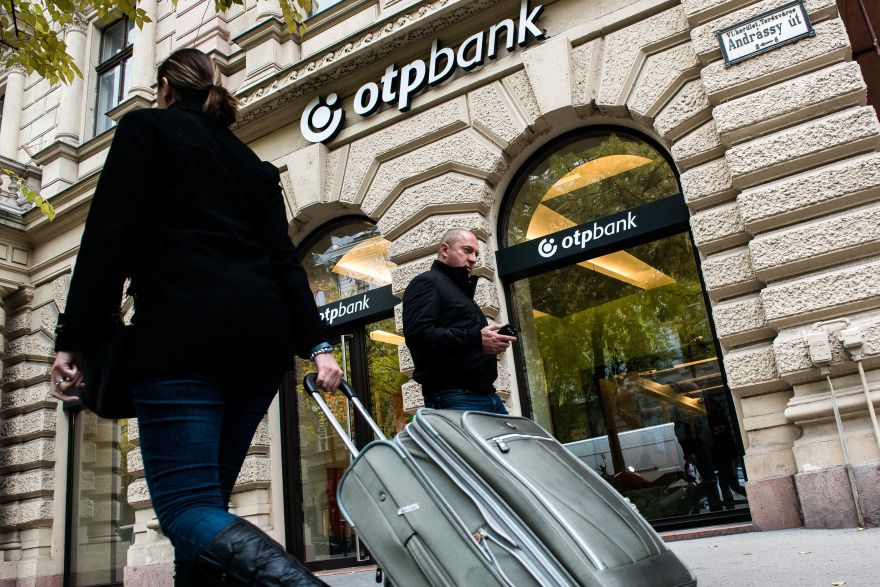
Mol, which has seen its profit rise from selling Russian crude, was the worst BUX performer on Thursday, dropping 9.1%, followed by the country’s largest lender, OTP Bank Nyrt., which declined 8.2%. Magyar Telekom Plc, a unit of Deutsche Telekom AG, retreated 4.4%. 

The yield on Hungary’s benchmark 10-year local-currency bond increased 11 basis points to a one-week high of 7.01%. The forint swung wildly, first losing as much as 1% against the euro and approaching a record low, then strengthening by 0.2%.

The fresh financing, along with the expenditure cuts, will help consolidate the Hungarian budget as the EU imposes an effective funding freeze against Orban’s government, which it accuses of flaunting democratic norms. 

The tax moves, even if they appeared less severe than investors anticipated, mark a reversal from the past years when Hungary tried to put on a more “business-friendly” face, according to Michal Konarski, an equity analyst at MBank SA in Warsaw. “We should expect extra premium applied to the cost of equity,” he said.

(Updates throughout with analyst comments and latest markets.)

More stories like this are available on bloomberg.com

©2022 Bloomberg L.P.
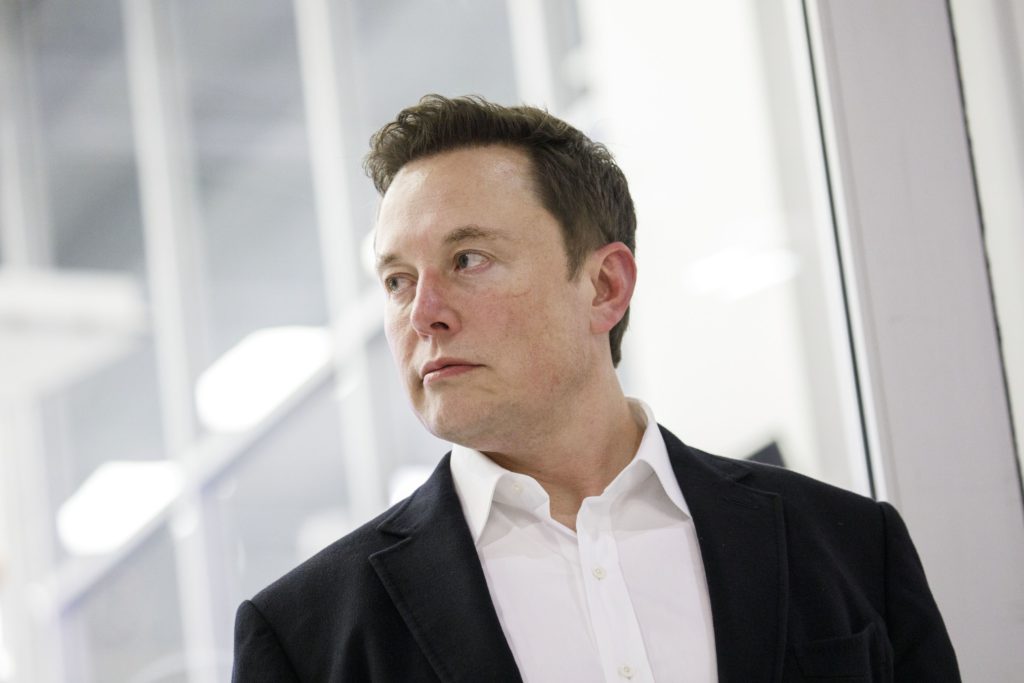
Midas Tech Investor at Center of $120 Billion Dealmaking Spree

(Bloomberg) — Egon Durban, one of the top tech investors in the gilded world of private equity, has found himself at the center of a resurgence in dealmaking in the industry. 

When Elon Musk decided to make a play for Twitter Inc., one of his first calls was to Durban, a longtime friend who sits on the social networking firm’s board. Durban is also a director of VMware Inc., which announced Thursday it’s being bought by chipmaker Broadcom Inc. in one of the biggest-ever takeovers of a tech company. 

Durban’s deep connections with billionaires ranging from Musk to Michael Dell have ensured his rapid rise at Silver Lake, the investment firm he helps lead, and given him a front-row seat for the latest series of megadeals. All in, Silver Lake and major portfolio firms have been involved in more than $120 billion of deals during the last 12 months, according to data compiled by Bloomberg. 

Silver Lake has plowed money over the past year into everything from Alphabet’s self-driving car venture to data mining company Splunk. Durban has a long history with Twitter, helping broker peace talks with an activist investor in 2020 and agreeing to buy a $1 billion stake in the firm. 

He was also one of the main architects of Dell’s landmark $24 billion leveraged buyout in 2013 of the personal computer maker he founded. The plain-spoken Durban grew up in Texas, studying finance at Georgetown University before working as an investment banker at Morgan Stanley. He joined Silver Lake in 1999 as a founding principal and has watched its assets balloon to around $90 billion. 

In recent years, he’s helped push Silver Lake beyond its original tech focus to seal transactions in adjacent areas like media and sports. The firm invested in Hollywood talent agency company Endeavor Group Holdings Inc., where Musk was briefly a board member, as well as the owner of the New York Knicks basketball team. It also has a stake in City Football Group Ltd., which controls professional clubs from Manchester to Melbourne. 

There have also been missteps. Durban worked directly with Musk on his ill-fated plan to take Tesla Inc. private in 2018, which eventually collapsed and led to a shareholder lawsuit. 

And the Silver Lake executive got a rare public rebuke on Wednesday, when he failed to get enough votes to be re-elected to Twitter’s board at the company’s annual shareholder meeting. Advisory firm Institutional Shareholders Services Inc. had recommended against Durban’s re-election because he serves on too many other boards. 

More stories like this are available on bloomberg.com

©2022 Bloomberg L.P.
Close Bitnami banner
Bitnami