
Bloomberg

America’s Political Right Has a New Enemy No. 1: ESG Investors

(Bloomberg) — Heading into the hotly contested midterm elections, the American political right has a new rallying cry: Down with ESG.

Conservatives have identified the popular investing strategy, which accounts for environmental, social and governance risks, as part of a broader narrative about left-wing overreach and “ wokeness” run amok. Utah Treasurer Marlo Oaks calls it “corporate cancel culture.” Behind the rhetoric lie policies designed to sap the momentum of one of Wall Street’s most successful initiatives in recent years, now worth $35 trillion globally. If it works, it will firmly ensconce ESG in the culture wars, galvanize voters and weaken the resolve of big asset managers to act on climate change and other big, societal issues.

West Virginians are already all too familiar with ESG, according to state treasurer Riley Moore. He’s preparing a list of banks that, he says, will lose the state’s business unless they declare they aren’t boycotting the coal industry and other fossil fuels. “Certainly ‘woke capitalism’ is something they are very familiar with,” he said. “We’re facing threats from that in my state, right now.”

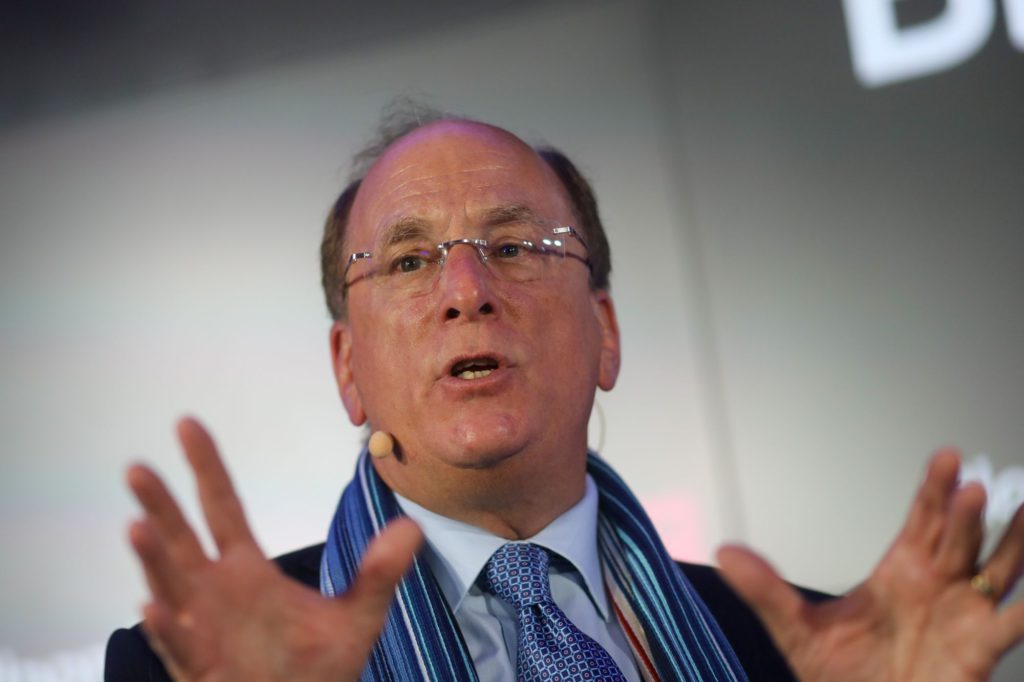
The attacks on ESG escalated last week when former Vice President Mike Pence made the strategy a key theme in an energy-policy speech in Houston. A potential candidate for the 2024 Republican presidential nomination, Pence said large investment firms are pushing a “radical ESG agenda” and took aim at BlackRock Inc., whose Chief Executive Officer Larry Fink is a champion of sustainable investing, and others who have pressed for progress on climate change. 

Pence added to the growing public attacks on ESG. On Wednesday, Tesla Inc. founder and libertarian influencer Elon Musk told his 94 million Twitter followers that “ ESG is a scam,” building on a March tweet in which he labeled the practice “the Devil incarnate.” Republican megadonor Peter Thiel called ESG a “hate factory for naming enemies” in a speech at a Bitcoin conference in April, and the Twitter bio of right-wing pundit Glenn Beck now reads, “Against ESG before it was cool.” 

With gas prices rising and energy a key factor in Russia’s invasion of Ukraine, it’s becoming easier for Republicans to tie ESG to pocketbook issues of their constituents. Just as Critical Race Theory grew from a catchall for parents unhappy or worried about what their children were learning in public schools to successful efforts to seize control of local school boards, ESG opponents see an opportunity to aim voters’ fears of inflation at the finance industry’s efforts to combat global warming and other social ills. 

It’s also a new front in a longstanding battle against further restrictions on fossil-fuel industries, which give generously to Republican party candidates, and more corporate accountability. At the state level, Republican governors and other officials are finding new ways to block major Wall Street firms from state business, including managing pension funds and bond issues, if they apply ESG principles to other parts of their portfolios.

Nationally, the broadsides against ESG bolster calls to abandon, or at least relax, environmental standards in favor of “energy independence.” It’s also a partisan issue at the US Securities and Exchange Commission, which is trying to require companies to report on their greenhouse gas emissions. In a virtual meeting on the plan in March, the agency’s only Republican commissioner, Hester Peirce, turned off her camera in protest, saying that she was trying to reduce her carbon footprint.

Republicans are increasingly using banks and “woke” companies as cudgels for their base voters, said Reed Galen, a co-founder of the anti-Trump group, The Lincoln Project. “If you’re taking on a company who has environmental and social justice goals, you don’t have to explain ESG to the voters. All you have to do is say ‘woke corporation.’”

In the past few years, as the world became more aware of the risks posed by global warming and social unrest, financial firms have rushed to offer investments that promise to account for those risks — and maybe even minimize them. With an ESG slant on everything from loans to complex derivatives, assets are set to balloon to $50 trillion worldwide by 2025, according to estimates from Bloomberg Intelligence.

In the US, a big proportion of that is via public pension funds, which are overseen by state or local officials, or in private sector retirement plans, and receive preferential tax treatment. In response to new federal rules that would allow pension funds to consider ESG alongside traditional fiduciary factors in making investing decisions, almost two dozen states registered their objection, saying the rules would allow investments to be guided by “social causes and corporate goals, even if it adversely affects the return to the employee.”

Those states are increasingly considering legislative action. State lawmakers and treasurers have for years been concerned that politically motivated investing strategies reduce long-term profits, said Jonathan Williams, chief economist at the American Legislative Exchange Council. The conservative group, which writes model legislation, is looking to  prevent public pensions from making investments using ESG. 

Credit ratings agency S&P Global Inc. also has come under fire for using ESG information to evaluate municipal debt. In West Virginia, Moore joined several state treasurers last month to demand the ratings agency drop ESG factors from its rating system. His state got a negative social score and a moderately negative environmental score, signaling higher risk than the vast majority of states, which are rated neutral. 

“The ESG movement is nothing but a slippery slope,” Moore said, cautioning that states will be forced to “bend the knee to the woke capitalists or suffer financial harm.”

S&P Global declined to comment on specific states and instead referred to a paper it published May 9 explaining how its ESG credit indicators work.

Kentucky, Texas and West Virginia have passed legislation that requires financial firms to say whether they have policies that limit doing business with oil, gas and coal companies, a common practice for firms that have made pledges to reduce their own carbon footprint. Banks that demur could lose their licenses in those states. Another 12 states are considering similar measures.

“Once ESG becomes commingled with corporate wokeness, it can become a powerful way for anti-corporate right wingers to talk about it and galvanize voters,’’ said Chris Stirewalt, an expert in US politics, voting trends and public opinion at free-market think tank American Enterprise Institute.  

In addition to shunning oil, gas and coal producers as part of climate change policies, investors and employees have encouraged companies in recent years to take positions on LGBTQ rights, gun control and other issues that add to rancor among Republican voters. 

Most recently, companies have begun to address the third rail of political issues: abortion. In March, Citigroup Inc. made waves when it said it would cover the travel and medical costs for any of its employees who needed to cross state lines to seek an abortion or other reproductive health care. In response, a Texas lawmaker said the bank could face criminal charges under that state’s abortion law, and Republican members of Congress called for the cancellation of US government contracts with Citigroup, which provides the credit cards that members of the US House of Representatives use to pay for flights, supplies and other goods.

Spokespeople for Citigroup and BlackRock declined to comment. A spokesman for Thiel didn’t respond to messages, nor did representatives for Tesla, run by Musk.

Few expect the Republican attacks on ESG to vaporize the industry. As of now, roughly $3.4 trillion of public retirement money is invested in line with ESG strategies of some sort, according to the sustainable-investing industry group US SIF. Some of the bigger, more liberal states like California and New York are pushing for more restrictive ESG screens for state funds, not less. What’s more, many of the world’s biggest financial institutions have their own goals to cut emissions, which include reducing the amount of business they do with heavy polluters — whether they bill it as ESG or not. Many also have set targets for workforce diversity and elevating women in management, neither of which are politically popular among the right.

Still, the political pressure seems to be taking a toll. BlackRock sent a letter this week to the Texas state comptroller, rebutting the assertion that the firm boycotts the oil and gas industries, and Fink has made it clear he opposes divesting from fossil-fuel companies. The firm also said this year that it won’t back as many shareholder efforts to push companies to reduce their emissions compared with 2021. JPMorgan Chase & Co. is also taking steps to re-establish itself in Texas’s muni-bond market, about eight months after a new law forced that bank out of most deals because of its policies on guns and fossil fuels. 

And if Wall Street’s usual suspects can’t be persuaded, others are eager to step in. With the backing of hedge fund manager Bill Ackman and Thiel, Vivek Ramaswamy, a pharmaceutical investor and author of “Woke Inc.,” has started an investing firm that attempts to be an antidote to the “political agendas” and “stakeholder capitalism” of bigger money managers. 

In Utah, state treasurer Oaks pointed to real pain points for his constituency. Dixie Power, for example, which delivers power to roughly 25,000 customers, recently learned its longtime auto insurer wouldn’t renew coverage. The utility owns a coal-burning power plant and has stakes in two others, and the insurance company is phasing out business with companies that derive profits from coal, according to Colin Jack, the firm’s chief operating officer. The co-op is also set to lose insurance coverage for its coal mine from Lloyd’s of London for the same reason.

Fueled by frustration with that and what he sees as other government intrusion into the energy sector, Jack is running as a Republican for a seat in the Utah state legislature.

He may be in line for a powerful endorsement. On Wednesday, less than three hours after tweeting that ESG is a scam, Musk wrote that although he’d voted Democrat in the past, “I can no longer support them and will vote Republican.” 

More stories like this are available on bloomberg.com

©2022 Bloomberg L.P.

Better Housing Policy Might Be the Best Climate Policy for the US

(Bloomberg) —

We all make a host of tiny decisions every day that, on their own, have little to no impact on the Earth’s climate. In aggregate, of course, they very much do. Such is the conundrum of individual action versus the world’s largest systemic problem. Little seems to matter, except perhaps the single biggest individual choice: where and how to live. 

And I’m not talking about which country or state, for those lucky enough to have such a choice. I’m primarily talking about the single most dominant choice: city vs. suburb. (Living the pastoral life off the land sounds lovely, but is not a viable option for most. Even Henry David Thoreau famously had his mother do his laundry.) 

“Choice,” here, is a loaded term. Many if not most such choices are driven by broader forces. That goes for what is deemed socially acceptable or expected — how the number of bedrooms in one’s home tends to be a rather public signal, readily shared, while the length of one’s commute is typically a more private matter, couched as a personal “sacrifice” for just those added bedrooms. Then there is the role of urban and regional planning in shaping our home choices. 

Planning is bound up with politics, and most of those politics are local, with communities deciding who should be allowed to live among them and how. Welcome to the wondrous world of exclusionary zoning. 

“Wondrous,” of course, is an even more loaded term than “choice.” Suburbs as a whole are far from uniform, but lots of the history of suburbia has been written in the ink of redlining and segregation: deliberate policy choices that excluded entire racial or religious groups. That applies to many U.S. cities as well. Plenty are replete with suburban-style neighborhoods where land is used inefficiently, often exclusively for single-family homes. Most of Atlanta, Houston and Los Angeles, to name a few, fall into this category.

There are lots of factors behind these developments, including the cult of domesticity — with the requisite traditional gender stereotypes of the stay-at-home mom taking care of the single-family house, while dad earns the money downtown to pay for it all. But enough with the stereotypical history. Where to go from here? 

In a recent Twitter post Andrej Karpathy, the head of artificial intelligence at Tesla, marveled at “how cool European cities are” and listed some of the reasons why:

I forgot how cool European cities are. More compact, denser, more unique / interesting, cleaner, safer, pedestrian/bike friendly, a lot more pedestrian only plazas with people relaxing / hanging out. A lot more of outside is an outdoor living space, not just transportation space.

— Andrej Karpathy (@karpathy) April 2, 2022

Yep. Not all European cities are created equal, of course. Even the best have plenty of their own problems, including giving too much space specifically to cars. But Karpathy is on to something.

It’s telling that Americans from car-addled places, with the requisite means, like to go to European cities — or Manhattan — on vacation, and happily forego driving for days on end. When there, they splurge on the most central of hotels. Why stay even 10 minutes farther away from where one needs to be? Vacation days, after all, offer limited time. 

Yet back home stateside, many see the “solution” to the problems caused by sprawl in a limited way, reflected in Karpathy’s day job: building a better car. Yes, electric vehicles are better than those powered by internal combustion engines. Technofixes are important. But they are indeed just that.

Societal changes are hard. Building better cities is doubly so, due to lock-in effects whereby seemingly small decisions are visible decades hence. Jane Jacobs is rightfully revered as an early urbanist who saved her beloved Lower Manhattan from the expressways of Robert Moses. Those would have handed even more of New York City over to cars, much as other cities had done at the time. 

There is no magic lever to fix it all, but one comes close: removing exclusionary zoning and building more housing in cities. Doing so helps ease housing costs where relief is most needed. Transit-rich urban neighborhoods command some of the highest prices for good reason. Demand is high, and supply limited. The answer is to build many more homes in cities. 

The Biden administration was right to highlight zoning reform as the first step in easing the burden of housing costs. Costs will not come down overnight, however. Meanwhile, rezoning must not only focus on cities. Making suburbs denser is indeed part of the plan. The most ambitious housing policy in the New York metropolitan area is not found in New York City, but just across the Hudson River in Jersey City.

Urban living cuts CO₂. That much is clear. Building more desirable, dense, mixed-use and largely car-free neighborhoods might be one of the most powerful climate policies. An added bonus: It furthers community and family and could, perhaps surprisingly, help bridge classic partisan divides. 

Gernot Wagner writes the Risky Climate column for Bloomberg Green. He teaches at Columbia Business School (on leave from New York University). His latest book is Geoengineering: the Gamble (Polity, 2021). Follow him on Twitter: @GernotWagner. This column does not necessarily reflect the opinion of Bloomberg LP and its owners. 

More stories like this are available on bloomberg.com

©2022 Bloomberg L.P.
Taiwan Posts Shock Export Order Fall on China Covid Curbs

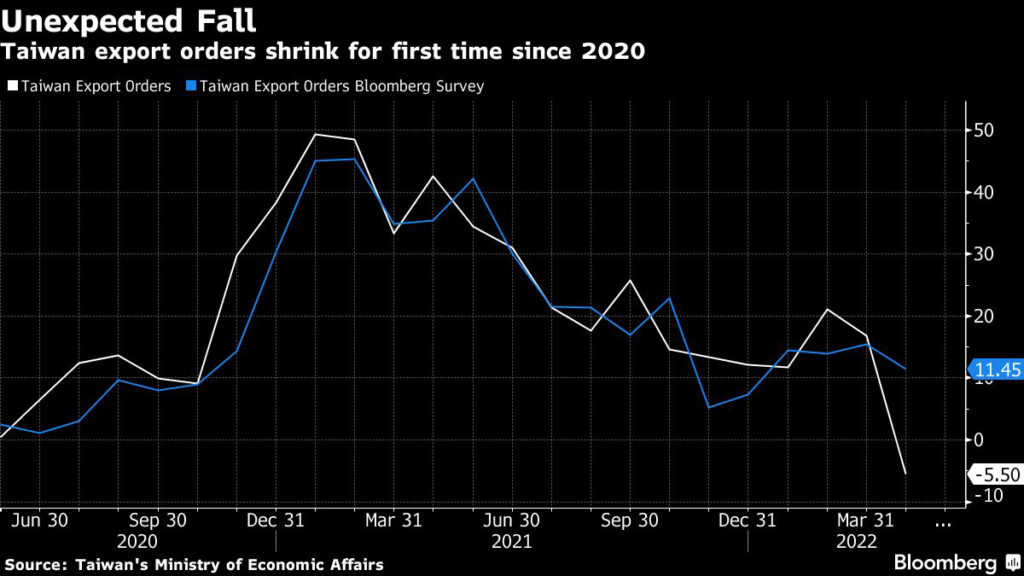
(Bloomberg) — Taiwan’s export orders fell in April for the first time since 2020 as Covid lockdowns in China weighed on production capacity for major Taiwanese companies. 

Orders dropped 5.5% from a year earlier, a far worse outcome than the 11.5% gain expected by economists surveyed by Bloomberg. It was the first drop in orders since February 2020, when the pandemic began, and the worst drop since January 2020, when orders fell 12.8% on year. 

The Taiwanese government warned a few weeks ago that export order growth would likely slow to between 1% and 3.8% in April, but Friday’s figures are even worse than the most bearish economist forecast.

“Although the demand for emerging technology applications and digital transformation continues to grow, the lockdown in mainland China has resulted in reduced production capacity,” the Ministry of Economic Affairs said in a statement Friday, citing problems such as logistics disruptions and shortages of raw materials. 

Orders for communications components and optical equipment dropped 21.5% and 27.7%, respectively, year-on-year because of the China lockdowns and slower demand for consumer products, officials said. 

The government expects May orders to continue to be a drag, ranging between a contraction of 1.1% and a gain of 1.7% from a year prior.

The lockdowns in China have posed challenges to Taiwan’s growth, given the extent to which Taiwanese firms operate there. Big names — including Foxconn Technology Group and Taiwan Semiconductor Manufacturing Company Ltd. — have plants in parts of China that were impacted by lockdowns, though they said they were able to keep operating by using so-called closed loop systems. That strategy allows firms to operate by having workers live on site and testing them regularly.

The economics ministry said Thursday that it expected export orders to be flat or growing in the second half of the year if China lockdowns end in the first half, and output resumes as expected.

Taiwan’s Economic Affairs Minister Wang Mei-hua said China’s Covid policy has triggered many firms to think about focusing on other regions. The ministry would “do its best to help Taiwanese businesses expand to other regions,” she said at an event for electronic manufacturers in Taipei Friday.

Economists have warned that the second quarter will be challenging for Taiwan because of the lockdowns in China and the extent to which they could hit operations of Taiwanese technology firms.

Taiwan’s economy cooled in the first quarter, expanding 3.06% from a year earlier compared to 4.9% growth in the prior three months. The government will release updated gross domestic product figures for the January-to-March period next Friday, and is also expected to revisit growth forecasts for the second quarter and the full year. 

Central bank Governor Yang Chin-long warned earlier this month that a cut to the forecast for full-year growth was “possible.” Its 2022 growth estimate was 4.05% in March.

(Updates throughout with additional context, government quotes.)

More stories like this are available on bloomberg.com

©2022 Bloomberg L.P.

Romania Vies for Chip, Battery Sites as Global Crisis Deepens

(Bloomberg) — Sign up for the New Economy Daily newsletter, follow us @economics and subscribe to our podcast.

Romania intends to host production sites for electric car batteries and semiconductors in the near future by tapping its mineral resources and access to European Union funds to lure investors struggling with snarled supply chains, Economy Minister Florin Spataru said.

The government is in talks with several foreign investors who are planning to construct new battery factories in eastern Europe. Romania, whose less developed transport infrastructure may be counterbalanced by a higher degree of energy independence and access to rare earth metals used in batteries, is a suitable location, Spataru said in an interview. 

“We are in close contact with several investors and we support them with finding the best options and potential locations for them,” he said on Thursday in Bucharest. “I’m convinced Romania will be on the map with an electric battery plant.” He declined to give any other details.

Major carmakers’ location search for new sites to host battery plants comes as Covid-19 shutdowns in China and Russia’s war on Ukraine are bringing supply chains to a halt, even as countries make new pledges to wean themselves off fossil fuels with plans that include a shift to electric vehicles.

The countries of the European Union’s eastern wing, which lured foreign-owned car plants at the start of the century with their low costs, educated workers and history of heavy industry, are now vying for battery production sites that will be crucial to the mass production of EVs.

Volkswagen AG recently chose Spain for a 7 billion euro ($7.7 billion) battery plant, but still wants to add more production units across Europe as part of its plan to invest around 52 billion euros over the next five years in EVs.

Romania also plans to use a 500 million euros in EU funds to support research, innovation and production for microchips, according to Spataru. It will also ask Brussels for help reopening mothballed mines containing copper, tin and bauxite.

“For many years, Romania hasn’t responded to this push for change, but right now we have a solid government and a solid coalition that’s determined to transform the economy and our industry,” Spataru said.  

He also said that Romania is vying to host at least 20 companies that are currently scrutinizing the market for potential relocation from Russia or Ukraine because of the war.  

More stories like this are available on bloomberg.com

©2022 Bloomberg L.P.
Zilingo Fires CEO in Escalating Clash at Singapore Startup

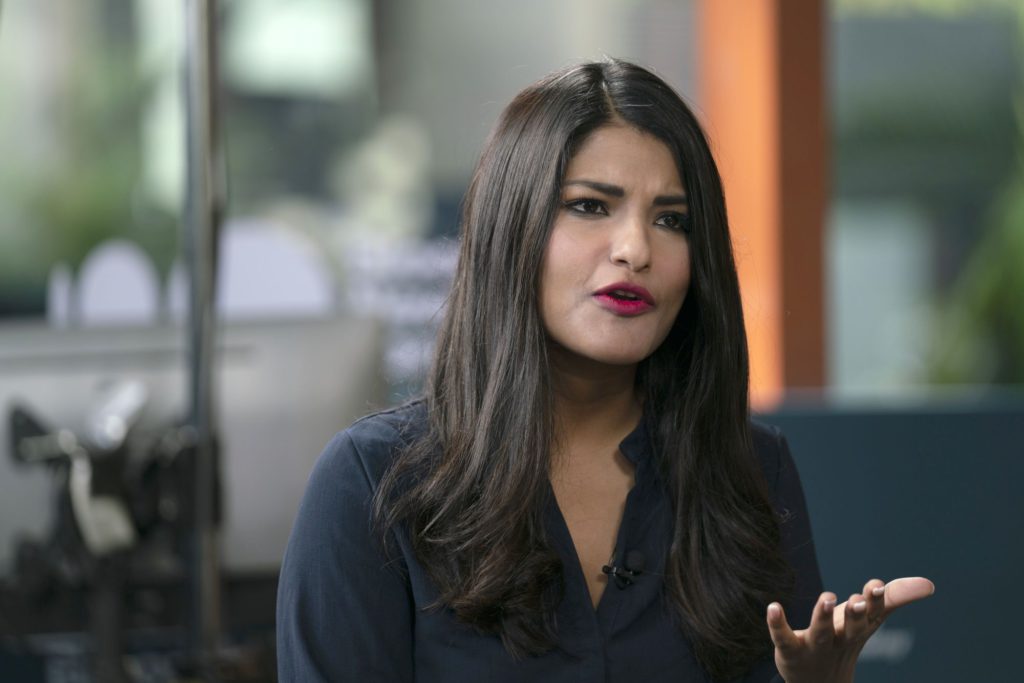
(Bloomberg) — Zilingo Pte has fired co-founder and Chief Executive Officer Ankiti Bose, deepening a dispute that’s plunged the once high-flying startup into crisis and sent shockwaves through Singapore’s technology industry.

Zilingo ousted Bose after an investigation led by an independent forensics firm into complaints of serious financial irregularities, it said in an emailed statement on Friday. The company “decided to terminate Ms Ankiti Bose’s employment with cause, and reserves the right to pursue appropriate legal action,” it said in the statement.

Bose was suspended from her duties at the fashion e-commerce platform on March 31 while the company opened an investigation into allegations of accounting irregularities. Kroll Inc. led the probe into its finances over past weeks, although its findings have not yet been made public. 

Bose has denied any claims of wrongdoing and has argued she is being unfairly targeted, Bloomberg News has reported. On Friday, she provided a separate statement to Bloomberg News.

“I have been suspended for the last 51 days on the basis of an anonymous whistle-blower complaint, and today I am informed that my employment has been terminated inter alia on grounds of ‘insubordination’,” Bose said in a statement.

The dispute has flared up on social media and in a slew of media reports, including from Bloomberg News. On Friday, Zilingo said the speculation online has caused “irreparable damage” to the company.

“The company is deeply pained and disappointed to see the manner in which the board, investors and employees have been constantly attacked through ostensibly leaked and fake information, along with what unfortunately appears to be paid and defamatory social media campaigns throughout the investigation period,” it said in its statement.

Creditors of Zilingo have decided to recall their loans, prompting the company’s board to appoint an independent financial adviser for options for the troubled Singapore-based fashion tech startup.

Read more: Zilingo Appoints Financial Adviser as Creditors Recall Loan

The clash represents a dramatic turn of fate for one of Singapore’s most celebrated startups, which Bose founded with Dhruv Kapoor in 2015.

Some of the concerns relate to the way that Zilingo, which regulatory filings show had not filed annual financial statements since 2019, accounted for transactions and revenue across a platform spanning thousands of small merchants.

Zilingo’s directors talked regularly in mid-April to consider Bose’s future, and that of the startup itself, Bloomberg reported April 19. The co-founder, meanwhile, had pressed the board to clarify her status in part because she was concerned the company was growing rudder-less.

As the clash between Bose and the board escalated, Bose hired an attorney to fight back against what they have described as a “witch hunt.” Bose has argued that she is getting blamed for decisions and practices that were well known by senior managers and directors, people familiar with the matter have said.

Zilingo had been one of the highest-profile startups to emerge from Singapore. Major investor Temasek Holdings Pte has expressed concern the meltdown is tainting its reputation and urged the company to fix the situation, people familiar with the matter have said.

The company raised $226 million at a valuation of $970 million in 2019 when Bose was 27 years old. But the Covid-19 pandemic took a toll on its business: Revenue dropped by about a third in fiscal 2021 to roughly $40 million. Bose took a pay cut of about 30% as a result, while the company laid off staff.

(Updates with company’s comments from the sixth paragraph)

More stories like this are available on bloomberg.com

©2022 Bloomberg L.P.
Tesla Loses Top Spot in Cathie Wood’s Flagship Fund

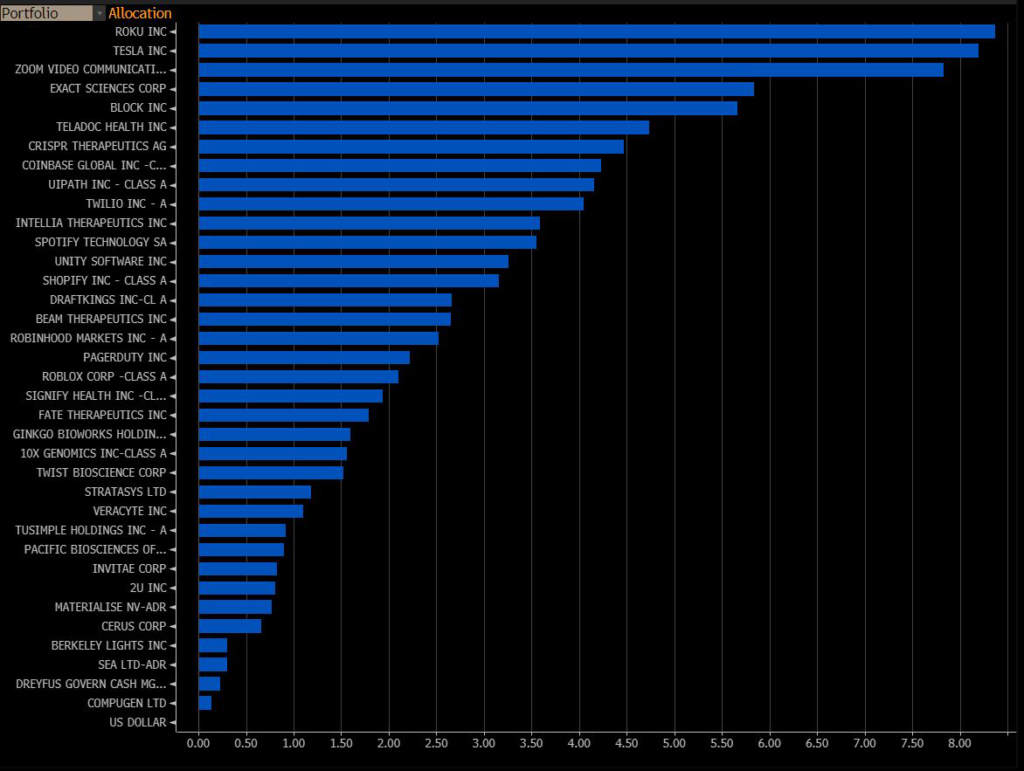
(Bloomberg) — Tesla Inc. has lost its crown jewel status in Cathie Wood’s main fund for the first time in about four-and-a-half years.

Elon Musk’s company had commanded the pole position by market value in the ARK Innovation ETF, an exchange-traded fund known as ARKK, on most days since at least 2017, according to data compiled by Bloomberg. That changed on Thursday, when electronics product maker Roku Inc., a firm with $13.2 billion of market value, pipped it to take the top spot.

ARKK held Tesla shares worth about $703 million as of Thursday’s close, versus a position of $717 million in Roku, according to ARK Investment Management LLC.’s data compiled by Bloomberg. 

Like ARKK’s 55% drop this year, Tesla’s loss of its star status in the ETF is a reminder of the pressure on growth stocks from rising interest rates and a darkening global economic outlook. It also came after a 33% plunge in the electric car maker’s shares this year, following their rise to a record in 2021. 

ARK Investment and its flagship fund have been selling Tesla shares for at least four quarters in a row, according to Bloomberg-compiled data. The firm owned nearly 1.59 million Tesla shares as of the end of March, down from nearly 5.79 million shares a year earlier.  

ARK’s daily trading updates show only active decisions by the management team and don’t include creation or redemption activity caused by investor flows. Wood’s oft-repeated mantra is that ARK invests with at least a five-year time horizon, and that volatility in their equity picks is expected.

More stories like this are available on bloomberg.com

©2022 Bloomberg L.P.
Turkey’s Anti-Immigration Challenger Tops Erdogan on Twitter

(Bloomberg) — Sign up for our Middle East newsletter and follow us @middleeast for news on the region.

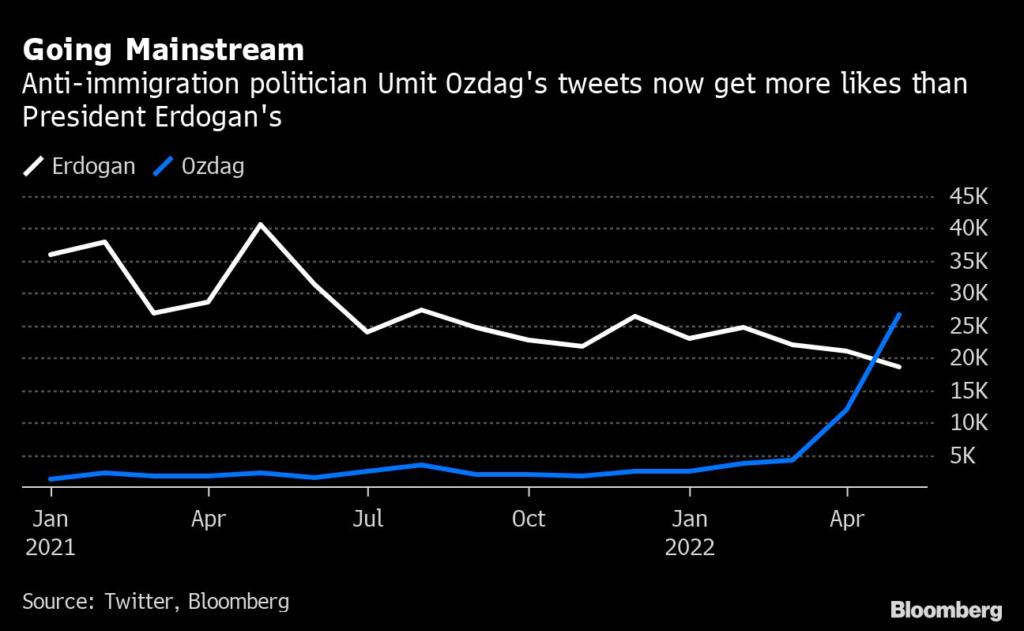
Turkey’s leading anti-immigration opposition politician now gets more “likes” than President Recep Tayyip Erdogan on Twitter, underlining the firebrand’s outsized effect on political debate ahead of elections next year.

Zafer Party leader Umit Ozdag’s tweets attracted an average 26,640 likes in May so far, topping Erdogan’s equivalent (18,627) for the first time, according to a Bloomberg analysis of Twitter data.

Ozdag’s most popular tweet, a challenge to a public showdown with the interior minister over immigration policy, racked up almost four times as many likes as Erdogan’s, at 209,691.

Erdogan Faces New Challenge From Anti-Immigration Firebrand

Despite his party having a single parliamentary seat, Ozdag closed the social-media gap with the man who’s led Turkey for almost two decades by riding growing anti-immigrant sentiment. The mood in Turkey is turning against hosting the world’s biggest refugee population as an inflation surge erodes living standards.

As Ozdag’s profile grew, and with it his calls to send millions of migrants home, the government announced plans in May for the voluntary return of a million refugees to Syria.

More stories like this are available on bloomberg.com

©2022 Bloomberg L.P.

Biden Lands in Asia With Semiconductors and Security in Mind

(Bloomberg) — President Joe Biden arrived in South Korea, where he’s set to visit a Samsung Electronics Co. semiconductor complex Friday as he seeks to bolster supply chains that reduce reliance on China.

Biden’s first trip to Asia as president, which runs through Tuesday, also includes Japan. He’ll meet with regional leaders in a bid to firm up support for his plans to help Ukraine fend off Russia’s invasion and counter security threats posed by China and North Korea, which may conduct its first nuclear test since 2017 with Biden nearby. 

Biden’s trip to the Samsung facility underscores the emphasis he’s placed on strengthening semiconductor alliances among the world’s largest chip making countries to try to ease shortages that have dragged on the global economy. The complex in Pyeongtaek, south of Seoul, houses the some of biggest chip production lines in the world and makes a wide range of products from memory chips to logic chips for Qualcomm Inc. and other companies.

Samsung is responsible for a third of global memory chip production and controls just less than 20% of outsourced chips for tech clients. South Korea’s largest company has been expanding its facilities at home and in the US to keep up with soaring demand.

The Biden administration has been pushing Congress to approve a broad China competition bill that includes $52 billion in funding for domestic semiconductor research and manufacturing. The president has recently gotten personally engaged in urging Congress to act. 

“Pass the damn bill and send it to me,” Biden said earlier this month. “If we do, it’s going to help bring down prices, bring home jobs, and power America’s manufacturing comeback.”

Read more: Biden Demands Passage of China Bill as Democrat Skips Ohio Event

Lawmakers, meanwhile, still have to work out differences between the Senate- and House-passed versions of the legislation, a process that could take until the end of the summer.

The White House has often used the continuing global semiconductor shortage and its impact on inflation as arguments for approval of the massive subsidies program. But analysts say the shortage will last through 2023, and the domestic supply of chips coming online will not meaningfully alleviate the crunch.

Samsung announced new investment plans in the US late last year. The company chose Texas in a $17 billion plan as the site of an advanced chip plant set to break ground this year, with a target to kick off operations in the second half of 2024.

Face-to-Face meetings

Biden is set meet new South Korean President Yoon Suk Yeol soon after arrival. The conservative Yoon, who took office on May 10, has backed support for Biden’s supply chain initiatives and intends to join a new regional economic grouping the US president is expected to unveil in Japan.

The US and its partners also will kick off the Indo-Pacific Economic Framework, part of the Biden administration’s efforts to counter China’s clout in Asia, following the US’s withdrawal from talks on the Trans-Pacific Partnership regional trade agreement under former President Donald Trump.

But some Asian nations are reluctant to sign up to the economic framework because they’re unsure what it will mean, US Ambassador to Japan Rahm Emanuel said.

Read more: Some in Asia Confused by Biden Strategy, Envoy Rahm Emanuel Says

Some details framework’s details remain hazy, and the Biden administration has stressed it won’t include lower tariffs or better access to US markets. 

Nuclear threat?

North Korea, which has a habit of timing its provocations to political events, may be preparing to launch an intercontinental ballistic missile or conduct a nuclear test to coincide with Biden’s trip to the region, security officials in the US and South Korea said this week. 

Read more: Biden Has Little to Entice Kim Jong Un to Stop Weapons Tests 

The U.S. push to isolate Russia over Vladimir Putin’s war in Ukraine, coupled with increasing animosity toward China, has allowed North Korean Leader Kim Jong Un to strengthen his nuclear deterrent without fear of facing more sanctions at the United Nations Security Council. 

There’s little chance Russia or China would support any measures against North Korea, as they did in 2017 following a series of weapons tests that prompted Trump to warn of “fire and fury” from Pyongyang. 

More stories like this are available on bloomberg.com

©2022 Bloomberg L.P.

UK Consumer Confidence Hit 48 Year Low: The London Rush

(Bloomberg) — Here’s the key business news from London-listed companies this morning.

M&C Saatchi Plc: The advertising house has agreed a takeover deal with London-listed Next Fifteen Communications Group Plc, valuing the company at about £310.1 million.

  • The agreed deal trumps a rejected offer made by AdvancedAdvT Limited, who sought the support from the company’s shareholders after failing to win the board’s support — the rival bidder said they’re now considering their options 

Playtech Plc: Talks between the gaming software developer and TTB Partners are making progress, the company said this morning, setting June 17 as a deadline for an offer to be made.

  • A six month-long restricted period under the takeover code expired today

Wincanton Plc: The UK-based supply chain partner appears to have managed rising prices, delivering earnings that beat the average analyst estimate.

UK Retail Sales: The latest data for April shows that retail sales including fuel have fallen 4.9% year on year, slightly better than estimated

  • Data released overnight showed UK consumer confidence fell to its lowest level in at least 48 years in another sign that the worst inflation in four decades is threatening the recovery from the pandemic

Outside The City

The pressure on Labour leader Keir Starmer is likely to build after yesterday’s news that Boris Johnson won’t be fined again for breaking coronavirus regulations. 

In Case You Missed It 

British entrepreneur Nick Candy is considering an offer to buy Manchester-based THG Plc, while the online retailer announced it rejected a rival bid. That’s as Bloomberg Opinion’s Chris Hughes writes that stars could be aligning for private equity to launch a fresh shopping spree in the UK. 

And party like it’s 1952: Here’s what’s on luxury offer during the celebrations of the Queen’s Platinum Jubilee.​​​​​

Looking Ahead

Supermarket Marks & Spencer Group Plc is the highlight of next week’s earnings, along with a number of other companies. 

On Monday, we’ll find out how higher interest rates and soaring inflation have impacted the property market as Rightmove data on house prices for May is released. 

(Corrects fifth paragraph regarding takeover code restrictions.)

More stories like this are available on bloomberg.com

©2022 Bloomberg L.P.
Elon Musk Gets Defensive Over Twitter Meme as Harassment Report Surfaces

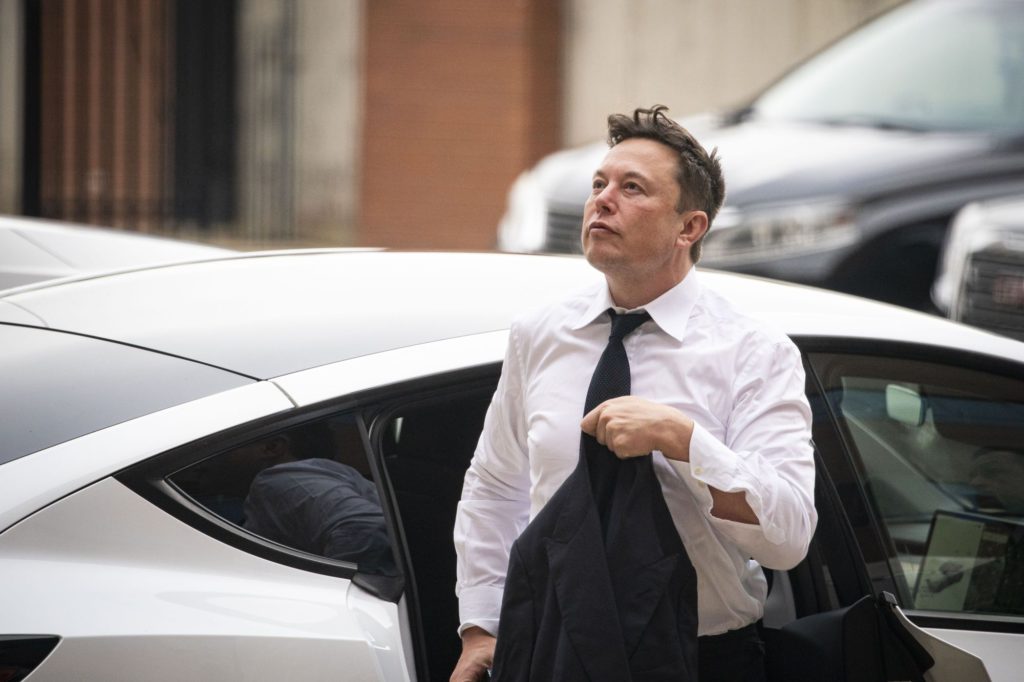
(Bloomberg) — Elon Musk is getting riled up over a meme poking fun at his obsession with Twitter.

The Tesla Inc. chief tweeted that “Tesla is on my mind” 24/7 after the meme suggested the billionaire is neglecting the EV maker while pursuing his on-again, off-again $44 billion takeover of Twitter Inc.

In the tweet Musk argues that he spends less than 5% of his time on his pursuit of the social media platform, despite a steady stream of tweets in past weeks that have up-ended markets and cast the landmark deal in doubt.

Musk’s defense came as another thorny issue made the rounds online: an Insider report that SpaceX — another of the entrepreneur’s passions — paid an employee $250,000 to settle a claim she was sexually harassed by Musk in 2016.


(Updates with Musk’s comments in the fourth paragraph)

More stories like this are available on bloomberg.com

©2022 Bloomberg L.P.

Close Bitnami banner
Bitnami
