
Bloomberg

Biden Struggles to Woo Asian Nations Wary of Upsetting China

(Bloomberg) — Joe Biden talked at length as a presidential candidate about the need to focus on China’s rising global power. Yet 17 months after taking office, Asian leaders are still waiting for details on a strategy for more US economic engagement in the region.

Before Biden touched down in South Korea on Friday, many officials in the region have struggled to understand the Indo-Pacific Economic Framework — the main policy initiative he plans to unveil on the five-day trip. The US ambassador to Japan, Rahm Emanuel, said this week that some governments were asking “What is it we’re signing up to?” 

While much of the framework remains vague, one thing is clear: It won’t provide lower tariffs to the US market, which is one of the main carrots for many nations to agree to higher labor and environmental standards that American lawmakers want in any pact. That’s particularly the case if they risk upsetting China by joining a framework seen as countering Beijing.

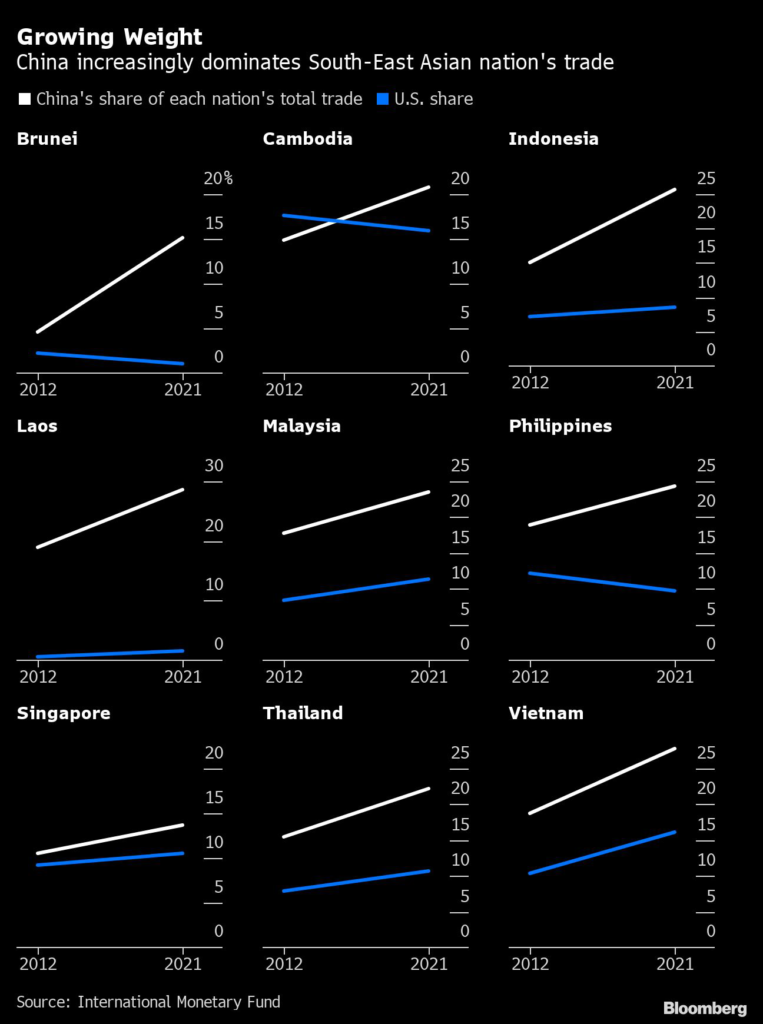
“All of the governments in Asia have China as their number one or number two importer and exporter, so how much do I want to potentially antagonize my biggest economic partner in exchange for unclear, if any, benefits from the US?” said Deborah Elms, Singapore-based executive director of the Asian Trade Centre. “What it looks like is a lot of conditions and not a lot of economic benefits for participants.” 

For Biden, the problem is largely domestic politics. The administration knows the US must engage more with Asia to counter China’s growing economic power, but it also doesn’t want to spend political capital making the case for rejoining the 11-nation Trans-Pacific Partnership, a regional trade deal that Donald Trump withdrew from in 2017. 

Already plagued by low approval ratings, the president’s ability to tackle soaring prices for gas, food and other every day items — as well as a baby formula shortage — could determine whether his fellow Democrats hang on to their slim House and Senate majorities in midterm elections six months from now. 

So instead the US is trying to come up with something that looks like a big trade deal without risking any domestic blowback. National Security Advisor Jake Sullivan described the economic framework as “not a traditional free trade agreement,” while saying it would deal with supply chains, the digital economy, clean energy and investments in infrastructure.

Details so far are hazy. The Financial Times reported Friday that the US had diluted the language in the document in a last-minute move to attract more countries to sign up. An earlier draft had said the nations would “launch negotiations,” the paper said, citing people familiar with the situation and an earlier draft. 

The White House did not immediately respond to a request for comment.

Singapore, which relies on strong open trade, has been an advocate of more US economic engagement in the region even as it has said it was a mistake to pull out of the TPP, now known as the Comprehensive and Progressive Agreement for Trans-Pacific Partnership.  

“I would say you could make this as substantive as possible,” Singapore Prime Minister Lee Hsien Loong said in March. “Let us take some baby steps towards market access and trade liberalization.”

Lawrence Wong, who is set to take over from Lee, also said the US framework should be open to China to “build shared interdependencies” and “ensure a path away from a conflict down the road.” Indonesia President Joko Widodo this month also said the initiative “surely must be inclusive.”

Still, the US is no longer having substantive talks with China on trade, even though Sullivan said this week that Biden was set to soon speak again with Chinese leader Xi Jinping. In March, U.S. trade chief Katherine Tai said discussions with China have been “unduly difficult” and said it was time to focus on boosting American competitiveness and working with allies to make supply chains more resilient. 

On Friday, Biden visited a Samsung Electronics Co. semiconductor complex in South Korea with newly elected President Yoon Suk Yeol, who said he’d seek to upgrade US-South Korea relations “into an economic-security alliance.”

The US global share of the market has declined to only 12%, and there is room for Taiwan and South Korean manufacturers to step in, said Thomas Byrne, president of The Korea Society.

“The sleeping elephant is semiconductor supply chain resiliency and restoring fab manufacturing in the U.S.,” he said. He also said the administration should “work harder — wake up? — with the reconciliation process in Congress” to pass legislation that would free up billions of dollars to boost chipmaking in the US.

In Asia, countries also want to see signs of US staying power in the wake of its withdrawal from Afghanistan and Russia’s invasion of Ukraine, said Bill Hagerty, a former American Ambassador to Japan. China has regularly flown military jets toward Taiwan, and asserted its territorial claims in boundary disputes with India, the Philippines and Japan. 

“What they are looking for is evidence of America’s resolve,” Hagerty said. “There’s also great concern that America’s attention might be taken away from their region because of what’s happening in Ukraine.”

More stories like this are available on bloomberg.com

©2022 Bloomberg L.P.
Musk’s Questions About Twitter Bot Problem Spur Race for Answer

(Bloomberg) — Elon Musk has said that his $44 billion purchase of Twitter Inc. hinges on the accuracy of one figure: the number of bots on the platform. That’s triggered a race for answers.

Twitter indicates in regulatory filings that the number of automated accounts is less than 5% of the total, but Musk has said he suspects that the number is much larger. If he can demonstrate that Twitter’s figures are inaccurate, the billionaire may attempt to use the information to get out of the deal or negotiate a lower price. 

Though many outside estimates do put the figure above the 5% threshold, their assessments and methodologies vary. Andrea Stroppa, a former data consultant for the World Economic Forum and a veteran of scrutinizing online counterfeit goods, estimates that bot accounts have accounted for about 10% of Twitter’s global audience over the past nine years.

The rate rises to as much as 20% for some specific topics such as cryptocurrencies, the researcher said, and above 30% for accounts engaged in certain conspiracy theories.

The research firm Bot Sentinel, meanwhile, estimates that 10% to 15% of accounts on Twitter are inauthentic. That includes fakes, spammers, scammers, nefarious bots, duplicates and single-purpose hate accounts. Inauthentic accounts are more likely to tweet about politics, cryptocurrency, climate change and Covid-19 than less controversial topics like kittens and origami, Bot Sentinel has found. Cyabra, a research firm with a different methodology, puts the percentage of inauthentic Twitter profiles at 13.7%.

Twitter didn’t immediately respond to a request for comment.

Musk said this week that spam bots amount to at least 20% of Twitter’s total, and he asked whether the true figure could be as high as 80% or 90%. He tweeted out a meme on Thursday jokingly suggesting that Twitter is “all bots.”

But it may be hard to use the issue to get out of buying Twitter, said Adam Badawi, a professor of law at the University of California at Berkeley.

“To have leverage, he would need to show that the difference between the true number of bots and the amount Twitter disclosed in its SEC filings rises to the level of a ‘material adverse effect,’” he said. “That’s M&A jargon for a complete calamity. He’d probably need to show that over half of Twitter’s users are not real.”

Musk, the head of Tesla Inc. and the world’s richest person, agreed last month to acquire Twitter and take it private for $44 billion. After that, as Musk sought to shore up financing for the transaction, he showed signs of wavering. He said last week that the deal was “on hold” until he gets more information, specifically proof from Twitter that so-called spam bots make up less than 5% of its users. 

Earlier this week, Musk stoked speculation that he could seek to renegotiate the takeover, saying at a tech conference in Miami that a viable deal at a lower price wouldn’t be “out of the question.” But the transaction isn’t officially on hold or being renegotiated; Musk is still contractually committed to it. 

Musk likely has a different experience with bots on the platform than most. Those designing automated accounts program them to follow popular users on a site, so that they fit in with the crowd and look more human. Musk, with a following of 94 million, probably attracts a higher percentage of bots than most users. His image has also been used by cryptocurrency accounts to run scams.

That said, bots are indeed more of an issue for Twitter than other platforms, Stroppa said.

“Twitter’s bot detection software is much weaker than other social media,” he said. On Twitter, you can run a botnet using outdated techniques and don’t need sophisticated tools such as Android emulators and 4G proxies, which can mimic customers using a mobile phone, Stroppa said. Professional botnets on Twitter are stealthy, especially the ones used for digital propaganda, he added. 

Bots also aren’t against Twitter’s rules. Some are comedic or useful in other ways, such as one that automatically tweets out the magnitude of earthquakes.

With hot-button issues such as the pandemic, automated activity tends to be higher. Carnegie Mellon University researchers collected more than 200 million tweets discussing coronavirus or Covid-19 from January 2020 to June 2020. Of the top 50 influential accounts retweeting material, 82% were bots, they found. Of the top 1,000 retweeters, 62% were bots.

But the overall number may be close to unknowable, even by Twitter — and it’s not even clear what constitutes a bot.

“I suspect that this will be drawn out in courts,” Duke University professor Chris Bail said. “Because reasonable people can disagree on what is or what isn’t a bot.” 

EXPLAINER: Why Elon Musk and Twitter CEO Are Sparring Over Bots 

More stories like this are available on bloomberg.com

©2022 Bloomberg L.P.
Richemont’s Rupert Forecasts ‘Volatile Times’ Amid Global Crises

(Bloomberg) — Richemont shares plunged the most in more than two years after the Cartier owner said Chinese demand will be slower to recover than expected, clouding prospects for a market that’s fueled the luxury industry’s recent growth.

The Swiss watch and jewelry maker suffered a financial hit in Russia, failed to strike a deal for its online sales unit and forecast rocky times ahead, particularly in the key market of China. The stock fell as much as 14% Friday, losing almost a third of its value this year.

“Even if the worst of Covid is hopefully behind us, we face a global environment which is the most unsettled we have experienced for a number of years,” said Chairman Johann Rupert. “We face volatile times ahead.”

The former investment banker’s comments raise questions about luxury demand, which has defied the recent economic gloom, buoyed by rich consumers who are more insulated from the effects of lockdowns and the cost-of-living crisis. Earlier this week, Burberry Group Plc said profitability reached the highest level in eight years as the UK trenchcoat maker benefited from efforts to make its brand more exclusive.  

The chairman said on a call with reporters that his “gut feeling” is that the Chinese economy is going to suffer the impacts of Covid and lockdowns longer than most people think and that the country’s rebound will be slower than that of others. About 40% of Richemont’s stores in that market are currently closed. China, where Richemont has about 3,000 employees, could face a “repeat of 2020” if Covid infections accelerate, Cartier Chief Executive Officer Cyrille Vigneron said. 

“The country is going to take an economic blow,” said Rupert, who founded Richemont in 1988. “There will be a temporary contraction.”

He clarified his comments by saying investors shouldn’t expect a triple-digit rebound in revenue from China and that it will be slower than the recent US recovery. Big companies in China are likely to cut jobs, weighing on consumers’ purchasing power, he said.

Richemont executives said revenue growth in the Asia-Pacific region was positive in April despite China. Rupert said the month was “OK.”

‘Feel-Good’

Political polarization in the US and countries like France risks damping the “feel-good factor” that drives luxury consumption, Rupert said. Also, inflation may lead to political demonstrations in some countries, he said.

“I’m worried about the crisis in basic foods,” the 71-year-old South African billionaire said. “We are going to have shortages. People riot when there’s no bread.”

Richemont said the suspension of its business in Russia knocked 168 million euros ($177 million) off of profit. Executives confirmed some of its products were seized in Russia and said the financial charges taken cover its risks in the county. Rupert called costs related to the seizure a “rounding error.”

The company ended the year with 5.3 billion euros in cash, which the chairman said is a “source of strength.” Richemont also announced a special dividend.

Operating income missed analysts’ estimates at 3.39 billion euros, as marketing and other costs increased more than expected and jewelry operating margins suffered. Sales rose a record 35%.

Full-year profit more than doubled as the maker of Vacheron Constantin Swiss watches benefited from a bounceback from the pandemic. 

‘The Word’

“Caution is the word of the moment,” said Chief Financial Officer Burkhart Grund.

The company said talks with partners for a luxury e-commerce alliance continue, but the process is protracted because it’s complex. Richemont is still in negotiations with Farfetch Ltd. and other entities it declined to identify. The company aims to sell a majority stake in its online business, which operates sites such as Net-a-Porter.

Richemont said it looks “forward to concluding matters in the near future.”

Analysts at Citi said they expected a deal to divest the online luxury business called YNAP with minority stake sales in the business to Farfetch and others. Farfetch shares have lost almost three-quarters of their value this year.

The lack of a YNAP spin-off announcement is disappointing, though if discussions are progressing, that suggests a deal might happen this quarter, which runs through June, the Citi analysts said.

Asked about acquisitions, Rupert said, “Let’s see if things calm down and if prices return to reality.”

The chairman, who has been nicknamed “Rupert the Bear,” said Friday that he would prefer being called “Rupert the Realist.”

“Central banks have behaved irresponsibly,” he said. “The people who did not need money got access to free capital. If you get something for free, you abuse it. Now unfortunately, the party is unwinding.”

The European, U.S. and Japan economies are going to face a “dose of reality,” he said. 


(Updates shares in second paragraph)

More stories like this are available on bloomberg.com

©2022 Bloomberg L.P.
Tesla Battles for Battery Engineers Commanding CFO-Like Salaries

(Bloomberg) —

If you’re tired of reading about shortages, I have some bad news for you.

We’ve talked about the lack of cars, chips, batteries, and all manner of minerals needed to make them, be it cobalt, nickel or lithium. Lately, I’ve been thinking about another pinch the industry is in: the shortage of people with the knowledge and skill to develop and produce batteries at scale.

The talent scarcity was apparent a few weeks ago when I attended Battery Brunch, an online networking event organized by the Volta Foundation, a nonprofit that aims to connect thousands of battery geeks around the world in their common mission to electrify transportation and curb climate change. It’s a monthly event, and there’s usually a slate of wonky topics discussed in breakout rooms: battery-pack failure modes, seabed mining, nanoscale materials.

Last month’s agenda included a chat with Tesla engineers and recruiting managers who spent a few hours of their Saturday answering questions about what it’s like to work for the electric vehicle leader. If the most valuable car company in the world, with a cult following and celebrity CEO, has to scrounge for battery engineers like this, what does it say about the rest of the auto industry?

Tesla has been working toward mass EV production for over a decade. These are still relatively unchartered waters for incumbent automakers. Sure, General Motors has been tinkering with EV projects since the days of the EV1. But designing, planning, hiring and building to mass manufacture EVs and batteries? This is their first big push. There are at least a dozen major battery plants that have been announced or are being built in the U.S. right now, creating thousands of jobs openings.

Median salaries for U.S. battery engineers have been climbing for years. In 2021, they ranged from around $100,000 for a junior engineer to nearly $200,000 for a director, according to a report from the Volta Foundation, which compiled data using H-1B visa applications. Battery executives in the C-suite reported salaries close to $400,000.

“A senior battery engineer in the U.S. sometimes can cost as much as a CFO,” Qichao Hu, the chief executive officer of SES AI, a solid-state battery startup backed by GM and Hyundai Motor, told me. “This whole industry now, it’s not sustainable, from people to raw materials.”

The Woburn, Massachusetts-based company has an in-house recruiter, though Hu will occasionally rely on an outside headhunter for certain positions. He does so sparingly, since they’ll in some cases charge a 25% to 35% commission on a successful hire, he said. SES recently got into a bidding war with Tesla, Rivian, GM and QuantumScape over a new hire. Tesla won out.

One battery engineer who works for a global automaker told me recruiters for Rivian, Ford, Tesla, Amazon and CATL have been showing up in his LinkedIn inbox.

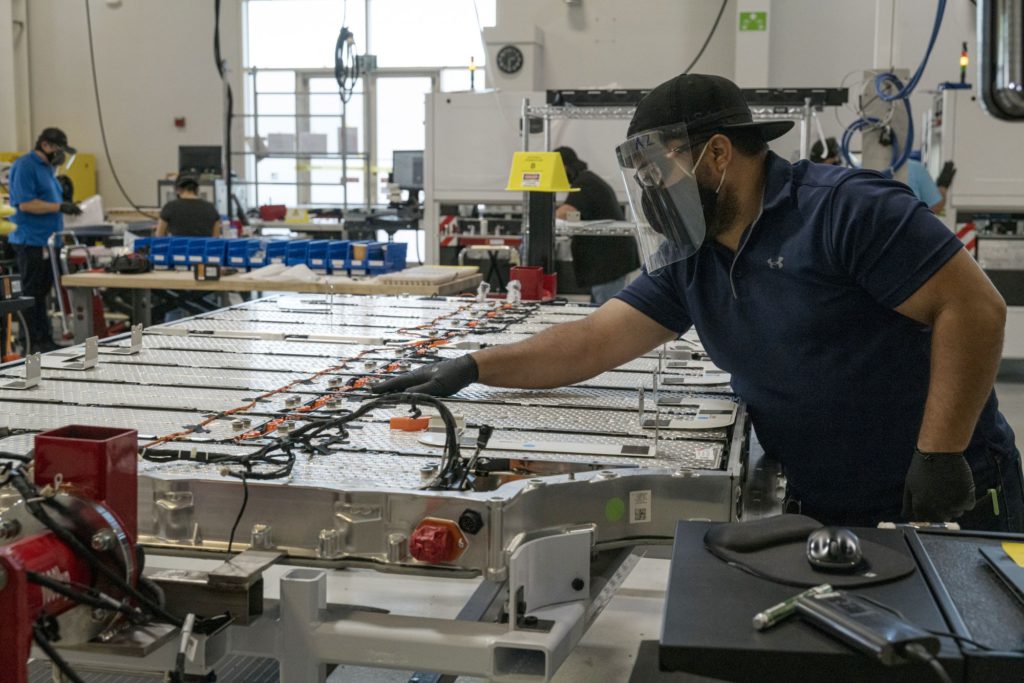
An engineering degree is one thing; experience solving problems on a factory floor or sourcing raw materials are another. Ramping up a plant is hard. It can take years to yield enough good batteries to be profitable. PhDs in materials science aren’t the only ones who make that happen. There’s a shortage of line workers, too.

“It’s not even just the high-skilled, it’s the medium-skilled,” said Ryan Melsert, who helped build Tesla and Panasonic’s Nevada factory before becoming CEO of American Battery Technology, a battery-recycling company.

Tesla’s expansion plans for the factory near Reno have been stymied by worker shortages, he said. “They can’t find enough labor, even in northern Nevada, to justify expansion.”

Yen T. Yeh, a battery engineer turned entrepreneur who started the Volta Foundation with friends from MIT, said he’s been talking with universities and labs about trying to set up sort of workforce pipeline for the industry. But it’s still early days.

“Workforce development is the key issue,” he told me. “If we don’t solve this, Americans are not going to be the leader we want to be in the battery race.”

Like getting this newsletter? Subscribe to Bloomberg.com for unlimited access to trusted, data-driven journalism and subscriber-only insights.

More stories like this are available on bloomberg.com

©2022 Bloomberg L.P.
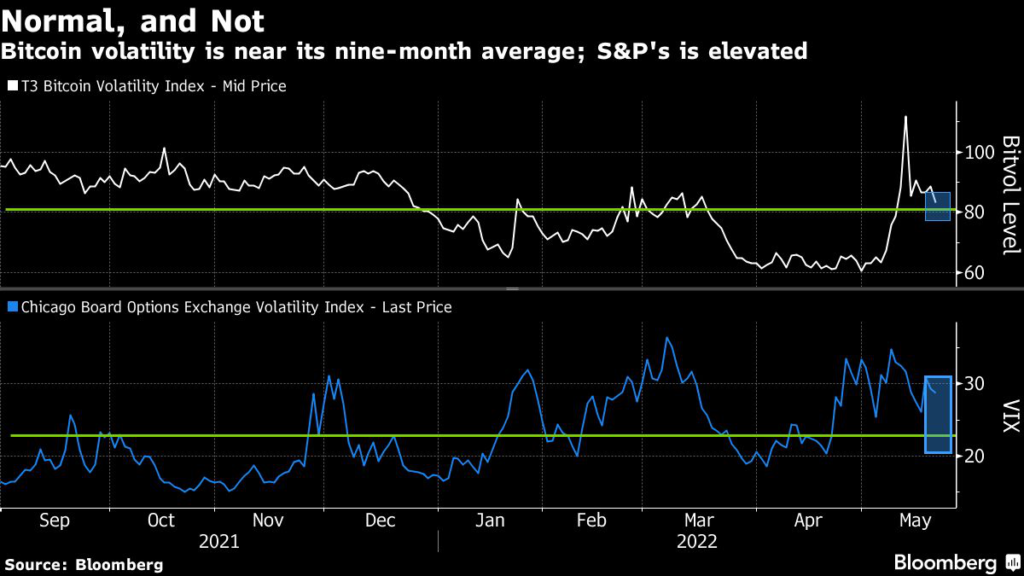
Bitcoin Market Snoozes in a Volatile Week for Stocks

(Bloomberg) — Cryptocurrencies are famed for their volatility, but you wouldn’t know it by comparing them with stocks over the past few days. The T3 Bitcoin Volatility Index has returned to around its nine-month average after the TerraUSD stablecoin implosion, while the Cboe Volatility Index, or VIX, remains elevated. Bitcoin’s 10-day correlation with the S&P 500 has also dropped off sharply. 

More stories like this are available on bloomberg.com

©2022 Bloomberg L.P.

Biden Hails US-South Korea Alliance on Tour of Samsung Plant

(Bloomberg) — President Joe Biden called the U.S-South Korea alliance “a lynchpin of peace, stability, and prosperity” during a visit Friday to a Samsung Electronics Co. semiconductor complex as he seeks to bolster supply chains that reduce reliance on China.

“I’ve just seen how this plant makes the most advanced semiconductor chips in the world,”  Biden said following a tour of the facility, his first stop after landing outside Seoul to start a five-day visit to South Korea and Japan.

During the trip, Biden’s first to Asia as president, he’s meeting with regional leaders in a bid to firm up support for helping Ukraine fend off Russia’s invasion and countering security threats posed by China and North Korea, which may conduct its first nuclear test since 2017 with Biden nearby.

“The alliance between the Republic of Korea and United States of America is a lynchpin of peace, stability, and prosperity for a region of the world that we seek,” Biden said. 

South Korean President Yoon Suk Yeol, who took office May 10, joined Biden at the event and said that “based on advanced technology and supply chain cooperation,” he’d seek to upgrade US-South Korea relations “into an economic-security alliance.”

Biden’s trip to the Samsung facility underscores the emphasis he’s placed on strengthening semiconductor alliances among the world’s largest chip making countries to try to ease shortages that have dragged on the global economy. The complex in Pyeongtaek, south of Seoul, houses the some of biggest chip production lines in the world and makes a wide range of products from memory chips to logic chips for Qualcomm Inc. and other companies.

Samsung is responsible for a third of global memory chip production and controls just less than 20% of outsourced chips for tech clients. South Korea’s largest company has been expanding its facilities at home and in the US to keep up with soaring demand.

South Korea “is taking a key role in a global chip supply chain by producing 70% of memory chips for the global market,” Yoon said.

Biden renewed his call for Congress to pass a broad China competition bill that includes $52 billion in funding for domestic semiconductor research and manufacturing. 

Read more: Biden Demands Passage of China Bill as Democrat Skips Ohio Event

Lawmakers still have to work out differences between the Senate- and House-passed versions of the legislation, a process that could take until the end of the summer.

The White House has often used the continuing global semiconductor shortage and its impact on inflation as arguments for approval of the massive subsidies program. But analysts say the shortage will last through 2023, and the domestic supply of chips coming online will not meaningfully alleviate the crunch.

Biden touted plans for new US investment that Samsung announced late last year. The company chose Texas in a $17 billion plan as the site of an advanced chip plant set to break ground this year, with a target to kick off operations in the second half of 2024.

Face-to-Face meetings

Biden plans additional meetings Saturday with Yoon, who has backed Biden’s supply chain initiatives and signaled he intends to join a new regional economic grouping the US president is expected to unveil in Japan.

“I look forward to a few days together where we can get to know one another better and explore ways to take the alliance between the Republic of Korea and the United States to an even greater heights than it already exists,” Biden said Friday.

The Indo-Pacific Economic Framework, which follows the US’s withdrawal from talks on the Trans-Pacific Partnership regional trade agreement under former President Donald Trump, is part of the Biden administration’s efforts to counter China’s clout in Asia. 

But some Asian nations are reluctant to sign on because they’re unsure what it will mean, US Ambassador to Japan Rahm Emanuel said.

Read more: Some in Asia Confused by Biden Strategy, Envoy Rahm Emanuel Says

Some of the framework’s details remain hazy, and the Biden administration has stressed it won’t include lower tariffs or better access to US markets. 

Nuclear threat?

North Korea, which has a habit of timing its provocations to political events, may be preparing to launch an intercontinental ballistic missile or conduct a nuclear test to coincide with Biden’s trip to the region, security officials in the US and South Korea said this week. 

Read more: Biden Has Little to Entice Kim Jong Un to Stop Weapons Tests 

The U.S. push to isolate Russia over Vladimir Putin’s war in Ukraine, coupled with increasing animosity toward China, has allowed North Korean Leader Kim Jong Un to strengthen his nuclear deterrent without fear of facing more sanctions at the United Nations Security Council. 

There’s little chance Russia or China would support any measures against North Korea, as they did in 2017 following a series of weapons tests that prompted Trump to warn of “fire and fury” from Pyongyang. 

More stories like this are available on bloomberg.com

©2022 Bloomberg L.P.
Amazon, Walmart’s Flipkart in Talks to Buy Stake in $1.1 Billion Diagnostics Chain

(Bloomberg) — Metropolis Healthcare Ltd., a diagnostics chain operating in India and Africa, is looking to raise more than $300 million and bring onboard a strategic partner by selling a significant minority stake, according to people familiar with the matter.

The company is in early discussions with several global strategic investors and other potential purchasers of the shares, said the people, asking not to be identified because the deliberations aren’t public. Metropolis, traded in Mumbai with a market value of $1.1 billion — about half what it was at the start of the year — tapped Barclays as an adviser, they said. A deal would likely include a sale of primary shares as well as secondary shares by existing investors, including the managing director, that could take the deal size over $300 million.

Walmart Inc.-owned retailer Flipkart and listed health-care chain Apollo Hospitals Enterprise Ltd. are among potential strategic investors that have signed non-disclosure agreements with Metropolis, while Amazon.com Inc. has held preliminary discussions, said one of the people. Agreements are also in place with global funds including KKR & Co., TPG Inc. and Barings, the person said, while talks are ongoing with Blackstone Inc.

A Flipkart spokesperson said in an email the company isn’t making any such investment. Representatives of Metropolis Healthcare, Amazon, Apollo Hospitals, Barings, Blackstone, KKR and TPG declined to comment. A representative for Barclays declined to comment.

Shares of Metropolis fell as much as 3.1% on Friday. They have halved since the start of the year amid a broader tech selloff and concerns about intensifying competition.

Metropolis runs more than 3,000 diagnostics centers as well as pathology laboratories in India and Africa. It has grown as consumers sought out branded operators for tests and scans during the pandemic. The chain was founded in 1981 by Sushil Shah, whose daughter Ameera Shah has since taken the reins. Ameera Shah currently owns 50% of the company and could offload some of her shares in a secondary transaction that could increase the size of the deal, a person familiar with the discussions said.

Diagnostics chains have become targets for the likes of Amazon and Walmart, which are ramping up health-care services to add to their retail offerings in India. Spending on preventive health care such as testing is rising in the country of 1.4 billion people, driven by chronic and lifestyle-related diseases and an aging population.

Intensifying competition is driving consolidation, with online pharmacy startup Pharmeasy buying a majority stake in publicly traded diagnostics chain Thyrocare Technologies last year for $612 million. Metropolis acquired diagnostic chain Hitech Diagnostic Centre for 6.36 billion rupees ($82 million) last year. To remain competitive, diagnostics companies need to invest heavily in newer technology and equipment and strengthen their online offerings.

Despite the hits to its market price, Metropolis said it is focusing on expansion. It plans to start 1,800 collection centers in the next three years, the company said in an exchange filing.  It will boost its home collection service to 200 locations within two years, it said in its most recent earnings filing in February.

(Updates with Flipkart’s response from the fourth paragraph; a previous version corrected founder and founding date in the sixth paragraph)

More stories like this are available on bloomberg.com

©2022 Bloomberg L.P.
Oakley Weighs Options for Women’s Fitness App Gymondo

(Bloomberg) — Oakley Capital is weighing strategic options for female-focused fitness app Gymondo, including a possible merger, people familiar with the matter said. 

The private equity firm and Gymondo founder Markan Karajica are also exploring potential partnerships or bolt-on acquisitions, the people said, to help keep the business competitive as gyms reopen after pandemic lockdowns.

Deliberations are ongoing and no final decisions have been taken, according to the people, who asked not to be identified discussing confidential information. A representative for Oakley declined to comment.

Fitness apps have proliferated as people spend more time maintaining their mental and physical health. They were in high demand during the coronavirus crisis, with gym closures forcing people to exercise at home or in parks and isolate from personal trainers. 

But appetite for such app-based services has cooled in recent months as the pandemic subsides in many countries and gyms reopen. The fundraising environment for technology companies has also become more challenging.

Shares in Peloton Interactive Inc. tumbled to a record low this month after the online fitness group and pandemic darling cut its revenue guidance. Earlier in the year, its rival IFit Health & Fitness Inc. saw its value fall about 60% in a new funding round and announced a restructuring and redundancies.

Geared toward women, Gymondo offers professional fitness classes, ranging from yoga to high intensity training, and nutrition programs for a monthly charge. Its user base has grown rapidly over the last four years to roughly 570,000. 

Oakley acquired the app as part of its 2020 takeover of German online fitness platform 7NXT GmbH. Gymondo generated earnings of 10 million euros ($10.6 million) on revenue of 30 million euros last year, the people said. 

More stories like this are available on bloomberg.com

©2022 Bloomberg L.P.

Elon Musk Is Visiting Brazil to Meet With Bolsonaro Friday

(Bloomberg) — Elon Musk, chief executive for Tesla Inc. and SpaceX, is traveling to Brazil to meet with Jair Bolsonaro just five months before the right-wing president seeks a second term in national elections, according to the communications minister. 

The world’s richest man will be received by Bolsonaro Friday at a hotel about 70 miles from Sao Paulo, the country’s financial capital, local newspaper O Globo reported Thursday, without saying how it obtained the information. It added that the gathering was organized by Communications Minister Fabio Faria, who visited the billionaire last year in the US.

Tesla and SpaceX did not respond to an inquiry about Musk’s travel plans. His plane was scheduled to depart to Brazil, according to an automated Twitter account maintained by Jack Sweeney, who follows the whereabouts of the billionaire’s jet.

“At the invitation of the Minister of Communications, Fábio Faria, entrepreneur @elonmusk arrives in Brazil on Friday to discuss Connectivity and Protection of the Amazon with the Brazilian government,” Faria wrote on his Twitter account.

The president confirmed he’s traveling to Sao Paulo. “We’ll have a meeting with a world-renowned person, who’s coming to help our Amazon,” he said during a live broadcast on social media on Thursday night, without revealing a name.

Musk has become even more popular among Bolsonaro’s supporters after announcing plans to buy Twitter Inc. and use the platform to defend “free speech.” Bolsonaro himself has had several social media posts taken down by Twitter and Facebook after the companies determined the president was spreading falsehoods about topics including the Covid-19 pandemic and the safety of Brazil’s electronic voting system. 

Bolsonaro, who’s being investigated in Brazil for allegedly spreading fake news, has been stepping up his rhetoric against the country’s top court and its electoral authorities, raising concerns that he could dispute the result of the October election if he were to lose. 

(Updates with communications minister comments in fourth paragraph.)

More stories like this are available on bloomberg.com

©2022 Bloomberg L.P.

Futures Rise With Stocks as China Lifts Sentiment: Markets Wrap

(Bloomberg) — US equity futures pushed higher Friday along with stocks in Europe after China’s latest measure to bolster its economy injected a note of optimism at the end of another volatile week for global markets.

Futures on the S&P 500 and Nasdaq 100 rose more than 1%, shrugging off modest losses on Wall Street on Thursday. Treasury yields edged higher, and the dollar was steady after its biggest one-day drop since 2020. Oil held above $111 a barrel. 

The Stoxx Europe 600 index added 1.5%, erasing the week’s losses. Carmakers led the advance, rebounding after two days of declines. Basic resources outperformed as industrial metals rallied. Consumer products was the only sector in the red as Richemont slumped after the Swiss watch and jewelry maker forecast rocky times ahead. 

Chinese lenders lowered the five-year loan prime rate by a record amount in an effort to boost mortgages and loans amid a property slump and Covid lockdowns. The move “is without doubt a positive in terms of raising the market’s sentiment,” said Niu Chunbao, a fund manager at Shanghai Wanji Asset Management.

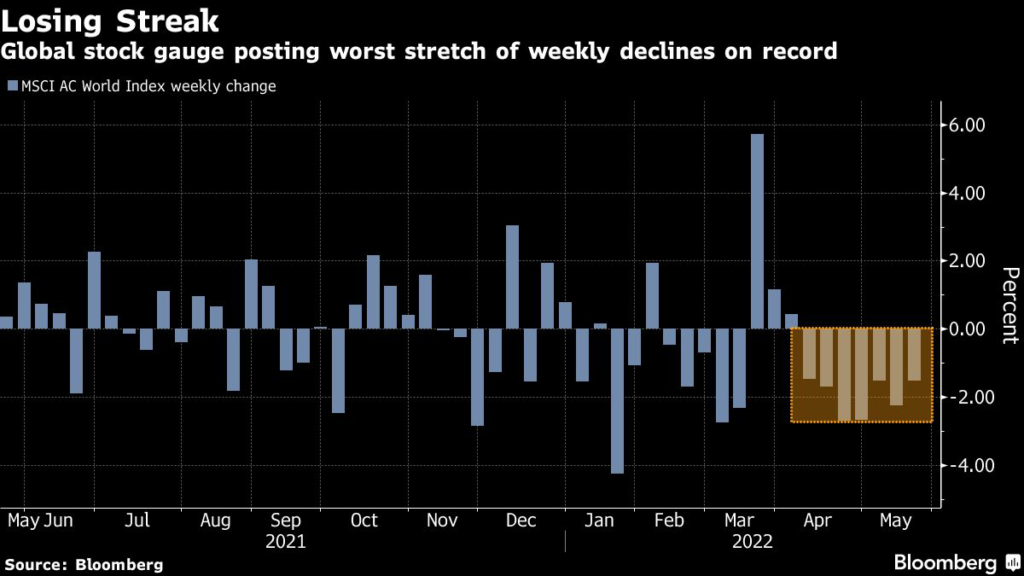
Rebounds in risk sentiment have tended to fizzle this year. Investors continue to grapple with concerns about an economic downturn, in part as the Federal Reserve hikes interest rates to quell price pressures. Global shares are on course for an historic seventh week of declines. 

“The risk-on trading mood has registered a solid rebound during the last couple of hours as traders cheered the significantly dovish monetary decision from China,” said Pierre Veyret, an analyst at ActivTrades. “This move significantly contrasts with the lingering inflation and recession risks in Western economies, where an increasing number of market operators and analysts are questioning the policies of central banks.”

Traders in the US will be bracing for more volatility later Friday due to the monthly expiration of options tied to equities and exchange-traded funds. The process is notorious for stirring up market swings.

The UK’s stock benchmark outperformed and the pound gained after a surprise increase in April retail sales outweighed a decline in consumer confidence to the lowest level in at least 48 years.

In the latest developments over Russia’s war in Ukraine, the Senate passed a more than $40 billion Ukraine aid package, sending the bill to President Joe Biden for his signature. Meanwhile, the Group of Seven industrialized nations will agree on more than 18 billion euros ($19 billion) in aid for Ukraine, according to German Finance Minister Christian Lindner.

What damage will be done to the US economy and global markets before the Fed changes tack and eases policy again? The “Fed Put” is the theme of this week’s MLIV Pulse survey. Click here to participate anonymously.

Some of the main moves in markets:

Stocks

  • Futures on the S&P 500 rose 1.1% as of 5:56 a.m. New York time
  • Futures on the Nasdaq 100 rose 1.5%
  • Futures on the Dow Jones Industrial Average rose 0.9%
  • The Stoxx Europe 600 rose 1.5%
  • The MSCI World index rose 0.5%

Currencies

  • The Bloomberg Dollar Spot Index was little changed
  • The euro was little changed at $1.0590
  • The British pound rose 0.1% to $1.2480
  • The Japanese yen fell 0.3% to 128.15 per dollar

Bonds

  • The yield on 10-year Treasuries advanced three basis points to 2.86%
  • Germany’s 10-year yield advanced four basis points to 0.99%
  • Britain’s 10-year yield advanced five basis points to 1.91%

Commodities

  • West Texas Intermediate crude fell 0.2% to $111.94 a barrel
  • Gold futures rose 0.1% to $1,850.50 an ounce

More stories like this are available on bloomberg.com

©2022 Bloomberg L.P.

Close Bitnami banner
Bitnami