Bloomberg

Swedish Unicorn Kry Lays Off 10% of Staff Amid Tougher Market for IPOs

(Bloomberg) — Online health-care provider Kry International AB, valued at $2 billion last year, has slashed 10% of its 1,000-strong workforce as part of a cost-cutting program aimed at placating investors including CPP Investments and Fidelity Management & Research.

“We need to respond to the market dynamics and we have to be conservative with our capital, and prove this to investors, partners and patients,” Kry’s co-founder and chief executive officer Johannes Schildt said in a statement.

Kry’s plans come at a time of tougher capital raising conditions across the private and public markets, where asset prices continue to tumble on accelerating inflation and the war in Ukraine. Sweden’s volume of initial public offerings is a case in point. Last year, the Nordic nation topped Continental Europe’s league for listings but deals have since slowed to a trickle.

Read More: Sweden Slips Down Europe IPO Rankings as Startup Listings Dry Up

Cash burn and profitability have become the main focal points for the market when analyzing unlisted firms, according to Isabella de Feudis, the chief executive officer of the Swedish Private Equity & Venture Capital Association.

“This is particularly true for late-stage companies closer to a public listing or other form of divestment,” de Feudis said in an interview. “It means firms need to be profitable earlier than before and reset their strategies from expansion to profitability.”

Those market dynamics have also caught up with other high-profile unicorns in Sweden. This week, Klarna Bank AB was reportedly looking to tap investors for more cash in a move that would cut its previous $45 billion valuation by about a third, according to people familiar with the matter.

Still, for de Feudis the changing investment climate has at least one silver lining. “In the long run all companies need to turn a profit, so the fact that expectations have been pushed forward might be healthy,” she said.

More stories like this are available on bloomberg.com

©2022 Bloomberg L.P.

Crypto Startup Tries to Claw Its Way Back From Luna Disaster

(Bloomberg) — The implosion of the algorithmic stablecoin TerraUSD and its sister Luna token sent shock waves through the cryptosphere, crashing prices and roiling the entire ecosystem behind the coins. 

The fallout reached across geographies, too. Stader Labs, based in Bengaluru, India, is among the many crypto startups that were engulfed by the crisis. 

Stader, backed by investors including Three Arrows Capital, had built a lucrative business providing a platform for so-called staking, where holders allow their tokens to be used to help order transactions on a blockchain in exchange for earning yield. Before the crash, almost all of that business came from the Luna coin, which like TerraUSD ran on the Terra blockchain and reached an all-time high in early April. 

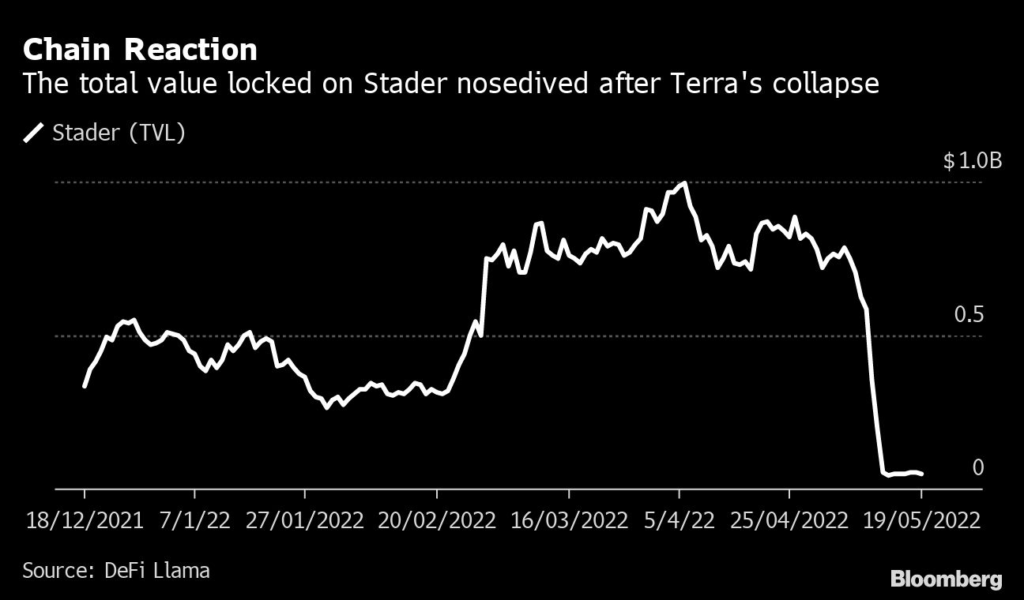
When TerraUSD (UST) collapsed from its intended 1-to-1 peg to the dollar this month and dragged Luna down with it, the impact on Stader’s business was swift. The total value locked on its protocol has dropped to $50 million from about $750 million just before the event, data from industry tracker DeFi Llama show. 

“We had a 40% hit on revenues,” co-founder and Chief Executive Officer Amitej Gajjala said in a text message. Stader’s monthly fees from its protocol had reached $6.3 million before the crash, he said.  

Gajjala’s experience highlights the hazards that lurk in the decentralized-finance space, where crypto holders borrow, lend and stake coins without intermediaries like banks. Because of the nature of its link with UST, the price of Luna has fallen close to zero, causing staking of the coin on platforms like Stader to evaporate. 

To some extent, the Terra implosion also underscores the crypto sector’s ability to quickly pivot after a big shakeout. 

Stader is already in rebuilding mode, Gajjala said. Having started in April last year entirely focused on the Terra ecosystem, it began expanding into rival blockchains like Fantom, Polygon and Hedera shortly before the UST crisis — a process Gajjala is now accelerating. The company will soon roll out staking on Ethereum, Solana, Cosmos and Near. 

There’s a long way to go. Stader now has about $50 million of total value locked on Hedera, according to DeFi Llama. While DeFi Llama doesn’t show equivalent data for Fantom and Polygon, Stader’s website says it has $3.6 million and $2.4 million staked on the two ecosystems, respectively. 

Luna’s market value has dropped to about $840 million from more than $20 billion before the TerraUSD collapse, according to data from CoinGecko. UST has lost roughly $17.5 billion in value since crashing from its peg. 

Gajjala said his startup has enough cash to weather the storm. Stader has raised more than $40 million since its inception, enough to last for more than 10 years, he estimated. In January, the Economic Times reported that Stader had raised $12.5 million in a funding round led by Three Arrows that valued it at $450 million. 

As for the lessons learned from UST’s flameout and the collapse of the Terra blockchain, Gajjala offers a reasonably upbeat view. He’s still waiting for more details from Terra’s backer Terraform Labs on how the UST crash unfolded, and expressed optimism about Terra founder Do Kwon’s proposal to revive the blockchain. 

The ecosystem could be rebuilt if Terraform Labs can retain its community of developers and users, he said.

“Algo stablecoins in current form and shape might not be the sustainable way in the short run,” Gajjala said. “In the long run there is scope for decentralized stablecoins, collateralized or algorithmic.”

(Updates with a comment from the co-founder in the penultimate paragraph.)

More stories like this are available on bloomberg.com

©2022 Bloomberg L.P.

Canada Bans Huawei From 5G, Ending Years-Long Impasse

(Bloomberg) — Prime Minister Justin Trudeau’s government joined Canada’s closest intelligence allies in banning Huawei Technologies Co. from fifth-generation wireless networks.

The Chinese state-championed telecommunications firm poses a threat to Canada’s national security, Industry Minister Francois-Philippe Champagne said Thursday, confirming an earlier Bloomberg News report. ZTE Corp. equipment will also be prohibited. 

Firms that already have Huawei or ZTE gear installed will have to remove it by the end of 2027, Champagne’s department said in a statement. Trudeau’s government had delayed the decision for more than three years, as relations between Canada and China deteriorated, and a ban would almost certainly stoke tensions.

The long-awaited announcement will be welcomed by President Joe Biden’s administration, which has sought to steer countries away from Huawei. American officials allege its gear could allow the Chinese government to interfere with 5G networks. Since 2019, the US has imposed what may be the strongest sanctions it has ever placed on a single company.

Relations between the two nations soured dramatically after Canada’s arrest of Huawei Chief Financial Officer Meng Wanzhou on a U.S. extradition request in December 2018. China imprisoned two Canadians, former diplomat Michael Spavor and entrepreneur Michael Kovrig, within days of Meng’s arrest.

The high-stakes standoff was resolved last September after the U.S. struck a deferred-prosecution deal with Meng, allowing her to return to China and for the two Canadians to come home.

But the feud has left hard feelings. Thursday’s announcement comes only three days after lawmakers voted to revive a special committee to study the country’s ties with China. On Wednesday, the Canadian government announced that China had lifted restrictions on canola imports.

The Chinese embassy in Canada said in a statement the blacklisting was groundless and violated free trade and market principles. “China will take all necessary measures to protect the interests of Chinese companies,” it said.

The move, however, should not pose big challenges for companies like BCE Inc. and Telus Corp. that have used Huawei equipment. Fearing an eventual ban, the two companies have already begun to exclude the state-championed Chinese firm from their 5G build-outs. BCE and Telus didn’t respond to requests seeking comment.

Huawei long played a key role in Canadian wireless networks. It won its first major North American project from BCE and Telus in 2008 — a pivotal contract that helped cement the Chinese provider’s reputation as a global player that could compete on quality. The deal paved the way for it to become a major supplier to Canada’s biggest telecom companies over the next decade.

In the lead-up to the decision, Canada’s military leadership argued the company posed too big a potential security risk to allow it into 5G networks. The nation’s human and signals intelligence agencies, however, were reportedly split on how best to deal with Huawei. 

In announcing its decision, the government cited in a policy statement serious concerns about Huawei and ZTE being “compelled to comply with extrajudicial directions from foreign governments.” Critics have pointed out that Chinese law obligates companies to cooperate with national intelligence work and to keep those requests secret, though Huawei disputes that interpretation of the law. 

Any breach would have a greater security impact than in the past because of the interconnectedness of 5G networks, the government said. With sensitive functions increasingly decentralized in 5G, the number of connected devices will also grow exponentially. “The Government is committed to maximizing the social and economic benefits of 5G and access to telecommunications services writ large, but not at the expense of security,” it said. 

Canada’s biggest wireless provider, Rogers Communications Inc., has partnered with Huawei rival Telefonaktiebolaget LM Ericsson on 5G. The Toronto-based firm’s vice chairman argued in 2019 that the Chinese giant posed too big a security risk to be allowed into the future network equations. “Rogers is focused on continuing to roll out 5G across Canada with our partner Ericsson,” Rogers spokesperson Chloe Luciani-Girouard said in an email. “Today’s decision has no impact on our plans and deployments.”

5G technology could end up being 100 times faster than existing top-of-the-line networks, with data speeds reaching 10 gigabits per second. That would greatly improve the ability of consumers to stream high-definition video and also help build out the so-called “internet of things” that can link everything from household appliances to traffic lights.

In July 2021, Canada’s telecom firms committed to paying C$8.9 billion ($7.1 billion) to buy licenses for 5G airwaves in a record-smashing government auction. Rogers, which is in the midst of trying to buy smaller rival Shaw Communications Inc., led the way with a C$3.3 billion spectrum purchase. 

(Updates with China’s response in the eighth paragraph)

More stories like this are available on bloomberg.com

©2022 Bloomberg L.P.

Grab Surges Most in 6 Months After Unveiling Post-Pandemic Gains

(Bloomberg) — Grab Holdings Ltd. climbed more than 24% after reporting a better-than-expected 6% revenue rise as the pandemic receded across Southeast Asia.

Revenue increased to $228 million in the first quarter after the ride-hailing and delivery giant added sales from Jaya Grocer, a platform it acquired in January. That was more than the $139.2 million analysts were expecting. Grab’s net loss narrowed to $435 million, as the company fights to gain profitability following years of heavy spending in pursuit of market share.

The company managed to grow monthly users 10% to 30.9 million after Southeast Asian countries removed pandemic-era restrictions. Per-user spending climbed 19%, it said. Unlike other internet companies that are grappling with cooling post-Covid online activity, Grab’s car-hailing and delivery businesses benefit as life returned to normal.

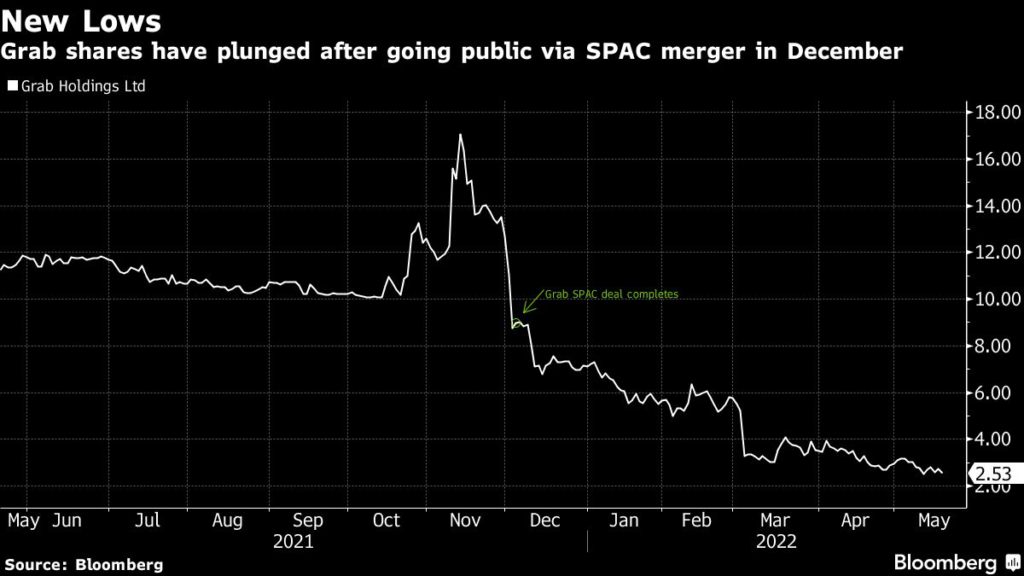
The company had struggled since becoming a publicly listed company in the U.S. through a merger with a blank-check company in December. Mounting losses, coupled with a broad tech selloff, have weighed on its shares. On Thursday, Grab rose 24.1%, its biggest gain since November.

Grab Soars 24% as 1Q Beat Raises Analyst Optimism: Street Wrap

What Bloomberg Intelligence Says

Grab appears on track for robust sales growth amid the mobility segment’s recovery from pandemic effects and strong momentum across deliveries and financial services. Meanwhile, Ebitda losses are narrowing on lower user-acquisition costs. Ride bookings are poised for a comeback as Southeast Asia’s social restrictions ease further and though the unit suffered a drop in 1Q sales, it fueled about 50% of total revenue. Online food and grocery delivery’s user expansion and rising scale economies should also support sales, particularly with the inclusion of the newly acquired Jaya Grocer in Malaysia. 

– Nathan Naidu, analyst

Click here for the research.


Key Insights 

  • Revenue from delivery business jumped 70% to $91 million
  • Revenue from mobility business declined 22% to $112 million
  • Revenue from financial services rose to $11 million
  • Grab plans to launch a Singapore digital bank, currently in internal pilot, in the second half, CEO Anthony Tan said during a conference call
  • Deliveries GMV was $2.56 billion vs its forecast of $2.4 billion to $2.5 billion
  • Mobility GMV was $834 million vs its forecast of $750 million to $800 million
  • The company said it expects full-year revenue to increase to $1.2 billion to $1.3 billion; sales excluding Jaya Grocer will rise no less than 50% this year, CFO Peter Oey said on the call

Get More

  • Grab’s cash and cash equivalents fell to $3.4 billion at the end of March from about $5 billion at the end of 2021, partly because of cash outflow from operating activities and the acquisition of Jaya Grocer
  • Partner incentives climbed 55% to $216 million, while consumer incentives rose 85% to $344 million
  • Grab expects second-quarter deliveries GMV of $2.55 billion to $2.65 billion
  • Company sees second-quarter mobility GMV of $950 million to $1 billion
  • Grab expects second-quarter financial services total payment volume, before consolidation, to reach $3.5 billion to $3.6 billion
  • Company sees GMV growing 30% to 35% in 2022

Market Reaction 

  • Grab shares rose more than 24% in New York.

More stories like this are available on bloomberg.com

©2022 Bloomberg L.P.

Bitcoin Slump Erodes Fortunes of Would-Be Miners in Thailand

(Bloomberg) — For Thailand’s market authorities, the rout in Bitcoin has been one of the few tools to cool down the once-unstoppable Jasmine Technology Solution Pcl.

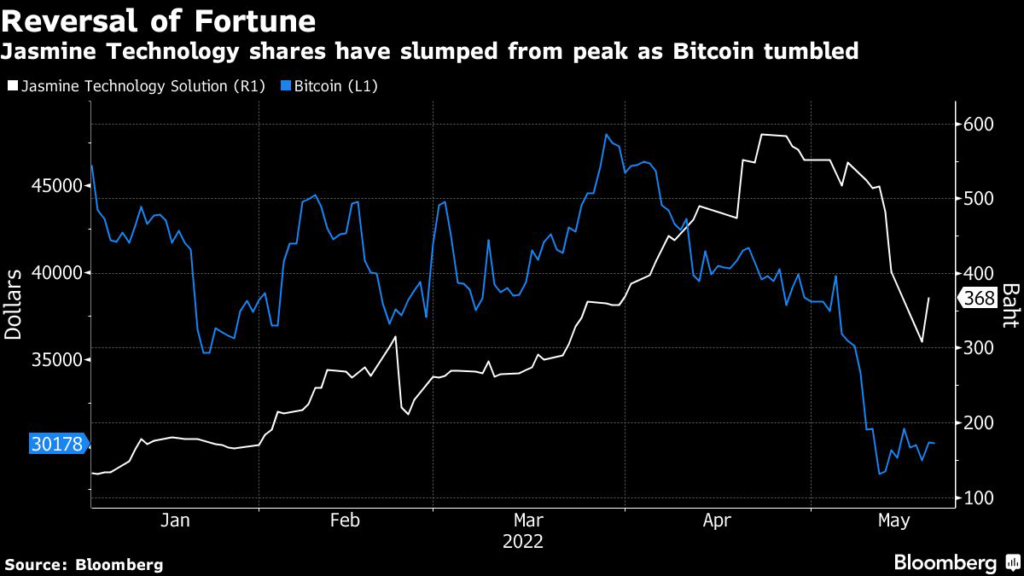
The telecom-turned-crypto company has lost more than a third of its value in the past month, cutting its market capitalization to 260 billion baht ($7.6 billion). That tumble also pared the wealth of its seven biggest individual shareholders, who had enjoyed earlier gains after the firm unveiled a plan in July to expand into Bitcoin mining. 

“The only frenzy has been from the company’s claim to be the pioneer of the Bitcoin-mining business in the country and region,” said Jitra Amornthum, an analyst at Finansia Syrus Securities Pcl. “That appeal has evaporated with the slide in Bitcoin.”

The Securities & Exchange Commission in February urged Jasmine Technology’s shareholders to make a “careful study and decision” of an independent financial adviser’s call to reject the company’s mining plan. The investment was ultimately approved in spite of the recommendation. 

Recent downturns in crypto exchanges and currencies including Bitcoin highlight the vulnerability of new fortunes, such as those of Jasmine Technology’s front-runners. The company, based just outside Bangkok, rode the digital-asset wave to become the 10th most-valuable company on the Stock Exchange of Thailand, prompting the bourse to halt trading in the stock for a day in April, citing a rally “without fundamentals.” 

The stock has also been hit by concerns about the regulatory environment, with Thailand banning the use of crypto for payments in March. 

The biggest paper loss has been to the fortune of Pete Bodharamik, who controls the parent company, broadband-network provider Jasmine International Pcl, founded by his father. Pete holds no official role in either, as he was forced to resign in 2019 after being found to have traded shares of the company, then known as Jasmine Telecom Systems, using non-public information. 

His stake has dropped below $1 billion since reaching a peak on April 22. Pete, 49, said he is unfazed by the drop. 

“JTS’s target is to become the largest Bitcoin mining company in Southeast Asia,” he said in an email. He said cryptocurrencies and blockchain technology are key to fintech and the metaverse. 

Another six shareholders have seen the value of their stock drop by about $1.3 billion in the same period. 

* Stake values as of May 19

The firm, whose net income more than doubled in the first quarter, said in its quarterly report that it aims to boost the proportion of revenue it makes from mining to 80% by late this year from less than 1% in 2021. Crypto-related activities accounted for about 5% of revenue in the first quarter. 

Jasime Technology remains under scrutiny. The stock was suspended again on Friday, the second suspension in a week, with the SET citing “abnormality” in its trading. 


The paper losses of Jasmine Technology’s top shareholders pale in comparison to hits taken by some digital-asset entrepreneurs elsewhere.     

Coinbase Global Inc. founder Brian Armstrong has seen his fortune plummet more than $11 billion to $2.2 billion in six months. Michael Novogratz, CEO of crypto merchant bank Galaxy Digital, also lost $6 billion in his fortune. 

More stories like this are available on bloomberg.com

©2022 Bloomberg L.P.

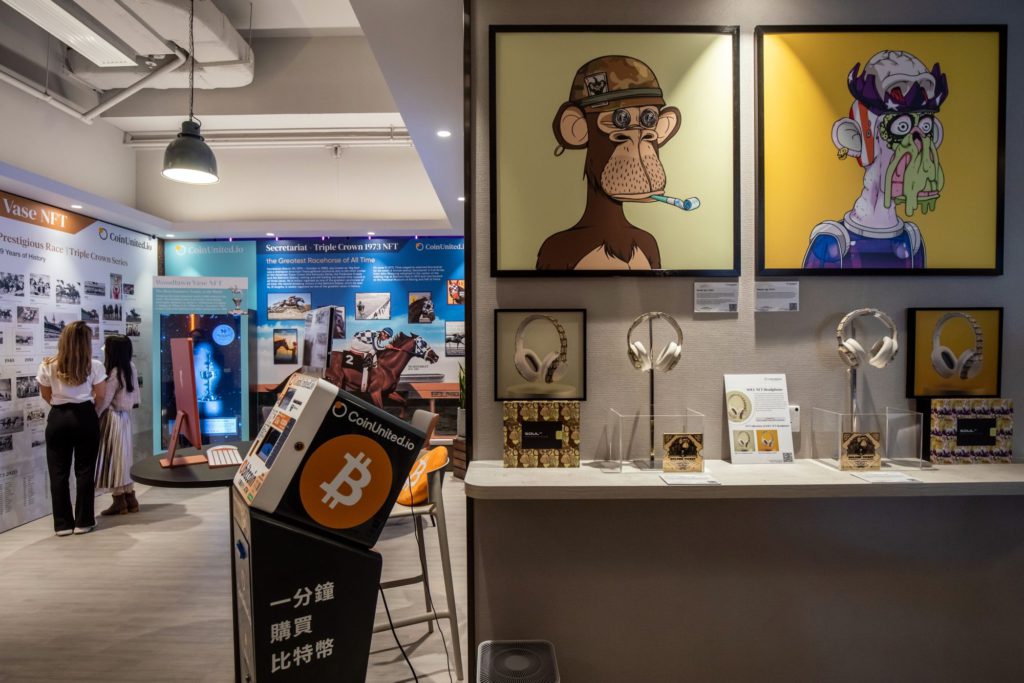
Bored Ape NFT Barred From Sale by Singapore Court After Dispute

(Bloomberg) — A court in Singapore has issued a freezing injunction preventing the sale of a Bored Ape nonfungible token, in one of the first cases of its kind that could have broad ramifications for digital assets.

The NFT, from the famed Bored Ape Yacht Club series, shouldn’t be sold pending the resolution of an ownership dispute after it was foreclosed on as collateral for a loan, a court said. The law does recognize both fungible and non-fungible tokens as a form of property to which court injunctions can attach, and the NFT case is a consistent application of that same principle, according to Hagen Rooke, a partner at law firm Reed Smith LLP in Singapore, who wasn’t involved in the case.

“It is the first decision in a commercial dispute where NFTs are recognized as valuable property worth protecting,” said Shaun Leong, lead counsel for the case and equity partner of Withersworldwide. “So more than merely strings of numbers and codes imprinted on a blockchain, the implication is that NFT is a digital asset and people who invest in it have rights that can be protected.”

The claimant, a Singapore citizen who is an active dealer in crypto and digital assets according to the case filing, is a frequent borrower on NFTfi, a platform that allows people to use NFTs as collateral for crypto loans. The defendant, whose username is chefpierre.eth but whose identity and physical location are unknown according to the filing, is a frequent lender on the platform.

The particular BAYC NFT, No. 2162, is “one of the Claimant’s most treasured possessions, and is irreplaceable to him,” according to the filing, which said he had “no intentions to ever part with or sell it.” However, he used the NFT as collateral to borrow crypto because “due to its rarity and high value” he could get larger loans, the filing said. 

The claimant in mid-April asked for a refinancing of a loan for which the NFT in question was being used as collateral, but after some back-and-forth, chefpierre gave a short time frame in which the loan could be repaid. After the claimant was unable to pay, chefpierre foreclosed on the NFT, according to the filing. The claimant is alleging “unjust enrichment” in the case.

Read more: Blue-Chip NFT Collections Hit Harder Than Bitcoin in Crypto Rout

“Having courts acknowledge a person’s potential ownership rights in a NFT is a positive for the industry,” said Chris Holland, a partner at Singapore advisory firm Holland & Marie, who was not involved in the case. “It’s also a reminder to NFT buyers to be vigilant about the rights and control they give to third parties over an NFT. For example, it appears that the borrower does not know the ‘in real life’ identity of the lender. That creates a significant complexity for the borrower’s legal proceedings.”

This is likely to be just one of many developments regarding rights in the NFT and metaverse space, according to Leong.

“With the advent of the Metaverse, I would not be surprised that the next set of challenges revolve around disputes over ownership of virtual land, and preserving that virtual land on the blockchain pending resolution of the ownership dispute,” he said. “NFT issuers (especially those of high value NFTs) or key NFT marketplaces may increasingly be encouraged to have an open registry of NFTs where the ownership of the specific NFT is formally disputed in courts of law.”

More stories like this are available on bloomberg.com

©2022 Bloomberg L.P.

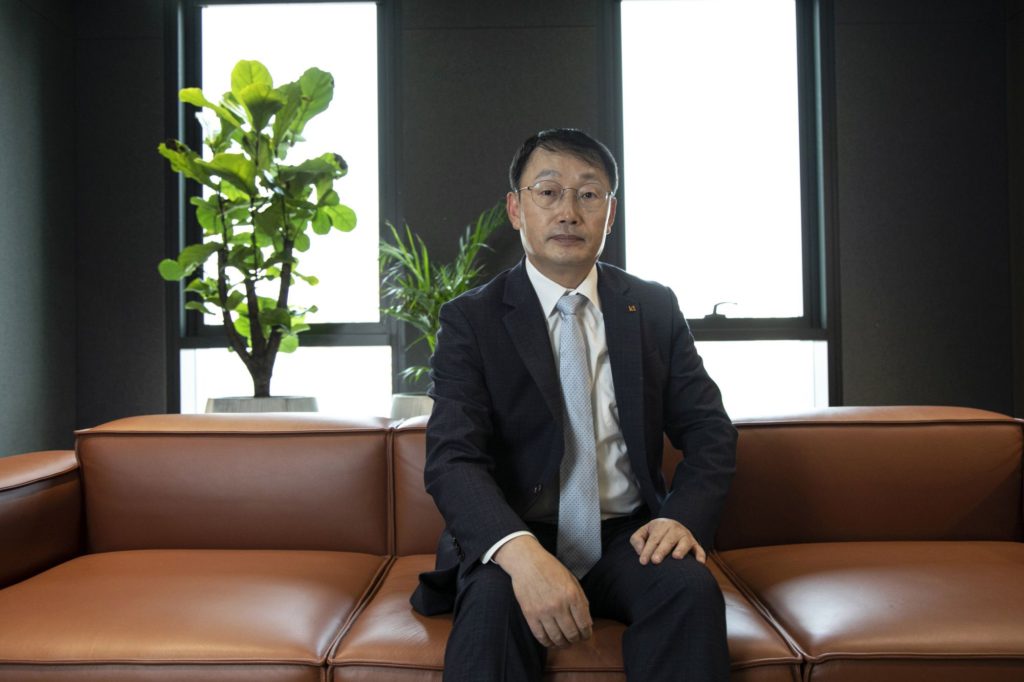
South Korea’s KT Sees Digital Expansion, Cloud Unit IPO in Shift From Telecoms

(Bloomberg) — South Korea’s telecom giant KT Corp. aims to double its sales from digital-related services to $10 billion by 2025, betting that artificial intelligence and cloud operations can offset the regulatory and market headwinds facing its traditional business. 

The telecom service provider is also considering listing its cloud centers unit separately as part of the plan to transform into a digital platform company, chief executive officer Ku Hyeon-mo said in an interview Thursday. Sales from digital services was about $5 billion last year.

“Global telecom companies are struggling to change, and that’s why their shares are discounted,” Ku, 58, said in Seoul. KT is one of the few “telecom companies in the world that are well-adapted to new digital industry.” 

KT’s push for new businesses comes as the nation’s telecom companies face tepid growth in new users for Internet services since 2017 amid saturation. Tight regulation holding down wireless fees has also weighed on companies, as South Korean presidents have pledged to lower mobile phone bills when they took office.

“KT has the highest dividend yields among Korea’s three telecom companies,” said Choi Nam-Kon, an analyst at Yuanta Securities Korea. “It has the largest size of non-telecom businesses among the three companies, which means it will be least affected by regulation on mobile phone bills.”

Shares of KT have risen 19% year-to-date, outperforming rivals SK Telecom Co. and LG Uplus Corp. and tracking better than the 13% loss by the benchmark Kospi index. 

The company is looking to almost triple its annual revenue from AI-driven software for call centers in three years, as well as target more sales from AI-led logistics services for shipping companies, Ku said. 

South Korea’s KT Said to Explore Sale of Stake in Cloud Unit (1)

KT will be able to list shares of its unit KT Cloud, which operates six cloud centers, once regulatory changes are made to allow such offerings by protecting the interests of shareholders of the parent company, Ku said, without providing any timing or expected size. KT is considering a sale of a minority stake in KT Cloud, people familiar with the matter said in April. A sale of about 20% of its holding to a strategic partner could raise around $400 million, the people have said. KT doesn’t have a plan to sell existing shares in the unit, the company said in April.

“We should not damage the interests of the existing shareholders” of KT Corp., Ku said.

KT, which used to be a government-controlled firm before 2002, will seek to win orders from the Korean government for cloud services based on its experiences with state-run projects, he said. The government tends to prefer local providers due to security concerns, he said, and that the market is expected to grow to 800 billion won ($626 million) by 2025.

It remains to be seen if KT can dominate in what’s a highly competitive space that’s already attracted regulatory scrutiny. Korea’s Fair Trade Commission started in February an investigation into 32 companies running cloud services, citing oligopoly concerns. The regulatory body said it will focus its first probe on unfair business practices in areas including order bidding and customer relationships.

The company is also seeking listing of additional units this year: Kbank, an online banking operator, and Bookclub Millie, an e-book company. It’s also planning sometime in the future to list KT Studio Genie, a film and TV studio seeking partnerships with global players like Paramount and Canal+. Ku declined to comment on their valuation, citing rising uncertainty in global markets. 

To Ku, opportunities for diversification continue to grow.

“When I talk about making profits from selling AI, people are surprised,” Ku said. “We are also planning to sell robots in near future — I’m sure we will be good at it, because we have experiences in sales of mobile phones and its maintenance.”

(Adds comment from Ku in ninth paragraph)

More stories like this are available on bloomberg.com

©2022 Bloomberg L.P.

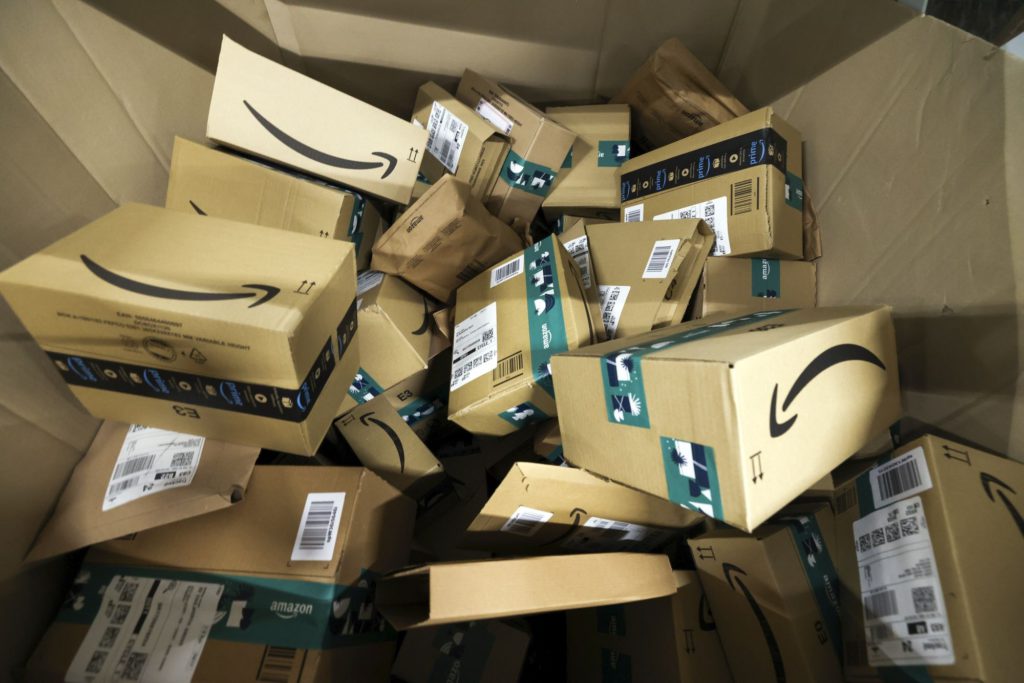
Amazon Threatened Workers Over Union Vote, Labor Officials Find

(Bloomberg) — U.S. labor board prosecutors plan to accuse Amazon.com Inc. of threatening staff that if they unionized it could propose paying them minimum wage and of punishing an employee for seeking a paid Juneteenth holiday.

Unless the company settles, the National Labor Relations Board will issue a complaint, agency spokesperson Kayla Blado said Thursday. An Amazon spokesperson didn’t immediately respond to a request for comment.

The allegations are among many taken to the labor board by the Amazon Labor Union, the upstart group that scored an upset election victory last month at a warehouse in New York’s Staten Island.

The NLRB’s Brooklyn-based regional director has determined that, prior to that election, the company held mandatory “captive audience” meetings at the warehouse in which it threatened that if workers chose the union to represent them, Amazon could use minimum wage pay as the starting point for negotiations. The company also said they might take years to get an actual union contract, or never get one, and that while those contract talks were going on, Amazon couldn’t make improvements to their working conditions, according to Blado.

The labor board official also found merit in the union’s claim that when an employee used Amazon’s “Voice of the Associate” board at the warehouse to advocate for a paid Juneteenth holiday, the company retaliated by barring that worker from posting there again.

Amazon has previously denied wrongdoing, and said that its “information sessions” are meant to ensure employees understand the facts about unions and elections. The company has formally challenged ALU’s election victory, alleging the union broke election rules and that the NLRB violated its duty to be impartial, including by suing Amazon to try to get a fired activist reinstated. The agency’s general counsel, Jennifer Abruzzo, dismissed that allegation in an interview last week. “But for Amazon’s unlawful labor practice, we would not have had to go into district court to seek an injunction,” said Abruzzo, a Biden appointee.

ALU’s attorney Seth Goldstein said he hopes the labor board will use the warehouse allegations to overrule existing precedents that allowed companies to hold mandatory anti-union meetings and to mislead employees about their rights.

By trying to get the election overturned rather than commencing contract talks, Amazon is “making good on the threat,” Goldstein said in an interview.

Complaints issued by labor board prosecutors are considered by agency judges, whose rulings can be appealed to NLRB members in Washington D.C. and from there to federal court.

More stories like this are available on bloomberg.com

©2022 Bloomberg L.P.

Crypto Growing in Latin America Adoption: New Economy Update

(Bloomberg) — Can Latin America seize the opportunities in front of it stemming from supply chain disruptions, cheap labor and a growing technology industry in order to revert a decade of tepid growth? 

That’s one of the key issues being discussed at Bloomberg’s inaugural New Economy Gateway Latin America event being held in Panama City. After a day that saw hesitation on the speed of adaptation for cryptocurrencies, warnings of growing populism and the potential to leverage relationships with both the US and China, speakers Thursday will address health, food scarcity, clean energy, cities and biodiversity.

You can follow the agenda here and the event will be streamed on the terminal at LIVE GO and on the web.

Tether founder Pierce sees “large” LatAm crypto adoption (4:35 p.m.)

Latin America is getting “large numbers” of investors entering the crypto space, said Brock Pierce, chairman of The Bitcoin Foundation and founder of Tether. “We are absolutely seeing large numbers of people in LatAm using this technology for things like remittances. The fundamentals are there.”

Still, algorithmic stable-coins are an ongoing experiment that still needs to be battle-tested to weather economic storms, he added, noting that he “still believes” in them even amid recent volatility.

“For the time being there’s a direct correlation between the old economy and the new economy,” he said. “That’s likely to continue to be the pattern.”

Though the US dollar is the reserve currency for all crypto transactions, investors shouldn’t put “too much confidence” in very new coins. Pierce also said there’s long term value in NFTs, though wouldn’t invest “heavily” in the space.

Private sector must take lead on biodiversity (4:05 p.m.)

When it comes to preserving biodiversity, the private sector has to take the lead, said Joshua Tewksbury, the director of the Smithsonian Tropical Research Institute. They’ll have to take on the challenge of understanding the investment opportunity, and increasing the conversation on where to invest in environmental, social and governance, he said.

“I think the private sector has the capacity to move faster,” Tewksbury said.

Danielle Wood, an assistant professor and director of the Space Enabled Research Group at the MIT Media Lab, said she’s optimistic because she sees enthusiasm from the private sector to be a positive player on biodiversity, both due to client pressure and from companies’ own internal desires.

Measuring the value of biodiversity can be challenging, more so even than the impact of climate change or carbon emissions. But when looking at the cost of maintaining biodiversity over replacing it, it’s going to be very expensive proposition to recover whatever is lost, Wood said.

As for balancing economic growth with environmental sustainability, the impact the planet has on growth is exceptional and often underestimated within local economies, Tewksbury said. If the impact on an ecosystem like the Amazon rainforest moves beyond an irreversible tipping point, it could result in a global impact that’s an existential threat, he added.

Copa says top leisure destinations beat pre-pandemic levels (3:45 p.m.)

Latin America is leading the recovery in passenger capacity, with demand beating 2019 levels and some top leisure destinations like Cancun and Punta Cana doing better than before the pandemic, said Pedro Heilbron, chief executive officer of Copa Holdings, said in an interview with Bloomberg TV’s Caroline Hyde. The comeback of leisure travel is the “big surprise” on the heels of the pandemic, with corporate travel still about half of what it was before the virus hit in 2020.

The company is grappling with jet fuel prices at record levels, but still isn’t seeing a slowdown in demand because of high prices.

“That’s the new challenge for the airline industry, but it’s also one we cannot do much about, except for trying to improve revenues and keep costs under control,” Heilbron said.

Local food sources can fight inflation (3:35 p.m.)

Chef Elena Reygadas, one of Latin America’s top restaurateurs, said she focuses on sourcing local and diverse ingredients both to preserve less known edible fruits and plants but also, in the current environment, to combat rising food inflation.

“If we conceive our menus and dishes with as much ingredients as possible we can keep our biodiversity alive,” Reygadas said. “And the more local we are, the more we can fight against the inflation that’s going on.”

Reygadas is the owner of the Rosetta and Lardo restaurants in Mexico City, among other eateries.

Public-private partnerships key to the electric mobility ramp-up (3:15 p.m.)

Uber is working on partnerships, like an alliance with Enel in Chile, to improve infrastructure to make it easier to deploy electric vehicles and reduce emissions, said George Gordon, its head for Latin America. Uber is working with the goal of having all trips globally be zero emission by 2040, he added. 

Enel X’s head of South America, Simone Tripepi, added that the company is working with Uber to replicate its Chile partnership in other countries. 

Emissions out of Latin America are growing faster than elsewhere in the world, making it a key issue regionally, said Adriana Lobo de Almeida, executive director of the World Resources Institute in Mexico. Improving public transit is a necessary step, with 200 million out of the 570 million living in Latin America relying on it regularly.

Formula E sees growing interest in zero-emission racing (2:50 p.m.)

Formula E racing, currently the fastest growing motor sport and the only motor sport to produce net zero emissions, is using the reach of sports to spread the “key message of sustainability and electromobility”, said Alvaro Buenaventura Acosta, Latin America director for Formula E. More than 100 cities want Formula E racing as part of a rise in consciousness on climate change.

Roche’s double-digit growth (2:10 p.m.)

Roche Pharmaceuticals expects to grow more than 10% in Latin America this year, driven by innovative drugs to treat cancer, hemophilia, multiple sclerosis, and rare diseases as well as in the ophthalmology space.

“Latam has been for years now a growth market,” Rolf Hoenger, the firm’s area head of Latin America, said in an interview.

The company is following regulation changes in the region around telehealth and drug approvals, and engaging with governments toward more accessible and sustainable health systems, he said.

Roche is also awaiting results on a trial, set in Colombia, around an Alzheimer drug this year. Latin America “is an important site for clinical trials, and we have interesting ones happening here,” he added.

Cities make a comeback (1 p.m.)

After a pandemic-induced exodus, people are flocking back to cities.

“People thought cities were over before that, but physical encounters are important,” said Carlo Ratti a director at MIT SENSEable City Lab.

But the changes brought on by Covid-19 such as hybrid work, and the growing concern with sustainability, will force governments and companies to adapt.


“The pandemic has changed the way we’re traveling and working so we need to redesign cities,” said Edelio Bermejo, the head of Global R&D and IP at Holcim Innovation Center. “Everyone in the value chain needs to discuss how to make buildings and construction more sustainable.”

Mauricio Ramos, the Chief Executive Officer at Millicom, said he’s working with governments to provide Wi-Fi outside and build smart cities. Costumers, he said, are willing to pay more for a sustainable product or service.

The resurgence of cities also has governments going back to some basics: Marina Bragante, the deputy secretary for Economic Development, Science, Technology and Labor for the state of Sao Paulo, talked about efforts to clean up polluted areas to rebuild public spaces.

Lasso says high oil prices helping Ecuador close fiscal gap (11:45 a.m.)

Ecuadorian President Guillermo Lasso spoke in a virtual interview from Quito.

The war in Ukraine is keeping oil prices elevated which will benefit Ecuador’s public sector with the potential for the fiscal deficit to close below a previously estimated level of 2% of GDP this year, Lasso said. At the same time, non-oil exports are also rising from pre-pandemic levels with bananas, shrimp and flowers finding new markets.

While some emering market countries are struggling with high inflation and debt burdens, Ecuador — which has a long history of defaults — is not at risk of a financial crisis, Lasso said. While the cost of imports of things like urea are surging, the country’s dollarized economy is not seeing a broad inflation spike.

After a first year in office that focused on stabilizing the economic and health crises in the country, the second year will be dedicated to promoting more public and private investments. Some $1.8 billion will be spent by the government in infrastructure while Lasso is personally talking to potential investors in mining to create jobs. 

Copper is the new oil, key to building new economy (11:20 a.m.) 

Metal producers have to reinvent their relationship with communities in order to gain social licenses to grow output and feed the clean-energy transition, according to billionaire mining entrepreneur Robert Friedland.

Speaking on a panel, Friedland said mining is crucial for building a new economy, given “copper is the new oil.” But the industry has to be better at engaging communities and reducing environmental footprints to gain acceptance. That means adopting a more holistic approach to communities by rolling out projects in everything from farming to education, he said.

Referring to ongoing community protests that have stalled output at MMG Ltd.’s Las Bambas copper mine in Peru, he said: “Miners need to reexamine the enterprise from day one to try to prevent that kind of problem from occurring.” With regards to ESG, he said: “Companies that get it right will inherit the industry. Companies that don’t, will die.”

The founder and executive co-chairman of Ivanhoe Mines Ltd. also urged governments to be “very, very careful” not to make operating environments too onerous and scare away investments to friendly jurisdictions. A lithium cartel is a “terrible idea,” he said. 

Fernanda Avila, mining secretary of Argentina, said the South American country’s later embracing of mining has a silver lining. “Argentina can introduce the ESG framework from the beginning of the life of the projects.”

Food crisis requires more public-private cooperation, capital (10:35 a.m.) 

Members of a food panel called for more action from governments and the private sector to accompany all the talk about how to mitigate a looming global good crisis.

There’s been a lot of talk about the need for public and private entities to work together more, but not enough action in terms of coordinating production and distribution of food, according to Ertharin Cousin, head of Food Systems for the Future. “There’s not enough financial action from either side,” she said, calling for more flows of “blended” capital.

A key tool to resolving the situation without compromising sustainability objections is technology such as digital farming, which can help ensure stable yields and optimize crops, said Mauricio Rodrigues, President for the Crop Science Division in Latin America, Bayer AG. It’s the role of government to make sure that technology spreads, said Marcela Escobari, assistant administrator at USAID’s Bureau for Latin America and the Caribbean.

The supply chains put together by the private sector for the global grain trade were built on globalization, said Bioceres Crop Solutions Corp. Chief Financial Officer Enrique Lopez. It would be hard to build something else now, he said.

Next pandemic has to be different (10 a.m.)

Covid-19 hit Latin America hard, and the region has to change its approach to deal with a next health crisis, according to Panama’s Minister of Foreign Affairs Erika Mouynes. The country is actively preparing and advocating to act as a bloc to buy vaccines, much like the EU is doing, she said.

“It has to be different the next time around — it doesn’t matter if you are able to vaccinate your country if your neighbors are still struggling,” she said. “The way vaccines were distributed the first time around clearly did not work.”

Rolf Hoenger, the area head of Roche Pharmaceuticals Latin America, said it’s key to know not only to invest more, but better.

Daniel Nathrath, the founder and chief executive officer of health fintech Ada Health, added that people need to look not just at virus cases — Covid accounted for about 25% of all assessments done by Ada — but also at the indirect effects of a health crisis. Data showed depression in kids and teenagers more than doubled in Germany amid prolonged school closures.

“I would advise governments to take a holistic view,” he said.

US awaits democratic opening in Venezuela for relief (9:35 a.m.)

Juan Gonzalez, Special Assistant to US President Joe Biden and Senior Director for Western Hemisphere Affairs at the National Security Council, spoke in a virtual interview about policy toward Latin America.

The US needs to see negotiated solutions between the Venezuelan government and opposition that leads to free and fair elections before reviewing the possibility of lifting economic sanctions, Gonzalez said. The issue of easing sanctions is not about boosting supply in the global oil market, he said.

Biden’s policy toward Cuba is about being “hard on the regime and soft on the people,” Gonzalez said. Biden wants to see a “secure, middle class and democratic” Western Hemisphere.

It’s too early to say whether the leaders from Mexico and Brazil will attend the Summit of the Americas in Los Angeles, Gonzalez said, as some countries demand the inclusion of Cuba, Venezuela and Nicaragua at the event.

Cortizo on crypto law, China trade and growth (7:40 p.m.)

In an interview with Bloomberg’s Stephanie Flanders, Panamanian President Laurentino Cortizo said his country is boosting cooperation with the private sector to lure investments and has the pandemic under control which is driving the fastest economic growth in the region.

While both China and the US are key trade partners, the US is most strategic relationship, Cortizo said. After a pause, trade talks with China will resume soon and Panama will push for more of its agricultural products to be included.

A new crypto law approved in Congress will be reviewed by lawyers and they’ll make a recommendation on whether to approve, partially sanction or reject the legislation, Cortizo said. In its current form, it wouldn’t be signed, he said, and any new rules will have to guarantee that the country’s fight against money laundering isn’t weakened.

“It is an innovative law from what I have heard, it’s a good law,” he said. “However, we do have a solid financial system here in Panama and one of the things I’m waiting on is when you have a global regulation of crypto-assets.” 

More stories like this are available on bloomberg.com

©2022 Bloomberg L.P.

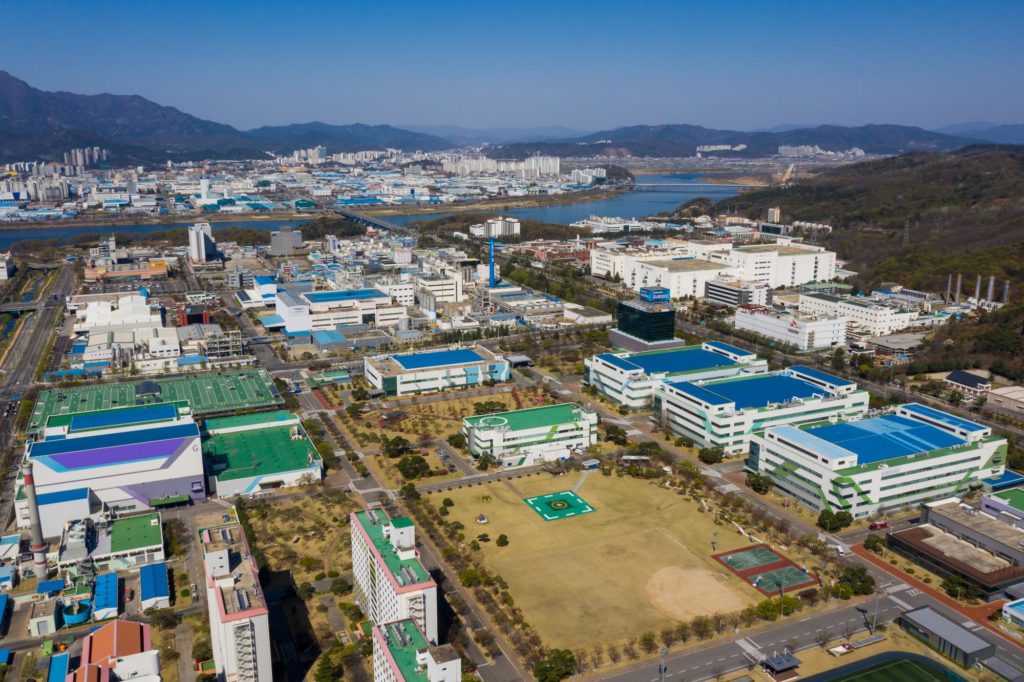
Samsung Struggles to Go Green in Coal-Addicted South Korea

(Bloomberg) — Samsung Electronics Co. runs its factories in Europe and the US entirely on clean energy. But in South Korea, the world’s largest smartphone maker is shackled by a domestic grid dependent on fossil fuels and a scarcity of renewable power.

Under pressure from climate-focused global investors, Samsung has emerged as a symbol of South Korea’s struggle to shift to green power. Now, with newly-inaugurated President Yoon Suk Yeol reviewing the country’s climate policies, environmental groups and some asset managers say it’s time for Samsung to set clear carbon targets and lobby the government to help it achieve them.  

“If Samsung is truly determined to use clean energy, it has the power to pressure the government and make meaningful, tangible changes in the renewables market,” said Park Yoo-kyung, Hong Kong-based head of APAC Responsible Investment & Governance at APG. The Netherlands-based pension fund has been particularly vocal in adding pressure on Samsung and other South Korean conglomerates to take climate action. 

A successful shift in South Korea and neighboring Japan is considered crucial in the global effort to combat climate change because both are home to some of the world’s biggest electronics makers, which are typically major energy consumers. The Asia Pacific region accounts for 60% of the global population and has the world’s fastest rising regional energy demand, according to the UN.

Some investors are particularly keen to see Samsung join a global initiative known as the RE100, in which members commit to eventually use 100% renewable energy. Some reports said it could join as early as last week, in time for Yoon’s inauguration, but the company said it wasn’t yet ready — showing the difficulty of making green promises in a market still short on clean energy options. 

Fossil fuels accounted for more than 60% of South Korea’s total electricity in 2020. With energy-intensive production lines for semiconductors, Samsung alone used 20% more energy than South Korea’s entire solar and wind power capacity in 2020, according to climate think tank Ember. 

Samsung is exploring how to achieve 100% clean power, including in regions “where securing renewable energy sources can be challenging,” it said.

Apple Inc. has already reached carbon neutrality for its global operations and plans to do the same with its supply chain by 2030. Apple supplier Taiwan Semiconductor Manufacturing Co. has joined the RE100 initiative, and investors say Samsung is at risk of losing business in the future if it doesn’t follow suit.

“For Samsung to not even make a commitment is extremely concerning because it will not only hurt its profitability in the long term, but also the economic growth of South Korea given its significance and influence,” said APG’s Park. 

Even if Samsung does make such clean energy commitments in coming months, appeasing some investors, analysts see little chance of an immediate, meaningful shift. 

Unlike in Europe, China and the US, where renewable energy prices have fallen thanks to competition and greater economies of scale, they remain costlier than fossil fuels in South Korea. That’s in part because of the nation’s lack of land availability for wind and solar, which means developers have had to use costlier technologies. 

Analysts say an effective way to spur change would be for the government to offer more subsidies and tax breaks on long-term contracts for renewable energy, known as power purchase agreements, or PPAs. Those PPAs help secure investment in wind and solar projects, and shield heavy electricity users like Samsung from price volatility, allowing them to commit more easily to clean energy targets. 

Jacqueline Tao, an analyst at climate research group TransitionZero, also recommended the removal of fossil fuel subsidies, which are still common in Asia. 

All eyes are on the new administration of President Yoon, a strong proponent of nuclear energy but whose policies on renewables are still somewhat unclear. There are concerns that he appears less aggressive than his predecessor when it comes to setting climate targets, with the new administration calling for “realistic and responsible decarbonization plans.” 

“South Korea needs to introduce various incentives, including tax rebates and lower rates for using its grid, to encourage direct procurement of clean power, which is critical in helping the nation reach its climate target,” said Park Young Wook, team leader of renewables strategy at SK E&S, the energy unit of conglomerate SK Group. 

Read more: South Korea’s Dream Island Offers a Cautionary Tale for Net-Zero Goals

Some investors speculate Samsung may use the return of the conglomerate’s de-facto leader Lee Jae-yong, known as Jay Y. Lee and previously jailed for bribery and embezzlement, to announce key decisions on clean energy. 

“There is still an opportunity for its leader Lee Jae-yong to demonstrate real climate leadership with a new 100% renewables commitment that has short-term solar, wind and battery storage-related targets, not just a vague long term goal that won’t calm shareholders,” said Kiran Aziz, head of responsible investment at KLP, Norway’s largest pension fund with $65 billion in assets under management.

More stories like this are available on bloomberg.com

©2022 Bloomberg L.P.

Close Bitnami banner
Bitnami