Bloomberg

Chinese Stocks Listed in US Add $177 Billion in Historic Month

(Bloomberg) — Chinese stocks listed in the US climbed for a third day, adding to a record rally this month fueled by optimism over reopening bets as some parts of the country loosened lockdown restrictions.

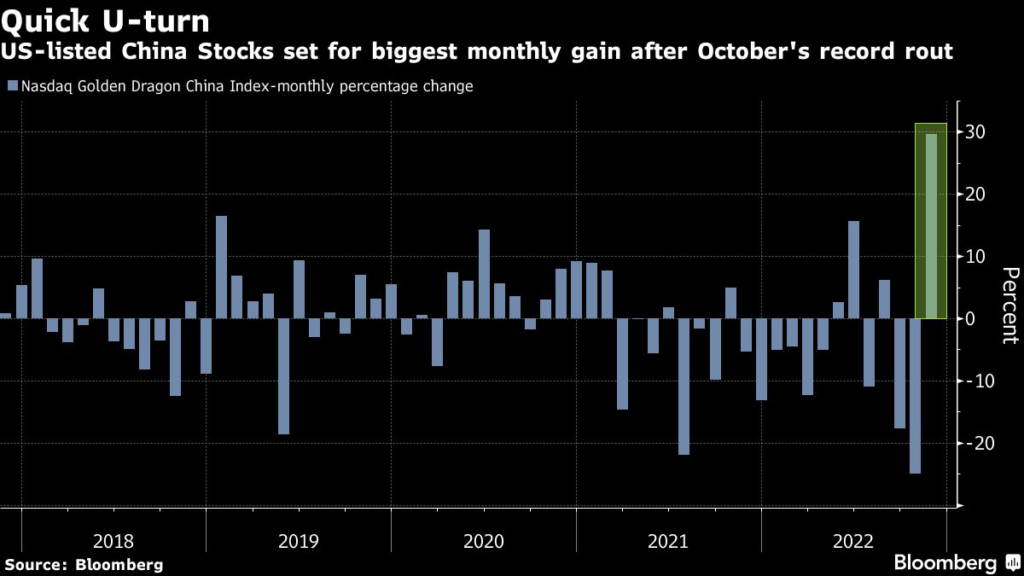
The Nasdaq Golden Dragon China Index gained 6% Wednesday, putting the benchmark on pace for a 37% surge this month that has added about $177 billion in market value. Bilibili Inc., JD.com Inc. and Pinduoduo Inc. were among the biggest gainers in November, advancing at least 45% each. 

November’s rally is a dramatic turnaround from October’s 25% plunge when fresh lockdowns started being implemented in China and the Communist Party Congress dashed hopes for more market-friendly policies. 

Strong quarterly earnings results from some of the nation’s biggest tech companies, the loosening of some of Beijing’s strict virus approach and a rescue package for the property sector has driven a reversal of bearish bets and lured investors back to the market after the selloff last month.

While the timeline of reopening remains highly uncertain, authorities have been taking incremental but clear steps toward winding down Covid restrictions. On Tuesday, markets rallied as the top health body said it will bolster vaccinations among senior citizens, while warning against any excessive control measures. 

China is now mulling rolling out a fourth Covid shot, according to a report based on people familiar. Guangzhou, a southern manufacturing hub, lifted lockdowns in most parts of the city and replaced those with targeted restrictions. While the city home to Apple Inc.’s largest manufacturing site in China, Zhengzhou, also lifted a lockdown of its main urban areas put in place five days ago. 

The shift has spurred hopes that China is laying the grounds for an eventual Covid Zero exit, prompting traders to place bets even as a spike in infections and nationwide protests suggest the path to reopening will be rocky. 

Even after this rally, the Nasdaq Golden Dragon China Index is 27% lower this year, with some bumpy rides and more volatility expected.

More stories like this are available on bloomberg.com

©2022 Bloomberg L.P.

Art Basel Miami Beach Sales Heat Up Despite Current Crypto Winter

(Bloomberg) — What a difference a year makes.

Just 12 months ago, with the price of Bitcoin hovering around $57,000, it seemed that Art Basel Miami Beach was in fact a crypto celebration with an art fair on the side. At the time, the NFT craze was in full swing, and the medium’s many proponents were bent on establishing it as on a par with such traditional art forms as painting and sculpture. In tandem with the City of Miami’s all-out push to become a crypto capital, Art Basel Miami Beach had become a ripe venue for digital art patrons and crypto companies to stake their claim as forerunners of a new establishment.

Now Bitcoin is trading around $17,000, and the excesses of 2021—think crypto- sponsored yacht parties, NFT stunts, Web3 conferences and metaverse ragers—are mostly things of the past. Holdouts include the blockchain company Tezos, which is an Art Basel Miami Beach partner again and has sponsored a series of talks at this fair. But on the whole, art is front and center once again this week in Miami.

It’s a turn of events that many in the art market are greeting with something bordering on relief.

“It’s the post-FTX world,” says New York dealer David Lewis in his booth on the fair’s opening day, referring to the collapse of the crypto exchange founded by Sam Bankman-Fried. “The art world has always been really wary of the crypto world,” a wariness, he says, that appears to have been justified. “I think there’s a lot of comfort in the fact that a lot of the ways of doing things that have been going on for years or decades—or if you think of painting, centuries—are back in the lead.”

As Art Basel Miami Beach (ABMB) opens its doors to a VIP crowd celebrating the Florida edition’s 20-year anniversary on Tuesday, Nov. 29 (VIP days Tuesday and Wednesday, with public days following through Saturday), it certainly feels as if analogue is ascendant. Many of the fair’s 282 galleries seem to have brought textile works and heavily layered paintings to the fair—“definitely things with texture, things that appear handcrafted,” says adviser Suzanne Modica, noting that she has yet to see the entirety of the fair. “I think the quality is quite good,” she says. “People have brought works to sell.”

Healthy Sales

In the first three or so opening hours, sales seem to be happening at a steady clip.

This is partly the result of a healthy amount of pre-selling, a phenomenon in which a gallery sends a PDF to clients containing artworks it intends to bring to the fair. Those clients might then put a work on reserve (or even better for the dealer, buy it outright), and consummate the transaction after viewing the work in the first few hours of the fair.

“We pre-sold a lot, so the first hour or two is people seeing the pieces,” says Malik Al-Mahrouky,  a sales director at Kurimanzutto, a gallery with locations in New York and Mexico City. Its pre-sales included, he says, a painting by Gabriel Orozco priced around $500,000 and two paintings by Roberto Gil de Montes, which sold for roughly $85,000 and $35,000. While English was far and away the dominant language heard in the fair’s aisles, Al-Mahrouky says he is surprised by the number of serious foreign collectors. “There are lots of Europeans this time around,” he says. “Last year there weren’t nearly as many.” 

One collector with works on reserve is Pete Scantland, the Columbus, Ohio-based chief executive officer of Orange Barrel Media, who says that while he “wanted to show up at the fair and be surprised,” he couldn’t help himself and “did peek at a few of the PDFs.”

Even before the fair began, Scantland purchased a work by Igshaan Adams, an artist known for lavish tapestries on view in Casey Kaplan Gallery’s booth. For the most part, Scantland says, he spent the first few hours of the fair just looking around. “Leslie Martinez, who’s showing at And Now gallery’s booth—I’d seen images of her work, but to see them in real life? That’s what it’s about,” he says.

Looking Ahead

The art fair comes on the heels of New York’s November auction season, where a few record-setting weeks nevertheless showed signs of slackening demand. The spotty bidding on view was attributed by some to jitters over the prospect of global recession.

Multiple dealers wonder if such fears will trickle down (or flow sideways?) into the rest of the market. “I think every dealer in the world asks themselves that question,” says the dealer and former Goldman Sachs partner Robert Mnuchin. “Has it, is it or will it? And I think the answer is none of us know at the moment.” His major takeaway from the November auctions, he continues, is that “the strongest part of the market was the outstanding works. Anything that was outstanding, almost irrespective of the price—not totally, but that was the predominant desire.”

Given the size of the fair and breadth of its offerings, it would be a stretch to say that most of the work at the fair is outstanding. But at the end of the first day, multiple galleries reported major sales. Mnuchin says he sold a large work by El Anatsui for $1.75 million. Gladstone Gallery reports selling an Alex Katz painting for $1.2 million. And Jack Shainman Gallery says it sold a 1997 painting by Kerry James Marshall for $2.8 million.

Indeed, as Miami enjoys yet another week filled with parties, art fairs, product launches and yes, a few crypto-related events, it seems that rich people are still spending money, with not so much going to digital art.

“It’s lovely to not have this kind of crypto frenzy,” says Kibum Kim, standing in the booth of his buzzy gallery Commonwealth and Council. “It’s just more calm, and there are more conversations about art. No one is sticking a phone into our faces trying to show us their digital wallet.”

So does he—or did he—have any crypto-rich clients? “Of course not,” Kim says. “We’re a serious gallery.”

More stories like this are available on bloomberg.com

©2022 Bloomberg L.P.

South Dakota Bans TikTok From State-Owned Devices Over Security

(Bloomberg) — TikTok is now banned on government employee devices in South Dakota because the governor believes the social media app’s ownership by a Chinese company poses a national security threat.

The state’s employees and contractors are no longer allowed to download the app or access TikTok via the web, according to an executive order signed Tuesday by South Dakota Governor Kristi Noem.

“Because of our serious duty to protect the private data of South Dakota citizens, we must take this action immediately,” Noem, who’s been floated as a potential 2024 Republican presidential candidate, said in a statement. “I hope other states will follow South Dakota’s lead, and Congress should take broader action, as well.”

TikTok, the popular video app owned by the Chinese company ByteDance Ltd., is facing broad hostility from US politicians and officials. The White House, Congress and the Committee on Foreign Investment in the US are all considering actions that could significantly alter the way TikTok operates in the US. The committee, called Cfius for short, specifically reviews foreign investments with national security implications.

On Wednesday, Treasury Secretary Janet Yellen, who is also the Cfius chair, joined the chorus voicing concerns about TikTok. “I think there are legitimate national security considerations,” Yellen said at a conference hosted by the New York Times.

In addition to their general concerns about all social media companies, US officials worry about TikTok’s data collection polices and its relationship to the Chinese government. That’s prompted calls from US Senators to fully ban the app. TikTok has said it is confident it will reach a resolution with US officials that allows the app to remain in the country.

–With assistance from Brody Ford.

(Updates with Janet Yellen’s comment in the TKth paragraph.)

More stories like this are available on bloomberg.com

©2022 Bloomberg L.P.

Cloud-Software Stocks Salesforce, Snowflake Weighed Down by Slower Growth

(Bloomberg) — Cloud-software stocks have been among the most hard-hit areas of the technology sector this year, and some investors are skeptical that demand from business customers will hold up well enough to stem the declines any time soon.

Two closely watched companies in the industry will report after the market closes Wednesday: Salesforce Inc., which is expected to post its slowest revenue growth ever, and data-warehousing company Snowflake Inc., which had soared during the pandemic after its landmark initial public offering. 

The $2.8 billion First Trust Cloud Computing exchange-traded fund has slumped 42% this year, steeper than the 29% decline for the Nasdaq 100 Index. Salesforce has lost 40% while Snowflake has dropped 61%. Valuations in the sector haven’t come down enough to make the stocks attractive yet, said Brendan Boken, an investment analyst at Penn Mutual Asset Management.

“Cloud software is a critical service for enterprises, but with so many headwinds and so much uncertainty heading into 2023, I think you can see prices coming down more,” he said. “Multiples are well off their top, but if growth is slowing, the fact that they’re cheaper doesn’t mean they’re cheap.”

Salesforce rose 0.9% on Wednesday while Snowflake fell 3.1%.

Even with the drop, the cloud index underlying the ETF is priced at 29 times estimated earnings, above its long-term average of 25.

While high-growth software stocks saw massive rallies during the pandemic, that trade has dramatically reversed this year. Inflation has pushed the Federal Reserve to raise interest rates, a particular headwind to high-valuation and unprofitable companies, where shares are priced on their prospects far out in the future. In addition, the prospect of a recession could mean that the sector’s growth comes under pressure if businesses cut back on spending.

Results for key companies in the sector have been mixed this season, even as they continue to show positive growth rates. Growth for Amazon.com Inc.’s cloud business came in below expectations, while Microsoft Corp. gave a lackluster forecast for its Azure product. Alphabet Inc.’s cloud offering was a relative bright spot, losing less money than expected. 

While Cloudflare Inc. beat expectations and raised its outlook, the report wasn’t seen as strong enough to justify the stock’s high valuation. NetApp Inc. slumped as much as 10% Wednesday data-management company cut its guidance for earnings and revenue growth.

Still, software and services remains the only sub-sector of tech for which analysts expect earnings growth in 2023. They predict a 6.3% increase in earnings, according to data compiled by Bloomberg Intelligence. While that is down from the 10.9% pace expected three months ago, the hardware and equipment segment is expected to see earnings fall 1.5% next year and semiconductor companies are seen posting a 15% drop in profits.

“Estimates look pretty close to reasonable, but even if there is some downside to the consensus, cloud is a steadier ship overall,” said Hilary Frisch, senior research analyst at ClearBridge Investments. “Valuations have gotten creamed, but fundamentals are holding up better than other parts of tech, and unlike in prior downturns, the world runs on these services. That will support them even in the event of a recession.”

Tech Chart of the Day

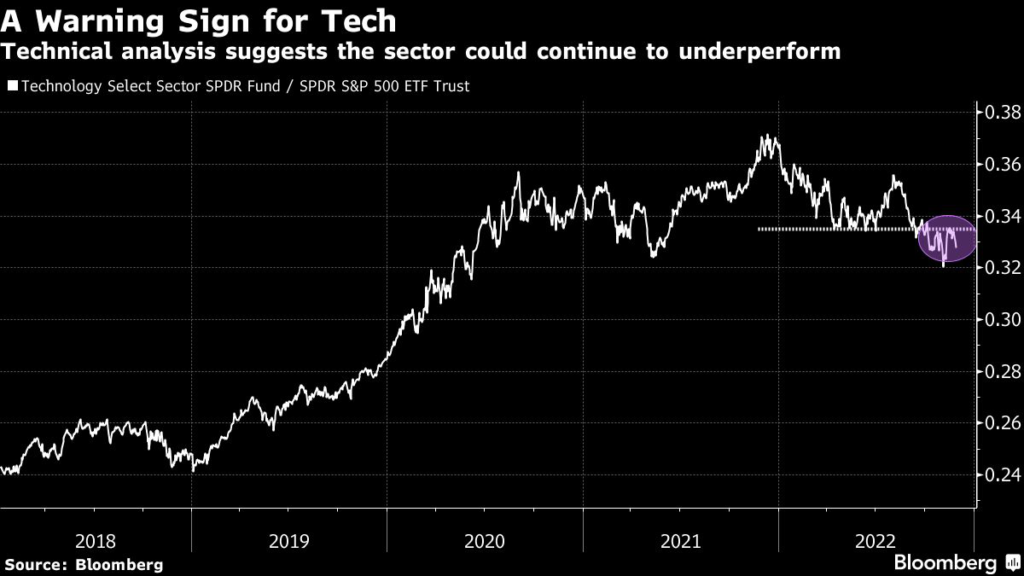
The tech sector has been underperforming this year, and technical analysis suggests it could continue trailing the broader market, according to Bloomberg Intelligence, which looked at a tech-sector exchange-trade fund as a ratio of an S&P 500 ETF. 

“Failing to close above resistance (the April low) suggests the XLK/SPY ratio could drop 3% to its November trough,” wrote Anthony Feld, a senior technical strategist at Bloomberg Intelligence. “The April floor — which was support — becomes resistance when pierced.”

Top Tech Stories

  • CrowdStrike Holdings Inc. tumbled after the cybersecurity company gave a revenue outlook for the current period that fell short of analysts’ estimates.
  • The Chinese city of Zhengzhou shuttered hundreds of buildings and apartment blocks hours after lifting broader lockdown measures, as officials strive to make their Covid controls more targeted in line with Beijing’s directives.
  • Ajinomoto Co. will accelerate production expansion of its signature high-tech chipmaking film and may invest more than the planned 17 billion yen ($122 million) to sate surging demand, Chief Executive Officer Taro Fujie said.
  • Amazon.com Inc.’s cloud unit plans to add employees next year and keep building new data centers, a sign that a hiring freeze elsewhere in the company hasn’t derailed investment plans for its most profitable business.
  • Revolut Ltd., one of the UK’s fastest-growing startups, is betting it can sustain its breakneck pace in Asia, even as it comes under greater scrutiny from regulators at home and abroad.
  • Apple Inc. Chief Executive Officer Tim Cook is in Washington to meet with top Republican lawmakers, according to people familiar with his visit, as the company seeks to forge ties with the GOP ahead of the party’s takeover of the House early next year.
  • Shares of GoTo Group, Indonesia’s largest tech company, plunged to a record low as a lock-up on its major shareholders’ stakes neared expiry, suggesting investors are expecting some of them to reduce their holdings.
  • Hewlett Packard Enterprise Co. projected revenue for the current quarter that beat analyst expectations, suggesting corporations are continuing to upgrade their technology infrastructure in an uncertain economy.

–With assistance from Subrat Patnaik.

(Updates to market open.)

More stories like this are available on bloomberg.com

©2022 Bloomberg L.P.

CrowdStrike Tumbles After Revenue Forecast Misses Estimates

(Bloomberg) — CrowdStrike Holdings Inc. fell 21% on Wednesday after the cybersecurity company gave a revenue outlook for the current period that fell short of analysts’ estimates.

The company projected sales of as much as $628.2 million in the fourth quarter, compared with analysts’ average estimate of $634.8 million in a statement on Tuesday. Chief Executive Officer George Kurtz also said total net new annual recurring revenue was below the company’s expectations amid increased economic headwinds that caused some customers to delay purchases.

The slowdown in annual recurring revenue is a sign that companies, especially small and mid-sized businesses, may be pulling back on information technology security spending amid uncertainty about the economy, said analysts at Bloomberg Intelligence.

“Still, we believe CrowdStrike’s net expansion rates of around 120% suggest steady win-rates and upselling to existing customers, which may be aided by potential provider consolidations in a tightening IT budget environment,” wrote Mandeep Singh, a senior analyst at Bloomberg Intelligence, and associate analyst Damian Reimertz, in a note after the results were announced. 

In the third quarter, sales jumped 53% to $580.9 million, CrowdStrike said in a statement. Earnings, excluding some items, were 40 cents a share.

The shares posted their biggest decline ever, plunging to $109.12 as the market opened in New York. The stock has dropped 33% this year through Tuesday. 

–With assistance from Subrat Patnaik.

(Updates share trading.)

More stories like this are available on bloomberg.com

©2022 Bloomberg L.P.

DoorDash to Cut 6% of Global Workforce in Cost-Cutting Push

(Bloomberg) — DoorDash Inc. is cutting about 1,250 jobs to rein in expenses, acknowledging that a rapid expansion during the pandemic boom has led to mounting losses.

“While our business continues to grow fast, given how quickly we hired, our operating expenses – if left unabated – would continue to outgrow our revenue,” Chief Executive Officer Tony Xu wrote in a letter to staff on Wednesday.

The cuts will affect about 6% of the company’s workforce, a mix of US and non-US based staff, according to people familiar with the matter asking not to be identified as the announcement was not yet public. By scaling back headcount, DoorDash aims to curb operating expenses, which topped $2 billion in the third quarter, largely due to stock-based compensation and the absorption of Wolt, the Finnish food-delivery company it acquired last year. 

DoorDash’s net losses have more than doubled over the past year, increasing every quarter to $296 million by the end of September, compared with a loss of $101 million a year ago. The company reported adjusted earnings before interest, taxes, depreciation and amortization of $87 million in the third quarter. That metric strips out expenses like stock-based compensation or non-recurring costs that executives deem to be outside the scope of operations. 

DoorDash shares jumped 4.4% as the market opened in New York.  

The San Francisco-based company is the latest technology firm to cut jobs amid higher interest rates and slowing economic growth. But unlike other companies that are seeing less consumer demand due to rising inflation, DoorDash’s order volumes have remained resilient, growing 27% in the third quarter compared with last year and boosting revenue to $1.7 billion.

The pandemic supercharged consumers’ affinity for takeout when coronavirus lockdowns shuttered indoor dining. DoorDash increased its share of the meal delivery market in the US and garnered 56% of food delivery sales as of September, according to YipitData. But that growth has also come at a cost. Competition in the sector has only intensified, and the company has spent heavily to sustain growth by expanding its footprint in non-restaurant categories like convenience store items, groceries and alcohol. Last year DoorDash acquired Wolt in an all-stock deal valued at about $8 billion to increase its international presence.

Xu said DoorDash “will continue to reduce our non-headcount operating expenses, but that alone wouldn’t close the gap. This hard reality ultimately led me to make this painful decision to reduce our team size.” 

Some tech companies that are implementing cost cuts are finding other ways to reduce payroll costs. Lyft Inc., which eliminated 13% of staff earlier this year, said it would be shifting hiring toward international markets like Canada and Eastern Europe, where equity is a smaller or nonexistent portion of an overall compensation package. Xu said DoorDash will offer affected employees recruiting support, honor stock that vests in February, and extend health benefits and termination dates until March to allow people living in the US on temporary visas sufficient time to find another job.

While deteriorating economic conditions were not the primary reason for the job reductions, Xu added that DoorDash is “not immune to the external challenges” and the company’s growth has tapered compared with pandemic metrics. 

“We must keep this level of discipline moving forward and act with the hunger, efficiency and creativity of the younger startup we once were while leading with the responsibility of the market leader we’ve become,” Xu wrote.

Rising interest rates and the prospect of an economic recession have contributed to a rout in tech stocks, as investors punish companies that have historically prioritized growth over profits. Shares of DoorDash and food-delivery rival Uber Technologies Inc. have fallen 64% and 34%, respectively, so far this year.

(Updates with additional background from letter starting in sixth paragraph.)

More stories like this are available on bloomberg.com

©2022 Bloomberg L.P.

Crypto Hedge Funds Burned by FTX Seek Wall Street-Style Middlemen

(Bloomberg) — Before it collapsed, FTX was a favorite in the world of professional crypto traders, with frenzied volumes, derivatives on steroids and a simpatico founder who got his start at storied Wall Street trading house Jane Street.

Now with millions lost on the bankrupt platform, its former fans are fighting for survival, writing off sizable chunks of their portfolios and facing an existential dilemma: Should they trust any crypto exchange at all? 

Unlike stock markets where every transaction is strung together by a daisy chain of middlemen, centralized crypto exchanges like Binance Holdings Ltd. do everything from margin loans and settlement to direct custody of client assets. This means funds must entrust platforms not only with the assets they trade, but also the collateral they put up for leverage to juice returns.

For many traders who saw their holdings evaporate in a matter of days on FTX, that’s now become too big of an ask. To avoid another catastrophe, some survivors have started seeking alternatives to the current infrastructure in crypto markets, taking a page from Wall Street’s rulebook and demanding that separate entities, like custodians, hold their crypto instead. 

“The era of posting collateral to offshore exchanges is over,” said David Fauchier, a portfolio manager at Nickel Digital Asset Management, which oversees about $200 million and has a partly-insured 6% exposure to FTX. “We’re refusing to post collateral directly to almost all venues, meaning we can’t trade there despite a great opportunity set, which is super frustrating. We’re hammering them every day to implement some form of off-exchange settlement solution.” 

While there have long been calls for change, Fauchier says there might finally be some momentum, after FTX appeared to have lost the majority of customer assets in its care, with the 50 largest unsecured creditors losing everything from $21 million to $226 million. 

It’s one irony of the whole saga: While FTX founder Sam Bankman-Fried spent his last months as a billionaire trying to make the old-school futures market more like crypto, he might end up making crypto look more like Wall Street. 

With the tagline ‘built by traders, for traders,’ his platform appealed to the pro set with its easy lending and products ranging from three-times leveraged bets to tokenized Tesla stock. At its peak this year, it processed more than $45 billion in a day, CoinGecko data show. 

Now, the exchange’s collapse has dealt a blow to a sweeping swath of the budding crypto fund industry, including Kevin Zhou’s Galois Capital, Travis Kling’s Ikigai Asset Management and CoinShares. CMS Holdings, which also invested in FTX, has about 15% of its assets frozen on the exchange, according to a person familiar with the matter who declined to be identified because the information is private.

Many crypto hedge funds are now looking at writing off the exposure and sidepocketing it, meaning they’ll carve out the illiquid assets to a separate share class that will receive any future distributions from the claim. Some are considering selling the claim now, which will allow them to raise cash rather than hold onto a distressed asset through the winding bankruptcy process — though claims are now priced at just 9% to 11.5% of their value, according to the broker Cherokee Acquisition. 

“It doesn’t wipe out the industry,” said George Zarya, chief executive officer at crypto prime brokerage Bequant. “But it’s a punch below the waistline and it really hurts.” 

FTX’s collapse is the latest blow in an already rough year. A Bloomberg index of crypto-hedge fund returns has plunged 43% this year as of October as Bitcoin lost more than 60% and waning retail sentiment killed the easy trading opportunities of 2021. 

Under the status quo, exchanges match buyers and sellers, safeguard assets, extend trading credit and also settle profits and losses, making it necessary for them to see and access users’ collateral directly, the argument goes. Critics say this has given exchanges outsize power over client assets and created a concentration of risk. 

While FTX’s shocking demise has prompted many exchanges to release a proof of reserves, that still falls short of revealing all their liabilities, leading users to yank millions from online platforms.  

This structure is a far cry from what the crypto world calls TradFi, or traditional finance, where the role of intermediaries from custodians to brokers and exchanges is regulated and trades are settled on an independent centralized clearinghouse. 

Some of these middlemen exist in crypto, but few have been able to chip away at the exchanges’ power. One solution offered by the custodian Copper Technologies Ltd. allows clients to trade without transferring assets to the exchange’s wallets. But so far none of the five largest trading platforms ranked by Coinmarketcap are plugged into it. FTX had signed onto that offering, but never implemented it, says Copper, adding that it expects to announce more exchange integrations in the coming months. 

Wall Street is also looking to familiar names like BNY Mellon and Nasdaq, which are working on their own custody services.

“Asset manager and market makers are demanding integration of the solution as they will no longer be able to lure in investors regardless of promised returns if they park assets on any exchange,” Copper head of research Fadi Aboualfa wrote in an email. 

At Cumberland, the crypto offshoot of Chicago trading giant DRW, the over-the-counter trading desk saw record volumes and an uptick in onboarding requests this month as liquidity on exchanges thinned out, says global head Chris Zuehlke.  

Wintermute, one of the largest crypto market makers, has cut “a lot” of exposure to centralized exchanges, according to founder Evgeny Gaevoy. His ideal: either executing on decentralized exchanges entirely or adopting a model more like CME Group Inc., where trading and custody are separated. 

The elephant in the room is Binance, the largest exchange by far that’s now grabbing even more market share from its disgraced rival. It has unveiled a custody solution of its own that would allow clients to keep their assets in segregated wallets while trading on the platform.

Still, it is doubtful institutions will accept a self-enforced separation within the same corporate group, said Larry Tabb, head of market structure research at Bloomberg Intelligence.

“The larger institutions will either self-custody in their own wallets or look for third-party custodians to hold their coins,” he said. “That’s going to very much disrupt the current business model of some of these larger crypto establishments.”

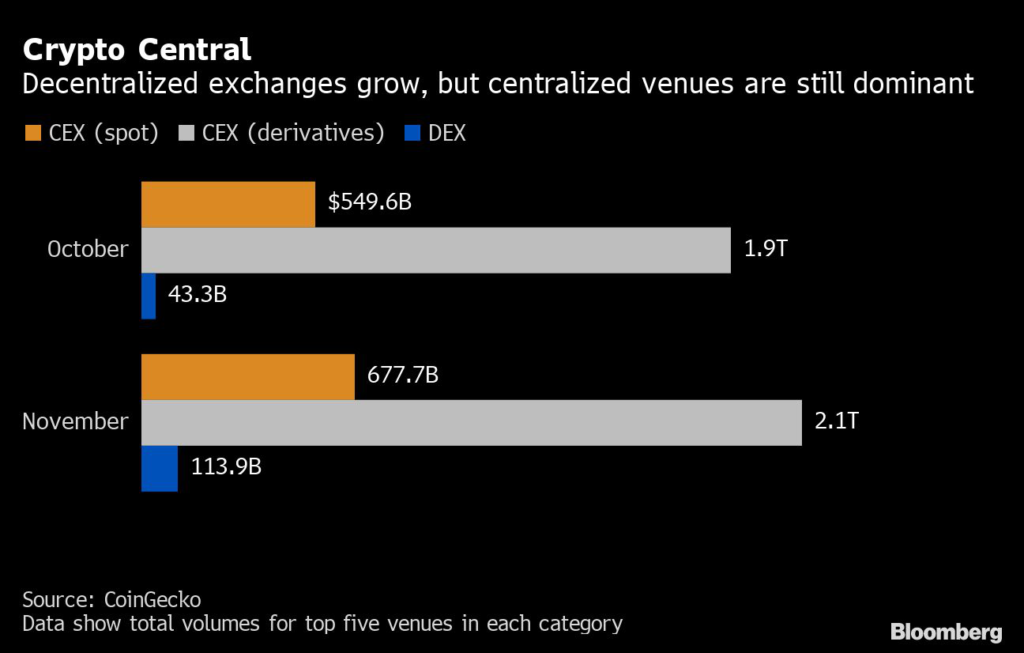
Then there’s decentralized finance, the solution those most faithful to the crypto vision are championing. On platforms like Uniswap and dYdX, users trade through software while retaining control of their assets. While volumes on the five largest Dexes more than doubled from October to $114 billion this month, that’s still just 4% of the total for centralized platforms, CoinGecko data show. DeFi is also not practical at scale for many regulated firms for now because it presents money-laundering and other compliance risks.

“We’re trading on chain when we can, but liquidity is not where it is on Binance, so it’s difficult when you have a bit of size,” said Felix Dian, a former Morgan Stanley trader who now runs MVPQ Capital, a crypto hedge fund with 2% assets lost to FTX. “The way forward is spreading your exposure, though to be honest it’s difficult because there are not many counterparties left.”  

More stories like this are available on bloomberg.com

©2022 Bloomberg L.P.

Former SpaceX Employee Alleges Age Discrimination in Complaint

(Bloomberg) — A former SpaceX employee is alleging in an essay published Wednesday that he experienced ageism while working at the Elon Musk-run company, and has filed a complaint claiming discrimination with Washington state authorities.  

John Johnson said he first came to the company in 2018 to work as a principal engineer in optics and early on got “consistently solid” performance reviews. “I was quite hardcore,” he wrote in the essay published on the whistleblower site Lioness.

After he had back surgery in early 2020, however, he said he started to see his responsibilities disappear until he had nothing left to work on and ultimately resigned, leaving SpaceX in July of this year.

“From that point forward there were a lot more aspects of my job that were taken over by other people,” Johnson, who is 62, told Bloomberg News in an interview. 

SpaceX didn’t respond to a request for comment on the allegations. 

In August, Johnson filed a complaint reviewed by Bloomberg with the Washington State Human Rights Commission, making the age discrimination and retaliation allegations he highlights in the essay. The state commission also didn’t respond to a request for comment on the status of the case. 

Johnson said he watched younger and less experienced workers take on his work, he wrote in the essay. On one occasion, Johnson asked an engineer why he was shadowing him to learn about his role. The engineer said that his manager told him it was necessary because Johnson might “retire or die.”

Johnson said he reported the comment and his diminishing responsibilities to human resources multiple times. He also reached out to SpaceX’s president and chief operating officer, Gwynne Shotwell. He said he was told there would be an investigation but that “nothing was done to remedy my situation or restore my job duties,” he wrote in the essay. 

In early 2022, Johnson wrote in the essay that he was invited to a meeting with HR and told that SpaceX no longer had work for him in his area of expertise, and that his manager would help him find other internal opportunities. That never happened, he wrote, and in June 2022, he put in his resignation. 

SpaceX’s vice president of human resources didn’t immediately respond to a request for comment.

Lioness, the publication that published Johnson, hosts essays from from people at companies across industries. Last year, it ran one essay by Ashley Kosak, another former SpaceX employee, who detailed allegations of sexual harassment while working at the company. Kosak also alleged HR didn’t address her complaints. 

SpaceX did not respond to Kosak’s essay. A few days before its publication, Shotwell sent a company-wide email saying that HR would conduct an internal and third-party audit of SpaceX’s sexual harassment reporting process.

In November, eight former SpaceX employees filed complaints with the US National Labor Relations Board, alleging they’d been wrongfully fired after penning a public letter criticizing Musk’s online behavior and tweets as “a frequent source of distraction and embarrassment for us.”

Musk recently took over Twitter Inc., where he has fired more than half of the social network’s staff, including employees who publicly disagreed with him and those who made perceived negative comments about him online.

In November, Musk sent an email to employees asking them to sign a pledge saying they would accept a “hardcore” culture or else they’d have to leave with severance.

More stories like this are available on bloomberg.com

©2022 Bloomberg L.P.
Tech Layoffs Create Rare Chance for Federal Recruiters to Snag Talent

(Bloomberg) — For the US Department of Veterans Affairs, the mass layoffs in Silicon Valley present a rare shot to snag top talent. With a chronic shortage of tech workers, hundreds of open roles and extra money from Congress in last year’s budget, the agency is keen to seize the opportunity. 

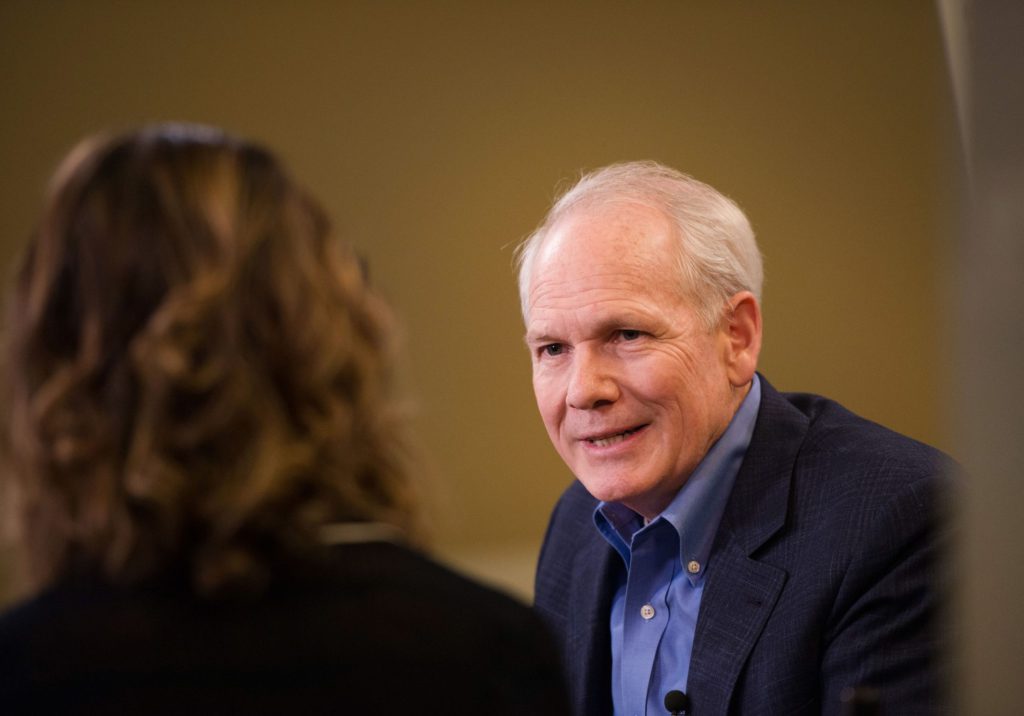
Kurt DelBene, the VA’s chief information officer, came to the federal government after roughly 30 years at Microsoft to help fix Healthcare.gov after the site’s infamous crash during the Obama administration. DelBene’s on an ambitious mission to recruit top designers and engineers for the agency, which he intends to make the “absolute best place” for IT in the federal government. Much like any software development or IT company, the agency is looking to fill a variety of roles: engineering leads, product managers, user-experience designers, and customer-support professionals, among others.

Historically, the US government has long trailed the private sector’s pay, driving much of the staffing shortfalls. The tech industry’s bull run widened the gap even further. According to research by Revelio Labs, a workforce intelligence firm, the nearly 2.5 million private tech workers in the US earn an average annual base salary of almost $110,000 — not counting bonuses and equity-based compensation — while the roughly 135,000 tech workers employed by the US government and all its agencies make little more than $80,000 on average. But with the boom turning into a bust, employers from government to finance to automakers are more than ready to scoop up some of the roughly 60,000 tech workers laid off so far this year as recorded by recruiting firm Challenger, Gray & Christmas Inc. 

Read more: Fired by Musk or Zuckerberg? The Old Economy Welcomes You

Andy Challenger, the recruiter’s senior vice president, said that the VA is far from alone in its thinking; he’s talked to people in just about every industry that have the same idea about tapping the talent pool. “They’re in the highest-paying industry, with the most favorable conditions, and the best benefits. If they have to go into an office, it’s this half a billion dollar playground, with foosball tables and the best food in the world,” Challenger said of the plush perks tech workers are used to. “It’s really hard to compete, for any industry, so I think government has a particularly difficult task ahead of them.”

Acutely aware of the pressing need for higher pay, DelBene said the VA is working to bring VA salaries more in line with market rates by the beginning of next year. Beyond boosting compensation, the VA is working on streamlining the hiring process, so an official offer doesn’t take six months to deliver. And with the adoption of remote work, the agency no longer has to convince new recruits to move to the nation’s capital.

Enticing enough workers to jump ship from the private sector to close the gap in government will be a daunting task. Last year, just over 1,300 tech workers made the leap, according to Revelio Labs. That’s little more than a rounding error when spread over dozens of agencies across the federal government, which employs more than 2 million people. The agency, which will be hosting hiring affairs and other recruiting events, created a website to answer common questions about working for the government and to call for those interested to submit their resumes directly to oitcareers@va.gov.

Salaries aside, DelBene wants to dispel some of the other myths about what it’s like to work in government. One he says is misguided: That the government is a sleepy backwater running on ancient systems (or none at all, in the stunning case of the Internal Revenue Service), the last place to go for cutting-edge innovation. “You might think you’d come to the federal government and say, oh my gosh, they’re all running COBOL,” he said. That’s the antiquated programming language underlying some government systems that crashed famously during the Covid-19 lockdown while distributing millions in relief payments. While some old systems are still running, the VA has a clear plan for modernization, said DelBene, who also serves as the department’s assistant secretary for technology and information.

“The idea that government is bad at innovation applies to a subset of problems — bad at web apps, maybe,” said Charles Worthington, the VA’s chief technology officer. “But innovation is actually something the government is really pretty good at.” The VA has been especially cutting-edge in health care, he said, with the first liver transplants and cardiac pacemakers pioneered by VA surgeons and researchers.

Worthington initially came to Washington in 2013 for a one-year assignment with the Presidential Innovation Fellows Program. Then, halfway through his fellowship, the Healthcare.gov site crashed — fueling his commitment to the idea that the federal government should have a public service-oriented corps to build most important citizen-facing sites.

“The tech industry, compared to other professions in the country, has not historically had a public-service tradition,” Worthington said. “The most prestigious thing you can do after law school is clerk for the Supreme Court. There isn’t, though, the idea that the equivalent of the most prestigious thing you can do as a top computer scientist or top designer is come work at SSA to deliver a great citizen-facing service.”

Too much of the tech industry is focused on solving problems that simply aren’t that important, such as maximizing the amount time users spend in an app, Worthington said. Joining the government meant abandoning his own startup idea, a live-music app to help people find concerts in their city. He’s had a few “twangs of regret,’’ and knows his friends in the tech industry have more money to show for their efforts. “But when I think about that product, at the end of the day — who cares, right? You’re helping relatively rich people have a cooler weekend,’’ he said.

DelBene and Worthington hope some of the laid-off tech workers will see value in considering the VA — and federal government as a whole — for their next venture.

“We’re talking about both the largest integrated health-care provider in the United States and one of the largest financial services institutions in the United States,  all combined into one,” DelBene said.  “If there are tech folks that are out there that want a challenge, there’s no greater challenge, I assure you, than coming to the VA and helping us with this kind of transformation.’’

More stories like this are available on bloomberg.com

©2022 Bloomberg L.P.

Biden Gets Victory Lap With $12 Billion TSMC Plant, Arizona Wins

(Bloomberg) — President Joe Biden will help celebrate a landmark step in Taiwan Semiconductor Manufacturing Co.’s construction of a $12 billion facility in Arizona next Tuesday — its first advanced chip plant in the US — a White House official said, capitalizing on his efforts to reinvigorate manufacturing in a politically crucial state.

During the visit to the TSMC construction site in Phoenix, the president will discuss how he plans to rebuild supply chains in the US and create jobs in Arizona and across the country, the official added.

Arizona has emerged as one of the most competitive political battlegrounds in the country. Biden’s victory in the state helped him win the presidency in 2020, and Democrats there won narrow elections for governor and a US Senate seat earlier this month. The Republican gubernatorial candidate, Kari Lake, is an ally of former President Donald Trump who has echoed his false claims about widespread fraud in the last presidential election and is contesting her own defeat.

The Dec. 6 “first tool-in” ceremony, in which TSMC will symbolically move equipment into a building, will be attended by company founder Morris Chang, Chairman Mark Liu, and Chief Executive Officer C.C. Wei. TSMC announced in 2020 that it would build the plant and has said that it expects to begin production in 2024, initially making 20,000 wafers of relatively advanced 5-nanometer chips per month. 

While the volume is modest and the technology will be at least one generation behind the latest available chips when the plant comes online, TSMC’s new site could be a turning point in the Biden administration’s efforts to bolster chip manufacturing in the US. 

Apple Inc. is preparing to begin sourcing chips for its devices from a plant under construction in Arizona, likely the TSMC factory, Bloomberg News reported.

Earlier: Apple Prepares to Get Made-in-US Chips in Pivot From Asia

The US has sought to reduce its reliance on Taiwan and other Asian nations after the coronavirus pandemic exposed the world’s dependence on their chips. Over the past two years, shortages of semiconductors caused production stoppages affecting industries from medical devices to consumer electronics and led some automakers to furlough workers.

The Biden administration intends to bolster domestic manufacturing through the $50 billion in subsidies from the Chips and Science Act that the president signed into law in August. TSMC is likely to receive billions in subsidies. 

Intel Corp. and South Korea’s Samsung Electronics Co. are among the companies that have announced plans for new cutting-edge facilities in the US. 

Still, Taiwanese officials and TSMC executives have insisted that they will keep the latest technology housed in Taiwan, creating a potential obstacle for the White House to secure the most advanced chips on US soil.

TSMC is laying the groundwork for a second plant in Arizona, that will make more advanced 3-nm chips, although it hasn’t made a final decision on whether to proceed.

Commerce Secretary Gina Raimondo, whose department is responsible for distributing the chips subsidies, is also set to attend the Tuesday ceremony.

More stories like this are available on bloomberg.com

©2022 Bloomberg L.P.

Close Bitnami banner
Bitnami