Bloomberg

Binance Eyes Bringing Twitter to Web3 With Backing for Musk Bid

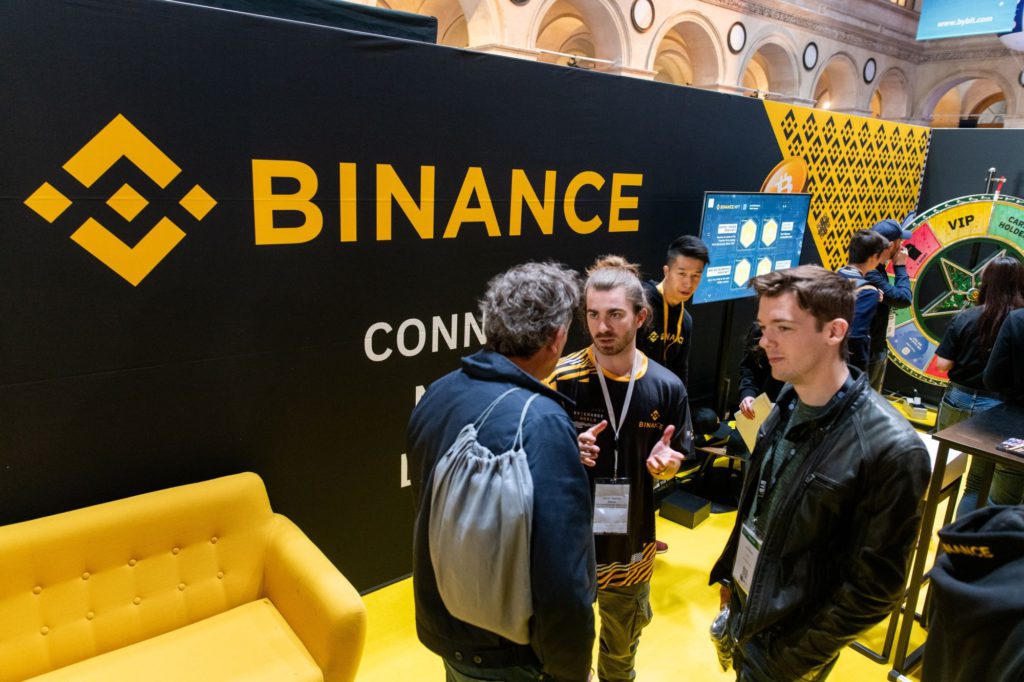
(Bloomberg) — Binance Holdings Ltd. has committed $500 million for Elon Musk’s proposed takeover of Twitter Inc., as part of its strategy to bring social media and news sites into the world of web3. 

“We’re excited to be able to help Elon realize a new vision for Twitter,” Changpeng Zhao, chief executive officer of Binance, said in a statement. “We hope to be able to play a role in bringing social media and web3 together and broadening the use and adoption of crypto and blockchain technology.” 

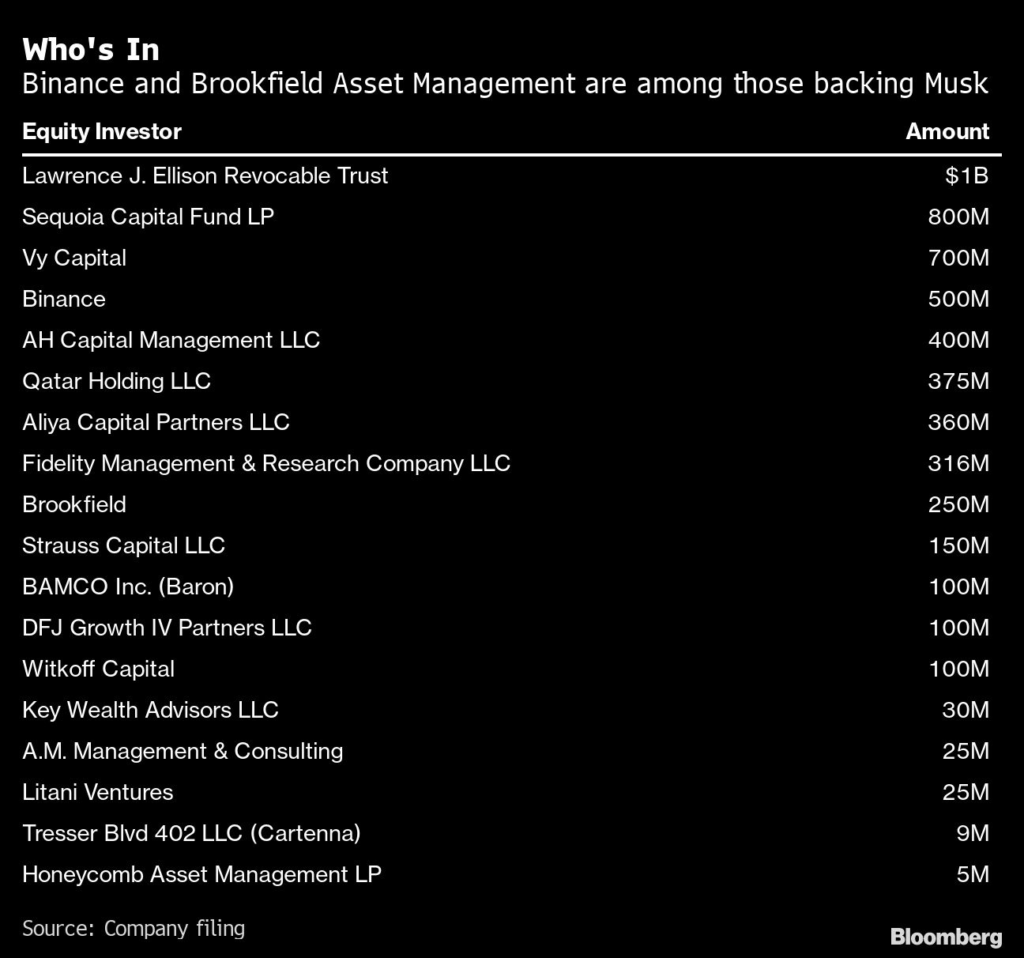
The deal was part of the $7.1 billion of new financing that Musk has secured for his proposed $44 billion takeover of Twitter. Sequoia Capital Fund, Qatar Holding LLC, and Brookfield Asset Management are among other backers in the package. 

Twitter is a main platform for online discourse by the crypto community. Yesterday, Musk briefly changed his Twitter avatar to a collage of Bored Ape NFTs, one of the most popular collections on the market. This resulted in a surge in the price of the ApeCoin token during European hours. 

Prior to the funding announcement, Zhao told Bloomberg TV that Binance is ready to invest in any “strong business with existing users, existing models” that can be helped with additional monetization models using Web3, blockchain and cryptocurrencies. Gaming, e-commerce, logistics and real estate are also sectors that the company is interested in investing. In these industries, “we’ll be pretty passive and pretty silent,” he said. 

Binance announced in February that it is making a strategic investment of $200 million into the more than 100 year-old news publisher Forbes and will advise its digital assets strategy. 

A Binance spokesperson declined to share further details on the deal, when asked if the company will pay for funding in crypto. 

More stories like this are available on bloomberg.com

©2022 Bloomberg L.P.

War in Ukraine Seen Putting Brakes on Kenya’s Strong Recovery

(Bloomberg) — After experiencing the fastest economic growth in more than a decade, Kenya now expects slower expansion this year due to the spill over effects of Russia’s invasion of Ukraine, according to Treasury Secretary Ukur Yatani.

East Africa’s biggest economy expanded by 7.5% last year and growth would have accelerated to 9% in 2022 were it not for challenges such as food and fuel inflation, scarcity of grains especially wheat, and the weakening of the shilling against the dollar, Yatani said Thursday in the capital Nairobi. Expansion is instead forecast at about 6.7%, he said.

“The last time we recorded such growth was many years ago,” Yatani said of output in 2021. “We deserve a pat on the back. That required good stewardship of the economy.”

Agriculture is projected to register growth in 2022 after shrinking 0.2% last year — the first contraction in four years — on account of good weather and a fertilizer subsidy, the minister said. 

While the ongoing rainy season will also help soften food inflation, price growth will remain elevated in the second and third quarters due to food and fuel prices, he said. The government will continue to tap a stabilization fund to “cushion the public from rapid rises in prices of fuel.” 

Political Disruption

Other than the war in Ukraine, a slowdown in global growth due to rising interest rates and Covid-19 shutdowns in China are likely to weigh on capital inflows and demand for Kenya’s exports. The nation is the world’s top exporter of black tea and the largest supplier of cut flowers in Europe.

Back home a persistent drought and a local currency that’s trading at all-time lows will also strain growth and fan inflation. Average inflation was 6.1% in 2021, the highest in three years.

The International Monetary Fund sees growth slowing to 5.7% in 2022, while the Central Bank of Kenya projects expansion of 5.9%.

Yatani said the ministry doesn’t expect much disruption from presidential elections scheduled for Aug. 9. Election-related violence that accompanied past voting periods discouraged investment in the economy. The worst fighting followed the election in 2007 when more than 1,000 people were killed.

“Our forecasts factor in a slowdown in activity around the August elections,” said Razia Khan, head of research for Africa and the Middle East at Standard Chartered Bank. The bank estimates growth at 4.8% this year.

“The outcome is too close to call for now; former Prime Minister Raila Odinga and Deputy President William Ruto, who has mobilized significant youth support, are both considered frontrunners,” she said.

Read: Ruto Remains Front-runner in Kenya’s Election Race, Poll Shows

(Updates story throughout)

More stories like this are available on bloomberg.com

©2022 Bloomberg L.P.

Private Credit’s Biggest Firms Are Crowding Out Newcomers

(Bloomberg) — The U.S. private credit market has ballooned to more than $1.2 trillion as investors seek higher returns. But it’s the biggest lenders that are attracting the most money, tilting market concentration to a select group and making it harder for newcomers to break in.

Nearly 40% of aggregate capital raised last year went to the top 10 biggest funds, according to London-based data analytics company Preqin. That’s up from about 27% in 2017, showing the increased domination of the largest firms.

Fundraising is running at a rapid clip as well, with lenders typically launching a fund every 15 to 18 months, an acceleration from the historical norm of three years, according to a report from Intertrust Group. That’s motivated established firms to launch even more new funds, according to the fiduciary services firm. Of the 2,800 individual funds launched in the last five years, 80% were from existing lenders, it added.

Among the biggest players, Blackstone Credit raised $32.6 billion for its business development company last year, while HPS put together a $15.4 billion fund. Those with larger scale are competing more and more with Wall Street banks by providing multi-billion dollar loans to help fund leveraged buyouts as they look for opportunities to deploy cash.

Read more: Blackstone Leads $4.5 Billion Unitranche Loan for H&F Buyout

Some private lenders are more focused on the lower middle-market where companies usually have maximum Ebitda of about $35 million. These firms, such as Crescent Capital Group, Adams Street Partners and Monroe Capital LLC, have also amassed huge sums, making it tough for new entrants to break into this area of the market as well. 

“The biggest barrier to entry is experience,” says Venkat Srinivasan, global head of private funds at Intertrust. “It’s a complicated market so investors want the comfort of a manager with a lot of know-how. That can be an experienced manager in a big firm or a manager who has earned their stripes and branched out on their own.”

So far, investors who’ve concentrated their money with top firms have seen steadier returns. Since 2009, funds with more than $1 billion in assets under management were less volatile compared to smaller-fund peers, according to data from Preqin. The internal rate of return for funds exceeding $1 billion saw a 4.4% variation between the best- and worst-performing vehicles between 2009 and 2018, while those smaller than $200 million varied by 6.9%.

The growing consolidation isn’t such a surprise, especially as loan portfolio managers sought easy safe havens during the pandemic, said Jess Larsen, chief executive officer at Briarcliffe Credit Partners. But he doesn’t think this is a long-lasting trend. In fact, it’s already changing based on conversations he’s having with investors, who are finding it easier to meet with smaller firms once again as pandemic restrictions ease.

Some new private credit funds are finding their way into the market by launching specialist strategies such as litigation, sports, supply-chain and aviation finance, the Intertrust report noted. Peter Gleysteen, chief executive officer at AGL Credit Management, said during a panel discussion Tuesday at the Milken conference that “the number of borrowers has vastly increased.”

Did You Miss?

  • Goldman’s Private-Credit Arm Steps In With Loan for CDK Buyout
  • Blackstone Leads $4.5 Billion Unitranche Loan for H&F Buyout
  • Ares-Led Group Snaps Up $2 Billion Chunk of Nielsen Buyout Debt
  • Brookfield Shifts Unsecured Bond to Private Credit in CDK Buyout
  • GSAM Commits $1.15 Billion of Junior Debt for Element LBO
  • Sanoptis Buyout Backed by Over $847m Direct Lending Deal
  • StepStone Closes $1.3 Billion Fund Amid Private Credit Boom
  • BlackRock TCP Capital 1Q Investment EPS Matches Estimates
  • BlackRock Seeks Up to $4 Billion for New Private Credit Fund
  • Blue Owl Starts a $2 Billion Private-Credit Fund for Wealth Push
  • Pemberton Hires Grammerstorf From Allianz to Lead Munich Office
  • Direct Lenders Are Accepting Weaker Protections in Europe: Q&A
  • Churchill Asset Adds Quinn to Spearhead West Coast Expansion
  • Hunton Leads Annaly’s Sale of Middle-Market Lending Book to Ares
  • Antares Sees Private Credit Funding Bigger Deals: Milken Update
  • Ares Capital: This Private Lender Regularly Masters Credit Risk
  • Ares Fee Gains Continue; Market Risk Manageable: Company Outlook

More stories like this are available on bloomberg.com

©2022 Bloomberg L.P.

E-Commerce Stocks Slump Amid Deepening Malaise Over Earnings

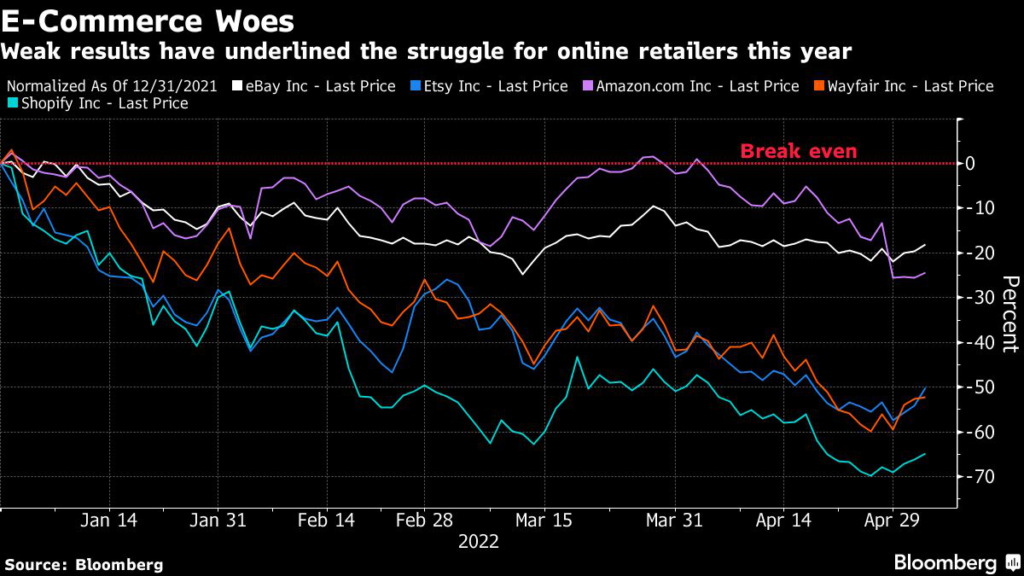
(Bloomberg) — Shares of e-commerce companies from Etsy Inc. to Shopify Inc. tumbled on Thursday after weaker-than-expected quarterly earnings and forecasts deepened concern that the pace of online shopping has slowed.

Etsy sank 17% after providing a second-quarter gross merchandise sales forecast that fell short of analyst expectations, while Canada’s Shopify dropped 17% in New York trading after merchandise volume and revenue for the first quarter failed to meet analyst expectations.

The flurry of disappointing results and guidance follows Amazon Inc.’s historic rout last week after the tech giant reported a revenue forecast that came in below what Wall Street had projected. Amazon’s shares have slumped 35% from their peak in July, including a 3.6% drop on Thursday, wiping out nearly $650 billion in market value.

The selloff has highlighted how difficult the environment has become for the group after their pandemic-driven boom. The blazing rally in e-commerce stocks at the height of Covid-19 lockdowns in 2020 has reversed as consumers returned to their pre-pandemic habits and inflation cooled their spending. Amazon executives said last week they were watching for whether shoppers will trim their purchases to offset rising prices as fuel and labor costs bite.

“The whole e-commerce group has been terrible, with growth slowing and stocks getting hurt,“ said Wayne Kaufman, chief market analyst at Phoenix Financial Services. “They’re obviously struggling post-pandemic, and there’s a question about how long it will be until growth trends reassert themselves. In the meanwhile, there’s still a tremendous amount of overvaluation in the sector.”

Among other e-commerce stocks, EBay Inc. fell 6.7% after giving lackluster sales and profit outlooks for the second quarter with analysts pointing to macro headwinds, including the Ukraine war, surging inflating and weakening consumer confidence. Wayfair Inc. plummeted 20% after its first-quarter adjusted loss per share was wider than analysts’ projections. Its chief executive officer Michael Fleisher also announced his retirement.

The Amplify Online Retail ETF is down 2.9% on Thursday, bringing its year-to-date decline to nearly 40%. To compare, the broader SPDR S&P Retail ETF is down about 20% this year.

(Updates with market open, adds comment.)

More stories like this are available on bloomberg.com

©2022 Bloomberg L.P.

Elon Musk Turns to Billionaire Backers, Skeptics for Twitter Bid

(Bloomberg) — Elon Musk’s $7.1 billion of new financing commitments to help him buy Twitter Inc. for $44 billion come from the the highest rungs of global finance — and some familiar faces from his other ventures. 

The Tesla Inc. co-founder won over the Saudi prince who initially balked at his offer and brought aboard Larry Ellison, the 11th richest person on the Bloomberg Billionaires Index. He also got a half-billion-dollar commitment from cryptocurrency exchange Binance.

Musk, 50, also got hundreds of millions of dollars from Sequoia Capital, a big backer of his Space Exploration Technologies Corp., and Vy Capital, which has previously invested in his Boring Co. and Neuralink.

There might be more money to come. Twitter founder Jack Dorsey, whose stake is worth about $1 billion, is continuing to have discussions about keeping his holdings in the company, according to a Thursday regulatory filing.

Here are the large investors throwing big money behind Musk’s Twitter bid.

Saudi Arabia Prince Alwaleed bin Talal: $1.9 Billion

Alwaleed has pledged to roll over his nearly 35 million Twitter shares, according to Thursday’s filing, which are worth about $1.9 billion at a price of $54.20 per share.

With a $16.4 billion fortune, he’s the richest individual in Saudi Arabia, according to the Bloomberg Billionaires Index. Most of his wealth is derived from his 95% ownership of Kingdom Holding Co.

He initially rejected Musk’s bid, saying the deal didn’t “come close to the intrinsic value” of the popular social-media platform. The move prompted a rapid retort from Musk, who asked how many shares the investor held in Twitter and the Kingdom’s view on freedom of speech for journalists.

Larry Ellison: $1 Billion

Ellison has made a fortune from Tesla. His stake in the electric carmaker is worth more than $14 billion. He was already one of the world’s richest people after founding Oracle Corp. He has a $95.6 billion fortune, as per the Bloomberg Billionaires Index.

Sequoia Capital: $800 Million

Sequoia Capital has been a major backer of Musk’s SpaceX and the links between the billionaire and some people at the firm go back a long time. Sequoia partner Roelof Botha was chief financial officer at PayPal Holdings Inc. when Musk was its CEO two decades ago.

Vy Capital: $700 Million

Vy Capital is a Dubai-based tech investment firm. Its website says it has “a focus on category-defining technology companies with the potential to meaningfully impact humanity.” It has previously invested in Musk’s ventures, including Neuralink and Boring Co.

Binance: $500 Million

This is the second high-profile investment in a media company for Binance, the world’s largest cryptocurrency exchange. The firm, founded by billionaire Changpeng Zhao, has also invested in Forbes.

AH Capital Management: $400 Million

AH Capital is the investment advisor of A16Z and was co-founded by prominent venture capitalist Marc Andreessen. Since Musk announced his plan to buy Twitter, Andreessen has encouraged the move, engaging with Musk on the social-media platform and even changing his biography to “shadow crew,” a jab at a Wall Street Journal article about those behind the scenes who encouraged the takeover.

Qatar Holding: $375 Million

Qatar, fittingly for Musk, is the world’s richest country per capita. It has a $450 billion sovereign-wealth fund that is seeking to diversify the country’s money by plowing into Asia and the U.S. after investing in Europe. The Qatar Investment Authority is the world’s ninth-largest sovereign-wealth fund, according to SWF Institute data.

Aliya Capital Partners: $360 Million

Miami-based Aliya, led by CEO Ari Shrage, has investments in companies it deems innovative and disruptive. Late last year, it was part of a $125 million Series B funding round for Kodiak Robotics, a self-driving truck startup.

Fidelity Management & Research: $316.14 Million

Musk is also getting backing from some large U.S. institutional investors. Boston-based Fidelity Investments, led by Chief Executive Officer Abigail Johnson, ended 2021 with $4.5 trillion of discretionary assets.

Brookfield: $250 Million

Toronto-based Brookfield Asset Management oversees about $700 billion. CEO Bruce Flatt said recently in an interview with David Rubenstein that his key to success is to encourage employees to make small mistakes every day, “just don’t make any really large mistakes.”

Strauss Capital: $150 Million

Strauss is a New York-based investment banking firm founded by Tom Strauss, a former co-head of the mergers and acquisitions group at Barclays Plc’s U.S. investment-banking arm.

$100 Million or Less: BAMCO, DFJ Growth, Witkoff Capital, A.M. Management & Consulting, Honeycomb Asset Management, Key Wealth Advisers, Litani Ventures, Tresser Blvd 402

Musk secured investments from several other firms, in denominations of as little as $5 million. 

He’s still looking for more investors. He “will continue to have, discussions with certain existing holders of Common Stock (including Jack Dorsey) regarding the possibility of contributing such shares of Common Stock to Parent, at or immediately prior to the closing of the Merger, in order to retain an equity investment in Twitter following completion of the Merger,” according to Thursday’s filing.

More stories like this are available on bloomberg.com

©2022 Bloomberg L.P.

New Africa Covid-19 Cases Outside Southern Region Remain Low

(Bloomberg) — Outside of southern Africa, new Covid-19 cases on the continent remain low, according to the Africa Centres for Disease Control and Prevention. South Africa is reporting the most weekly new cases, Africa CDC Deputy Director Ahmed Ogwell Ouma told reporters Thursday in a virtual briefing. In most of the African countries that are …

New Africa Covid-19 Cases Outside Southern Region Remain Low Read More »

South African State Workers Demand 10% Wage Increases

(Bloomberg) — Labor unions representing South Africa’s 1.3 million state workers demanded 10% pay increases to help them offset soaring electricity, transport and food costs.  The unions are also pushing for a single-year pay deal because they no longer trust the government to honor longer-term accords, according to a presentation they made to the public …

South African State Workers Demand 10% Wage Increases Read More »

Block Is Wall Street’s Top Fintech Despite Its Price Tag

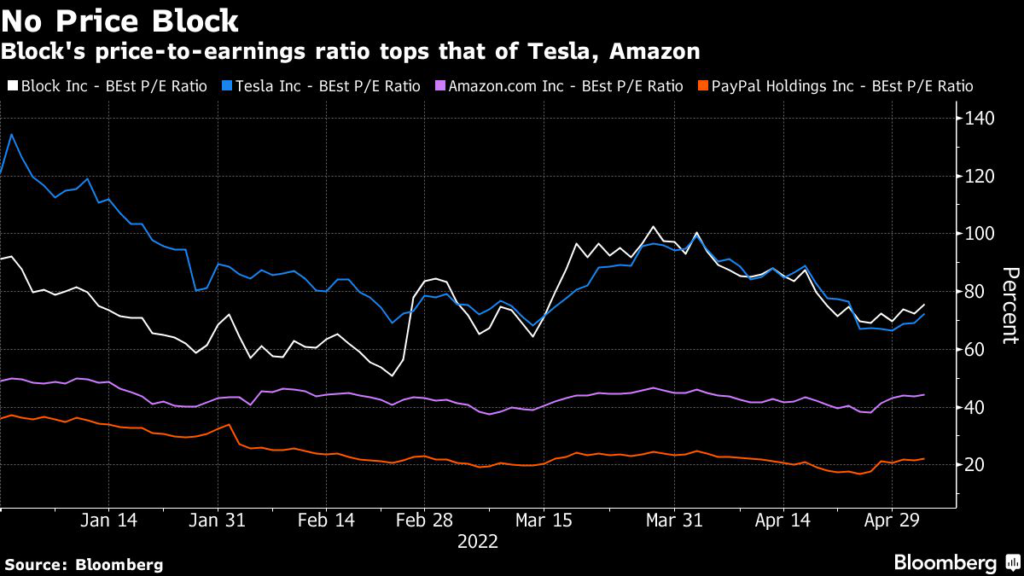
(Bloomberg) — Wall Street loves Block Inc. — even with a valuation that’s frothier than tech high fliers like Tesla Inc. and Amazon.com Inc.

Analysts see more than 66% upside for the payments company, while shares in its bigger rival, PayPal Holdings Inc., have a return potential of 35%, according to Bloomberg data. At the same time, Block shares are by no means cheap, trading at 76 times estimated earnings and dwarfing PayPal’s valuation at 22 times.

The high price tag means that the company, formerly called Square, needs to deliver when it reports first-quarter results after the close today. Analysts at Jefferies said more clarity is needed around future growth for Block’s consumer payments service, Cash App, and around the impact of its $29 billion acquisition of Afterpay.

The set-up into results is “tricky,” with consensus estimates for Cash App “looking stretched” beyond the first quarter, and the profit drag from the Afterpay deal not fully reflected in expectations, analyst Trevor Williams wrote in a note. Still, Williams said that despite these near-term bumps, he’s bullish on the long-term opportunity. He has a buy rating on the stock.

So far, investors seem willing to pay out for Block’s growth potential. The company led by former Twitter Inc. Chief Executive Officer Jack Dorsey has expanded meaningfully from a simple point-of-sale firm into digital payments and crytocurrencies with Cash App, and into the buy-now, pay-later space with the Afterpay deal, which closed in January.

Block has evolved “into a full business management and fintech service company,” Tigress Financial Partners LLC analyst Ivan Feinseth said. “They’re going beyond the payment.”

That diversification also means that some investors prefer Block over PayPal, which is still highly reliant on e-commerce transactions.

Block has “executed admirably” over the past 6-9 months compared with PayPal, which experienced “several operational missteps” that hurt revenue growth, according to SMBC Nikko Securities America analyst Andrew Bauch, who has a buy-equivalent rating on Block. The stock has 42 buy ratings, 8 holds and 2 sell recommendations, according to data compiled by Bloomberg.

Bauch added that Block isn’t pricey when looking at its long-term prospects. “When compared to other fintech names with similar levels of gross profit growth, the stock appears much more affordable,” he said.

Investors like Cathie Wood have also remained bullish. Wood’s Ark Fintech Innovation ETF dumped shares in PayPal after the company’s fourth-quarter results, while adding exposure to Block at the same time.

Still, the fintech favorite hasn’t been immune to recent market turmoil, falling about 34% this year. And, even if it jumps 60% to hit analyst targets, that level is still lower than last year’s record high.

Tech Chart of the Day

Tech stocks rebounded on Wednesday after Federal Reserve Chairman Jerome Powell said the central bank was not actively considering a 75-basis-point rate hike following its biggest increase in rates in more than two decades. The benchmark S&P 500 Index jumped 3%, its best performance since May 2020, pushing its rebound into a third straight day. That rally is now in jeopardy with the market broadly lower Thursday.

Top Tech Stories

  • Facebook parent company Meta Platforms Inc. is slowing or pausing hiring for some mid- to senior-level positions, part of a broader plan to cut costs and cope with the challenges facing the social media giant
  • U.S. regulators added more than 80 companies, including JD.com Inc., Pinduoduo Inc. and Bilibili Inc., to an expanding list of firms that face possible expulsion from American exchanges because of Beijing’s refusal to allow access to the businesses’ financial audits
  • Expedia Group Inc. is unveiling a new e-commerce platform that will allow businesses to use its tools for their websites, helping attract new partners and expand business-to-business revenue
  • Shares of Hangzhou Hikvision Digital Technology Co. tumbled 10% as the U.S. considers imposing new sanctions on the surveillance-technology giant, potentially the harshest measures so far against a major Chinese company
  • China’s CATL shares tumbled Thursday after the electric-vehicle battery maker posted its sharpest-ever drop in quarterly earnings and disclosed a sizable derivatives liability

(Updates potential return values in the second paragraph.)

More stories like this are available on bloomberg.com

©2022 Bloomberg L.P.
South Africa Records Highest Positivity Rate Yet of Fifth Wave

(Bloomberg) — South Africa’s daily coronavirus test positivity rate rose to its highest level yet on Wednesday amid its fifth wave of infections. There were 6,170 new Covid-19 cases identified, representing a 22.6% positivity rate of those tested, with the majority of the cases in Gauteng province at 41%, followed by KwaZulu-Natal with 27%, the …

South Africa Records Highest Positivity Rate Yet of Fifth Wave Read More »

Verizon Mulls Price Increase in Response to Rising Costs

(Bloomberg) — Verizon Communications Inc. is considering raising prices for wireless service — one of several possible options to pass along inflation-related costs to consumers following AT&T Inc.’s decision this week to increase rates on older calling plans by $6 or more.

An increase like AT&T’s isn’t likely for Verizon, but alternatives such as the introduction of a higher-priced unlimited plan or added fees are among the possibilities, according to a person with knowledge of the company’s deliberations. Either way, if costs keep rising, Verizon customers will see higher monthly bills.

A Verizon representative declined to comment. The company’s shares slipped 0.6% at 9:36 a.m. in New York.

Like many companies, wireless carriers are seeing wages rise. AT&T said in April that pay increases would add a $1 billion or more to its costs. Both Verizon and T-Mobile US Inc. raised employees’ starting pay to $20 an hour in the past few months in response to a tight job market.

Hans Vestberg, Verizon’s chief executive officer, raised the prospect of boosting prices on an April call with investors, citing what he said was a 40-year high in inflation.

“We have plans to be prepared for what it takes,” Vestberg said. “So that will, of course, include different type of cost adjustments, but also looking into what you can do with pricing.”

Read more: AT&T raises prices on wireless plans to address higher costs

Not everyone is buying the higher-costs-made-me-do-it rationale. Some are saying ‘I told you so’ after the industry shrank from a four-player field to three when T-Mobile acquired Sprint Corp. in 2020. That left customers with fewer options and made them more captive to their current providers, opponents of that deal say.

“We are skeptical of claims that carriers are raising wireless prices because of inflation,” said Diana Moss, president of the American Antitrust Institute. “It is too easy to blame price increases on such an obvious factor.”

While AT&T broke from past practices and raised prices for the first time in three years, T-Mobile has been holding firm and offering a range of price plans to attract customers from rivals. The company recently introduced new prepaid plans starting at $20 a month. 

“Of course AT&T did what it did,” T-Mobile Chief Executive Officer Mike Sievert said during a presentation Wednesday. “This gives us the opportunity to stand up for the customer.”  

AT&T’s price increase isn’t evidence of a concentrated market, according to Makan Delrahim, who led the U.S. Justice Department’s antitrust division when the agency approved T-Mobile’s purchase of Sprint.

‘Real Competitor’

The combined company emerged as a “real competitor” to AT&T and Verizon, Delrahim said in an interview. It also empowered Dish Network Corp. as a potential fourth player, he said, with the combining companies selling assets to the new rival.

“The overall deal was much better for the consumer,” Delrahim said.

But even T-Mobile isn’t exactly a hero on the price front. The company used to boast that its unlimited plans included all fees and taxes in the advertised price. Today, only the two upper-tier Magenta plans include the extra charges in the posted price, while such items are added on top of the lower-tier plans.

“One big issue that the carriers need to be careful about is doing anything that would appear to increase the digital divide,” said Tammy Parker, an analyst with GlobalData. “They must balance price increases with the need to provide options that allow budget-constrained customers to remain connected.”

The wireless industry this week also saw hints of fresh competition. On Wednesday, Dish launched its 5G service in Las Vegas, a milepost in that company’s nearly two-year journey to become a new wireless competitor after the Sprint/T-Mobile deal.

But it will be years before Dish becomes a major competitor, giving the incumbents a “raise-your-prices-while-you-can” moment, according to Harold Feld, senior vice president of the Washington-based policy group Public Knowledge.

(Updates shares in third paragraph.)

More stories like this are available on bloomberg.com

©2022 Bloomberg L.P.

Close Bitnami banner
Bitnami