Bloomberg

Bitcoin Drops the Most in Almost a Month as Fed Optimism Fades

(Bloomberg) — Bitcoin dropped the most in almost a month as the optimism seen across financial markets following the Federal Reserve’s meeting on Wednesday faded. 

The largest digital currency fell as much as 8.4% to $36,639, the biggest intraday drop since April 11. It had gained 5.3% on Wednesday. Ether slumped as much as 7.2%. Avalanche and Solana, among some of the largest gainers after the U.S. central bank raised rates Wednesday, were down as much as 11% and 7.3%, respectively.  

“The market still needs to digest the impact of tighter monetary policy on all risk assets and crypto might take a hit as correlations” with U.S. stocks increase, said Josh Lim, head of derivatives of New York-based brokerage Genesis Global Trading.


The U.S. central bank’s policy-making Federal Open Market Committee on Wednesday voted unanimously to increase the benchmark rate by a half percentage point and said it will begin allowing its holdings of Treasuries and mortgage-backed securities to roll off in June. Risky assets surged after Fed Chair Jerome Powell said a 75-basis point increase is “not something that the committee is actively considering.” 

Still, in this higher-rate environment, Bitcoin hasn’t been able to break out in any meaningful way beyond its highs at the start of the year. The coin has largely traded within a tight range over the past few months. 

The “technical picture in BTC remains poor, in spite of a less hawkish Powell, BTC failed to regain 40,000, hence this pull back.” said Teong Hng, chief executive of Hong Kong-based crypto investment firm Satori Research. “As equity markets in U.S. reversing yesterday’s gains, crypto follows suit.”

Money has been flowing out of the sector amid the malaise. Investors yanked roughly $120 million from crypto products last week, bringing total outflows over the past four weeks to $339 million, according to data tracked by fund provider CoinShares. Bitcoin last week accounted for the majority of the flows in what was its largest single week of outflows since June 2021. 

More stories like this are available on bloomberg.com

©2022 Bloomberg L.P.

Commodities Trader ED&F Man in Talks to Sell Brokerage Business

(Bloomberg) — ED&F Man Holdings Ltd. is in talks to sell its brokerage unit as the commodities trader best known for hauling sugar and coffee seeks to turn its business around, according to people familiar with the matter.

The London-based trader already has an offer for its ED&F Man Capital Markets unit from rival brokerage Marex Group, said the people, who asked not to be named because the discussions are private. The company has also held talks with Prudential Financial Inc. and no final decision has been made, the people said.

ED&F Man and Marex both said they don’t comment on market speculation. Prudential declined to comment.

ED&F Man has been selling non-core and under-performing assets as it refocuses on its trading roots. The company earlier this year got the green light from a U.K. court to ring-fence its commodities business and restructure about $1 billion in debt beyond 2025.

This isn’t the first time ED&F Man has tried to sell its brokerage business, with a previous attempt being disrupted by the pandemic. Offloading the unit — which handles everything from metals to crypto currencies — would allow the firm to focus on trading sugar, coffee and liquid products including molasses.

While the trading division turned profitable in the past few years, the company still posted a fifth year of losses in the 12 months through September.

Buying ED&F Man’s brokerage business could provide a boost to Marex, which was forced to cancel an initial public offering last year due to challenging market conditions. A deal with Prudential could be easier as the companies are not direct competitors. PGIM, Prudential’s asset management arm, invested $65 million in ED&F Man Capital Markets last year.

More stories like this are available on bloomberg.com

©2022 Bloomberg L.P.

What Audi and Porsche Stand to Gain From Joining Formula 1

(Bloomberg) — The announcement that Porsche and Audi want to lend their names to Formula 1 comes at a high point of popularity in the U.S. for the world’s most glamorous racing series.

Miami’s first-ever F1 Grand Prix will run on May 8. Race-day ticket prices hit $1,342 this week on the secondary market, more than prices for the NBA finals, Stanley Cup, and World Series, according to the ticket-seller TickPick. Luxe hotel, restaurant, and entertainment packages are selling for as much as $110,000. More than 240,000 fans are expected to attend the sold-out event, with 82,500 surrounding the track in Hard Rock Stadium.

Experts credit the popular Netflix documentary Formula One: Drive To Survive with stirring a surge of U.S. interest in the once-obscure sport founded in Europe in the 1950s.

Read More:  Formula One Finally Found a Way to Get Americans to Care

“The F1 Grand Prix has always been a popular event, but it hasn’t become the story that this Miami Formula 1 race has been,” says Brett Goldberg, co-founder and co-CEO of TickPick. “A fair amount of it was the success of the Netflix documentary. That itself has brought massive awareness to the U.S.”

Race organizers in Miami have said they plan to increase capacity in coming seasons. A second new American race is scheduled for November 2023 in Las Vegas.

How They’ll Do It

Much remains unclear about what it will mean for Porsche and Audi as they buy their way into the prestige of a sport that reported annual revenue of $2.136 billion across its 22-race calendar in 2021. The series made $92 million in profits that year after losing $386 million during 2020. Race promotion—companies and promoters paying to be associated with F1’s grandeur—was the biggest revenue stream, accounting for 40% of total income. Qatar, for instance, pays $55 million per year for its contract to host F1—the highest amount on the list of contract costs; Mexico pays $25 million. 

There are three ways Audi and Porsche could enter such a blue-blooded field. They have already supplied engines to other teams. This year, for instance, Mercedes supplied engines to four of the 10 teams on the F1 grid; Porsche briefly supplied turbocharged engines to McLaren in the 1980s and to a team called Footwork (formerly Arrows) in the early 1990s.

Stronger options are to buy an existing team and use that platform for their own engineering, or to launch a bona fide factory team, like Ferrari’s, which would demand hundreds of millions of dollars in research, engineering, and other investment—not to mention years of time refining the new technology for a race. 

Spokespeople from both brands declined to answer questions about whether joining F1 means launching such a team, or if they would go another route such as supplying engines and technology for others.

Bloomberg earlier reported that Porsche is considering providing power units to Red Bull. Porsche’s plans, while unannounced, are “quite concrete,” said parent-group Volkswagen AG’s chief executive officer, Herbert Diess. Audi’s plans are less advanced, though progressing, Diess said. Audi may offer around $556.3 million to acquire McLaren as a means to enter, according to some reports.

“Both premium brands see it as the right decision [to join F1] and are prioritizing it,” Diess said during a town hall discussion in Wolfsburg, Germany, on May 1. He declined to specify the timing or exact nature of the commitment. 

A Moneymaking Opportunity 

There is clearly potential to leverage newly minted American F1 fans into conquests for VW’s highly profitable premium car brands. Winning in Formula 1 bolsters brand image and awareness across multiple segments of consumers, Goldberg says, which translates to car sales. It is no coincidence that some of the coolest inventions now popular on modern sports cars—big rear wings, paddle-shifting, and carbon-fiber elements to help increase efficiency—directly descended from F1 cars. 

“Your [potential] Porsche enthusiast, your sports car enthusiast—they don’t always translate to NASCAR, but they do translate to Formula 1,” he says. “That’s a wealthy group of individuals.”  

In addition to potential car sales, Porsche and Audi teams could also make money from co-branding and sponsorships. The most successful racing teams such as Ferrari, Mercedes, and Red Bull count multimillion-dollar deals with sponsors and advertisers like Oracle, Puma, Tag Heuer and Walmart. In February, Red Bull Racing signed a single sponsorship deal worth $150 million with Bybit, a Singapore-based cryptocurrency platform. 

They could also win hundred of millions of dollars in prize money. Roughy 47.5% of F1 profit makes up the prize money, which is then divided into two categories: Half goes to the F1 and its shareholders; half goes to the teams, which divvy it up based on final standings for the year.

“The sport in North America [is] under-viewed, under-monetized, under-everything,” said Greg Maffei, the president and CEO of Liberty Media, which owns F1. “I don’t think that gets solved in a week, but I think that’s an interesting long-term opportunity.”

A Risky Bet on a Marketing Goldmine

There are some risks to joining F1, especially for Porsche, which built its brand image on the plucky race cars and rallies of the 1960s, ‘70s and ‘80s. For the power brokers at VW, the old adage “win on Sunday, sell on Monday” still holds true. (Cars that win races instill consumers with a favorable view of their brands and make people want to drive the street-legal cousins of the winning cars.)

“We are assuming that in 2026 or 2028, Formula 1 will be the biggest motorsport spectacle in the world—even more than today—bigger in China, bigger in the United States,” Diess said. “And with that, also the largest marketing platform for premium vehicles.”

But “win” is the operational word. For Porsche, which got mixed results in Formula E and races only occasionally, in lesser-known series such as Le Mans, entering F1 but faring poorly would potentially hurt the image of VW group’s most profitable brand. Porsche has built its allure on the back of a highly successful (non-F1) racing car, the 911. As Porsche’s most profitable vehicle, the 911 contributes 11% of Porsche sales by volume while accounting for roughy 30% of earnings. 

Aston Martin, for instance, has suffered this season as its drivers continue to finish at the back of the pack. While the company also faces other headwinds, such as a disappointing initial public offering and subsequent churning of top management, the fact that the British brand is currently ranked ninth of 10 teams doesn’t help morale among loyal fans, or win new ones for the brand. On May 4, Aston Martin Lagonda named former Ferrari NV boss Amedeo Felisa as top executive. Felisa immediately replaced Tobias Moers, who joined the company in 2020 from Mercedes-Benz’s high-performance AMG brand. Rumors have circulated for months that Aston Martin racing team owner Lawrence Stroll is looking to sell it. 

A Proven Record

Ferrari provides the gold standard case study for the power of F1. It is the world’s strongest brand in all categories for nearly a decade, according to the Annual Brand Ranking report that balances scorecard of metrics evaluating marketing investment, stakeholder equity, and business performance. Ferrari makes just over 11,000 cars per year but trades on a gargantuan footprint of loyalty, heritage, and a winning tradition bolstered largely by its longstanding involvement in F1. Cumulatively, the Italian supercar maker and racing team are worth more than $27 billion.

“The embodiment of luxury, Ferrari continues to be admired and desired around the world,” wrote David Haigh, the CEO of Brand Finance. “It is no wonder that many consumers, who might never own a Ferrari car, want a bag or a watch emblazoned with the Prancing Horse.”

The success of Ferrari’s racing cars on the track in the 1950s and ‘60s built the fame and reputation that fueled the appetite for the brand’s first popular road-going cars; its million-dollar icons such as the F40 drew close parallels to the race cars of the 1980s. Its fans, known as Tifosi, are the most notorious force behind any F1 team on the planet. In 2017, one in three F1 fans described themselves as Ferrari supporters, according to a F1 fan survey in 2021. 

The caveat is that on the world’s best-known race track, you’ve got to win to stay popular—and feel you’re getting your money’s worth from the more than $145 million budget required to field a team. In the years since 2017, Ferrari fell off its competitive race pace and has lacked the star power of a driver such as Mercedes’s Lewis Hamilton. It’s no coincidence that last year, just 18%—fewer than one in five—of racing fans still described themselves as supporters of the brand. (Sales of Ferrari street cars nonetheless rose.) Close observers might observe a bump in popularity after this year: Ferrari is currently running in first place in the constructors team standings. 

Selling Electric in 2026

There’s also the question of how entering an old, fossil fueled race series could help sell electric vehicles, which Audi and Porsche have committed to selling extensively. The brands have timed any move carefully. A rule change stipulates that in 2026 all F1 race cars will have new engines that are more electrified and run on synthetic fuel.

The adjustment levels the playing field for any brands that might want to enter the series. All will be building engines to comply with the rule change. 

“You can’t enter Formula 1 unless a technology window opens up, which means, in order to get in there, a rule change so that everyone starts again from the same place,” Diess said.

It was unclear whether ownership of Rimac, a Croatian battery provider and automaker, might play a role in Porsche moves to develop technology for itself or others in the series. A spokesperson for Porsche declined to say whether making an F1 move means Porsche would withdraw from Formula E.

Diess, for his part, was more direct: “It’s really only Formula 1 that counts,” Diess said. “If you do motorsport, you should do Formula 1, as that’s where the impact is greatest.”

More stories like this are available on bloomberg.com

©2022 Bloomberg L.P.

Sibanye Says Unions Using Gold Strike to Leverage Platinum Deal

(Bloomberg) — Sibanye Stillwater Ltd. said the almost two-month long strike at its South African gold mines is being used as leverage by labor unions for upcoming wage negotiations at its platinum operations. South African miners, including Anglo American Platinum Ltd. and Impala Platinum Holdings Ltd., are entering pivotal talks over a multiyear pay deal …

Sibanye Says Unions Using Gold Strike to Leverage Platinum Deal Read More »

Shopify Shares Hit Two-Year Low on Profit Miss, Softer Outlook

(Bloomberg) — Shopify Inc. shares plunged to the lowest since April 2020 after it missed analysts’ profit estimates and announced the largest acquisition in its history, a $2.1 billion deal for delivery startup Deliverr Inc. 

Shopify was down 17% to 400.83 as of 11:15 a.m. in New York. They’ve declined more than 70% this year.

The Canadian e-commerce software firm earned 20 cents per share on an adjusted basis in the first quarter, far short of analyst calls for 64 cents. The company gave a weaker outlook for adding new business customers in 2022, saying growth in merchants using the platform would be “comparable” to 2021. 

E-Commerce Stocks Tumble Amid Deepening Malaise Over Earnings

E-commerce stocks have been pummeled this earnings season on concerns that online shopping is slowing as the Covid-19 pandemic fades. Amazon.com Inc. suffered the biggest one-day drop since July 2006 after it reported a weaker-than-expected revenue forecast. Wayfair, Etsy and EBay all dropped on Thursday. 

Revenue rose 22% to $1.2 billion from a year earlier, but couldn’t match analyst expectations of $1.25 billion, according to data compiled by Bloomberg.

Gross merchandise volume, the value of merchant sales flowing through Shopify’s platform, grew 16% in the first quarter from a year earlier to $43.2 billion. Analysts, on average, expected $46.5 billion in GMV. 

“While SHOP continues to give less specific guidance across key metrics, new merchant comment commentary was revised lower,” Citigroup analyst Tyler Radke said in a note to clients. “We expect the stock to trade down given the significant miss on GMV, profitability and continuation of headwinds into Q2.”

Shopify is contending with consumers returning to physical stores and rising inflation, as well as labor shortages, Chief Financial Officer Amy Shapero said.

“We saw lower merchant adds than last year and we largely attribute that to a very tight and transitional labor market,” Shapero told analysts. “We expect that the labor market will start to ease.”

Deliverr Deal

Shopify also reached a deal to acquire Deliverr to expand in fulfillment services, confirming an April 20 report by Bloomberg News. In January, Shopify canceled several fulfillment and warehouse contracts intended to create its own distribution network.

Shopify to Buy Deliverr for $2.1 Billion: M&A Snapshot

The purchase of Deliverr — which provides two-day delivery services for companies including Amazon, EBay, Etsy, and Walmart — more than doubles the size of Shopify’s fulfillment team. The transaction will be financed using 80% cash and 20% Shopify Class A shares.

The deal marks the beginning of one of Shopify’s most important and definitive long-term initiatives, according to KeyBanc Capital Markets analyst Josh Beck. To build its own fulfillment network, Shopify needs an experienced team with established technology, which it gains with Deliverr. But the process is expensive and takes up time and resources, he noted.

“With the way the stock is trading, investors are focused on the extra dilution associated with the Deliverr deal,” Beck said in an interview. “In this market environment, that message of less near-term profitability and more investment is not well received, particularly by short-term investors.”

Shopify has had a rough start to the year. A parade of analysts slashed the company’s price target ahead earnings. In a bid to draw retail investors, Shopify announced in April plans to split its stock 10-for-1. 

The company is also seeking to make governance changes that would give Chief Executive Officer Tobi Lutke a “founder share” that will preserve his voting power as long as he’s at the company, under certain conditions.

When asked why shareholders should vote in favor of the plan, Lutke pointed out his voting power will be capped at 40% and he’ll be forbidden from passing on the special share to his family. 

“Shareholders can get some assurance that this is a structure that supports the founder-led-ness of the company,” Lutke said. 

When asked on the conference call about how the company’s beleaguered stock is affecting its ability to attract and retain talent, Lutke said that employees want to work for and investors look to buy companies based on their values — and stock performance plays a small part.

“The stock price is something that factors into this, but it’s one input of many,” Lutke said. “Most people tend to understand that the stock price is a snapshot in time.”

(Updates share price move and adds additional details from conference call and more additional analyst commentary.)

More stories like this are available on bloomberg.com

©2022 Bloomberg L.P.
Booking Rises Most in 18 Months on Outlook for ‘Busy Summer’

(Bloomberg) — Booking Holdings Inc. rose the most in 18 months after the company gave a stronger-than expected first-quarter earnings report and executives were optimistic about a busy summer travel season. 

Western Europe and North America are leading the summer travel rebound, with gross bookings 30% higher for the regions than at this time in 2019, Chief Financial Officer David Goulden said on a call with analysts to discuss the results on Wednesday.

“If the current trends continue, we could see a record summer travel season, and we’re gearing up to prepare for that across all parts of our business,” he said.

The shares rose as much as 9.7% to $2,308 in New York, marking their biggest gain since November 2020. 

The U.S.’s biggest online travel company reported revenue rose 136% to $2.7 billion in the three months ended March 31, while analysts projected $2.54 billion. Gross bookings, which represent all travel services excluding cancellations, were $27.3 billion, the highest quarterly amount ever for the company. That beat the average analyst estimate of $25.39 billion, according to data compiled by Bloomberg. 

After more than two years of limited travel options due to Covid-19 restrictions, travel executives are expecting a surge in bookings this summer as consumers splurge on vacations. Airbnb Inc., which reported strong results on Tuesday, said it sees “substantial demand” for travel heading into the busiest time of the year. And Chief Executive Officer Brian Chesky said Airbnb is seeing “higher than historical demand” for the fourth quarter, “which indicates that consumer confidence to travel remains strong beyond the summer months.”

But the market punished Expedia Group Inc., which earlier this week reported an 80% jump in revenue in the first quarter, signaling investors’ rising concern about inflation and the risk for recession. Travel companies from hotels to airlines have been saying consumers are willing to pay the rising prices so far, but there appears to be a limit. Hilton Worldwide Holdings Inc. also gave a profit forecast that fell short of analysts’ expectations.

Still, there are positive signs that people are itching to take a trip. For example, United Airlines Holdings Inc. is boosting capacity for transatlantic flights and Southwest Airlines Co. said it expects to be profitable for the remaining three quarters of the year, even with oil prices well over $100 a barrel.  

Booking also owns flight aggregator Kayak and travel booking site Priceline, as well as an alternative accommodations platform. The Norwalk, Connecticut-based company has a strong global presence, with close to 90% of 2020 revenue coming from its international segments, which made it more exposed to the war in Ukraine than its rivals. But positive signs for cross-border travel in Europe are emerging, with Covid-19 restrictions easing and greater demand on low-cost carriers EasyJet Plc and Ryanair Holdings Plc, according to Cowen Inc. analyst Kevin Kopelman. 

While Airbnb has attracted guests seeking to rent full homes in more rural areas where they can work remotely, Booking, which is more dependent on hotels, flights and car rentals, is anxiously awaiting tourists to return to large cities and international vacation hotspots. 

Investors were initially rattled by the war, but Booking disclosed in a March securities filing that despite a drop in room nights driven by the Eastern European region, Western Europe levels remained above 2019 levels. The slowdown in room nights is likely improving, Kopelman wrote in a note last week. Despite Americans’ feelings about the war, Fogel said in March that he didn’t think it would change their summer travel plans. 

Booking reported a net loss of $700 million. Adjusted earnings per share were $3.90, far better than expected than analysts’ estimates of 71 cents.  Despite the executives’ optimism over summer demand, all three online travel companies have seen their shares suffer this year. Booking is down about 12% while Airbnb is down about 6% and Expedia tumbled 17%.  


More stories like this are available on bloomberg.com

©2022 Bloomberg L.P.

Crypto-Rich Puzzle Over How to Pass On High-Risk Wealth to Heirs

(Bloomberg) — J.W. Verret has a plan for his heirs to follow when he dies. And it’s unlike anything estate planners could have imagined just a decade ago.

That’s because the middle-aged law professor has spent two years building up various crypto holdings. To access that wealth, should he meet an untimely end, his three children may have to go through a 25-page document with details on websites to navigate, special wallets to download, web applications to connect and exchanges to cover.

“I tried to give the instructions as best I could, to have the websites and warn them about everything,” said Verret, an associate professor at George Mason University’s law school. “But it’s very possible either from user error or lack of understanding or from things changing in the interim, that they’ll need expert help.”

Verret’s scavenger hunt document may seem unusually challenging for an asset class that has ballooned to a nearly $2 trillion market. But it underscores that for all the wealth accumulated in the world of digital tokens in recent years, the best way to pass it along to the next generation is still very much a puzzle — even for the usual experts.

In 2021, investors poured more than $25 billion into crypto and nonfungible token startups, a 700% increase from the previous year, according to data provider CB Insights. The digital assets are increasingly going mainstream, with Fidelity Investments recently unveiling a product that will allow 401(k) plan participants to direct a portion of their savings into Bitcoin.

Yet as more crypto holders need help structuring their wealth, the staid world of estate planning is still playing catch up. Experts remain few and far between for an asset beset with volatility and at risk of being lost forever.

What Wallet?

Those who are wading in encounter other hurdles. Charles Kolstad, who has 42 years of experience in the wealth planning industry, now heads a cryptocurrency practice group as a partner at Withers. The law firm has represented founders of crypto exchanges and companies, token issuers and artists who mint NFTs, which are digital certificates of authenticity for content.

And he’s had to convince crypto holders whose natural instinct is to keep their wealth anonymous and shielded to share basic details. 

The challenge is “getting them to actually tell you all of the crypto they’ve got and where it is, and what wallets it’s in: Is it a hot wallet? A cold wallet? Is it on an exchange? Are there multiple exchanges?” said Kolstad, 68, who is based in Los Angeles. (A hot wallet is connected to the internet for transactions, whereas a cold wallet holds crypto offline.)

Fortunes built on crypto are more volatile than most anything estate planners have seen before. Bitcoin and Ether are both down about 40% from their peaks in November and trading below their one-year average. 

Those kinds of swings make holding crypto unpalatable for trustees, the typical go-tos for wealth planning. They’re obligated to maintain a broadly diversified portfolio of assets in the interest of beneficiaries.

HODL Mindset

Trustees “know very little, most of them, about crypto, and their natural inclination would be to sell, sell, sell,” Kolstad said.

Selling, of course, is an anathema in the world of crypto, which preaches HODL, or “hold on for dear life.” So firms have advised clients to use directed trusts or put their holdings in limited liability corporations, or LLCs, which are in turn put into trusts. Both give someone other than trustees control over how investments are managed.

Wyoming is becoming a popular place for trusts that hold crypto, according to Jonathan Mintz, founding partner at Evergreen Legacy Planning. The state has no income tax and it allows the formation of directed trusts. 

In some cases, large crypto holders have even created their own private trust companies, which allows them to retain more control and custody over assets, said Chris Duncan, counsel for Carey Olsen’s trusts and private wealth practice in the Cayman Islands.

For clients who maintain a dizzying array of private wallets with esoteric assets in sole custody, lawyers like Duncan have had to write special provisions. In one recent case, he had a client who maintained assets on behalf of their trust and required approval from the trustee to transact. The Cayman team gamed out a scenario for a black swan event.

‘Fatal Flaw’

“What if something happens that none of us have predicted?” Duncan said. “The client’s in London, say, and the trustee is in Cayman and there’s a five-hour, six-hour time difference. Trustees are in bed and the client sees some announcement on Twitter about a fatal flaw in the code of some project and has an opportunity to exit.”

They ended up working in a provision for urgent decisions, which allowed the client to proceed if they didn’t hear back from the Cayman trustee within a set period of time.

“There is a trade-off with holding your assets in a way that lets you do a lot with them very, very quickly, whether it’s yield farming, doing DeFi or buying NFTs,” said Geoff Costeloe, an associate at Lindsey MacCarthy in Canada. “You have to trade off between that and a system that is primed to distribute it to your beneficiaries in the event you die.”

Most crypto holders may just need the basics: a way to share keys with beneficiaries at some point in the future and a set of instructions for them to follow to move crypto then. More solutions are coming to market to support secure key sharing, including multisig technology by companies like Casa and Unchained Capital. Multisig wallets require multiple approvals before transactions can be made.

Costeloe recommends using these services in conjunction with a lawyer and an estate plan. 

As for Verret and his 25-page document, he’s been teaching his three children, all under the age of 10, how to use wallets by putting their allowance in them. His instructions clearly indicate that his heirs must never share his seed phrase with anyone — or the crypto could be lost forever.

Like others in the crypto world, he’s wary of any conversations about his holdings. 

“In our last half hour, no offense, I’ve assumed you’re trying to steal my money,” Verret said.

More stories like this are available on bloomberg.com

©2022 Bloomberg L.P.

Inflation Spike Pressures Paraguay Central Bank to Boost Rates

(Bloomberg) — Sign up for the New Economy Daily newsletter, follow us @economics and subscribe to our podcast.

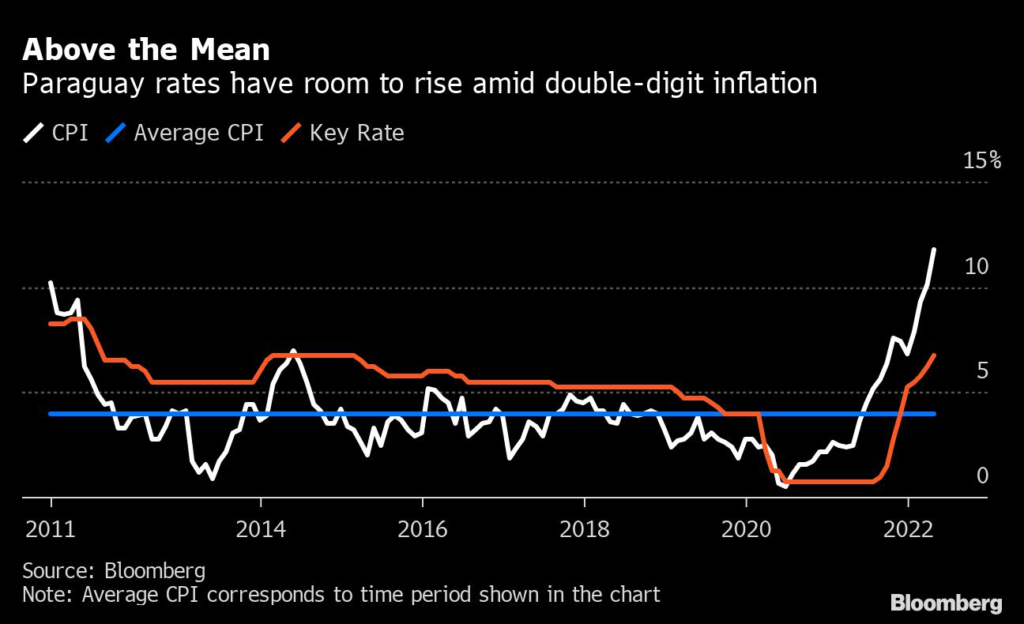
Paraguay’s central bank is prepared to keep raising borrowing costs if the biggest surge in consumer prices in almost 14 years further erodes inflation expectations, according to a senior policy maker.

The central bank has lifted its benchmark interest rate by 600 basis points to 6.75% since the start of its tightening cycle in August. Rising food and imported fuel prices sent inflation soaring 11.8% last month, almost three times the central bank’s 4% target and one of the highest in the region.

Future interest rate increases might be smaller than the 50 basis-point hikes in recent policy meetings, said Humberto Colman, a member of the central bank’s board of directors.

“We haven’t had an increase in inflation like this since we adopted inflation targeting in 2011,” Colman said in an interview from Asuncion. “It’s an important challenge for monetary policy.”

Like most economies around the world, the South American nation was already battling rising consumer prices from the pandemic recovery when Russia’s invasion of Ukraine increased the inflationary pressures. A deep drought early in the year not only aggravated food inflation, but led the central bank to slash its growth forecast for 2022 to almost zero due to the worst soy harvest in two decades.

Inflation probably won’t peak until the second half of the year before slowing to 8.2% in December, central bank chief economist Miguel Mora said during the same interview. Medium-term inflation expectations have started to deteriorate, with an April survey of analysts by the central bank forecasting 4.6% inflation in 18 to 24 months, up from 4% in December.

“What is happening with expectations concerns us a lot because it’s an important price setting factor,” Mora said. “Our monetary policy addresses that concern: aligning expectations again.”

FX Intervention

The guarani appreciated 0.7% against the U.S. dollar this year amid higher local interest rates and central bank intervention in the currency market. The monetary authority made discretionary dollar sales of almost $342 million in the first four months of the year, compared to $355 million for all of 2021. 

With its intervention, the central bank sought to mitigate volatility from the war in Ukraine, the interest rate outlook in the U.S. and market expectations that a bad soy harvest would reduce dollar inflows, Mora said.

“It appeared opportune to keep the exchange rate relatively stable during that period” until volatility eased, he said. “Going forward we are going to respect market fundamentals.”

Other key points from the interview:

  • The central bank has put in place a task force to study the regulation of digital assets including cryptocurrencies in Latin America, Colman said
    • The central bank is not expecting to publish regulations for digital assets this year, he said
  • The task force is also evaluating the creation of a central bank issued digital currency, or CBDC, to encourage financial inclusion
    • ”This might accelerate next year into a proposal. It’s too early to say. I think we are going to take a little more time to have a concrete proposal” for a CBDC, Colman said


More stories like this are available on bloomberg.com

©2022 Bloomberg L.P.

Musk Cuts His Margin Risk With New Equity Partners for Twitter

(Bloomberg) — Elon Musk may be the world’s richest person, but that doesn’t mean he wants to put his massive fortune at risk to buy Twitter Inc.

The Tesla Inc. co-founder restructured his complex bid for the social-media giant by getting $7.1 billion in equity commitments from investors. He also cut in half the size of a record margin loan arranged last month with an array of investment banks.

Read more: Musk Gets Extra $7.1 Billion From Ellison, Qatar for Twitter Bid

As a result, Musk is significantly less exposed to any potential market volatility. Before, he needed Tesla to remain above about $837 a share for him to have the $62.5 billion to collateralize the $12.5 billion margin loan when it’s first funded. Now Tesla needs to trade above $419 for his available shares to be enough to secure the smaller, $6.25 billion loan.

The shift in the financing bolstered optimism that Musk can complete the transaction, for which he’s offering $54.20 a share. The stock climbed 3.7% to $50.90 at 10:19 a.m. in New York, even as U.S. equities broadly declined. Tesla slipped 4.4% to $910.62.

Musk’s $44 billion purchase of Twitter originally relied on $21 billion of equity that he has to come up with and $12.5 billion in margin loans secured by his Tesla stock. 

After selling $8.5 billion of shares in the electric carmaker to help raise cash, it wasn’t obvious that his remaining stake would be sufficient to secure the margin loan. Even if it were, he’d be left covering an enormous debt load with his Tesla holdings levered to the hilt. 

Musk already had more than half of his $134 billion Tesla position pledged to secure existing debt as of June, according to Tesla’s most recent proxy filing. The $12.5 billion margin loan would be secured by Tesla stock worth $62.5 billion — shares that could be sold by his lenders in the event that he defaulted.


‘Cash Poor’

Musk now has to come up with $27.25 billion in equity, according to a filing Thursday. He’s built his cash war chest by recently selling Tesla stock and has already amassed 9.6% of the social-media company.

Musk is worth $267.7 billion, according to the Bloomberg Billionaires Index, but much of that fortune is illiquid and he has on occasion bemoaned being “cash poor.” 

Along with the new commitments from investors including Larry Ellison, Sequoia Capital and Qatar, Saudi Prince Alwaleed bin Talal is rolling his $1.9 billion of Twitter stock into the privatized company. Musk is also trying to persuade Twitter founder Jack Dorsey to do the same with his stake. 

Musk can continue seeking additional investors to close any potential financing gap.

One immediate benefit: Owning Twitter could now be significantly cheaper for him. The original margin loan was set to cost Musk about $500 million a year, depending on interest rates. That number now drops to about $250 million. 

More stories like this are available on bloomberg.com

©2022 Bloomberg L.P.

Elon Musk Secures $7.1 Billion in New Financing for Twitter 

(Bloomberg) — Elon Musk has secured about $7.1 billion of new financing commitments, including from billionaire Larry Ellison, a Saudi Prince, and Sequoia Capital, to help fund his proposed $44 billion takeover of Twitter Inc. 

The equity commitments from 19 investors come as the Tesla Inc. billionaire marshals capital to bankroll one of the biggest tech industry takeovers. Musk had originally said he planned to fund the deal in part with a $12.5 billion loan against his shares in Tesla, the electric-vehicle company he runs. The new funding will allow him to reduce by half the size of that margin loan to $6.25 billion, making the deal less risky for both Musk and his lenders. It also slightly reduces the amount of cash Musk needs to put up personally.

CNBC reported that Musk is expected to serve as temporary chief executive officer of Twitter for a “few months,” after he completes the deal.


Saudi Prince Alwaleed bin Talal, chairman of the board at Kingdom Holding Company, made the biggest contribution, agreeing to commit almost 35 million shares in Twitter — worth $1.9 billion — to retain a stake in the company following Musk’s takeover, according to an amended securities filing on Thursday morning. Ellison, the co-founder of Oracle Corp. who has a big stake in Tesla and a seat on its board, committed $1 billion through his trust.

Other investors named in the filing on Thursday include the world’s largest crypto exchange, Binance Holdings Ltd, Brookfield Asset Management, Fidelity Management & Research, and Qatar Holding.

Changpeng Zhao, Chief Executive Officer of Binance, which promised $500 million, tweeted that it was “A small contribution to the cause.”

Read more about the billionaire backers of Musk’s Twitter bid.

With the financing picture becoming clearer, the market seems to be coming around to the idea that the deal will close. The gap between Twitter’s stock price and the $54.20 per share that Musk offered to pay for the company is narrowing to its lowest since April 26. Twitter shares rose 2.9% as the market opened in New York to $50.49. The deal is set to close later this year and the two sides have each agreed to pay a $1 billion breakup fee if it falls apart.

The world’s wealthiest person reached an agreement on April 25 to acquire Twitter using a financing plan that’s alarmed some Tesla investors. In addition to pledging tens of billions of dollars worth of his Tesla shares to support margin loans, Musk vowed to line up some $21 billion worth of equity. That number has risen to $27.25 billion, according to Thursday’s filing. Musk has sold more than $8.5 billion of Tesla stock to finance the deal. 

“In this game of high stakes poker, Ellison and the impressive list of backers will remove more of an overhang from Tesla shares as the Musk leverage of shares now becomes less onerous,” said Dan Ives, analyst at Wedbush. “This was a smart financial and strategic move by Musk that will be well received across the board.”

Musk’s latest backers includes a bevy of traditional asset managers, venture capital firms, boutique hedge funds, and one of the world’s largest pools of capital. Qatar Holding, a unit of the nation’s wealth fund, has agreed to commit $375 million.

Saudi Prince Alwaleed previously rejected Musk’s bid, stating that it failed to come “close to the intrinsic value of Twitter.” 

Musk is also in discussions with Twitter co-founder Jack Dorsey on contributing some of his shares toward the acquisition.

Ellison, 77, is the richest person in the group besides Musk. The corporate software titan has a net worth of $95.6 billion, placing him 11th on the Bloomberg Billionaires Index. He’s not an active Twitter user — his only tweet was a decade ago — but he does share Musk’s political views. Ellison is a major Republican donor and hosted a fundraiser for former President Donald Trump in 2020.

Silicon Valley venture capitalist Marc Andreessen, who has publicly feuded with Dorsey on Twitter, has agreed to commit $400 million via his fund Andreessen Horowitz, known as A16Z. Fellow venture firm Sequoia Capital is putting up double that, with $800 million.  

Ben Horowitz, a general partner at Andreessen Horowitz, cited the work of Twitter founders Evan Williams and Dorsey as a reason the firm invested. “We believe in Ev and Jack’s vision to connect the world and we believe in Elon’s brilliance to finally make it what it was meant to be.”

Several Tesla investors are among those committing support for Musk’s Twitter bid, including Ellison, who owns 1.45% of the carmaker’s outstanding shares, and Fidelity Management & Research Co., which owns about 1%. Both are among Tesla’s biggest investors.

Smaller investors include Witkoff Capital, the real estate-backed family office, and Cartenna Capital, a hedge fund set up by Peter Avellone, a former Millennium Management portfolio manager.

Musk had been building up a stake in Twitter since early this year, eventually amassing more than 9% of the company and becoming its largest individual shareholder. He was offered a seat on the board, which he turned down because of the restrictions it would have placed on him for buying more shares. Instead, and he made a formal offer for Twitter on April 14, subject to financing that wasn’t immediately spelled out. 

With more than 90 million followers on Twitter, Musk is one of the platform’s most prominent and outspoken users. He is known for sometimes cryptic or mysterious tweets, lobbed at all hours of the day, on everything from cryptocurrencies to space travel to whether Twitter should have an edit button.

He has said his main motivation in buying Twitter is to make it a bastion for free speech, which he says is “essential to a functioning democracy.”

Some of the ideas he has thrown out for Twitter include that it limig advertising, have an open-source algorithm and do more to emphasize free speech principles.

Read more: Twitter Plans ‘Spectacle’ to Calm Advertisers Amid Musk Deal


EXPLAINER: Confused by Musk’s Twitter LBO? Here’s What’s Weird: QuickTake

(Updates with comment from Ben Horowitz. A previous version was corrected to reflect the right figure for financing.)

More stories like this are available on bloomberg.com

©2022 Bloomberg L.P.
Close Bitnami banner
Bitnami