Bloomberg

Bitcoin Pierces $40,000 After Fed Quells Talk of Jumbo Hikes

(Bloomberg) — Bitcoin staged its biggest rally in nearly two months after the Federal Reserve quashed fears it will make jumbo-sized moves on interest-rate policy.  The world’s largest cryptocurrency rose as much as 5.9% to $40,007 in New York trading, while other digital assets including Ether and Litecoin also rallied. The move follows comments from Fed …

Bitcoin Pierces $40,000 After Fed Quells Talk of Jumbo Hikes Read More »

Europeans Are Dressing Down as Inflation Bites, Zalando Says

(Bloomberg) — European consumers are hunting for bargains, buying cheaper clothes as inflation crimps the budgets of many households, according to Zalando SE.

Europe’s biggest online clothing retailer said it’s seeing the first cracks in consumer spending as rising expenses lead shoppers to choose entry prices over mid-market clothing. More well-heeled shoppers are still opting for pricier clothes, however.

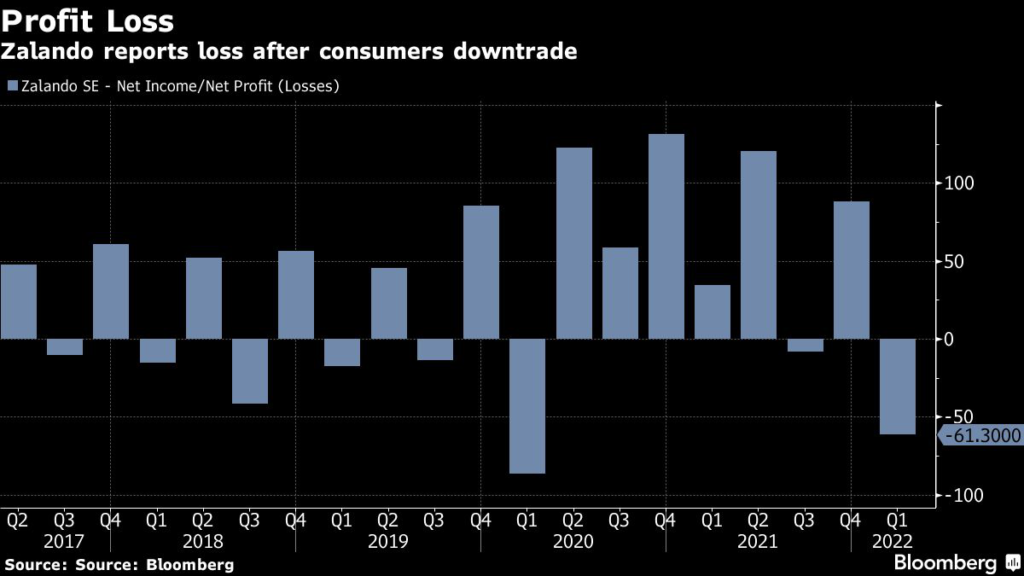
The German company expects revenue and profit will be in the lower part of its 2022 forecast ranges after reporting first-quarter earnings short of analyst expectations on Thursday. The stock, which has lost about half its value this year, fell as much as 5.4%.

Evidence is starting to trickle in that some consumers are struggling to deal with tighter budgets. Asos Plc, a close rival of Zalando, said last month its full-year earnings goal is at risk from accelerating inflation. U.K. clothing retailer Joules warned this week its profit could be hit as customers have become highly dependent on promotions and demand for full-price items has reduced. Heineken NV Chief Executive Officer Dolf van den Brink has pointed to the risk that higher energy bills may lead consumers to pull back on other expenses, such as beer.  

Gross merchandise value, which measures how much inventory the platform has sold, rose only 1%, meaning excess stock is likely weighing on margins.

 “There were good reasons for the overstock: we really wanted to ensure the customer experience, give them the full choice and mitigate those supply chain disruptions,” Chief Financial Officer Sandra Dembeck said on an earnings call.

The company, which sells clothing from brands such as Moschino and The Kooples, had an operating loss of 52 million euros ($55 million) due to discounts and increased fulfillment costs.

The retailer said Thursday it’s adjusting its offering to changing shopping patterns and expanding its logistics network, with fulfillment centers being built in Germany, Poland and France.

More stories like this are available on bloomberg.com

©2022 Bloomberg L.P.

Gucci to Start Accepting Crypto Payments in Some U.S. Stores

(Bloomberg) —

Gucci will accept payments in cryptocurrencies in the U.S. starting this month, as the luxury industry takes tentative steps into the digital-asset universe. 

Customers in some stores in New York, Los Angeles, Miami, Atlanta and Las Vegas will be able to pay using digital tokens from the end of May, the Italian fashion house said in a statement. It will adopt this payment option throughout its North American stores this summer.

Gucci, owned by Kering SA, will initially accept 10 cryptocurrencies including Bitcoin, Bitcoin Cash, Ether, Dogecoin and Shiba Inu.

The company joins fashion designer Philipp Plein, whose online store started accepting crypto payments in 2021. Plein said in an interview in late April that he expects purchases made with digital tokens to surge this year, and that accepting cryptocurrencies had gained his company “a lot of new clients” in the crypto community. 

Kering Chief Executive Officer Francois-Henri Pinault in February said Gucci and other fashion houses like Balenciaga had innovation teams looking at opportunities related to the metaverse and web3 — versions of the internet built around blockchain technology, cryptocurrencies and nonfungible tokens. 

“We’re at a very precocious stage of what may happen, nothing is certain,” Pinault said at the time. The approach taken by Kering and its brands is more “test and learn” than “wait and see,” he said, adding that crypto payments have “very heavy” legal and fiscal implications.

The decision to embrace crypto payments shows how luxury brands are trying to appeal to younger generations of consumers by catering to emerging trends, such as creating outfits for digital characters. But not all luxury groups are convinced. Axel Dumas, the executive chairman of Hermes, warned earlier this year of the risk of “hype” around the metaverse, saying it could be a way to make “easy money.”

Bitcoin and cryptocurrencies started rallying in 2020 and into last year as central banks and governments unleashed unprecedented stimulus into Covid-ravaged economies. That bull market came to an abrupt end in November, as soaring inflation forced central banks to take a more hawkish stance. 

Bitcoin is more than 40% off its peak, and many smaller tokens have suffered even steeper declines. Among notable crypto skeptics are investment legend Warren Buffett and his longtime business partner Charlie Munger, who last week reiterated their disdain for assets like Bitcoin.

Gucci generated more than half of Kering’s revenue in the first quarter of this year. The fashion house has recently been hit by lockdowns in China, where the government has battled to contain a resurgence of Covid-19.

More stories like this are available on bloomberg.com

©2022 Bloomberg L.P.

Costly Beer and Cars? Consumers, and Profits, Fine With That

(Bloomberg) — Consumers seem undaunted by higher prices of everything from luxury cars to beer, letting companies like Anheuser-Busch InBev NV and BMW AG boost profits despite economic threats ranging from inflation to war to China’s Covid flare-up.

AB InBev, the world’s largest brewer, on Thursday reported profit growth that was almost twice as much as analysts expected. BMW AG’s first-quarter earnings rose 12% on strong demand for luxury cars. Revenue at Stellantis NV, formed by the merger of Fiat Chrysler and Peugeot, jumped on the back of strong demand for new high-end models like the Jeep Grand Cherokee.

With costs of many raw materials flaring amid bottlenecks, companies have been testing how much they can raise prices after years of subdued inflation. Russia’s invasion of Ukraine has exacerbated shortages, cutting off supplies of some auto parts and cooking oils, while China’s continuing Covid-zero policy has crimped demand and added to supply-chain woes.

Nestle SA increased prices at the fastest rate in more than a decade during the first quarter, lifting the cost for everything from Nespresso capsules to Purina dog chow to blunt the impact of surging food inflation on its profitability. Procter & Gamble Co. and Danone SA also started the year with price increases of about 5%. 

Like Budweiser owner AB InBev, brewers Heineken NV and Carlsberg A/S have delivered sales growth ahead of analyst estimates, largely driven by price increases. So far, drinkers returning to bars after lockdowns have been undeterred by having to pay more, with costs of brewers’ raw materials such as aluminum and barley soaring.

“Inflation continues to move very fast and is moving above or faster than what the expectation was,” AB InBev Chief Executive Officer Michel Doukeris said by phone. It’s “a little too early” to gauge how resilient demand for beer will be, given most of the brewer’s price increases were implemented late last year, he said.

Home Prices

Even U.K. home builder Barratt Developments Plc said Thursday that it’s been able to lift prices enough to offset higher materials costs.

Carmakers have significantly increased prices after a strong rebound in demand, as a semiconductor shortage has put a lid on vehicle production. With the number of buyers looking for a set of new wheels far outstripping supply, prices have soared for new and used vehicles.

Manufacturers including Volkswagen, BMW and Stellantis have also shifted production to their biggest money-spinners, like Porsche and Audi models. This week, VW Chief Executive Officer Herbert Diess said Europe’s biggest carmaker was sold out of electric cars for the year in its home region and the U.S. because of supply bottlenecks.

At the same time, carmakers are facing a price jump in everything from shipping rates to basic raw materials, a situation that’s set to remain tense as the war in Ukraine roils logistics and component production and China’s zero-Covid policies shutter plants. Passing on those increases as inflation burns through consumers’ wallets will be an uphill battle.

“Car prices still need to rise by 5%-10% and electric cars by more than 10% to compensate for current cost inflation,” Bank of America Corp. analysts including Horst Schneider wrote in a note. “Given the mounting pressure facing consumers, this may prove challenging.”

Some companies have warned of emerging strains. Last week, Unilever Plc forecast full-year revenue growth at the top end of its forecast, though it said profitability may suffer as consumers start to cut back on purchases. The Dove soap maker has covered about two-thirds of the cost increases it’s been facing with price hikes, Chief Financial Officer Graeme Pitkethly said at the time. 

In some corners of the economy, European consumers are already hunting for bargains. They’re buying cheaper clothes as inflation crimps household budgets, according to Zalando SE, the region’s largest online-only fashion retailer. 

(Updates with AB InBev CEO comment in sixth paragraph)

More stories like this are available on bloomberg.com

©2022 Bloomberg L.P.

Marshall Wace Makes Hire to Focus on Blockchain Investments

(Bloomberg) — Marshall Wace is building out a team that invests in private blockchain-related companies, hiring William Benattar for its crossover investment fund, according to people familiar with the matter.

The London-based investment firm manages about $60 billion, mostly in hedge funds that bet on stocks rising or falling. Last July, Bloomberg News reported the firm was raising a new digital finance fund to bet on private companies in areas such as blockchain technology, digital payments and stablecoins.

Hedge funds have increasingly looked to break into digital asset investment as the sector gains traction with institutional investors. Last year, Brevan Howard Asset Management formed a new unit to manage cryptocurrency and digital assets.

Benattar previously led tech investing for U.K. property developer Nick Candy’s family office, according to his LinkedIn page. He started at Marshall Wace this week in its London office, one of the people said, asking for anonymity because the move hadn’t been announced.

Read more: Marshall Wace Joins Hedge Fund Peers Betting on Crypto Boom


More stories like this are available on bloomberg.com

©2022 Bloomberg L.P.

California’s All-Renewable Moment Shows the Future of the Power Grid

(Bloomberg) —

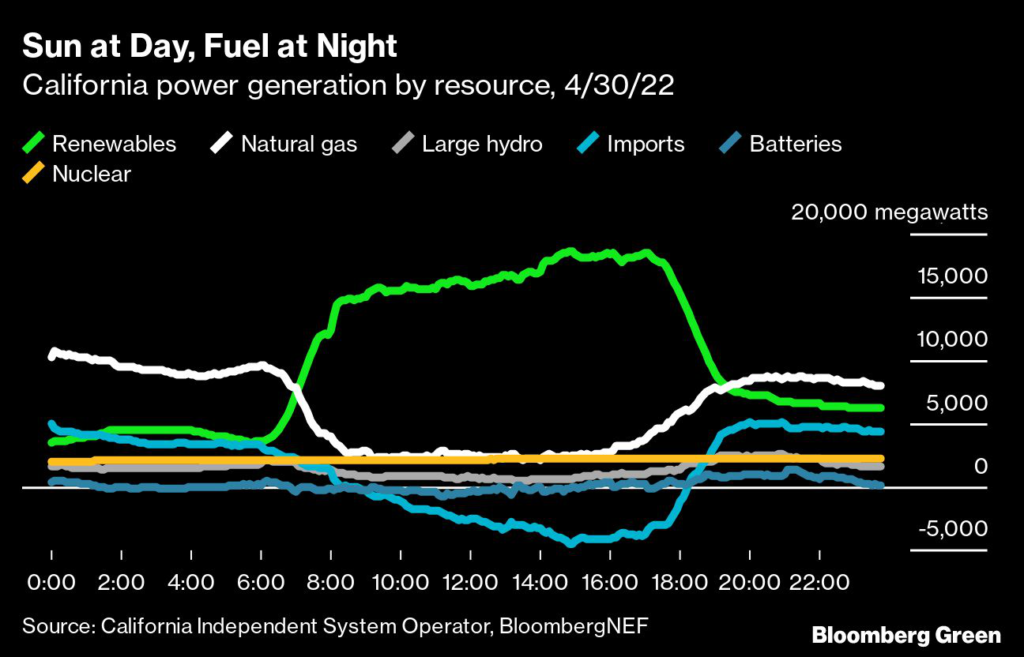
On the last day of April, California hit a milestone: For a brief spell during a sunny Saturday afternoon, renewable sources met 99.87% of electricity demand. Power systems outside the U.S. have reached this target before (Denmark with wind power and South Australia with solar alone last year). But California’s main grid, which serves 80% of the state, is far bigger than those examples. 

Last year, I described South Australia as a glimpse of the power industry’s future. We should think of California the same way but on a much larger scale. Its recent milestone points to a future full of zero-carbon power, with a great deal of variability; there will be new technologies and business models as well as room for further innovation. 

The chart above doesn’t offer a big enough view of this future. There are more than two lines in the state power system, so to speak, and there is more going on than just renewable generation matching grid demand. 

As well as wind and solar, California’s power system draws on natural gas, large hydropower plants, nuclear plants, electricity imported from neighboring states and batteries, which charge and discharge to maintain system stability. All of these technologies work in harmony to ensure the supply of electricity meets demand and that it is as reliable and low-emission as possible.

Now, if we zoom in on just wind, solar and batteries, the interplay among these three resources becomes clear. Batteries charge at night when demand is low and wind power is available; they discharge back to the grid as wind tapers, before solar begins ramping up. Then they charge throughout the sunny midday and discharge again as solar generation quickly falls off. Batteries play an integral role in maintaining grid stability.

However—and this is a big “however”—California’s battery capacity is not enough to absorb every wind and solar electron the state is capable of producing. In the same hour last week that renewables hit 99.87% of demand, more than 2,900 megawatts of solar energy were “curtailed,” meaning that output was deliberately reduced in order to balance the grid. 

Curtailment is not a new function for the state’s grid operator, but it is used more and more frequently. Since 2014, the California Independent System Operator has curtailed more wind and solar power each year than in previous ones, following a seasonal pattern peaking in late spring. March 2022 set an all-time record, with curtailment that one month exceeding all of 2018.

Curtailment is not a problem per se. In one sense it is a sign of a system that is properly functioning. But it is also a missed opportunity, at minimum. The electrons that are being curtailed, which have zero emissions and zero marginal cost, should ideally be flowing to companies and processes that can use them productively. 

Decarbonizing California’s power system will require more batteries to maintain reliability. It will also require more of … everything, really. The state will need to ramp up clean power generation, and perhaps, as governor Gavin Newsom suggests, to keep its nuclear power online for longer. And in the near term, it will require more curtailment. 

Ingenuity and invention are in order. As BloombergNEF highlighted in its latest Pioneers competition, there are technologies emerging for new and improved ways to produce net-zero power, to store energy for a long duration and to bolster the strength of the grid. These include small-scale nuclear reactors, advances in electric-vehicle charging and new software for grid operations. 

Finally, it will require imagination to figure out what to do with excess energy. There are many more options than mining bitcoin—from creating hydrogen to running data centers to powering zero-carbon steel and aluminum production. The future of deeply decarbonized grids will combine technologies designed to generate round-the-clock, zero-emissions power with others that store power for weeks, make the grid run more flexibly, and soak up electrons as available. 

We don’t know all of the technologies that will absorb extra electrons. But we don’t have to yet. That’s the job of inventors, entrepreneurs, and founders who look at tomorrow’s grid and see not just problems to solve, but value to be created. 

Nathaniel Bullard is BloombergNEF’s Chief Content Officer.

More stories like this are available on bloomberg.com

©2022 Bloomberg L.P.

Bill Gates Says Shorting Tesla Isn’t Hurting the Environment

(Bloomberg) — Elon Musk has accused Bill Gates of damaging his environmental credibility by shorting Tesla Inc. stock. The Microsoft Corp. founder says he’s simply diversifying his investments.

Asked by the BBC whether he had bet against the electric-vehicle pioneer, Gates said the move had nothing to do with climate change.

“The popularity of electric cars will lead to more competition for selling those cars,” Gates said in an interview on the BBC Today program. “So there’s a difference between electric cars being adopted, and companies becoming infinitely valuable.”

While both Musk and Gates donate heavily to climate-protection causes, the two have a long history of public spats, with disagreements on issues including the pandemic, electric trucks and cryptocurrencies.

“There’s no need for him to be nice to me,” Gates said of Musk.

More stories like this are available on bloomberg.com

©2022 Bloomberg L.P.
Thiel-Backed Fintech Neo Turns Unicorn With $185 Million Funding

(Bloomberg) — Peter Thiel’s Valar Ventures Management is leading a $185 million funding round for Canada’s Neo Financial Technologies Inc., propelling it to a valuation of more than $1 billion as it plans expansion into mortgages. 

It’s the third time New York-based Valar has led a fundraising for Neo, which offers a no-fee Mastercard, bank accounts and investments primarily through a mobile app. The company says it has gathered more than 1 million customers since it launched in 2019.

“The pace at which this team releases new products and grows its customer base is among the fastest we have seen in our careers,” Valar Founding Partner Andrew McCormack said in a statement. The firm has invested in more than a dozen challenger banks globally, including digital payments provider Wise Plc.

New investors in Neo include San Francisco-based Tribe Capital Partners, Blank Ventures, Gaingels and Knollwood Investment Advisory. Existing investors Maple VC and Altos Ventures also participated in this round. 

Battling Banks

Since its last funding round in September, Neo has nearly doubled in size to 650 employees from 350, with plans to add another 100 this year, and increased the number of retailer partners on its rewards platform to 7,000 from 4,000.

By the end of this year, it plans to enter the mortgage market with loans done through partnerships with financial institutions including Home Trust Co. and First National Financial Corp., two non-bank lenders in Canada. 

“The Canadian market is still entrenched with the big five banks,” Neo Chief Executive Officer Andrew Chau said in an interview. “When we think about challenges, we really see it more as an opportunity to bring new options and competition to the market.”

In April, Neo launched a low-fee wealth management product by partnering with OneVest Management Inc., a Canadian firm that’s registered as a portfolio manager. 

Several Canadian startups in the past two years have become unicorns, the term for new companies reaching a $1 billion valuation, including Freshbooks, Clio, Visier and Clearco.

More stories like this are available on bloomberg.com

©2022 Bloomberg L.P.
China Plans Policies to Rescue Growth, Support Tech Firms

(Bloomberg) — China may soon reveal more policies intended to rescue the economy after top leaders vowed to meet growth targets without compromising on the country’s stringent Covid Zero strategy. 

Actions to promote investment, shore up exports and support technology platform companies are all on the table, state media outlets reported Thursday. The People’s Bank of China also said late Wednesday it would conduct “normalized financial supervision” over online platforms, echoing language used last week by the Communist Party’s Politburo, the top decision-making body. 

The State Administration of Foreign Exchange on Thursday vowed to deepen reform, too, by promoting cross-border financing and investment — both to encourage the flow of more foreign capital into China, and to spur domestic firms to go global. The foreign exchange regulator also pledged in its statement to prevent and resolve any external shocks and risks to safeguard a stable foreign exchange market.

The media reports and government agency statements come days after the Politburo issued its sweeping pledge to support the economy, which is in the throes of the country’s worst coronavirus outbreak since 2020. Authorities deployed strict lockdowns in places like Shanghai and Jilin province to contain infections, measures that have pummeled factory activity and consumer spending, imperiling the government’s growth target of about 5.5% for the year.

Read More: China Lockdowns Wreak Havoc on Economy as Xi Pledges Support

The state media reports don’t contain much detail about specific actions, which are likely to come from various government departments and agencies over coming weeks. However, some of the highlights from the reports include support for technology platform businesses, possible easing of real estate curbs and a boost in fiscal spending.

  • Beijing can’t rule out the possibility of increasing this year’s fiscal deficit to boost infrastructure spending, according to one report in the China Securities Journal citing Wang Qing, an analyst at Golden Credit Rating
  • The government could use special government bonds and policy bank bonds to promote infrastructure projects, or ease more curbs on the property sector to spur demand, the newspaper — which is owned by China’s official Xinhua News Agency — cited analysts as saying
  • In a separate front-page report, the China Securities Journal said the economy may have bottomed out in April and should start to recover this month
  • Authorities are expected to roll out measures to support the technological innovation of internet platform companies, according to a report in the official Economic Daily newspaper
  • Tech platform businesses are key in stabilizing growth and ensuring employment, the newspaper said, reiterating comments made by the Politburo last week that urged for regulation supporting the “healthy” development of the sector. The report also parallels the PBOC’s Wednesday remarks

(Adds statement from the State Administration of Foreign Exchange in paragraph three.)

More stories like this are available on bloomberg.com

©2022 Bloomberg L.P.

Singapore Court Adds Two More Charges to Briton in Wirecard Case

(Bloomberg) — A Singapore court has charged 47-year-old U.K. national James Henry O’Sullivan with two additional counts of allegedly abetting falsification of documents, according to local police. 

O’Sullivan allegedly helped Singaporean businessman R. Shanmugaratnam to falsify documents and issue letters that falsely claimed certain amounts of money were held in a bank under escrow, the Singapore Police Force said Thursday in a statement on its website. 

Wirecard filed for bankruptcy in 2020 after acknowledging that 1.9 billion euros ($2 billion) it had listed as assets probably didn’t exist.

O’Sullivan has also been charged with five counts on similar matters, the statement said. 

On the same day, 58-year-old Thilagaratnam S/O Rajaratnam was also held responsible for allegedly failing to use reasonable diligence in the discharge of the duties of his office by confirming that Strategic Corporate Investments Pte, where he served as director, held the money under escrow in its bank account without checking whether the letter contents were true.


More stories like this are available on bloomberg.com

©2022 Bloomberg L.P.

Close Bitnami banner
Bitnami