
Bloomberg

Traders Face Up to Reality as Nasdaq 100 Profit Forecasts Drop

(Bloomberg) — Tech bulls are grappling with a new reality: breakneck profit growth is no longer something they can count on.

Analysts are becoming more glum on tech earnings as weaker-than-expected results and guidance from the likes of Amazon.com Inc. and Apple Inc., along with a new era of rising interest rates, cast doubt on what has been the market’s most long-standing growth narrative. 

Big tech shares were modestly lower on Tuesday. Apple fell 0.2%, Microsoft lost 0.4%, Alphabet declined 0.2%, and Amazon slid 0.7%. Meta Platforms fell 0.7%. 

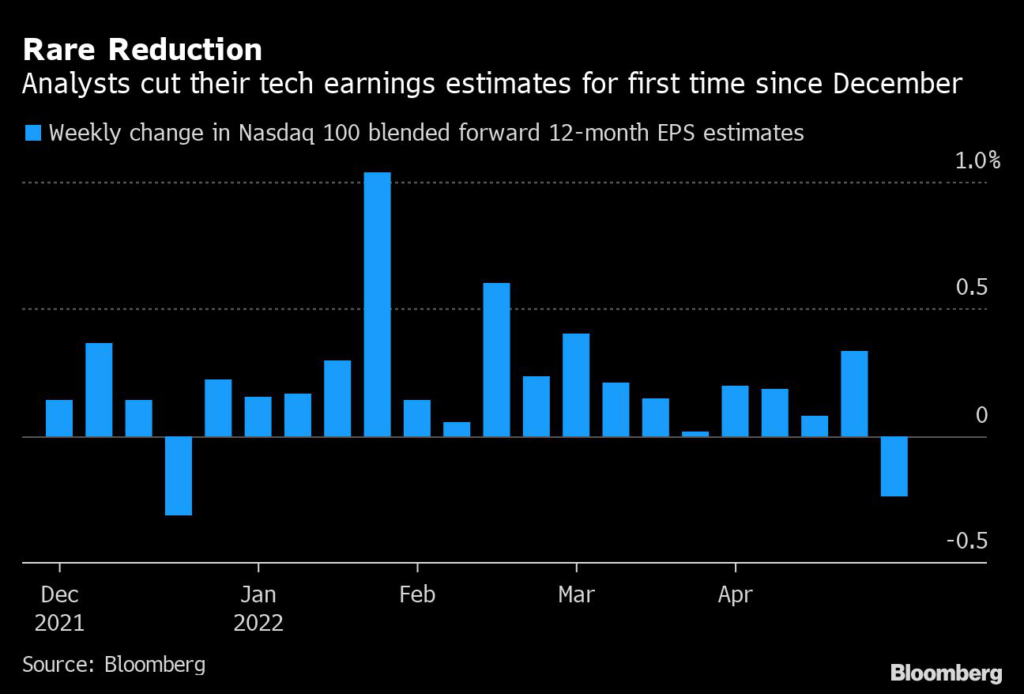
Analyst estimates for 12-month forward earnings-per-share for stocks on the Nasdaq 100 Index fell about 0.2% last week on aggregate. That was the first drop in weekly estimates since December. The same measure for S&P 500 company earnings, meanwhile, rose about 0.1%, according to data compiled by Bloomberg.

Recent quarterly results represent the “end of euphoria” for tech, Savita Subramanian, head of U.S. equity and quantitative strategy at BofA Securities, said in a May 1 report, with the sector’s weakness among the most notable trends of the quarter. 

Numerous factors have been weighing on tech sentiment this year, including fears of an economic slowdown, the impact of surging inflation on consumer demand and — perhaps most crucially — the start of what is expected to be a series of Federal Reserve rate hikes. Fed officials meeting this week are widely expected to deliver a 50 basis-point increase, with higher rates especially negative for tech stocks valued on future growth expectations.

Less-than-stellar results from some of the Nasdaq 100’s biggest companies have also hurt. Last week, Amazon plunged in a historic rout amid slowing e-commerce growth and disappointing forecasts, while shares in Apple also dropped after the iPhone maker warned that supply constraints would hurt sales by billions of dollars. Alphabet Inc. also released first-quarter revenue that fell short of analysts’ expectations.

And analysts aren’t just cutting profit expectations. They’re also lowering their price targets for tech stocks. The Nasdaq 100’s 12-month price target — calculated by aggregating the average targets of its constituents — fell by 2.3% last week, the biggest weekly drop since late 2008. It was also the 10th straight week of declines for that measure, something that hasn’t happened since U.S. stocks tumbled to close out 2018.

“Tech and other growth stocks are facing a double whammy, with earnings growth that’s underwhelming and valuation compression that’s overwhelming,” said Mona Mahajan, senior investment strategist at Edward Jones.

Still, with the Nasdaq 100 already down 20% year-to-date, she remains positive on tech in the longer term.

“We think a large part of the correction has now occurred, and valuations have become more interesting,” she said in a phone interview. “As we look out 12 months, we expect that either economic growth will be slowing, or that inflation will be. In either scenario, tech should be back in favor.”

Tech Chart of the Day

This year’s tech rout means that the Dow Jones Industrial Average is enjoying a rare stretch of outperformance. While the blue-chip gauge is down 9% in 2022, that’s far milder than the 20% retreat seen by the Nasdaq 100. The Dow’s outperformance is due to the fact that it doesn’t include Amazon, Alphabet, Meta Platforms Inc. or Netflix Inc. — which are all down at least 20% this year — among its components.

Its price-weighted structure also limits Apple’s influence on the benchmark. Tech has a 21% weighting in the Dow, while communication services — the sector Alphabet and Meta are classified under — is just 3.2%. Meanwhile, tech is more than 50% of the Nasdaq 100, followed by a nearly 17% weighting for communication services.

Top Tech Stories

  • Alibaba briefly plunged as much as 9.4% in Hong Kong, erasing about $26 billion of market value, after Chinese state broadcaster CCTV reported that authorities in the company’s home base of Hangzhou had imposed curbs on an individual surnamed Ma. Shares erased the majority of the losses after police reports indicated the accused person’s name was spelled differently to Alibaba co-founder Jack Ma
  • Zepto, an instant grocery startup founded by two teenagers, has raised $200 million in a funding round led by Y Combinator, taking its valuation to around $900 million within nine months of beginning 10-minute deliveries in India’s fast-growing quick commerce segment
  • Twitter Inc.’s $44 billion deal to be acquired by Elon Musk means it risks losing advertisers and employees, who may be concerned about the company’s uncertain future, the company said in a regulatory filing Monday
  • Amazon workers at a facility in New York voted not to join an upstart union only weeks after the group won a resounding victory at a warehouse across the street

(Adds Tuesday trading in third paragraph.)

More stories like this are available on bloomberg.com

©2022 Bloomberg L.P.
Roku Moves Into Food TV With Help From Martha Stewart, Emeril

(Bloomberg) — Martha Stewart and Emeril Lagasse, two icons of cable TV, are taking the leap to the internet with the Roku Channel.

Roku Inc., which owns the network, has licensed the rights to reruns of shows hosted by Lagasse, Stewart and chef Christopher Kimball—more than 3,000 episodes in all—and is commissioning new projects as well. Stewart will host three programs, company executives said in interviews, including one in which she gardens at her 153-acre farm, while Lagasse will host a couple, including one dedicated to food at tailgate parties.

Roku, best known for making set-top boxes and devices people use to stream Netflix and YouTube, ordered the food shows as part of a larger slate of original programming that it will unveil Tuesday at a presentation for advertisers in New York. The company plans to make at least 25 original programs over the next year, spanning reality TV, scripted series and movies. 

“In fairly short order, it’s going to be a Roku original almost every week,” said David Eilenberg, the head of original programming for Roku.

Roku makes most of its money by selling subscriptions and advertising for streaming services on its platform. The company is starting to make shows that compete for attention and advertising dollars with those same services. Management believes these series will create additional, lucrative advertising inventory and help validate the quality of Roku’s programming in the eyes of marketers.

Advertising sales for connected TV—online video watched on television sets—are expected to eclipse $20 billion this year. It’s been one of the fastest-growing categories as more viewers shift to the web from cable or satellite service.

Roku needs Wall Street to believe it can sustain its sales growth and differentiate itself from competitors. Shares of the company have plummeted 55%  this year, erasing two years of gains. Once worth more than $60 billion, the company is now valued at around $14 billion. Investors have grown skeptical about the economics of video streaming, and worry about Roku’s ability to compete in hardware and advertising with technology giants like Amazon.com Inc. and Google parent Alphabet Inc., among others.

“People buy Roku as a play on streaming growth,” said Michael Morris, an analyst with Guggenheim Securities, and both usage and sales growth have slowed. The reopening of the economy after the pandemic shutdown has affected all at-home entertainment, while supply chain bottlenecks have limited the sale of Roku devices and spending by advertisers.

“The street collectively may have overestimated the sustainability of the strength of 2021 in streaming and digital advertising,” Morris said.

Based in San Jose, California, Roku is following a playbook used by others in Silicon Valley. Several consumer technology companies have expanded into film and television—first by distributing other companies’ programming and then experimenting with making their own shows. Some, like Yahoo and Microsoft, recoiled at the cost and canceled their plans after brief flirtations. Others, such as Netflix and Amazon, now rank among the biggest entertainment studios in the world.

Roku already has a large captive audience. More than 60 million people have set up accounts on its devices and software, and the company says the Roku Channel is one of the five most-watched on its platform.

“It’s a really strong, healthy, fast-growing business,” said Alison Levin, Roku’s vice president of advertising sales and strategy. “The missing piece was always exclusive content.”

Management aims to avoid the mistakes of some of its predecessors by starting small. Roku acquired rights to “This Old House,” producer of the popular PBS program, and a slate of shows abandoned by the defunct streaming service Quibi. Neither deal broke the bank. Original programming constitutes a tiny part of Roku’s business, said Rob Holmes, the company’s vice president of programming.

Yet as its original series have drawn in more viewers, the company has started to write larger checks, including a deal to license movies from Lions Gate Entertainment Corp., the studio behind the “John Wick” franchise. Earlier this year, Roku hired Eilenberg, a TV producer with a deep history in unscripted programming who worked for Mark Burnett on “The Voice” and “Shark Tank,” and later for British broadcaster ITV’s U.S. division.

Eilenberg will devote the majority of his slate to unscripted programming like food shows, which are less expensive and lend themselves to advertising integrations. He also plans to fund scripted fare, such as “Weird: The Al Yankovic Story,” a film starring Daniel Radcliffe and “Weird Al” Yankovic.

Roku is earmarking as much as cable networks have in the past, devoting hundreds of thousands of dollars to episodes of unscripted TV and planning to spend in the low seven figures for scripted projects. The company declined to discuss its budget.

The owner of the Lagasse and Stewart shows, Marquee Brands was initially looking only to license old episodes of shows that were mainstays of cable TV in the 1990s and 2000s and remain relevant today. The company envisioned selling new shows in a separate deal. But Roku mentioned packaging the two, allowing fans to toggle between the catalog and the newer episodes. Lagasse’s tailgating show will debut around the start of the National Football League season in September, followed not long after by cooking shows from both Stewart and Lagasse.

“We’ll do 39 shows a year with Emeril,” said Christian Martin, president of Marquee Media. “You can only cook so many things in 39 shows. But if you marry that with 1,200 episodes of previous Emeril cooking shows, you can find just about anything you need or want.”

More stories like this are available on bloomberg.com

©2022 Bloomberg L.P.

Sila to Make Advanced Battery Materials in Washington State

(Bloomberg) — Sila, one of a wave of young companies trying to pack more power into batteries, will open its first stand-alone factory in a small city in central Washington state, as the U.S. tries to build up its own energy-storage supply chain and expand the production of electric vehicles.

Sila has purchased a facility in Moses Lake to make its silicon-based anode material, which the company says can boost the energy density of lithium-ion batteries by 20%. While not releasing full financial details, Chief Executive Officer Gene Berdichevsky said buying and equipping the building for the first phase of production will cost “$100-plus million,” with full operation expected in the first half of 2025. Until now Sila has made its material, which can replace graphite in battery anodes, at its headquarters in the San Francisco Bay Area.

President Joe Biden has made ramping up U.S. battery manufacturing a pillar of his efforts to fight climate change, and battery makers are planning plants across the country. Berdichevsky said Sila isn’t receiving any federal help for the new factory’s initial phase of production, projected to make enough anode material for 100,000 to 500,000 electric cars per year, depending on whether the substance completely or partially replaces the graphite in their batteries. The company has announced partnerships with Bayerische Motoren Werke AG (BMW) and Mercedes-Benz Group AG.

But the facility could be expanded to supply as many as 10 million cars per year, and Sila may seek federal funding for expansion, Berdichevsky said. As the global battery industry booms, more of it can and should be based in the U.S., he said.

“You  either get behind it,” Berdichevsky said, “or you get left behind.”

More stories like this are available on bloomberg.com

©2022 Bloomberg L.P.

Coinbase Is on Other Side of Goldman’s First Bitcoin-Backed Loan

(Bloomberg) — Goldman Sachs Group Inc.’s first ever lending facility backed by Bitcoin is the latest effort by crypto exchange Coinbase Global Inc. to bring money from the Wall Street to the digital-asset space.

“Coinbase’s work with Goldman is a first step in the recognition of crypto as collateral which deepens the bridge between the fiat and crypto economies,“ Brett Tejpaul, head of Coinbase Institutional, said in an email response. Coinbase did not provide further details about the loan. A spokeswoman from Goldman Sachs said last week the loan was collateralized by Bitcoin owned by the previously undisclosed borrower.

Bitcoin-backed loans are not new in the digital-currency sector, though for Wall Street they are novel. Some “crypto-native” lenders such as Babel Finance even allow Bitcoin mining firms to put up their machines as loan collateral to borrow cash. 

Such borrowers usually post Bitcoin at loan-to-value in the 40% to 60% range, according to Matthew Ballensweig, managing director and co-head of trading and lending at crypto prime brokerage Genesis. The collateral is held by a qualified custodian, and borrowers receive U.S. dollars from the lender at an agreed-upon interest rate.

“Tenors can vary as well as other prepayment terms, but it’s a simple structure to bring institutional lenders into the market,” Ballensweig said.

As of the end of last year, Coinbase held more than $566 million of cryptocurrencies including more than $183 million worth of Bitcoin, according to its 2021 annual report. At the same time, the firm reported it had cash and cash equivalents of $7.1 billion, exclusive of restricted cash and customer custodial funds.

Genesis’s Ballensweig said that his firm has already structured similar loans with crypto-friendly banks such as Silvergate Bank and Signature Bank. “We are exploring similar structures with large investment banks that want exposure to the space,” he added.

“These types of bilateral agreements are rarely done in a vacuum,” according to a report Monday from crypto hedge fund Arca. “It is far more likely that Goldman is seeing a lot of demand for this type of transaction and is just testing the waters before making a bigger splash.”

Goldman told Bloomberg previously that the deal was interesting to the bank because of its structure and 24-hour risk management. The bank also traded its first over-the-counter Bitcoin options in March. Other Wall Street banks like Jefferies Financial Group Inc. have also started experimenting with crypto-related products and services.

More stories like this are available on bloomberg.com

©2022 Bloomberg L.P.

Paul Tudor Jones Says Investors Are in Tough Spot With Fed in New Era

(Bloomberg) — The Federal Reserve is in uncharted territory and investors are facing a period not seen since the 1970s, according to Paul Tudor Jones.

“This is a most challenging period ahead for the Fed in its history,” Tudor Jones, who runs the $12 billion Tudor Investment Corp., said in an interview Tuesday on CNBC. “You can’t think of a worse environment than where we are right now for financial assets,” he added. “Clearly you don’t want to own bonds and stocks.”

The central bank is dealing with dueling forces of inflation and slowing growth and interest rates are likely to reach 2.5% by September, the hedge fund manager said.

Tudor Jones said he’s not sure investors can make money in the current environment and that capital preservation may be the best course.

“There is huge volatility straight ahead,” he said, adding that “inflation is much harder to tame than we think.”

Other comments:

  • He reiterated that he has a “modest allocation” to Bitcoin
  • He’s “constructive” on commodities and oil

More stories like this are available on bloomberg.com

©2022 Bloomberg L.P.
Wall Street Regulators Consider ‘Staggering’ Curbs on Complex ETFs

(Bloomberg) — Wall Street watchdogs and issuers of “complex” exchange-traded products are headed for a showdown as regulators weigh tough and far-reaching rules to curb retail investor access. 

Market players are up in arms after the Financial Industry Regulatory Authority called for comments last month on whether strict measures should be introduced to raise the barriers to such products. Depending how Finra chooses to define the term, the crackdown could hit everything from leveraged and inverse vehicles to cryptocurrency-linked funds and defined-outcome strategies.

Enhanced disclosures, a “knowledge check” for retail customers and a requirement to seek Finra approval for the advertising of complex products are among the restrictions up for discussion, as well as controls on push notifications on digital devices and heightened supervision of investment recommendations.

“The restrictions on individual investors that Finra is considering are staggering and unprecedented,” ProShares Advisors, a leading issuer of inverse and leveraged ETFs, said in a statement to Bloomberg News. “For the first time ever, individual investors could be prevented or deterred from buying everything from target-date funds to closed-end funds, to all public funds that use futures contracts or are related to cryptocurrency.”

The consultation, which runs to May 9, comes as trading volumes in leveraged and inverse products surge, with retail investors thought to be behind the boom. Finra has already received hundreds of published responses, many of which oppose new measures.

“It will make our job more difficult,” said Bruce Bond, chief executive officer at Innovator, which manages $6.8 billion across a lineup of primarily defined-outcome ETFs. “Whenever you single out a certain group of products, especially when you call them complex, it scares people.”

Current regulations were adopted at a time when most individuals accessed markets through financial professionals. Now Finra is looking at whether the existing market regime adequately protects a new breed of “self-directed” retail investors, trading commission-free via apps like Robinhood.

A spokesperson for the regulator said it welcomed the responses and pointed out that the consultation contained no firm proposals. 

“It is a broad solicitation of comments,” the spokesperson said. “We will evaluate the feedback we receive to determine what changes, if any, should be proposed.”

Broader Scope

Finra isn’t alone in worrying about complex ETPs or the state of current rules. 

The global association for regulators, the International Organization of Securities Commissions, also kicked off a consultation last month on updating the ETF principles and good practices it published in 2013. The proposed changes include encouraging watchdogs to consider the “appropriateness and adequacy” of disclosures made by products using complex strategies.

Meanwhile, the U.S. Securities and Exchange Commission in October said it is considering tightening the rules around leveraged and inverse ETPs. The regulator made the announcement after approving new ETFs that revived and revamped two infamous volatility-linked products that exited Wall Street in controversy.

Read more: Two Leveraged VIX Funds Are Back on Wall Street Amid SEC Warning

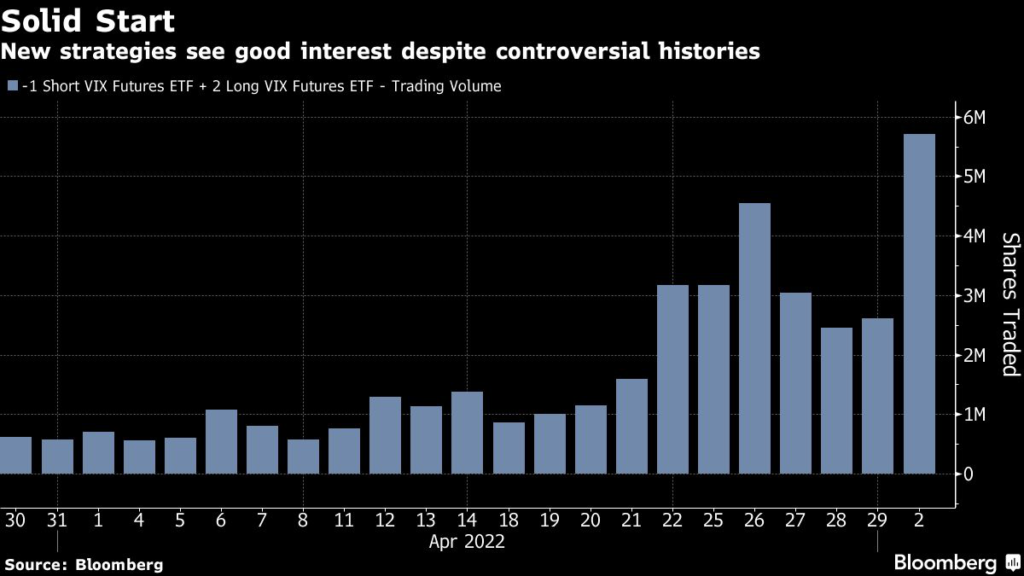
The 1x Short VIX Futures ETF (ticker SVIX) and 2x Long VIX Futures ETF (UVIX) have since made successful, if subdued, launches. The pair have attracted a combined $40 million after debuting just over a month ago, while trading volumes are steadily rising.

That’s part of a broader pattern where activity in leveraged and inverse U.S. ETPs has hit or approached records amid this year’s market turbulence. Trading volumes for inverse products rose to a new all-time high as recently as Wednesday, with retail investors thought to be a key driver. Leveraged vehicles had their second-busiest day in January.

But the consultation by Finra — a private, self-regulatory body for brokerages and exchanges — goes beyond such vehicles.

The agency also pointed to the growth in defined-outcome ETFs as a concern. These so-called buffer ETFs shield holders against a certain percentage of declines in exchange for a cap on gains. They boast nearly $10 billion in assets after the first such products launched in 2018, Finra said.

‘Skeptical’

While the scope of what’s considered complex is worrisome, Finra’s notice does raise some valid points, according to VanEck CEO Jan Van Eck. The potential for leveraged and inverse funds to go haywire has kept his firm from launching such products, he said, while the interaction of social media and trading is a trend worth discussing. 

However, he warns it’s unlikely that Finra will be able to accurately assess an individual’s knowledge level.

“My main philosophical objection to the Finra proposal is the concept that individual investors are somehow less sophisticated and need protection from themselves,” said Van Eck, whose firm launched a Bitcoin derivatives ETF in November. “I am skeptical that regulations can differentiate between investors’ knowledge level.”

Requiring knowledge checks and other assessments for self-directed investors would be a departure from the U.S. regulatory status quo, which is a disclosure-based system. 

“Generally speaking, educated investors are our best customers, regardless of the platforms they use to access our products,” said Dave Mazza, head of product at Direxion, which specializes in leveraged and inverse ETFs. “Rather than limiting investor choice, we believe that investor education, transparency and risk disclosure should be the industry’s primary focus.”

More stories like this are available on bloomberg.com

©2022 Bloomberg L.P.
Mercedes, BMW Go Back to Basics With Retreat From Urban Rentals

(Bloomberg) — Mercedes-Benz AG and BMW AG pioneered a service that allowed city-dwellers to rent a car by the minute, but after more than a decade of struggling to make money, they’re returning to their roots.

Germany’s luxury-car makers started out as competitors in offering free-floating car-sharing before merging their ventures into Share Now in 2019 to cut costs. On Tuesday, they announced the sale of the unit to Stellantis NV — the maker of Chrysler, Fiat and Peugeot cars — for an undisclosed sum. 

The deal closes the chapter on a bold initiative to offer urban consumers an alternative to car ownership by renting them for cents a minute. The vehicles were booked over a smartphone app and then could be returned anywhere in the service’s geofenced business area.

While car-sharing has proven successful with consumers — Share Now boasts 3.4 million customers in 16 European cities — it didn’t become a feeder for sales in the way the manufacturers had hoped. Those prospects aren’t getting any easier. Initiatives in cities like London, Singapore and Paris to reduce congestion and curb harmful emissions are undermining urban car ownership.

The move shows the strain on BMW and Mercedes as they battle with supply-chain disruptions and the costs of competing with Tesla Inc. in upscale electric cars. The two German manufacturers will notably maintain their joint electric-charging unit and said the Charge Now venture is planning additional partnerships.

The luxury-car makers, which are gradually transitioning away from combustion engines, will focus more squarely on their traditional business of selling pricey vehicles like the $85,000 BMW 8-Series and $111,000 Mercedes S-Class to wealthy consumers. They’re both pushing new battery-powered flagship models — for Mercedes, it’s the EQS and for BMW, the i7.

A business that collected tens of euros per transaction wasn’t an easy fit for BMW and Mercedes. And then there was the struggle to make money in an asset-heavy sector that required significant local resources to maintain and service the fleets.

Juergen Pieper, an analyst at Bankhaus Metzler, estimates that Share Now lost around 200 million euros ($210 million) annually and that the unit was likely sold for around 250 million euros. 

Despite the challenges, the business may be more critical for mass-market carmakers like Stellantis, which face greater risk of urban consumers switching to mobility services, according to Tom Narayan, an analyst at RBC Capital Markets. 

Stellantis will merge Share Now into its Free2Move mobility unit. Volkswagen AG is also active in car-sharing with its WeShare service, which offers short-term rentals of its electric models. 

Companies like Alphabet Inc.’s Waymo are pouring billions into developing autonomous-driving technology, and driverless vehicles already ply certain established routes. The technology could one day provide another alternative to private cars. 

Stellantis clearly sees Free2Move’s mobility offerings, which including parking services alongside ride- and car-sharing, as a way of future-proofing its business. The purchase adds 10,000 vehicles to its fleet of 2,500. 

“We want to be able to have all the solutions in all the cities around the world,” said Brigitte Courtehoux, the unit’s chief.

More stories like this are available on bloomberg.com

©2022 Bloomberg L.P.
Uruguay’s DLocal Seeks Deals as Cash Pile Grows, Valuations Drop

(Bloomberg) — Uruguayan payment services company DLocal Ltd. plans to use part of its growing pile of cash to accelerate expansion in developing nations through acquisitions. 

The company, which tripled its cash hoard last year to $336 million as of December, is targeting Africa and Asia for potential acquisitions. 

“We continue to explore the M&A market on a weekly basis,” Chief Executive Officer Sebastian Kanovich said in an interview from the company’s office in Tel Aviv. “We have enough cash on balance and also enough access to capital to fund these acquisitions.”

DLocal, which listed shares in New York last year, helps more than 400 companies including Microsoft Corp. and Shopify Inc. make and receive payments in 35 developing countries. DLocal had largely stayed away from purchasing other companies, with the exception of last year’s $40 million acquisition of payment services provider Primeiropay, as it prioritized building its business from scratch.


Now, the company is eyeing acquisitions that would give it access to new clients, products or licenses, Chief Operating Officer Sumita Pandit said. Potential deals are getting cheaper as the drop in technology stocks spills over into private-equity markets, where just months ago companies were selling for “crazy” valuations, she said.

“These won’t be billion-dollar deals. We are going to be very disciplined about what we acquire,” said Pandit, who said a deal could come as soon as this year. 

Read More: Uruguay Gets Its First Billionaires With U.S. Fintech IPO

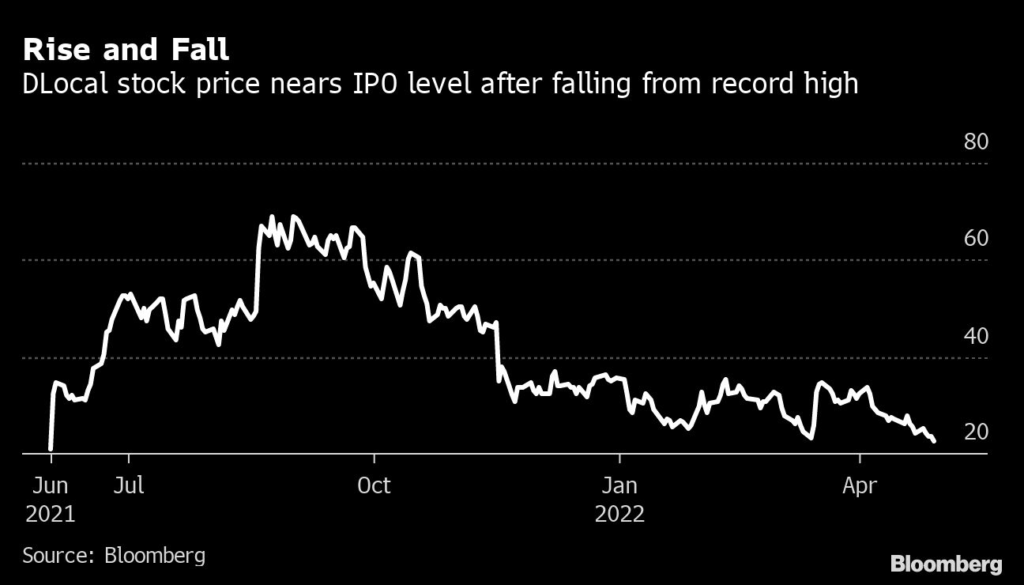
DLocal shares have tumbled almost 40% this year alongside the wider rout for tech companies. At $23 on Monday, the stock trades barely above its IPO price of $21 with a market capitalization of $6.7 billion. Shares reached as high as $73 in September, valuing the firm at more than $21 billion.

The stock price “really is not a function of what I think is our intrinsic value, it’s a function of what else is available in the market that is extremely, extremely cheap,” Pandit said. 

Other key points from the interview:

  • DLocal’s priority this year is growing in its current markets though Kanovich expects to enter new countries depending on the needs of clients.
    • “We are excited about Latin America, Africa, Southeast Asia, India. Those are the markets where we think we can add the most value.”
  • DLocal is exploring how to provide payment services to cryptocurrency exchanges, Kanovich said
    • ”We are trying to build partnerships for the next 10 years. We want to make sure we are choosing the right players to work with.”

More stories like this are available on bloomberg.com

©2022 Bloomberg L.P.

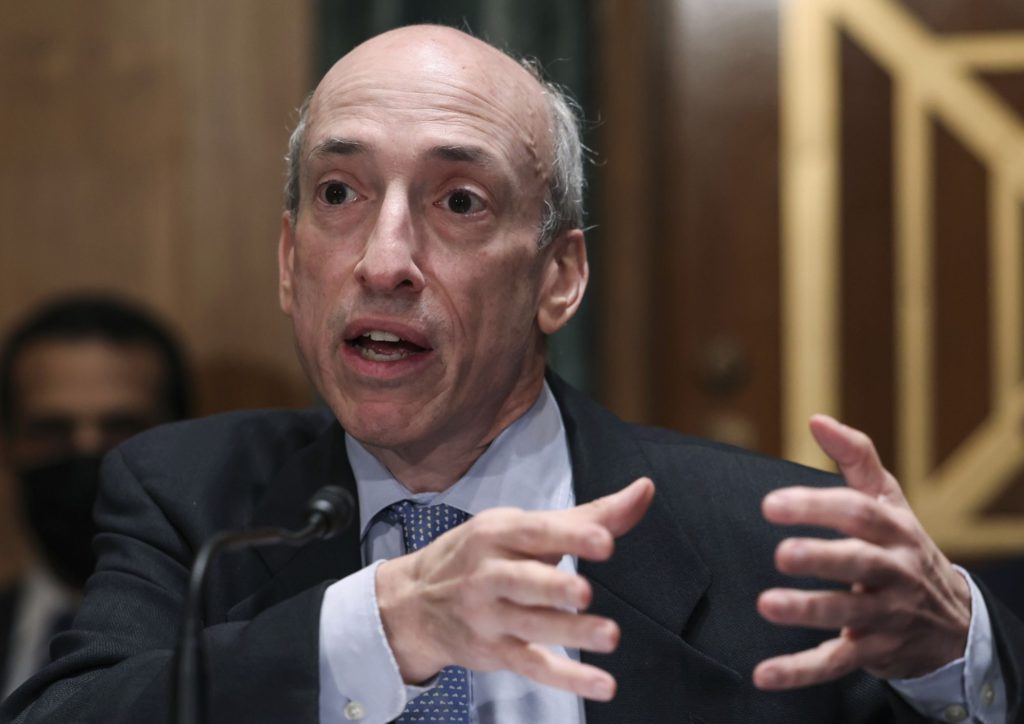
SEC Crypto Team Getting 20 More Officials in Bid to Crack Down

(Bloomberg) —

The U.S. Securities and Exchange Commission is adding 20 more officials to a team dedicated to policing crypto markets, the latest move by Wall Street’s main regulator to crack down on digital tokens that may run afoul of its rules.

The additions will bring the SEC’s Crypto Assets and Cyber Unit to 50 people, the agency said Tuesday in a statement. The focus of the expanded enforcement group will include virtual-currency offerings, decentralized finance and trading platforms, as well as stablecoins, according to the regulator. 

Over the past year, the SEC has moved aggressively to expand oversight of digital-assets with Chair Gary Gensler frequently saying he considers many of them to be securities and subject to his agency’s rules. The regulator has launched probes into marketplaces offering certain types of nonfungible tokens, or NFTs, and companies behind crypto-lending products.

Read More: SEC Scrutinizes NFT Market Over Illegal Crypto Token Offerings

“By nearly doubling the size of this key unit, the SEC will be better equipped to police wrongdoing in the crypto markets while continuing to identify disclosure and controls issues with respect to cybersecurity,” Gensler said in the statement.

The SEC team, which was previously known as the Cyber Unit, has brought more than 80 enforcement actions since its inception in 2017, the agency said. 

More stories like this are available on bloomberg.com

©2022 Bloomberg L.P.

Sweden’s Polarium Rides Battery Boom to Reach Unicorn Valuation

(Bloomberg) — The latest unicorn to emerge from Sweden’s booming battery industry is an energy-storage developer that counts major telecommunications firms such as Vodafone Group Plc and Verizon Communications Inc among its client roster.

The valuation of just over $1 billion for Polarium Energy Solutions AB follows a 10% stake sale in the company to Swedish pension fund AMF, which occurred alongside its latest funding round.

AMF, one of the country’s biggest pension funds, has invested 955 million kronor ($96.6 million) in Stockholm-based Polarium, it said Tuesday. The funds will help go into development as the company, founded in 2015, prepares for an initial public offering.

Polarium should be ready for a stock market listing this year and will take a decision “whenever such a move might be right for the company,” Chief Executive Officer and Founder Stefan Jansson said in an interview. No decision has yet been made, he said. 

The company provides back-up lithium-ion power solutions to telecom and commercial sectors, helping them to reduce their reliance on diesel generators to reduce emissions. Vargas Holding, backed by Northvolt AB Chairman Carl-Erik Lagercrantz and private equity veteran Harald Mix, remains the largest owner in the company. 

The duo have also initiated H2 Green Steel, a green steel startup building a plant for fossil-free steel production in Sweden’s north.  

“It was in fact at a board meeting at Polarium that the idea of Northvolt was born,” Jansson said. 

Polarium has about 700 employees globally and generated revenues of 1.1 billion kronor last year with earnings before interest, tax and amortization of 83 million kronor. Revenues are expected to double this year, Jansson said. 

Last week Polarium opened its third lithium-ion battery assembly plant in Cape Town, South Africa. Other facilities are located in Mexico and Vietnam.

JPMorgan AG acted as sole placement agent to Polarium.

More stories like this are available on bloomberg.com

©2022 Bloomberg L.P.

Close Bitnami banner
Bitnami