

Bloomberg

Army’s $22 Billion Spending Estimate for Microsoft Goggles Risks a 50% Cut

(Bloomberg) — The U.S. Army’s initial estimate that it may spend nearly $22 billion over the next decade on high-tech combat goggles and related services from Microsoft Corp. may be double what the service really expects. 

Pushing back on criticism in a report Friday from the Pentagon’s inspector general that the contract “could result in wasting up to $21.9 billion in taxpayers funds to field a system that soldiers may not want to use or use as intended,” the Army said the estimate was a worst-case scenario and a ceiling for what the service would expect to spend. 

“Less than half of this total is possible for the U.S. Army,” according to the rebuttal by Army Assistant Secretary for Acquisition Douglas Bush. The $21.9 billion figure that has been seen by some investors and analysts as possible revenue for Microsoft represents “a contract ceiling that includes all possible hardware, components, and services over a 10-year period at the worst possible pricing structure,” it continued. 

The full estimate includes “all possible sales to sister services, Foreign Military Sales and all maximized service contracts,” according to Bush’s response.  

Microsoft’s Integrated Visual Augmentation System, or IVAS, is expected to provide a “heads-up display” for U.S. ground forces, similar to those for fighter pilots. The system — a customized version of Microsoft’s HoloLens goggles — would let commanders project information onto a visor in front of a soldier’s face and would include other features such as night vision.

Microsoft $22 Billion Army Goggles Still Aren’t Combat-Ready

But the system has already faced delays and other hurdles. Despite progress since the initial development contracts Bloomberg News reported in January that the system “has not yet demonstrated the capability to serve as a fighting goggle,” according to an assessment by the Pentagon’s director of operational testing that was sent to the Army for review. 

The Army announced in October a delay in fielding the program to allow more time to prepare for the intense combat testing needed for full-rate production and initial fielding. The test, previously scheduled for last September, was tentatively re-scheduled for between May 23 and June 25 and will result in a “Rapid Fielding Report” from the Pentagon testing office. 

Bush will evaluate the report to determine whether the goggles should be fielded and go into full production. 

An official at Redmond, Washington-based Microsoft said via email that the company continues to develop IVAS as a “transformational platform” that will enhance soldier safety and effectiveness, without addressing the potential contract size. 

Redacted Audit

On Friday, the inspector general’s heavily-redacted audit concluded that the Army made mistakes in the program’s initial stages in not clearly delineating minimum performance standards the devices must meet during soldier acceptance tests. 

The audit stressed — as the service has — the importance of soldier feedback and acceptance during a series of five increasingly complex “Capability Set” exercises. “However, program officials did not define clear measures of user acceptance to determine whether IVAS would meet user needs.”

Bush, in his rebuttal, also disagreed with the overall thrust of the inspector general’s report. He said the watchdog’s conclusion about potential wasted taxpayer dollars was “fundamentally flawed and inflammatory and must be removed or rewritten” because “it is a biased word, intended to illicit an emotional response.”

The report retained the phrase but censored as “Controlled Unclassified Information,” or CUI, large chunks of the report, including the conclusions section.  The redactions and CUI markings usually come at the recommendation of the individual services or the department.

More stories like this are available on bloomberg.com

©2022 Bloomberg L.P.
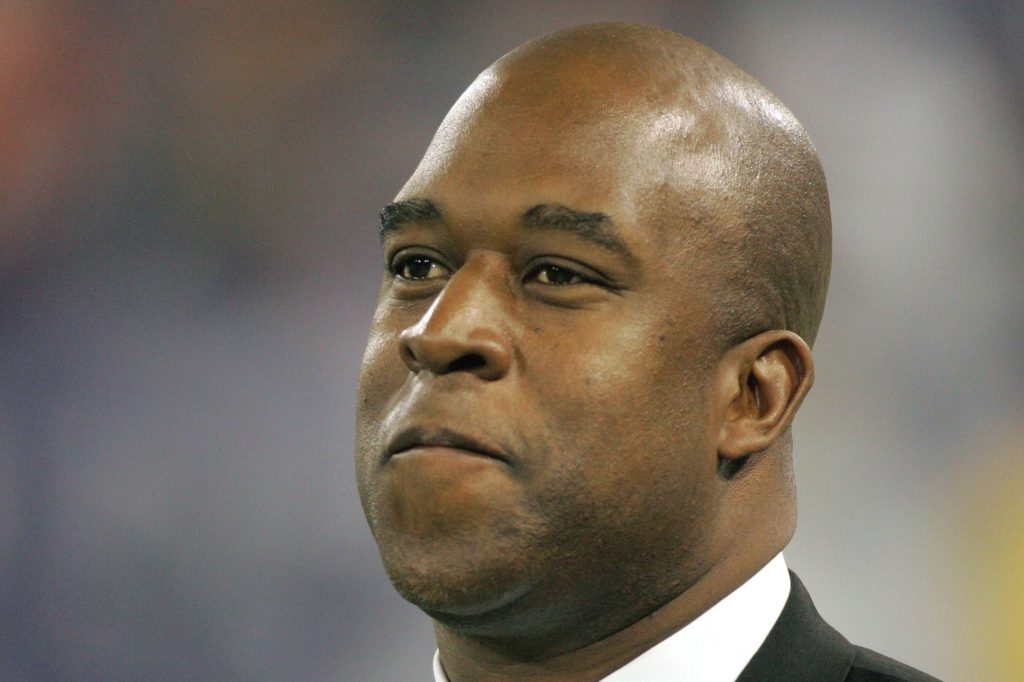
Former NFL Investor Fowler Will Plead Guilty to Fraud in Crypto Case

(Bloomberg) — A former investor in the National Football League’s Minnesota Vikings will plead guilty to fraud over an unlicensed banking operation for cryptocurrency traders, his lawyer told a federal judge.

Reginald Fowler will enter an “open plea,” meaning he will plead without having reached a sentencing agreement with prosecutors, attorney Edward Sapone told the court in a filing late Thursday in federal court in Manhattan. He will plead guilty to wire fraud and conspiracy to commit bank fraud and operate an unlicensed money-transmitting business.

“Every case must be evaluated individually,” Sapone said in an email. “There is a freedom attached to this anticipated open plea that will empower us to tell Reggie’s unique truth in a way that otherwise would be handcuffed by a traditional plea agreement.”

Fowler had rejected a deal with prosecutors that would have allowed him to plead guilty to a single count. Under that agreement, the government had required him to give up as much as $371 million held in more than 50 accounts.

Read More: Ex-Vikings Investor Rejects Plea Deal in Cryptocurrency Case

Prosecutors alleged in a February 2020 indictment that the Arizona businessman told banks he was opening accounts for real estate transactions, when he knew they would be used to move funds for cryptocurrency exchanges. The arrangement shunted hundreds of millions of dollars through the U.S. financial system and allowed the exchanges to avoid money-laundering safeguards that apply to licensed financial institutions, according to the government.

Fowler was also charged with defrauding people associated with a professional sports league by trying to buy a stake in the league using illegally obtained funds. Though prosecutors didn’t identify the league, the timing and details matched up with Fowler’s reported investment in the Alliance of American Football, an upstart rival to the NFL that shut down in April 2019 after only eight weeks of play.

Fowler tried to buy the Vikings for $600 million in 2005 but settled for minority ownership when he couldn’t come up with the cash. His involvement with the team ended in 2014.

The case is U.S. v. Fowler, 19-cr-254, U.S. District Court, Southern District of New York (Manhattan).

Read More: Former NFL Investor Fowler Faces New Fraud Charge in Crypto Case

More stories like this are available on bloomberg.com

©2022 Bloomberg L.P.

U.K. Criticizes Challenger Banks Over Financial Crime Checks

(Bloomberg) —

The U.K.’s markets regulator has told challenger banks to improve their financial crime controls, saying some are failing to carry out adequate checks on new customers.

The Financial Conduct Authority said Friday that a review conducted last year had showed suspicious activity reports filed by the banks had risen, raising concern about the adequacy of checks that they carry out when taking on new customers. It said some failed to adequately check even basic details such as the occupations and income of customers.

The review focused on relatively new challenger banks with quick and easy application processes. This included six challenger retail banks, which primarily consist of digital banks and covering over 8 million customers. 

“The control weaknesses found by the FCA in its review of challenger banks increase the risk that these banks will be targeted by professional money launderers,” said Howard Cooper, managing director in Kroll’s Forensic Investigations and Intelligence practice. “These weaknesses must be overcome.”

The FCA didn’t name the firms it had reviewed but Starling Bank Ltd. said it was one of the firms reviewed. 

“Starling has been extremely vocal in raising awareness on these matters and in January this year announced that it would no longer be advertising on Meta platforms,” a spokesperson for the company said. “We hope that the government will ensure enforcement is prioritized and that regulators are properly funded to discharge their duties.”

The firms where material issues were identified have established remedial programmes to address the FCA’s concerns, the regulator said. The changes may result in higher rejection rates of new customers and may also result in the termination of existing banking relationships with customers.

“There cannot be a trade-off between quick and easy account opening and robust financial crime controls,” said Sarah Pritchard, executive director of markets at the regulator. “Challenger banks should consider the findings of this review and continue enhancing their own financial crime systems to prevent harm.”

(Adds comment from Kroll in fourth paragraph.)

More stories like this are available on bloomberg.com

©2022 Bloomberg L.P.

Houston Gets the Green Light for Nation’s Largest Urban Solar Farm

(Bloomberg) — The city of Houston has received approval to move forward with plans to convert a former landfill into a 50-megawatt solar farm.

Mayor Sylvester Turner made the announcement Friday, saying the Texas Commission on Environmental Quality OK’d the city’s proposal to build a solar array in Sunnyside, a historically black neighborhood in southeast Houston. The farm, which will generate enough energy to power 5,000 to 10,000 homes, will be the largest urban solar project in the U.S., according to Turner.

“In Houston, we have re-imagined this space with an environmental-justice lens,” Turner said during a press conference. 

The city has been in discussion for years on ways to redevelop the Sunnyside landfill that closed in 1970. The 240-acre solar project will provide renewable energy to nearby residents and create jobs in the community. Turner said he hopes to break ground next year and be fully operational in July 2023.

More stories like this are available on bloomberg.com

©2022 Bloomberg L.P.

Bain-Backed Chindata Fielding Preliminary Takeover Interest

(Bloomberg) — Chindata Group Holdings Ltd., the Chinese data center operator backed by Bain Capital, is attracting takeover interest from industry rivals, according to people familiar with the matter.

Shanghai-based GDS Holdings Ltd. is considering a bid to combine with Chindata, the people said, asking not to be identified because the matter is private. Asian private equity firm PAG, which launched a digital infrastructure platform last year, is separately weighing an offer, according to the people. 

Competitors like EdgeConneX, backed by buyout firm EQT AB, could also study bids for the business, the people said. Chindata’s American depositary receipts jumped as much as 22% in Friday trading, the biggest intraday gain in more than a month. They were up 14% at 11:04 a.m. in New York, giving the company a market value of about $1.8 billion. GDS gained as much as 5.8%. 

Chindata shares have suffered in the past year following China’s crackdown on technology companies. Bain could decide to delay any transaction until Chindata’s stock price bounces back, they said. Chindata’s board hasn’t yet considered any proposal, one of the people said. 

There isn’t currently a formal sale process, and discussions may not proceed to a more advanced stage, the people said. Representatives for Bain, EQT and PAG declined to comment, while spokespeople for Chindata and GDS didn’t immediately respond to requests for comment.

Digital infrastructure assets such as data centers became hot assets during the coronavirus pandemic thanks to demand from video streaming to online gaming. Investor enthusiasm for Chinese technology companies was blunted by regulators, whose campaign to rein in the industry flattened once-high-flying share prices. Chinese companies traded in New York have also been hit by tensions between China and the U.S. over auditing rules.

Bain bought Chindata in 2019 from Wangsu Science & Technology Co. and merged it with its portfolio firm Bridge Data Centres, creating a pan-Asian company operating hyperscale data centers in China, India and Southeast Asia.

GDS, listed both in the U.S. and Hong Kong, has seen its stock drop more than 60% in the last year, valuing the firm at around $5.7 billion. The company had previously explored a combination with GLP Pte’s data centers in China, although talks stalled over valuation, Bloomberg News reported in January.

EQT’s infrastructure arm bought EdgeConneX from an investor group led by Providence Equity Partners back in 2020. Founded in 2009, it is headquartered in northern Virginia, Singapore and Amsterdam. Last year, it made an investment in Chinese data center provider Chayora to access data centers in Beijing, Shanghai and potentially other cities across the country.

(Updates with PAG interest in second paragraph)

More stories like this are available on bloomberg.com

©2022 Bloomberg L.P.
Argentine Tech Industry Earns Billions of Dollars Off the Books

(Bloomberg) — Billions of dollars in Argentine technology exports are going unreported as companies and freelance workers skirt currency controls, according to an industry group. 

About $2.2 billion of service exports from the country’s technology sector may go unreported in official data this year, according to Luis Galeazzi, executive director of Argencon, an advocacy group that published its semiannual report on Thursday. Last year, the figure was about $1.8 billion, Galeazzi said. 

The phenomenon is due to the distortions caused by the nation’s different exchange rates, which create incentives to under-report export earnings. Two forces are at play. On one hand, high-skilled tech workers are increasingly taking jobs off the books as freelancers to earn dollars from companies abroad. 

On the other, some Argentine tech firms aren’t registering all their service exports to avoid a local law that they must exchange dollars for pesos at the official rate of 114 pesos per dollar, well below the parallel rate of 205 per dollar, a benchmark for tech salaries.  

Read More: Hidden Brain Drain Poses Threat to Argentina’s Fragile Recovery

To retain workers with dollar-denominated salaries, some local companies don’t declare service exports, even if the employee is based in Argentina. Earlier this year, Galeazzi estimated that between 100,000 to 200,000 tech workers are living in Argentina but working off the books, outside the formal economy.

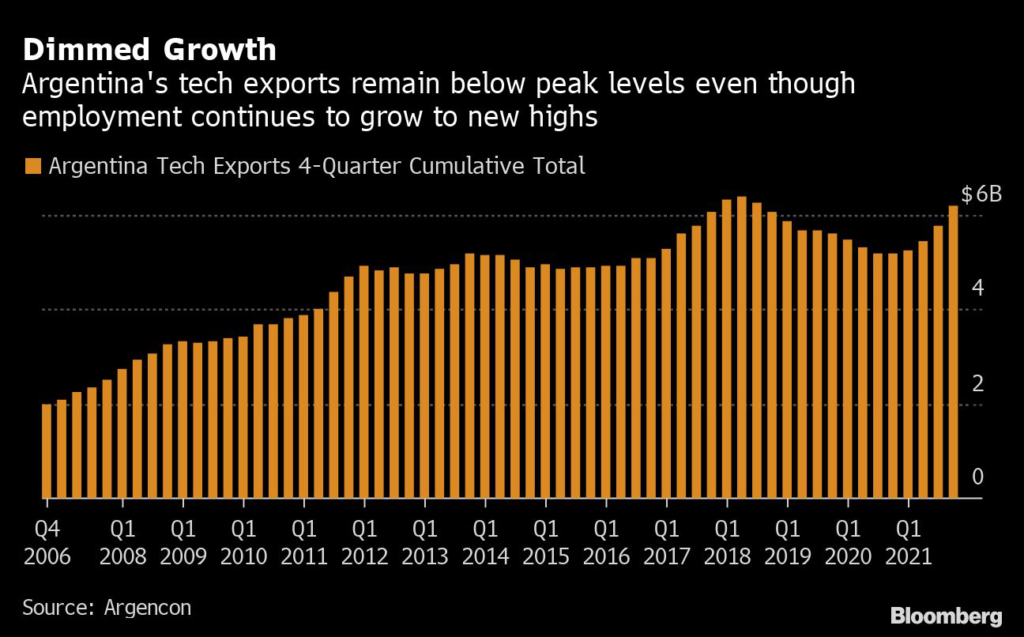
The growing tech sector is one of Argentina’s biggest success stories in recent years. Government data show that the sector has added about 50,000 new jobs since 2017, while many others were shedding payrolls during a severe recession. Yet official data aren’t capturing this growth: the country’s tech exports are still below levels seen in 2018, as so much of the activity goes unreported, according to Argencon. 

Read More: Nobody Wants Pesos: Argentine Currency Meltdown Upends Business

Argencon warns about a “brain drain” as skilled workers seek better pay from abroad, either staying to live in the country as freelancers or moving out of Argentina. 

More stories like this are available on bloomberg.com

©2022 Bloomberg L.P.

Verizon Cuts Sales View on Inflation, Pressure From Rivals 

(Bloomberg) — Verizon Communications Inc. had its biggest drop in two years after cutting its full-year sales forecast as rapid inflation and rising gas prices coincided with a slowdown in store traffic.

The largest U.S. wireless carrier is also facing heated competition from AT&T Inc. and T-Mobile US Inc. That combined with a more anxious consumer caused Verizon to lower its projection for sales to be around flat this year, compared with a prior projection of 3% growth. Earnings are also now expected to be at the lower end of Verizon’s prior guidance.

“Look at the gas pump price and what’s happened there, it’s significantly different than what people saw at the start of the year,” Chief Financial Officer Matt Ellis said in an interview Friday. “And the overall rate of inflation now at 40-year highs, this wasn’t baked in to our planning assumptions.”

Ellis said it’s too early to know if the slowdown in store traffic is temporary. AT&T and T-Mobile have been chipping away at Verizon’s market share. In the first quarter, Verizon lost 36,000 phone customers. That was less than analysts expected, but the company has relied on costly phone giveaways and cash rewards. Strength in business customers led to a surprise gain in overall monthly wireless subscribers.

Verizon’s first-quarter earnings of $1.35 a share excluding some items matched the average analyst estimate, as did revenue of $33.6 billion. It’s the first time that the company hasn’t beaten earnings estimates since 2019.

Shares of the New York-based carrier fell as much as 5.9% Friday, their biggest intraday drop since March 2020. Verizon had been up almost 6% this year through Thursday’s close, trailing a 8.9% gain for AT&T and 14% increase for T-Mobile.

Verizon’s cautious tone is somewhat at odds with what investors heard this week from AT&T, which blew past estimates for wireless subscriber growth in the first quarter. While AT&T said it’s seeing some inflationary pressures, Chief Executive Officer John Stankey argued that consumers still willing to pay for high-quality connectivity.

T-Mobile, which reports results on April 27, is trying to extend its customer growth streak by capitalizing on its wide lead in 5G deployment.

(Updates with stock drop in first, sixth paragraphs.)

More stories like this are available on bloomberg.com

©2022 Bloomberg L.P.
Pound Hits Lowest Since Lockdown on Signs U.K. Recovery Slows

(Bloomberg) — The pound hit the lowest since November 2020 when the U.K. was in a coronavirus lockdown as three separate reports suggested the economic recovery is faltering.

S&P Global’s PMI for both services and the whole economy fell to a three-month low in April, while consumer confidence sank to its lowest since the recession in 2008. Retail sales fell more sharply than expected in March.

The figures add to evidence that a cost-of-living crisis is starting to drag down activity. Consumers are struggling with a surge in energy bills, higher taxes and the strongest inflation in three decades, and that’s starting to constrain the outlook for the rest of the year.

“Higher prices and the associated rising cost of loving were often cited as a principle cause of lower demand, with Covid continuing to affect many businesses,” said Chris Williamson, chief business economist at S&P Global.

The weak figures triggered a sell-off in sterling, which tumbled more than 1% against the U.S. Dollar and the euro, and plumbed a 1 1/2-year low against the greenback of $1.2857.


The pound is on track to post its biggest one-day loss against the euro since December 2020, as growing signs of a sluggish economic recovery prompt investors to pare back expectations that the Bank of England will raise interest rates quickly.

The readings will feed into debate about how quickly policy makers should move to calm inflation, which at 7% is more than triple the target. Investors anticipate another increase in interest rates next month, bringing the key lending rate to 1% for the first time since the global financial crisis more than a decade ago.

BOE policy maker Catherine Mann on Thursday raised the prospect of a bigger jump in interest rates to control inflation. She also said she’s focused on how well demand holds in determining how to vote in May. 

She noted that data suggested “consumers were forward-looking, which would translate into a period of softer demand growth, perhaps even retrenchment.”

“Mann put the cat amongst the pigeons yesterday by suggesting the BOE could accelerate its pace of tightening if the economy withstood the cost of living crisis,” ING analysts wrote in a note. “Today’s soft U.K. March retail sales release is a notch against such an outcome.”

What Bloomberg Economics Says …

“The U.K.’s composite PMI fell in by more than forecast in April, suggesting momentum is slowing as high inflation hits consumer spending and drags on growth. The PMI is likely to deteriorate further in coming months, as the squeeze on the cost-of-living tightens. Bloomberg Economics expects GDP to contract in 2Q and the economy to flirt with recession in the second half of the year.”

–Ana Luis Andrade, economist. Click for the REACT.

S&P’s composite PMI fell to 57.6 in March, the lowest in three months and below the reading of 58.7 anticipated by economists. Services fell, while manufacturing output reached a two-month high. The report showed manufacturing orders stalled and the highest increase on record for prices at the factory gate. 

U.K. retail sales plunged more than forecast, with the volume of goods sold in stores and online down 1.4% last month, the Office for National Statistics said. Economists had expected a decline of 0.3%. 


A separate survey by GfK showed that U.K. consumer confidence sank for a fifth-straight month in April, with Britons more pessimistic about the outlook for their personal finances and the general economy than during the depths of the financial crisis. Bloomberg Economics said the figures were synonymous with recession. 

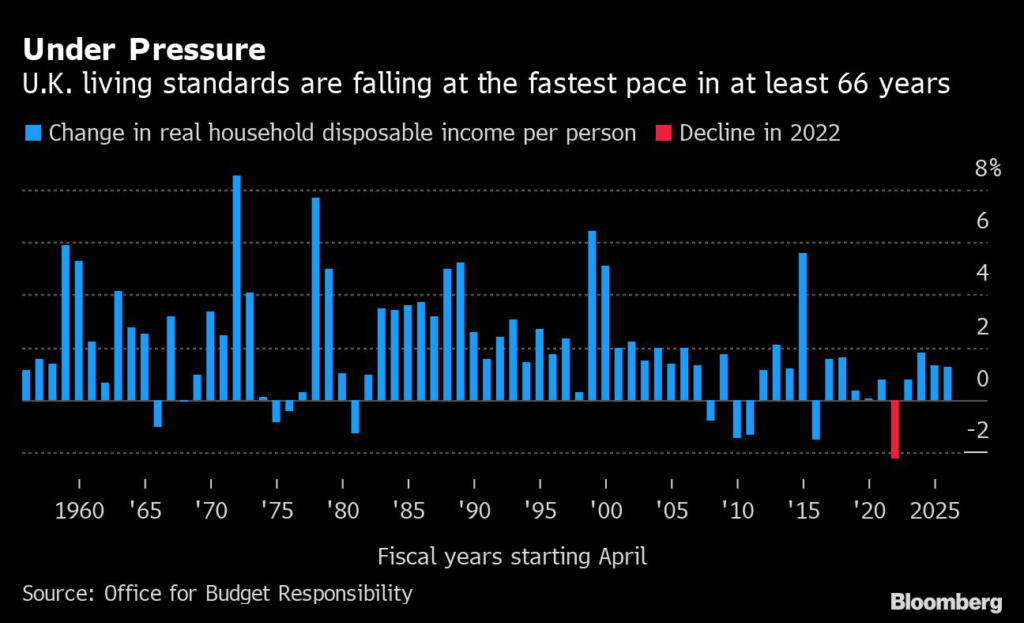
Wages are increasingly falling behind the rate of inflation. Households suffered a further blow this month when energy bills and payroll taxes rose sharply. Together, the shock is forecast to deliver the biggest blow to living standards in at least six decades.

The plunge in retail sales was led by sales of food, clothing and footwear, and auto fuel. Record-high petrol and diesel prices, driven up by the war in Ukraine, led people to make fewer non-essential journeys. 


Online sales also declined sharply to 26% of total sales, the lowest proportion since February 2020, as people cut discretionary purchases.

The impact was partially offset by increased sales of household goods, thanks to sales of DIY and second-hand items, itself a possible sign of Britons economizing.

Consumers are also facing the prospect of more expensive mortgage costs as the Bank of England raises interest rates in an effort to tame inflation.


A separate ONS survey found that 87% of adults reported their cost of living had increased over the past month, up from 83%. Some 88% said the reason was an increase in the price of food.

The outlook for retail sales and the broader economy will depend on the willingness of households to use savings built up during the pandemic to cushion the blow.

That’s not an option for poorer families, who will be forced to borrow to maintain their living standards or buy fewer goods and services. Economists in a regular Bloomberg survey put the chance of a recession in the coming year at 30%, the highest it has been since early 2021.

“Retailers are themselves squeezed between rising costs of operations, exacerbated by the situation in Ukraine, and weaker demand from customers,” said Helen Dickinson, chief executive of the British Retail Consortium. “Higher global commodity prices, rising energy and transport costs, and a tight labor market, are all taking their toll.”

(Updates market reaction.)

More stories like this are available on bloomberg.com

©2022 Bloomberg L.P.
U.K. Probes WindAcre’s Nielsen Stake Under New Takeover Law

(Bloomberg) — The U.K. is investigating the rapid stake-building of WindAcre Partnership LLC in Nielsen Holdings Plc to ensure it complies with the country’s new beefed-up takeover regime, according to a person familiar with the matter.

WindAcre had amassed a 27.3% stake as of April 18, according to U.S. filings. 

U.K. officials at the Investment Security Unit are investigating whether that stake should have also been declared in Britain, where the company is incorporated and has more than 500 employees. It’s an early test for Britain’s National Security and Investment Act, which came into force in January. 

It mandates investors declare if they control more than 25% of any business dealing in “notifiable” sensitive sectors, including artificial intelligence, if the asset is from, in, or has a connection to the U.K. 

WindAcre crossed this threshold but hadn’t declared its stake to the U.K. government, the person said, asking not to be identified because the discussions are private. 

A representative for WindAcre wasn’t immediately available for comment. 

WindAcre, a hedge fund which was started by Snehal Amin, an alumnus of London-based activist firm TCI, opposes the structure of a $16 billion private equity buyout led by Evergreen Coast Capital Corp., an affiliate of Elliott Investment Management, and Brookfield Asset Management Inc. A representative for Nielsen didn’t immediately respond to a request for comment and a representative for the consortium declined to comment. 

New York-headquartered, U.K.-incorporated Nielsen is best known for its TV ratings service but has also been investing in AI for years to learn how consumers are responding to marketing and adapt services rapidly in real time.

WindAcre owned 9.6% of Nielsen at the time Nielsen accepted the consortium’s offer. WindAcre opposed that offer but would have supported if it was awarded roughly $1.1 billion in additional equity, according to people familiar with the matter. 

The U.K.’s Department for Business, Energy and Industrial Strategy monitors the market but doesn’t routinely comment on individual transactions, a spokesperson said by email.

“The Business Secretary has powers under the National Security and Investment Act to intervene in acquisitions where necessary,” the spokesperson added. “Completing a notifiable acquisition without approval will mean the acquisition is void and may mean that the acquirer is subject to civil or criminal penalties.”

More stories like this are available on bloomberg.com

©2022 Bloomberg L.P.

Shopify’s Stock Split Fails to Rekindle Investor Romance

(Bloomberg) — Shopify Inc. set out to win the affection of retail investors with a 10-for-1 stock split. The gambit appears to be too little, too late.

A pop on the day of the April 11 announcement has given way to a relentless selloff. Shopify is down 23% since then to about C$605, far underperforming Canada’s benchmark index, the Nasdaq 100 Index and many other software stocks. So much for signaling to the market that the e-commerce company was becoming more shareholder friendly.

Timing may be to blame. After surging during the early months of the pandemic to become Canada’s most valuable company, Shopify had already tumbled 56% this year before the split. Investors are looking closer at its slowing growth rate, its modest level of profitability and rising interest rates, which tend to put pressure high-multiple stocks. It’s now on the brink of falling off the list of the S&P/TSX Composite Index’s 10 most valuable companies.

Shopify needed a way to boost the shares and stock splits have worked for other companies, said David Trainer, chief executive officer at research firm New Constructs LLC. “Non-fundamental tricks like stock splits tend to boost prices more when stock price momentum is positive,” he said.

Now the next catalyst for the stock may not come until Shopify reports earnings on May 5, when investors will be looking for insight into the growth outlook as the company battles more competition and the return of shoppers to physical stores. 

To be sure, retail traders almost doubled their daily average purchases of the stock to $8.3 million in the two sessions after the split announcement. But the net inflow was still negligible compared to stocks like Apple Inc. and Amazon.com Inc., which saw more than $170 million and $33 million of purchases each after their announcements, according to Vanda Research data.

Why Shopify Is Shopping for its Biggest M&A Yet: Bloomberg Deals

There’s another problem, too. In announcing the stock split, Shopify also announced that it wants to give Chief Executive Officer Tobi Lutke a special “founder share” that will preserve his voting power as long as he’s at the company. He and his affiliates could retain 40% of the votes at the company even if their equity stake declines.

The new structure, which is subject to approval from shareholders, would shield Lutke and Shopify from shareholder activism. 

“This could mean that the company will remain independent, and not be forced into a sale,” said Ben Silverman, director of research at VerityData. 

The underlying concerns surrounding its fundamentals haven’t waned. Competition is increasing with Amazon.com Inc. saying Thursday it will launch a new “Buy With Prime” feature that could blunt Shopify’s momentum. In its last earnings report, Ottawa-based Shopify warned that sales growth will be lower in the first quarter of this year than in same quarter of 2021.


Tech Chart of the Day

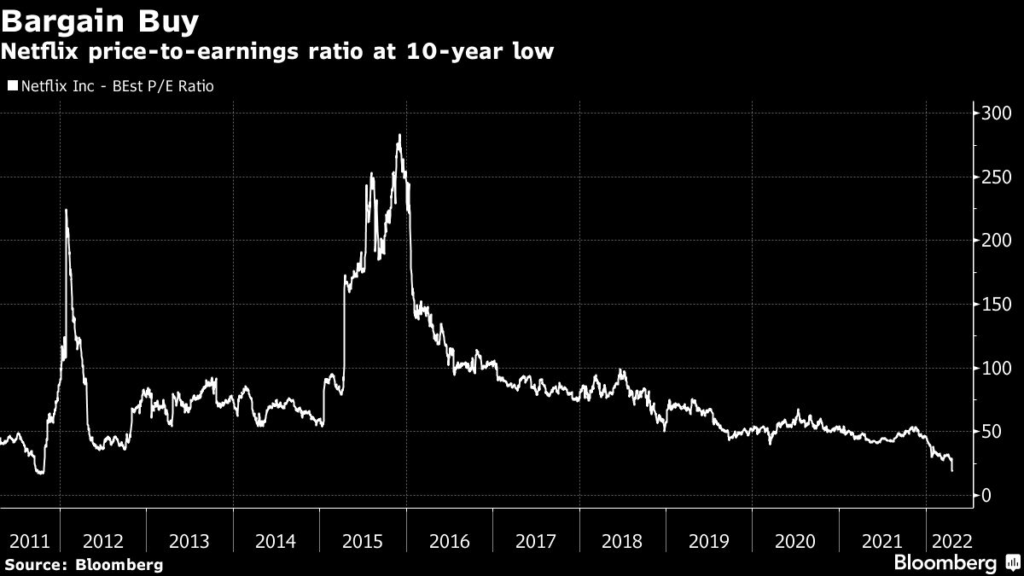
Netflix Inc.’s price-to-earnings ratio soared to more than 280 in 2015, when the streaming giant was attracting millions of subscribers with its binge-worthy original content and quickly expanding into new geographies. Now with the market saturated and clogged with competition, the valuation has slid 93% to 18.7 times profit, in line with the S&P 500.

Top Tech Stories

  • The world’s biggest technology companies could face billions of dollars in fines for breaches of new European Union legislation, details of which are expected to be agreed upon by lawmakers as soon as Friday.
  • Snap Inc. reported user growth that beat analysts’ estimates, sending shares up in after-market trading
  • Elon Musk has said his $54.20 per share offer for Twitter Inc. was his “best and final.” While that may prove true, he just signaled that he might go higher by putting together a financing package that gives him room to increase the offer.
  • SAP SE reported a further acceleration in its newer cloud business that exceeded expectations, providing a boon to the company amid its turnaround plan
  • SoftBank Group Corp. expects to retain a controlling stake in Arm Ltd. after the planned initial public offering of the chip business, selling a smaller portion than originally expected, according to people familiar with the matter
  • Applied Materials Inc., Netflix Inc., Intuitive Surgical Inc., and Nvidia Corp., are the biggest winners of one-time, multimillion-dollar California grants intended to spur job creation and investment
  • Bain Capital is considering a deal for European technology-services provider Solutions 30 SE, according to people familiar with the matter

(Updates share price move in the second paragraph.)

More stories like this are available on bloomberg.com

©2022 Bloomberg L.P.

Close Bitnami banner
Bitnami