Bloomberg

Two New Omicron Sublineages Discovered by South African Scientists

(Bloomberg) — South African scientists have discovered two new sublineages of the omicron coronavirus variant, said Tulio de Oliveira, who runs gene-sequencing institutions in the country. The lineages have been named BA.4 and BA.5, he said by text message and in a series of tweets. Still, de Oliveira said, the lineages have not caused a …

Two New Omicron Sublineages Discovered by South African Scientists Read More »

Circle Will Apply for U.S. Crypto Bank Charter in ‘Near Future’

(Bloomberg) — The crypto payments startup Circle Internet Financial said it’s closer to submitting an application to operate as a bank in the U.S., pushing forward with a months-old plan even as regulators make it more difficult for crypto companies to secure this kind of license.

Circle, the issuer of the second-largest stablecoin, disclosed its intention to become a crypto bank in August and has held ongoing discussions with regulators since then, Chief Executive Officer Jeremy Allaire said in an interview. He declined to say when the company would submit the application, saying only that it would be “hopefully in the near future.”

The company, which issues USD Coin, is deeply funded. On Tuesday, Circle said it raised $400 million from BlackRock Inc., Fidelity Management and Research LLC and others. The startup plans to go public by merging with a special purpose acquisition company in a deal valued at $9 billion.

The U.S. Office of the Comptroller of the Currency, which oversees bank charters, has discussed a variety of topics with Circle management in regards to the company’s banking ambitions. Those include interoperability between blockchains and how to assess the operational risks of a specific blockchain, according to Allaire. A representative for the OCC declined to comment on the conversations with Circle.

The risk of connecting different blockchains was laid bare recently. Hacks involving crypto bridges totaled more than $1 billion in a little over a year, including a $600 million attack involving the crypto video game Axie Infinity.

If approved, Circle would be the fourth federally chartered crypto bank in the U.S. Those that have secured at least preliminary approval for a charter are Anchorage Digital, Protego Trust Bank NA and Paxos Trust Company. Getting a bank charter could be key to Circle’s future. The Federal Reserve and other U.S. watchdogs have said stablecoins need more regulation and should be issued by banks.

Circle is “making good progress” as it prepares to submit a formal application, Allaire said in the interview in Miami, where Circle hosted events related to the Bitcoin 2022 conference. There hadn’t been any delays or obstacles in working with the OCC, he said, even though the regulator heightened supervision requirements in November for banks looking to engage in crypto activities. The U.S. hasn’t granted a new banking charter to any crypto-focused company in almost a year.

“They’ve been doing a lot of work laying the groundwork for how they’re going to supervise crypto, how they’re going to supervise stablecoin issuers specifically,” Allaire said.

More stories like this are available on bloomberg.com

©2022 Bloomberg L.P.

Former Trump Official Mick Mulvaney Joins Crypto Firm as Adviser

(Bloomberg) — Mick Mulvaney, who worked as acting White House chief of staff for former President Donald Trump, has joined crypto compliance firm Astra Protocol as a strategic adviser. 

Astra provides DeFi, or decentralized finance, platforms with software to comply with government regulations, such as know-your-customer requirements — identity verification standards designed to prevent fraud, money laundering, and terrorism financing. 

Mulvaney told Bloomberg that for the last several months he’s been mostly focused on connecting the Astra team to potential investors to aid their capital raising efforts. But eventually he plans to leverage his government expertise to help the Zurich-based firm navigate U.S. regulations. He’ll also provide guidance on filling senior leadership positions.  

Read more: Crypto Masters Washington’s ‘Revolving Door’ as Influence Grows

Mulvaney held several positions under the Trump administration, including U.S. special envoy for Northern Ireland, director of the Office of Management and Budget, and acting director of the Consumer Financial Protection Bureau. Before that, he was a Republican member of the U.S. House of Representatives for a district in South Carolina. 

“Adding him as a strategic adviser will enable Astra Protocol to tap into his expertise across a variety of regulatory environments and help us deliver on our mission to provide the industry’s leading KYC/AML solution for DeFi protocols around the world,” Phil Hogan, head of Astra Protocol’s advisory board, said in a statement Wednesday. 

DeFi platforms allow users to trade, borrow, and lend digital assets without having to go through an intermediary. The platforms, which surged in popularity over the past year, have garnered the attention of financial regulators, like the U.S. Securities and Exchange Commission, that have been calling for more oversight. 

Firms like Astra are what regulators want to see, Mulvaney said. They “can take some of the cloak-and-dagger out of crypto and take some of the mystery out of blockchain.”

Read more: Crypto Lobbying Skyrocketed Last Year and Quadrupled Since 2018  

More stories like this are available on bloomberg.com

©2022 Bloomberg L.P.

Ethereum’s Highly-Anticipated Upgrade Will Be Later Than June

(Bloomberg) — One of the leading Ethereum software developers said the blockchain network’s much-anticipated technical upgrade known as the Merge will likely be completed a few months after June. 

The comment helps to establish a possible timeline for the completion after Ethereum passed another major test on Monday. The network’s developers had launched a mainnet shadow fork to stress test the new upcoming software.    

“No firm date yet, but we’re definitely in the final chapter of PoW on Ethereum,” Tim Beiko, a computer scientist who coordinates Ethereum developers tweeted on Tuesday, referring to the way transactions on the Ethereum network are ordered that is known as proof of work.

The Merge will enable the blockchain to move from the proof-of-work consensus mechanism, which uses energy-intensive specialized computers to validate transactions and secure the network, to proof-of-stake. The new mechanism allows Ether holders or stakers to operate as validators to perform those tasks. 

Beiko earlier said he wouldn’t be surprised the Merge happens in the fall but didn’t give a more specific timeline. Ether outperformed Bitcoin in late March as another test for the upgrade went through on March 15. Beiko didn’t immediately respond to a request for additional comment. 

The Merge, which aims to help the network run more efficiently and reduce carbon footprint, has seen multiple delays since its inception.

Some Ethereum miners, who leverage specialized computers such as repurposed graphics cards or machines with application-specific integrated chips, to secure the network and get subsidies in Ether from the blockchain, are betting on another delay so that they have more time to make a profit from their mining operations.    

Ether rose about 2% to around $3,000 on Wednesday. It has slumped about 18% this year, while larger rival Bitcoin has decreased around 14%.

More stories like this are available on bloomberg.com

©2022 Bloomberg L.P.

Airbnb’s 135% Rally Takes IPO Crown With Room to Run 

(Bloomberg) — With shares skyrocketing since its trading debut, Airbnb Inc.’s initial public offering was well-timed. That rally shows little sign of abating.

It has soared 140% since it went public in December 2020. The timing was auspicious: Covid-19 vaccines were just arriving, sparking a revival in travel and also demand for lodging where travelers could isolate more easily than in a hotel. Employees also embraced a work-anywhere environment, encouraging the use of temporary homes. 

And investors have more reasons to stay bullish. Airbnb’s stock is expected to climb by an average of 22% over the next 12 months with a majority of the 41 analysts covering the firm recommending investors hold on to their shares or buy more, according to data compiled by Bloomberg.

“It is evolving, and becoming an interesting play with respect to work-from-home and long-term rental trends,” said Thomas George, a portfolio manager at Grizzle Investment Management, which owns the stock. “Those are additional levers it can unlock for growth.” 

Brokerages on average predict the company next month will report a 64% jump in first-quarter sales. Airbnb, which was profitable on a net-income basis the past two quarters, probably lost money again in the first three months of this year, analysts say. 

Its revenue grew 78% to $1.53 billion in the fourth quarter, beating analysts’ projections as people spread out over thousands of towns and cities and stayed for weeks and months with workers no longer having to be in traditional offices five days a week. 

“The benefits seen over the past year or so are expected to continue, especially as traveling increases with the pandemic hopefully continuing to wane,” said Scott Kessler, an analyst at Third Bridge. 

Airbnb’s stock performance also has given it the title of best performer of any IPO to raise $1 billion or more since its debut, according Bloomberg data. This comes at a time where weak trading in recent IPOs has weighed on the listings pipeline. At $105 billion in market value, it’s now the biggest online travel company, eclipsing Booking Holdings Inc., Expedia Group Inc. and Marriott International Inc. 

Some caution is warranted. Its stock rally has surpassed its peers by a mile in the travel industry since it went public, which could mean its upside is minimal. Booking has climbed 5.5%, Marriott is 29% higher and Expedia is up 44% in that time period. 

And it isn’t cheap. Airbnb sells for about 12 times its estimated sales. That’s well above its peers with Booking sitting at 5.3, and both Expedia’s and TripAdvisor’s are below 3. 

To be sure, shares of Airbnb more than doubled in value in its blockbuster debut and seen a more moderate growth rate since. The company has, however, fared better than other growth stocks as the market navigated through multiple tech selloffs.  

Tech Chart of the Day

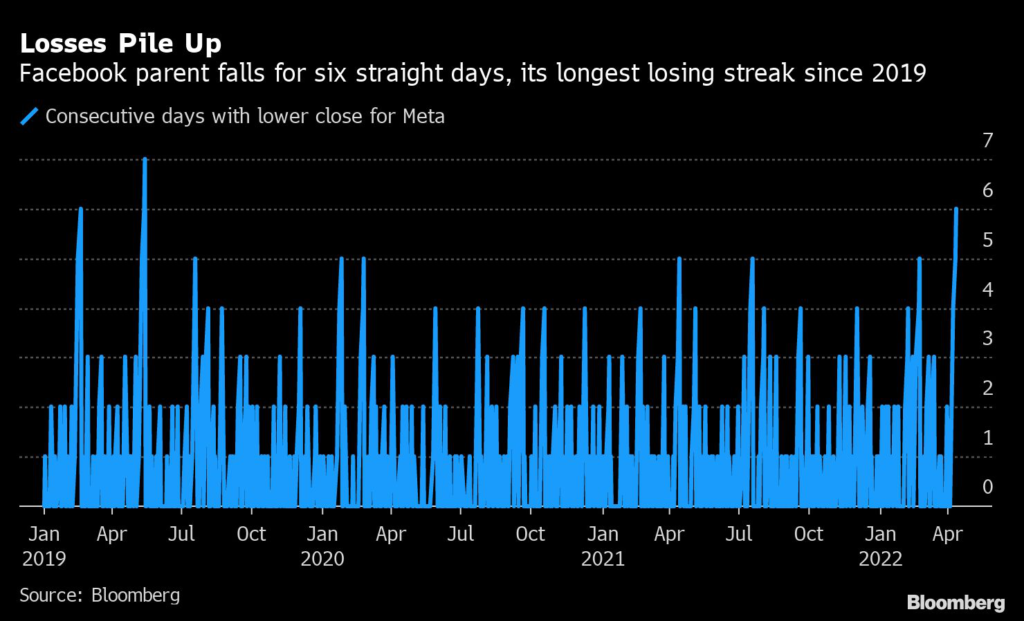
The cloud continues to darken around Facebook parent Meta Platforms Inc. Its shares fell 1.1% on Tuesday, rounding out a sixth day of losses. Its losing streak, which has erased $55 billion in market value, is its longest since May 2019. All eyes will be on the company’s quarterly results slated for April 27, where investors will be looking for any guidance on future growth and its metaverse strategy.

Top Tech Stories

  • Google said it will invest $9.5 billion in offices and data centers in the U.S. over 2022, putting money behind its bid to get more workers back in its buildings. The Alphabet Inc.-owned company based in Mountain View, California will spend on campuses across the country, and is expecting to create 12,000 new jobs as part of the investment
  • Deutsche Telekom AG paid $2.4 billion to SoftBank Group Corp.to increase its stake in T-Mobile US Inc., taking it closer to its goal of holding a majority of the U.S. division
  • More than 30 Taiwanese companies including Pegatron Corp.and Macbook maker Quanta Computer Inc. have now halted production in the electronics hubs of eastern China to comply with local Covid-related restrictions, spelling more trouble for an already fragile global tech supply chain
  • Cathie Wood added her voice to one of Wall Street’s favorite parlor games: What will Elon Musk do next with his new stake in Twitter Inc.
  • The architect of Spotify Technology SA’s podcasting strategy, including the signing of controversial commentator Joe Rogan, is leaving the company after almost five years, according to people with knowledge of matter.
  • ZujuGP, a digital football community helmed by the son of secretive Singaporean investor Peter Lim and fronted by global superstar Cristiano Ronaldo, is bringing over the employees of a gaming-technology startup to bolster the infrastructure behind its app
  • More than 60 musicians, actors and other personalities collectively offered about $87 million in crypto-payments company MoonPay’s latest round of funding

(Updates to add detail on share movement.)

More stories like this are available on bloomberg.com

©2022 Bloomberg L.P.

Rogers Keeps Rising as Shaw Deal Nears Key Antitrust Ruling

(Bloomberg) — It’s decision time for the people who control the fate of one of Canada’s biggest-ever mergers. 

Telecom and cable giant Rogers Communications Inc. has two more hurdles before it can close its takeover of rival Shaw Communications Inc. The C$20 billion ($16 billion) deal needs a green light from the country’s antitrust watchdog and a key federal government ministry. Those rulings could come as early as next month. 

Rogers shares rose to near a record on Wednesday, up 0.6% to C$74.23 in Toronto, and have jumped 23% this year. Shaw has been marching closer to the takeover price of C$40.50 a share, a sign of investor confidence that the transaction will get done. But that doesn’t mean the road will be easy. The biggest looming question is how hard the government will squeeze the company in return for its approval. 

The antitrust review is expected to be the most difficult obstacle. Rogers has long been the biggest wireless firm in Canada. Adding Shaw would eliminate the No. 4 player in key hubs like Toronto and Vancouver. Rogers executives believe the government simply won’t allow that, so they’ve been looking for a buyer for Shaw’s wireless division, Freedom Mobile. It may be worth C$3 billion to C$4 billion, according to analysts. 

But even a divestiture of Freedom Mobile may not be enough to satisfy regulators in a country that has some of the world’s highest wireless bills. And it will be a test for the administration of Prime Minister Justin Trudeau, whose Liberal party pledged in 2019 to force companies to reduce the cost of wireless services.

The Competition Bureau and the government have broad powers to impose conditions on their deal approval. They can force Rogers to divest retail stores, spectrum licenses and other assets, or require it to share infrastructure with Freedom Mobile’s new owner to make the market more competitive.

Moreover, the government would probably want Rogers to sell Freedom Mobile to an owner that has money to invest. The Shaw division has a major disadvantage: It currently runs a 4G network that’s competing with three dominant companies, Rogers, BCE Inc. and Telus Corp., that have all started 5G services.

Without a long-term network-sharing deal with a larger player, Freedom Mobile’s buyer may find it “a challenge to generate sufficient return on capital,” Scotiabank analyst Jeff Fan said in a note to clients. It will need hundreds of millions, perhaps billions, to buy the spectrum needed for 5G. 

The Stakes for Rogers

Toronto-based Rogers found itself in a global spotlight last year because of a family feud over leadership that erupted in the public eye. Before that drama stole the headlines, the Shaw takeover was lauded as fulfilling the dream of the company’s late founder, Ted Rogers.

The acquisition would help Rogers improve its network across western Canada and extend its cable business nationally. It’s the key piece to any successful turnaround for a company that, before this year, had underperformed BCE and Telus for a long time. 

Rogers has said it can strip out C$1 billion in costs, crucial to helping the company pay down the enormous debt it’s taking on in the takeover. A Rogers spokesperson declined to comment on the ongoing regulatory process. 

“If you consider that the deal will happen and all of the synergies that management expect will happen, the stock is definitely too cheap,” said Jerome Dubreuil, a telecommunications analyst at Desjardins Securities Inc.

“We believe further valuation and share price upside will be driven by strong Q1/22 results, the closing of the Shaw acquisition by mid-June, and merger synergies, which we do not believe the street has fully factored into their estimates,” Scotiabank’s Fan wrote in a note to clients Wednesday that raised his price target to C$87 from C$80. 

The Regulatory Path 

BCE’s 2017 acquisition of Manitoba Telecom Services Inc. — a much smaller deal — could shed light on the path ahead, said Michael Geist, a professor who specializes in internet and e-commerce law at the University of Ottawa. 

In that deal, BCE agreed to sell parts of the business, including stores, spectrum and some customer accounts, to Telus and internet provider Xplornet Communications Inc.. BCE was also required to help Xplornet in other ways, such as sharing access to cell towers.  

“It provided the playbook for Rogers in trying to get a deal forward and left them with the view that so long as you provided enough goodies, you were likely to get this through,” Geist said in an interview.

Dwayne Winseck, a professor at Carleton University who was consulted by the government on both the BCE-Manitoba and the Rogers-Shaw deals, called the MTS agreement a “complete disaster” because Xplornet didn’t become a strong wireless competitor. The market in Manitoba is now dominated by three providers instead of four.

The same potential problem exists in the Shaw transaction. It’s in Rogers’ interest to help Freedom’s new owners as little as possible, he said. 

“What you’re asking a company to do is something that’s diametrically opposed to their interests,” Winseck said, “which is basically to cultivate a new player that’s going to become an effective rival.”

For years, Canada has tried to promote the emergence of smaller firms to compete with the Big Three. But the tide has turned toward a more friendly backdrop for consolidation, Geist said, and approval for the Shaw takeover would further that trend.

“We’ve got a Competition Bureau that has been reluctant to stop deals altogether, and a government that, charitably, has been far more supportive of the telecom players than their predecessors,” Geist said. “It’s a government that doesn’t seem to be willing to take a particularly strong position against those players.”

One reason for the change in tone is the heightened reliance on communications networks during the pandemic as many people worked remotely, Geist said. 

“The government may have become more willing to be supportive of those large players given the importance that they play in our society,” he said. 

If the deal gets approved, it will probably “drive further market consolidation,” said Matthew Hatfield, campaigns director at OpenMedia, a nonprofit organization that advocates for open and affordable internet. 

“This will probably trigger a round of further buyouts and mergers among major players,” he said. 

(Updates share price move, adds new Scotiabank analyst note)

More stories like this are available on bloomberg.com

©2022 Bloomberg L.P.

Banking Circle in Funding Talks at Half Initial Valuation Pitch

(Bloomberg) — Financial technology startup Banking Circle is in discussions with investors to raise funding at around a $3 billion valuation, according to people familiar with the matter, about half the level previously sought amid rocky markets and a slowdown in the venture capital sector.

The firm is seeking to raise about $300 million in new capital, the people said, asking for anonymity because the talks are private. Swedish investment firm EQT AB acquired a majority stake in Banking Circle in 2018 from Saxo Bank and other minority owners. 

EQT will also sell down some of its stake in the company as part of the round, one of the people added. The funding talks are ongoing and the valuation may change, the people added. 

Representatives for EQT and Banking Circle declined to comment.

Bloomberg News reported in August that Banking Circle was working with advisers to solicit interest from investors for financing at around a $6 billion valuation. The drop-down on valuation in talks is further evidence of turbulence in private technology markets after a year of record fund-raising and investment.

Founded in 2013, Banking Circle is a fully-licensed bank and facilitates cross-border payments in 25 currencies. Clients include Stripe Inc. and Alibaba Group Holding Ltd., according to its website.

Read more: Banking Circle Said to Seek Funding at $6 Billion Valuation

More stories like this are available on bloomberg.com

©2022 Bloomberg L.P.

Chipmakers Argue Inventory Build-Up Signals Increased Demand

(Bloomberg) — The accumulation of inventory by chipmakers has usually been a sign of impending doom for the industry. As companies raced to meet demand that built up during the pandemic, they amassed a huge stockpile of chips.

Ordinarily, gluts are followed by a plunge in prices and a struggle for chipmakers to find buyers. That concern is why investors are selling semiconductor stocks this year after three years of gains. The Philadelphia Stock Exchange Semiconductor Index has dropped 23% so far in 2022 compared with a slide of 7.7% by the S&P 500 Index. 

But many companies argue this time is different. Executives from Analog Devices Inc., Micron Technology Inc. and Broadcom Inc. are among those who say inventory is rebounding from dangerously low levels and they’re only building what’s required to meet the growing demand for their products.

Analog Devices Chief Financial Officer Prashanth Mahendra-Rajah said that looking at inventory in aggregate, whether in value or measured in days, doesn’t give as accurate a picture as it has in the past. More devices use chips now, so higher stockpiles reflect what’s needed to satisfy these new markets rather than an impending glut. Based on what Analog Devices is seeing, there might be some pockets of inventory build-up, but in general there’s healthy demand and not enough supply, he said. 

“There is a concern by investors that customers have stockpiled inventory,” Mahendra-Rajah said in an interview. “There’s a concern by customers that there’s no inventory available for them.”

Not everyone is convinced. 

“Over the last several months, inventory levels have become elevated within nearly every end market segment, as compared to the pockets of inventory that we identified in prior quarters,” said Chris Caso, an analyst at Raymond James. “The pattern unfortunately looks eerily similar to our analysis at this point in 2018 — which preceded the subsequent industry downturn by six months.”

Investors and analysts will be seeking clues to which view is correct as the industry’s largest companies give their latest quarterly updates in the next two weeks. 


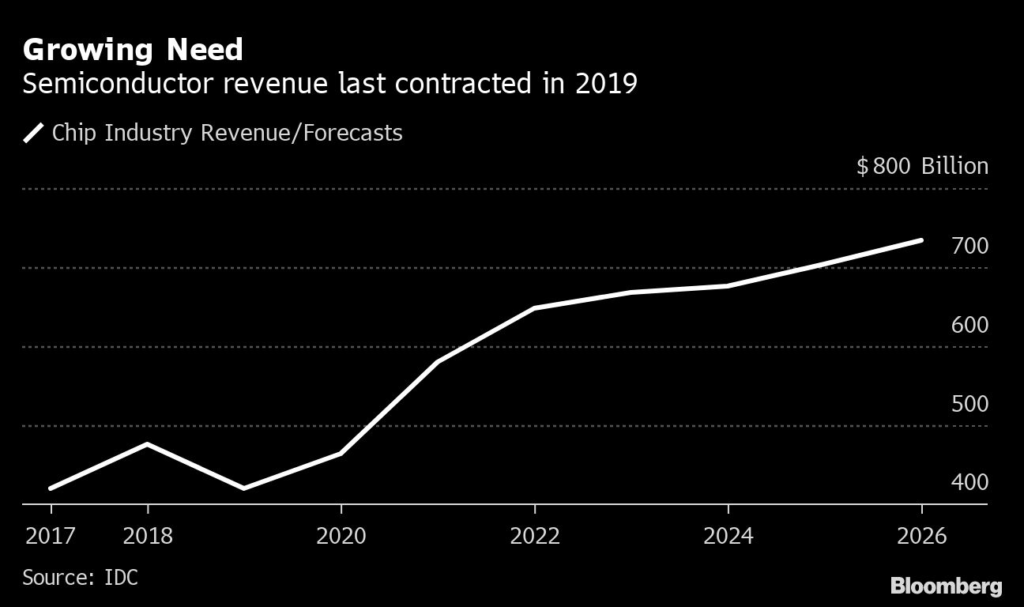
Many chipmaker management teams are sticking to the assertion that the industry is still only at the beginning of a massive expansion fueled by ever increasing numbers of items that are getting computer-like functionality. In the past, orders for personal computers and smartphone components determined the health of the industry. Now, company executives say demand is more widely distributed and less prone to swing from gluts to shortages. 

Last week, the Analog Devices management team repeated their belief that semiconductor sales, which took about 45 years to reach $500 billion, will double to $1 trillion within the next 10 years. 

More stories like this are available on bloomberg.com

©2022 Bloomberg L.P.

Fintech Brex Ventures Beyond Corporate Cards and Into Spending Software

(Bloomberg) — Brex, the startup known for its corporate credit cards, is rolling out a new platform to help businesses manage spending as the company branches into financial software.

The company’s new platform, Brex Empower, will help the company build out more products in the future, Brex said in a statement Wednesday. The first product on the platform, a spending-management program, has signed DoorDash Inc. as a customer. 

The new software platform will help deepen Brex’s relationships with the startups and other businesses that have come to use its card for corporate expenses. San Francisco-based Brex, valued at $12.3 billion in a funding round earlier this year, started creating the platform last summer and is now doing an early-access setup for customers, with a plan to roll it out more broadly by this summer, co-Chief Executive Officer Henrique Dubugras said. 

“Brex, in this next step for us, has a way to bridge companies from that culture of command and control — of everything needs to be reviewed, everything needs to be approved — to this culture of trust and empowerment in which companies can move a lot faster by trusting and empowering their employees,” Dubugras said. “With this platform, we’re focusing on how do we both increase the speed, reduce the friction for employees and decrease spend — triple win for the company.”

Brex’s expansion has fueled an increase in hiring, with the company’s workforce growing to around 1,100 today from roughly 600 people at the beginning of 2021. Dubugras said he expects to end the year with almost 1,700 employees, with a “good part” of the hires going toward the new platform.

Earlier this year, the company announced the hiring of Karandeep Anand from Meta Platforms Inc. as its chief product officer. The startup also raised $300 million in a funding round led by Greenoaks Capital and Technology Crossover Ventures.

“I want to be a public company eventually,” Dubugras said. “Even though Brex has a big valuation, we’re a quite young company. So we still need to mature more to be ready for the public markets.” 

More stories like this are available on bloomberg.com

©2022 Bloomberg L.P.
BrokerTec Plans Expansion for Treasuries Streaming Technology

(Bloomberg) — BrokerTec, an electronic-trading platform for U.S. Treasuries, plans this year to roll out improvements to a technology called streaming that’s aimed at smaller financial institutions, according to its parent company, CME Group Inc.

Streaming has existed in foreign exchange for years, and in Treasuries since at least 2017. It allows small institutions that buy and sell mainly to hedge risk to receive a continuous pricing feed from a large bank or trading firm whose main business is market-making, effectively forming a private market.

Streaming purports to deliver better pricing in low-volatility markets than BrokerTec’s main trading platform — its publicly displayed order book, which dates back to the company’s inception in 1999 as a tool for primary dealers. This so-called central limit order book aggregates the best bid and offer prices from all participants, and trading is done anonymously — though it can disadvantage smaller, less sophisticated firms.

“As the market leader in U.S. Treasuries over our central limit order book, it’s important for us to have a strong competitive solution in streaming space as well,” John Edwards, CME’s global head of BrokerTec, said in an interview.

For the purposes of streaming, trading firms are either liquidity providers or liquidity consumers. A liquidity consumer can request a price stream from a provider and receive prices at narrower bid-offer spreads than exist on the central limit order book.

BrokerTec’s streaming capability, launched in mid-2020, has a minimum price increment of one-sixteenth of a 32nd for the most recently issued Treasury notes and bonds. On the central limit order book — a term often shortened to “clob” — minimum price increments range from one-eighth of a 32nd for two-year notes to half a 32nd for notes and bonds maturing in 10 or more years.

At times when the market is very volatile, however, the more diverse liquidity on the clob may mean that pricing is better than in a pricing stream from a single provider.

“Clob and streaming venues have different value propositions which are correlated to market conditions and volatility,” Sean Hodgson, CME executive director, BrokerTec products, said in an interview. “We’re offering the choice of venue to our customers.”

The enhancements CME is making to its BrokerTec Stream product include faster processing times and market data, and new features such as sweepable orders, the company said in a statement.

In building up its streaming capabilities, CME is defending its turf against Tradeweb Markets Inc., whose institutional division Dealerweb began offering direct-stream capabilities in Treasuries to dealers, market-makers and proprietary trading firms in 2017. 

Tradeweb acquired a clob last year, when it picked up the interdealer trading business formerly known as eSpeed from Nasdaq Inc.

CME, whose main business is exchange-traded futures and options — including Treasury futures and options — bought BrokerTec in 2018. 

Other market competitors in electronic bond trading include MarketAxess Holdings Inc., Fenics and Bloomberg LP, the parent company of Bloomberg News.

More stories like this are available on bloomberg.com

©2022 Bloomberg L.P.

Close Bitnami banner
Bitnami